Article by Josh Gabbatiss republished from Carbon Brief under a CC license.
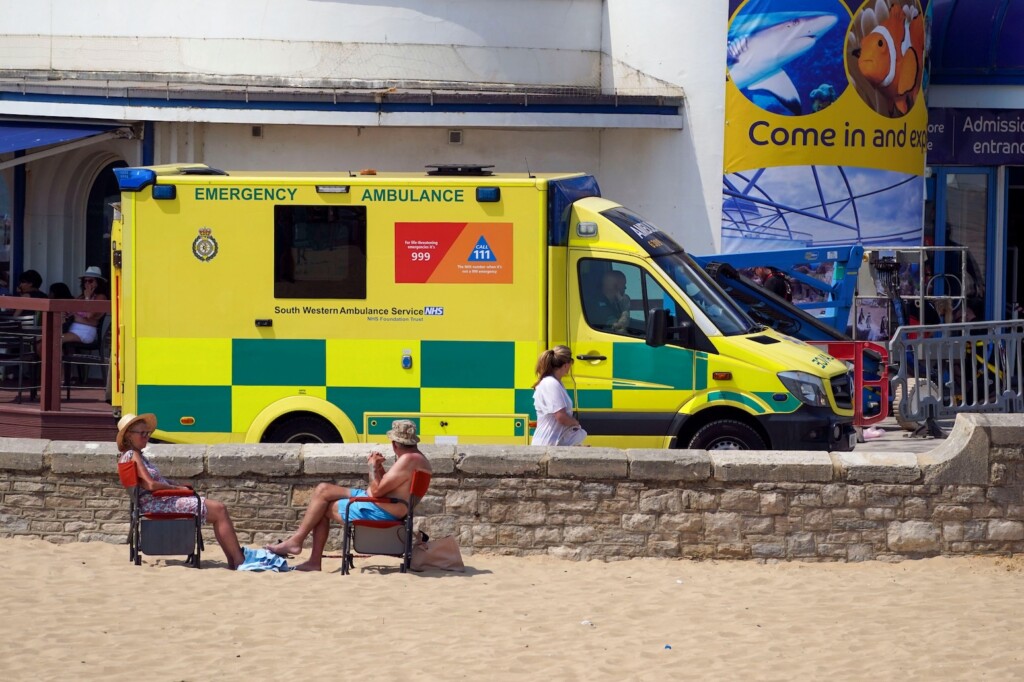
All the ambulance services in England experienced some of their busiest-ever days during this summer’s record-breaking June heatwave, according to data obtained by Carbon Brief.
In June, temperatures climbed past 37C in parts of the country as authorities declared only the second ever “red” extreme heat warning.
Four out of 10 NHS ambulance services, including London’s, responded to unprecedented numbers of life-threatening emergencies on at least one day from 23-27 June.
Another two services – in the south-west and east of the country – received their highest volume of 999 calls on record.
Ambulance services provided data on their busiest days since records began, in response to freedom-of-information (FOI) requests from Carbon Brief.
The results show how demand during the June heatwave exceeded levels seen during the traditionally busy winter season in other years – and even the height of the Covid-19 pandemic – for many services.
Heat demand
Extreme heat ramps up the risk of numerous life-threatening conditions, including heart disease and respiratory problems.
England experienced record-breaking temperatures at the end of June, with the whole country covered by amber or red “heat health alerts” from the government.
A red alert, which was issued for the entire Midlands and south of England, indicates “significant risk to life for even the healthy population”. This was only the second time such an alert has been triggered.
Researchers calculated that there were nearly 3,000 heat-related deaths in the UK this summer. There has also been unprecedented demand for A&E departments and some ambulance services.
To investigate the strain facing ambulances, Carbon Brief sent FOI requests to the 10 NHS ambulance trusts in England, asking for lists of their busiest days.
This covered both the total volume of 999 calls and “category 1” responses – referring to incidents involving “life-threatening injuries and illnesses”, such as heart attacks.
The chart below shows the busiest days on record for England’s ambulances, including both total calls and category 1 responses. Most services were able to provide records back to the 2010s. (See: Methodology.)
The five-day period from 23-27 June is overrepresented in these results, with at least two heatwave days ranking in the top 20 for every service in the country.
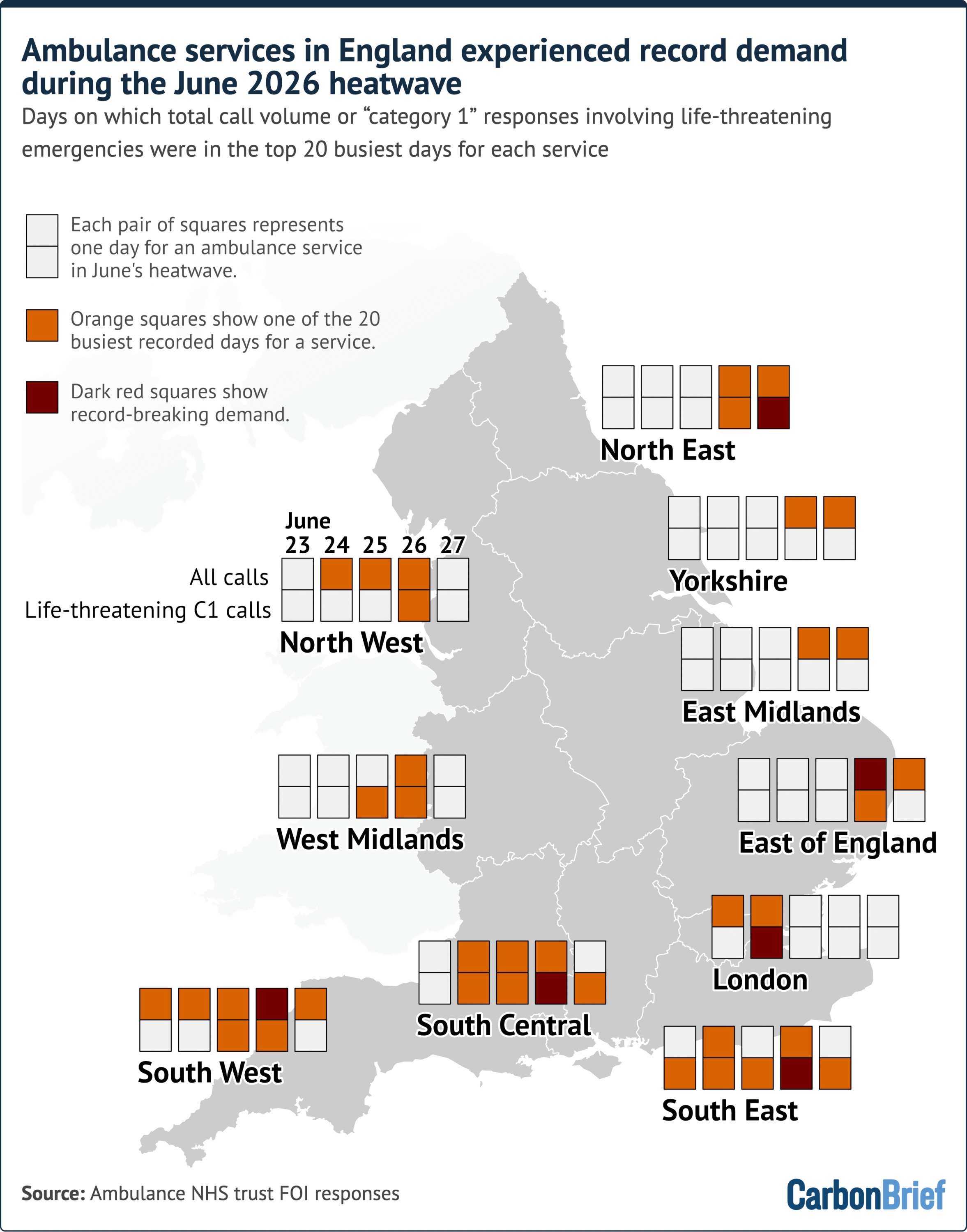
This trend is especially pronounced in the south and east of England, where June temperatures exceeded 36C and even approached 38C in some regions.
London, South East Coast, South Central and North East ambulance services all reported daily records for responding to life-threatening emergencies during the heatwave.
For the South East Coast and South Central services – which cover a region stretching from Oxfordshire to Kent – 25, 26 and 27 June all saw unprecedented numbers of category 1 callouts.
South Western and East of England services both saw record numbers of 999 calls on 26 June, the same day the highest-ever June UK temperature was reported in Norfolk.
It is worth noting that demand for ambulance services – including category 1 calls – has been growing for many years, driven by factors such as an ageing population, more complex health conditions and growing mental-health pressures.
This helps to explain why dates from before the 2020s are rare in the top rankings provided to Carbon Brief.
Beyond the heatwave, 2026 as a whole is on track to be a record year for ambulance demand.
‘Stifling heat’
On 26 June, the busiest day of the heatwave, ambulances across England responded to 4,084 life-threatening emergencies.
The average daily volume of such incidents is normally around 2,500 during the summer months.
Stu Holliday, head of emergency preparedness, resilience and response at North East Ambulance Service, tells Carbon Brief:
“During periods of hot weather, we typically see an increase in calls from people affected by dehydration, heat exhaustion and heatstroke, as well as those whose existing health conditions, particularly heart and respiratory illnesses, can be made worse by prolonged high temperatures.
“Older people, young children and pregnant people can be especially vulnerable.”
Ambulance teams are generally busier in the winter because cold weather and seasonal illnesses drive up the number of severe medical emergencies.
However, the data from June shows that extremely hot days are starting to match or even edge out cold ones as the busiest days. This is a trend seen across the healthcare system.
While not every service provided records back to 2019, the data broadly shows that ambulances were busier during the heatwave than at the height of the Covid-19 pandemic.
As well as patients, heatwaves put pressure on ambulance workers. The UNISON union has warned of crews facing “stifling heat with faulty or no air conditioning” and “back-to-back callouts” due to increased demand.
Methodology
Carbon Brief requested data on the top 50 busiest days for England’s 10 main ambulance services.
These are: London; South East Coast; South Central; South Western; West Midlands; East Midlands; East of England; North East; Yorkshire; and North West.
Data was requested for as far back as service records go. Most were able to provide records going back to some point in the 2010s, with the exception of North East and South Central, which only had records from 2021 and 2022 onwards, respectively.
Rising annual demand for ambulance services means that most of the busiest days for ambulances have been in the 2020s. For example, all but four of the busiest days for category 1 emergencies reported to Carbon Brief were in the 2020s.
Carbon Brief requested data on ambulance demand for all the UK nations. In Scotland and Northern Ireland – where temperatures are cooler – services did not see call volumes reach the top 50 rankings during the June heatwave. The Welsh Ambulance Service did not respond to Carbon Brief’s request.
Article by Josh Gabbatiss republished from Carbon Brief under a CC license.


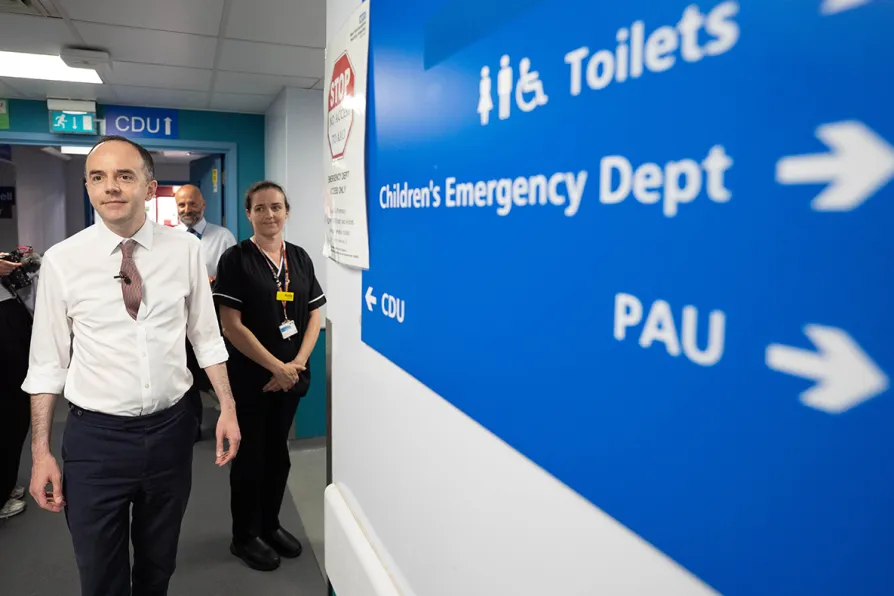
 Health Secretary James Murray during a visit to Watford General Hospital in Hertfordshire, July 9, 2026