Members of the Save Brick Lane campaign protested against the construction of an AI datacentre in the east London neighbourhood in June. Photograph: David Levene/The Guardia
Investigation finds dozens of ministers and civil servants moved into AI roles as government developed datacentre expansion plans
The UK’s policy on datacentres and AI was developed without any meetings with environmental groups, an investigation has found.
The nonprofit organisation Spotlight on Corruption said a “considerable revolving door” shaped the government’s development of “AI growth zones”, a central plank of the former prime minister Keir Starmer’s AI and economic policy, with 38 ministers, senior civil servants and special advisers hired to positions in AI companies between July 2024 and September 2026.
Meanwhile, even as top officials left government for jobs at OpenAI and Anthropic, government departments largely failed to engage meaningfully with stakeholders outside the technology industry.
Kamila Kingstone, a campaign lead at the NGO, said: “The government totally failed at the most senior level to speak to environmental NGOs or community groups when developing its flagship policy on AI datacentres. This is despite the serious environmental implications of its plans.”
Over 12 months, Spotlight on Corruption filed 40 freedom of information requests to 18 government agencies, seeking details of meetings and investment figures relating to the government’s policymaking on the growth zones, covering the period between July 2024 and June 2026.
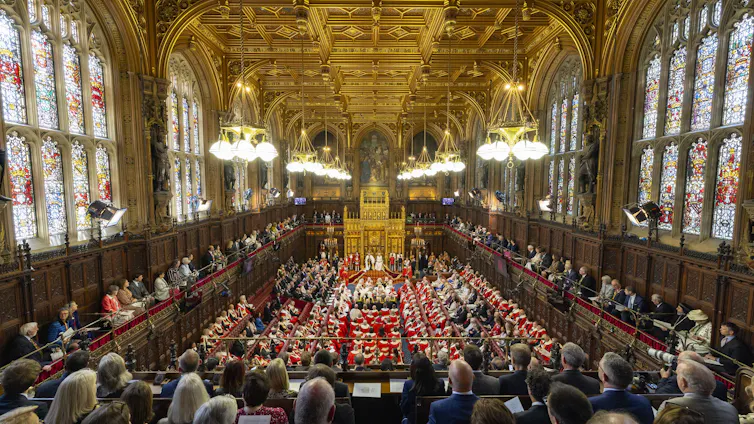
On April 29, 2026, the remaining hereditary peers left the House of Lords. These 92 individuals were the last vestiges of an era in which the landed aristocracy dominated the UK’s second chamber. In the recent past, as many as 800 aristocrats filled the red benches. Now though, a new financial elite appears to have taken their place.
Gradually, the dominance of the aristocrats gave way to a more meritocratic order of life peers. In 1999, Tony Blair’s government removed most of the hereditary peers; in 2026, Keir Starmer’s government finished the job. But did removing them really make the House of Lords any less elitist?
These were some of the issues I sought to explore with a team of graduate researchers at the University of Birmingham. We set about gathering what is, to the best of our knowledge, the largest-ever repository of the financial and political activities of the Lords. Over 18 months, we collected details of all the shareholdings, company directorships, landholdings, rental properties, education, attendance and speeches in the second chamber, as well as voting records for all Lords. These are presented in my new book, The Assetocracy.
What we uncovered was staggering. More than 260 peers hold multiple, individual shareholdings – stakes in listed companies – worth more than £100,000 apiece. In fact, some Lords held more than 200 individual holdings, each valued in excess of £100,000. Even assuming each asset was only worth £100,000, that would put the combined value of those shareholdings alone at more than £22 million.
Put simply, this reflects a level of wealth far beyond that of all but the richest people in Britain. In fact, 14 Lords appear in The Sunday Times Rich List of the UK’s wealthiest people, with a combined net worth of £27.8 billion.
Moreover, half of the House are landlords with rental income. And 250 peers hold one or more paid company directorship. In short, this is an extraordinary concentration of wealth at the heart of Britain’s second chamber.
The social profile of the Lords is equally revealing. Nearly half of peers were privately educated, compared with just 7% of the wider population. Around one third went to Oxford or Cambridge, compared with just 1% nationally. And 11% attended some of Britain’s most elite schools, where annual fees can now top £60,000.
Our conclusion? The Lords is not merely wealthy, it is an institution steeped in economic, educational and social privilege. Yet remarkably little is known about the extent of this wealth. Disclosure requirements remain limited, leaving many of the peers’ financial interests hidden from public view.
And that matters. Membership of the Lords can sit alongside extremely lucrative private-sector careers. Several peers, for example, declared earning between £100,000 and £300,000 a year from company directorships and advisory positions – on top of their parliamentary roles and Lords allowances (a £371 daily rate).
Aristocrats have gone – but privilege has not
This is the paradox at the heart of the modern House of Lords. The old aristocracy may be disappearing from the red benches, but wealth and privilege have not disappeared with it. The aristocracy has increasingly given way to what we termed an “assetocracy” – members of the new financial elite whose power rests on property, finance and accumulated asset-based wealth.
Reforming the second chamber has previously been tied to either removing the aristocratic hereditary peers or (ostensibly) increasing the scope for non-elite appointments. This is primarily done through the House of Lords Appointments Commission and the introduction of crossbenchers, whose appointment does not depend on prime ministerial patronage or political donations.
Yet while these efforts appeared to be producing a diverse collection of Lords through the early 2000s, the trend was reversed with the arrival of the Conservative governments of the 2010s. Since then, my research shows that the second chamber has seen a striking influx of the new “assetocratic” elite.
Appointments of peers with shareholdings over £100,000 (by political party)
My research also reveals a small but clear relationship between wealth and participation in the Lords. Previous accounts have shown that some political donors appear to treat a peerage as a status symbol, playing little part in the day-to-day work of the House. My findings suggest however, that the pattern extends beyond political donors. On average, the wealthiest peers tend to attend less, speak less and contribute less to the work of the House.
One of the book’s central conclusions is that the rise of the assetocrats in the Lords coincided with a wider transformation of British society. It was a period when wealth inequality grew and asset ownership became an increasingly important source of economic advantage.
The Lords did not create these changes, nor are its members the only or primary beneficiaries. But my research shows how peers have often sought to narrow the terms of political debate around wealth and redistribution. They have defended a system that privileges asset ownership and particular forms of wealth accumulation.
For example, Lord Leigh of Hurley, a Conservative peer and businessman, told the House in 2025 that “we need to teach kids that so-called ‘earned income’ is paid, weekly or monthly, without any risk whatever, while ‘unearned income’ is typically generated from an investment, which involves risk to capital and, therefore, deserves greater reward”.
The research points to three conclusions. The first may seem paradoxical, but the more I researched the Lords, the more convinced I became that – certainly on issues beyond wealth and inequality – it is a remarkable source of expertise that often improves and strengthens legislation. That is why abolishing the Lords would throw away an institution that still performs an important democratic function.
Second, reform is nonetheless overdue. Prime ministerial patronage should be curtailed; minimum expectations for attendance and participation introduced; transparency over financial affairs should be increased; and outside employment more tightly regulated where it creates conflicts of interest.
But there is a bigger issue. The transformation of the Lords reflects a much more profound transformation of society. Over the past five decades, the UK has become an economy in which owning property, shares and other assets is an increasingly important route to extraordinary wealth. Removing the last vestiges of the old aristocracy from the Lords will not solve the problem. The deeper challenge is confronting the structural forces that have allowed a new asset-owning elite to take its place.
This article features references to books that have been included for editorial reasons, and may contain links to bookshop.org. If you click on one of the links and go on to buy something from bookshop.org The Conversation UK may earn a commission.
Orcas discuss Donald Trump and the killer apes’ concept of democracy. Front Orca warns that Trump is crashing his country’s economy and that everything he does he does for the fantastically wealthy.
Diggers were seen demolishing Palestinian homes on Friday afternoon
The Israeli military has begun demolishing Palestinian buildings in the city of Hebron, after two Israeli soldiers were killed in an attack by two Palestinian gunmen.
Prime Minister Benjamin Netanyahu said the military would “destroy” the neighbourhood where the two attackers came from, and that Israel was ready for “extensive action” in the occupied West Bank.
Three other soldiers were wounded in the attack at a checkpoint outside Hebron, before the gunmen were shot dead, officials say.
It comes at a time of high tensions, with extremist Jewish settlers targeting Palestinians during the annual olive harvest, and Israel’s general election taking place in four days’ time.
Footage verified by the BBC shows an intense gun battle between soldiers and the gunmen. Other footage shows two gunmen exit a car armed with what appears to be a handgun and an assault rifle and start firing on soldiers at the checkpoint, before coming under return fire.
…
Speaking later from the scene, Netanyahu said that the military would “demolish this place and completely transform it,” referring to the Hebron neighbourhood where the attackers are said to have come from.
It is common for Israeli forces to demolish the homes of Palestinians who are suspected of carrying out attacks on Israelis -a practice Israeli rights groups have criticised as collective punishment.
Netanyahu likened his plans to previous operations in West Bank refugee camps where residential buildings were demolished and thousands were displaced.
Keir Starmer objects to criticism of the IDF. He asks how could anyone object to them starving people to death, forced marches like the Nazis did, bombing Gaza’s hospitals and universities, mass-murdering journalists, healthworkers and starving people queuing for food, killing and raping prisoners and murdering children. He calls for people to stop obstructing his genocide for Israel. New Labour UK Prime Minister Andy Burnham continues Labour party policy of active support and complicity in Israel’s genocide.
An injured child is transferred to a Yemeni hospital after a Saudi strike in Saada province on 18 October (Photo: Houthi Media Center/Alamy)
Wes Streeting once called for an arms embargo on Saudi Arabia. Now he’s helping its air force bomb Yemen.
Britain is expanding its aerial refuelling of Saudi fighter jets to include bombing raids on Yemen, despite a major spike in civilians being killed in these airstrikes.
Wes Streeting initially said the UK would only provide air-to-air refuelling for Saudi jets patrolling the kingdom’s skies to ward off drone and missile attacks on airports and oil infrastructure by Yemen’s Houthi movement.
The defence secretary is now letting British fighter jets join those patrols, as well as providing refuelling for Saudi airstrikes on “Houthi military targets in Yemen”.
It comes as last month saw more civilian casualties resulting from Saudi airstrikes on Yemen than any other since 2022, according to the Yemen Data Project.
At least 66 civilians were killed and a further 90 injured, with eight children among the dead.
One of the deadliest strikes came on 22 September, when six civilians including a woman and two children were killed in the bombing of a residential home in the city of Mokha.
That same day, Britain agreed to provide air-to-air refuelling support to the Saudi air force, supplementing the deployment of air defence equipment and UK personnel already in the region.
Saudi forces struck a market in the Al-Taiziyah district of Taiz governorate five days later, killing seven civilians and injuring 40 others, including five children.
Keir Starmer objects to criticism of the IDF. He asks how could anyone object to them starving people to death, forced marches like the Nazis did, bombing Gaza’s hospitals and universities, mass-murdering journalists, healthworkers and starving people queuing for food, killing and raping prisoners and murdering children. He calls for people to stop obstructing his genocide for Israel. New Labour UK Prime Minister Andy Burnham continues Labour party policy of active support and complicity in Israel’s genocide.UK Prime Minister Andy Burnham admits to blatently lying and engaging in deception to become leader of the UK Labour Party and Prime Minister.Ed Miliband says that he and the Labour Party are full of shit criminalising people holding signs as terrorists despite anything he says.
This work by Middle East Monitor is licensed under a Creative Commons Attribution-NonCommercial-ShareAlike 4.0 International License.
Wounded Yemeni civilians receive treatment under dire conditions at Al-Thawra Hospital, the city’s largest public hospital, in Taiz, Yemen, on October 21, 2026. [Hamza Mustafa – Anadolu Agency]
At least 1,574 people have been killed and 6,939 others injured in Yemen since the latest military escalation began in August, the World Health Organization (WHO) said Thursday.
In a report seen by Anadolu Agency, the UN health agency said it had recorded 8,513 casualties since the beginning of August.
The figure included 1,574 deaths and 6,939 injuries as of Oct. 19, the WHO said, without specifying whether the casualties were civilians, military personnel or both.
The agency said 292 people were killed and 1,048 others injured during the latest eight-day reporting period.
Last Thursday, the WHO said it had recorded 1,282 deaths and 5,891 injuries since the escalation began on Aug. 6, 2026, before the toll rose to the latest figures.
Yemen has been engulfed in conflict since the Houthis seized Sanaa and several other provinces in 2014, prompting a Saudi-led coalition to intervene in March 2015 in support of the internationally recognized government.
The Houthis control much of northern and western Yemen, while government forces and their allies hold Aden and large parts of the country’s southern and eastern provinces.
Keir Starmer objects to criticism of the IDF. He asks how could anyone object to them starving people to death, forced marches like the Nazis did, bombing Gaza’s hospitals and universities, mass-murdering journalists, healthworkers and starving people queuing for food, killing and raping prisoners and murdering children. He calls for people to stop obstructing his genocide for Israel. New Labour UK Prime Minister Andy Burnham continues Labour party policy of active support and complicity in Israel’s genocide.UK Prime Minister Andy Burnham admits to blatently lying and engaging in deception to become leader of the UK Labour Party and Prime Minister.Ed Miliband says that he and the Labour Party are full of shit criminalising people holding signs as terrorists despite anything he says.