Prospective GB News Board Member is Fossil Fuel Investor

Spread the love

Original article by Adam Barnett and Sam Bright republished from DeSmog.
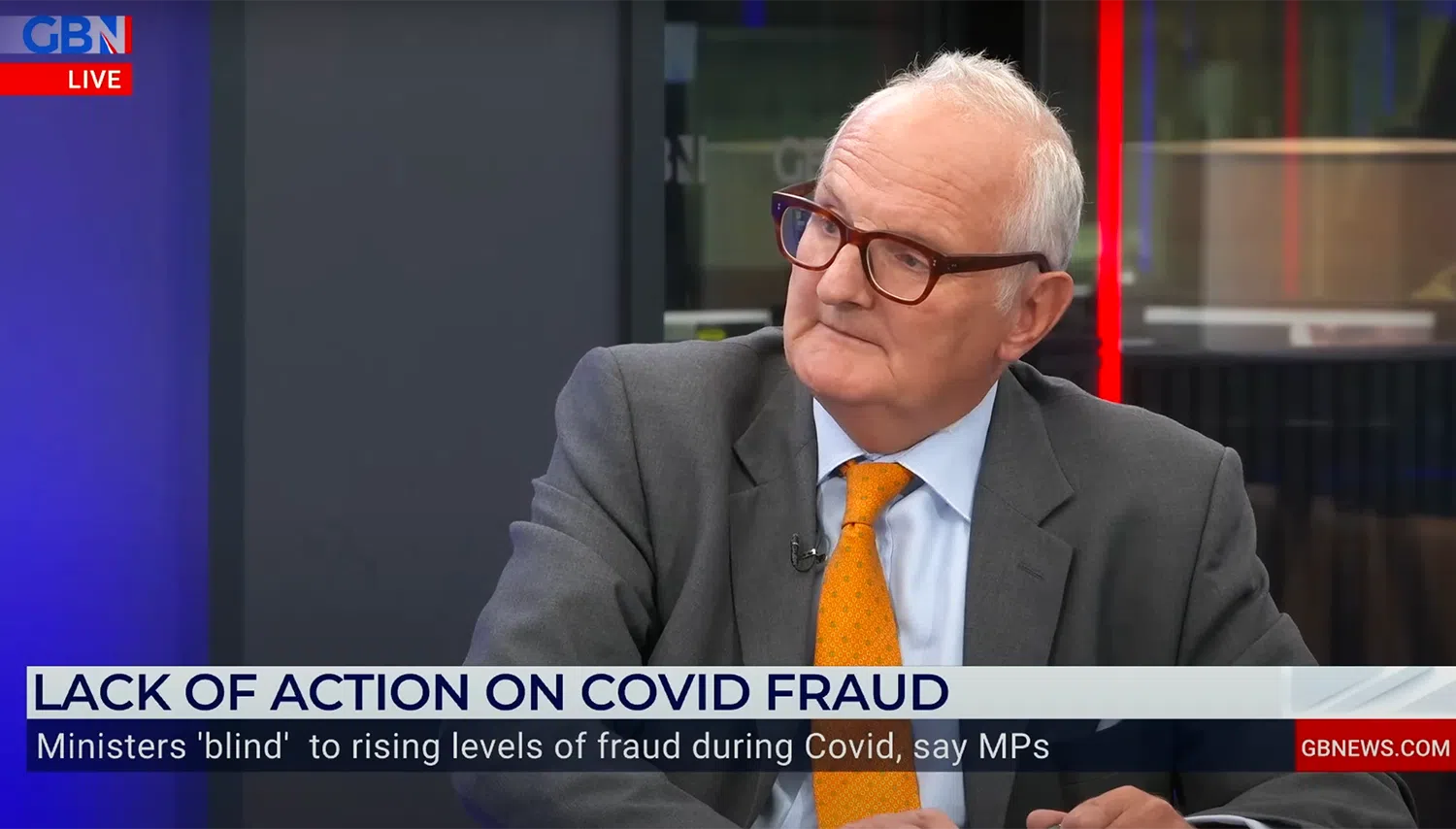
Conservative peer and prospective GB News board member Lord Theodore Agnew. Credit: GB News / YouTube

Lord Agnew is a shareholder in Equinor, the Norwegian oil and gas firm behind the ‘carbon bomb’ Rosebank oil field.

A Conservative peer who is expected to join the board of broadcaster GB News has shares in Equinor, the oil and gas multinational behind the Rosebank oil field in the North Sea. 

According to his parliamentary register of interests, Lord Theodore Agnew has shares of at least £100,000 in Equinor, the Norwegian state-owned energy producer. Equinor has a majority stake in the Rosebank North Sea oil field, which has been dubbed a “carbon bomb” by environmental law charity ClientEarth. 

Agnew is set to replace hedge fund millionaire Paul Marshall on the board of GB News’s parent company All Perspectives Ltd, according to Sky News. 

Marshall is one of the key backers of GB News, holding a 45 percent stake in the company. He is reportedly planning to step back from GB News in order to launch a bid for the Telegraph Media Group, which includes The Telegraph newspaper and The Spectator magazine. 

His withdrawal could potentially throw GB News into turmoil. The startup broadcaster has lost £76 million since its launch in 2021 and relies on the resources of Marshall and its other big stakeholder, UAE-based investment firm Legatum, to survive. Sky News reported that GB News is now preparing to make job cuts as part of a “corporate reorganisation”.

This may have implications for how climate change is covered in the UK. An investigation by DeSmog found that one in three GB News presenters had spread climate science denial on air in 2022, while more than half had attacked climate action.

“It comes as no surprise that members of the GB News board have ties to the oil and gas industry, given the way its presenters have championed continued oil and gas expansion,” said Tessa Khan, director of environmental non-profit Uplift. 

Agnew, a former Cabinet Office minister under Boris Johnson, was in October appointed chair of UnHerd Ventures, another Marshall media vehicle. The company runs UnHerd, a publication founded in 2017 to give a platform to marginalised views.

Agnew also has shares in Carbon Plus Capital, a private investment company which specialises in carbon offsetting “based on the protection of forests”. This involves companies paying to plant trees to “offset” their greenhouse gas emissions. 

Carbon offsetting is a controversial idea that has been criticised by climate campaigners as a form of greenwashing. An investigation published last year by newspapers The Guardian, Die Zeit and non-profit SourceMaterial found that 90 percent of rainforest carbon offsets approved by the world’s largest certifier Verra were “largely worthless” and could actually increase global heating. 

Carbon Plus Capital partner Robin Warwick Edwards is a trustee of the Institute of Economic Affairs (IEA) think tank and the chair of its advisory council. The IEA, a free market group that has advocated for more fossil fuel extraction, received funding from BP for at least 50 years. 

Agnew and Edwards declined to comment. GB News did not respond. 

“Climate denial and investment in the fossil fuel industry go hand in hand”, said Carys Boughton of campaign group Fossil Free Parliament. 

“It makes complete sense that an expected new board member of GB News – a channel absolutely committed to attacking climate science and policy at every turn – is invested in Equinor, a company that, according to research by Oil Change International, ranks eighth worst in the world for its commitment to expanding oil and gas production.”

She added: “By spreading disinformation about the climate crisis, GB News is feeding into the fossil fuel industry’s licence to operate and thus helping to line the pockets of the industry’s shareholders.”

GB News in Turmoil

GB News hosts regularly attack climate policies and the science behind them. 

Numerous GB News presenters have also been vocal about their support for policies that would maintain and even extend the UK’s reliance on oil and gas. 

On 9 December 2022, host Mark Dolan praised West Cumbria Mining’s plan to open a new coal mine in Cumbria. He said the UK should “drill, baby, drill” for coal, oil and gas,  adding: “I think the push for net zero here is another element of liberal progressivism which is infecting the West.”

DeSmog revealed in October that Marshall Wace, the hedge fund run by Paul Marshall, had £1.8 billion invested in fossil fuel companies as of June 2023. This included Chevron, Shell, Equinor, and 109 other fossil fuel companies. 

Marshall reportedly invested £10 million in GB News when it first launched two years ago and, in August 2022, joined the Dubai-based investment firm Legatum Group in a £60 million capital injection and buyout of GB News’s other major investor, Discovery. 

If he joins the All Perspectives board, Agnew would become the latest Conservative politician to be adopted by the right-wing broadcaster. GB News hosts include Jacob Rees-Mogg, who was business and energy secretary under Liz TrussLee Anderson, a former Tory deputy chair who defected to anti-net zero party Reform UK last month, as well as Conservative MPs Esther McVey and Philip Davies.  

The All Perspectives board also includes Tory peer Baroness Helena Morrissey and George Farmer, a Reform UK donor and the son of Conservative peer Lord Michael Farmer. 

GB News reported losses of £42 million in the year to May 2023, and £76 million since its launch in 2021. This comes as rival populist channel TalkTV is closing its TV operation and switching to YouTube, having suffered losses of £90 million since it launched in 2022. 

Agnew’s appointment has not been confirmed by Marshall, Agnew or the company. 

“With advertisers steering clear, GB News is haemorrhaging cash – yet they continue to push misleading messages on climate change,” said Richard Wilson, director of the Stop Funding Heat campaign.  

“In the last month alone, GB News commentators have claimed climate change is a ‘social mania’, dismissed climate harms as ‘hypothetical’, and attacked United Nations warnings about the need for urgent climate action as ‘hysteria’.

“Now we learn that a prospective GB News board member has fossil fuel investments”.

He added: “Britain urgently needs a media that supports the public interest – not the interests of a toxic industry that is putting all of our futures at risk”.

Fossil Fuel Projects

Equinor claims it supplies 27 percent of the UK’s energy from oil and gas, and is currently investing $6 billion (£4.8 billion) a year in fossil fuel exploration and drilling. It also says that it powers one million homes in Europe via renewable offshore wind. 

Rosebank is the UK’s largest undeveloped oil and gas field, and could produce around 300 million barrels of oil over its lifetime, emitting 200 million tonnes of carbon dioxide. 

In October, DeSmog revealed that Equinor urged the UK government to help promote the oil and gas industry, and was one of several companies which lobbied to water down the windfall tax on oil and gas company profits following Russia’s invasion of Ukraine. 

The UK government controversially approved the Rosebank project in September, despite the International Energy Agency stating that new oil and gas exploration is incompatible with the ambition to reach net zero emissions by 2050. Green Party MP Caroline Lucas labelled the decision “morally obscene”.

Prime Minister Rishi Sunak used his address at the COP28 climate summit in December to claim that “climate politics is close to breaking point”, while stating that the UK will meet its net zero targets, “but we’ll do it in a more pragmatic way, which doesn’t burden working people”.

However, a 2023 court case found that the government’s plans only added up to 95 percent of the reductions needed to meet its net zero targets. The Conservative government has said it plans to “max out” the UK’s North Sea oil and gas reserves.

Tessa Khan added: “Those pushing for new oil and gas drilling, whether that’s the UK government, GB News or Equinor, are making things worse for the millions struggling with high energy bills and for those now struggling to cope with the impacts of climate change such as UK farmers – and all just to make a few oil and gas companies and their shareholders even richer.”

DeSmog has previously revealed that the Conservative Party received £3.5 million in donations from fossil fuel interests and climate science deniers in 2022, while two-thirds of the directors in charge of the party’s multi-million-pound endowment fund have a financial interest in oil, gas, and highly polluting industries.

Original article by Adam Barnett and Sam Bright republished from DeSmog.

Image of InBedWithBigOil by Not Here To Be Liked + Hex Prints from Just Stop Oil's You May Find Yourself... art auction. Featuring Rishi Sunak, Fossil Fuels and Rupert Murdoch.
Image of InBedWithBigOil by Not Here To Be Liked + Hex Prints from Just Stop Oil’s You May Find Yourself… art auction. Featuring Rishi Sunak, Fossil Fuels and Rupert Murdoch.
Continue ReadingProspective GB News Board Member is Fossil Fuel Investor

IEA Think Tank Contributes to Climate Science Denial Documentary

Spread the love

Original article by Sam Bright republished from DeSmog.
The Institute of Economic Affairs has its headquarters on Lord North Street, Westminster. Credit: Des Blenkinsopp (CC BY-SA 2.0)

A senior figure at the influential Institute of Economic Affairs (IEA) think tank contributed to a new documentary that spread numerous myths about climate change. 

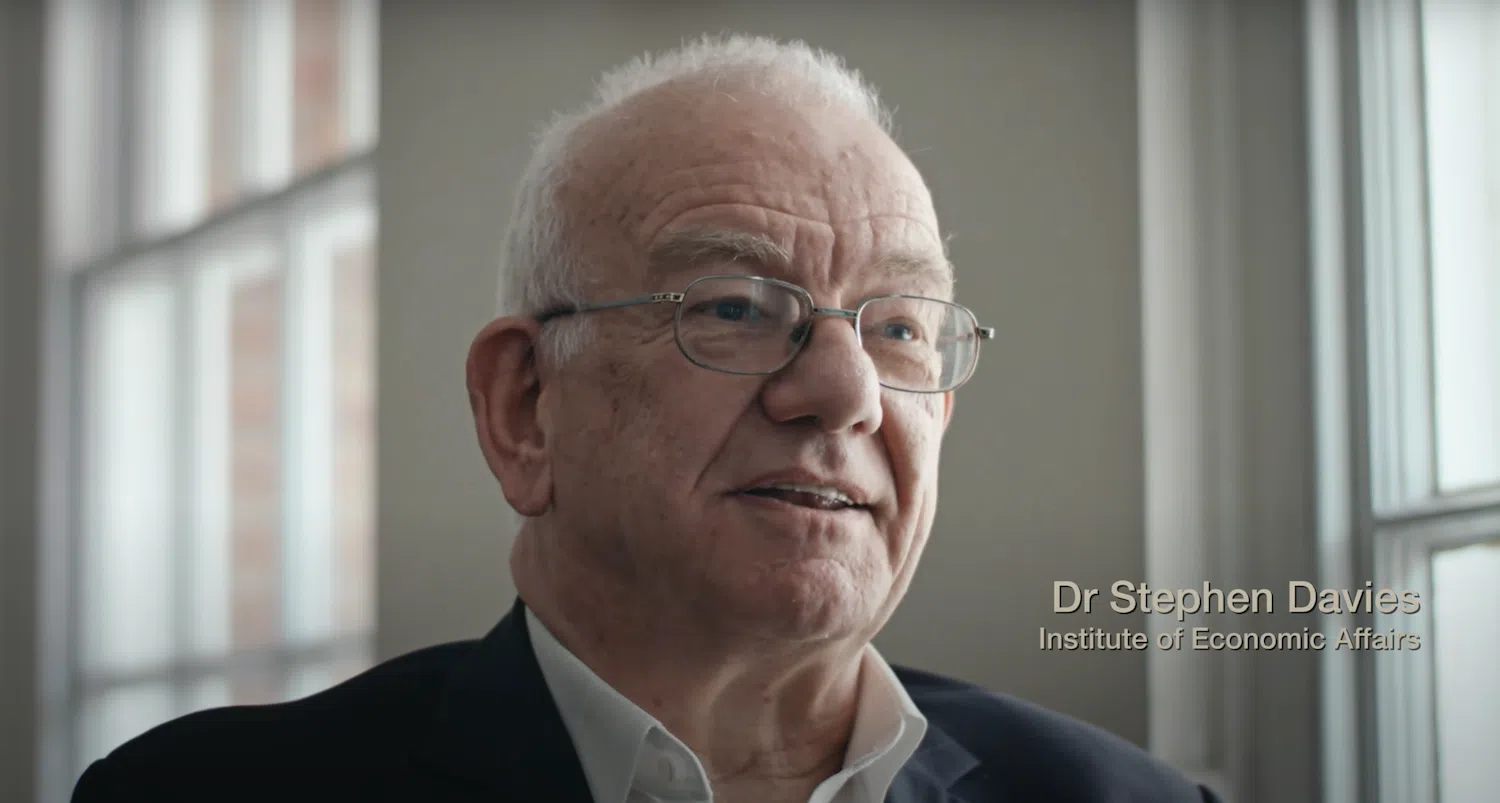
Stephen Davies, an academic who has worked in educational outreach roles at the IEA since 2010, appeared several times in Climate The Movie: The Cold Truth – a new film directed by climate science denier Martin Durkin

In the documentary, Davies claims that climate activists want to impose an “austere” life on ordinary people. “Behind all the talk about a climate emergency, climate crisis” is “an animus and hostility towards” working-class people, “their lifestyle, their beliefs and a desire to change it by force if necessary,” he says.

According to the website Skeptical Science, which debunks climate misinformation, Climate The Movie contains more than two dozen myths about climate change. The film suggests that we shouldn’t be worried about greenhouse gas emissions, because plants need carbon dioxide. “We’re in a CO2 famine,” one interviewee claims.

The UN’s Intergovernmental Panel on Climate Change (IPCC), the world’s foremost climate science body, has stated that carbon dioxide “is responsible for most of global warming” since the late 19th century, which has increased the “severity and frequency of weather and climate extremes, like heat waves, heavy rains, and drought”.

Climate The Movie producer Thomas Nelson told DeSmog that “I see the misguided fight against carbon dioxide as being as crazy as fighting against oxygen or water vapour, and I think scaring innocent children about this is deeply evil”.

The IEA said that “Steve firmly believes that climate change is happening and carbon emissions are having an impact. His view that climate policy imposes costs, particularly on working-class communities, is entirely mainstream. IEA publications and spokespeople have supported action on climate change, including carbon pricing.”

A screenshot of Stephen Davies of the Institute of Economic Affairs in Climate The Movie: The Cold Truth. Credit: Climate The Movie / YouTube

In 2018, Greenpeace’s investigative journalism unit Unearthed revealed that the IEA had received funding from oil major BP every year since 1967. In response to the story, an IEA spokeswoman said: “It is surely uncontroversial that the IEA’s principles coincide with the interests of our donors.” 

The IEA also received a £21,000 grant from U.S. oil major ExxonMobil in 2005.

The IEA has extensive influence in politics and the media. It was pivotal to Liz Truss’s short-lived premiership as prime minister, and has boasted of its access to Conservative ministers and MPs. During the year ending March 2023, the IEA appeared in the media on 5,265 occasions, a figure 43 percent higher than its previous peak in 2019.

The group has also received donations from a number of philanthropic trusts accused of channelling funds from the fossil fuel industry and helping to support climate science denial groups. The IEA is a member of the Atlas Network – an international collaboration of “extreme” free market groups that have been accused of promoting the interests of fossil fuel companies and other large corporations.

It’s not known if the IEA has received funding from BP since 2018.

The IEA is a prominent supporter of the continued and extended use of fossil fuels. The group has advocated for the ban to be lifted on fracking for shale gas, calling it the “moral and economic choice”. The IEA has also said that a ban on new North Sea oil and gas would be “madness”, has criticised the windfall tax imposed on North Sea oil and gas firms, and said that the government’s commitment to “max out” the UK’s fossil fuel reserves is a “welcome step”.

The IEA is part of the Tufton Street network – a cluster of libertarian think tanks and pressure groups that are in favour of more fossil fuel extraction and are opposed to state-led climate action. These groups are characterised by a lack of transparency over their sources of funding. The IEA does not publicly declare the names of its donors. 

“From Brexit to Trussonomics, the IEA has consistently peddled and promoted destructive and damaging policies,” Green Party MP Caroline Lucas told DeSmog. “Yet perhaps nothing will prove more dangerous long term than the stream of climate denialism and calls to delay action that have been pouring out of Tufton Street for many years.

“Clearly the IEA is now ramping up its climate culture war and the Conservative Party has been following suit. The cross-party consensus on climate action we used to have in Parliament is under strain like never before.”

The IEA and Stephen Davies were approached for comment. 

Climate The Movie

During the documentary, Davies suggests that action to reduce greenhouse gas emissions is being used to limit the freedom of individuals. He claims that climate activists want to impose “a much more austere simple kind of lifestyle” on people “in which the consumption choices of the great bulk of the population are controlled or even prohibited.”

Davies adds that: “What you have here is a classic example of class hypocrisy and self-interest masquerading as public spirited concern. You could take these kinds of green socialist more seriously if they lived off grid, they cut their own consumption down to the minimum, they never flew. Instead you get constant talk about how human consumption is destroying the planet but the people making all this talk show absolutely no signs of reducing their own.”

The documentary also features an interview with Benny Peiser, the director of the Global Warming Policy Foundation (GWPF) – the UK’s leading climate science denial group. Peiser has previously claimed that it would be “extraordinary anyone should think there is a climate crisis”, while the GWPF has expressed the view that carbon dioxide has been mischaracterised as pollution, when in fact it is a “benefit to the planet”. 

The film was favourably reviewed by commentator Toby Young in The Spectator magazine, who described it as “a phenomenon”. Young has previously said that he’s sceptical about the idea of human-caused climate change. 

The IPCC has stated it is “unequivocal that human influence has warmed the atmosphere, ocean and land”, while scientists at NASA have found that the last 10 years were the hottest on record. Earth’s average surface temperature in 2023 was the warmest since records began in 1880. 

The IPCC has also warned that false and misleading information “undermines climate science and disregards risk and urgency” of climate action.

The documentary also features Claire Fox, a member of the House of Lords who was nominated for a peerage by former prime minister Boris Johnson in 2020. 

Fox used the documentary to claim that, by tackling climate change, people will be forced to pay more “to simply live the lives that they were leading”.

She suggests that supporters of climate action are trying to “take away what we consider to be not luxuries but necessities.”

The UK’s Climate Change Committee, which advises the government on measures to achieve net zero emissions by 2050, estimates that the combined policies will cost less than one percent of the country’s national output.

The Office for Budget Responsibility, the UK’s independent economic forecaster, has also said that “the costs of failing to get climate change under control would be much larger than those of bringing emissions down to net zero”.

Those suffering during the cost of living crisis have seen their energy bills increase by nearly £2.5 billion, in turn reducing their disposable incomes, due to successive governments failing to implement green reforms. 

Claire Fox and the GWPF were approached for comment. 

A Charitable Cause?

The IEA is a registered charity, meaning that it receives generous tax breaks. 

The group justifies this charitable status partly on the basis of its educational outreach programme, which aims to “equip tomorrow’s leaders with a deep understanding of free market economics”.

The IEA claims that: “Our aim is to change the climate of opinion in the long term and our work with students is a key part of this.”

In the year ending March 2023, the group claimed to have engaged with 3,500 students and 1,200 teachers via its seminars, internships and summer schools.

Formerly the IEA’s head of education and now a senior education fellow, Davies is a senior member of the group’s outreach programme. He is the first person listed in the IEA’s student speakers brochure, which advertises the IEA staff members who are available to speak at schools or universities. 

The brochure also lists the IEA’s chief operating officer Andy Mayer, who has said that the government should “get rid of” its target of achieving net zero emissions by 2050, which he called a “very hard left, socialist, central-planning model”.

The non-profit Good Law Project recently made a complaint to the Charity Commission about the IEA, claiming that the libertarian group had breached charity rules. Namely, the Good Law Project claims that the IEA is in breach of rules stating that charities must avoid presenting “biased and selective information in support of a preconceived point of view”.

The Charity Commission rejected this complaint, stating that: “We have assessed the concerns raised and have not identified concerns that the charity is acting outside of its objects or the Commission’s published guidance.” 

Good Law Project campaigns manager Hannah Greer told DeSmog: “It won’t be a surprise to anyone that the IEA is cementing its role as a major mouthpiece for climate change scepticism. It’s a huge scandal that the IEA is still allowed to peddle fringe views under the guise of being an ‘educational charity’ while benefiting from taxpayer subsidies.

“This has been allowed to happen because we have seen alarming and unambiguous regulatory failure from the Charity Commission – who have been presented with evidence of how the IEA is flouting charity law, but have chosen to look the other way.”

Original article by Sam Bright republished from DeSmog.
Continue ReadingIEA Think Tank Contributes to Climate Science Denial Documentary

I’m still reeling from Rishi Sunak’s shameless, dangerous speech

Spread the love

Caroline Lucas

https://www.theguardian.com/commentisfree/2024/mar/03/sunak-speech-protest-tories-friday-no-10-caroline-lucas

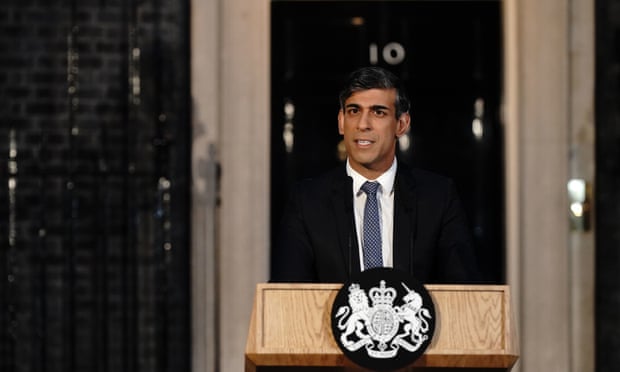
Rishi Sunak giving a press conference outside No 10 on 1 March 2024. Photograph: Aaron Chown/PA

The prime minister’s address on Friday was a masterclass in gaslighting and made a new art form of rank hypocrisy

“We must face down the extremists who would tear us apart,” Sunak declared to the country on Friday evening. And perhaps never were truer words spoken – at least not by this morally bankrupt prime minister, who is rapidly proving to be one of the most dangerously irresponsible leaders this country has ever faced.

I am still in disbelief at the sheer chutzpah of Sunak wheeling out the No 10 lectern and calling on the whole nation to tune in to an emergency address. Because what came next was not the announcement of a major natural disaster or attack. It wasn’t, as we saw from other world leaders that day, a condemnation of open gunfire against starving people trying to reach aid trucks in Gaza, or a statement of solidarity with Russian protesters against Putin. It wasn’t even the calling of an election.

Instead, what Britain got was a masterclass in gaslighting. Sunak’s performance made a new art form of rank hypocrisy, as he pretended not to know that the very extremism he criticised was being actively driven by his party and peddled in his speech.

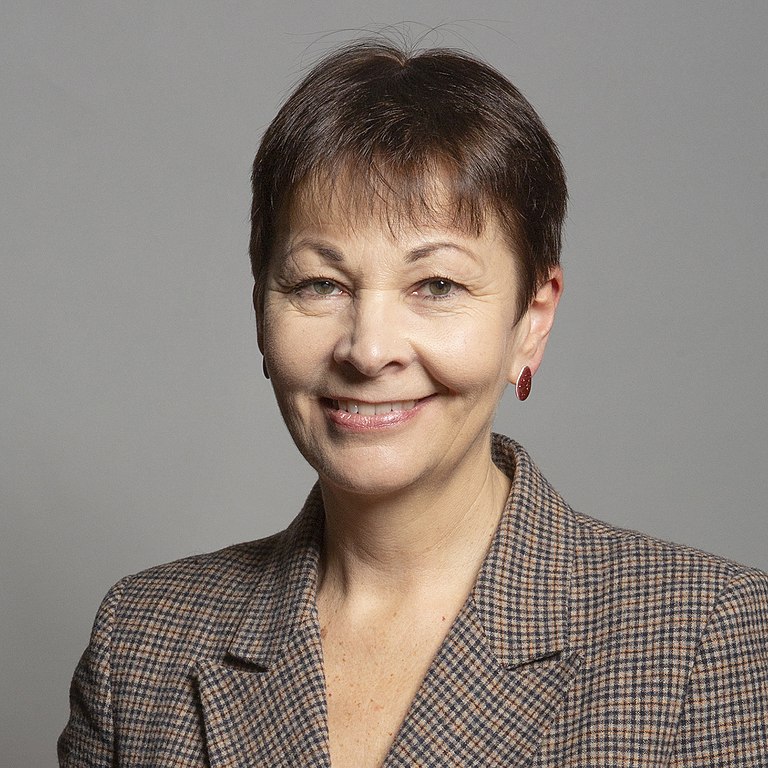
Caroline Lucas Green Party MP for Brighton Pavilion. Official image by David Woolfall Creative Commons Attribution 3.0 Unported license.

By choosing to give that inflammatory speech, Sunak has shown that he is prepared to lurch even further to the right in a bid to stop defections to the Reform UK party. The mask has well and truly slipped: this was yet another step in the culture war right from the very top. The hard right of his party will have been overjoyed to see Sunak the strongman, cracking down on dissent, stifling protest and taking aim at immigrants and Muslims.

Ultimately, that speech was a dark moment in British politics. Democracy is indeed under threat from extremists. The problem is, they’re running the government itself – and we need to wake up and stand up to the seriousness of the threat that they pose.

  • Caroline Lucas is the Green MP for Brighton Pavilion

https://www.theguardian.com/commentisfree/2024/mar/03/sunak-speech-protest-tories-friday-no-10-caroline-lucas

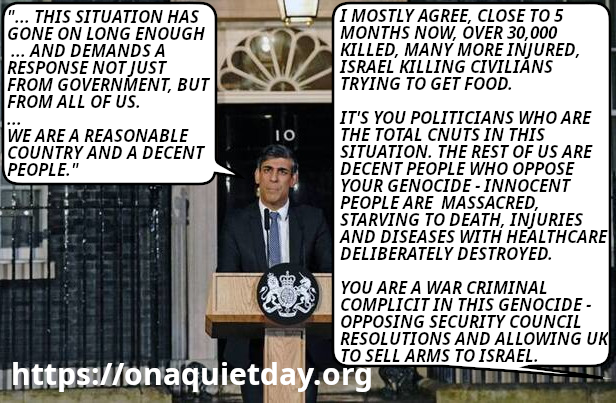
Response to Rishi Sunak's extremism speech at Downing Street 1 March 2024. Second version of this image with text slightly altered.
Response to Rishi Sunak’s extremism speech at Downing Street 1 March 2024. Second version of this image with text slightly altered.

Sunak’s extremism speech 1 to 5

Continue ReadingI’m still reeling from Rishi Sunak’s shameless, dangerous speech

PMQs: Caroline Lucas takes Rishi Sunak to task over Gaza ceasefire

Spread the love

https://leftfootforward.org/2024/01/pmqs-caroline-lucas-takes-rishi-sunak-to-task-over-gaza-ceasefire/

‘What will it take for him to back a permanent, bilateral ceasefire?’

Rishi Sunak faced MPs in parliament today at the latest Prime Minister’s Questions (PMQs). He fielded questions from the Labour leader Keir Starmer on the Rwanda scheme and the SNP’s Westminster leader Stephen Flynn on the cost of living crisis.

But one of the most dramatic moments in the exchanges came as a result of a question from Green Party MP Caroline Lucas. She asked Sunak “what will it take for him to back a permanent, bilateral ceasefire?”

Speaking in the House of Commons, Lucas said: “Until the UK government calls for an immediate ceasefire, it is complicit in Gaza. Not my words, but those of the head of Oxfam, who like every single agency trying to operate on the ground is clear: that aid can’t be effectively delivered while fighting continues. More UK aid is, of course, welcome, but even when it does get through, it can result in what one Palestinian aid worker calls ‘bombing us on full stomachs’.

“24,000 people have already been killed. So can he tell us what will it take for him to back a permanent, bilateral ceasefire?”

https://leftfootforward.org/2024/01/pmqs-caroline-lucas-takes-rishi-sunak-to-task-over-gaza-ceasefire/

Continue ReadingPMQs: Caroline Lucas takes Rishi Sunak to task over Gaza ceasefire

The UK is abdicating its responsibility to help bring about peace in Gaza

Spread the love

https://leftfootforward.org/2024/01/the-uk-is-abdicating-its-responsibility-to-help-bring-peace-in-gaza/

Simon Walker / Number 10 Downing Street – Creative Commons

The IDF carries out raids to destroy tunnels in Central Gaza, killing dozens. Hamas fires rockets back into Israel. A ground invasion follows aerial bombardments, civilian targets are struck, the number killed climbs into the thousands. This is not a description of the Israel-Hamas war we’re witnessing now, in 2024 – but a near-identical one almost 15 years ago.  

In December 2008, the Gaza War (also known as Operation Cast Lead) erupted. On 9 January 2009, the UN Security Council debated a resolution which called for “an immediate, durable and fully respected ceasefire”. The UK voted for it, successfully shifting the US position from opposition to abstention, and the vote was reinforced at the UN General Assembly on January 16. Two days later, Israel declared a unilateral ceasefire, and the war was over. Bold and creative diplomacy by the UK, which whilst they didn’t follow up in a similar vein, nonetheless made a significant difference on the international stage.  

Fast forward to today, 100 days since the October 7 Hamas terror atrocities in Israel, and that diplomacy is sorely lacking. In early December, the UK Government committed a grave error by abstaining on a ceasefire motion at the UN Security Council – the lesson of history wasted. It then abstained again a week later in a UN General Assembly vote – making the UK just one of 33 countries to oppose or abstain on the ceasefire motion, while 153 countries voted in favour. 

These past 15 years have witnessed five wars – consigning the people of Gaza to ever deteriorating living conditions with barely enough supplies and aid allowed in; the stalemate continues, undermining still further the security of Israel. But with violence spreading through the region into Lebanon, for example, and now the UK and US escalating tensions with their bombing of Yemen, we must make it inconceivable to slip back permanently into endless cycles of violence.

Listening to experts on all sides, there seem to be four key principles that might just start a conversation about how to build the kind of peace which only a fair and lasting political resolution to this crisis can deliver for the people of the region. 

Securing a bilateral ceasefire is clearly a critical first principle – ending the current bloodshed and freeing the remaining Israeli hostages is a pre-requisite for peace. As the UN repeatedly states, the bombs and missiles being dropped aren’t just killing people in their tens of thousands; they are also destroying roads, warehouses, hospitals, schools and other so-called safe places.  

No wonder so many aid agencies on the ground have gone beyond calling for humanitarian corridors, pauses or safe zones. The size and population density of Gaza mean there is nowhere safe for civilians, and no safe means for aid workers to reach people who urgently need help. The only way to ensure men women and children can escape the bombs is to stop them from being dropped.  

The humanitarian case for a ceasefire is overwhelming, but there is a judicial one too – which brings me to the second principle of accountability. Both the Israeli Government and Hamas have responsibilities under international law – above all to minimise civilian casualties, but also only a ceasefire will enable the ICC to conduct investigations into potential war crimes and other human rights violations by both parties, and to establish an Independent Commission of Inquiry. 

The UK Government says the right things about adherence to international law, yet very little has changed, and accountability has not been delivered.  

Fundamental to this principle is that international law forms the foundations on which all policies must rest both about the conduct of the hostilities and the necessary foundations of a lasting settlement. All parties to this conflict must fulfil the requirements of international law and face the full force of censure and other sanctions if they refuse to do so. The UK’s actions are badly out of step with its legal and moral obligations – it must consistently uphold the international rule of law and make sure Benjamin Netanyahu’s government faces the full consequences of violating international law.  Nor should it be involved in any further military action in the region, when this can and will be interpreted as condoning and siding with Israel’s attacks on Gaza.

Thirdly, there has to be dialogue. I understand the rationale behind states refusing to negotiate with terrorist groups. But ensuring lines of communication with Hamas are kept open – along with every back and front channel accessible via the other players in this region, such as Qatar – is the only way to bring the remaining Israeli hostages home to their families and enduring peace. 

Clearly the US has the greatest influence over Israel, but the UK can play a critical role too, as the 2009 UN vote demonstrated – our links with Qatar and Egypt should be used to pull every lever possible in support of a consensus on Israel’s right to exist and a Palestinian state. Conversations must happen for peace to be on the table.  

It takes courage to start a dialogue – especially when even a shared goal feels unattainable, let alone a peaceful outcome, and murderous regimes like Iran are also involved. But from Northern Ireland and Colombia, talking has secured positive and lasting outcomes. No dialogue is the death of peace. We must believe in it and shake hands for it, as Nurit Cooper, one of the Israeli hostages, so memorably did on her release. 

Finally, we must directly confront the complexities that have made peace so elusive to date. My inbox is bursting with different versions of what has brought us to this point – the facts and the feelings. Nuance and debate have been lacking in an era of judgment and condemnation. Those marching for peace are decried as hateful, places of worship are attacked, and our streets have become places where too many people feel afraid. 

Laying the groundwork for peace requires acknowledging how people truly feel. A truth and reconciliation process might be one model. Every Palestinian and Israeli has their own story, their own hurt and their own hopes. Here in the UK, this conflict awakens strong feelings too – so we must weigh the impact of our words, as well as the arms we are still supplying to the region, the bombs we are now ourselves dropping on war ravaged Yemen. The UK must stop repeating the same mistakes and instead bring the alternatives to life.

Decades of suffering and Western backed military intervention have acted as potential recruiting sergeant for the likes of Hamas and the Houthis.

Hunger, isolation and hopelessness are among the conditions in which conflicts thrive. So achieving peace demands that the world address these challenges – and only in the context of a settlement that embodies justice, above all the end to occupation.

An ideology cannot be destroyed by guns and bombs. It can only be destroyed by giving people food and medicine, alongside justice and a more hopeful future in which they are treated with dignity – guaranteeing them freedom and a voice. 

The eyes of the world may well be on this narrow strip of land right now, but they’ve been largely absent as Gazans have been forced to live in an open prison, systematically stripped of their dignity and freedom, by both the Israeli authorities and by Hamas. We mustn’t let our gaze turn away again. 

It’s often said that waging peace is far more difficult than waging war. But we have no choice if we’re to build a safer and more secure world for every child, no matter which side of a border they are born. 

Caroline Lucas Green Party MP for Brighton Pavilion. Official image by David Woolfall Creative Commons Attribution 3.0 Unported license.

Caroline Lucas is the Green Party MP for Brighton Pavilion

https://leftfootforward.org/2024/01/the-uk-is-abdicating-its-responsibility-to-help-bring-peace-in-gaza/

I’ve quoted all Caroline Lucas’s article, hope that nobody objects. Authors: It’s likely that you are able to use a Creative Commons licence despite being published by others.

Continue ReadingThe UK is abdicating its responsibility to help bring about peace in Gaza