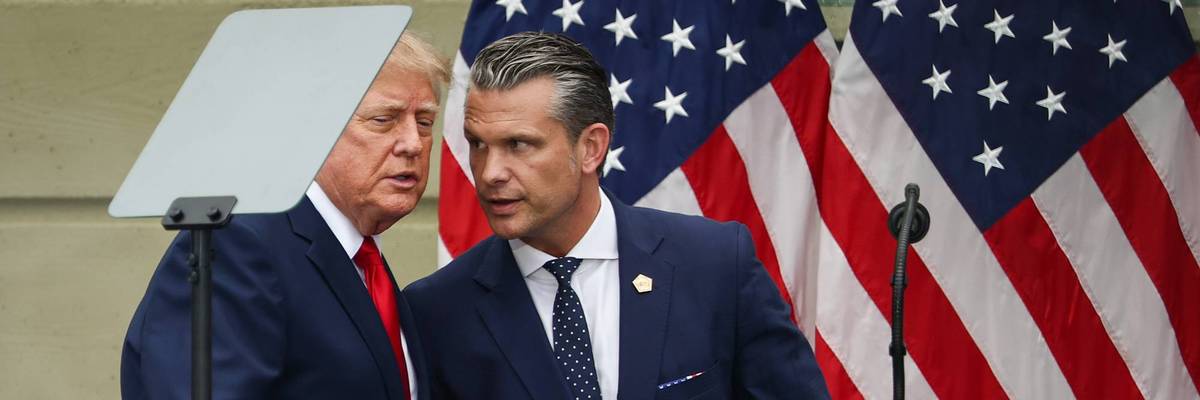
US President Donald Trump shakes hands with Pentagon Secretary Pete Hegseth on September 11, 2026 in Arlington, Virginia.(Photo by Finn Gomez/Getty Images)
If carried out, says Sen. Chris Murphy, the attack Trump and Hegseth are plotting “will lead to devastating escalation and the likely destruction of our commitment to the rule of law.”
US Sen. Chris Murphy disclosed Wednesday that he was among the members of Congress recently briefed behind closed doors on the Trump administration’s discussions of a possible post-midterm assault on Iran, and he came away with a startling assessment: “Their plan is insane.”
Murphy (D-Conn.), who recently traveled to Gulf countries to survey the extensive damage Iran has inflicted on American military installations in retaliation for US President Donald Trump’s illegal war, said during an event hosted by the Middle East Institute that he and some of his colleagues got the chance during a classified briefing “to have a fairly detailed conversation about what the war plan would be if we restarted military operations.”
Without disclosing specific details from the briefing, the senator said administration officials told lawmakers that a renewed assault would be a “short-duration plan”—a common narrative from an administration that pledged shortly after launching the war that it would be over in a matter of weeks.
“It will lead to devastating escalation and the likely destruction of our commitment to the rule of law,” Murphy warned of the administration’s post-election plan.
Asked to elaborate, he said that “there’s been open reporting as to what we may be planning and the civilian infrastructure that we may be targeting.”
“They’ve been asked by the president to develop a plan,” Murphy continued. “The plan that they have developed will lead, in my view, to a prolongment and an escalation of this war that would be devastating for our security interests.”
Watch:
Ryan Costello, policy director at the National Iranian American Council (NIAC), called Murphy’s remarks “a chilling warning that underscores the need to end the Iran war immediately.”
According to the Journal, the US “has told several Gulf Arab countries to be prepared for a short, intense military campaign” in Iran following the midterms.
Citing unnamed officials, CNN reported that “Trump has not made up his mind on what he will do after the midterms but that he appears to be leaning toward ordering major action.” The outlet noted that “leaders in US Central Command and the Pentagon have been developing a wide-ranging target list, which includes Iranian energy infrastructure, military sites, and nuclear facilities.”
Sina Toossi, a senior non-resident fellow at the Center for International Policy, said Thursday that he increasingly believes “some level of infrastructure warfare between the US/Israel and Iran, on a scale we haven’t yet seen, is inevitable.”
“With that said, I wouldn’t expect such an infrastructure war to last long, or reach catastrophic levels, largely because I expect Iran would retaliate on a scale that would compel the US to stop quickly,” Toossi continued. “Yet if that doesn’t happen, the consequences could be disastrous for all sides. The destruction of critical regional energy infrastructure would greatly exacerbate the existing energy crisis, likely push many economies, including the US, into recession, and deal a devastating blow to the rest of Trump’s presidency and his legacy.”
“Whether that prospect has already deterred him, however, remains quite unclear,” he added.
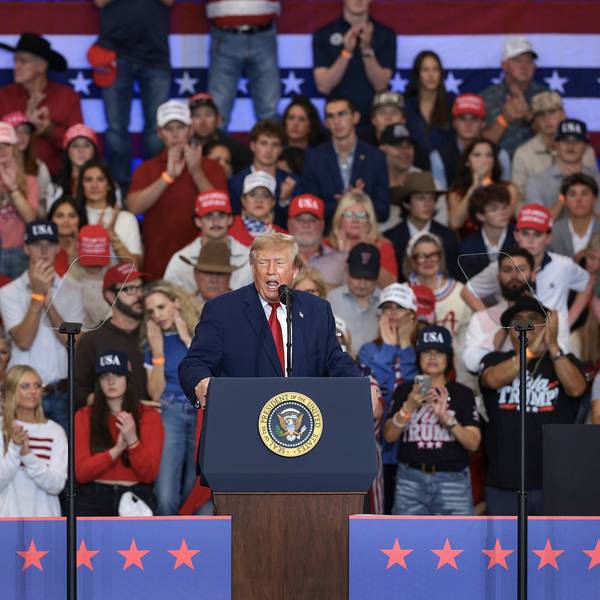
Trump himself has floated a possible attack on Iran while campaigning for Republicans in recent weeks. At a rally in Lubbock, Texas earlier this week, the president told a crowd of supporters: “You’ll see Iran in a couple of weeks, if you don’t mind.”
“There is a way forward, but it can only materialize once the US administration genuinely accepts that it has no military options.”
Meanwhile, US Vice President JD Vance—widely viewed as the leading choice to succeed Trump at the top of the Republican ticket in 2028—has reportedly reached out to a leading Iranian official in a bid to revive diplomatic talks.
The Journal reported on Wednesday that Vance, with Trump’s approval, “sent a letter to Mohsen Rezaei, the secretary of Iran’s top security body, the Supreme National Security Council, and previously Iran’s longest-serving commander of the Islamic Revolutionary Guard Corps.”
“Vance is testing whether Tehran and Washington could find enough common ground to persuade Trump not to give a final order for a short, intense attack on Iran in the coming weeks,” the Journal reported. (Trump, who has repeatedly threatened to “annihilate” Iran, publicly denied that he directed Vance to try to revive peace talks with Iran.)
Costello of NIAC said in a statement Thursday that “while the desire to pursue an off-ramp is positive, Trump needs to walk the walk.”
“Thus far, there is little to indicate a new approach and a serious desire to end the war,” said Costello. “There is no military solution to the conflict with Iran, yet Trump still seems to think there is and that he’ll get to decide when the next round of fighting pauses. These are wrong-headed and dangerous conclusions to hold.”
On the Iranian side, Foreign Minister Abbas Araghchi wrote in a Financial Times op-ed last week that while Tehran is “firmly committed to seeking a dignified peaceful resolution to the conflict, we are also fully prepared to defend ourselves.”
“President Donald Trump entered this war on the basis of fundamentally erroneous assumptions about Iran’s fortitude. It appears that he continues to be wrongly told that our armed forces are unprepared to defend the homeland, despite all evidence to the contrary,” Araghchi wrote. “To state the obvious, we have no trust whatsoever in the sincerity of the US administration’s professed desire for peace with Iran.”
“Given that the White House has shown no willingness to reach an understanding on the way forward, while also threatening more violence, there is little reason to expect progress now,” he added. “In spite of all this, as a career diplomat, I am obliged to do my utmost to give diplomacy a chance, even when hope of success is scant… There is a way forward, but it can only materialize once the US administration genuinely accepts that it has no military options.”
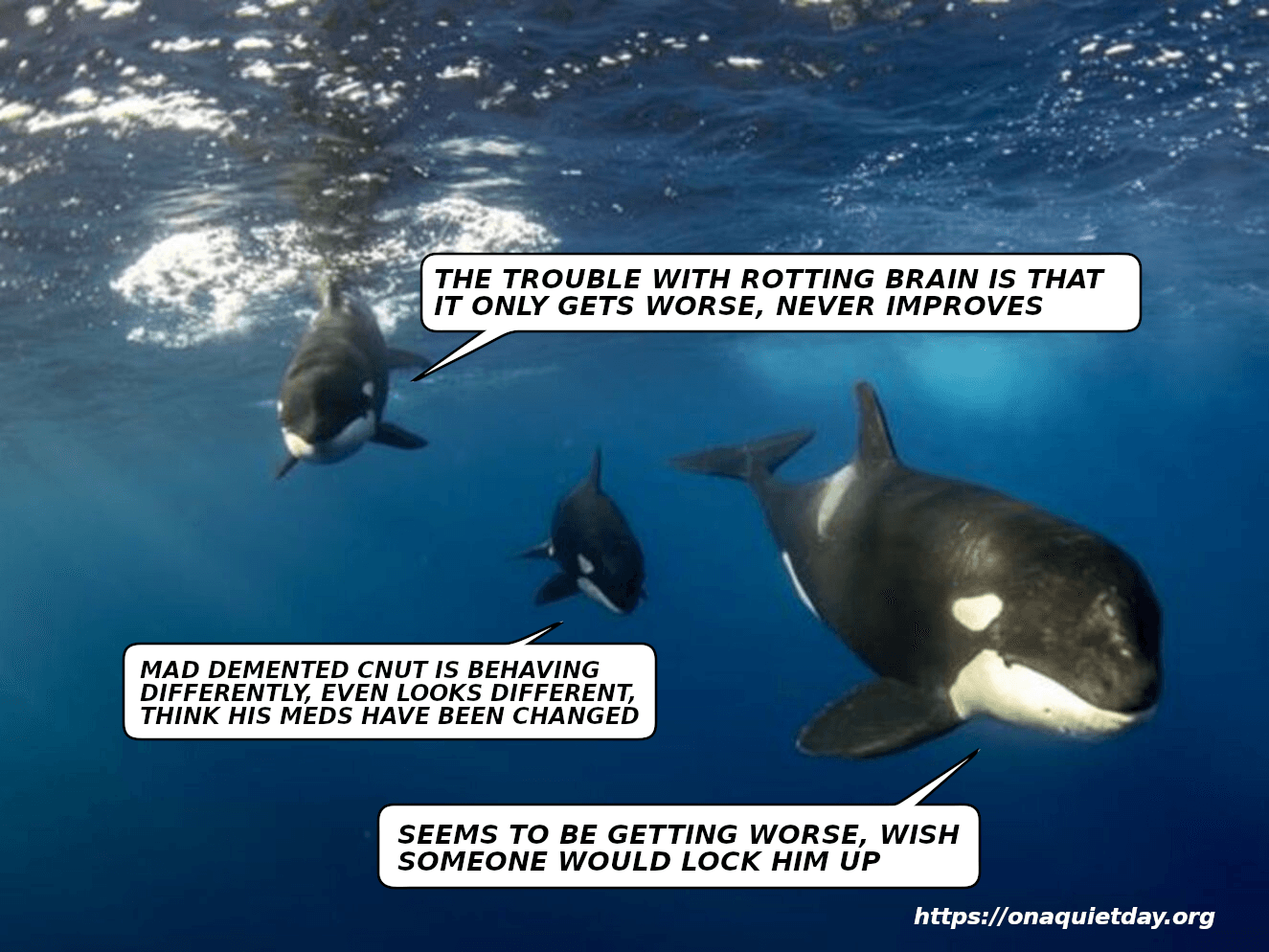
Donald Trump sings and dances, says that it’s fun to kill everyone … unless he gets distracted or falls asleep.Orcas discuss rotting brain, front Orca says he wishes someone would Lock Him Up, small Orca says he thinks that his meds have been changed.
An actor impersonating U.S. President Donald Trump stands behind symbolic prison bars set up inside an interactive billboard frame at Tajrish Square in Tehran, Iran. [Fatemeh Bahrami – Anadolu Agency]
There appears to be little prospect of lasting peace between Iran and the United States while Donald Trump remains in the White House. This is a view that an increasing number of serious actors across the region now seem to share. Eight months into Iran war, Washington has neither broken Tehran’s resolve nor found a clear path out. The president’s own remarks point to a narrowing set of options. Trump told TIME he does not believe peace with Iran is ever possible, a striking admission from the leader still expected to negotiate one.
Tehran, for its part, has set conditions it knows this administration cannot meet, insisting that sanctions and threats be lifted before talks resume and that not a single gram of enriched uranium leaves the country. Neither side is bargaining towards a settlement. Each is waiting for the political ground beneath the other to shift.
Trump’s problem is that the ground is shifting under him first, as the 3rd November midterms approach with his approval rating near 39 per cent and crude trading above 110 dollars a barrel. The House has voted three times to restrict his war powers in Iran, with Republican candidates in competitive seats now campaigning openly on ending the war to lower petrol prices. Facing a likely defeat, the president has promised no strikes before polling day while Central Command has reportedly been told to prepare for resuming major combat operations. Therefore, it is quite likely that Trump may order striking Iran even before the mid-term day.
Analysts have noted that a Republican defeat could strengthen this incentive, as a president with little left to lose at the ballot box faces fewer costs for escalation. Yet such strikes would do little damage control, since a Politico survey found 46 per cent of voters said ending the war before the election would not change their vote at all. Iran has meanwhile fortified its nuclear sites and warned that regional energy infrastructure would be targeted, so any parting blow risks sending oil prices even higher.
The president’s own inner circle appears to have read the same numbers and is quietly positioning itself for the aftermath. Vice President JD Vance, reportedly sceptical from the outset, has kept his distance and this week declined to endorse Benjamin Netanyahu ahead of Israel’s election.
Secretary of State Marco Rubio, his chief rival for 2028, spent the same week in India on a trip devoted largely to trade rather than Iran.
Defence Secretary Pete Hegseth, by contrast, made an unannounced visit to Israel a day after Trump endorsed Netanyahu, keeping himself firmly in the frame. Commentators suggested as early as April that Hegseth was being set up as the fall guy should the war end badly. His visibility since has only reinforced that impression.
The Gulf states have reached the same conclusion. They are hedging accordingly against an American policy they no longer trust to last. The UAE joined the campaign against Iran in February, yet they opened a backchannel with Iranians lately after the realization that it is better to deal directly instead of relying on the US. Moreover, the UAE, by the virtue of being in support of the Saudis vis-à-vis Yemen, is trying to find a diplomatic way to lower tensions. It signals a striking reversal in barely eight months. Having absorbed thousands of Iranian missiles and drones, Abu Dhabi appears to be securing its own understandings before Washington’s next round begins.
Yemen shows how the burden is being shifted, since the United States has twice rebuffed Saudi requests for airstrikes against the Houthis and says it will not take kinetic action for now. Instead, the UAE has reportedly agreed to resume funding anti-Houthi forces in southern Yemen. This is an arrangement that lets Washington stay out while a partner carries the fight on its behalf.
Iran’s strategy rests on patience and its leaders appear confident they can absorb another year or so of American pressure before the political weather in Washington changes. Its posture towards Saudi Arabia fits this reading more closely than the images of burning airports suggest. Houthi strikes have killed at least 19 people at Saudi airports, and the Wall Street Journal has reported Revolutionary Guard officers helping to direct them. Yet within days of the deadliest attack, Foreign Minister Abbas Araghchi called Riyadh to offer mediation with the Houthis and insist the crisis had no military solution.
The aim is not to destroy Saudi infrastructure but to convince the kingdom that American protection is unreliable and that any opening to Israel will carry a heavy price. Riyadh has begun to absorb that lesson, but the pressure is unlikely to ease while Trump remains in office and Tehran sees no reason to settle.
The real question is how Israel reacts to all this, both during the remainder of Netanyahu’s tenure and after it. Trump has endorsed Netanyahu so he can help “finish the job” against Iran, and Israel has reportedly asked that any renewed strikes wait until after its 27 October vote. Polls give Netanyahu’s coalition fewer than 50 of the 61 seats needed to govern, raising the prospect of a weakened caretaker with every reason to keep the Iran file burning.
A successor led by Gadi Eisenkot would hardly soften Israel’s line on the Iranian nuclear programme, but it might be less willing to tie national strategy to American president’s fortunes. Should Israel strike alone after an American exit, Gulf hedging would only accelerate and normalisation with Riyadh would recede further from view.
Tehran and the Gulf have made their calculations. Both now wait for a different figure in the Oval Office.
The views expressed in this article belong to the author and do not necessarily reflect the editorial policy of Middle East Monitor.
Donald Trump sings and dances, says that it’s fun to kill everyone … unless he gets distracted or falls asleep.
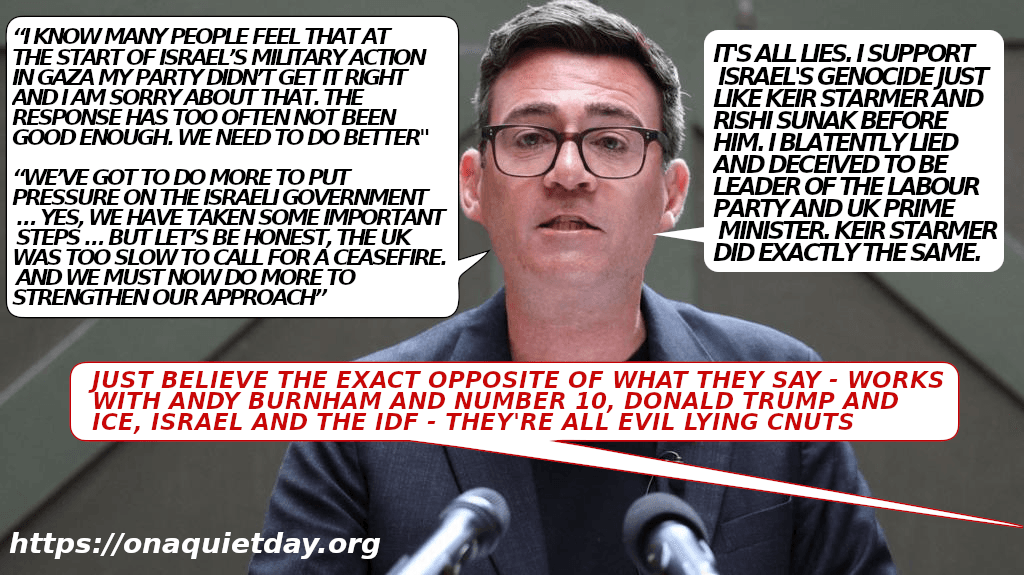
Keir Starmer objects to criticism of the IDF. He asks how could anyone object to them starving people to death, forced marches like the Nazis did, bombing Gaza’s hospitals and universities, mass-murdering journalists, healthworkers and starving people queuing for food, killing and raping prisoners and murdering children. He calls for people to stop obstructing his genocide for Israel. New Labour UK Prime Minister Andy Burnham continues Labour party policy of active support and complicity in Israel’s genocide.UK Prime Minister Andy Burnham admits to blatently lying and engaging in deception to become leader of the UK Labour Party and Prime Minister.Ed Miliband says that he and the Labour Party are full of shit criminalising people holding signs as terrorists despite anything he says.
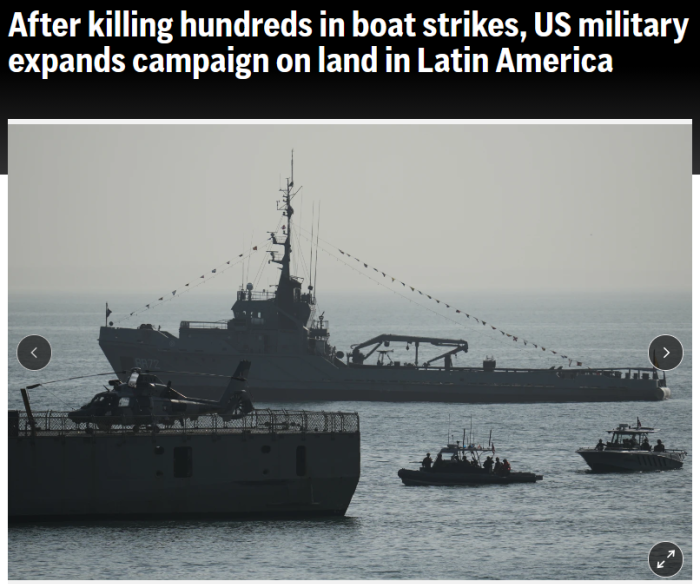
Addressing the UN General Assembly in September, Donald Trump gloated about his strategy toward “narcoterrorist” cartels, the menace du jour in the United States’ self-declared backyard. Pulling numbers out of his ass per usual, Trump claimed that the manic bombing campaign against alleged seafaring narcoterrorists (read: fishermen) in Central and South America has cut maritime drug trafficking by 97%, and called drug cartels the “ISIS of the Western Hemisphere.”
While it was by no means the president’s intention, he accidentally hit the nail on the head with the ISIS comparison. Both the Islamic State and Latin American drug trafficking outfits are a direct result of US policy—as well as a convenient excuse for the Americans to continue terrorizing people under the pretext of combating the very phenomena they caused in the first place. Just as ISIS owes its origins to the US invasion of Iraq, drug traffickers wouldn’t be in big business if not for—what else?—the US’s so-called “war on drugs” that renders the international movement of illicit substances so lucrative.
‘Same effect on land’
AP (8/17/26) describes the US military’s role in Latin America as “supplying allies with weapons, intelligence and training to fight drug trafficking”—while acknowledging “a fraught legacy of support for military coups and dictatorships.”
This year, the Trump administration has significantly ramped up its drug war beyond just randomly blowing people up in the ocean. In August, the Associated Press (8/17/26) reported on the government’s plans to expand operations to terra firma, quoting Secretary of War Pete Hegseth:
It will be “like you saw with the strikes on the drug boats,” Hegseth said during a military drill in the jungle in Panama. “Same effect on land.”
But since there are generally more people on land than in the middle of the sea, there will no doubt be far greater opportunities for extrajudicial execution in this new terrestrial phase of operations.
The escalated campaign takes place against the backdrop of the US-led “Shield of the Americas,” a hemispheric “anti-cartel coalition” inaugurated in March that now boasts the participation of 19 countries. Ecuador has been among the most gung-ho about joining forces with the US to launch “anti-cartel” raids, with such impressive feats to show for it as the joint bombing of a drug trafficking compound that turned out to be a dairy farm.
‘Long and bloody history’
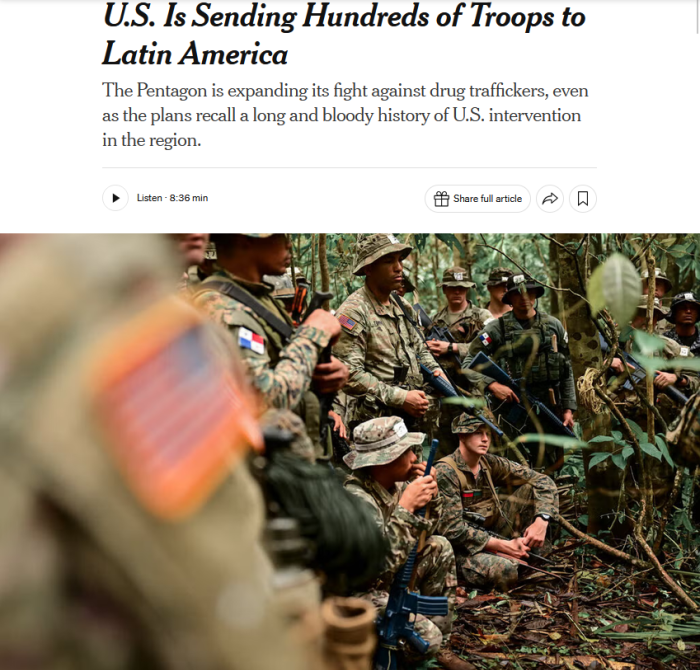
The New York Times (10/14/26) describes the US sending hundreds of combat troops to Latin America as “expanding its fight against drug traffickers.”
This month, the New York Times (10/14/26) was the first to report that the US had begun deploying a shit ton of troops to Latin America, and that a “new jungle training facility” in Panama was receiving “the first elements of a 600-soldier battalion from the 10th Mountain Division at Fort Drum, NY.” The Times also mentioned the Defense Department’s “recent movement of several MQ-9 Reaper drones from Africa to Colombia and Ecuador.”
The article’s subhead—“The Pentagon is expanding its fight against drug traffickers, even as the plans recall a long and bloody history of US intervention in the region”—leaves us with the expectation that we might be hearing something about, I dunno, the long and bloody history of US intervention in the region. And yet the only reference to that history in the body of the article occurs in a single sentence that is a modified replica of the subhead: “But the prospect of US operations on Latin American soil has raised concerns about sovereignty, and has recalled a long and bloody history of US intervention in the region.”
Surely an example or three of “intervention” wouldn’t have taken up too much space on the pages of the Times; the authors could have mentioned that time in 1989 the US military bombed to smithereens an impoverished neighborhood in Panama City, killing as many as several thousand civilians, in a bid to capture Panamanian leader Manuel Noriega. A longtime US buddy who had been on the CIA payroll for decades despite common knowledge of his involvement in the drug trade, Noriega had outlived his usefulness, and his drug dealings were suddenly so wrong and horrible as to necessitate the psychotic bombardment of poor Panamanians living in wooden shacks.
Or the Times could have delved into disproportionate US financial and moral support for the homicidal regime of Colombia’s far-right President Alvaro Uribe during the first decade of this century. Uribe himself appeared on a 1991 US Defense Intelligence Agency list of the “more important Colombian narco-traffickers contracted by the Colombian narcotic cartels”—but that was no reason he couldn’t be promoted to the role of America’s Super Drug War Ally and vanquisher of narcoterrorists.
As president, Uribe oversaw what came to be known as the “false positives” scandal, in which potentially more than 10,000 Colombian civilians were slaughtered by members of the Colombian army, who disguised the corpses as left-wing guerrillas in order to accrue promotions and vacation time. The Uribe administration then used these ostensible battlefield achievements to petition the US for yet more aid.
Last but not least, the Times could have brought up the Contra war on Nicaragua in the 1980s, when CIA-backed mercenaries unleashed terror on that nation while overseeing a profitable side hustle trafficking drugs to the US. The ensuing crack cocaine epidemic devastated Black communities across the country, but, hey, it was all in the name of saving the world from Communism.
Indeed, not only would such details give the Times’ readers an idea of the extent to which the US has traditionally been up to no good in Latin America (and at home), they would also soundly obliterate the official “drug war” narrative and expose it for what it is: a façade for imperial domination that really has nothing to do with stopping the flow of drugs at all.
‘Fight against drug traffickers’
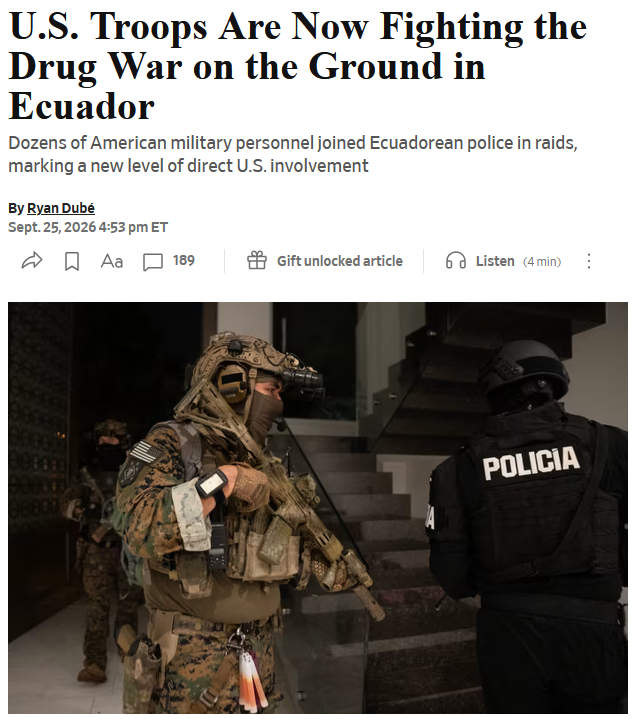
The Wall Street Journal headline (9/25/26) called the US military carrying out assassinations in Ecuador “Fighting the Drug War on the Ground.”
But for the New York Times and other corporate media, speaking truth to power is not part of the job description. While they may critique the methods or effectiveness of the “war on drugs,” these media stop far short of questioning its entire premise, and time and again the US government is allowed to set the terms of the discourse. Thus we have the Times droning on about the “fight against drug traffickers,” the “war against drugs,” the “escalating US-led military campaign against drug traffickers,” and the move “to target cartels.”
In a typical example from September, the Wall Street Journal (9/25/26) announced that “US Troops Are Now Fighting the Drug War on the Ground in Ecuador.” This month, the Washington Post (10/16/26) reported on shifting tactics in US “anti-drug strikes at sea.” The Hill’s Filip Timotija (10/7/26) observed that “the Pentagon is expanding the US military’s multifront war against drug cartels in South America.” And so on.
For its part, Reuters (9/22/26) has described Trump’s escalation as an “expanding campaign against drug cartels,” even while diplomatically cautioning that “rights groups” have said the US boat strikes “amount to extrajudicial killings.” This sort of diplomatic maneuver is another hallmark of a corporate media that can never come right out and say that spontaneously pulverizing people on fishing vessels actually counts as extrajudicial killing, whether you’re a “rights group” or not.
Mechanism for control
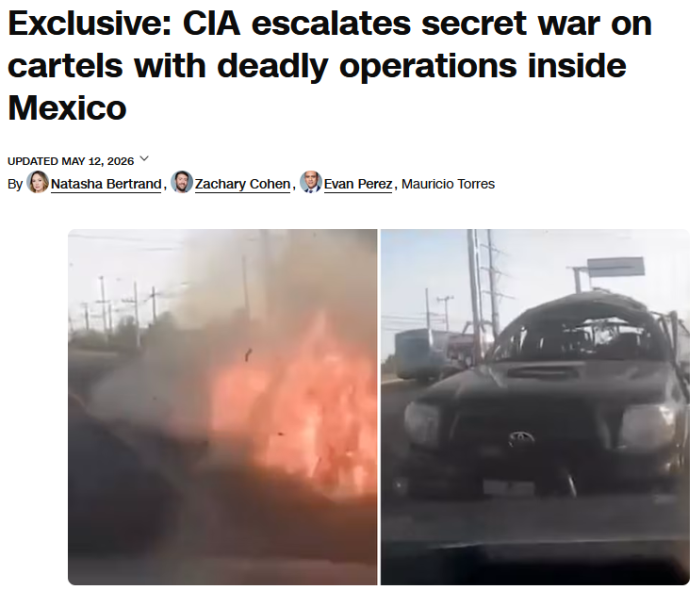
CNN (5/12/26) reported on an alleged CIA assassination in Mexico as being part of an effort “to dismantle the entrenched cartel networks.”
In May, CNN (5/12/26) published an exclusive report titled: “CIA Escalates Secret War on Cartels With Deadly Operations Inside Mexico.” This is the same CIA, of course, that has been up to its ears in drug trafficking since the Korean war—including, as it so happens, in Mexico. (For a rundown on CIA narco-exploits over the decades, see the 1993 article “The CIA Drug Connection Is as Old as the Agency,” which somehow made it onto the New York Times website. It begins with a “recent news item: The Justice Department is investigating allegations that officers of a special Venezuelan anti-drug unit funded by the CIA smuggled more than 2,000 pounds of cocaine into the United States with the knowledge of CIA officials.”)
The CNN piece details the targeted assassination of alleged Sinaloa Cartel operative Francisco Beltrán, whose car was blown up in March on a highway outside Mexico City. According to CNN:
The Beltrán operation was part of an expanded, and previously unreported, CIA campaign inside Mexico—spearheaded by the agency’s elite and secretive Ground Branch—to dismantle the entrenched cartel networks.
On the surface, at least, CNN is thus being insubordinate by publishing information that the US government does not want people to know; as the article specifies, the news outlet even gets dramatically accused by the CIA spokesperson of “false and salacious reporting that serves as nothing more than a PR campaign for the cartels and puts American lives at risk.”
And yet the apparent defiance of the government only goes so far. At the end of the day, the CNN exposé simply reinforces the narrative that the US is in fact fighting against drug cartels—and not using the “drug war” apparatus as a politico-economic weapon and mechanism for control.
No reference is made to the history of US government agencies collaborating with Mexican drug trafficking groups, including the Sinaloa Cartel itself, or to the preponderant role of US weapons manufacturers in arming criminal organizations in Mexico. (Recall that brilliant experiment during the Barack Obama presidency when the US Bureau of Alcohol, Tobacco, Firearms and Explosives facilitated the illegal purchase of thousands and thousands of guns on the off chance the trail would lead them to Mexican cartel leaders.)
‘Politics of extermination’
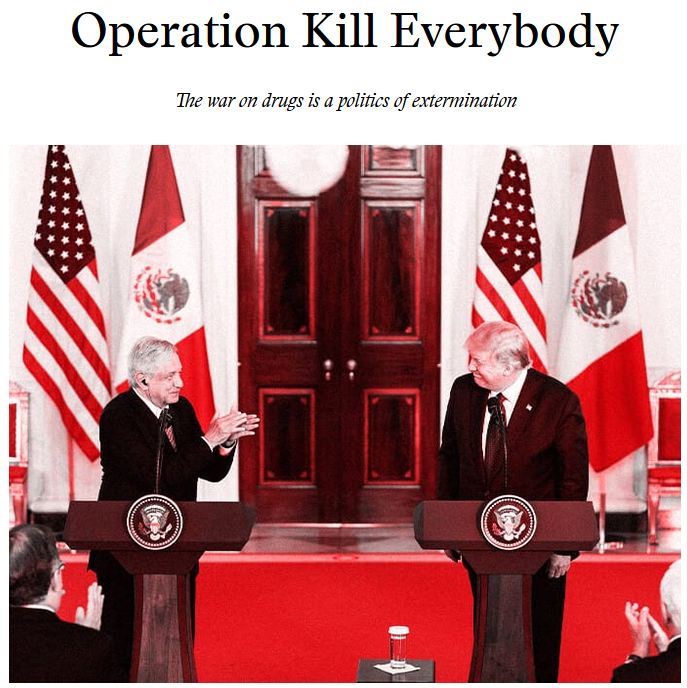
Oswaldo Zavala (Baffler, 6/18/26): “Government-sanctioned extrajudicial murders have been part of US military operations across the planet for several decades.”
Many corporate media interventions do take care to note that the current US approach in Latin America has not had any apparent effect on the drug trade; the New York Times (10/14/26), for instance, notes that “experts say that killing members of trafficking groups—even top leaders—does little to stem the flow of drugs.”
But media are never compelled to entertain the idea that stemming the flow of drugs may not even be the point—not even when, after using the drug war as a pretext, Trump straight-up admits that he attacked Venezuela and kidnapped its president for oil, plain and simple.
Since President Richard Nixon launched the “war on drugs” in 1971, the US still hasn’t managed to stem the flow, but the war has provided a whole lot of opportunities for the US militarization of Latin America and alliances with an array of regional right-wing nutjobs who are only too happy to facilitate imperial intrusion and neoliberal corporate assault at the expense of their populations.
The scholar Oswaldo Zavala, author of Drug Cartels Do Not Exist, contends in a recent essay for the Baffler (6/18/26) that “the ‘war on drugs’ is an overt politics of extermination.” It’s part of a panorama in which
from the Middle East to Latin America, a transnational military use of force has consistently been deployed against impoverished people in developing countries and sold as a war against “narcos,” “terrorists,” the artificial hybrid “narco-terrorists.”
Mexico, Zavala writes, has hosted the “most devastating such campaign in Latin America”; since the launch of the US-imposed war on drugs in 2006, more than 460,000 people have been killed and more than 134,000 disappeared, “a disproportionate number [of whom] have been poor, young, brown, uneducated men living in the outskirts of major cities.”
In their book Cocaine, Death Squads and the War on Terror:US Imperialism and Class Struggle in Colombia, Oliver Villar and Drew Cottle illustrate how the US-backed drug war in Colombia has traditionally not been against drugs, but rather for the control of the drug trade, which in the 1980s became a significant “source of profit for US capital.” To this day, the overwhelming majority of profits from the ongoing drug trade remain in the US.
‘Failed to curb cocaine supply’
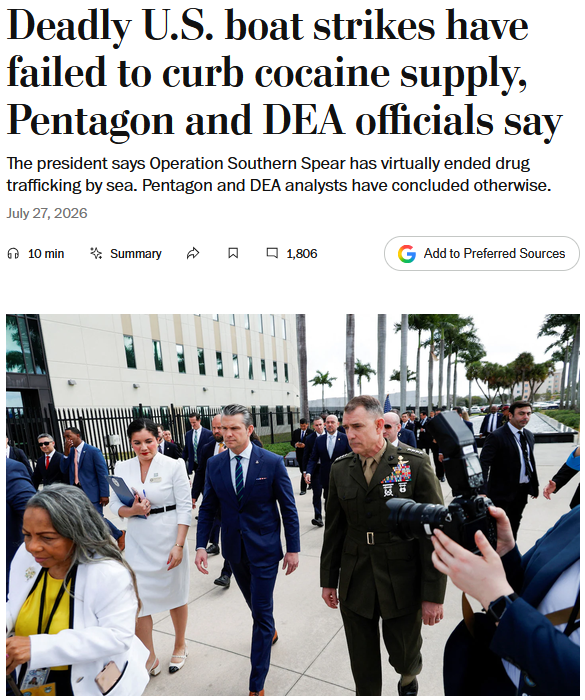
Washington Post (7/27/26): “Trump has transformed traditional US drug enforcement into a military campaign that fuses the legal and strategic approaches of the war on drugs and the war on terror.”
But corporate media continue to portray the “war on drugs” as just that, casting hints to the contrary as mere failures of drug war tactics and strategy. In an article headlined “Deadly US Boat Strikes Have Failed to Curb Cocaine Supply, Pentagon and DEA Officials Say,” the Washington Post (7/27/26) speculates that “there might, in fact, now be more cocaine circulating in the United States.” But for the Post, it’s still all ultimately part of a “decades-long war on drugs”—and no need to turn the entire concept on its head.
It should be quite clear, after 250 years of the United States of America, that the government is very often lying through its teeth. But corporate media outlets just can’t bring themselves to integrate the mass of incriminating material on the political expedience of the “drug war” into one cohesive anti-systemic analysis that would upend the government narrative.
Forty years ago, in September 1986, then-President Ronald Reagan solemnly addressed the nation about the dangers of drugs, even as he was funding the drug-running Contras: “Drugs are menacing our society. They’re threatening our values and undercutting our institutions. They’re killing our children.”
And judging from the behavior of the media, it seems that defying the government line might be equally menacing to society.
Featured Image: Secretary of Defense Pete Hegseth speaks at a forum of the Americas Counter Cartel Coalition in Panama City, August 12, 2026 (AP Photo: Matias Delacroix).
FAIR’s work is sustained by our generous contributors, who allow us to remain independent. Donate today to be a part of this important mission.
Belén Fernández is the author of The Darién Gap: A Reporter’s Journey through the Deadly Crossroads of the Americas and Inside Siglo XXI: Locked Up in Mexico’s Largest Immigration Center, among other titles. She is an opinion columnist at Al Jazeera.
Orcas discuss Donald Trump and the killer apes’ concept of democracy. Front Orca warns that Trump is crashing his country’s economy and that everything he does he does for the fantastically wealthy.
Addressing the UN General Assembly in September, Donald Trump gloated about his strategy toward “narcoterrorist” cartels, the menace du jour in the United States’ self-declared backyard. Pulling numbers out of his ass per usual, Trump claimed that the manic bombing campaign against alleged seafaring narcoterrorists (read: fishermen) in Central and South America has cut maritime drug trafficking by 97%, and called drug cartels the “ISIS of the Western Hemisphere.”
While it was by no means the president’s intention, he accidentally hit the nail on the head with the ISIS comparison. Both the Islamic State and Latin American drug trafficking outfits are a direct result of US policy—as well as a convenient excuse for the Americans to continue terrorizing people under the pretext of combating the very phenomena they caused in the first place. Just as ISIS owes its origins to the US invasion of Iraq, drug traffickers wouldn’t be in big business if not for—what else?—the US’s so-called “war on drugs” that renders the international movement of illicit substances so lucrative.
‘Same effect on land’
AP (8/17/26) describes the US military’s role in Latin America as “supplying allies with weapons, intelligence and training to fight drug trafficking”—while acknowledging “a fraught legacy of support for military coups and dictatorships.”
This year, the Trump administration has significantly ramped up its drug war beyond just randomly blowing people up in the ocean. In August, the Associated Press (8/17/26) reported on the government’s plans to expand operations to terra firma, quoting Secretary of War Pete Hegseth:
It will be “like you saw with the strikes on the drug boats,” Hegseth said during a military drill in the jungle in Panama. “Same effect on land.”
But since there are generally more people on land than in the middle of the sea, there will no doubt be far greater opportunities for extrajudicial execution in this new terrestrial phase of operations.
The escalated campaign takes place against the backdrop of the US-led “Shield of the Americas,” a hemispheric “anti-cartel coalition” inaugurated in March that now boasts the participation of 19 countries. Ecuador has been among the most gung-ho about joining forces with the US to launch “anti-cartel” raids, with such impressive feats to show for it as the joint bombing of a drug trafficking compound that turned out to be a dairy farm.
‘Long and bloody history’
The New York Times (10/14/26) describes the US sending hundreds of combat troops to Latin America as “expanding its fight against drug traffickers.”
This month, the New York Times (10/14/26) was the first to report that the US had begun deploying a shit ton of troops to Latin America, and that a “new jungle training facility” in Panama was receiving “the first elements of a 600-soldier battalion from the 10th Mountain Division at Fort Drum, NY.” The Times also mentioned the Defense Department’s “recent movement of several MQ-9 Reaper drones from Africa to Colombia and Ecuador.”
The article’s subhead—“The Pentagon is expanding its fight against drug traffickers, even as the plans recall a long and bloody history of US intervention in the region”—leaves us with the expectation that we might be hearing something about, I dunno, the long and bloody history of US intervention in the region. And yet the only reference to that history in the body of the article occurs in a single sentence that is a modified replica of the subhead: “But the prospect of US operations on Latin American soil has raised concerns about sovereignty, and has recalled a long and bloody history of US intervention in the region.”
Surely an example or three of “intervention” wouldn’t have taken up too much space on the pages of the Times; the authors could have mentioned that time in 1989 the US military bombed to smithereens an impoverished neighborhood in Panama City, killing as many as several thousand civilians, in a bid to capture Panamanian leader Manuel Noriega. A longtime US buddy who had been on the CIA payroll for decades despite common knowledge of his involvement in the drug trade, Noriega had outlived his usefulness, and his drug dealings were suddenly so wrong and horrible as to necessitate the psychotic bombardment of poor Panamanians living in wooden shacks.
Or the Times could have delved into disproportionate US financial and moral support for the homicidal regime of Colombia’s far-right President Alvaro Uribe during the first decade of this century. Uribe himself appeared on a 1991 US Defense Intelligence Agency list of the “more important Colombian narco-traffickers contracted by the Colombian narcotic cartels”—but that was no reason he couldn’t be promoted to the role of America’s Super Drug War Ally and vanquisher of narcoterrorists.
As president, Uribe oversaw what came to be known as the “false positives” scandal, in which potentially more than 10,000 Colombian civilians were slaughtered by members of the Colombian army, who disguised the corpses as left-wing guerrillas in order to accrue promotions and vacation time. The Uribe administration then used these ostensible battlefield achievements to petition the US for yet more aid.
Last but not least, the Times could have brought up the Contra war on Nicaragua in the 1980s, when CIA-backed mercenaries unleashed terror on that nation while overseeing a profitable side hustle trafficking drugs to the US. The ensuing crack cocaine epidemic devastated Black communities across the country, but, hey, it was all in the name of saving the world from Communism.
Indeed, not only would such details give the Times’ readers an idea of the extent to which the US has traditionally been up to no good in Latin America (and at home), they would also soundly obliterate the official “drug war” narrative and expose it for what it is: a façade for imperial domination that really has nothing to do with stopping the flow of drugs at all.
‘Fight against drug traffickers’
The Wall Street Journal headline (9/25/26) called the US military carrying out assassinations in Ecuador “Fighting the Drug War on the Ground.”
But for the New York Times and other corporate media, speaking truth to power is not part of the job description. While they may critique the methods or effectiveness of the “war on drugs,” these media stop far short of questioning its entire premise, and time and again the US government is allowed to set the terms of the discourse. Thus we have the Times droning on about the “fight against drug traffickers,” the “war against drugs,” the “escalating US-led military campaign against drug traffickers,” and the move “to target cartels.”
In a typical example from September, the Wall Street Journal (9/25/26) announced that “US Troops Are Now Fighting the Drug War on the Ground in Ecuador.” This month, the Washington Post (10/16/26) reported on shifting tactics in US “anti-drug strikes at sea.” The Hill’s Filip Timotija (10/7/26) observed that “the Pentagon is expanding the US military’s multifront war against drug cartels in South America.” And so on.
For its part, Reuters (9/22/26) has described Trump’s escalation as an “expanding campaign against drug cartels,” even while diplomatically cautioning that “rights groups” have said the US boat strikes “amount to extrajudicial killings.” This sort of diplomatic maneuver is another hallmark of a corporate media that can never come right out and say that spontaneously pulverizing people on fishing vessels actually counts as extrajudicial killing, whether you’re a “rights group” or not.
Mechanism for control
CNN (5/12/26) reported on an alleged CIA assassination in Mexico as being part of an effort “to dismantle the entrenched cartel networks.”
In May, CNN (5/12/26) published an exclusive report titled: “CIA Escalates Secret War on Cartels With Deadly Operations Inside Mexico.” This is the same CIA, of course, that has been up to its ears in drug trafficking since the Korean war—including, as it so happens, in Mexico. (For a rundown on CIA narco-exploits over the decades, see the 1993 article “The CIA Drug Connection Is as Old as the Agency,” which somehow made it onto the New York Times website. It begins with a “recent news item: The Justice Department is investigating allegations that officers of a special Venezuelan anti-drug unit funded by the CIA smuggled more than 2,000 pounds of cocaine into the United States with the knowledge of CIA officials.”)
The CNN piece details the targeted assassination of alleged Sinaloa Cartel operative Francisco Beltrán, whose car was blown up in March on a highway outside Mexico City. According to CNN:
The Beltrán operation was part of an expanded, and previously unreported, CIA campaign inside Mexico—spearheaded by the agency’s elite and secretive Ground Branch—to dismantle the entrenched cartel networks.
On the surface, at least, CNN is thus being insubordinate by publishing information that the US government does not want people to know; as the article specifies, the news outlet even gets dramatically accused by the CIA spokesperson of “false and salacious reporting that serves as nothing more than a PR campaign for the cartels and puts American lives at risk.”
And yet the apparent defiance of the government only goes so far. At the end of the day, the CNN exposé simply reinforces the narrative that the US is in fact fighting against drug cartels—and not using the “drug war” apparatus as a politico-economic weapon and mechanism for control.
No reference is made to the history of US government agencies collaborating with Mexican drug trafficking groups, including the Sinaloa Cartel itself, or to the preponderant role of US weapons manufacturers in arming criminal organizations in Mexico. (Recall that brilliant experiment during the Barack Obama presidency when the US Bureau of Alcohol, Tobacco, Firearms and Explosives facilitated the illegal purchase of thousands and thousands of guns on the off chance the trail would lead them to Mexican cartel leaders.)
‘Politics of extermination’
Oswaldo Zavala (Baffler, 6/18/26): “Government-sanctioned extrajudicial murders have been part of US military operations across the planet for several decades.”
Many corporate media interventions do take care to note that the current US approach in Latin America has not had any apparent effect on the drug trade; the New York Times (10/14/26), for instance, notes that “experts say that killing members of trafficking groups—even top leaders—does little to stem the flow of drugs.”
But media are never compelled to entertain the idea that stemming the flow of drugs may not even be the point—not even when, after using the drug war as a pretext, Trump straight-up admits that he attacked Venezuela and kidnapped its president for oil, plain and simple.
Since President Richard Nixon launched the “war on drugs” in 1971, the US still hasn’t managed to stem the flow, but the war has provided a whole lot of opportunities for the US militarization of Latin America and alliances with an array of regional right-wing nutjobs who are only too happy to facilitate imperial intrusion and neoliberal corporate assault at the expense of their populations.
The scholar Oswaldo Zavala, author of Drug Cartels Do Not Exist, contends in a recent essay for the Baffler (6/18/26) that “the ‘war on drugs’ is an overt politics of extermination.” It’s part of a panorama in which
from the Middle East to Latin America, a transnational military use of force has consistently been deployed against impoverished people in developing countries and sold as a war against “narcos,” “terrorists,” the artificial hybrid “narco-terrorists.”
Mexico, Zavala writes, has hosted the “most devastating such campaign in Latin America”; since the launch of the US-imposed war on drugs in 2006, more than 460,000 people have been killed and more than 134,000 disappeared, “a disproportionate number [of whom] have been poor, young, brown, uneducated men living in the outskirts of major cities.”
In their book Cocaine, Death Squads and the War on Terror:US Imperialism and Class Struggle in Colombia, Oliver Villar and Drew Cottle illustrate how the US-backed drug war in Colombia has traditionally not been against drugs, but rather for the control of the drug trade, which in the 1980s became a significant “source of profit for US capital.” To this day, the overwhelming majority of profits from the ongoing drug trade remain in the US.
‘Failed to curb cocaine supply’
Washington Post (7/27/26): “Trump has transformed traditional US drug enforcement into a military campaign that fuses the legal and strategic approaches of the war on drugs and the war on terror.”
But corporate media continue to portray the “war on drugs” as just that, casting hints to the contrary as mere failures of drug war tactics and strategy. In an article headlined “Deadly US Boat Strikes Have Failed to Curb Cocaine Supply, Pentagon and DEA Officials Say,” the Washington Post (7/27/26) speculates that “there might, in fact, now be more cocaine circulating in the United States.” But for the Post, it’s still all ultimately part of a “decades-long war on drugs”—and no need to turn the entire concept on its head.
It should be quite clear, after 250 years of the United States of America, that the government is very often lying through its teeth. But corporate media outlets just can’t bring themselves to integrate the mass of incriminating material on the political expedience of the “drug war” into one cohesive anti-systemic analysis that would upend the government narrative.
Forty years ago, in September 1986, then-President Ronald Reagan solemnly addressed the nation about the dangers of drugs, even as he was funding the drug-running Contras: “Drugs are menacing our society. They’re threatening our values and undercutting our institutions. They’re killing our children.”
And judging from the behavior of the media, it seems that defying the government line might be equally menacing to society.
Featured Image: Secretary of Defense Pete Hegseth speaks at a forum of the Americas Counter Cartel Coalition in Panama City, August 12, 2026 (AP Photo: Matias Delacroix).
FAIR’s work is sustained by our generous contributors, who allow us to remain independent. Donate today to be a part of this important mission.
This work by Middle East Monitor is licensed under a Creative Commons Attribution-NonCommercial-ShareAlike 4.0 International License.
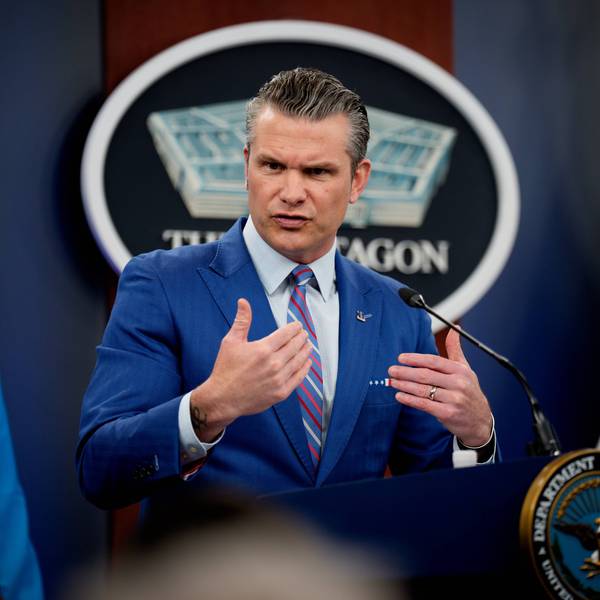
United States Secretary of War Pete Hegseth speaks during the press conference held by The United States President Donald Trump in the James S. Brady Press Briefing Room at the White House on April 6, 2026, in Washington DC, United States. [Celal Güneş – Anadolu Agency]
US Defense Secretary Pete Hegseth said Saturday that Iran faces a choice between abandoning its “nuclear ambitions” and reaching a deal or facing devastating military action, Anadolu reports.
“Iran’s going to have a choice to make real quick about whether they’re going to give those up at the table or face the kind of devastation that America can bring and will bring swiftly if necessary,” Hegseth told Reserve Officers’ Training Corps cadets and military recruits at the University of Tennessee.
He accused Tehran of building a large conventional missile arsenal to deter military action while pursuing “nuclear ambitions,” arguing that US military strength was essential to forcing adversaries to negotiate.
Hegseth also said that Iran “funds the proxies in Hezbollah, funds the proxies in the Houthis in Yemen,” adding that Washington had sought to deter attacks on US forces and shipping.
The defense chief framed the policy on Iran as part of US President Donald Trump’s wider effort to reassert American power, including confronting drug cartels and limiting the influence of Iran, China and Russia in Latin America.
Referring to Venezuela, Hegseth said the US operation there would have “generational implications,” describing the country as a strategic partner and highlighting its oil resources.
He said Washington was seeking to push its rivals out of the Western Hemisphere while strengthening its military presence and partnerships across the Americas.
Keir Starmer objects to criticism of the IDF. He asks how could anyone object to them starving people to death, forced marches like the Nazis did, bombing Gaza’s hospitals and universities, mass-murdering journalists, healthworkers and starving people queuing for food, killing and raping prisoners and murdering children. He calls for people to stop obstructing his genocide for Israel. New Labour UK Prime Minister Andy Burnham continues Labour party policy of active support and complicity in Israel’s genocide.UK Prime Minister Andy Burnham admits to blatently lying and engaging in deception to become leader of the UK Labour Party and Prime Minister.Ed Miliband says that he and the Labour Party are full of shit criminalising people holding signs as terrorists despite anything he says.