Category: Pete Hegseth

  • Don’t Pretend the ‘War on Drugs’ Has Anything to Do With Fighting Drugs

    Spread the love

    Article by Belén Fernández republished form FAIR under a Creative Commons Attribution-NonCommercial-NoDerivs 3.0 Unported License.

    Addressing the UN General Assembly in September, Donald Trump gloated about his strategy toward “narcoterrorist” cartels, the menace du jour in the United States’ self-declared backyard. Pulling numbers out of his ass per usual, Trump claimed that the manic bombing campaign against alleged seafaring narcoterrorists (read: fishermen) in Central and South America has cut maritime drug trafficking by 97%, and called drug cartels the “ISIS of the Western Hemisphere.”

    While it was by no means the president’s intention, he accidentally hit the nail on the head with the ISIS comparison. Both the Islamic State and Latin American drug trafficking outfits are a direct result of US policy—as well as a convenient excuse for the Americans to continue terrorizing people under the pretext of combating the very phenomena they caused in the first place. Just as ISIS owes its origins to the US invasion of Iraq, drug traffickers wouldn’t be in big business if not for—what else?—the US’s so-called “war on drugs” that renders the international movement of illicit substances so lucrative.

    ‘Same effect on land’
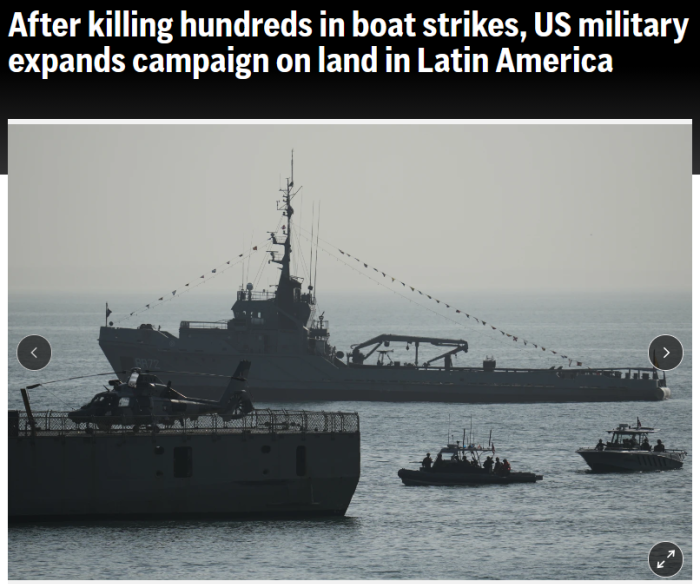
    AP: After killing hundreds in boat strikes, US military expands campaign on land in Latin America

    AP (8/17/26) describes the US military’s role in Latin America as “supplying allies with weapons, intelligence and training to fight drug trafficking”—while acknowledging “a fraught legacy of support for military coups and dictatorships.”

    This year, the Trump administration has significantly ramped up its drug war beyond just randomly blowing people up in the ocean. In August, the Associated Press (8/17/26) reported on the government’s plans to expand operations to terra firma, quoting Secretary of War Pete Hegseth:

    It will be “like you saw with the strikes on the drug boats,” Hegseth said during a military drill in the jungle in Panama. “Same effect on land.”

    But since there are generally more people on land than in the middle of the sea, there will no doubt be far greater opportunities for extrajudicial execution in this new terrestrial phase of operations.

    The escalated campaign takes place against the backdrop of the US-led “Shield of the Americas,” a hemispheric “anti-cartel coalition” inaugurated in March that now boasts the participation of 19 countries. Ecuador has been among the most gung-ho about joining forces with the US to launch “anti-cartel” raids, with such impressive feats to show for it as the joint bombing of a drug trafficking compound that turned out to be a dairy farm.

    ‘Long and bloody history’
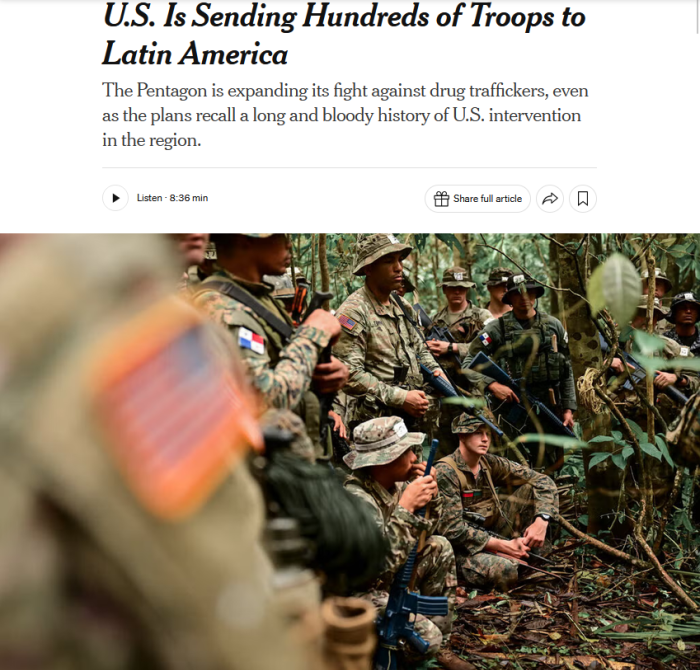
    NYT: U.S. Is Sending Hundreds of Troops to Latin America

    The New York Times (10/14/26) describes the US sending hundreds of combat troops to Latin America as “expanding its fight against drug traffickers.”

    This month, the New York Times (10/14/26) was the first to report that the US had begun deploying a shit ton of troops to Latin America, and that a “new jungle training facility” in Panama was receiving “the first elements of a 600-soldier battalion from the 10th Mountain Division at Fort Drum, NY.” The Times also mentioned the Defense Department’s “recent movement of several MQ-9 Reaper drones from Africa to Colombia and Ecuador.”

    The article’s subhead—“The Pentagon is expanding its fight against drug traffickers, even as the plans recall a long and bloody history of US intervention in the region”—leaves us with the expectation that we might be hearing something about, I dunno, the long and bloody history of US intervention in the region. And yet the only reference to that history in the body of the article occurs in a single sentence that is a modified replica of the subhead: “But the prospect of US operations on Latin American soil has raised concerns about sovereignty, and has recalled a long and bloody history of US intervention in the region.”

    Surely an example or three of “intervention” wouldn’t have taken up too much space on the pages of the Times; the authors could have mentioned that time in 1989 the US military bombed to smithereens an impoverished neighborhood in Panama City, killing as many as several thousand civilians, in a bid to capture Panamanian leader Manuel Noriega. A longtime US buddy who had been on the CIA payroll for decades despite common knowledge of his involvement in the drug trade, Noriega had outlived his usefulness, and his drug dealings were suddenly so wrong and horrible as to necessitate the psychotic bombardment of poor Panamanians living in wooden shacks.

    Or the Times could have delved into disproportionate US financial and moral support for the homicidal regime of Colombia’s far-right President Alvaro Uribe during the first decade of this century. Uribe himself appeared on a 1991 US Defense Intelligence Agency list of the “more important Colombian narco-traffickers contracted by the Colombian narcotic cartels”—but that was no reason he couldn’t be promoted to the role of America’s Super Drug War Ally and vanquisher of narcoterrorists.

    As president, Uribe oversaw what came to be known as the “false positives” scandal, in which potentially more than 10,000 Colombian civilians were slaughtered by members of the Colombian army, who disguised the corpses as left-wing guerrillas in order to accrue promotions and vacation time. The Uribe administration then used these ostensible battlefield achievements to petition the US for yet more aid.

    Last but not least, the Times could have brought up the Contra war on Nicaragua in the 1980s, when CIA-backed mercenaries unleashed terror on that nation while overseeing a profitable side hustle trafficking drugs to the US. The ensuing crack cocaine epidemic devastated Black communities across the country, but, hey, it was all in the name of saving the world from Communism.

    Indeed, not only would such details give the Times’ readers an idea of the extent to which the US has traditionally been up to no good in Latin America (and at home), they would also soundly obliterate the official “drug war” narrative and expose it for what it is: a façade for imperial domination that really has nothing to do with stopping the flow of drugs at all.

    ‘Fight against drug traffickers’
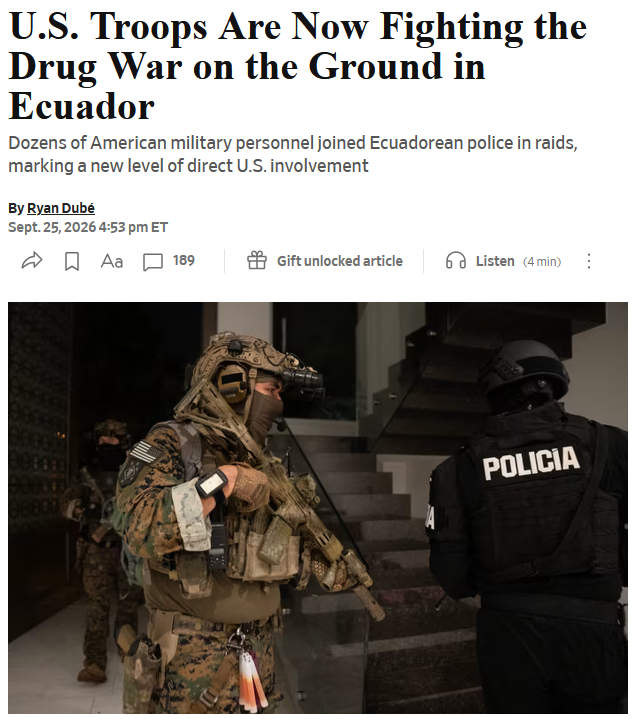
    Wall Street Journal: U.S. Troops Are Now Fighting the Drug War on the Ground in Ecuador

    The Wall Street Journal headline (9/25/26) called the US military carrying out assassinations in Ecuador “Fighting the Drug War on the Ground.”

    But for the New York Times and other corporate media, speaking truth to power is not part of the job description. While they may critique the methods or effectiveness of the “war on drugs,” these media stop far short of questioning its entire premise, and time and again the US government is allowed to set the terms of the discourse. Thus we have the Times droning on about the “fight against drug traffickers,” the “war against drugs,” the “escalating US-led military campaign against drug traffickers,” and the move “to target cartels.”

    In a typical example from September, the Wall Street Journal (9/25/26) announced that “US Troops Are Now Fighting the Drug War on the Ground in Ecuador.” This month, the Washington Post (10/16/26) reported on shifting tactics in US “anti-drug strikes at sea.” The Hill’s Filip Timotija (10/7/26) observed that “the Pentagon is expanding the US military’s multifront war against drug cartels in South America.” And so on.

    For its part, Reuters (9/22/26) has described Trump’s escalation as an “expanding campaign against drug cartels,” even while diplomatically cautioning that “rights groups” have said the US boat strikes “amount to extrajudicial killings.” This sort of diplomatic maneuver is another hallmark of a corporate media that can never come right out and say that spontaneously pulverizing people on fishing vessels actually counts as extrajudicial killing, whether you’re a “rights group” or not.

    Mechanism for control
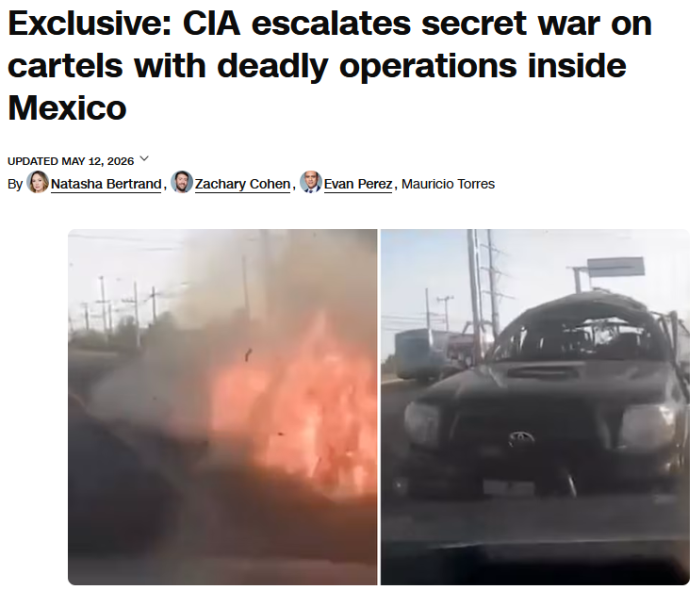
    CNN: CIA escalates secret war on cartels with deadly operations inside Mexico

    CNN (5/12/26) reported on an alleged CIA assassination in Mexico as being part of an effort “to dismantle the entrenched cartel networks.” 

    In May, CNN (5/12/26) published an exclusive report titled: “CIA Escalates Secret War on Cartels With Deadly Operations Inside Mexico.” This is the same CIA, of course, that has been up to its ears in drug trafficking since the Korean war—including, as it so happens, in Mexico. (For a rundown on CIA narco-exploits over the decades, see the 1993 article “The CIA Drug Connection Is as Old as the Agency,” which somehow made it onto the New York Times website. It begins with a “recent news item: The Justice Department is investigating allegations that officers of a special Venezuelan anti-drug unit funded by the CIA smuggled more than 2,000 pounds of cocaine into the United States with the knowledge of CIA officials.”)

    The CNN piece details the targeted assassination of alleged Sinaloa Cartel operative Francisco Beltrán, whose car was blown up in March on a highway outside Mexico City. According to CNN:

    The Beltrán operation was part of an expanded, and previously unreported, CIA campaign inside Mexico—spearheaded by the agency’s elite and secretive Ground Branch—to dismantle the entrenched cartel networks.

    On the surface, at least, CNN is thus being insubordinate by publishing information that the US government does not want people to know; as the article specifies, the news outlet even gets dramatically accused by the CIA spokesperson of “false and salacious reporting that serves as nothing more than a PR campaign for the cartels and puts American lives at risk.”

    And yet the apparent defiance of the government only goes so far. At the end of the day, the CNN exposé simply reinforces the narrative that the US is in fact fighting against drug cartels—and not using the “drug war” apparatus as a politico-economic weapon and mechanism for control.

    No reference is made to the history of US government agencies collaborating with Mexican drug trafficking groups, including the Sinaloa Cartel itself, or to the preponderant role of US weapons manufacturers in arming criminal organizations in Mexico. (Recall that brilliant experiment during the Barack Obama presidency when the US Bureau of Alcohol, Tobacco, Firearms and Explosives facilitated the illegal purchase of thousands and thousands of guns on the off chance the trail would lead them to Mexican cartel leaders.)

    ‘Politics of extermination’
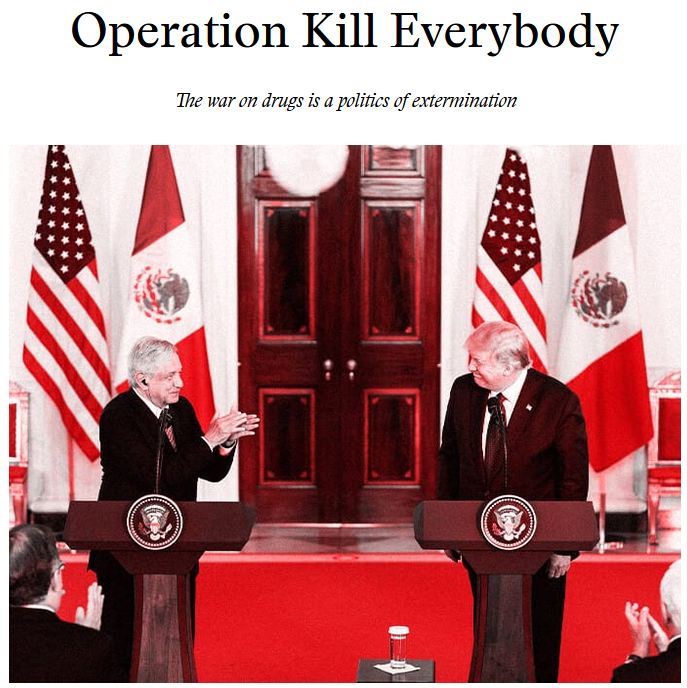
    Baffler: Operation Kill Everybody

    Oswaldo Zavala (Baffler, 6/18/26): “Government-sanctioned extrajudicial murders have been part of US military operations across the planet for several decades.”

    Many corporate media interventions do take care to note that the current US approach in Latin America has not had any apparent effect on the drug trade; the New York Times (10/14/26), for instance, notes that “experts say that killing members of trafficking groups—even top leaders—does little to stem the flow of drugs.”

    But media are never compelled to entertain the idea that stemming the flow of drugs may not even be the point—not even when, after using the drug war as a pretext, Trump straight-up admits that he attacked Venezuela and kidnapped its president for oil, plain and simple.

    Since President Richard Nixon launched the “war on drugs” in 1971, the US still hasn’t managed to stem the flow, but the war has provided a whole lot of opportunities for the US militarization of Latin America and alliances with an array of regional right-wing nutjobs who are only too happy to facilitate imperial intrusion and neoliberal corporate assault at the expense of their populations.

    The scholar Oswaldo Zavala, author of Drug Cartels Do Not Exist, contends in a recent essay for the Baffler (6/18/26) that “the ‘war on drugs’ is an overt politics of extermination.” It’s part of a panorama in which

    from the Middle East to Latin America, a transnational military use of force has consistently been deployed against impoverished people in developing countries and sold as a war against “narcos,” “terrorists,” the artificial hybrid “narco-terrorists.”

    Mexico, Zavala writes, has hosted the “most devastating such campaign in Latin America”; since the launch of the US-imposed war on drugs in 2006, more than 460,000 people have been killed and more than 134,000 disappeared, “a disproportionate number [of whom] have been poor, young, brown, uneducated men living in the outskirts of major cities.”

    In their book Cocaine, Death Squads and the War on Terror: US Imperialism and Class Struggle in Colombia, Oliver Villar and Drew Cottle illustrate how the US-backed drug war in Colombia has traditionally not been against drugs, but rather for the control of the drug trade, which in the 1980s became a significant “source of profit for US capital.” To this day, the overwhelming majority of profits from the ongoing drug trade remain in the US.

    ‘Failed to curb cocaine supply’
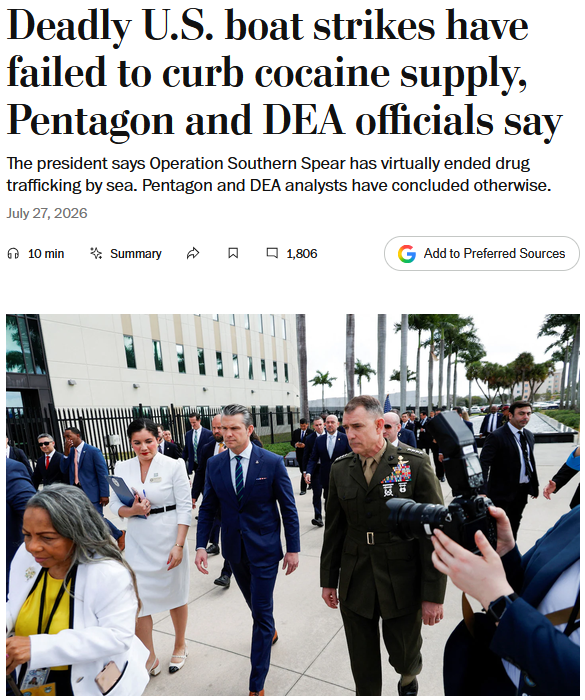
    WaPo: Deadly U.S. boat strikes have failed to curb cocaine supply, Pentagon and DEA officials say

    Washington Post (7/27/26): “Trump has transformed traditional US drug enforcement into a military campaign that fuses the legal and strategic approaches of the war on drugs and the war on terror.”

    But corporate media continue to portray the “war on drugs” as just that, casting hints to the contrary as mere failures of drug war tactics and strategy. In an article headlined “Deadly US Boat Strikes Have Failed to Curb Cocaine Supply, Pentagon and DEA Officials Say,” the Washington Post (7/27/26) speculates that “there might, in fact, now be more cocaine circulating in the United States.” But for the Post, it’s still all ultimately part of a “decades-long war on drugs”—and no need to turn the entire concept on its head.

    It should be quite clear, after 250 years of the United States of America, that the government is very often lying through its teeth. But corporate media outlets just can’t bring themselves to integrate the mass of incriminating material on the political expedience of the “drug war” into one cohesive anti-systemic analysis that would upend the government narrative.

    Forty years ago, in September 1986, then-President Ronald Reagan solemnly addressed the nation about the dangers of drugs, even as he was funding the drug-running Contras: “Drugs are menacing our society. They’re threatening our values and undercutting our institutions. They’re killing our children.”

    And judging from the behavior of the media, it seems that defying the government line might be equally menacing to society.


    Featured Image: Secretary of Defense Pete Hegseth speaks at a forum of the Americas Counter Cartel Coalition in Panama City, August 12, 2026 (AP Photo: Matias Delacroix).

    FAIR’s work is sustained by our generous contributors, who allow us to remain independent. Donate today to be a part of this important mission.

    Belén Fernández

    Belén Fernández is the author of The Darién Gap: A Reporter’s Journey through the Deadly Crossroads of the Americas and Inside Siglo XXI: Locked Up in Mexico’s Largest Immigration Center, among other titles. She is an opinion columnist at Al Jazeera.

    Article by Belén Fernández republished form FAIR under a Creative Commons Attribution-NonCommercial-NoDerivs 3.0 Unported License.

    Orcas discuss Donald Trump and the killer apes' concept of democracy. Front Orca warns that Trump is crashing his country's economy and that everything he does he does for the fantastically wealthy.
    Orcas discuss Donald Trump and the killer apes’ concept of democracy. Front Orca warns that Trump is crashing his country’s economy and that everything he does he does for the fantastically wealthy.

  • Don’t Pretend the ‘War on Drugs’ Has Anything to Do With Fighting Drugs

    Spread the love

    Article by Belén Fernández republished from FAIR under a Creative Commons Attribution-NonCommercial-NoDerivs 3.0 Unported License.

    Addressing the UN General Assembly in September, Donald Trump gloated about his strategy toward “narcoterrorist” cartels, the menace du jour in the United States’ self-declared backyard. Pulling numbers out of his ass per usual, Trump claimed that the manic bombing campaign against alleged seafaring narcoterrorists (read: fishermen) in Central and South America has cut maritime drug trafficking by 97%, and called drug cartels the “ISIS of the Western Hemisphere.”

    While it was by no means the president’s intention, he accidentally hit the nail on the head with the ISIS comparison. Both the Islamic State and Latin American drug trafficking outfits are a direct result of US policy—as well as a convenient excuse for the Americans to continue terrorizing people under the pretext of combating the very phenomena they caused in the first place. Just as ISIS owes its origins to the US invasion of Iraq, drug traffickers wouldn’t be in big business if not for—what else?—the US’s so-called “war on drugs” that renders the international movement of illicit substances so lucrative.

    ‘Same effect on land’

    AP: After killing hundreds in boat strikes, US military expands campaign on land in Latin America

    AP (8/17/26) describes the US military’s role in Latin America as “supplying allies with weapons, intelligence and training to fight drug trafficking”—while acknowledging “a fraught legacy of support for military coups and dictatorships.”

    This year, the Trump administration has significantly ramped up its drug war beyond just randomly blowing people up in the ocean. In August, the Associated Press (8/17/26) reported on the government’s plans to expand operations to terra firma, quoting Secretary of War Pete Hegseth:

    It will be “like you saw with the strikes on the drug boats,” Hegseth said during a military drill in the jungle in Panama. “Same effect on land.”

    But since there are generally more people on land than in the middle of the sea, there will no doubt be far greater opportunities for extrajudicial execution in this new terrestrial phase of operations.

    The escalated campaign takes place against the backdrop of the US-led “Shield of the Americas,” a hemispheric “anti-cartel coalition” inaugurated in March that now boasts the participation of 19 countries. Ecuador has been among the most gung-ho about joining forces with the US to launch “anti-cartel” raids, with such impressive feats to show for it as the joint bombing of a drug trafficking compound that turned out to be a dairy farm.

    ‘Long and bloody history’

    NYT: U.S. Is Sending Hundreds of Troops to Latin America

    The New York Times (10/14/26) describes the US sending hundreds of combat troops to Latin America as “expanding its fight against drug traffickers.”

    This month, the New York Times (10/14/26) was the first to report that the US had begun deploying a shit ton of troops to Latin America, and that a “new jungle training facility” in Panama was receiving “the first elements of a 600-soldier battalion from the 10th Mountain Division at Fort Drum, NY.” The Times also mentioned the Defense Department’s “recent movement of several MQ-9 Reaper drones from Africa to Colombia and Ecuador.”

    The article’s subhead—“The Pentagon is expanding its fight against drug traffickers, even as the plans recall a long and bloody history of US intervention in the region”—leaves us with the expectation that we might be hearing something about, I dunno, the long and bloody history of US intervention in the region. And yet the only reference to that history in the body of the article occurs in a single sentence that is a modified replica of the subhead: “But the prospect of US operations on Latin American soil has raised concerns about sovereignty, and has recalled a long and bloody history of US intervention in the region.”

    Surely an example or three of “intervention” wouldn’t have taken up too much space on the pages of the Times; the authors could have mentioned that time in 1989 the US military bombed to smithereens an impoverished neighborhood in Panama City, killing as many as several thousand civilians, in a bid to capture Panamanian leader Manuel Noriega. A longtime US buddy who had been on the CIA payroll for decades despite common knowledge of his involvement in the drug trade, Noriega had outlived his usefulness, and his drug dealings were suddenly so wrong and horrible as to necessitate the psychotic bombardment of poor Panamanians living in wooden shacks.

    Or the Times could have delved into disproportionate US financial and moral support for the homicidal regime of Colombia’s far-right President Alvaro Uribe during the first decade of this century. Uribe himself appeared on a 1991 US Defense Intelligence Agency list of the “more important Colombian narco-traffickers contracted by the Colombian narcotic cartels”—but that was no reason he couldn’t be promoted to the role of America’s Super Drug War Ally and vanquisher of narcoterrorists.

    As president, Uribe oversaw what came to be known as the “false positives” scandal, in which potentially more than 10,000 Colombian civilians were slaughtered by members of the Colombian army, who disguised the corpses as left-wing guerrillas in order to accrue promotions and vacation time. The Uribe administration then used these ostensible battlefield achievements to petition the US for yet more aid.

    Last but not least, the Times could have brought up the Contra war on Nicaragua in the 1980s, when CIA-backed mercenaries unleashed terror on that nation while overseeing a profitable side hustle trafficking drugs to the US. The ensuing crack cocaine epidemic devastated Black communities across the country, but, hey, it was all in the name of saving the world from Communism.

    Indeed, not only would such details give the Times’ readers an idea of the extent to which the US has traditionally been up to no good in Latin America (and at home), they would also soundly obliterate the official “drug war” narrative and expose it for what it is: a façade for imperial domination that really has nothing to do with stopping the flow of drugs at all.

    ‘Fight against drug traffickers’

    Wall Street Journal: U.S. Troops Are Now Fighting the Drug War on the Ground in Ecuador

    The Wall Street Journal headline (9/25/26) called the US military carrying out assassinations in Ecuador “Fighting the Drug War on the Ground.”

    But for the New York Times and other corporate media, speaking truth to power is not part of the job description. While they may critique the methods or effectiveness of the “war on drugs,” these media stop far short of questioning its entire premise, and time and again the US government is allowed to set the terms of the discourse. Thus we have the Times droning on about the “fight against drug traffickers,” the “war against drugs,” the “escalating US-led military campaign against drug traffickers,” and the move “to target cartels.”

    In a typical example from September, the Wall Street Journal (9/25/26) announced that “US Troops Are Now Fighting the Drug War on the Ground in Ecuador.” This month, the Washington Post (10/16/26) reported on shifting tactics in US “anti-drug strikes at sea.” The Hill’s Filip Timotija (10/7/26) observed that “the Pentagon is expanding the US military’s multifront war against drug cartels in South America.” And so on.

    For its part, Reuters (9/22/26) has described Trump’s escalation as an “expanding campaign against drug cartels,” even while diplomatically cautioning that “rights groups” have said the US boat strikes “amount to extrajudicial killings.” This sort of diplomatic maneuver is another hallmark of a corporate media that can never come right out and say that spontaneously pulverizing people on fishing vessels actually counts as extrajudicial killing, whether you’re a “rights group” or not.

    Mechanism for control

    CNN: CIA escalates secret war on cartels with deadly operations inside Mexico

    CNN (5/12/26) reported on an alleged CIA assassination in Mexico as being part of an effort “to dismantle the entrenched cartel networks.” 

    In May, CNN (5/12/26) published an exclusive report titled: “CIA Escalates Secret War on Cartels With Deadly Operations Inside Mexico.” This is the same CIA, of course, that has been up to its ears in drug trafficking since the Korean war—including, as it so happens, in Mexico. (For a rundown on CIA narco-exploits over the decades, see the 1993 article “The CIA Drug Connection Is as Old as the Agency,” which somehow made it onto the New York Times website. It begins with a “recent news item: The Justice Department is investigating allegations that officers of a special Venezuelan anti-drug unit funded by the CIA smuggled more than 2,000 pounds of cocaine into the United States with the knowledge of CIA officials.”)

    The CNN piece details the targeted assassination of alleged Sinaloa Cartel operative Francisco Beltrán, whose car was blown up in March on a highway outside Mexico City. According to CNN:

    The Beltrán operation was part of an expanded, and previously unreported, CIA campaign inside Mexico—spearheaded by the agency’s elite and secretive Ground Branch—to dismantle the entrenched cartel networks.

    On the surface, at least, CNN is thus being insubordinate by publishing information that the US government does not want people to know; as the article specifies, the news outlet even gets dramatically accused by the CIA spokesperson of “false and salacious reporting that serves as nothing more than a PR campaign for the cartels and puts American lives at risk.”

    And yet the apparent defiance of the government only goes so far. At the end of the day, the CNN exposé simply reinforces the narrative that the US is in fact fighting against drug cartels—and not using the “drug war” apparatus as a politico-economic weapon and mechanism for control.

    No reference is made to the history of US government agencies collaborating with Mexican drug trafficking groups, including the Sinaloa Cartel itself, or to the preponderant role of US weapons manufacturers in arming criminal organizations in Mexico. (Recall that brilliant experiment during the Barack Obama presidency when the US Bureau of Alcohol, Tobacco, Firearms and Explosives facilitated the illegal purchase of thousands and thousands of guns on the off chance the trail would lead them to Mexican cartel leaders.)

    ‘Politics of extermination’

    Baffler: Operation Kill Everybody

    Oswaldo Zavala (Baffler, 6/18/26): “Government-sanctioned extrajudicial murders have been part of US military operations across the planet for several decades.”

    Many corporate media interventions do take care to note that the current US approach in Latin America has not had any apparent effect on the drug trade; the New York Times (10/14/26), for instance, notes that “experts say that killing members of trafficking groups—even top leaders—does little to stem the flow of drugs.”

    But media are never compelled to entertain the idea that stemming the flow of drugs may not even be the point—not even when, after using the drug war as a pretext, Trump straight-up admits that he attacked Venezuela and kidnapped its president for oil, plain and simple.

    Since President Richard Nixon launched the “war on drugs” in 1971, the US still hasn’t managed to stem the flow, but the war has provided a whole lot of opportunities for the US militarization of Latin America and alliances with an array of regional right-wing nutjobs who are only too happy to facilitate imperial intrusion and neoliberal corporate assault at the expense of their populations.

    The scholar Oswaldo Zavala, author of Drug Cartels Do Not Exist, contends in a recent essay for the Baffler (6/18/26) that “the ‘war on drugs’ is an overt politics of extermination.” It’s part of a panorama in which

    from the Middle East to Latin America, a transnational military use of force has consistently been deployed against impoverished people in developing countries and sold as a war against “narcos,” “terrorists,” the artificial hybrid “narco-terrorists.”

    Mexico, Zavala writes, has hosted the “most devastating such campaign in Latin America”; since the launch of the US-imposed war on drugs in 2006, more than 460,000 people have been killed and more than 134,000 disappeared, “a disproportionate number [of whom] have been poor, young, brown, uneducated men living in the outskirts of major cities.”

    In their book Cocaine, Death Squads and the War on Terror: US Imperialism and Class Struggle in Colombia, Oliver Villar and Drew Cottle illustrate how the US-backed drug war in Colombia has traditionally not been against drugs, but rather for the control of the drug trade, which in the 1980s became a significant “source of profit for US capital.” To this day, the overwhelming majority of profits from the ongoing drug trade remain in the US.

    ‘Failed to curb cocaine supply’

    WaPo: Deadly U.S. boat strikes have failed to curb cocaine supply, Pentagon and DEA officials say

    Washington Post (7/27/26): “Trump has transformed traditional US drug enforcement into a military campaign that fuses the legal and strategic approaches of the war on drugs and the war on terror.”

    But corporate media continue to portray the “war on drugs” as just that, casting hints to the contrary as mere failures of drug war tactics and strategy. In an article headlined “Deadly US Boat Strikes Have Failed to Curb Cocaine Supply, Pentagon and DEA Officials Say,” the Washington Post (7/27/26) speculates that “there might, in fact, now be more cocaine circulating in the United States.” But for the Post, it’s still all ultimately part of a “decades-long war on drugs”—and no need to turn the entire concept on its head.

    It should be quite clear, after 250 years of the United States of America, that the government is very often lying through its teeth. But corporate media outlets just can’t bring themselves to integrate the mass of incriminating material on the political expedience of the “drug war” into one cohesive anti-systemic analysis that would upend the government narrative.

    Forty years ago, in September 1986, then-President Ronald Reagan solemnly addressed the nation about the dangers of drugs, even as he was funding the drug-running Contras: “Drugs are menacing our society. They’re threatening our values and undercutting our institutions. They’re killing our children.”

    And judging from the behavior of the media, it seems that defying the government line might be equally menacing to society.


    Featured Image: Secretary of Defense Pete Hegseth speaks at a forum of the Americas Counter Cartel Coalition in Panama City, August 12, 2026 (AP Photo: Matias Delacroix).

    FAIR’s work is sustained by our generous contributors, who allow us to remain independent. Donate today to be a part of this important mission.

    Article by Belén Fernández republished from FAIR under a Creative Commons Attribution-NonCommercial-NoDerivs 3.0 Unported License.

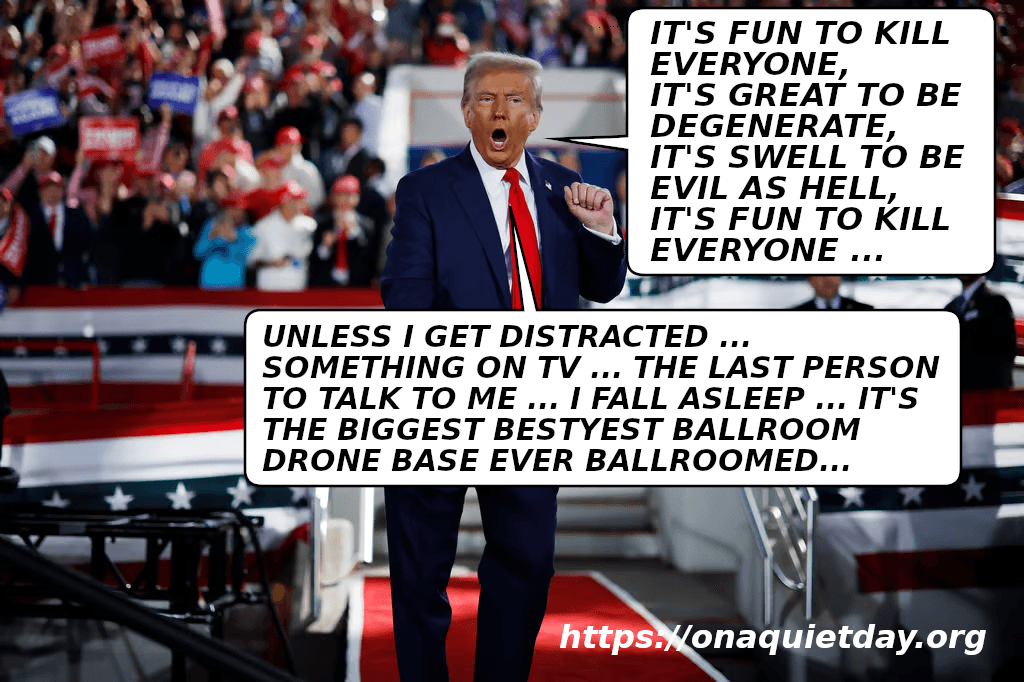
    Donald Trump sings and dances, says that it's fun to kill everyone ... unless he gets distracted or falls asleep.
    Donald Trump sings and dances, says that it’s fun to kill everyone … unless he gets distracted or falls asleep.

  • Hegseth says Iran has choice between deal or ‘devastation’

    Spread the love

    This work by Middle East Monitor is licensed under a Creative Commons Attribution-NonCommercial-ShareAlike 4.0 International License.

    United States Secretary of War Pete Hegseth speaks during the press conference held by The United States President Donald Trump in the James S. Brady Press Briefing Room at the White House on April 6, 2026, in Washington DC, United States. [Celal Güneş – Anadolu Agency]

    US Defense Secretary Pete Hegseth said Saturday that Iran faces a choice between abandoning its “nuclear ambitions” and reaching a deal or facing devastating military action, Anadolu reports.

    “Iran’s going to have a choice to make real quick about whether they’re going to give those up at the table or face the kind of devastation that America can bring and will bring swiftly if necessary,” Hegseth told Reserve Officers’ Training Corps cadets and military recruits at the University of Tennessee.

    He accused Tehran of building a large conventional missile arsenal to deter military action while pursuing “nuclear ambitions,” arguing that US military strength was essential to forcing adversaries to negotiate.

    READ: Iran says renewed talks with US require ‘credible guarantees’ against new attacks

    Hegseth also said that Iran “funds the proxies in Hezbollah, funds the proxies in the Houthis in Yemen,” adding that Washington had sought to deter attacks on US forces and shipping.

    The defense chief framed the policy on Iran as part of US President Donald Trump’s wider effort to reassert American power, including confronting drug cartels and limiting the influence of Iran, China and Russia in Latin America.

    Referring to Venezuela, Hegseth said the US operation there would have “generational implications,” describing the country as a strategic partner and highlighting its oil resources.

    He said Washington was seeking to push its rivals out of the Western Hemisphere while strengthening its military presence and partnerships across the Americas.

    READ: Beyond oil: The Gulf crisis is becoming a food security crisis

    This work by Middle East Monitor is licensed under a Creative Commons Attribution-NonCommercial-ShareAlike 4.0 International License.

    Donald Trump sings and dances, says that it's fun to kill everyone ... unless he gets distracted or falls asleep.
    Donald Trump sings and dances, says that it’s fun to kill everyone … unless he gets distracted or falls asleep.
    Keir Starmer objects to criticism of the IDF. He asks how could anyone object to them starving people to death, forced marches like the Nazis did, bombing Gaza's hospitals and universities, mass-murdering journalists, healthworkers and starving people queuing for food, killing and raping prisoners and murdering children. He calls for people to stop obstructing his genocide for Israel. New Labour UK Prime Minister Andy Burnham continues Labour party policy of active support and complicity in Israel's genocide.
    Keir Starmer objects to criticism of the IDF. He asks how could anyone object to them starving people to death, forced marches like the Nazis did, bombing Gaza’s hospitals and universities, mass-murdering journalists, healthworkers and starving people queuing for food, killing and raping prisoners and murdering children. He calls for people to stop obstructing his genocide for Israel. New Labour UK Prime Minister Andy Burnham continues Labour party policy of active support and complicity in Israel’s genocide.
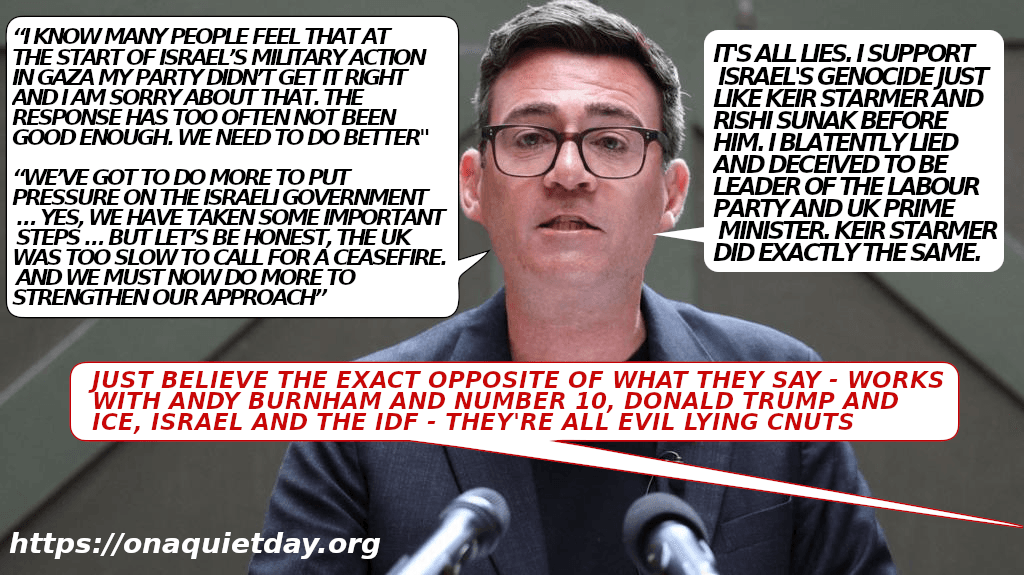
    UK Prime Minister Andy Burnham admits to blatently lying and engaging in deception to become leader of the UK Labour Party and Prime Minister.
    UK Prime Minister Andy Burnham admits to blatently lying and engaging in deception to become leader of the UK Labour Party and Prime Minister.
    Ed Miliband says that he and the Labour Party are full of shit criminalising people holding signs as terrorists despite anything he says.
    Ed Miliband says that he and the Labour Party are full of shit criminalising people holding signs as terrorists despite anything he says.

    Andy Burnham stands with Israel

  • UN officially accuses U.S. of war crimes in Iran

    Spread the love

    Article by R. L. Richards republished from People’s World under http://creativecommons.org/licenses/by-nc-nd/3.0/us/.

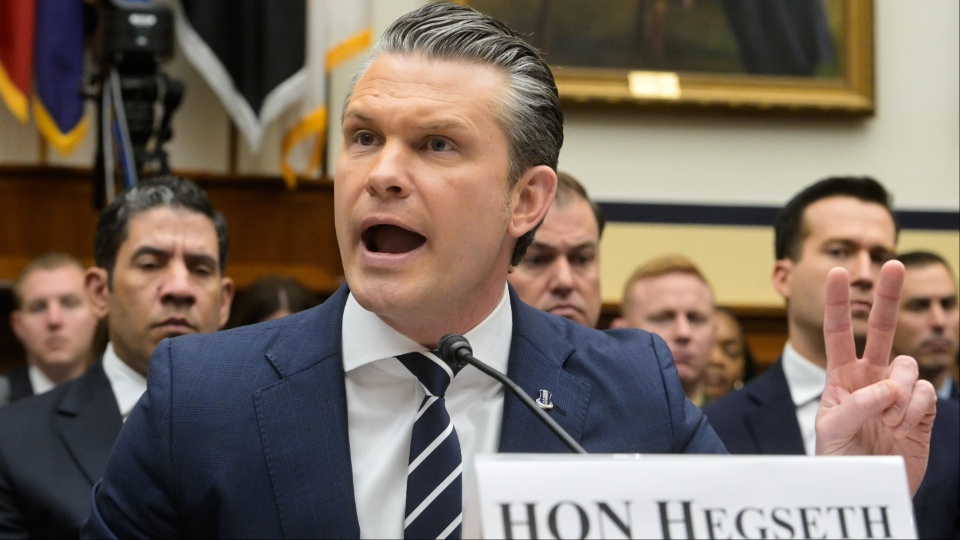
    Secretary of Defense Pete Hegseth appears before the House Armed Services Committee on April 29, 2026. | Rod Lamkey Jr. / AP

    UNITED NATIONS—There are reasonable grounds to believe the United States, under the leadership of the Trump administration, has committed war crimes in the illegal bombing of Iran, one of which targeted a  children’s school in the city of Minab and a sports center in Lamerd, according to experts with the United Nations Human Rights Council.

    The bombs in question were used in two separate strikes that reportedly murdered 178 civilians, including women and children, at the beginning of a joint military operation between the U.S. and Israel.

    In February of this year, what began as any other day in the city of Minab, Iran, turned bloody when munitions likely fired by the United States Armed Forces struck Shajareh Tayyebeh school, devastating the Iranian people and sparking a military response from the Islamic Revolutionary Guard Corps (IRGC).

    “Following the United States and Israeli attacks on 28 February, the mission found reasonable grounds to believe the United States committed the war crime of launching indiscriminate attacks resulting in the loss of life or injury to civilians or damage to civilian objects,” the UNHRC experts said in a statement.

    While the Trump administration accused Iran of the bloodshed, fragments recovered at the scene indicate that a U.S. Tomahawk Land Attack Missile was used in the bombing—munitions that Iran does not utilize or possess.

    To date, the United States has not confirmed the allegations, nor released the findings from the Pentagon regarding its investigation into the unauthorized war and subsequent bombings in Iran that initially killed 178 people, 26 of them being adult teachers—the rest children. Many argue that the continued denial of any wrongdoing and challenging the credibility of the UN’s findings is a reflection of the same tactics used by the Israel Defense Forces (IDF) under the leadership of Israeli Prime Minister Benjamin Netanyahu.

    After the bombing in Manab, a second strike occurred hours later that targeted the Shahid Haj Khalil Naimi Cultural and Sports Complex in Lamerd, also in Southern Iran, killing 22 people. The final death toll and reported casualties included the murder of four children and varying degrees of injuries to over 100 people.

    The Trump administration faces several legal hurdles regarding the war in Iran, including Rep. Thomas Massie putting Secretary of War Pete Heseth on notice with articles of impeachment, prompting the Republican House Speaker Mike Johnson to send everyone home until after the midterms. It is still unclear whether the impeachment will succeed, but the early send-home could signal the kind of trouble the administration faces.

    Recent polls make it clear that public approval of Trump and the Republican Party is sinking. This has resulted in the party becoming more defensive and subsequently offensive in its posturing, attempting to control the narrative surrounding hot-button political issues such as genocide in Gaza, Trump’s illegal kidnapping of the president of Venezuela, and more, leaving many to speculate if this is the end of the Trump regime that has consistently taken its insecurities out on the working class and oppressed people of the United States.

    No paywalls at People’s World

    We hope you appreciated this article. At People’s World, we believe news and information should be free and accessible to all, but we need your help. Our journalism is free of corporate influence and paywalls because we are totally reader-supported. Only you, our readers and supporters, make this possible. If you enjoy reading People’s World and the stories we bring you, please support our work by donating or becoming a monthly sustainer today. Thank you!

    Article by R. L. Richards republished from People’s World under http://creativecommons.org/licenses/by-nc-nd/3.0/us/.

    Donald Trump sings and dances, says that it's fun to kill everyone ... unless he gets distracted or falls asleep.
    Donald Trump sings and dances, says that it’s fun to kill everyone … unless he gets distracted or falls asleep.

  • ‘Do I Blow the Entire Nation Up?’: Trump Says He’s in ‘Deciding Mode’ on Iran War

    Spread the love

    Article by Brett Wilkins republished from Common Dreams under Creative Commons (CC BY-NC-ND 3.0).

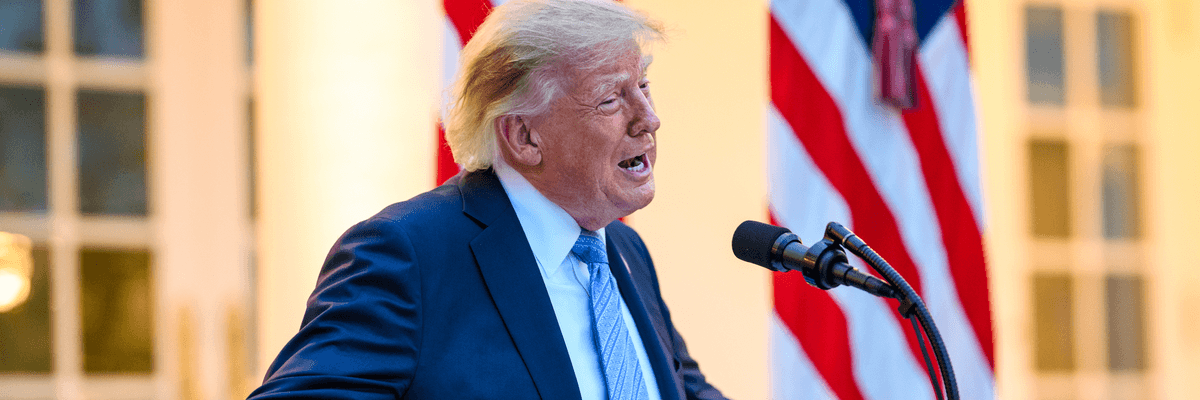
    US President Donald Trump speaks in the White House Rose Garden on September 17, 2026.
     (Photo by Joyce N. Boghosian/White House)

    A senior Iranian official said that “our conditions are an end to the war on all fronts, the release of our frozen funds, and an end to the naval blockade.”

    Three days after saying that he’s weighing whether or not to “annihilate” Iran in a bid to end his increasingly unpopular and protracted war against the Middle Eastern nation, US President Donald Trump on Sunday again said that he is deciding if he should destroy the entire country of over 90 million people.

    Fox News chief foreign correspondent Trey Yingst reported he “just spoke with President Trump about the situation with Iran” and that the US leader said he’s “in a deciding mode and that very big things are going to be happening in the not-so-distant future.”

    RECOMMENDED…

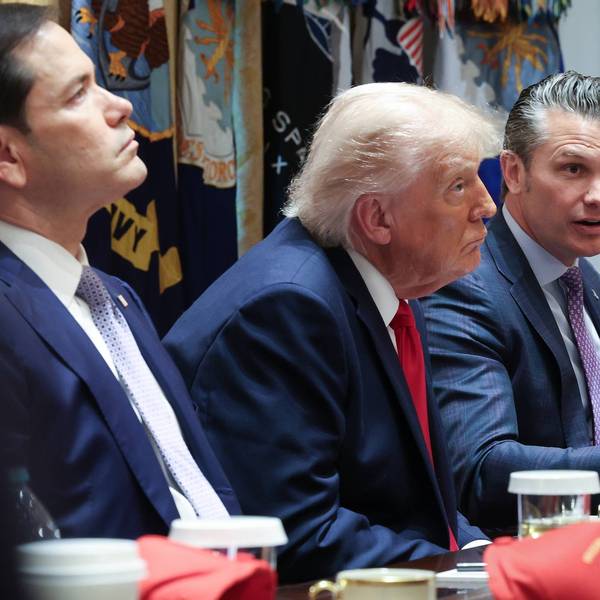
    rubio, trump, hegseth

    Trump Says ‘Big Decision’ Coming on Whether to ‘Annihilate’ Iran

    US President Donald Trump

    ‘The President of the United States Is Mentally Unwell’: Deranged Trump Posts AI Slop of Iran Bombing

    Trump said he is considering three strategies for ending the 204-day war: “wiping Iran out, letting them rot economically, or making a deal.”

    “My question is, if and when do I blow the entire nation up, they better behave,” Trump added, according to Yingst.

    On Saturday, Mohsen Rezaei, the secretary of Iran’s Supreme National Security Council, told Al Jazeera that Tehran has conveyed its conditions for ending the war to Qatari mediators and is “awaiting President Trump’s response.”

    “Our conditions are an end to the war on all fronts, the release of our frozen funds, and an end to the naval blockade,” Rezaei added. “It is in Washington’s interest to accept these conditions. Trump’s threats will not achieve any results. We are prepared for a decisive war.”

    Iran’s military responded to Trump’s latest threat by warning US allies Sunday that they will be considered “complicit” if American strikes resume, vowing “painful attacks” in retaliation.

    Trump—who has been threatening to destroy Iran since at least 2019—is facing pressure on multiple fronts to end his highly unpopular and illegal war of choice, in which at least 23 US troops have died and tens of thousands of Iranians have been killed or wounded.

    Americans are feeling the pain of higher consumer prices, especially for gasoline and diesel fuel, for a war that many say is making the country less safe. Six in 10 US voters queried in a new Fox News poll said Trump was wrong to wage war on Iran, while 7 in 10 respondents believe that his administration has no clear strategy for ending the conflict.

    Republican lawmakers are also increasingly expressing dissatisfaction with the war and distancing themselves from the conflict ahead of November’s midterm elections, with some going as far as helping to pass a war powers resolution directing Trump to withdraw US forces from hostilities with Iran, and one—outgoing Rep. Thomas Massie of Kentucky—supporting the impeachment of Defense Secretary Pete Hegseth.

    Article by Brett Wilkins republished from Common Dreams under Creative Commons (CC BY-NC-ND 3.0).

    Orcas discuss Donald Trump and the killer apes' concept of democracy. Front Orca warns that Trump is crashing his country's economy and that everything he does he does for the fantastically wealthy.
    Orcas discuss Donald Trump and the killer apes’ concept of democracy. Front Orca warns that Trump is crashing his country’s economy and that everything he does he does for the fantastically wealthy.
    Orcas discuss rotting brain, front Orca says he wishes someone would Lock Him Up, small Orca says he thinks that his meds have been changed.
    Orcas discuss rotting brain, front Orca says he wishes someone would Lock Him Up, small Orca says he thinks that his meds have been changed.