Palestinians walk along a street surrounded by buildings destroyed in Israeli military strikes during the Israel-Hamas war in Gaza City, October 6, 2026
Israelis and Palestinians to mark three years since October 7 Hamas attack and beginning of the Gaza genocide
PALESTINIANS and Israelis are to mark three years since the Hamas-led assault on southern Israel on October 7, 2023.
During the attack, 1,221 people were killed and 251 others were taken hostage.
Israel’s subsequent invasion of the Gaza Strip has killed at least 74,237 Palestinians, including more than 20,000 children, and wounded around 175,000.
Since a so-called ceasefire agreement took effect on October 10 2025, at least 1,454 Palestinians have been killed and another 5,090 have been injured by the Israelis. Israel has also escalated ethnic cleansing across the occupied West Bank.
Global hunger watchdog the Integrated Food Security Phase Classification says more than 1.2 million people face acute hunger in Gaza.
Stop the War convener Lindsey German told the Morning Star: “Three years of Israel’s genocide in Gaza is a grim milestone.”
But, she added, “we finally see a shift in the British government’s position — undoubtedly a victory for the Palestine movement.”
Referring to planned protests on Saturday, Ms German said it was “the first time we have seen a truly global co-ordination of protests for Palestine — from the Netherlands to Nigeria, South Africa to South Korea, and London to Lima.”
Independent MP for Islington North Jeremy Corbyn said: “Three years ago, we warned that Israel was embarking upon the total annihilation of the Palestinian people in Gaza. We were ignored and smeared, while the British government armed a genocide as it was live-streamed around the world.
“Today, politicians are pretending they have always been opposed to the war crimes they supported and facilitated. Too little, too late. We have been witnessing a genocide — and Britain’s complicity can never, ever be forgotten.
“Three years on, I’m calling for Andy Burnham to finally call Israel’s destruction of Gaza what it is: a genocide.
“He should say: Today, as of now, I am ending all military co-operation with Israel. And he should finally heed my long-standing demand for a full, public inquiry into Britain’s continued involvement.”
Ms German pointed out that on Ukraine, Iran and hikes in arms spending “there remains no difference between Mr Burnham and his predecessor,” adding that it was vital to “link the Palestine campaign to one against all these fundamentally wrong foreign policy priorities.”
Mr Corbyn said: “In the near future, our history books will shame those in our government who enabled one of the greatest crimes of our time. Britain is involved in acts of genocide.”
“Stop it, change it and shut the arms supply to Israel,” he added.
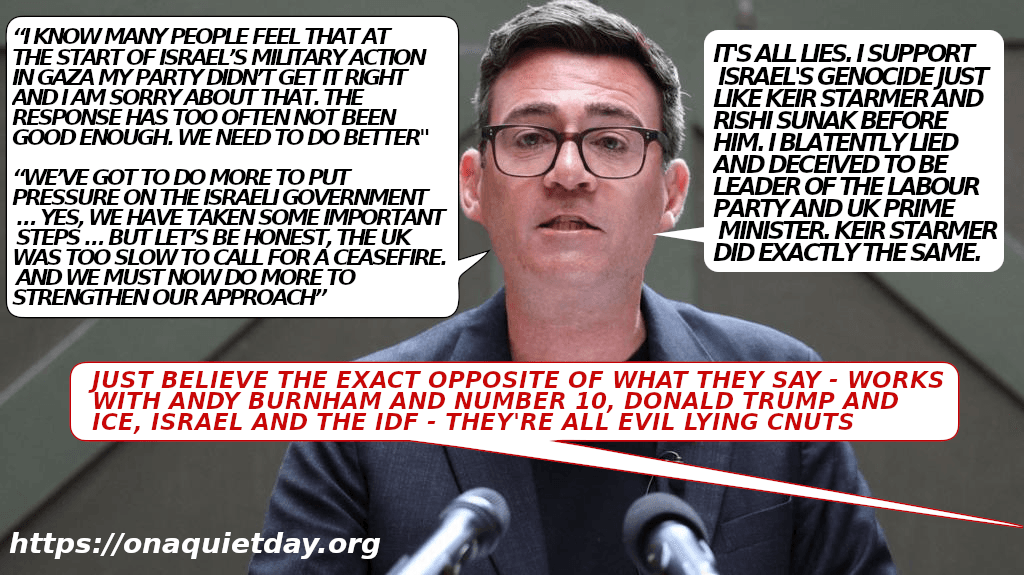
UK Prime Minister Andy Burnham admits to blatently lying and engaging in deception to become leader of the UK Labour Party and Prime Minister.Ed Miliband says that he and the Labour Party are full of shit criminalising people holding signs as terrorists despite anything he says.
A large group of Jewish and Muslim demonstrators carrying banners and Palestinian flags march from Bryant Park toward the United Nations headquarters to protest the policies of Israeli Prime Minister Benjamin Netanyahu and US President Donald Trump regarding the war in Gaza in New York, United States, on September 24, 2026. [Waleed Zein – Anadolu Agency]
In 1975, the United Nations General Assembly adopted Resolution 3379 declaring Zionism “a form of racism and racial discrimination.” Sixteen years later, the resolution was revoked in the political context surrounding the Madrid Peace Conference. Western politics subsequently behaved as though the argument itself had been buried. It had not. History did not end in 1991, and neither did the political question the resolution raised.
Today, that question has returned under circumstances far more devastating than those of 1975.
Apartheid is no longer a term confined to Palestinian activists or to the margins of political debate. Major international, Palestinian, and Israeli human-rights organisations, UN experts and scholars have documented a system of domination, segregation, dispossession, demographic engineering and unequal rights imposed on Palestinians.
Gaza has taken the argument into even darker territory. Genocide is no longer merely a warning about what could happen, but a conclusion reached by major human-rights organisations, UN experts and genocide scholars.
We therefore need to stop behaving as though the central political task is to prove, for the thousandth time, that Palestinians are subjected to systematic oppression. The evidence has been documented for decades. The more difficult question is what follows from it.
When I wrote about Zionist apartheid in 2013, even the terminology was largely excluded from mainstream Western political discourse. The argument was routinely dismissed before it could even be examined.
Today, the vocabulary has changed dramatically. Words that were once considered beyond the boundaries of respectable debate, apartheid, ethnic cleansing and genocide have moved into mainstream legal, academic and political discussion. But language alone changes nothing.
If we recognise apartheid while refusing to examine the political system that produces it, we have achieved little. If we condemn individual settlements while leaving untouched the ideology that makes settlement and demographic domination politically meaningful, we have avoided the central question. If we condemn individual military operations while refusing to confront the structure within which Palestinian life has been made permanently subordinate, we are describing consequences while protecting causes. That is no longer enough.
If apartheid is structural rather than an accidental deviation from Israeli politics; if dispossession, settlement, demographic engineering, unequal rights and the prevention of Palestinian return are enduring features rather than temporary policies; and if Gaza represents an extreme manifestation of a political order in which Palestinian existence can be subordinated to the maintenance of Zionist Jewish political and demographic supremacy, then the ideology through which that order was established and justified must itself be confronted. That ideology is Zionism.
Zionism is a modern political ideology and movement. Judaism is an ancient religion, culture and tradition stretching back thousands of years. The two cannot simply be collapsed into one another. Jewish religious attachment to Palestine is not Zionism. Jewish historical connection to the land is not Zionism. Jewish residence in Palestine is not Zionism. There are Jewish Zionists, Christian Zionists and secular Zionists, just as there are Jewish people who are non-Zionist and anti-Zionist. Zionism must therefore be examined for what it is: a political project.
The modern Zionist movement contained different ideological currents: socialist, liberal, religious, revisionist and others, and supporters of Zionism understand it in different ways, most commonly as a movement for Jewish national self-determination. But political ideologies are not judged by their self-description. They must be judged by the institutions they build, the relations of power they create and the consequences they produce for those subjected to them. The political question is therefore not what Zionism promises in the abstract, but what Zionism has meant in practice.
Who possesses the right to the land? Who can immigrate from anywhere in the world while people expelled from that same land and their descendants are prevented from returning? Who controls territory, borders and resources? Whose communities can expand and whose homes can be demolished? Whose demographic presence is protected as a political objective and whose demographic presence is discussed as a threat? Who possesses sovereignty, and who lives permanently under the sovereignty of others? These are not theological questions. They are questions of political power, and political power must be judged by its consequences.
This is why the question of racism cannot simply be declared illegitimate. If a political project requires the maintenance of political and demographic predominance for one group while another population is displaced, fragmented, prevented from returning and denied equal political power, then the relationship between that ideology and racism is not an antisemitic question. It is a political question, and it must be confronted politically.
For too long, much of Western politics has avoided that confrontation by reducing the problem to individual Israeli governments. Netanyahu becomes the problem. Ben-Gvir becomes the problem. Smotrich becomes the problem. A settlement becomes the problem. A military operation becomes the problem. An extremist minister becomes the problem. A particular government becomes the problem. Yet every time, the underlying structure survives.
Governments change. Coalitions change. Prime ministers change. The language changes. Yet Palestinian refugees remain unable to return. Settlements continue. Palestinian land continues to be fragmented. Different legal and political regimes continue to determine people’s rights according to identity and location. The fundamental struggle over land, sovereignty and demographic control remains. At some point, blaming only the most extreme administrators of a system becomes a way of avoiding the system itself.
The political challenge is therefore no longer simply to condemn the excesses. It is to confront the structure, and that requires confronting its ideological foundations.
This is why the decision of the Green Party of England and Wales in October 2026 matters. Its members voted by 1,022 to 813 to adopt an explicitly anti-Zionist policy, defining Zionism as an ethnonationalist political project and rejecting the proposition that anti-Zionism should automatically be equated with antisemitism.
Something politically important has happened: a major European political party has crossed a line that mainstream Western politics spent decades insisting could not be crossed. It has moved the discussion from Israeli policy to Zionism itself.
That matters because the argument can no longer credibly end with Netanyahu, the settlements or individual military operations. If the structures are permanent, their ideological foundations have to be examined as well.
Human beings have rights. Political ideologies do not. Every Jewish person has the right to live free from antisemitism, discrimination, dispossession, violence and hatred. Palestinians possess exactly the same human rights.
They have the right to live free from discrimination, dispossession, forced displacement, military domination, ethnic cleansing and genocide. There can be no serious universalism that passionately defends the rights of one people while treating the rights of another as permanently negotiable.
This is where the debate becomes larger than Zionism itself. It becomes a question about political responsibility. For decades, Western governments and political institutions have presented themselves as defenders of international law, human rights and a rules-based international order. Gaza has exposed the limits of those claims with extraordinary brutality. International law means very little if it applies only to enemies. Human rights mean very little if they are defended selectively. And “never again” means very little if it describes only crimes safely located in the past.
The purpose of historical memory cannot simply be to condemn yesterday’s atrocities after their victims have already been destroyed. Its purpose must also be to recognise the structures, language and political choices that make atrocities possible while they are happening. That requires taking sides, not between peoples, but between domination and equality.
There is a persistent idea in Western politics that refusing to take a position represents moderation. It does not. In situations of profound inequality, neutrality does not stand outside politics. It operates within existing relations of power. When one side possesses the state, the army, the borders, the resources and the ability to determine the rights and movement of another population, refusing to challenge that structure does not create balance. It leaves the structure intact.
There are moments when political ambiguity ceases to be caution and becomes complicity. This is one of them. Future generations will not primarily ask whether politicians used sufficiently careful language, whether institutions protected themselves from controversy or whether commentators maintained an appearance of neutrality. They will ask what people did when the destruction was visible, when the structures of domination were known and when the consequences of decades of dispossession could no longer be denied. They will ask who defended the system, who challenged it and who remained silent.
History has asked these questions before. It is asking them again.
The debate over Zionism is therefore not an academic exercise and it is not merely an argument about terminology. It is a political struggle over whether a system that privileges one people while dispossessing and dominating another can continue to claim legitimacy. No political ideology, whether nationalism, colonialism, religious fundamentalism or Zionism is entitled to protection from judgment simply because questioning it has become politically uncomfortable.
The question before political parties, civil-society organisations, universities and governments is increasingly simple: if you recognise apartheid, if you recognise dispossession, and if you recognise genocide, are you willing to confront the political ideology and structures that made them possible?
The views expressed in this article belong to the author and do not necessarily reflect the editorial policy of Middle East Monitor.
This work by Middle East Monitor is licensed under a Creative Commons Attribution-NonCommercial-ShareAlike 4.0 International License.
UK Prime Minister Andy Burnham admits to blatently lying and engaging in deception to become leader of the UK Labour Party and Prime Minister.Ed Miliband says that he and the Labour Party are full of shit criminalising people holding signs as terrorists despite anything he says.
ANTI-WAR campaigners have called for the further removal of US militarism from Britain after the country’s bombers were withdrawn from RAF Fairford.
Downing Street insisted the site remains safe following the withdrawal, despite initial reports linking it to recent threats against the base.
US Secretary of State Marco Rubio later downplayed the move, saying: “It’s not unusual to see movement of assets to different parts of the world based on exercises, redeployments, people changing out and new people coming in, new planes coming in and old planes going out.”
…
Campaign for Nuclear Disarmament general secretary Sophie Bolt welcomed the removal of the B-1 bombers from the site, saying it was “something we have long campaigned for.”
“This also extends the extends to the removal of US nuclear weapons — now stationed at RAF Lakenheath — US fighter jets, personnel and US military control of RAF bases,” she said.
“It’s time to end the uncontrolled and unaccountable foreign military presence in this country.”
This work by Middle East Monitor is licensed under a Creative Commons Attribution-NonCommercial-ShareAlike 4.0 International License.
A man in handcuffs after being arrested by police. [AI generated image]
Israeli prosecutors charged a Bar-Ilan University mathematics professor Monday with preparing a terrorist attack, blackmail and obstruction of justice for plotting to kill hundreds of Arab citizens and force thousands more to flee to Jordan, Lebanon and the Gaza Strip, according to Israeli media.
The State Prosecutor’s Office said the suspect, whose identity remains under a gag order, developed a “thorough and detailed” plan over nearly three years and sought assistance from “subversive elements” in the Israeli Air Force, artillery and armored corps, The Times of Israel reported.
The suspect, around 60 years old, was arrested Sept. 17 and has admitted to the charges against him, according to prosecutors.
The indictment says he spent the past 18 months trying to recruit people for the plan and sought a “significant political figure” who could help enlist armed participants.
He eventually approached former Likud lawmaker Moshe Feiglin, whose Zehut faction has teamed up with extremist Finance Minister Bezalel Smotrich’s Religious Zionism party ahead of the Oct. 27 election, the newspaper said.
After Feiglin did not respond, the professor tried about a month ago to blackmail him into joining while using methods to conceal the plan and obstruct its discovery, prosecutors said.
Feiglin, his deputy Yitzhak Hai Zaga and Zehut executive director Shai Malka later handed police threatening letters they received from the suspect, according to a court filing.
The professor called the plan “Ayit,” Hebrew for “eagle,” also used as an acronym for a phrase meaning “the nation will carry out transfer,” referring to the expulsion of Palestinians.
He began working on the plan in February 2023 following the 2021 protests in mixed Arab-Jewish cities, the newspaper said.
As part of the preparations, the Israeli professor obtained numerous aerial photographs of the northern Bedouin town of Tuba-Zangariyye in northern Israel in March 2023 and visited the area several times to identify what he considered suitable access and attack routes.
He also prepared a 20-page document for recruits, which he kept at both his home and his Bar-Ilan University office.
The plan called for 72 armed Jewish attackers, divided into 12 groups of six, to simultaneously attack Arab population centers with firearms and axes, with support from sympathetic elements in the military.
It estimated that 600 to 700 people would be killed and stipulated that at least half of the attackers, including the professor, should hold gun licenses.
The document also called for women and children to be targeted and for the attacks to be broadcast on social media in real time to drive Arabs to flee Israel and the occupied West Bank.
It envisioned appeals for soldiers, police officers, Israeli occupiers, and criminals to join the attacks after they began.
The professor planned to gather 71 other participants at an event organized by a candidate in the 2026 election under the guise of a campaign gathering, with the attacks scheduled for the following day, the indictment said.
Around June, he asked his daughter to recruit acquaintances among the so-called “hilltop youth,” a term referring to extremist Israeli occupiers in the West Bank, but she refused.
The Central District Attorney’s Office filed the indictment at Lod District Court and asked that he remain in custody until the end of the proceedings.
Bar-Ilan University said it was “shocked” by the charges and suspended the professor pending the conclusion of the legal process.
Arab Israelis make up about 21% of Israel’s population of more than 10 million.
Ed Miliband says that he and the Labour Party are full of shit criminalising people holding signs as terrorists despite anything he says.UK Prime Minister Andy Burnham admits to blatently lying and engaging in deception to become leader of the UK Labour Party and Prime Minister.
This work by Middle East Monitor is licensed under a Creative Commons Attribution-NonCommercial-ShareAlike 4.0 International License.
A view of damaged buildings as Palestinian families displaced by Israel’s relentless bombardment of the Gaza Strip struggle to survive in makeshift tents they have set up around the Islamic University building, which was heavily damaged in Israeli attacks in Gaza City, Gaza, Palestine, on Spetember 29, 2026. [Mahmoud Abu Hamda – Anadolu Agency]
Around 82% of buildings in the Gaza Strip have been damaged as a result of Israel’s genocide since Oct. 8, 2023, the Palestinian Central Bureau of Statistics (PCBS) said Monday, Anadolu reports.
The agency said in a statement marking World Habitat Day that around 201,290 buildings in Gaza had been damaged, representing about 82% of all buildings in the enclave, according to figures through June 16, 2026.
It explained that 134,422 buildings were completely destroyed, while 13,848 sustained severe damage and around 328,627 housing units were damaged.
Since Oct. 8, 2023, Israel’s genocidal war in Gaza has killed more than 74,000 Palestinians and injured over 175,000 others, and destroyed around 90% of the enclave’s infrastructure.
The destruction has also affected water and wastewater infrastructure, around 90% of which had been damaged or destroyed as of the first half of 2026, PCBS said.
The agency said that 82% of households in Gaza face water insecurity, while around 70% receive only about six liters (1.6 gallons) of water per person per day.
Despite a ceasefire in effect since Oct. 10, 2025, Israeli attacks have killed 1,445 Palestinians and injured 5,072 others, according to Gaza’s Health Ministry.
Israel also continues to restrict the entry of agreed quantities of food, medicine, medical supplies, shelter materials and prefabricated homes into Gaza, where around 2.4 million Palestinians live, including 2.15 million displaced people, according to the agency.
In the occupied West Bank, Israeli attacks and home demolitions have continued since the beginning of the year alongside increased occupier attacks, land seizures and displacement, PCBS said.
Citing figures from the Colonization and Wall Resistance Commission, the agency said Israeli authorities carried out around 341 demolition operations during the first half of 2026.
The operations resulted in the demolition of 740 Palestinian structures, while Israeli authorities issued 254 demolition notices on the grounds of lacking permits, it said.
Since the start of the Gaza war in October 2023, the Israeli army and occupiers have intensified attacks in the West Bank, involving killings, arrests, displacement, home demolitions, land leveling and illegal settlement expansion.
Ed Miliband says that he and the Labour Party are full of shit criminalising people holding signs as terrorists despite anything he says.UK Prime Minister Andy Burnham admits to blatently lying and engaging in deception to become leader of the UK Labour Party and Prime Minister.

 Palestinians walk along a street surrounded by buildings destroyed in Israeli military strikes during the Israel-Hamas war in Gaza City, October 6, 2026