Chancellor of the Exchequer John Healey visits the UK Manufacturing Technology Centre in Coventry, September 7, 2026
JAGUAR Land Rover confirming 4,000 jobs will go took the shine off Chancellor John Healey’s claim that Britain’s economy is “turning the corner” today.
Healey’s “pre-Budget speech” suggests his own well-publicised assessment that Andy Burnham’s is a “continuity” government, rather than representing a sharp policy break from Keir Starmer, holds true.
He emphasises adherence to his predecessor Rachel Reeves’s fiscal-rules straitjacket, severely constraining government room for manoeuvre on spending. Burnham may have called for Britain to “get beyond” being “in hock to the bond market” when he was Manchester mayor but in government he runs as scared of the money men as his predecessor.
Healey’s prescription for economic growth falls under two main headings.
One, fiscal devolution, including greater tax-retention powers by local authorities, could begin to reverse the hollowing-out of local democracy we have seen since Thatcher’s day, though the specifics, which he says he will map out at the Budget, are crucial: his refusal to rule out devolution of corporation tax was worrying, since that could prompt a race to the bottom by regions hoping to attract corporate favours.
But the other repeats the tried-and-tested-to-destruction mantra of government after government: that deregulating business will spur growth.
Healey’s pledge to reduce business regulation by “25 per cent” echoes David Cameron’s notorious “bonfire of the regulations.”
These arbitrary targets encourage reckless deregulation ignoring the principle dubbed “Chesterton’s Fence” — that you should find out why a fence was put up before you tear it down.
Deregulation is responsible for atrocities like the Grenfell Tower blaze and outrages like the poisoning of our rivers and coastlines by privatised water companies exploiting the lax “operator self-monitoring” system so effectively skewered in Channel 4’s Dirty Business drama. Indeed, deregulation of the banking sector allowed the high-risk lending and speculation that exploded in the 2008 bankers’ crash, which prompted the long squeeze on wages and cuts to public services which Healey laments.
Given how far trade unions’ hopes in this government are tied up with the Employment Rights Act, key provisions of which we’re still waiting on and which is already heavily diluted from the original New Deal for Workers, we need clarity on what Healey means by reducing the regulatory burden on business, particularly since he lists “labour costs” as part of that burden.
He also objects to “planning constraints,” and specifies that changes to judicial review rules already applied to energy projects, which reduce the scope to challenge them legally, will be extended to “all major infrastructure.” The government classifies the energy and water-intensive, and overwhelmingly US-owned, data centres springing up on our land as “critical national infrastructure” — will we lose our limited democratic power to fight these?
Aside from the risk that deregulation will weaken worker, consumer and public protections, the notion that letting corporations do whatever they want will lead to growth ignores the underlying weaknesses behind Britain’s low levels of private-sector investment.
A corporate culture that prioritises short-term profit over long-term sustainability is actually the result of under-regulation, especially when it comes to allowing private equity to buy up British businesses and services.
Jaguar Land Rover (JLR’s) problems include the frankly hostile trade policy of the United States and its tariffs, but also the transition to electric vehicles. Tories cite government targets for production of electric cars as a burden on the business — as if petrol cars have an indefinite future. But JLR’s plummeting sales in China are down to consumer preferences shifting towards electric cars. Investment in accelerating the transition to renewables, as we have seen in China, is the route to more competitive exports.
A clear judgement on the new Chancellor’s approach must wait for the Budget. But the signs so far are that the crippling misapprehensions of the last government are shared by its successor.
Pro-Palestinian protesters take part in a Palestine Solidarity Campaign demonstration as they march to the Labour Party conference venue on September 21, 2024 in Liverpool, England. [Ian Forsyth/Getty Images]
It’s difficult to comprehend the horrors of what’s happening in Gaza, Lebanon and beyond in the Middle East. The heartbreaking scenes of dirt-encrusted toddlers screaming as they’re pulled from the rubble of what was once their homes; the small children carrying plastic bags containing the remains of their slain siblings; the white-bandaged bodies of whole families laid out next to hospitals in their hundreds; the shaking youngsters trying to hide as Israeli soldiers fire indiscriminately at anything that moves. Surely, feeling a deep, painful empathy for the victims of such savagery, especially the children, is part of what gives us our humanity.
This isn’t the same for everyone, of course. Not for the perpetrators, who use their cutting-edge western-manufactured machines of death to extinguish these innocent lives. Nor, in most cases, for politicians here in Britain. For Prime Minister Keir Starmer, these scenes are even the set up for a joke.
During the new prime minister’s triumphant speech at this week’s Labour Party conference, a heckler dared to challenge the Dear Leader on his lack of empathy for Israel’s victims. After Starmer said that, “Every child, every person, deserves to be respected for the contribution they make,” Labour member Daniel Riley, 18, shouted in response: “Does that include the children of Gaza?”
“This guy’s obviously got a pass from the 2019 conference,” quipped the smug Starmer, in a reference to years when Labour was led by pro-Palestinian Jeremy Corbyn. The more sycophantic element of Starmer’s congregation, stronger than ever thanks to Sir Keir’s purges of the left, lapped up the jibe.
It’s become a cliché to respond to such things with variations of “imagine the response if Corbyn had said something like that about Israeli children,” but sometimes you can’t help but be stunned at the double standards. Corbyn would never have said such a thing, but if he had it would have been frontpage news; irrefutable proof of his alleged anti-Semitism.
But they weren’t Israeli children. They were Arabs. And in mainstream western discourse, they don’t count. They don’t suffer. They don’t have dreams. They’re abstract numbers, if that.
They’re just Arabs, unworthy of our empathy.
To really hammer home the hypocrisy, the words “genocide” and “apartheid” had already been banned from the Labour conference. The Palestine Solidarity Campaign was forced to remove both words from the title of its fringe meeting. Some activists responded by painting the words “genocide conference” on the windows of the venue.
In many ways, the Labour government, elected in July after 14 years in the wilderness, is an improvement on their Conservative predecessors regarding Palestine. But that’s a pretty low bar. Starmer may have banned his MPs from attending the huge protests against the war on Gaza, which often numbered hundreds of thousands of people, but he didn’t go as far as former home secretary Suella Braverman, who branded them “hate marches”.
Pro-Palestinian protesters campaign near Downing Street in London, UK, on Wednesday, July 24, 2024. [Betty Laura Zapata/Bloomberg via Getty Images]
And despite Labour’s top team repeating the mantra that “Israel has the right to defend itself” like a broken record whenever the issue comes up, it has at least (and belatedly) called for a ceasefire and the establishment of a Palestinian state (however problematic that demand in itself is).
The Labour government has also drawn the ire of Israel for dropping its opposition to the International Criminal Court’s bid for an arrest warrant against Benjamin Netanyahu. A further schism was seen when the UK resumed its £21 million funding to the Palestinian refugee agency, UNRWA. Again, it was a low bar.
Much has also been made of the new government’s decision to block arms sales to Israel (although this is limited to a pitiful eight per cent of exports). Unsurprisingly, the Palestine solidarity movement says it’s not enough. And so do the British public: in May, 55 per cent of the British public wanted arms sales to Israel to be suspended until the war against the Palestinians in Gaza ends.
Even less surprisingly, it was met with fury from Israel. Benjamin Netanyahu said that it was “sending a horrible message” to Hamas. Starmer responded to Netanyahu’s comment during an interview on LBC Radio over the conference period. “No, he’s not right about that,” he tried to reassure the audience. “We had to comply with international law and our domestic law in relation to that. I’ve always been clear, I support Israel’s right to self-defence, I’ve been robust about that… I’ve taken blows in relation to that – there’s no doubting that support – but it’s got to be done in accordance with international law.”
In other words, “I’m really sorry, and I’m not saying you’re committing war crimes, it’s just that it would be a bad look for a former lawyer to end up in The Hague.”
Foreign Secretary David Lammy was also questioned on LBC during the conference about why the other 92 per cent of arms sales to Israel had not been banned, including the export of parts for F-35 fighter jets, which Israel has used, among other things, to bomb heavily-populated refugee camps in Gaza. Lammy said that a full embargo would limit Israel’s ability to fight the Houthis in Yemen “and other proxies”.
“I think that would be a mistake,” he added. “It would lead to a wider war and an escalation that we here in the UK are committed to stopping, so I’m afraid I disagree with that position.”
In Lammy’s eyes, war is peace.
By coincidence, two of the arms companies currently selling their merchandise to Israel for use in Gaza were also at the conference. According to Private Eye magazine, BAE Systems, which makes parts for the F-35, hosted a high-profile meeting with defence secretary John Healey. A separate event, featuring armed forces minister Luke Pollard, was sponsored by US arms firm Northrop Grumman. Northrop Grumman makes parts for the F-35, the F-16 and the Apache helicopter. All are being used to massacre civilians in Israel’s war in Gaza and the wider region.
To ensure compliance with the Zionist narrative, Israeli politicians came to the conference themselves. Among them was opposition leader Yair Golan, who has said that Palestinians should “starve to death” until the hostages are released. He was granted audiences with several ministers, including Lammy, and attended a meeting hosted by Labour Friends of Israel.
Nevertheless, the conference did at least spark some hope for the Palestine cause, albeit inadvertently. During its opening weekend, 15,000 protesters gathered in Liverpool to send a message to Labour over its appalling support for the occupation state.
And that’s where the hope is. The Labour government won’t stand up to Israel’s devastating behaviour without pressure. If what we’ve seen already isn’t enough to make them change this attitude, I’m not sure what would. If Israel invaded London, Keir Starmer would probably still be trying to sell them the weapons to do it with.
Labour has pretty much always backed wars that align with the needs of the British and now US empires, from the First World War to Vietnam. It wants to preserve the British state, its crown and its interests, albeit in a way that slightly improves life for its working-class base. It’s currently in the interests of the British ruling class to cling to the coattails of the United States. The US, in turn, needs Israel as its outpost in the Middle East. This is all hardwired into Establishment politics.
Politicians who deviate from such norms, such as Corbyn, are vilified. That’s not how we do grown-up politics in this country, don’t you know?
Starmer is no radical. He’s not really much at all.
His main use was to seize back control of the Labour party from the left and return it to the hands of the Establishment. He did this by standing on a left-wing manifesto during his leadership election only to abandon it, ally himself with the right of the party and purge the left once he assumed the leadership.
His domestic agenda is hampered severely by his unwillingness to tax the rich to repair the devastation left by the Conservatives. Instead, he is removing winter fuel allowances from pensioners and maintaining benefit restrictions on anyone with more than two children. These, he keeps saying, are “tough choices”, even though they are the easiest choices for him, as he is so scared of upsetting the rich and powerful.
He’s desperate to be seen as an effective manager for the British state, which means maintaining the easy ride enjoyed by the wealthy and aligning himself with US-led geopolitical interests. Moreover, the British Establishment that Starmer works for is fully behind the US and its Middle Eastern proxy, Israel.
Just as a middle manager at a fast food company would enthusiastically and unquestioningly promote its unhealthy products, despite their harmful effects on consumers, Starmer is hardwired to enthusiastically and unquestioningly execute the will of the people with real power over Britain. That’s not the electorate.
Tales of children suffering in Gaza are as irrelevant to him as children suffering under his benefit restrictions in Britain. Elderly people freezing in makeshift shelters in Lebanon are as irrelevant to him as elderly people freezing in Britain because they can’t afford to pay their energy bills.
And all the while, Starmer enjoys the patronage of the powerful. His bewilderment at a recent outcry over major donations of cash, designer clothes and tickets to football matches and concerts to him and his top team reveals his belief that he should be reaping the rewards of his subservience as much as any effective manager.
The Labour party conference showed us a government that will continue to stand firmly behind Israel, no matter what the state does or the wider horrors it looks set to unleash. Mild reprimands aside, Labour under Starmer will not abandon the apartheid state without huge pressure.
That’s why real opposition to Israel’s crimes remains in the hands of those outside parliament who take to the streets, occupy their universities and speak up loudly in defence of Palestinians. The Labour leadership’s limited concessions to Palestinian rights would not have been made without that pressure from below. It’s only when actions like these begin to challenge Starmer’s tentative grip on power that he will be forced to offer any sort of meaningful opposition to Israel’s barbarism.
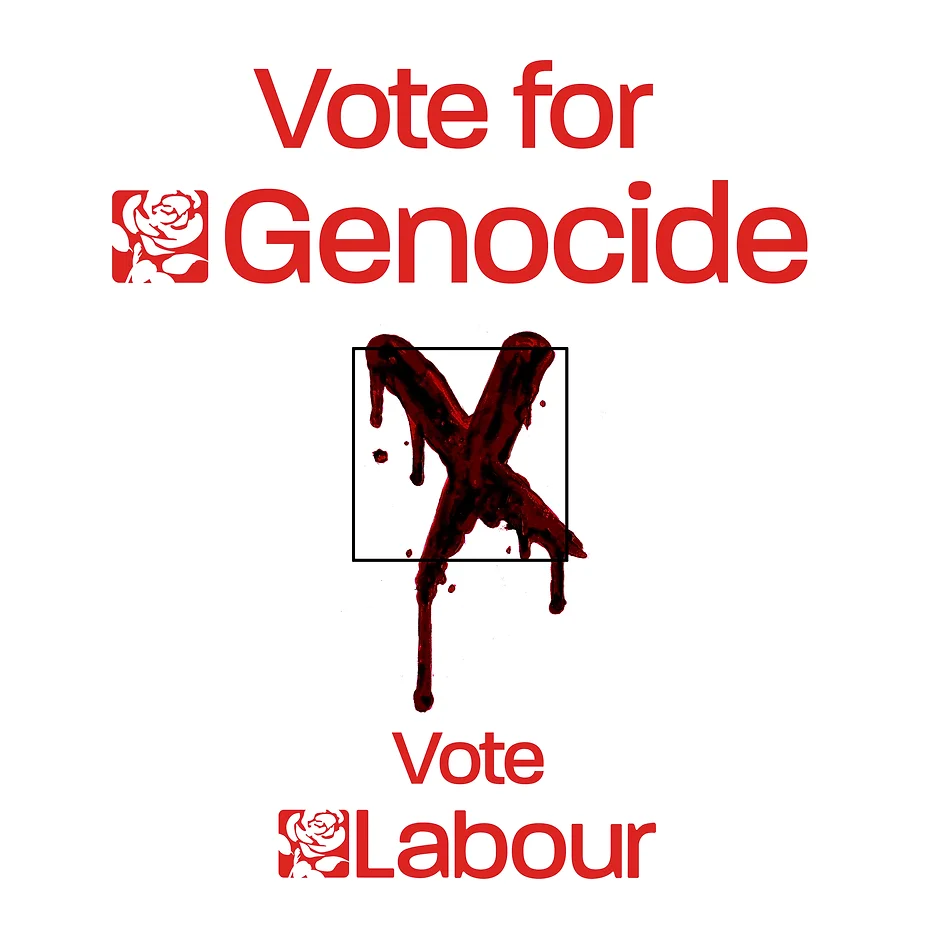
Zionist Keir Starmer is quoted “I support Zionism without qualification.” He’s asked whether that means that he supports Zionism under all circumstances, whatever Zionists do.Vote For Genocide Vote Labour.UK Foreign Secretary David Lammy says that UK is suspeding 30 of 350 arms licences to Israel. He also confirms the UK government’s support for Israel’s Gaza genocide.

 Chancellor of the Exchequer John Healey visits the UK Manufacturing Technology Centre in Coventry, September 7, 2026