Wind turbines in a field. Credit: Alamy / Chris Rout.
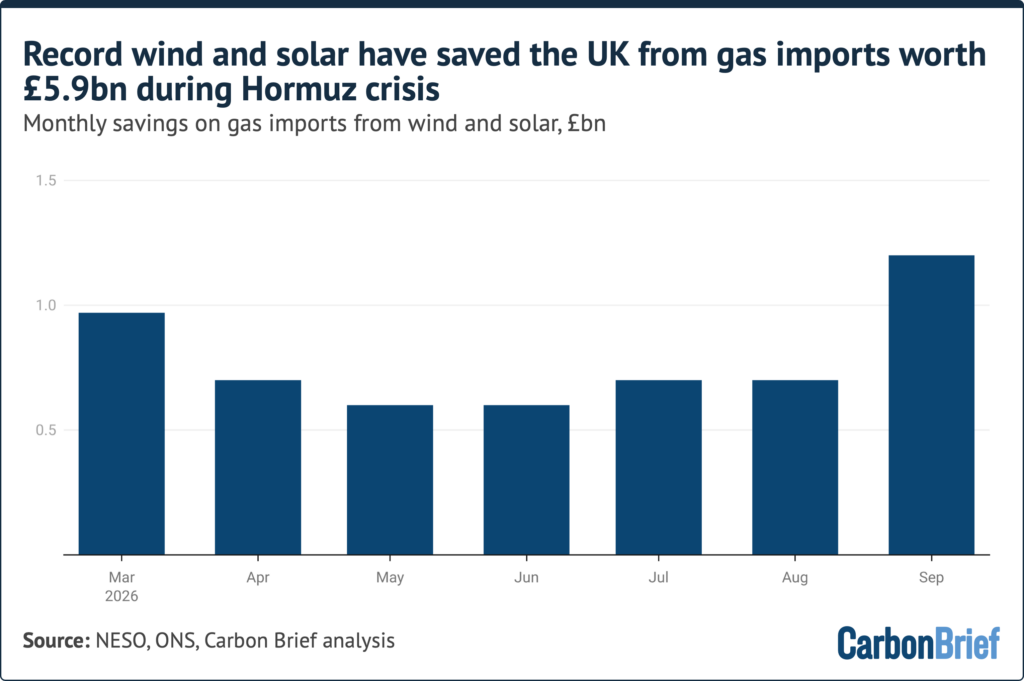
The UK has avoided the need for gas imports worth £5.9bn since the start of the Hormuz crisis as a result of record generation from wind and solar, reveals Carbon Brief analysis.
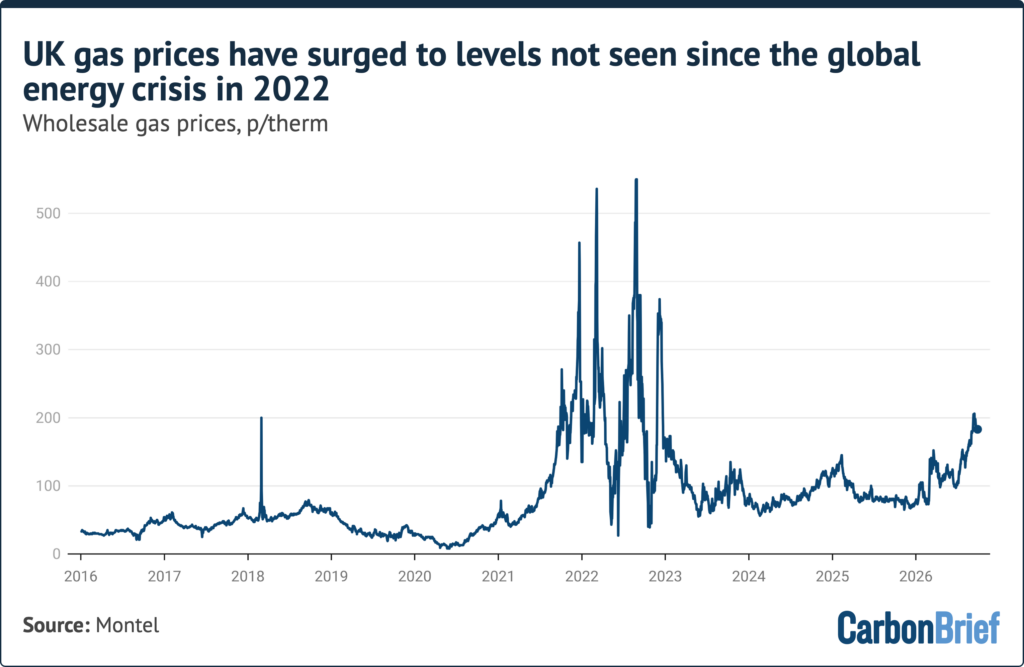
While gas prices are surging to levels not seen since the 2022 energy crisis, the UK has been generating record amounts of power from wind and solar, up 14% year-on-year.
This unprecedented clean-power generation is directly cutting the need for gas-fired electricity, which is down by nearly 10% year-on-year in 2026 to date.
In total, wind and solar have generated a record 41% share of the UK’s electricity needs in 2026 to date, compared with 25% from gas, according to Carbon Brief’s analysis.
The figure below shows that wind and solar has avoided the need for UK gas imports worth £5.9bn, since the outbreak of war between the US and Iran in February 2026.
These avoided gas imports would have required the UK to secure the equivalent of more than 100 additional tanker deliveries of liquefied natural gas (LNG).
The £1.3bn import saving in September 2026 to date is the result of record wind and solar output, at nearly 10 terawatt hours (TWh), combined with surging gas prices.
The latest analysis updates figures published by Carbon Brief in April and May.
Wholesale gas prices in the UK have remained elevated ever since Russia cut off supplies to Europe in the wake of its invasion of Ukraine in 2022.
Gas averaged 90p per therm from 2023 until the start of this year, roughly three times above 2019 prices, before the Covid and Ukraine crises.
Since the outbreak of war in the Middle East in March, gas prices have climbed higher still, averaging 134p per therm or nearly four times the level seen in 2019.
In September 2026 to date, gas prices have averaged 189p per therm, reaching their highest level since the global energy crisis in 2022, as shown in the figure below.
UK gas prices are spiking again because winter is approaching – meaning higher demand for heating – and there is no end in sight for the Hormuz crisis.
At the same time, European gas stocks are low. This means Europe will have to compete with Asia to secure the cargoes of LNG needed to keep warm.
In the UK, high wholesale gas prices are hitting household gas bills under the price cap set by energy regulator Ofgem, whereas electricity bills have barely increased.
From this Thursday, 1 October, typical household gas bills will be 33% higher than they were in April, some £200 per year, according to thinktank Nesta.
In contrast, household electricity bills will only have risen 4%, according to Nesta’s analysis, as a result of growing generation from clean-energy sources.
Andrew Sissons, director for sustainable future at Nesta, explained in a social media post that “the link between electricity and gas prices has already begun to break”.
The UK and other fossil-fuel importing nations are being hit not only by high gas prices, but also by high prices for oil, diesel and other refined fuels.
The EU has reportedly had to pay an extra €100bn for fossil-fuel imports since the start of the crisis. Higher import bills have fallen particularly hard on low and middle-income countries, according to separate analysis.
In the UK, diesel prices have hit record levels of around £2 per litre. In contrast, recent Carbon Brief analysis shows that electric cars are up to nine times cheaper to drive.
In her speech to the Labour party conference, energy secretary Miatta Fahnbulleh said that energy bills were high because the UK is “exposed to global fossil-fuel markets”.
In his own conference speech, prime minister Andy Burnham said the expansion of clean energy was easing the impact of high gas prices on electricity bills. He said:
“We are already taking more control of our electricity prices with a massive expansion of home-grown renewables and nuclear. I have asked Miatta to speed up the breaking of the link between what we pay for power at home and the international gas market, to get bills down.”
Is net zero pushing up our bills? Ruining British industry? A worthless target? We weighed these claims up against the facts
“This is what climate change looks like, here and now,” Andy Burnham said last month, reflecting on a summer of catastrophic fires, drought and heatwave after heatwave. People were left without water, crops failed and emergency services had their busiest summer ever.
And yet with disaster on our doorsteps – and the government now recommending we stockpile in preparation for future extreme weather – there remains a sustained opposition to the UK’s plan to tackle it all: net zero.
In fact, many have doubled down on “ditching net zero” this summer. And in some fringes this is accompanied by claims that our changing climate has nothing to do with human activity. Let’s be clear: this goes against the overwhelming majority of scientists and scientific study.
We’ve already reported on how this sort of straight-up climate denial is creeping back into UK politics. But what about the softer arguments against net zero, those that appeal to people’s anxieties about the cost of living, job losses and the supposed need for pragmatism?
Many of these are also based on fallacies and falsehoods – some of them warping the scientific concept of net zero into something different altogether. Let’s dig into some of the most common myths out there.
‘Net zero is a made-up term’
The UK became one of the first major economies to bring net zero into national law in 2019, under Theresa May’s Conservative government. In a nutshell it means reducing greenhouse gas emissions by 100%, from 1990 levels, by 2050. The “net” part is that some emissions may still exist but are balanced out by removing emissions through carbon sinks, such as tree planting, or technology.
It’s a legal commitment enshrined in an amendment to the 2008 Climate Change Act, and it is based on rigorous climate science.
And yet one of the more common narratives online is that net zero is some arbitrary idea, a figure plucked out of thin air to make us poorer, colder, and plunder our economy. Reform MPs regularly refer to “net stupid zero” and Conservative leader Kemi Badenoch has called it “political fiction”. Conservative MP Andrew Bowie, who acted as May’s parliamentary private secretary when the target was brought in said in an interview with Politico last year: “What’s quite clear is that the setting of arbitrary targets with no clear plan on how to deliver them does not work for the country.”
Professor Myles Allen from Oxford University is one of the leading scientists on net zero, and has worked on the need for a finite carbon budget for over 20 years. “When I hear politicians saying, ‘I’m not a climate denier, I’m a net zero denier’, that doesn’t make any sense,” he told us. “The implication of that, obviously, is, ‘I’m comfortable with the world warming forever.’”
Key fact: Net zero by 2050 is a legal commitment, rooted in physics and atmospheric science, based on a finite carbon budget to stay within 2 degrees of warming.
‘Net zero is sending our energy bills through the roof’
Energy bills are extremely high, and set to rise further next month when the price cap increases. We are all feeling this. And many – including Reform in its election manifesto and Restore Britain’s energy policy paper – blame net zero for pushing up prices and “crippling our economy”.
But the main culprit has nothing to do with net zero.
Wholesale gas prices – the sums paid by our suppliers when they buy gas in bulk – have skyrocketed since the Iran war. In the last year, they have more than doubled. And our bills, which include a unit cost based on that wholesale price, have risen accordingly. Depending on where you live and the tariff you’re on, you’ll be paying around 7p per kilowatt-hour this September.
But what about electricity – surely that’s unaffected by price shocks in the gas industry?
This is where a concept called “marginal pricing” comes in. It’s a principle of all commodity markets, and it’s where the last available technology sets the price for what all energy suppliers receive. So if all of the UK’s energy demand is met by renewables suppliers (the cheapest option), it’s renewables setting the price. But if renewables aren’t being offered on the markets, or if demand is high, then it’s more expensive options – like gas – that set the wholesale electricity price. (Analysis from the Energy and Climate Intelligence Unit earlier this year found that wind power had reduced electricity prices by over 30%.)
The last part of the bill is the standing charge. This covers network operating costs, the maintenance of infrastructure, debt recovery and VAT. It also includes costs for some government policies such as social or environmental schemes – but this is a small percentage. So yes, our standing charges are helping pay for net zero. But they are mainly going towards upgrading pipelines and cables or claiming back unpaid bills. And they tend to make up between a fifth and a third of the total bill.
Adam Berman, policy director at Energy UK, the trade body for energy companies, explains that network costs have hugely increased because “successive governments have made the decision to finance our electricity infrastructure entirely through bills”. This is instead of “some balance between bills and general taxation which is what almost everyone else across the OECD does”. And it is this difference which makes our electricity bills more expensive than gas when you compare your two bills side by side.
However, he said: “If we hadn’t invested, in five or 10 years we would be close to the water sector, in that you’d have to be doing massive levels of investment”.
Key fact: Sky-rocketing energy bills are due to extremely high gas prices, which make both gas and electricity more expensive.
‘Net zero is destroying British industry’
Jobs are being lost in the UK’s oil and gas sector in the North Sea, and industries like steel have taken a hammering in recent decades. Reform and the Conservatives have put this down to net zero.
While it is true that the oil and gas industry reports staggering job losses – unions say 1,000 direct and indirect jobs are being lost each month – the reasons are complex. For a start, production in the North Sea has largely been in decline since 1999. Many of the wells and basins are reaching maturity, meaning that the fossil fuels are harder and more costly to extract. And as production has waned, so have jobs. (In fact, new research has shown that even in the small windows when production increased, jobs still declined.)
Losing your job can be a traumatic experience. But there is cause for hope: a recent government analysis found that oil and gas workers’ skills will be in high demand in critical sectors including clean power, construction, defence, advanced manufacturing and life sciences. It found that around 70% of oil and gas workers are already employed in occupations identified as a priority for these sectors. (For more on North Sea oil myths see Carbon Brief’s excellent analysis.)
On the other side, jobs in the UK’s renewable energy sector are growing – and have topped 145,000 for the first time according to a recent report.
Key fact: Oil and gas production in the North Sea has been in decline long before Net Zero, and jobs are declining too. However, renewables jobs are growing, and oil and gas skills are highly sought after in other industries.
‘The UK achieving net zero would make no difference anyway’
The UK’s carbon emissions have been in overall decline for decades and now account for less than 1% of the global total.
There are many variations on this myth: from “How will it make any difference?” to “Why should we make an effort when we aren’t as bad as other countries?” Rishi Sunak said it when he was prime minister in 2023. And Reform MP Lee Anderson last year asked in Parliament: “If the UK went net zero tomorrow, by how much would it reduce the Earth’s temperature by?”
Less than 1% does sound very low. However, we are also the 22nd highest emitter in the world; there are over 160 other countries with lower emissions than us.
And if you add together all the countries accounting for less than 2% of emissions, it comes to just under half the global total. If all of them took the “Why bother?” approach, it would write off our chances of a net zero world.
It’s also important to note that while China, the US and India make up the top three (with 26%, 11% and 8% respectively) this doesn’t tell the full story when it comes to emissions per person. China is the 35th highest country for emissions per capita, way behind the US and all the petrostates. The UK is 83rd, putting us roughly in the middle.
Nor does the 1% figure take into account historic emissions. England was among the first countries to industrialise. Our emissions have risen since the mid-1800s, while other countries’ did not until closer to the end of the century. When you look at historic cumulative emissions from 1750, the UK is the fifth worst offender.
A final caveat: when looking at global emissions the aviation and shipping industries are not included. They are grouped together like a separate country and according to 2024 data count for just over 3% of global emissions. So flights taken by British people don’t count towards the UK’s reported emissions. And British people take a relatively high number of flights.
If anything, the 1% figure is obscuring the fact that the UK is in fact an outsized contributor to global emissions. A net zero UK would make a huge difference to the world.
(None of this is to mention the simple argument that we have a moral duty to clean up after ourselves, regardless of the size of the mess – as summarised by this caller to LBC).
Key fact: The UK is a lower emitting country at less than 1% of global emissions. However there are over 160 low emitting countries and if everyone gave up on net zero that’s around 42% of global emissions.
‘Climate change is happening. Let’s just accept it’
Climate change is certainly happening. Forecasters warn of a “super” El Niño into 2027, with droughts, flash floods and extreme heat likely to get worse.
And yet some instruct us to simply look on the bright side and adapt to the changing world. “When it’s a bit warm, let’s enjoy it,” said Reform’s Richard Tice last month. “And if it means that English wine and sparkling wine gets better and better, fantastic.” A fortnight earlier, Sunday Telegraph editor Allister Heath had written a column titled: “Britain can’t stop climate change. Let’s just embrace a Mediterranean lifestyle.”
Pallavi Sethi, a researcher into climate misinformation at the LSE’s Grantham Institute, described the suggestion that we should simply accept climate change and scrap net zero as “dangerous and misleading”.
Reform’s Richard Tice told a press conference that there is ‘no evidence’ net zero would stop climate changeOli Scarff / AFP via Getty
At Jordan Peterson’s Alliance for Responsible Citizenship conference in London, and most recently Reform’s party conference in Birmingham, participants have raised the need to adopt more air conditioning, like the US.
It is true that we need more money to be spent on adaptation. The Climate Change Committee estimates that we need investments of around £11bn per year of both public and private investment to adapt homes, hospitals, infrastructure and many industries for a changing climate. A recent report states that “the UK was built for a climate that no longer exists today”.
Sethi told us: “Accepting that climate change is happening while giving up on efforts to limit further warming means accepting greater risks, more damage, as well as higher costs in the years ahead.”
However this is not an “either/or” scenario, and increasing temperatures lay bare the increased inequality in the UK. Some people can afford to adapt where they live, installing air con or heat pumps, or planting trees in their garden. Others cannot: they do not have the money, or the agency over Council property or a landlord’s private home. Enjoying England’s vineyards is not for the many.
Key fact: The fact that the climate crisis is already here doesn’t mean we can’t still mitigate it.
Reporter: Grace Murray Deputy Editor: Chrissie Giles Editor: Franz Wild Production Editor: Alex Hess Fact checker: Lydia Morrish
The Bureau has a number of funders, a full list of which can be found here. None of our funders have any influence over editorial decisions or output.
Donald Trump urges you to ignore facts and reality and be a Climate Science denier like him. He says that he makes millions and millions for destroying the planet, Burn, Baby, Burn and Flood, Baby, Flood.Nigel Farage urges you to ignore facts and reality and be a climate science denier like him. He says that Reform UK has received millions and millions from the fossil fuel industry to promote climate denial and destroy the planet.UK Prime Minister Andy Burnham says that he’s going to permit the Jackdaw and Rosebank North Sea fossil fuel projects. He urges you to ignore facts and reality and be a climate science denier like him. The proof is in the pudding.
This morning the Green Party leadership, Green MPs and Green peers co-signed a letter to the Secretary of State for Energy Security and Net Zero, Miatta Fahnbulleh, to urge her not to approve the Jackdaw gas field in the North Sea, citing the fact that it will not reduce energy prices, protect jobs, or give the UK energy sovereignty.
Orcas comment on killer apes destroying the planet by continuing to burn fossil fuels.
The full text of the letter is as follows:
Dear Miatta,
Do not approve Jackdaw gas field in the North Sea.
We are writing in response to alarming reports that you intend to give the go ahead to the Jackdaw gas field as soon as next week. As Green MPs and peers we cannot sit back and watch you proceed unchallenged with this act of climate vandalism.
Approving new drilling at Jackdaw will not take a penny off energy costs nor protect jobs. As you said last month, “if you care about affordability, North Sea does not solve that problem for you”, with UK bill-payers still facing the highest energy prices in three years this winter, as a result of our continued exposure to volatile global gas markets. Further, jobs in the North Sea have been in decline for two decades. Jackdaw would only create 27 direct full-time jobs, with the platform unstaffed for most of its operating life and much of the construction already having taken place in Norway. It is completely dishonest of your government to use the legitimate concerns of job security and the cost of living to falsely justify more fossil fuel extraction.
Approving Jackdaw will not give the UK energy sovereignty. Even under the most optimistic scenarios Jackdaw is projected to contribute just 2% of UK gas demand over its lifetime (Uplift, 2026). We know that the only way to achieve energy sovereignty is to get the UK off fossil fuels as fast as possible, by significantly scaling up renewable energy and electrification.
Approving new oil and gas will add fuel to the fire of the climate emergency. Last week, the UN Environment Programme warned that “immediate and sustained cuts to greenhouse gas emissions” were crucial to avoid the worst impacts of climate breakdown. Approving more fossil fuels, at a time when the UK has just experienced record-breaking and deathly heatwaves and wildfires, is a complete dereliction of responsibility.
Approving Jackdaw will line the pockets of shareholders. The operating company, Adura, a joint venture between Shell and Equinor, has been criticised for potentially allowing Shell to write off £1.3 billion in UK tax (Global Witness, 2025). Shell has also faced criticism that it paid little or no tax in this country over several years despite huge global profits. Instead of new drilling, we need to ensure that the existing tax instruments, like the windfall tax, actually bring in the revenue that was promised, and end the subsidies that multinational oil and gas companies have received at UK taxpayers’ expense.
We are therefore urging you to be straight with the public – and instead focus on measures that would actually bring down bills and create secure jobs, like scaling up cheaper home-grown renewables, rolling out a fully-funded national home insulation programme, fully decoupling the price of electricity from gas, and ending rampant profiteering by energy companies.
Your government promised change, not continuity. Approving Jackdaw, after the hottest summer on record, isn’t doing things differently. The new Prime Minister must not repeat Keir Starmer’s mistake of treating climate and nature as second order. Change starts with ruling out all new oil and gas.
Yours sincerely,
Carla Denyer MP Dr Ellie Chowns MP Adrian Ramsay MP Hannah Spencer MP Siân Berry MP Zack Polanski, Leader of the Green Party Mothin Ali, Deputy Leader of the Green Party Rachel Millward, Deputy Leader of the Green Party Anthony Slaughter, Wales Green Party Leader Baroness Bennett of Manor Castle Baroness Jones of Moulsecoomb
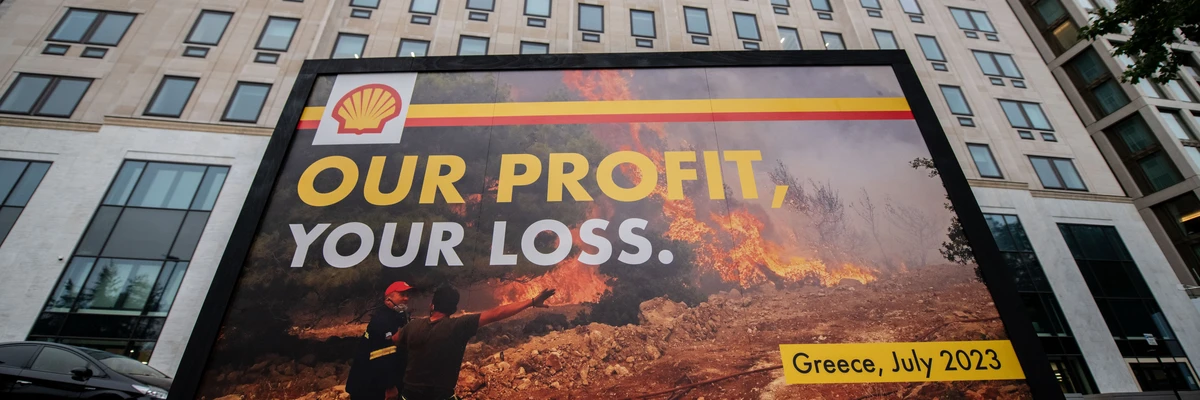
Greenpeace activists display a billboard during a protest outside Shell headquarters on July 27, 2023 in London. (Photo: Handout/Chris J. Ratcliffe for Greenpeace via Getty Images)
Solar power generation in the UK reached a new record over the summer of 2026, as temperatures across the nation soared, according to new analysis by Carbon Brief.
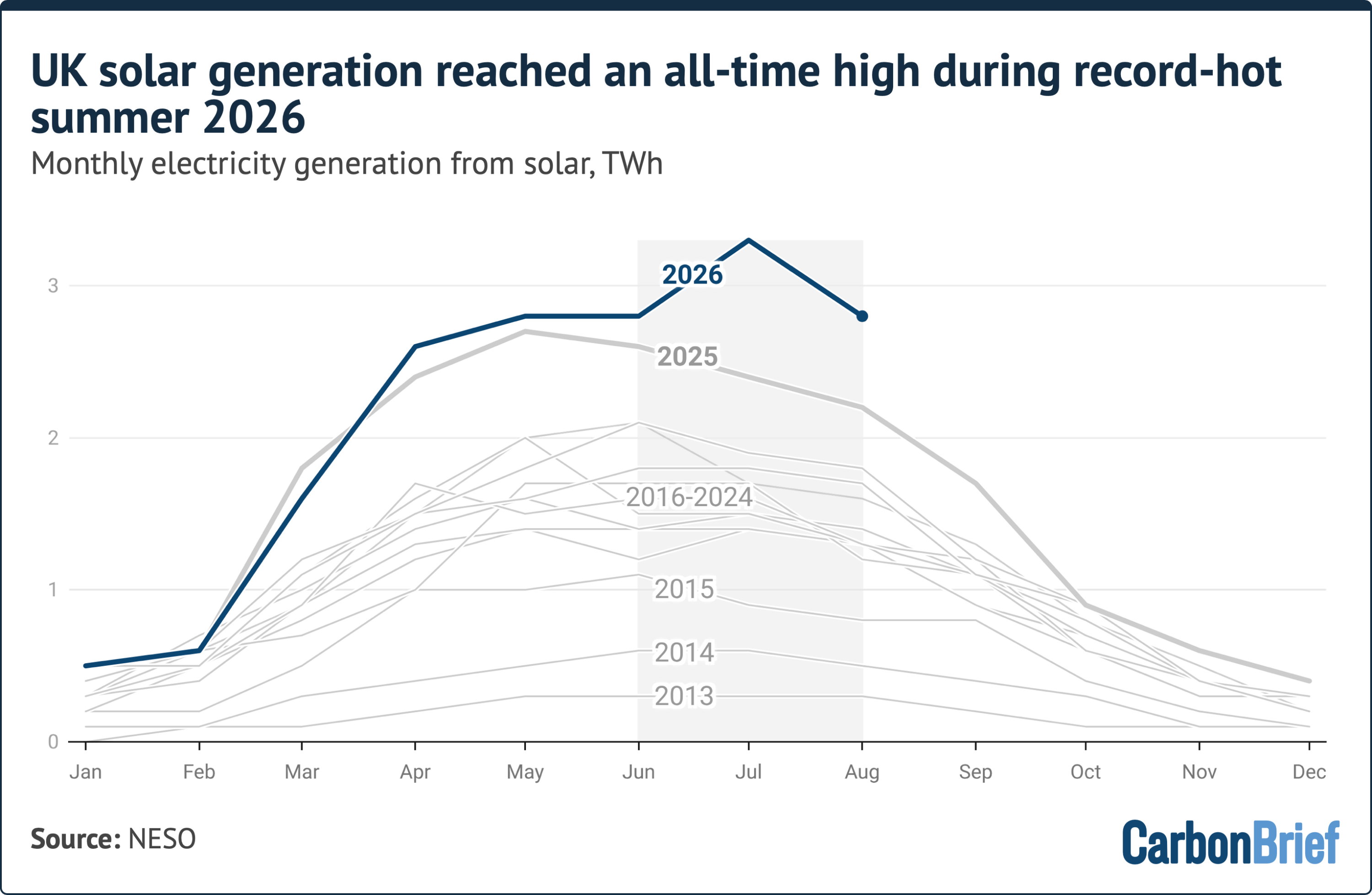
Collectively over June, July and August, solar farms and rooftops generated 8.8 terawatt-hours (TWh) of electricity in the UK*, as shown in the chart below.
Speaking to Carbon Brief, Chris Hewett, chief executive of trade association Solar Energy UK welcomed the new record, adding that it was driven by “clear skies and continued growth in deployment”.
This surge in generation took place amid the hottest summer on record in the UK, with five heatwaves between May and August.
Summer 2026 was the sixth sunniest on record, with more than 620 hours of sunshine, according to the Met Office. England and Wales – which experienced the most extreme heat – saw their second-sunniest summers on record.
June 2026 was the hottest June in England since records began in 1884, according to Met Office data, while Wales and the UK as a whole experienced their second-warmest June.
It was the driest July for England and Wales since records began in 1836, with some parts of London seeing no rain at all in the month, while Wisley in Surrey had no rain for 62 days.
In England, temperatures peaked at 38.1C at Kew Gardens in London on 13 August.
According to the Met Office, this summer’s record mean temperature was made 130 times more likely by climate change.
Amid these hot and sunny months, solar power generation increased 23% from the same period in 2025. This is double the level of solar generation over the summer of 2021, according to Carbon Brief analysis.
While solar panels can be affected by periods of extreme heat, the longer hours of daylight and higher levels of irradiation over the summer more than offset any efficiency losses.
June, July and August all saw solar set new monthly records for solar generation – July saw the highest solar generation in a calendar month ever, with 3.3TWh meeting 15% of overall electricity demand for the month.
As of the end of August, the total UK solar generation in 2026 stood at 17TWh – 13% higher than the same point in 2025.
The number of solar farms and rooftop installations has grown substantially in recent years, helping to boost generation. Domestic rooftop solar accounts for around 29% of total capacity.
In 2025, the UK’s solar capacity reached 21 gigawatts (GW) by the third quarter of the year, according to UK government figures. This is a jump of 3GW, or 18%, year-on-year, as Carbon Brief reported in January.
(Capacity is the maximum output possible from an electricity generation, whereas generation is what was produced over a certain time period, such as a day, month or year.)
This includes nearly 172,000 solar installations that have been fitted across the UK since the start of 2026, according to recent government figures. In July alone, more than 19,800 rooftop solar panels were installed – the equivalent of one installation every two minutes.
In total, nearly 1.7m households in the UK now have solar panels installed.
Over 26 heatwave days this summer – periods of at least three days when temperatures exceed the Met Office’s county-level heatwave temperature threshold – UK households with rooftop solar panels avoided an estimated £86.7m in electricity costs, according to analysis by Utility Bidder.
Talking about the surge in solar generation this summer, Hewett says:
“[It] not only kept bills down for people with solar and batteries in their homes, but helped keep overall power prices much lower than they would have been if Britain had been relying on more gas generation during the day”.
Despite the record generation, no new half-hourly solar power output record was set in the summer of 2026. This still stands at 15.2 megawatts (MW) on 23 April 2026.
* This article refers to the UK throughout, but strictly relates to the island of Great Britain, made up of England, Scotland and Wales. Northern Ireland is part of the separate, all-Ireland electricity system.
The argument that approving Rosebank and Jackdaw would cut bills and improve energy security is a ‘delusion’, say experts. Photograph: James Willoughby/SOPA Images/Shutterstock
Exclusive: Economic harm of CO2 pollution from Rosebank and Jackdaw forecast to far outweigh any boost to UK
The climate damage caused by developing the Rosebank and Jackdaw oil and gas fields under consideration by the UK government would destroy their economic benefits many times over, according to an analysis.
It estimates the economic damage caused by the carbon pollution from the oil and gas produced would be between £119bn and £336bn in the coming decades, compared with the £28.7bn in value to the UK estimated by Adura, the fossil fuel company promoting the new fields.
The assessment applies peer-reviewed research on how rising temperatures harm economies to the production estimates for the fields from the company. The figures are likely to be underestimates, as they do not include losses from amplified extreme weather, sea level rise or climate deaths. The analysis has been submitted to the Rosebank consultation and to an academic journal.
…
The argument that approving Rosebank and Jackdaw would reduce UK bills and improve energy security is a “delusion”, according to energy experts, as they are internationally traded commodities. Proponents of new drilling argue it would boost the UK economy, but the new analysis indicates this would be outweighed by long-term economic damage.
“The numbers presented here show there’s going to be a very strong destruction of [economic] value above and beyond what Rosebank and Jackdaw could generate for the UK,” said Luke Hatton, at Imperial College London, who conducted the analysis. “The alternative is to really double down on clean energy technologies.” The UK’s net zero sector has grown three times faster than the overall UK economy in recent years.
Experienced climbers scale a rock face near the historic Dumbarton castle in Glasgow, releasing a banner that reads “Climate on a Cliff Edge.” One activist, dressed as a globe, symbolically looms near the edge, while another plays the bagpipes on the shores below. | Photo courtesy of Extinction Rebellion and Mark RichardsGreenpeace activists display a billboard during a protest outside Shell headquarters on July 27, 2023 in London. (Photo: Handout/Chris J. Ratcliffe for Greenpeace via Getty Images)