This work by Middle East Monitor is licensed under a Creative Commons Attribution-NonCommercial-ShareAlike 4.0 International License.
Iranian Foreign Minister Abbas Araghchi discusses the agreement reached with the United States and regional developments at a meeting with ambassadors and diplomatic representatives from foreign countries in Tehran, Iran, on June 16, 2026. [Iranian Foreign Ministry / Handout – Anadolu Agency]
Iranian Foreign Minister Abbas Araghchi denied on Tuesday that Tehran was plotting to use chemical weapons in Washington, DC, as Parliament Speaker Mohammad Bagher Qalibaf accused US media of carrying pro-war messaging, Anadolu reports.
Araghchi wrote on US social media company X that outlets he described as “pro-Israel” circulated the chemical weapons allegation and a separate claim that Iran was building missile bases beneath dams during the previous 72 hours.
“Spare us the Iraq War-style propaganda, especially with Israeli fingerprints all over it. Nobody is buying it,” he wrote.
“Same false flags, same war mongering, new logos,” Qalibaf wrote on X. “The right’s credibility deficit is maxed out, so the messaging operation pivoted to NYT and CNN.”
Qalibaf said the operation was “approved by Larry Ellison,” whom he described as the Israeli military’s largest private donor and “CNN’s new owner.” He added, “Media capture in full swing.”
The Iranian rejection followed a CNN report Monday citing seven US officials familiar with intelligence indicating that Iran had been exploring potential attacks on senior Trump administration officials in Washington involving a radioactive dirty bomb or chemical weapons.
The intelligence points to efforts to develop possible attack options rather than evidence of an imminent operation, according to the report. Some sources said specific locations and potential targets in the US capital had been identified.
The reported activity has prompted heightened security concerns and contingency planning among US officials, but there is disagreement about whether Tehran has the capability or intention to carry out an attack.
White House spokesperson Lauren Bis said the administration is monitoring potential threats but stressed that there are no “credible threats to the homeland” at this time.
During the meeting with representatives of Saudi Arabia, Turkey, and Pakistan earlier this month, Iran proposed greater unity with the Gulf countries and Iraq for regional peace and stability.
In the latest round of “tit-for-tat” attacks, Iran claimed it destroyed the US army’s early warning radar system in Bahrain on Friday, November 13, in retaliation to its attack against its telecommunication tower in Sirik earlier.
In the statement, the Islamic Revolutionary Guard Corps (IRGC) also reiterated the warning to the “aggressor enemy to cease its aerial provocations and oil smuggling in the Strait of Hormuz” and other countries aiding in its aggression.
Meanwhile, the Iranian Navy claimed at least two more oil tankers caught fire after they violated its warnings and tried to enter the prohibited area of the Strait of Hormuz on Thursday.
The tankers had switched off their radar system and entered the “unsafe” area when they hit sea mines and caught fire, it claimed.
In recent weeks, scores of tankers and ships have been hit in a similar manner while trying to cross the Strait of Hormuz, bypassing Iranian restrictions. On Wednesday, two super tankers reportedly carrying over 4 million barrels of oil had suffered similar explosions after failing to comply with Iranian warnings.
The regular attacks on oil tankers contradicts US claims of control over the Strait of Hormuz and the normalization of oil shipments in the waterway through which nearly a quarter of global energy trade passes.
Iran’s retaliation will have no geographical boundary
On Thursday, Mohsen Rezaei, chief of Iran’s Supreme National Security Council (SNSC) had warned the US that if it “launches another war against Iran, every military base involved in the aggression – from West Asia to Europe – will be a legitimate target for Iran’s lethal strikes.”
“No safe distance. No safe heaven. No immunity,” he said in a post on X.
During an interview with Al-Mayadeen earlier he explained that unlike in the previous rounds, the Iranian retaliation to any fresh US attack will have no geographical limitation.
He claimed the decision about this has been made on the basis of orders issued by Supreme Leader Ayatollah Mojtaba Khamenei last month.
Iran has already removed the 2,000 mile restrictions on its missile ranges, various Iranian military officials have been reported saying by the Iranian media in recent days. In the previous rounds of the war, Iranian retaliation against US military bases and assets were limited to the region.
US President Donald Trump has given mixed signals about the war on Iran. In his recent statements, he has admitted there was no further need of restarting the war without ruling out limited targeted attacks on its nuclear facilities.
Reacting to a statement issued after the G7 Foreign Ministers meeting on Thursday about their possible involvement in US efforts in the Strait of Hormuz, Esmail Baghaei, official spokesperson of Iran’s Ministry of Foreign Affairs, warned all foreign governments against providing any kind of military or logistical support to the US even on the pretext of protecting “freedom of navigation.”
Any such assistance would be considered an “unlawful act of aggression” against Iran and would invite Iranian retaliation, Baghaei warned.
The ball is in Washington’s court
In an interview with Al-Jazeera on Wednesday, Mohammad Bagher Ghalibaf, speaker of Iran’s Parliament and its chief negotiator, claimed that Iran has conveyed a clear and reasonable response to the US setting out its conditions and now the US has to decide how it would like to take it forward.
“Iran would like to end the no war no peace situation,” he said claiming “we are not warmongers, we are not seeking war, and we do not want war to continue.”
Ghalibaf also dismissed the claims made by Secretary of State Marco Rubio that the Iranian conditions were unreasonable.
How are the lifting of the blockade, removing sanctions, and ending the war on all fronts “unreasonable,” Ghalibaf asked, claiming that these are the basic minimum demands concerning the Iranian people and the US must accept them if it wants further engagement.
Underlining the lack of trust with the US; it has attacked Iran during the ongoing negotiations twice and has violated the June 17 Memorandum of Understanding (MoU), weeks after signing it, Ghalibaf argued that it is natural that Iran is very cautious about any future deal.
Ghalibaf reiterated the Iranian position that the presence of the US military in the region has created insecurity rather than stability and the countries in the region must work together to establish lasting security without outside interference.
During his meeting with the representatives of Saudi Arabia, Turkey, and Pakistan earlier this month, Rezaei had reportedly proposed the formation of an eight-country Gulf Union, including the six Gulf countries and Iran and Iraq.
The three countries have recently formed a collective security group called the Mecca Defense Pact and are seeking to increase its membership.
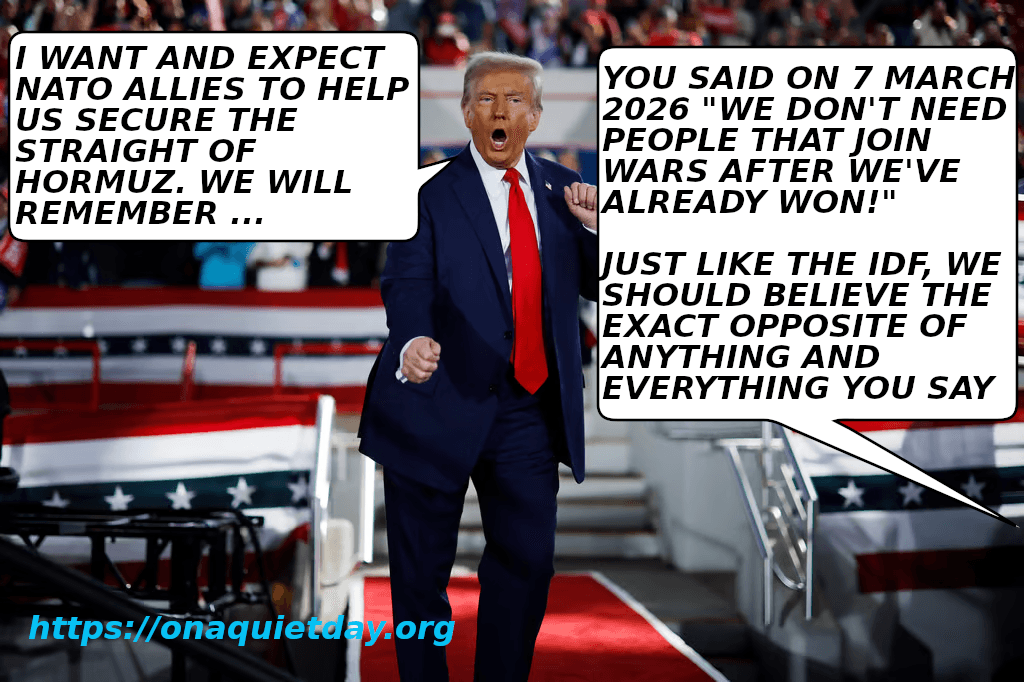
Donald Trump calls for help from NATO allies in securing the Strait of Hormuz despite saying on 7 March 2026 that they don’t need people to join wars after they’ve already won. He’s challenged with the claim that he lies as much as the IDF.
This work by Middle East Monitor is licensed under a Creative Commons Attribution-NonCommercial-ShareAlike 4.0 International License.
The Bab al-Mandeb Strait. [Photo/AA]
Forces loyal to Yemen’s internationally recognised government have withdrawn from positions west of Taiz near the Bab al-Mandab Strait, while the Houthis have announced that they have taken control of the forces’ rear positions.
The Yemeni Armed Forces, which are backed by Saudi Arabia and loyal to the internationally recognised government, said they had carried out a redeployment from Dhubab Airport and the Bab al-Mandab area in western Taiz province, heading towards Aden, where the government is based.
In a statement, the Southern Forces said the move was aimed at prioritising the security of Aden and neighbouring provinces, strengthening front lines and addressing existing threats.
Meanwhile, a Houthi military source said the withdrawing forces had lost their positions and rear lines and had been forced to retreat towards Aden under the pretext of protecting the city.
The withdrawal of government forces from the Bab al-Mandab area gives the Houthis greater control over the narrow maritime passage and increases pressure on global shipping, at a time when Iran continues to disrupt maritime traffic through the Strait of Hormuz on the other side of the Arabian Peninsula.
This dual pressure could further disrupt oil supplies from Gulf producers through their main shipping routes. Bab al-Mandab is one of the world’s most important and busiest waterways for the transport of goods, particularly shipments travelling from Asia to Europe through Egypt’s Suez Canal.
This work by Middle East Monitor is licensed under a Creative Commons Attribution-NonCommercial-ShareAlike 4.0 International License.
U.S. Navy warplane takes off from the aircraft carrier USS Abraham Lincoln during Operation Epic Fury targeting Iran in the Gulf of Oman, on March 01, 2026. [U.S. Navy / Handout – Anadolu Agency]
The aircraft carrier USS Theodore Roosevelt arrived in the Middle East on Sunday, increasing the number of US carrier strike groups in the region to three, US news outlet Axios reported, citing an American official.
The Nimitz-class warship entered the area of responsibility of US Central Command (CENTCOM), which oversees military operations across the Middle East, after departing Singapore earlier this month and transiting the Strait of Malacca.
Built by Northrop Grumman in Virginia and in active service for 40 years, the USS Theodore Roosevelt serves as the flagship of Carrier Strike Group 9 and began its current deployment on Sept. 27.
Its arrival reinforces two other US carriers already operating primarily in the Arabian Sea. The USS George H.W. Bush has remained in the region on an extended deployment since April as part of Carrier Strike Group 10, while the USS George Washington, normally forward-deployed to Japan, has operated there with Carrier Air Wing 5 since August.
The New York Times reported earlier Sunday that the vessel was expected to reach the Middle East within a day.
Neither the US 5th Fleet nor CENTCOM responded to Anadolu’s request for confirmation.
The naval buildup comes amid the ongoing Iran war, which began with coordinated US-Israeli strikes in late February, and stalled diplomatic efforts between Washington and Tehran. US President Donald Trump recently removed Vice President JD Vance from peace talks and declared on social media that Washington no longer needs an agreement with Iran.
Despite the expanded carrier presence, the US military recently denied an Israeli media report alleging it was preparing to resume operations against Iran, dismissing claims of regional force posture changes as “pure speculation.”
This work by Middle East Monitor is licensed under a Creative Commons Attribution-NonCommercial-ShareAlike 4.0 International License.
Commercial vessels and oil tankers preparing to transit through the Strait of Hormuz, one of the most critical strategic waterways for global trade flows, maintain their wait in the Gulf of Oman, on June 17, 2026. [Shady Alassar – Anadolu Agency]
Iran’s navy said Saturday that two oil tankers caught fire in the eastern Strait of Hormuz after hitting a naval mine, Anadolu reports.
“Fire and explosions are the fate of tankers involved in illegal activities that have turned off their tracking systems and are operating in restricted areas,” the navy said in a statement carried by Iran’s semi-official Tasnim news agency.
The statement did not identify the tankers, their flags or the extent of the damage. There was no immediate independent confirmation of the incident.
The Strait of Hormuz, a strategic shipping route connecting the Gulf with the Gulf of Oman, has faced repeated disruptions since the US-Israeli military offensive against Iran began on Feb. 28.
Iranian forces have previously reported similar incidents involving commercial vessels entering restricted waters, while tensions over maritime access and the US naval blockade remain central to diplomatic efforts between Tehran and Washington.
Donald Trump calls for help from NATO allies in securing the Strait of Hormuz despite saying on 7 March 2026 that they don’t need people to join wars after they’ve already won. He’s challenged with the claim that he lies as much as the IDF.