Author: dizzy

  • Who funds Reform? Farage’s party bags £15m from crypto and finance donors

    Spread the love

    Article by Ethan Shone republished from OpenDemocracy under a Creative Commons Attribution-NonCommercial 4.0 International licence.

    Darren Staples/Bloomberg via Getty Images

    Reform has accepted more large donations than any other party in 2026, despite mounting funding scandals, new data shows

    Nigel Farage’s party received large donations totalling almost £15m in the first six months of this year, according to Electoral Commission records, including millions of pounds from a crypto billionaire who was pardoned by Donald Trump last year. 

    Reform’s fundraising operations continue to prove highly effective in spite of its ongoing scandals. The party is amassing a massive financial war chest ahead of the next general election, which many in Westminster believe could take place as soon as next autumn.

    The latest donations data comes as Reform suspends two senior aides pending an investigation, after an undercover sting exposed their alleged role in facilitating secret donations, including from impermissible donors overseas. Rival parties said they have reported Reform to the police, while the Electoral Commission said it is “considering all relevant information” and is “in touch with the Met Police”. Reform has denied any wrongdoing.

    The events have overshadowed the party’s conference in Birmingham this weekend, and are the latest in a series of scandals the party has faced over its funding this year. In July, openDemocracy travelled to Montenegro to investigate the lives and business interests of key Reform allies and donors, including ‘Posh George’ Cottrell and billionaire crypto investor Christopher Harborne, in the glamorous coastal resort of Tivat.

    At the same time, a number of news reports raised serious questions about Cottrell and Farage, after The Sunday Times reported the Clacton MP had failed to disclose in-kind support from the 32-year-old convicted fraudster. The allegations led to calls for an investigation by parliamentary authorities, which were already probing a £5m gift that Farage allegedly failed to declare having received from Harborne.

    Reform’s crypto funding

    The latest data shows Reform continues to bring in significantly more from large donations than the other parties: £5.3m in the second quarter of 2026, compared to £3.6m for Labour and £2.8m for the Conservatives. 

    That brings the party’s total donations this year to almost £15m, meaning it has accepted almost twice as much as Labour (£8m) and more than double the Conservatives (£7m).

    Reform receives the vast majority of its funding from a small number of high-value donors, with Harborne, a crypto investor based in Thailand, by far the party’s most significant donor to date. 

    Now, the party has added another crypto billionaire with offshore links to its ranks of mega donors; Sheffield-born Ben Delo gave the party £4m in April, following two £2m donations in January and March. 

    British crypto entrepreneur Delo has rapidly become one of Reform UK’s largest individual donors, having given the party £8m across the first half of 2026 – £4m in each quarter. If he continues this trend throughout the rest of the year, he could surpass Harborne’s current total.  

    Delo is one of many Reform donors with strong interests in the crypto sector. He was a software engineer at IBM and later built high-frequency trading systems at JPMorgan and GSA Capital in Hong Kong, before co-founding cryptocurrency derivatives exchange BitMEX. In 2020, US federal authorities charged the BitMEX founders with violating the Bank Secrecy Act over inadequate anti-money-laundering controls; Delo pleaded guilty in 2022, paid a $10m penalty and served 30 months’ probation, which ended in December 2024. Trump pardoned him in March 2025.

    Delo’s latest donations come after the government imposed a £100,000 cap on donations from overseas residents in March 2026. At the time, Delo said he would move back to the UK to sidestep the restriction, and he has reportedly signalled plans to keep funding the party from Britain going forward. 

    Big finance and former Tories

    Reform also continues to add new donors with interests in the financial sector. Over the past year, senior figures in the party have engaged with lobbyists in the City of London, seeking both policy ideas and financial support. 

    Lucas Bitencourt, a young finance entrepreneur, gave the party £100,000, while private equity firm Bryden Capital gave £50,000 and a Jersey financial adviser who works with “the world’s first bitcoin investment fund” gave £25,000. 

    A Scottish corporate lawyer specialising in private equity and technology continues to provide funding, giving £100,000 in May. He has now given the party £300,000 in total. 

    An investment firm linked to Chelsea owner Todd Boehly – a significant donor to conservative politics in the US – also gave the party £75,000. 

    Robert Jenrick, Reform’s Treasury spokesman, also received a significant donation after defecting to the party from the Conservatives. Jenrick received £50,000 from a donor with ties to financial services and crypto, Michael Cohen of Capital Group, an investment firm that the Wall Street Journal last year reported was “ploughing billions into crypto”.

    Three former Tory donors continue to make up a significant portion of Reform’s funding base: Bassim Haidar, Johan Christofferson and Roger Nagioff all contributed six-figure sums in recent months and have now given over a million between them since the last election. Excluding Harborne, who gave Boris Johnson £1m in 2022, former Tory donors have given Reform over £3m since the 2024 vote. 

    Article by Ethan Shone republished from OpenDemocracy under a Creative Commons Attribution-NonCommercial 4.0 International licence.

    Nigel Farage is scathing at the £250,000 cost to the taxpayer of his unnecessary and ridiculous Clacton-on-Sea election campaign that he caused to avoid scrutiny and acccountability for the £5MILLION 'gift' that he didn't declare.
    Nigel Farage is scathing at the £250,000 cost to the taxpayer of his unnecessary and ridiculous Clacton-on-Sea election campaign that he caused to avoid scrutiny and acccountability for the £5MILLION ‘gift’ that he didn’t declare.
    Nigel Farage urges you to ignore facts and reality and be a climate science denier like him and his Deputy Richard Tice. He says that Reform UK has received £Millions and £Millions from the fossil fuel industry to promote climate denial and destroy the planet.
    Nigel Farage urges you to ignore facts and reality and be a climate science denier like him and his Deputy Richard Tice. He says that Reform UK has received £Millions and £Millions from the fossil fuel industry to promote climate denial and destroy the planet.
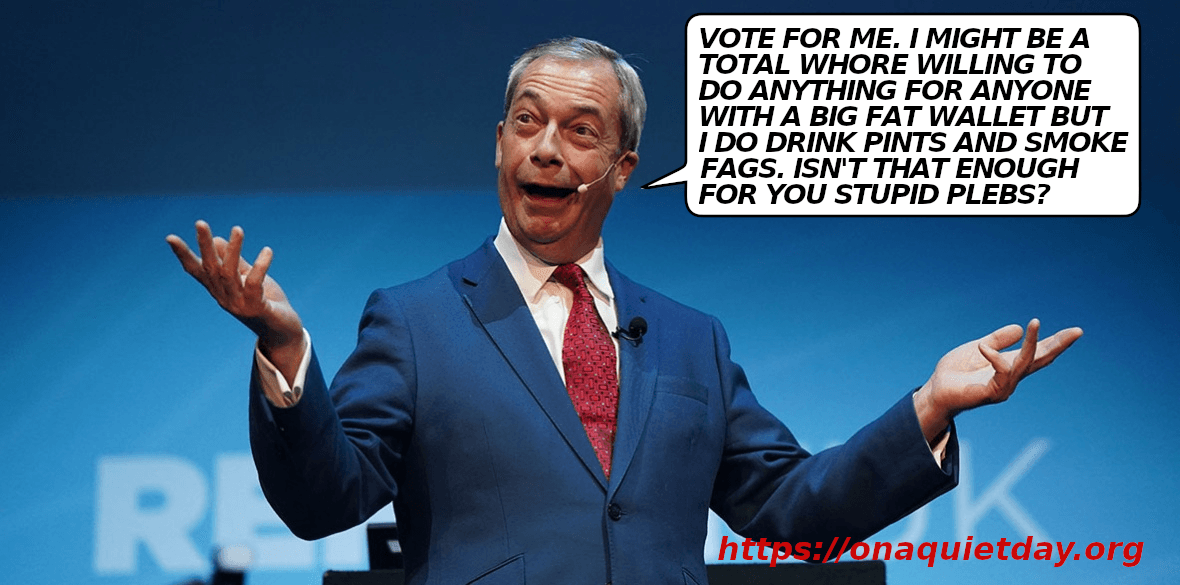
    Nigel Farage admits to being a whore willing to do anything for someone with a big fat wallet and asks whether drinking pints and smoking fags is not enough for the stupid plebs.
    Nigel Farage admits to being a whore willing to do anything for someone with a big fat wallet and asks whether drinking pints and smoking fags is not enough for the stupid plebs.
  • Palestine activists appeal ‘unprecedented’ terror sentences

    Spread the love

    https://youtu.be/gv24jq6vkA0

    Palestine Action activists are appealing their unprecedented terrorism convictions. Their sentencing in June 2026 was the first time in British legal history that criminal damage convictions were sentenced as terrorism.

    At a press conference in London, Simon Natas, the lawyer for Ellie Kamio, Charlotte Head, Fatema Zainab and Samuel Corner, told the press that in his 15 years working on similar cases, he would have been completely shocked if any of those were charged with a terrorism connection.

    Also speaking were Emma and Sukaina – the mothers of Ellie and Fatema – as well as Dr James Smith and Dr Shahd Hammouri.

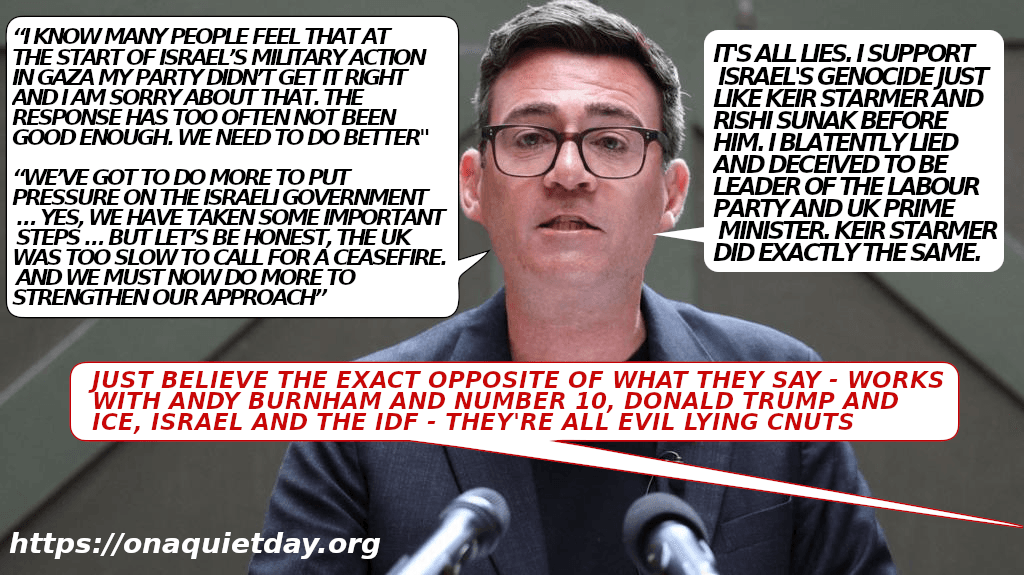
    Keir Starmer objects to criticism of the IDF. He asks how could anyone object to them starving people to death, forced marches like the Nazis did, bombing Gaza's hospitals and universities, mass-murdering journalists, healthworkers and starving people queuing for food, killing and raping prisoners and murdering children. He calls for people to stop obstructing his genocide for Israel. New Labour UK Prime Minister Andy Burnham continues Labour party policy of active support and complicity in Israel's genocide.
    Keir Starmer objects to criticism of the IDF. He asks how could anyone object to them starving people to death, forced marches like the Nazis did, bombing Gaza’s hospitals and universities, mass-murdering journalists, healthworkers and starving people queuing for food, killing and raping prisoners and murdering children. He calls for people to stop obstructing his genocide for Israel. New Labour UK Prime Minister Andy Burnham continues Labour party policy of active support and complicity in Israel’s genocide.
    UK Prime Minister Andy Burnham admits to blatently lying and engaging in deception to become leader of the UK Labour Party and Prime Minister.
    UK Prime Minister Andy Burnham admits to blatently lying and engaging in deception to become leader of the UK Labour Party and Prime Minister.
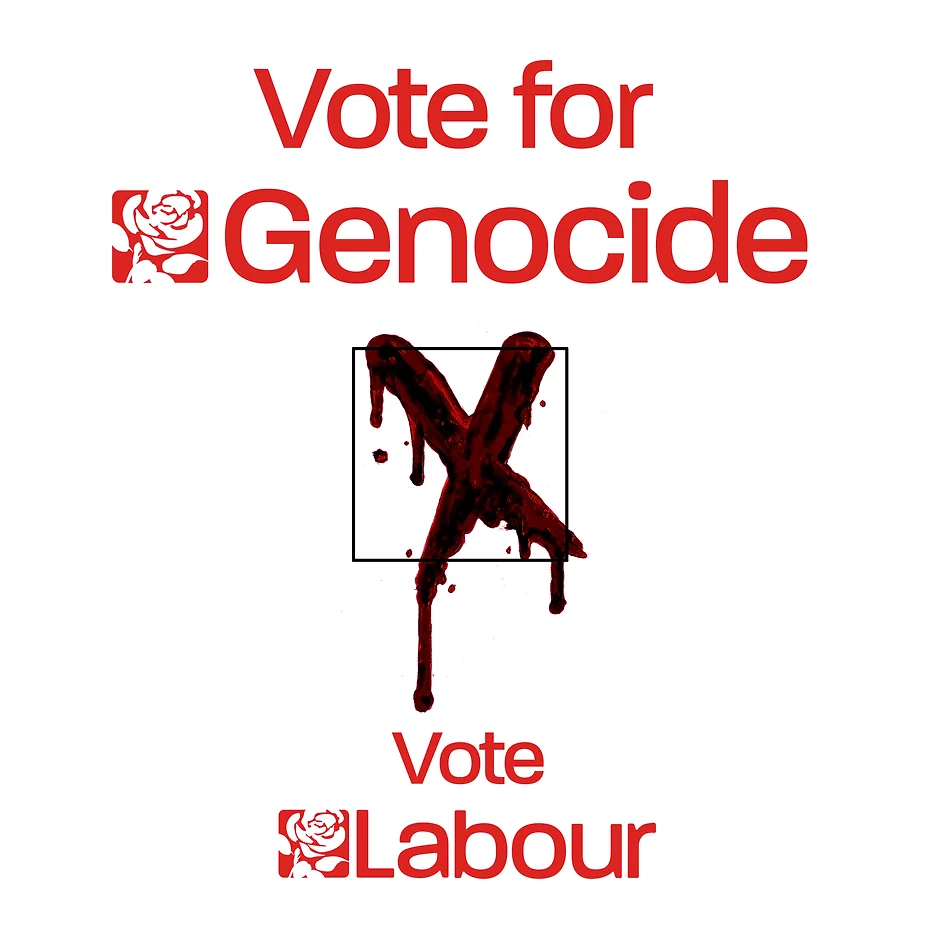
    Vote Labour for Genocide.
    Vote Labour for Genocide.
  • ‘What a Disgrace’: Trump Treasury Dept. Refuses to Close Billionaire’s Private Jet Loophole

    Spread the love

    Article by Jon Queally republished from Common Dreams under Creative Commons (CC BY-NC-ND 3.0).

    Allen & Co Brings Together Media And Tech Titans In Sun Valley
    SUN VALLEY, IDAHO – JULY 10: Private jets parked at the Friedman Memorial Airport during the Allen & Company Sun Valley Conference on July 10, 2025 in Sun Valley, Idaho. Every year, some of the world’s wealthiest and most powerful figures from the media, finance, technology, and political spheres converge at the Sun Valley Resort for the exclusive week-long conference hosted by boutique investment bank Allen & Co. Photo by Kevin Dietsch/Getty Images

    “While working families struggle to afford groceries, housing, and gas,” said Sen. Chris Van Hollen, the Trump administration “focuses on tax breaks for billionaires—including tax breaks for private jets.”

    A group of Democratic Caucus members in the US Senate on Thursday denounced the US Treasury Department under President Donald Trump over its refusal to close a gaping loophole in the federal tax code that allows some of the wealthiest people in the country to reap tax benefits from their ownership and use of private jets—even as working people and the middle class families struggle to make ends meet in Trump’s economy.

    In response to a previous request made in July by Sens. Sheldon Whitehouse (D-RI), Elizabeth Warren (D-Mass.), Chris Van Hollen (D-Md.), Ed Markey (D-Mass.), and Bernie Sanders (I-Vt.) to close a rule that allows the wealthy “to substantially undervalue the taxable cost of personal travel on a corporate private jet,” a letter from a top Treasury official on Thursday said such an effort would be too “burdensome,” including for the uber-rich taxpayers subject to it.

    RECOMMENDED…

    Elon Musk Holds Town Hall Ahead Hotly Contested Wisconsin State Supreme Court Election

    Trump Admin Permanently Guts Law ‘Designed to Stop Criminals from Laundering Money’ After Push From Elon Musk

    US-POLITICS-TRUMP-WEALTH-FUND

    ‘A Government of the Rich, by the Rich, for the Rich’: Nearly 60 Top Trump Officials Worth $100 Million or More

    Known as the Standard Industry Fare Level (SIFL) loophole, the lawmakers have argued that it has been exploited by the extremely wealthy to lower their tax burden even as they travel the country—and the world—in the least energy efficient and most polluting way possible.

    “President Trump’s 2017 tax law and Big, Beautiful-for-Billionaires bill handed billionaires and big corporations massive tax breaks on private jets,” said Sen. Whitehouse in a statement. “The Trump administration now says it would be ‘burdensome’ to close the private jet tax loophole because this is an administration hell-bent on using the powers of government to make the ultra-rich even richer, and they don’t care if middle-class taxpayers get stuck with the tab.”’

    Alongside their July letter, the lawmakers shared analyses detailing the loss of the revenue made possible by the SIFL loophole. According to the Whitehouse’s office,

    analyses by the nonpartisan Joint Committee on Taxation detailing the boom in private jet sales after passage of Republicans’ tax cut for corporate jets and highlighting the extent of the tax revenue lost by the abuse of the SIFL loophole. One analysis responds to an inquiry from the senators on the tax consequences of the SIFL loophole, finding that a wealthy executive would pay roughly between $1,577 and $1,804 less in taxes for a flight from JFK airport in New York City to DCA airport in Washington, D.C. under the SIFL method. The fair market value of that flight could range from $4,500 to $5,112, but under SIFL, that executive would only have to report a value of $235.77.

    Van Hollen on Thursday denounced the shamefulness of yet another Trump administration position that rewards the wealthy and powerful at the expense of working people.

    “Trump’s priorities revolve around enriching himself and his billionaire friends. While working families struggle to afford groceries, housing, and gas, this Administration focuses on tax breaks for billionaires—including tax breaks for private jets,” said Van Hollen.

    “What a disgrace,” he added.

    Article by Jon Queally republished from Common Dreams under Creative Commons (CC BY-NC-ND 3.0).

    Orcas discuss Donald Trump and the killer apes' concept of democracy. Front Orca warns that Trump is crashing his country's economy and that everything he does he does for the fantastically wealthy.
    Orcas discuss Donald Trump and the killer apes’ concept of democracy. Front Orca warns that Trump is crashing his country’s economy and that everything he does he does for the fantastically wealthy.
  • How this summer’s heat and drought impacted crops in Europe – in six charts

    Spread the love

    Food and farming By: Orla Dwyer, Ho Woo Nam

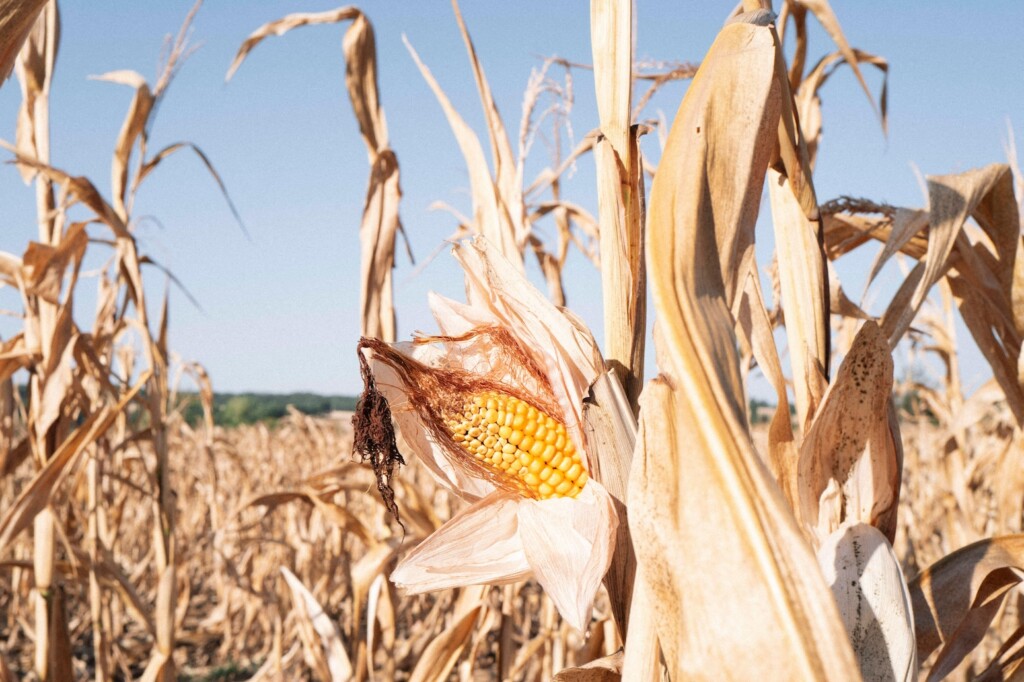
    A dried-out field of maize crops in Tarn-et-Garonne, France in August 2026. Credit: Abaca Press / Alamy Stock Photo

    Farmers around Europe are dealing with the aftermath of a summer of extreme heat, drought and wildfires that were exacerbated by climate change. 

    Human-caused climate change is increasing the severity and likelihood of many extreme weather events around the world, which is increasing volatility for food producers.

    This summer resulted in, for example, shrunken potatoes in the Netherlands, reduced carrot harvests in France, dried-up rice fields in Italy and scorched olive groves in parts of the Mediterranean region.

    Global food prices are currently at their highest level since early 2023 due to “heatwaves and energy price dynamics”, according to the UN Food and Agriculture Organization. 

    Other factors such as blocked fertiliser supplies in the Strait of Hormuz and high fuel costs have also played a role in this year’s agricultural outputs. 

    In the six charts below, Carbon Brief provides a snapshot of the impact this summer’s extremes are considered to have had on crop production and yields across Europe. 

    1. Most EU countries expect to see declines in cereal production this year

    2. Most countries are recording reduced crop yields

    3. Around €2bn worth of cereal losses after June heatwave

    4. UK yields of wheat, barley and oats are all due to drop in 2026

    5. Maize production in France is due to hit a four-decade low

    6. Declines in EU grains since 2025

    6. Declines in EU grains since 2025

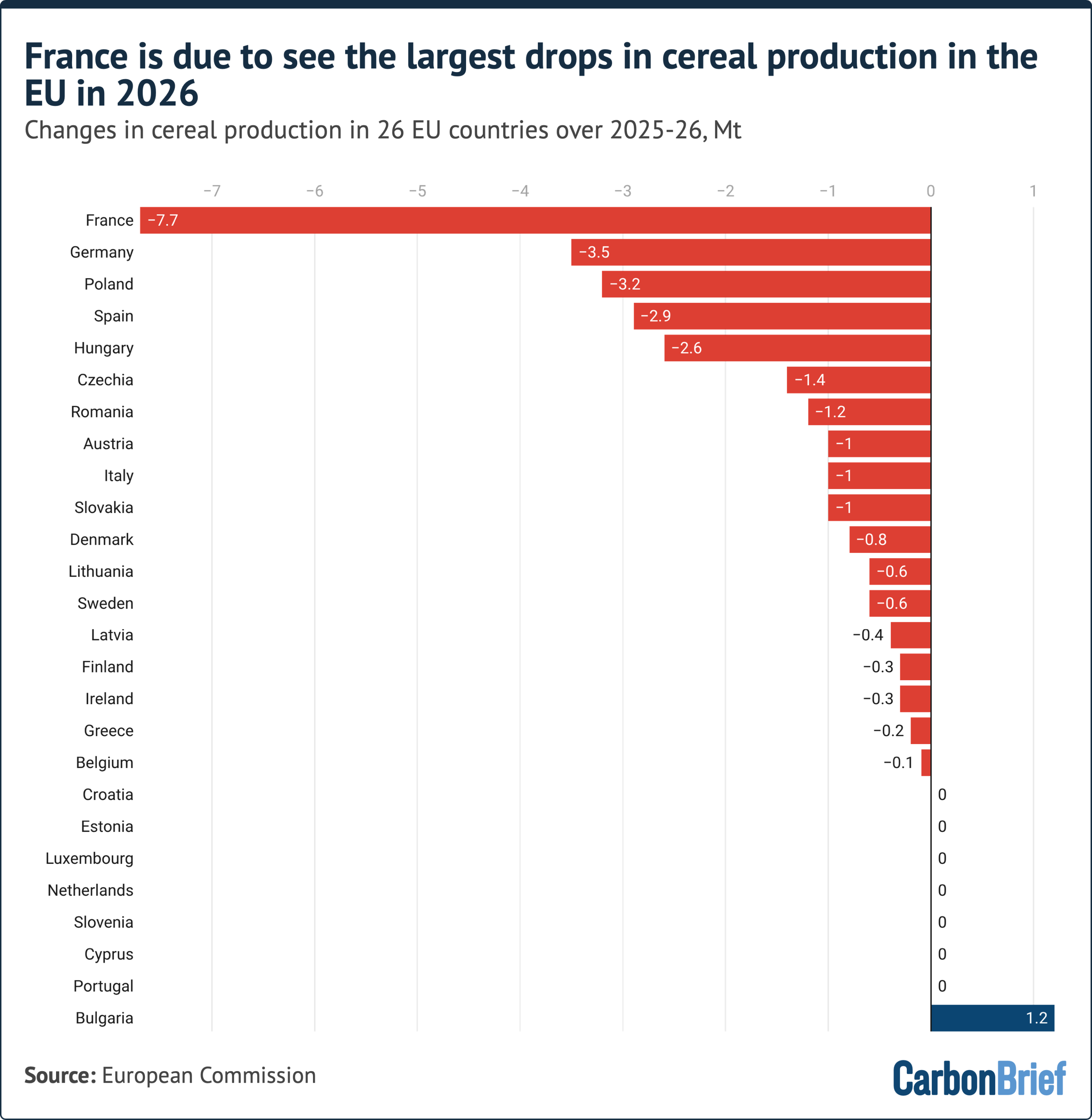
    1. Most EU countries expect to see declines in cereal production this year

    Bar chart showing that France is due to see the largest drops in cereal production in the EU in 2026. The bar chart shows that France's cereal production in 2026 has dropped -7.7 Mt of followed by Germany (-3.5 Mt), Poland (-3.2 Mt), Spain (-2.9 Mt), and Hungary (-2.6)
    Changes in cereal production in 26 EU countries between 2025 and 2026. Malta is excluded due to a lack of available data. Source: European Commission.

    France, in particular, will see heavy losses in the amount of cereals – such as wheat, barley and oats – it produces this year, according to European Commission data. 

    French cereal production is expected to drop by almost 8 megatonnes (Mt) in 2026, compared to 2025. 

    The chart above shows that most European countries, aside from Bulgaria, will also see production losses this year. 

    Germany is due to see the second-largest losses in production, dropping by almost 4Mt compared to 2025.

    Prof Til Feike, a cropping systems expert at the Julius Kühn-Institut, says many areas in Germany and Austria, as with other parts of Europe, have been “hit hard by a long-lasting dry period in combination with record-high heatwaves”.

    This has resulted in dry grassland for animals and lower yields of maize, which is a “key fodder crop” for livestock. He tells Carbon Brief: 

    “In the long run, farming must adapt better to more extreme weather conditions, not only heat and drought, but also prolonged wet periods. So, there is no one-fits-all solution for climate change adaptation.” 

    2. Most countries are recording reduced crop yields 

    Heat and a lack of water have “substantially worsened” crop expectations this summer in western and most of central Europe, according to a recent bulletin from the EU Joint Research Centre.

    Yields are expected to be “significantly reduced”, with local crop failures “likely” in areas such as France, southern Germany, northern and central Italy, and Hungary, it added. 

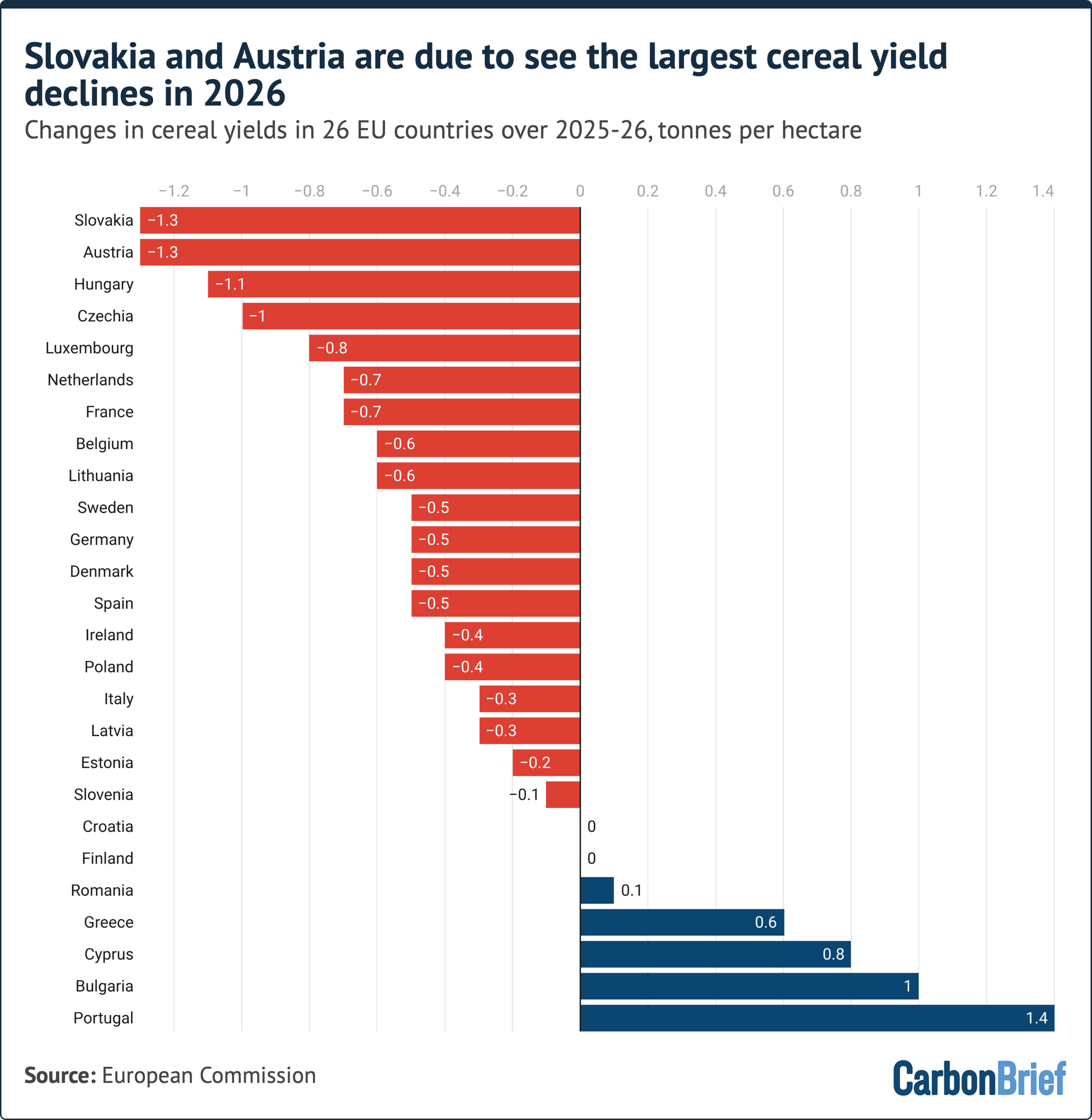
    The chart below shows that yields of cereal grains – which, here, refers to the tonnes of a grain grown per hectare of land – are expected to fall in most EU countries in 2026.

    Bar chart showing that Slovakia and Austria are due to see the largest cereal yield declines in 2026. The bar chart shows that both Slovakia and Austria have seen their cereal yields drop -1.3 tonnes per hectare over 2025-26.
    Changes in cereal yields in 26 EU countries between 2025 and 2026. Malta is excluded due to a lack of available data. Source: European Commission.

    Slovakia, Austria and Hungary are expected to see the largest declines in cereal yields, reducing by more than one tonne per hectare in 2026 compared to 2025.

    The recent EU bulletin noted that irrigated crops performed well in Portugal this summer – the country with the largest yield increases. Other crops relying on rainfall showed growing signs of heat stress, it added.  

    3. Around €2bn worth of cereal losses after June heatwave 

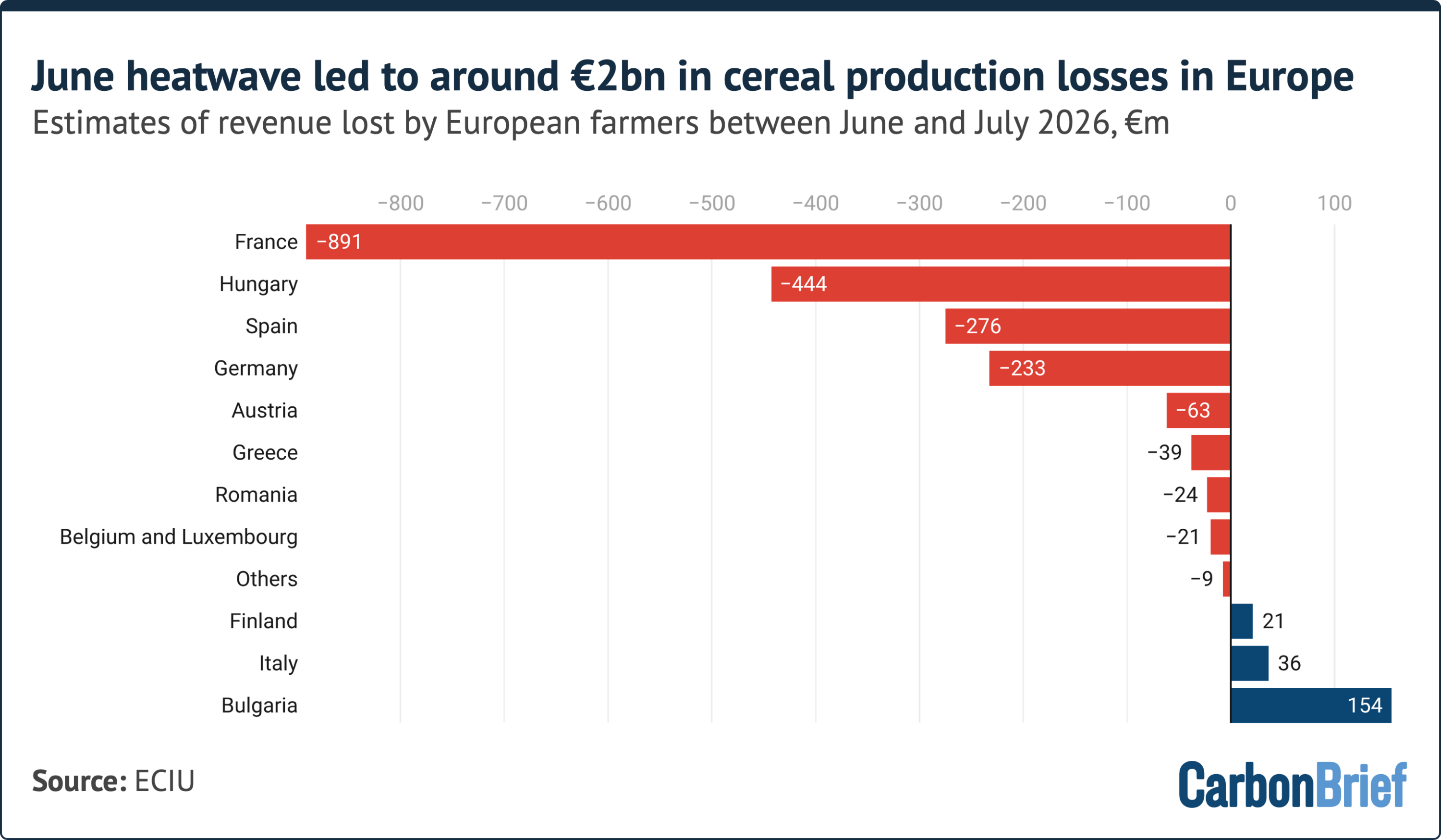
    The record heatwave that hit many parts of Europe in June contributed to an estimated €2-2.3bn in cumulative grain production losses, as shown in the chart below.

    Bar chart showing that the June heatwave in 2026 led to around €2bn in cereal production losses in Europe. The bar chart shows that France is the EU country that lost the most revenue, with an estimated loss of €891 million, followed by Hungary (with an estimated loss of €444 million) and Spain (with an estimated loss of €276)
    Estimates of revenue lost due to changes in production forecasts between June and July 2026. Source: ECIU.

    The intense June heat in western Europe would have been “virtually impossible” just 50 years ago, according to a rapid climate attribution study. It was the region’s hottest June on record. 

    The Energy & Climate Intelligence Unit (ECIU) thinktank analysed June and July 2026 grain forecasts from Coceral, a European grain traders association.

    ECIU estimated lost supply by multiplying the change in tonnes of grains between these two months by prices for harvest delivery in 28 European countries. 

    Major grain producers France, Germany, Hungary and Spain accounted for 86% of the lost revenue, according to the ECIU.  

    Extreme heat is also expected to have a wider economic impact across the continent. Analysis from Triodos Bank found that this summer’s extreme weather could reduce the EU’s gross domestic product (GDP) by around 1% this year, or around €180bn. 

    4. UK yields of wheat, barley and oats are all due to drop in 2026

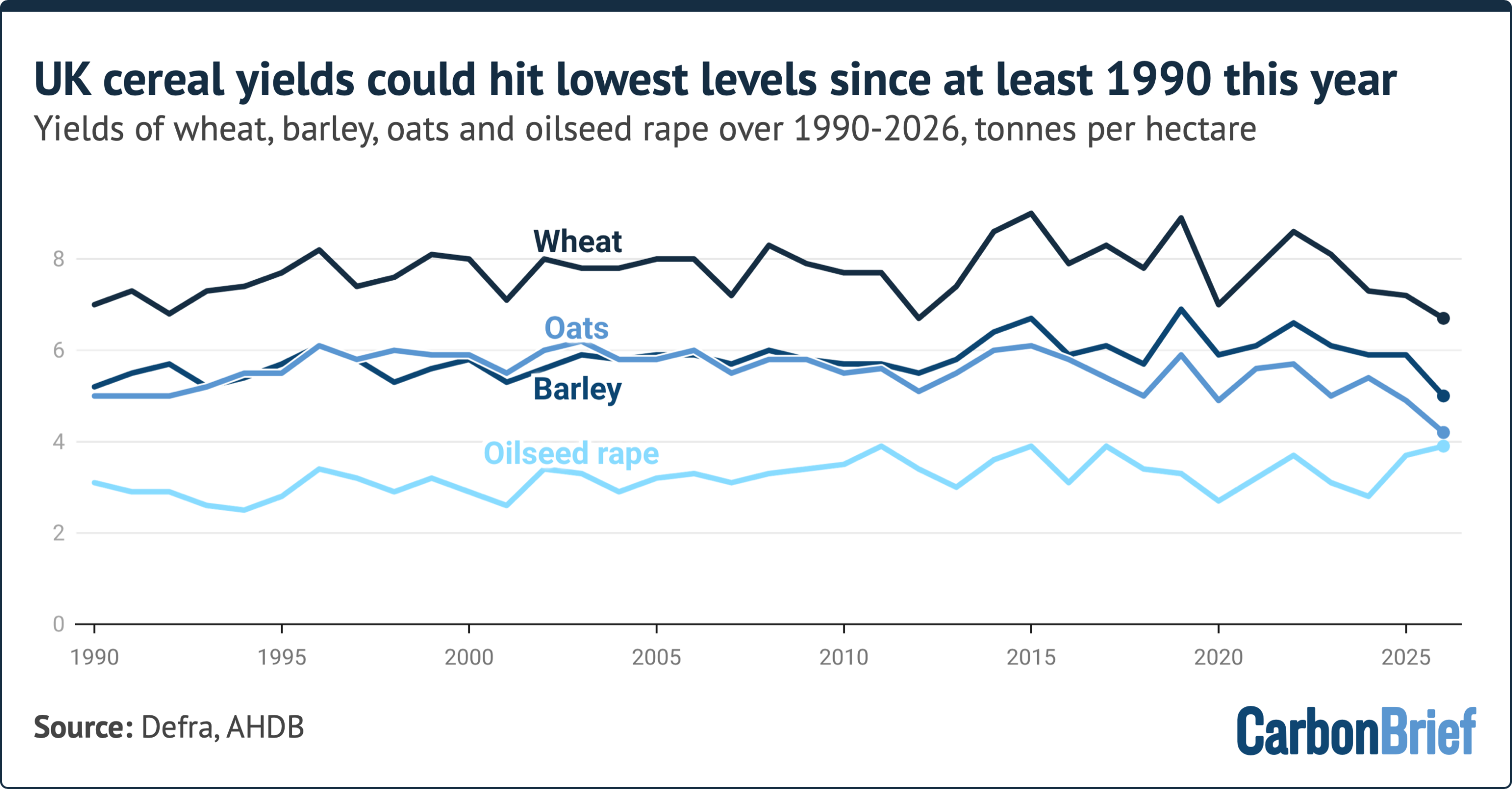
    If current trends continue, the average yields for cereals and oilseeds will result in the UK’s worst harvest since detailed records began in 1984, according to ECIU.  

    Line chart showing that UK cereal yields could hit lowest levels since at least 1990 this year.
    Yields of cereals and oilseed rape in the UK over 1990-2026. Source: Department for Environment, Food & Rural Affairs and Agriculture and Horticulture Development Board.

    Barley yields could fall by 15%, oats by 14% and wheat yields by 6% year-on-year, according to 2026 harvest surveys from the Agriculture and Horticulture Development Board, a non-departmental public body that provides agricultural data to the UK government. 

    ECIU said that, even if the situation improves, this year is still expected to be one of the five worst harvests on record. This means that four of the five worst harvests in the UK have occurred in the past decade. 

    Consumers will likely see higher prices and/or smaller vegetables in supermarkets as a result, Tim O’Malley, chairman of UK company Nationwide Produce, told BBC News in August.

    Other crops, such as berries, have grown successfully in the extreme heat. But the Guardian noted fears this could dip later this year “as plants become exhausted from heavy cropping during the heatwave”. 

    5. Maize production in France is due to hit a four-decade low 

    France has been acutely affected by this summer’s extreme weather, with more than 7,300 excess deaths during heatwaves and a record number of weather stations recording temperatures of above 40C. 

    The country is the EU’s largest agricultural producer, but heat, drought and wildfires have affected many crops. 

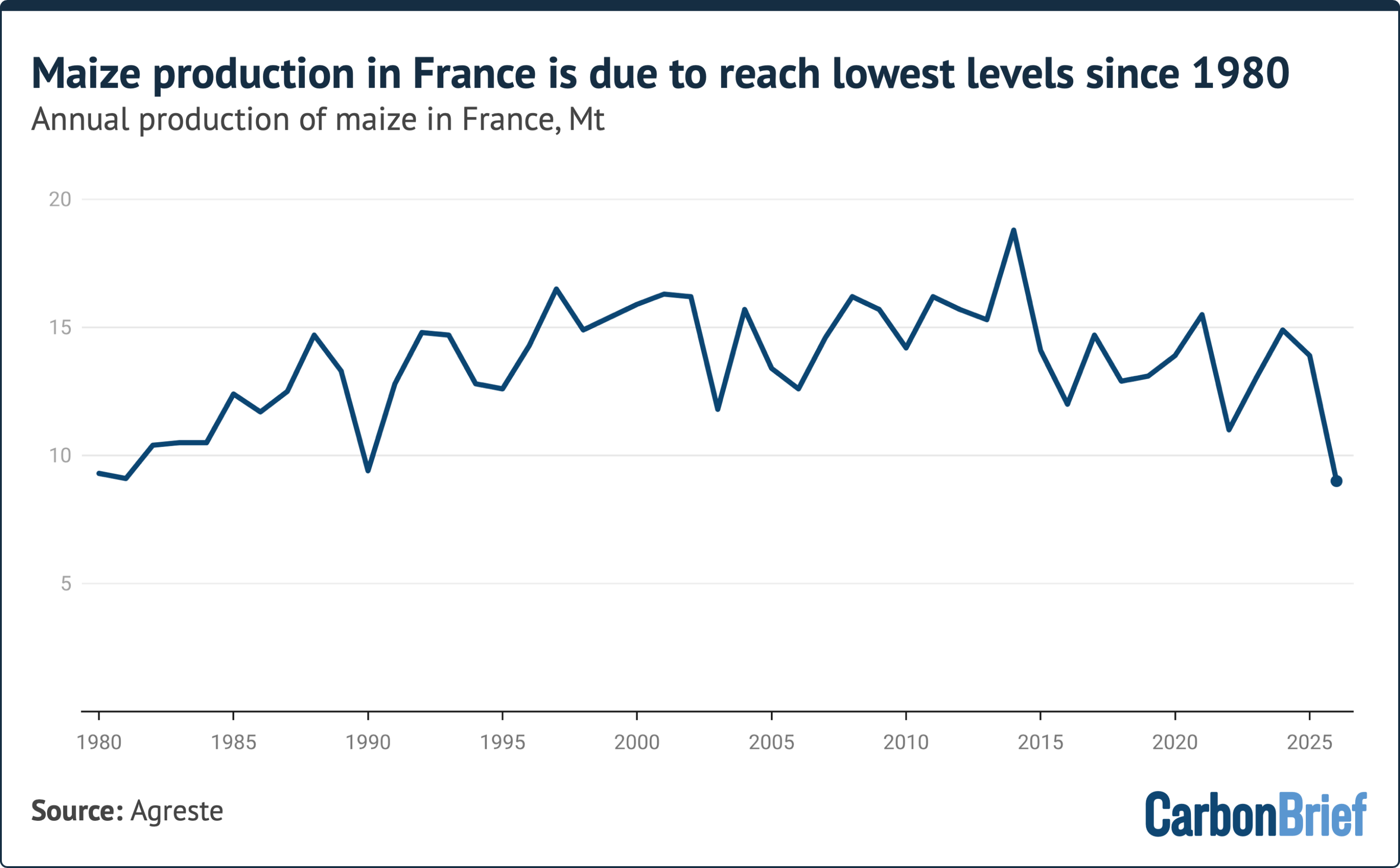
    The chart below shows that maize production is set to drop by more than one-third (35%) year-on-year. 

    Line chart showing that maize production in France is due to reach lowest levels since 1980
    Maize production in France over 1980-2026. Source: Agreste.

    This could result in France’s lowest maize production since 1980, according to data from Agreste, the country’s agriculture ministry’s statistics service.  

    Due to the heat, “record-early” grape harvests have also been recorded in various parts of the nation since mid-July, reported Le Monde. In some cases, this means “smaller, less juicy grapes, which will yield less wine”, explained the newspaper. 

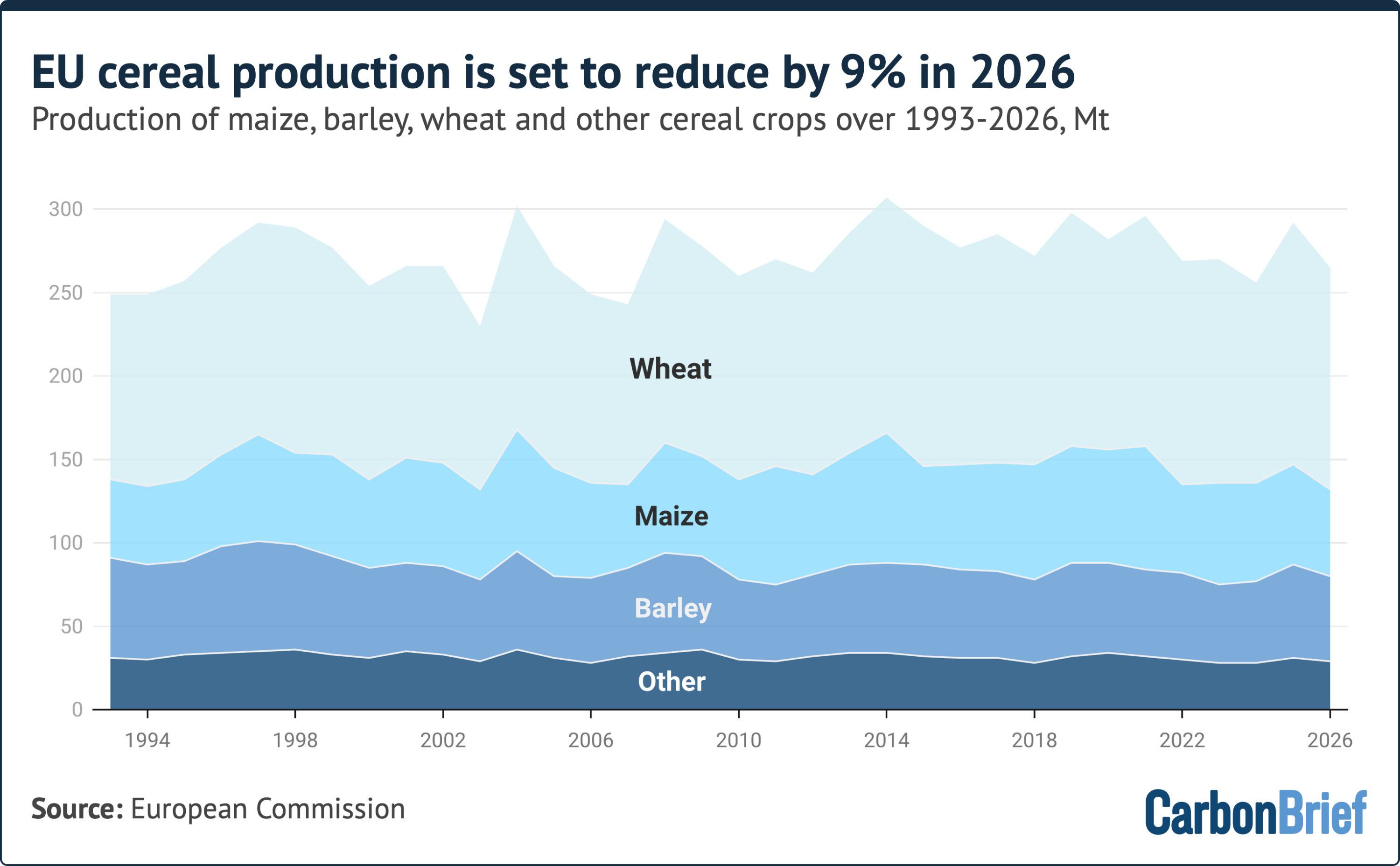
    6. Declines in EU grains since 2025

    Chart showing that EU cereal production is set to reduce by 9% in 2026.
    Production of cereal crops in Europe over 1993-2026. The “other” category includes oats, rye, sorghum, millet and buckwheat. Source: European Commission.

    Overall in the EU, data and projections indicate declines in the output of cereal grains this year. 

    Cereal production is set to fall by 9% compared to 2025, according to the European Commission. 

    Just one year in the past decade – 2024 – recorded lower production levels. 

    Maize production is set to be particularly affected, with projections indicating a 13% drop, to 52Mt – the lowest level in the EU since 2007.