Original article republished from MEMO under a Creative Commons Attribution-NonCommercial-ShareAlike 4.0 International License.
Flag of Scotland [Getty]
The Scottish government announced Monday that it had suspended all meetings with Israeli ambassadors until “real progress” is made towards peace in the Gaza Strip and unimpeded access is granted to humanitarian assistance to the enclave, Anadolu Agency reports.
In a statement, External Affairs Secretary, Angus Robertson, said the Scottish government would not accept any invitation for a further meeting with Israel until there was real progress on the Gaza conflict.
“This will remain our position until such time as real progress has been made towards peace, unimpeded access to humanitarian assistance is provided and Israel cooperates fully with its international obligations on the investigation of genocide and war crimes,” said Robertson.
This came after a recent meeting between Robertson and Israel’s Deputy Ambassador to the UK, Daniela Grudsky, about two weeks ago, sparking criticism within the Scottish National Party (SNP).
The External Affairs Secretary said his view was that, given Grudsky had requested the meeting this was “an opportunity to express the Scottish Government’s clear and unwavering position” on the need for an immediate ceasefire in Gaza. And I did exactly that, “he added.
“No one intended that this meeting be presented as legitimising the actions of the Israeli government in Gaza,” he noted, expressing that the Scottish Government has been consistent in its “unequivocal condemnation of the atrocities” in the Palestinian enclave.
Noting that many had seen the meeting as a sign of normalisation between the Israeli and Scottish governments, Robertson stressed that it was clear that it would have been better to ensure that its agenda was strictly limited to the need for an immediate ceasefire in Gaza .
“I apologise for the fact that this did not happen,” he said.
Robertson added that, “going forward, it is clear that, having now spoken directly to the Israeli Government and making them aware of our position on an immediate ceasefire, it would not be appropriate to accept any invitation for a further meeting.”
Highlighting that this would remain the Scottish government’s position until real progress on a ceasefire is made, he said: “The Scottish Government does not support any normaliation of its relations with the Israeli Government during this period.”
“The Scottish Government will never hold back in expressing support for an immediate ceasefire in Gaza, the release of all hostages, an end to UK arms being sent to Israel and the recognition of a sovereign Palestinian State within a two-state solution.”
Former Scottish First Minister, Humza Yousaf, welcomed the statement, saying Robertson has “clearly listened and reflected on the anger and upset” in relation to his meeting with the deputy Israeli ambassador.
“Crucially, he has made it clear there cannot be normal relations with the Govt of Israel,” Yousaf said on X.
Original article republished from MEMO under a Creative Commons Attribution-NonCommercial-ShareAlike 4.0 International License.
The World Health Organisation (WHO) announced on Monday that 540,000 Yemeni children under the age of five are severely emaciated. The WHO made its announcement in a post on X to mark World Humanitarian Day.
“Yemen faces a double burden of disease and conflict, whereby 17.8 million need health assistance, including 540,000 children under 5 with severe wasting,” said the UN-affiliated organisation. “With ongoing conflict and a collapsing healthcare system, it is crucial that we #ActForHumanity.”
The health sector in Yemen faces difficult challenges, amid great suffering experienced by most citizens who are in dire need of assistance due to the repercussions of the war that has been ongoing for a decade.
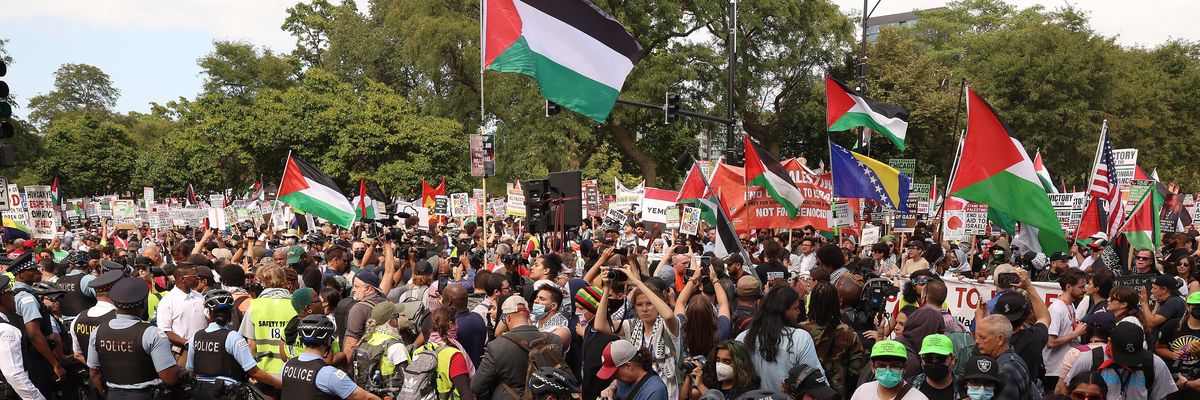
Police and demonstrators are seen at a march during the Democratic National Convention on August 19, 2024 in Chicago. (Photo: Scott Olson/Getty Images)
“For Palestinian Americans, this is a fundamental issue,” said one marcher.
What’s expected to be the biggest protest march during this week’s Democratic National Convention kicked off in Chicago Monday afternoon, with demonstrators demanding that Vice President Kamala Harris support an end to unconditional U.S. military support for Israel amid its assault on Gaza, now in its tenth month.
Thousands gathered in Union Park before beginning their march to the United Center, where the convention is taking place.
Protesters carried signs and banners reading, “End State Violence From Chicago to Gaza” and “Dems’ Silence = Israel’s Violence.”
Organizers—who hoped to see 15,000 people in the streets—have expressed alarm in recent months over the Chicago Police Department’s aggressive response to pro-Palestinian protests, with a legal coalition last week expressing concern about Police Superintendent Larry Snelling’s intimidating comments about arresting protesters and other issues, and city officials have clashed with organizers about the route the march will take.
But threats of arrest did not deter groups including Jewish Voice for Peace from joining the march, with the local chapter saying its members would “make clear our commitment to freedom and safety for all people, from Chicago to Gaza” and as they demanded an “arms embargo now.”
We are here, loud and proud, marching in the streets of Chicago, outside the DNC, to make clear our commitment to freedom and safety for all people, from Chicago to Gaza! We demand an #ArmsEmbargoNow! #MarchOnTheDNCpic.twitter.com/ylwt4LvlzH
Organizers of the Uncommitted movement, which emerged during the Democratic primary season to pressure President Joe Biden to end his support for Israel’s assault on Gaza, continue to press the Harris-Walz campaign to break with the administration’s position.
While Harris initially indicated to the group a willingness to discuss support for an arms embargo earlier this month, a top adviser for the Democratic nominee said soon after that the vice president does not support ending weapons transfers to Israel.
“For Palestinian Americans, this is a fundamental issue,” sociologist Eman Abdelhadi told Democracy Now! at the march. “We have spent 10 months watching our people die every day, and to ask us to simply just wait and hope that some change will happen… It’s just offensive and it’s completely insensitive.”
"We have spent ten months watching our people die every day," says Palestinian American sociologist @emanabdelhadi, who is in Chicago protesting against Israel's assault on Gaza. pic.twitter.com/Vvv3loE9Lk
As the protesters assembled on Monday, journalist Mehdi Hasan warned in a column in The Guardian that Harris should see agreeing to the demand for an immediate cease-fire in Gaza and an arms embargo not as a risk, but as “a moral, geopolitical, and—for the Democrats—electoral no-brainer.”
“Biden may want to continue sending more and more weapons to an Israeli government accused of war crimes at the international criminal court and of genocide at the international court of justice,” wrote Hasan, “but Harris should take a different stance—a bolder stance, a stance that is more in line with her party’s base, as well as with the American public at large.”
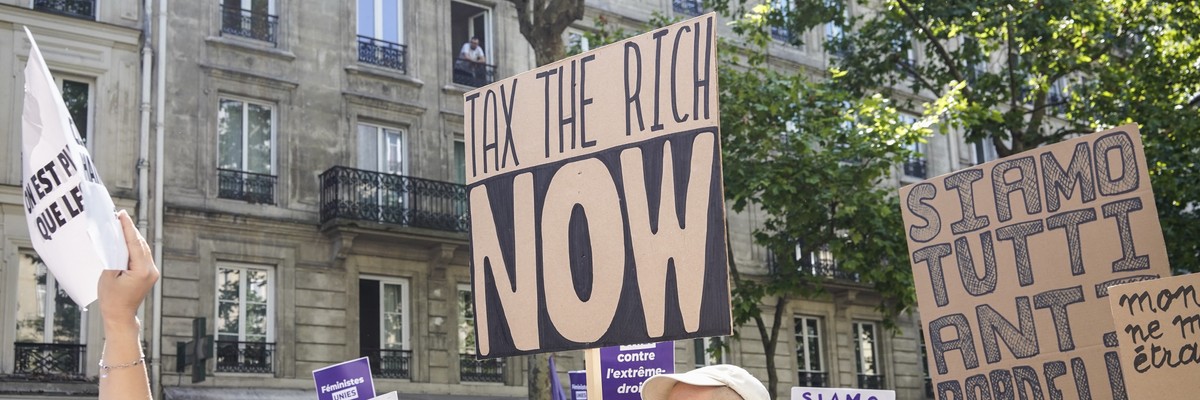
A man holds a sign reading, “Tax the Rich Now” at a protest in Paris on June 23, 2024. (Photo: Laure Boyer/Hans Lucas/AFP via Getty Images)
“To make our economies secure and protect the earner way of life that has defined the modern era, we need wealth taxes that end the two-tier treatment of wealth,” says a new report.
With countries set to focus heavily on climate finance for the Global South at the 2024 United Nations Climate Change Conference in November, the Tax Justice Network on Monday offered a proposal that could raise double the amount of money needed to help developing countries transition to clean energy and adapt to extreme weather—and there’s already proof the idea is effective and politically feasible.
The “featherlight” wealth tax introduced in Spain less than two years ago raised hundreds of millions of euros last year by taxing the net worth of the 0.5% richest households, and the group’s report argued that the law should serve as a model for a global wealth tax like the one increasingly supported by finance ministers in wealthy countries.
Spain’s wealth tax, also called the “solidarity surcharge” by Prime Minister Pedro Sánchez, applied a tax of 1.7% to 3.5% to the richest 0.5% of the country’s households—turning away from the “two-tier treatment of collected wealth and earned wealth” that TJN said is “the root of the problem” of growing inequality.
“Collected wealth—i.e. dividends, capital gains, and rent gained from owning things—is typically taxed at far lower rates than earned wealth—i.e. salaries gained by working,” said TJN. “At the same time, collected wealth typically grows faster than earned wealth. Today, only half of the wealth created around the world each year goes to people who earn for a living—the rest is collected as rent, interest, dividends, and capital gains.”
The two-tier tax system allows billionaires to pay tax rates that are half the rates paid by the rest of society, which has allowed the wealth of the richest 0.0001% people in the world to quadruple since 1987 “to the detriment of economies, societies, and planet,” said TJN.
Because the richest 0.5% of households control, on average, more than 25% of any given society’s wealth, the report states, if countries around the world replicated Spain’s solidarity surcharge, governments could raise $2.1 trillion annually—enough to pay for climate finance as well as other pressing needs.
“By definition, a billionaire owns more wealth than an average U.S. household could spend in 10,000 years. Wealth contributes a lot less to the economy than it can when it’s pharaoh-tombed like this, making economies poorer than the sum of their parts.”
“To guarantee a good life for all citizens and preserve social cohesion despite these challenges, governments around the world need the fiscal space to transform economies in a socio-ecological manner, ensure high-quality education for all, guarantee access to modern health services, and fulfill basic needs like affordable housing, food, and transportation at the same time,” reads the report. “Such measures are only feasible with sufficiently endowed and stable public budgets. A moderate, progressive wealth tax could help countries to raise these urgently needed funds.”
The report shows, said Oxfam International, that “E.U. governments can no longer excuse their ‘lack of funds’ for failing to fight the climate crisis and end poverty. The money they need is in the pockets of the super-rich!”
In each country, half the population holds only about 3% of the wealth—a persistent inequality that is “making economies insecure and is directly linked to people having to spend more than they bring in.”
The current global tax system treats billionaires as though they “earn wealth like everybody else, they’re just better at it,” said Mark Bou Mansour, head of communications for TJN. “This is bogus.”
“It’s impossible to earn a billion dollars,” Bou Mansour said. “The average U.S. worker would have to work for a stretch of time 13 times longer than humans have existed to earn as much as wealth as the world’s richest man has today. Salaries don’t make billionaires, dividends and rent money do. But we tax dividends and rent money much less than we tax salaries, and this is destabilizing the earner model our economies are based on.”
“By definition, a billionaire owns more wealth than an average U.S. household could spend in 10,000 years,” he added. “Wealth contributes a lot less to the economy than it can when it’s pharaoh-tombed like this, making economies poorer than the sum of their parts. To make our economies secure and protect the earner way of life that has defined the modern era, we need wealth taxes that end the two-tier treatment of wealth.”
On the BBC, which featured TJN’s report in a segment on Monday, Bou Mansour debunked the common claim that taxing the richest households would harm countries’ economies by pushing rich people to move away.
“This is an area where public perception has been lagging behind the evidence,” said Bou Mansour. “Recent wealth taxes in Norway, Sweden, and Denmark all resulted in a migration rate of 0.01% among the super-rich who were taxed. So what the data shows is that the super-rich do not leave en masse, and what’s more striking is that the data shows if countries do not implement wealth taxes, that is far more harmful to the economies.”
Countries can raise $2 trillion a year by following the example of Spain’s #WealthTax, our new study shows. But just as important as the amount that wealth taxes can raise, our study talks about how the extreme wealth of the superrich left untaxed makes our economies insecure. pic.twitter.com/eXgluZ24tq
— Tax Justice Network Bsky: @taxjustice.net (@TaxJusticeNet) August 19, 2024
The report notes that concerns about the super-rich simply hiding their wealth in tax havens are valid, and called on countries to ensure that the U.N. tax convention currently being negotiated “delivers robust tax transparency standards.”
“Countries should collaborate to combat tax abuse by the ultra-rich, a challenge addressed in another strand of literature,” reads the report. “A straightforward starting point for combating this form of tax abuse in the context of a wealth tax is the implementation of full beneficial ownership transparency, at least within the country itself.”
While a number of G20 finance ministers have come out in support of a global wealth tax this year, leaders in some wealthy countries including U.S. Treasury Secretary Janet Yellen have refused to back the proposal.
“The vast majority of countries are currently working on what can be the biggest shakeup in history to global tax rules, to end the scourge of global tax abuse by multinational corporations and the superrich. But a minority of rich countries still seem to be holding back from support for a robust framework convention on tax,” said Alison Schultz, research fellow at TJN and co-author of the report. “This needs to change now—the climate can’t wait, and nor can the people of the world.”
Indiscriminate killing: Mourners pray at the funeral for more than 15 people, including several children and women, killed in an Israeli strike, at Al-Aqsa Martyrs Hospital in Deir al-Balah at the weekend
THE number of aid workers killed in conflict zones more than doubled last year, the UN reported today.
Its Office for the Co-ordination of Humanitarian Affairs said that 280 aid workers were killed in 33 countries in 2023, compared to 118 in 2022.
Over half the killings took place in Gaza following Israel’s invasion, which began in October following a Hamas cross-border attack, with the majority of these down to Israeli air strikes, the office said.
Israel’s military has been accused of deliberately murdering aid workers, with the killing of seven working for World Central Kitchen on April 1 causing headlines around the world because they included US, Canadian, British and Australian citizens.
It has also been accused of attempting to starve Gaza by blocking or delaying aid convoys. Its National Security Minister, Itamar Ben-Gvir, caused uproar in June when he told police not to interfere with mobs attacking aid convoys headed for Gaza.