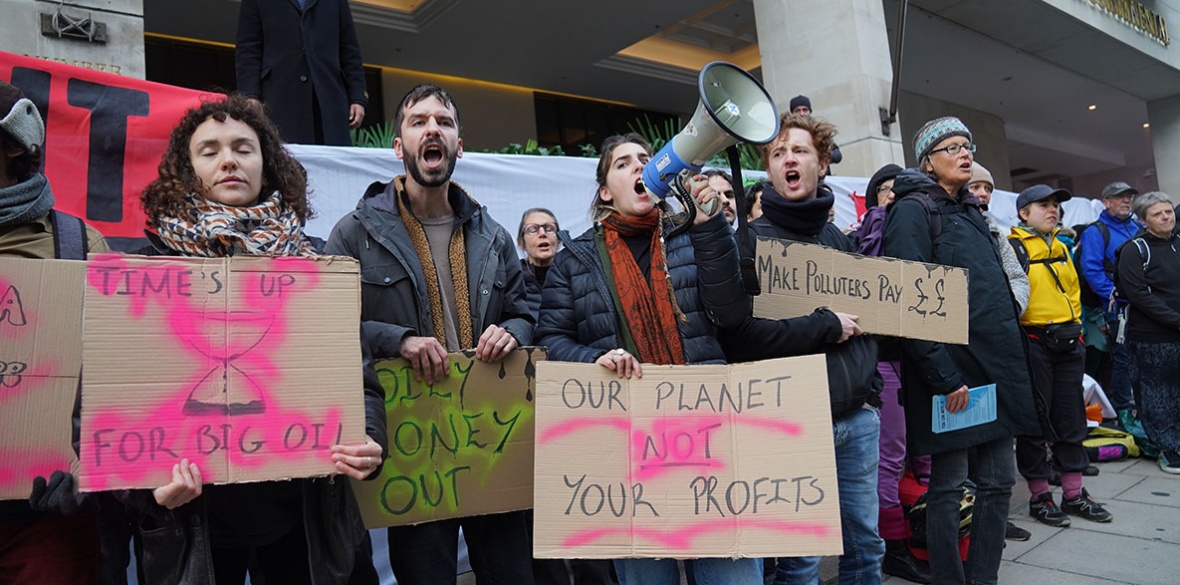
Activists from Fossil Free London outside the InterContinental in central London, demonstrate ahead of the Energy Intelligence Forum, a gathering between Shell, Total, Equinor, Saudi Aramco, and other oil giants, October 17, 2023
CAMPAIGNERS have branded Shell CEO’s multimillion pay packet a “bitter pill to swallow” after the corporation announced today it would be watering down its climate pledges.
…
It also revealed that CEO Wael Sawan pocketed £7.94 million in pay in 2023.
Since taking charge last year, the executive oversaw plans to axe 25 per cent of Shell’s low-carbon solutions team and abandoned a policy to cut oil production each year for the rest of the decade.
Greenpeace campaigner Philip Evans took aim at the new boss, saying he has “doubled down on fossil fuels while ruthlessly slashing jobs and investment from Shell’s renewables division — and personally pocketed a tidy £8m for his trouble.”
…
Global Witness campaigner Jonathan Noronha-Gant said Mr Sawan’s payout “is a bitter pill to swallow” for the millions struggling with energy costs.
He said: “Our reliance on Shell’s dirty oil and gas make them rich whilst the rest of us get poorer.”
Image of InBedWithBigOil by Not Here To Be Liked + Hex Prints from Just Stop Oil’s You May Find Yourself… art auction. Featuring Rishi Sunak, Fossil Fuels and Rupert Murdoch.
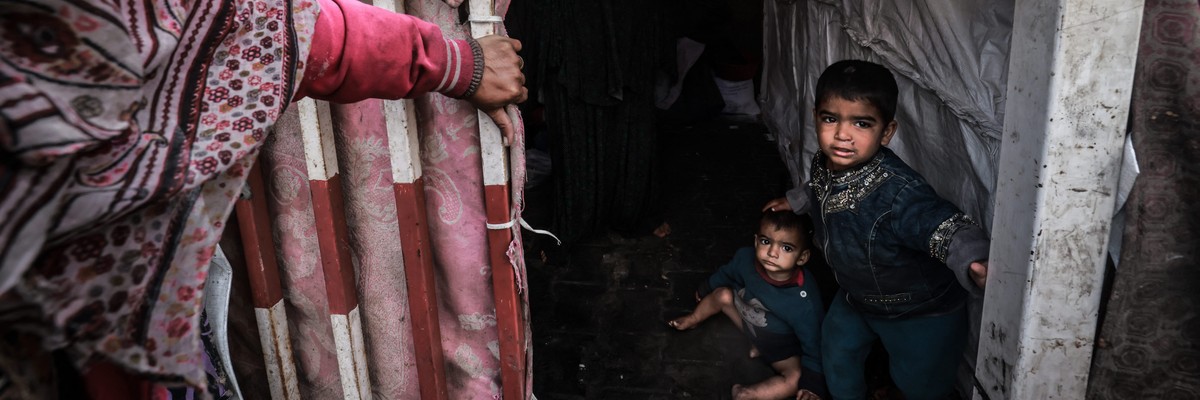
Displaced Palestinian children are pictured inside a makeshift tent in Rafah, Gaza on March 13, 2024. (Photo: Mohammed Abed/AFP via Getty Images
“There is nothing humanitarian about Israel’s proposal to push civilians into ‘humanitarian islands’ in Gaza.”
Aid groups reacted with alarm Thursday to the Israeli military’s stated plan to transfer much of the population of Rafah—a small city in southern Gaza that’s currently packed with more than 1.5 million people—to so-called “humanitarian islands” in the central part of the enclave.
William Bell, the head of Middle East policy and advocacy at Christian Aid, called the proposal “a preposterous idea” that the international community must reject in favor of an immediate, permanent cease-fire and a massive surge of humanitarian assistance.
“The half-baked plan to force more than a million displaced civilians out of Rafah into so-called ‘humanitarian islands’ further north beggars belief,” said Bell. “And the suggestion that they will be safe simply cannot be given credence.”
“How long will it take to build and equip these islands? And how much longer to get people to them?” Bell asked. “With Gaza on the brink of famine, children dying of malnutrition, and desperate families reportedly eating grass to survive, men, women, and children need lifesaving aid now.”
“The past five months have taught us that places labeled ‘safe zones’ in Gaza quickly become death zones.”
During a news briefing on Wednesday, Israel Defense Forces (IDF) spokesperson Daniel Hagari said the planned humanitarian zones would be created in concert “with the international community,” but he did not provide specifics or a timeline.
Ahead of a planned ground invasion of Rafah, Hagari said the IDF intends to direct a “significant” portion of the city’s population—most of which is living in makeshift tents—to designated areas in central Gaza, where he claimed they would be provided with temporary housing, food, and other necessities that Israel has systematically restricted.
Given that Rafah was once considered a relatively safe area for Palestinians displaced by Israel’s assault and is currently under IDF bombardment, aid campaigners expressed deep skepticism that the plan outlined by Hagari is in any way viable or humane.
“There is nothing humanitarian about Israel’s proposal to push civilians into ‘humanitarian islands’ in Gaza,” said Melanie Ward, CEO of Medical Aid for Palestinians. “They are dangerous and must be stopped. The past five months have taught us that places labeled ‘safe zones’ in Gaza quickly become death zones.”
An investigation published Wednesday by the London-based research firm Forensic Architecture shows how the Israeli military has used supposed humanitarian measures to advance its assault on Gaza’s civilian population.
The investigation details the IDF’s repeated bombardment of so-called “safe zones” to which it has instructed desperate Gazans to flee and makes the case that Israel’s evacuation orders have functioned “as a tool of mass displacement, pushing civilians into unlivable areas that later come under attack.”
NEW INVESTIGATION: Since 7 Oct 23, the Israeli army has weaponised humanitarian measures such as ‘evacuation orders’, ‘safe routes’ & ‘safe zones’ to support their military operations & facilitate the mass displacement of Palestinians.
“Military evacuation of civilian populations is only legal under select, rare circumstances, and requires that displaced civilians be temporarily relocated to areas safe from conflict and with access to fundamental provisions for their safety and survival,” the Forensic Architecture analysis said. “Where Israel’s evacuation orders might individually be framed as humanitarian in nature, in fact when closely analyzed and considered over time, they reveal patterns of systematic mass displacement, with Palestinians deliberately and repeatedly being expelled from one unsafe and under-resourced location to another.”
“A ground invasion in Rafah,” the research firm argued, “would exacerbate the already dire humanitarian situation for the 1.5 million displaced Palestinians taking refuge there.”
In an interview this past weekend, U.S. President Joe Biden said that an IDF incursion into Rafah would cross a “red line”—a remark that the White House has since tried to walk back after Israeli Prime Minister Benjamin Netanyahu vowed the planned assault would go ahead.
Asked about Israel’s “humanitarian islands” proposal on Thursday, White House National Security Council spokesperson John Kirby said, “We can’t confirm that that is in fact a plan that they have.”
“Our position has not changed,” Kirby said of a potential Rafah invasion. “We do not want to see large-scale operations in Rafah… unless there is [a] legitimate, executable plan to provide for the safety and security of the civilians that are there.”
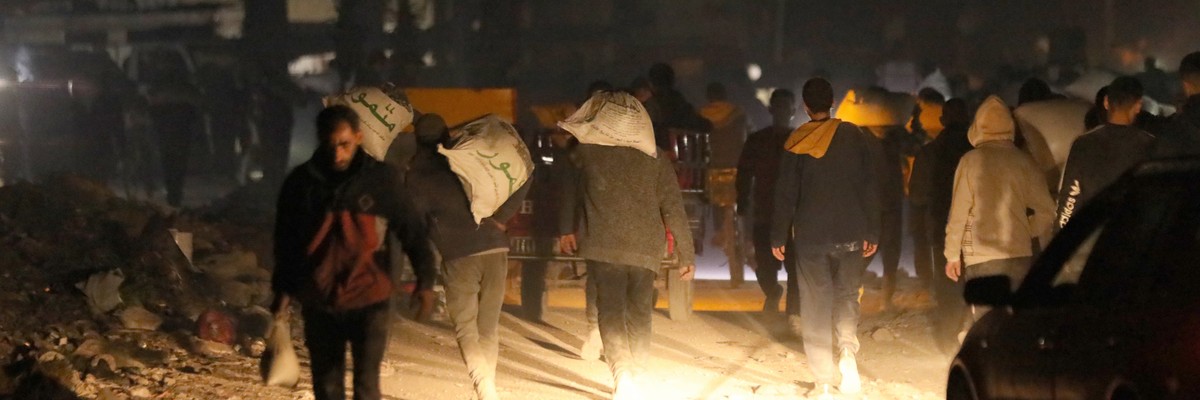
Palestinians receive humanitarian aid supplies brought by trucks to Gaza City on March 13, 2024. (Photo: Dawoud Abo Alkas/Anadolu via Getty Images)
“Our governments did nothing to hold Israel accountable last time it attacked desperate hungry people seeking aid in Gaza,” said one aid campaigner. “So why wouldn’t it do the exact same thing again?”
Gaza health officials said Thursday that Israeli forces killed at least 20 people and injured over 150 more as they waited for humanitarian aid in the northern part of the Palestinian enclave, where deliveries of food, medicine, and other necessities have become virtually impossible due to Israel’s persistent obstruction and attacks.
Mohammed Ghurab, the director of emergency services at a hospital in the area, told AFP that there were “direct shots by the occupation forces” at people waiting for a truck carrying food. Northern Gaza is in the grip of famine-like conditions, and desperate people there have resorted to eating weeds and livestock feed amid Israel’s suffocating blockade.
Dozens of people, including children, have died of starvation and dehydration in northern Gaza in recent weeks.
Thursday’s attack took place at the Kuwaiti Roundabout in Gaza City, according to the territory’s health ministry, which said nearby hospitals were “unable to deal with” the influx of wounded patients.
Horrific video footage posted to social media shows bloody bodies lying motionless amid debris. Middle East Eye reported that “a truck transporting aid into Gaza” later “collided with a vehicle carrying victims” of Thursday’s attack to a hospital.
“Eyewitnesses said the area was struck by what they said sounded like tank or artillery fire,” CNN reported. “The incident at the Kuwaiti Roundabout followed earlier violence at the same site on Wednesday, where large crowds were waiting for a food distribution. At least seven people were killed and 86 others injured after Israeli troops opened fire.”
A day earlier, Israel allowed an aid convoy to enter Gaza’s north directly through an Israeli border crossing for the first time since the Hamas-led October 7 attack.
Ziad Saeed Madoukh, who was shot in the foot during Thursday’s attack, told the Euro-Mediterranean Human Rights Monitor that Israeli forces started “heavily firing live ammunition towards the crowd of civilians as soon as aid trucks approached” the roundabout.
“Another survivor of today’s massacre, Ibrahim Al-Najjar, was shot in the hand by Israeli forces,” the rights group said. “Al-Najjar told Euro-Med Monitor’s team that he tried to get a bag of flour for his children at the Kuwait Roundabout, but that he and others were subjected to live ammunition and artillery shells despite gathering in an area previously designated as safe by Israel’s army.”
The Israel Defense Forces (IDF) denied attacking Gazans at the aid distribution point and said it was “analyzing” the incident.
Thursday’s bloodshed drew comparisons to the February 29 attack in which Israeli forces opened fire on crowds of starving Gazans trying to get their hands on bags of flour. The attack was later dubbed the “flour massacre.”
“Our governments did nothing to hold Israel accountable last time it attacked desperate hungry people seeking aid in Gaza,” said Rohan Talbot, director of advocacy and campaigns at Medical Aid for Palestinians. “So why wouldn’t it do the exact same thing again?”
Prior to Thursday’s attack—described as “another flour massacre”—Gaza authorities estimated that Israeli forces had killed at least 400 people waiting for humanitarian aid deliveries. Between mid-January and the end of February, the United Nations documented at least 14 instances of Israeli forces opening fire on crowds gathered to receive humanitarian aid.
“This is something that is preventable and shouldn’t be happening,” Shaina Low, communications adviser for the Norwegian Refugee Council, told Al Jazeera.
Asked Wednesday about Israel’s repeated attacks on Palestinians awaiting aid, U.S. State Department spokesperson Matthew Miller said that “we want to see it investigated promptly, and, if appropriate, see accountability.”
“We also press them to take measures to keep it from happening again,” said Miller, who did not warn of any consequences for Israel’s military if it continues to massacre desperate civilians.
A group of senators warned earlier this week that it is a violation of U.S. law to arm a government that is obstructing the delivery of humanitarian assistance.
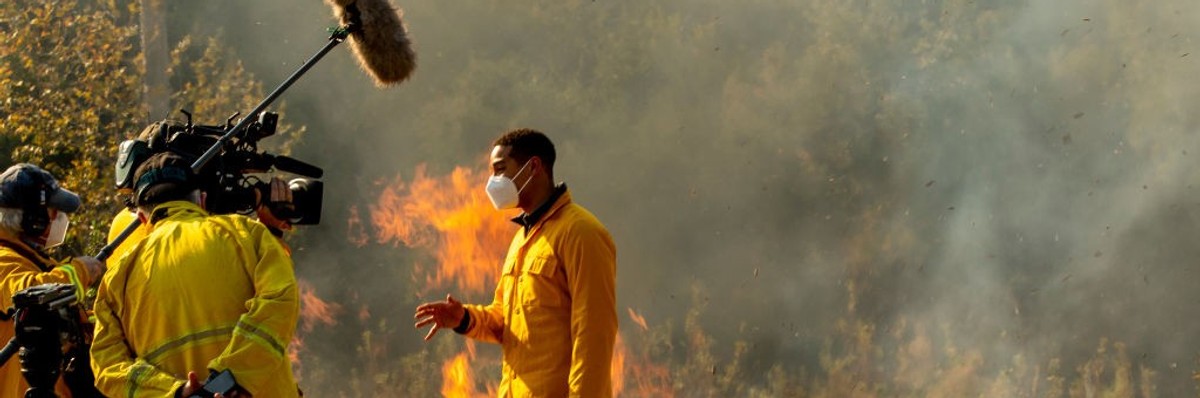
A journalist reports from the Santa Ana wind-driven Bond Fire burning near a hillside residence along Santiago Canyon Road in Silverado, California on December 3, 2020. (Photo: Allen J. Schaben/Los Angeles Times via Getty Images)
“We need more climate journalism, not less,” said one Media Matters for America writer.
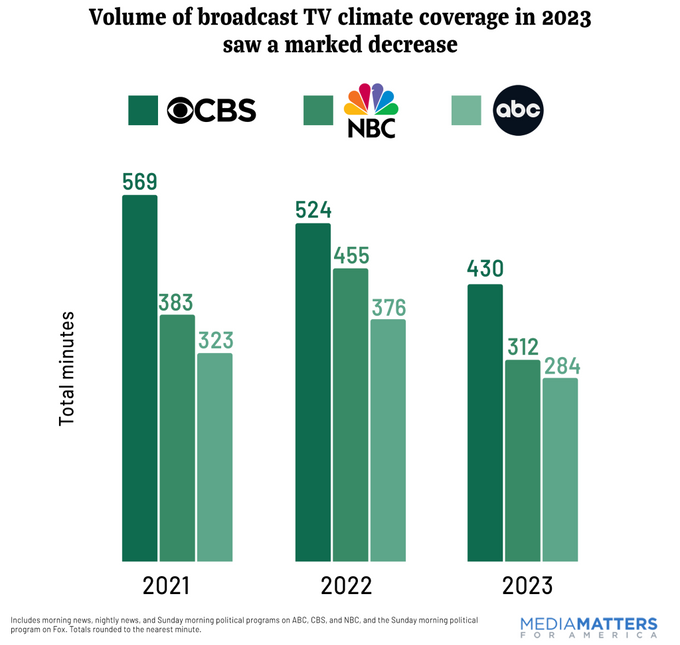
Last year featured not only what scientists worldwide confirmed was the hottest year in human history but also a 25% drop in corporate broadcast networks’ coverage of the fossil fuel-driven climate emergency, according to an analysis released Thursday.
Media Matters for America, which has long tracked television networks’ climate coverage, reviewed transcripts and video databases for ABC, CBS, NBC, and Fox Broadcasting Co. The watchdog found that in 2023, despite the worsening global crisis, the networks collectively had just 1,032 minutes of coverage, down from 1,374 minutes in 2022 and 1,316 minutes in 2021.
That amounts to less than 1% of all corporate broadcast coverage aired last year, notes the analysis authored by Media Matters senior writer Evlondo Cooper with contributions from Allison Fisher, director of the group’s climate and energy program.
“Last year’s extreme climate events further illustrated the need for consistent, substantive, and wide-ranging news coverage about all facets of climate change.”
They wrote that “discussion of extreme weather events aired during 37% of coverage, or 160 out of 435 segments. June through September saw the most severe extreme weather events and accounted for just over 54% of total coverage.”
“Only 12% of climate segments on corporate broadcast news, or 52 out of 435, mentioned ‘fossil fuels,’” the pair pointed out. “This is a slight increase from 2022, when ‘fossil fuels’ were mentioned in only 8% of climate segments.”
“Solutions or actions that may be taken in response to climate change were mentioned in 22% of climate segments,” they highlighted. That ended an upward trend: 29% in 2020, 31% in 2021, and 35% in 2022.
Cooper and Fisher also noted that climate scientists made up 10% of featured guests, compared with just 4% in 2022; “white men dominated the demographics of guests featured in climate segments” for the seventh year straight; and discussions of climate justice appeared in only 5% of coverage, up from 3% the previous year.
Looking at only the “Big Three” of the television world—ABC, CBS, and NBC—they found that climate coverage dropped 23% for morning news programs and 36% for nightly shows. CBS aired 42% of all climate coverage while ABC had the least of the trio and NBC had the biggest decrease from 2022.
For the review of Sunday morning political shows, the researchers included Fox. They found that in 102 combined minutes of airtime across 26 segments, CBS again led the pack—it was the only network that increased coverage, from 20 minutes in 2022 to 66 minutes, or over half the total, in 2023.
The analysis recognizes a “significant decline” in coverage of the Biden administration’s efforts to combat the climate emergency, explaining:
This reduction in corporate broadcast news attention occurred during a critical period for climate policy implementation, particularly of the Inflation Reduction Act, which continued to drive positive outcomes in the clean energy market, and new regulations announced during COP28 to curb methane emissions. Despite these significant actions, corporate broadcast networks’ focus on the administration’s climate initiatives was limited.
COP28, the United Nations’ annual climate summit near the end of the year, also received “very limited” coverage from the networks, the report says. The conference—which scientists called “a tragedy for the planet” because its final agreement didn’t demand a global fossil fuel phaseout—was mentioned in just 14 segments, accounting for 3% of climate coverage.
As Common Dreams has reported, the National Oceanic and Atmospheric Administration found that in addition to being the hottest year on record, 2023 also had 28 U.S. disasters that caused at least $1 billion in damage, which collectively cost at least $92.9 billion.
“Last year’s extreme climate events further illustrated the need for consistent, substantive, and wide-ranging news coverage about all facets of climate change,” Cooper and Fisher wrote. “Effective reporting should incorporate a wide range of voices during coverage of extreme weather events, major climate studies, and policy decisions; when applicable, coverage should expose systemic issues that contribute to disproportionate climate impacts; and climate coverage must consistently report not only the impacts of climate change but the drivers of global warming and the solutions that move us away from fossil fuel dependence.”
In a social media post promoting the new analysis, Cooper concluded that “we need more climate journalism, not less.”
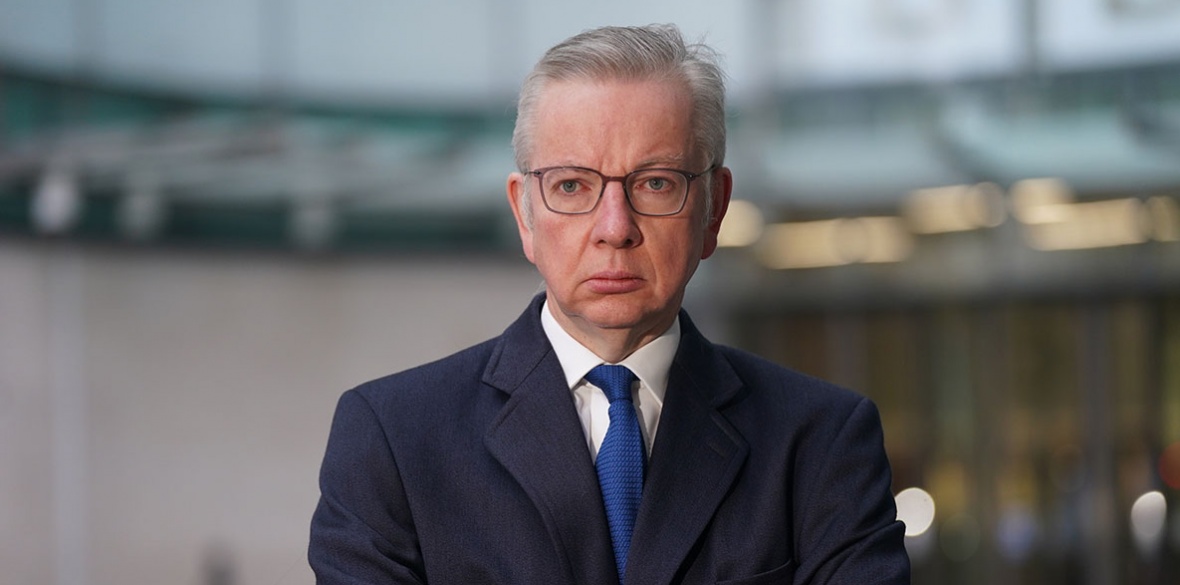
Communities secretary, Michael Gove, February 11, 2024
DEMOCRACY is under threat, campaigners warned today as the Tories launched a new “anti-extremism” drive aimed mainly against Muslims.
Communities Secretary Michael Gove named three Muslim organisations in the Commons as he unveiled the government’s new definition of extremism, apparently responding to the mass movement of solidarity with the Palestinian people that has mushroomed over the last five months.
One of the organisations named by Mr Gove, the Muslim Association of Britain, has been part of the coalition of five groups organising the national demonstrations.
The others singled out by the Tories are Mend and Cage. For show, two obscure far-right groups, British National Socialist Movement and Patriotic Alternative, were also identified.
The five pro-Palestinian campaigns, which include Stop the War and Palestine Solidarity, said in a statement that the “redefinition of extremism is in reality an assault on core democratic freedoms, seeking to silence dissenting voices.”
Stressing “the fundamental right to legitimately campaign to change government policy,” the joint statement added that “the marches have been overwhelmingly peaceful and attended by a broad cross-section of British society.