Author: dizzy

  • High levels of PFAS forever chemicals found flowing into River Mersey – new study

    Spread the love
    Heavy industry and dense urban populations both contribute to high levels of effluent containing toxic forever chemicals that don’t biodegrade.
    Shaun Jeffers/Shutterstock

    Patrick Byrne, Liverpool John Moores University

    Huge volumes of toxic and cancer-causing forever chemicals are flowing into the River Mersey in north-west England. With a busy, industrialised skyline and both Manchester and Liverpool nearby, it’s the second-most populated river catchment in the UK after the Thames.

    None of England’s rivers are in good chemical health. The recent State of Our Rivers 2024 report from The Rivers Trust found that one of the most concerning groups of synthetic chemicals, per- and polyfluorinated substances (PFAS), contaminates almost every river in England.

    Known as forever chemicals because they can take thousands of years to break down, PFAS persist in the environment and accumulate in living things. They threaten ecosystems and human health, not just in the Mersey, but in every industrialised river around the world.

    My team of hydrologists and I found that levels of two cancer-causing PFAS washing off the land and into the Mersey – perfluorooctane sulfonate (PFOS) and perfluorooctanoic acid (PFOA)– are among the highest in the world. Both PFOS and PFOA, now banned in most countries, were used to make many consumer and industrial products including furniture, cookware and fire-fighting foams.

    Our study established that around 50% of PFOS, a type of PFAS that’s classed as probably carcinogenic, in the River Mersey was coming from supposedly clean water discharges from 44 different wastewater treatment works. PFAS are found in treated water because they are very difficult to remove using current water treatment technologies. Almost all wastewater treatment work effluents in the UK contain PFAS.

    Our research highlights that we don’t really know where the remaining 50% of that PFOS is coming from. Other potential sources include runoff from airports where big amounts of fire-fighting foams are used,
    agricultural land and landfills. Some PFAS could contaminate groundwater or surface waters used as drinking water.

    PFAS chemicals are all around us and impossible to avoid. Found in everything from food packaging to cosmetic products, they are also used to manufacture green energy technologies like electric cars and wind turbines.

    Whenever PFAS are used to make these products they end up draining into rivers, so wildlife and humans living in the river basin are exposed to them. We don’t really know the long-term implications of the current exposure levels. But these chemicals will persist. If we keep discharging them into the environment, PFAS exposure levels – and potential risk to humans – can increase through drinking water contamination and accumulation in the food chain.

    Pinpointing exactly where, how and when these chemicals enter rivers is not straightforward so scientists and governments don’t really have the regulatory measures and tools to hold polluters to account.

    Aerial shot of round water treatment container, gree water, spinning filters with grey infrastructure
    Significant PFAS levels were found in effluent from 44 wastewater treatment plants flowing into the River Mersey.
    Avigator Fortuner/Shutterstock

    Dilute, disperse and detect

    Since the 1850s, the Mersey has been a hub of industry, particularly for cotton manufacturing and chemical production. Most cities, including Liverpool and Manchester, have been built close to rivers and seas, partly to dilute pollution and transport it away. Out of sight, out of mind.

    Today, enormous volumes of toxic waste are discharged into rivers and seas because dilution reduces chemical concentrations to extremely low or undetectable levels. But undetectable does not mean toxic chemicals are not present.

    PFAS are ubiquitous. These forever chemicals have been detected almost everywhere we look, including in Antarctica, in whales and polar bears and in rainwater. Most people on Earth probably have detectable concentrations of PFAS in their blood. An estimated [97% of the US population] have PFAS in their blood, according to one study of 1,682 people.

    A state of flux

    Governments need to phase out PFAS from society to reduce human exposure and halt their accumulation in the environment and wildlife. The development of safer, healthier, greener alternatives is essential.

    Even if the tap gets turned off immediately, the PFAS already in the environment, and in the River Mersey, will persist for thousands of years. To prevent further PFAS entering our rivers, more needs to be known about how they move into and through river systems. As part of our study, we measured this flux.

    Instead of measuring a chemical’s concentration, flux is a measure of how much PFAS, for example in kilograms per year, flows off the land and out to sea. By measuring PFAS flux at multiple locations across a river basin like the Mersey, we can distinguish different sources of PFAS to the river, such as runoff from landfills, and establish how much comes from that source.

    Governments and environmental regulators need more data like this to develop strategies that will prevent PFAS entering rivers. Our study not only confirmed wastewater treatment works effluents as a source of PFAS to the Mersey, we established exactly how much is coming from that source. This direct accountability is required to effectively target regulations and apply measures that make a difference.

    Greater understanding of the flux and movement of PFAS in rivers and seas will help ensure better monitoring and regulation of these toxic forever chemicals – especially in hotspots like the Mersey that should be a top priority for enforcement.


    Imagine weekly climate newsletter

    Don’t have time to read about climate change as much as you’d like?

    Get a weekly roundup in your inbox instead. Every Wednesday, The Conversation’s environment editor writes Imagine, a short email that goes a little deeper into just one climate issue. Join the 30,000+ readers who’ve subscribed so far. The Conversation


    Patrick Byrne, Reader in Hydrology and Environmental Pollution, Liverpool John Moores University

    This article is republished from The Conversation under a Creative Commons license. Read the original article.
  • Rishi Sunak’s plan to redefine extremism is disingenuous – and a threat to democracy

    Spread the love
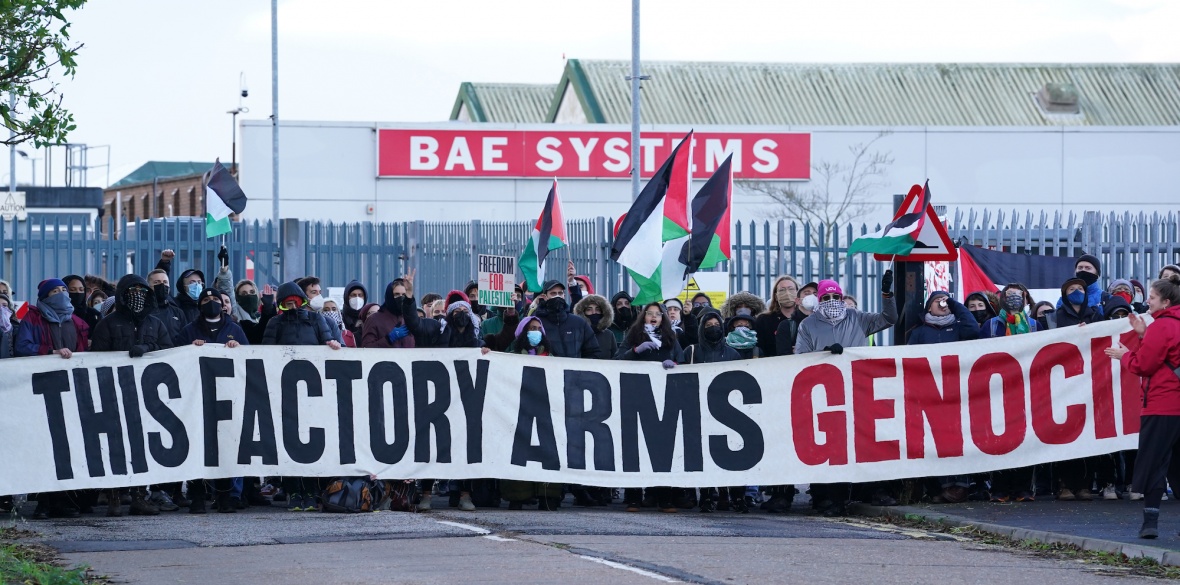
    Over 400 disrupt operations at BAE Systems site and call for ceasefire ahead of national march for Palestine 10 Nov 2023
    Over 400 disrupt operations at BAE Systems site and call for ceasefire ahead of national march for Palestine 10 Nov 2023

    Alan Greene, University of Birmingham

    Unhappy with large protests against the increasingly dire situation in Gaza, Prime Minister Rishi Sunak is seeking to update the UK’s definition of extremism. This, he has argued, is needed because “our democracy itself is a target” of antisemitic and Islamophobic extremists.

    However, the reality is that no measures do more damage to democracy than policy proposals like the one Sunak is promoting.

    The UK already has a definition for extremism, which is used in efforts to tackle terrorism. We may think of the police as leading those efforts, but the UK’s Prevent strategy now also places a duty on certain other authorities to “have due regard to the need to prevent people from being drawn into terrorism”.

    These authorities include local government, education institutions and the NHS. In reality, the UK has placed teachers and NHS staff on the frontline in the fight against terrorism, on top of all their other duties that they were actually trained to do.

    To help those with a duty under Prevent to identify people at risk of being drawn into terrorism, the government currently defines extremism as “vocal or active opposition to fundamental British values, including democracy, the rule of law, individual liberty and mutual respect and tolerance of different faiths and beliefs”. Also included are “calls for the death of members of our armed forces”.

    This definition is not contained in any law, however. Instead, it features in the government’s Prevent guidance. A key reason why this definition is not contained in legislation is because it is so vague and unclear. It would be difficult to legally oblige anyone with a duty under Prevent to apply the definition – and even more difficult for a court to determine what it means.

    Even as guidance, there are still problems with the definition. It offers enormous discretion to the people deciding who is at risk of being drawn into terrorism. Discretion can lead to inconsistent application. That, in turn, can lead to discrimination.

    Vague to vaguer

    It has been suggested that the new definition of extremism will include the “promotion or advancement of ideology based on hatred, intolerance or violence or undermining or overturning the rights or freedoms of others, or of undermining democracy itself”.

    What does it mean to undermine or overturn the rights or freedoms of others? Would arguing for the UK to leave the European convention on human rights count meet the bar?

    Likewise, what does it mean to undermine democracy? Does excessive corporate lobbying do so? What about calling for restrictions on the right to free speech or the right to protest? These are fundamental rights that are absolutely necessary for a democracy to flourish. Would they be extremist?

    Existing laws are enough

    Sunak is presenting the new definition of extremism as a response to protests he depicts as being out of control. But the UK already has numerous laws in place to tackle what it considers to be unacceptable behaviour at protests. The Terrorism Act (which is also incredibly broad) can be used to prosecute people who damage property or create a serious risk to public safety during protests.

    Counter-terrorism laws can also capture forms of expression at public demonstrations or online. It is already a crime to express support for a proscribed (unlawful) organisation, or to wear clothing, symbols or publish images in a way which can raise suspicion that you support an unlawful organisation. So, for example, if you express support for Hamas — a proscribed organisation — you are already committing a crime and can be prosecuted for it.

    Meanwhile, the Public Order Act contains offences dealing with hate speech. These include using threatening, abusive or insulting words or behaviour, or displaying written material which is intended to or likely to stir up racial or religious hatred.

    In 2022, the Police, Crime, Sentencing and Courts Act expanded the criminal offence of causing a public nuisance to include “serious distress, serious annoyance, serious inconvenience or serious loss of amenity”. This can now be applied by he police to criminalise protests that are considered to be making too much noise.

    It is hard, therefore, to see which bases are not already covered for a government looking to prosecute people for extremism. These mechanisms have already been used to clamp down on all kinds of activism. In reality, there is no gap in the law that needs fixing. Rather, this proposal looks like a classic example of a government talking tough on crime and terrorism in order to boost its poll ratings in an election year.

    The right to protest

    Adding new definitions for extremism only creates problems. The vaguer a definition gets, the easier it is to misuse. It can also have a pervasive chilling effect on free speech. People may self-censor out of fear of being identified as extremist, not least when their employer has a duty under Prevent.

    The fact of the matter is that human rights law allows for protests to be disruptive. Otherwise, they could be simply ignored. Human rights law also allows people to “shock, offend, and disturb” through speech.

    The government may not be happy with large public protests against its foreign policy but it should not be viewed as extremist to march for a ceasefire in Gaza. Likewise, it should not be viewed as extremist to vocalise opposition to the potential genocide being committed by the Israeli Defence Forces. If this were so, then the International Court of Justice is extremist.

    There is a deep danger of conflating protest with extremism and terrorism, undermining the legitimacy of these protests. To stretch the concept of extremism to cover these views is what is actually undermining democracy and the rights and freedoms of others. The Conversation

    Alan Greene, Reader in Constitutional Law and Human Rights, University of Birmingham

    This article is republished from The Conversation under a Creative Commons license. Read the original article.


  • Morning Star: Rishi Sunak must answer for the abuse endured by Diane Abbott — but so must Keir Starmer

    Spread the love

    https://morningstaronline.co.uk/article/e/sunak-and-starmer-must-answer-abuse-abbott

    Labour leader Sir Keir Starmer (left) and Prime Minister Rishi Sunak walk through the Peer’s Lobby at the Palace of Westminster ahead of the State Opening of Parliament in the House of Lords, London, November 6, 2023

    THE sickening racist abuse directed at Diane Abbott by top Tory donor Frank Hester represents a challenge to the leaders of both the major political parties.

    Hester, who has given the Conservative Party £10 million over the last year, told a meeting in 2019 that looking at the MP for Hackney North and Stoke Newington made him “want to hate all black women” and added for good measure that Abbott “should be shot.”

    Such remarks should be enough to immediately terminate anybody’s involvement in public life, and they may indeed constitute a criminal offence.

    Hester was speaking, remember, just three years after a Labour MP, Jo Cox, was indeed shot to death by a far-right fanatic.

    Everyone should first of all send their unqualified solidarity to Abbott, long the victim of more racist and misogynistic abuse than any other MP.

    …

    Racism is a bipartisan problem. And it is reinforced by Starmer’s own treatment of Abbott.

    She has been suspended from the Labour whip in Parliament for nearly a year now. Her offence was to write a newspaper letter suggesting Jewish people, among others, had not suffered from racism.

    Her letter was clearly wrong and she immediately and fulsomely apologised for it. Since then her case has been “under investigation.”

    Yet it is unclear what there is to investigate. There can be no possible reason for leaving her in political suspense for such a protracted period over what is a fairly straightforward issue.

    The reason for this procrastination is obvious: because Abbott has spent her life on the left of the Labour Party, and served in senior roles under Jeremy Corbyn, he wants rid of her.

    If she remains whipless when the next general election is called then she will be unable to stand as a Labour candidate, allowing some gormless Starmerite or other to be imposed on Hackney North.

    Abbott is Britain’s first black woman MP, and its longest-serving black MP too. For her to be treated like this ought to be a source of national shame.

    It is past time that the phoney “investigation” into her was terminated and the whip restored.

    …

    https://morningstaronline.co.uk/article/e/sunak-and-starmer-must-answer-abuse-abbott

  • Greens respond to Frank Hester’s remarks on Diane Abbott

    Spread the love

    The Green Party has accused the Conservative Party of being funded by racists and have challenged them to donate the £10m received from Frank Hester to anti-racism and domestic violence charities. 

    Green Party spokesperson for Policing and Domestic Safety, Amanda Onwuemene
    Green Party spokesperson for Policing and Domestic Safety, Amanda Onwuemene

    Green Party spokesperson for Policing and Domestic Safety, Amanda Onwuemene, said: 

    “It’s clear that racists are funding the Tory Party to the tune of millions of pounds. No wonder they fail to call this out for what it is – a vile racist and misogynist attack on a woman who made history by becoming Britain’s first Black woman MP and who has had a remarkable political career.  

    “The Green Party stands in solidarity with Diane Abbott and all Black women. Nobody should have to face the abuse and threats she is subject to.  

    “Labour wants the Conservative Party to return the £10m donation – to a man guilty of racism and misogyny. As Greens we challenge the Conservative Party to donate the sum it has received from Hester to some of the many anti-racism and domestic violence campaigns around the country that are doing such valuable work. That would demonstrate the Tories are genuinely concerned about fighting racism and misogyny.” 

  • UK plans to adapt to climate crisis ‘fall far short’ of what is required

    Spread the love

    https://www.theguardian.com/environment/2024/mar/13/uk-climate-crisis-plans-fall-far-short-of-what-is-required-ccc-says

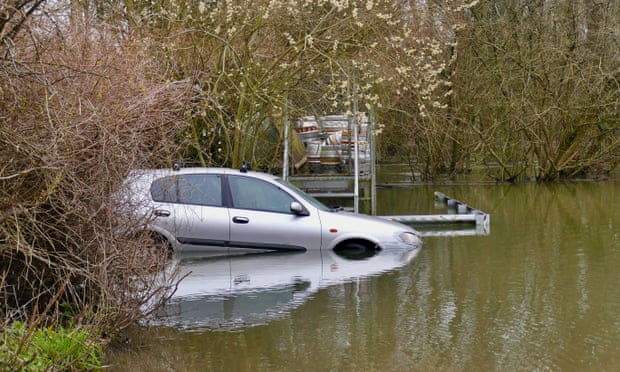
    A car gets submerged in flood waters in a pub car park in Sonning on Thames, Berkshire, UK. Photograph: Geoffrey Swaine/REX/Shutterstock

    Government has no credible plan for effects of extreme weather, says Committee on Climate Change

    The UK’s plans for adapting to the effects of the climate crisis “fall far short” of what is required, the government’s statutory adviser has said.

    The Climate Change Committee (CCC) has examined the national adaptation programme published by ministers last July, intended to set out how people, buildings and vital national infrastructure such as water, transport, energy and telecommunications networks could be protected from the increasing severity of storms, floods, heatwaves and droughts that are afflicting the UK as a result of global heating.

    In a damning verdict delivered on Wednesday, the committee found that the government had no credible plan for making the UK resilient to the increasing effects of extreme weather.

    Julia King, chair of the adaptation subcommittee of the CCC, said: “The evidence of the damage from climate change has never been clearer, but the UK’s current approach to adaptation is not working.”

    …

    https://www.theguardian.com/environment/2024/mar/13/uk-climate-crisis-plans-fall-far-short-of-what-is-required-ccc-says