Featured before on this blog, the Highway to Hell was a short poem published by me to oppose the USUK-Iraq War 2003. It unfortunately repeatedly appears appropriate, currently for the Israeli genocide of Gaza.
THE HIGHWAY TO HELL
I respect all religions And belief-systems worldwide
But I have no time for those b******s
That claim to be Christians That claim Divine guidance On the Highway to Hell
The wikipedia page appears incomplete. I understood that large earth-moving machines were used to kill retreating Iraqi soldiers through burying them alive but there’s no mention of it.
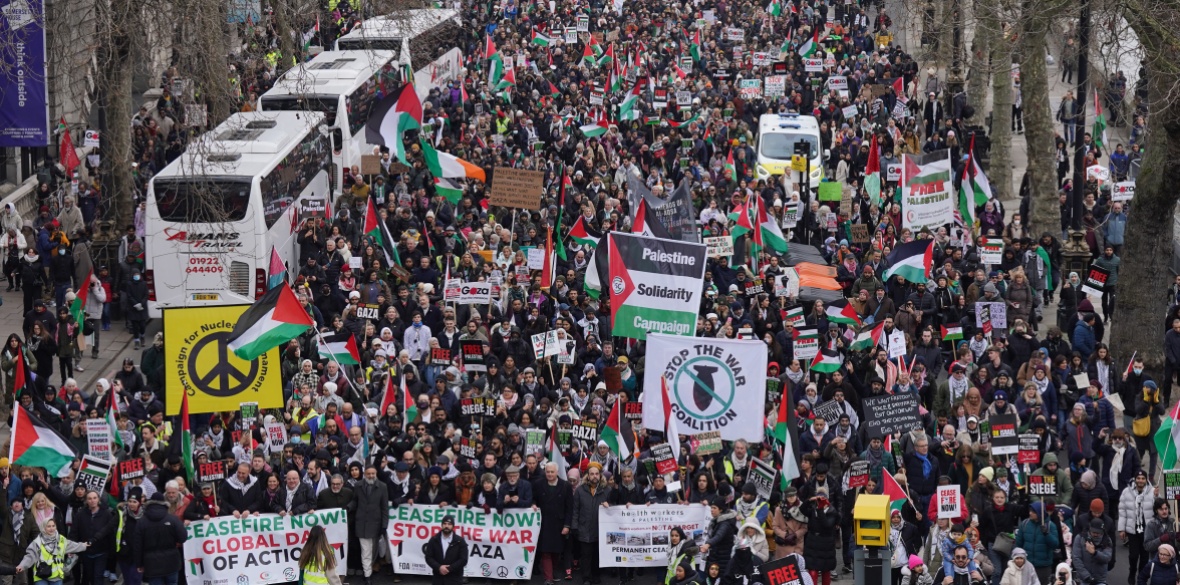
Protesters during a National March for Palestine in central London, January 13, 2024
THE government ignored “overwhelming evidence” that Israel was breaching international human rights laws in Palestine and continued to supply the murderous regime with weapons, including those being used in Gaza, legal documents have revealed.
A Foreign Office assessment unit reviewing UK arms sales to Israel in November raised “serious concerns” with Foreign Secretary David Cameron.
But the former PM recommended that arms sales continue, accepting Israel’s reasoning that it has a different interpretation of its international humanitarian law obligations.
The revelations are contained in a document in a case brought by the Global Legal Action Network (GLAN) and Palestinian human rights group Al Haq over UK arms sales to Israel.
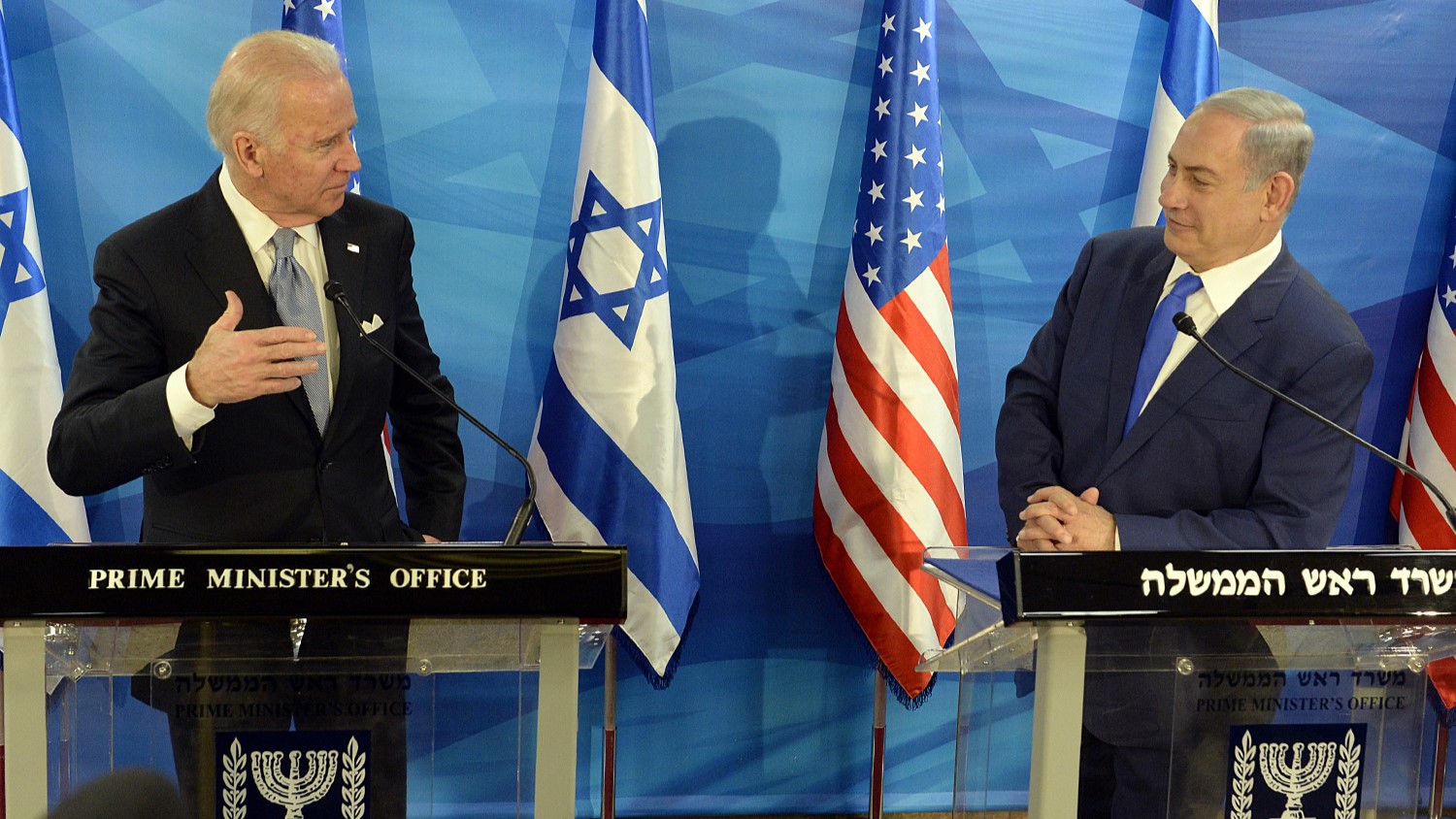
Israeli prime minister Benjamin Netanyahu (right) denied any possibility of a Palestinian state now or in future, rejecting Joe Biden’s (left) peace proposals earlier this week. (Photo: Wikimedia Commons)
Rejecting proposals for peace in the region, Israeli prime minister Benjamin Netanyahu denies any possibility of a two-state solution, wants Israeli occupation on Palestinian land to continue forever
Israel does not see any possibility of a two-state solution, proclaimed Prime Minister Benjamin Netanyahu on Thursday, January 18 even as his forces killed more than 150 Palestinians in less than 24 hours in various air and ground offensives across Gaza and other occupied territories. Gazans are also facing an unprecedented days-long communications blackout.
As of Friday, January 19, day 105 of the war, over 24,760 Palestinians have been killed and over 62,000 have been wounded in Israeli attacks on Gaza which began on October 7.
In one Israeli attack, at least 15 civilians, most of them children and women, were killed near the Al-Shifa hospital on Friday morning and massive Israeli attacks are taking place in Khan Younis.
Al-Shifa and other hospitals in Gaza have been repeatedly attacked by the Israeli forces since the early days of the war despite condemnations and allegations of war crimes.
Meanwhile, Israeli forces continued their raid in Tulkarm in the occupied West Bank for the second consecutive day on Thursday. At least eight Palestinians have been killed in the raids with over a hundred injuries.
During the raid, Israeli forces shot and left Abdul Rahman Othman on the ground, preventing any medical aid from reaching him. They also tied his leg with rope and dragged his body on the ground. Othman died of his wounds later, Wafareported.
Israeli forces also bombed several houses inside the refugee camp which has been attacked several times since October 7 and detained hundreds of Palestinians.
The total number of Palestinians killed in the occupied West Bank since October 7 is now close to 370. At least 95 of these were children.
Unprecedented communication blackout in Gaza
In yet another attempt to prevent the flow of information about humanitarian suffering in Gaza caused by its war, Israeli forces have maintained a near total communication blockade in the territory for eight straight days now. This is the longest communication blackout imposed on Gaza since October 7.
Palestinian telecommunication companies PalTel and Ooredoo had announced a halt in their operation last week claiming their lines and infrastructure were completely damaged due to Israeli aggression. They have not been able to restore their services due to lack of equipment and repair work prevented due to Israeli blockade and attacks on the staff carrying out the repair work.
Ihab Sbeih, undersecretary of the Ministry of Communication and Information Technology claimed on Thursday that, “the communication sector has been continuously targeted during the Israeli aggression on Gaza with the extent of damage exceeding 80%. He also claimed that the technical crew has been constantly targeted by Israel, preventing them from carrying out repair work,” Wafa news reported.
At least two crew members of PalTel were killed last Saturday when their vehicle was attacked by Israeli forces in Khan Younis.
Israel says no to a two-state solution
In a press conference on Thursday, Israeli Prime Minister Benjamin Netanyahu publicly denied any possibility of a Palestinian state now or in future in what is seen as a direct rebuttal to Joe Biden administration’s proposals earlier this week for a post-war scenario in the region.
“In any future arrangement, or in the absence of an arrangement Israel must maintain security control of all territory west of the Jordan River. That is the vital condition” Netanyahu said.
Facing widespread criticism for its total support to the Israeli genocide of Palestinians in Gaza since October 7, the Joe Biden administration has paid lip service to the proposal for a Palestinian state as a way forward for peace in the region.
As a compensation to Israel the US promised increased normalization with the Arab countries including Saudi Arabia. The proposals were worked out during Secretary of State Antony Blinken’s fourth visit to the region since October 7 last week.
Speaking in Davos during the World Economic Forum, Blinken claimed on Wednesday that a two-state solution would bring “genuine security” to Israel as it will bring it closer to Arab states and isolate Iran.
Perhaps to pre-empt the Israeli rejection, Blinken emphasized that no future Palestinian government would be allowed to work “in active opposition to Israel.”
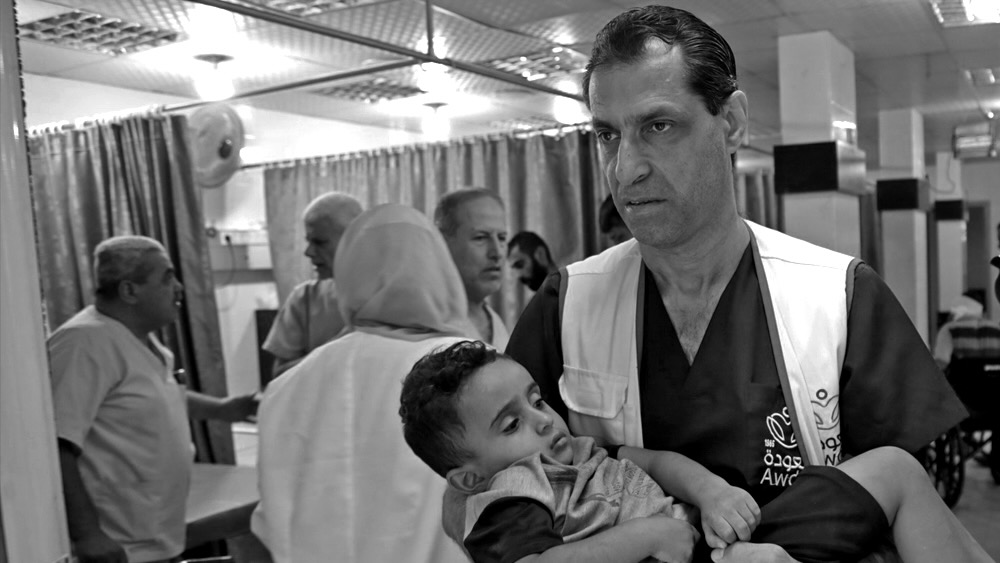
Al-Awda Hospital Manager Dr. Ahmed Muhanna was arrested by Israeli Forces on December 17, 2023 and his whereabouts are unknown. Photo: People’s Health Movement
The status of health workers arrested by Israeli Occupying Forces in northern Gaza remains uncertain as attacks on health infrastructure continue
One month ago, Ahmed Muhanna, the director of Al-Awda Hospital in Jabalya, northern Gaza, was detained by the Israeli Occupation Forces (IOF). According to the most recent information made available to Awda Association, the anesthetist is currently being held in Naqab prison in the Negev desert, with other details about his status remaining unknown.
Dr. Muhanna’s fate is shared by many other health workers who were arrested during the ongoing Israeli war on the Gaza Strip. Mohammed Al-Ran, a surgeon who worked at the Indonesian, Kamal Adwan, and Al-Ahli hospitals since October 7, is currently also imprisoned by the Israeli authorities, although he had been granted permission to leave for Bosnia.
Sparse information about his health conditions and location, much like that of Dr. Muhanna, is communicated through friends and relatives who have either witnessed the arrest or met Dr. Al-Ran while in prison. The IOF has remained silent unless faced with pressure, usually from abroad.
The arrest of several directors of Gaza’s hospitals has mostly been interpreted as a sign of the next phase of Israel’s attacks on healthcare in the Strip. Some, like surgeon Ghassan Abu-Sittah, predict that this will lead to a series of show trials to further the criminalization and persecution of the sector. Others, including sources close to Awda, consider it possible that the doctors will be held in prison for a prolonged period of time, with their post-war destiny unknown.
Different interpretations converge on one point, though. They all note that the health workers taken by the IOF were strong voices speaking from northern Gaza and had refused to leave the area and abandon their patients. In other words, they constituted a thorn in the side of the army that breaks international law every time it targets health infrastructure in Palestine.
While arresting and targeting health workers to silence them, Israeli soldiers continue to attack hospitals and health centers in Gaza. As a result of the ongoing attacks, many international organizations have been forced to abandon their operations for good or move to the southern regions. Among them were the Medical Aid for Palestinians (MAP) and Médecins Sans Frontières (MSF) teams.
“Drone strikes, sniper fire and bombardments in the close vicinity of the hospital made the space too unsafe to work in. The volatile conditions leave us feeling incapacitated; there’s virtually no secure space to provide even minimal medical care to people,” said Enrico Vallaperta, MSF Project Medical Referent, commenting on the organization shifting its operations from Al-Aqsa Hospital.
Yet, health workers are not giving up on protecting health infrastructure in Gaza, including in Al-Awda centers in Nuseirat and Rafah. In fact, safeguarding and reactivating the local health system remains a priority for international organizations, including the World Health Organization (WHO).
The WHO also continues to conduct visits to the remaining hospitals in Gaza. Although the situation can change in a matter of hours – with hospitals going from partially operational at 10 am to completely out of function by 2 pm – generally they are all working multiple times over their capacity as well as trying to shelter thousands of forcibly displaced people.
During a visit conducted on January 13, the WHO team found Al-Aqsa Hospital and Nasser Medical Complex short-staffed and crowded. In Al-Aqsa, there were only 12 health workers remaining, providing care to 140 people and sharing space with over 1,000 displaced people. Nasser held twice the number of patients it was supposed to accommodate. “The hospital continues to receive a high volume of trauma and burn cases but the ICU and burns unit are severely understaffed, delaying lifesaving treatment for many,” the WHO team reported back.
Unsurprisingly, the situation continues to be ripe for the spread of communicable diseases. Before October 7, “immunization levels in Gaza were among the best globally,” according to Rana Ahmad Hajjeh from the WHO Eastern Mediterranean office. Now, without coolers and fuel to operate them, there is little hope in rolling out vaccination campaigns that could help curb major outbreaks.
Even when the WHO and other international organizations are able to get vaccines into Gaza, the IOF does not allow them to distribute them in the northern areas. Multiple missions over the past weeks had to be canceled due to the lack of security guarantees on the Israeli side. This has meant that medicines, as well as fuel needed to operate generators, are simply not where they should be.
“In the 21st century, most medical equipment operates on electricity. Unfortunately, electricity has become a scarce commodity [in Gaza],” observed Ayadil Saparbekov from WHO’s Health Emergencies program.
Amid ongoing communication blackouts, it is not only electricity that has become a scarce commodity. The same is true for information coming directly from health workers in Gaza; without that information, the fate of Dr. Muhanna, Dr. Al-Ran, and others remains difficult to predict.
So again: why does this ailing technology enjoy such intense and persistent generosity?
The UK government has for a long time failed even to try to justify support for nuclear power in the kinds of detailed substantive energy terms that were once routine. The last properly rigorous energy white paper was in 2003.
Even before wind and solar costs plummeted, this recognised nuclear as “unattractive”. The delayed 2020 white paper didn’t detail any comparative nuclear and renewable costs, let alone justify why this more expensive option receives such disproportionate funding.
A document published with the latest announcement, Civil Nuclear: Roadmap to 2050, is also more about affirming official support than substantively justifying it. More significant – in this supposedly “civil” strategy – are multiple statements about addressing “civil and military nuclear ambitions” together to “identify opportunities to align the two across government”.
These pressures are acknowledged by other states with nuclear weapons, but were until now treated like a secret in the UK: civil nuclear energy maintains the skills and supply chains needed for military nuclear programmes.
The military has consistently called for civil nuclear
Official UK energy policy documents fail substantively to justify nuclear power, but on the military side the picture is clear.
For instance, in 2006 then prime minister Tony Blair performed a U-turn to ignore his own white paper and pledge nuclear power would be “back with a vengeance”. Widely criticised for resting on a “secret” process, this followed a major three volume study by the military-linked RAND Corporation for the Ministry of Defence (MoD) effectively warning that the UK “industrial base” for design, manufacture and maintenance of nuclear submarines would become unaffordable if the country phased out civil nuclear power.
A 2007 report by an executive from submarine-makers BAE Systems called for these military costs to be “masked” behind civil programmes. A secret MoD report in 2014 (later released by freedom of information) showed starkly how declining nuclear power erodes military nuclear skills.
In 2017, submarine reactor manufacturer Rolls Royce even issued a dedicated report, marshalling the case for expensive “small modular reactors” to “relieve the Ministry of Defence of the burden of developing and retaining skills and capability”.
The government itself has remained coy about acknowledging this pressure to “mask” military costs behind civilian programmes. Yet the logic is clear in repeated emphasis on the supposedly self-evident imperative to “keep the nuclear option open” – as if this were an end in itself, no matter what the cost. Energy ministers are occasionally more candid, with one calling civil-military distinctions “artifical” and quietly saying: “I want to include the MoD more in everything we do”.
In 2017, we submitted evidence to a parliamentary public accounts committee investigation of the deal to build Hinkley Point C power plant. On the basis of our evidence, the committee asked the then MoD head (who – notably – previously oversaw civil nuclear contract negotiations) about the military nuclear links. His response:
We are completing the build of the nuclear submarines which carry conventional weaponry. We have at some point to renew the warheads, so there is very definitely an opportunity here for the nation to grasp in terms of building up its nuclear skills. I do not think that that is going to happen by accident; it is going to require concerted government action to make it happen.
This is even more evident in actions than words. For instance hundreds of millions of pounds have been prioritised for a nuclear innovation programme and a nuclear sector deal which is “committed to increasing the opportunities for transferability between civil and defense industries”.
An open secret
Despite all this, military pressures for nuclear power are not widely recognised in the UK. On the few occasions when it receives media attention, the link has been officially denied.
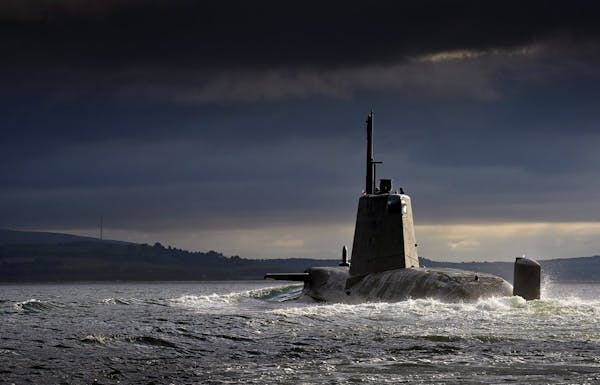
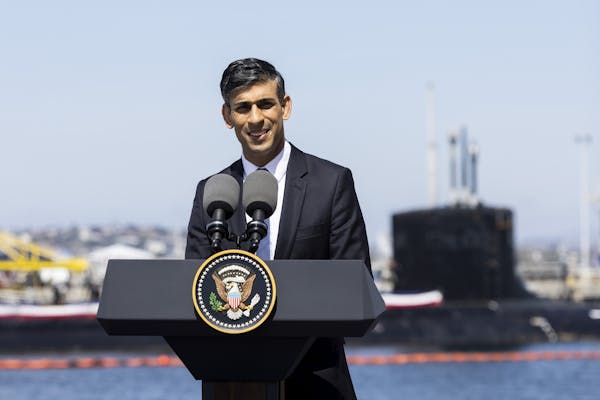
UK prime minister Rishi Sunak announces a US-UK-Australia nuclear submarine deal in March 2023. Etienne Laurent / EPA
Other nuclear-armed states are also striving to maintain expensive military infrastructures (especially around submarine reactors) just when the civilian industry is obsolescing. This is true in the US, France, Russia and China.
Other countries tend to be more open about it, with the interdependence acknowledged at presidential level in the US for instance. French president Emmanuel Macron summarises: “without civil nuclear power, no military nuclear power, without military nuclear, no civil nuclear”.
This is largely why nuclear-armed France is pressing the European Union to support nuclear power. This is why non-nuclear-armed Germany has phased out the nuclear technologies it once lead the world in. This is why other nuclear-armed states are so disproportionately fixated by nuclear power.
Neglect of this picture makes it all the more disturbing. Outside defence budgets, off the public books and away from due scrutiny, expensive support is being lavished on a joint civil-military nuclear industrial base largely to help fund military needs. These concealed subsidies make nuclear submarines look affordable, but electricity and climate action more costly.
The conclusions are not self-evident. Some might argue military rationales justify excessive nuclear costs. But history teaches that policies are more likely to go awry if reasons are concealed. In the UK – where nuclear realities have been strongly officially denied – the issues are not just about energy, or climate, but democracy.
The Conversation asked the UK Department for Energy Security and Net Zero to comment but did not receive a reply before the publication deadline.