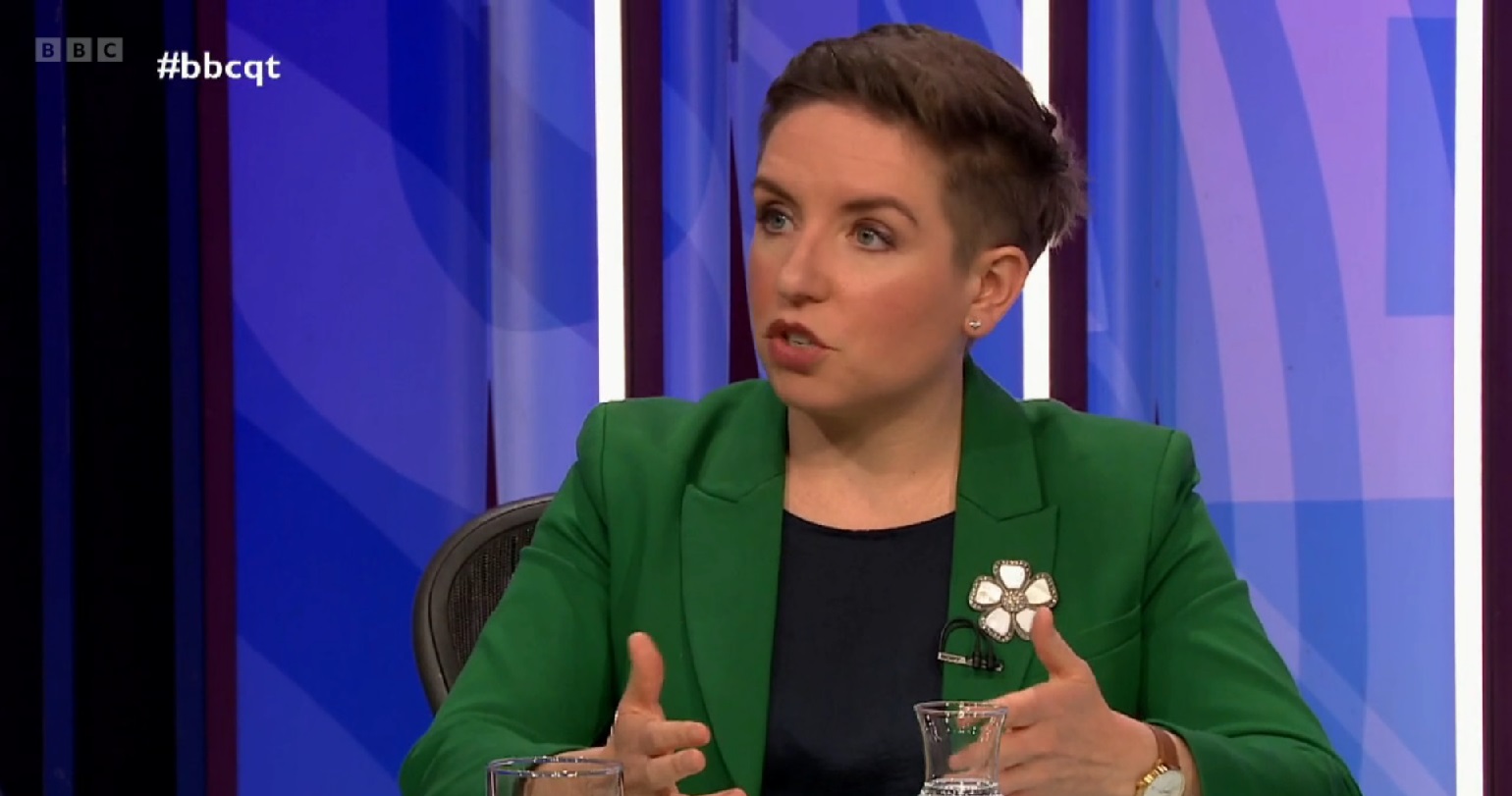
Image of the Green Party’s Carla Denyer on BBC Question Time.
Reacting to news that 2023 is set to become the warmest year on record following unprecedented October temperatures, co-leader of the Green Party, Carla Denyer, said:
“Another week, another indicator that our climate is in meltdown. News that 2023 will almost certainly be confirmed as the hottest year on record, comes just a day after the government made the totally reckless decision to push for new oil and gas licences. This represents a massive two fingers up at communities at home and abroad who are on the front line of floods, droughts and fires, and to future generations who face an uninhabitable planet if we continue with business as usual. It’s also another alarming example of the Conservatives’ allergy to evidence-based policymaking.
“This is another wake-up call – as if any more were needed – on the urgent need to transform our economy and society – ramping up cheaper and abundant renewable resources such as solar and wind power, insulating millions of homes, investing in the infrastructure for active travel, boosting public transport and changing land management practices so that nature can thrive and help to soak up the emissions we’ve released.
“Only Greens give the climate crisis the focus it needs, which is why, whoever forms the next government, we need more Green Party MPs in parliament pushing for climate action.”
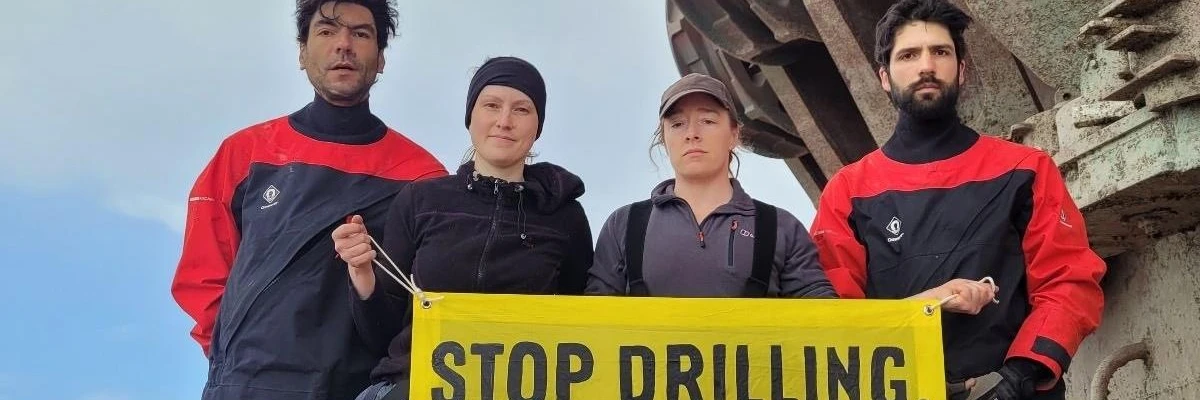
Four Greenpeace activists are pictured on a Shell vessel in the Atlantic Ocean on January 31, 2023.
“I will stand up in court and fight this; and if Shell refuses to stop drilling, I refuse to stop fighting for climate justice,” one activist named in the suit said.
Oil giant Shell is menacing Greenpeace International and Greenpeace U.K. with a lawsuit that represents “one of the biggest legal threats against the Greenpeace network’s ability to campaign in its more than 50-year history,” the environmental group revealed Thursday.
The lawsuit comes in response to a protest in January in which activists boarded one of the Shell’s oil platforms while it was en rote to a North Sea oil field. Shell has given Greenpeace a choice between facing a full $8.6 million in damages or settling for a reduced charge of $1.4 million and a promise never to protest on Shell infrastructure again.
“Shell is trying to silence my legitimate demands: that it must stop its senseless and greedy pursuit of fossil fuels and take accountability for the destruction it is wreaking upon the world,” Yeb Saño, executive director of Greenpeace Southeast Asia, said in a statement.
Shell claim our peaceful protest earlier this year caused $8m in damages.
Saño, who is one of the activists named in the suit, attempted to board the platform and then met it in port in Norway to protest its arrival.
“I will stand up in court and fight this; and if Shell refuses to stop drilling, I refuse to stop fighting for climate justice,” Saño continued.
The protest that triggered the suit lasted from January 31 to February 12. Four Greenpeace activists used ropes to haul themselves onto the vessel while it was moving at full speed off the Canary Islands, Reuters reported. They stayed occupying the platform until it reached Norway. The platform was set to be used in the Penguins oil and gas field in the North Sea, which has not yet started production.
“He’s trying to crush Greenpeace’s ability to campaign, and in doing so, seeking to silence legitimate demands for climate justice and payment for loss and damage.”
The platform, the Penguins floating production storage and offloading unit, was the first new vessel that Shell had sent to the northern part of the North Sea in 30 years, Greenpeace said. While the protest was ongoing, Shell announced record 2022 profits of almost $40 billion. Greenpeace wanted Shell to stop extracting new oil and gas and to pay into a loss and damage fund to help vulnerable countries respond to the climate crisis. The activists carried signs reading, “Stop drilling—start paying,” The Guardian reported.
Saño said he had a personal reason to object to Shell’s business model.
“I have lived through the devastation caused by Shell and companies like them,” he said in a statement. “Ten years ago I spoke at COP global climate talks while my brother was still missing in the fallout from Super Typhoon Haiyan. Incredibly, he survived, but he helped carry the bodies of 78 innocent people who tragically did not.”
During the occupation itself, Shell and platform builder Fluor promised to seek more than $120,000 in damages. However, in a document seen by Reuters, Shell is now demanding $2.1 million in damages related to shipping delays, security, and legal costs, and Fluor is seeking $6.5 million. The suit was filed in London’s High Court.
SHOCKING FACT: Shell made the amount it’s threatening to sue us for in 2 hours last year.
THIS is corporate greed.
Shell CAN afford to pay for climate loss and damage it causes.
“The right to protest is fundamental, and we respect it absolutely. But it must be done safely and lawfully,” a Shell spokesperson said in a statement reported by The Guardian. “Shell and its contractors are entitled to recover the significant costs of responding to Greenpeace’s dangerous actions.”
While Shell has offered to reduce the damages if Greenpeace stops protesting its infrastructure, Greenpeace answered that it would only agree if Shell promised to obey a Dutch court order to cut its emissions by 45% of 2019 levels by 2030.
Greenpeace said that negotiations between it and Shell had wrapped up and the organization had been waiting for details, or “particulars,” from Shell since November 1.
Areeba Hamid, co-executive director of Greenpeace U.K., said the lawsuit reflected the climate-polluting direction of Shell under new CEO Wael Sawan, who took the reins in early 2023. Under his leadership, Hamid said, “Shell’s abandoned any pretence of good intentions, and is brazenly embracing a sinister strategy that’s not just risky for shareholders, but completely devastating for people on the frontlines of the climate crisis. Sawan’s ditching green policies, sacking former colleagues from his renewables division, and he’s gaslit the world by claiming a retreat from fossil fuels would be ‘dangerous.’”
“Now he’s trying to crush Greenpeace’s ability to campaign, and in doing so, seeking to silence legitimate demands for climate justice and payment for loss and damage,” Hamid continued. “We need this case to be thrown out and for Shell to be regulated by the government because it’s clear Sawan is hell-bent on profit, regardless of human cost.”
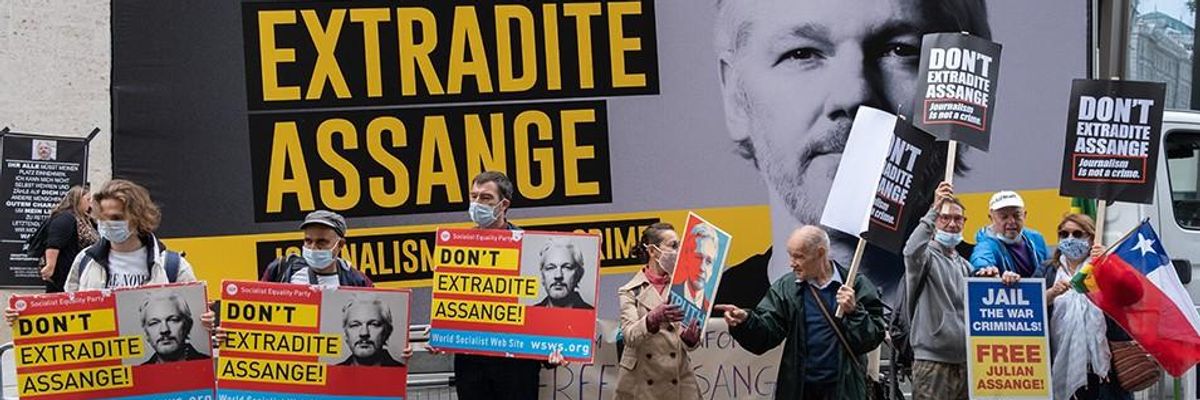
Supporters of WikiLeaks founder Julian Assange protest outside London’s Old Bailey court on September 7, 2020 as his fight against extradition to the U.S. resumed. (Photo: Richard Baker/Getty Images)
“The bottom line is that journalism is not a crime,” said Rep. Jim McGovern. “The stakes are too high for us to remain silent.”
Imploring the Biden administration to “not pursue an unnecessary prosecution that risks criminalizing common journalistic practices,” a bipartisan group of 16 U.S. lawmakers have signed a letter dated Wednesday to President Joe Biden urging him to end the attempted extradition of Julian Assange and drop all charges against the jailed publisher.
“Assange, the founder of WikiLeaks, faces multiple charges under the Espionage Act due to his role in publishing classified documents about the U.S. State Department, Guantánamo Bay, and wars in Iraq and Afghanistan,” states the letter, which is led by Reps. Jim McGovern (D-Mass.) and Thomas Massie (R-Ky.). “He has been detained on remand in London since 2019 and is pending extradition to the U.S., having lost his appeal of the extradition order in the courts of the United Kingdom.”
Assange—who suffers from physical and mental health problems including heart and respiratory issues—published materials, many of them provided by whistleblower Chelsea Manning, exposing U.S. and allied war crimes, including the “Collateral Murder” video showing a U.S. Army helicopter crew killing a group of Iraqi civilians, the Afghan War Diary, and the Iraq War Logs.
“Deep concerns about this case have been repeatedly expressed by international media outlets, human rights, and press freedom advocates, and members of Congress,” the lawmakers wrote. “In April of this year… members of the House argued to Attorney General Merrick Garland that ‘every day that the prosecution of Julian Assange continues is another day that our own government needlessly undermines our own moral authority abroad and rolls back the freedom of the press under the First Amendment at home.’”
The new letter has been signed by Reps. Alexandria Ocasio-Cortez (D-N.Y.), Jamaal Bowman (D-N.Y.), Ayanna Pressley (D-Mass.), Greg Casar (D-Texas), Ilhan Omar (D-Minn.), Cori Bush (D-Mo.), Rashida Tlaib (D-Mich.), Eric Burlison (R-Mo.), Marjorie Taylor Greene (R-Ga.), Paul Gosar (R-Az.), Jesús “Chuy” García (D-Ill.), Pramila Jayapal (D-Wash.), Matthew Rosendale (R-Mont.), and Sen. Rand Paul (R-Ky.).
In a message last month inviting congressional colleagues to sign the letter, McGovern and Massie explained that their goal is”to strongly encourage the Biden administration to withdraw the U.S. extradition request currently pending against Australian publisher Julian Assange and halt all prosecutorial proceedings against him as soon as possible.”
McGovern said last month in a statement to The Intercept that “the bottom line is that journalism is not a crime.”
“The work reporters do is about transparency, trust, and speaking truth to power,” he added. “When they are unjustly targeted, we all suffer the consequences. The stakes are too high for us to remain silent.”
The new letter follows last month’s official state visit of Australian Prime Minister Anthony Albanese, an Assange supporter who raised the jailed journalist’s case with President Joe Biden, insisting that “enough is enough.” A cross-party delegation of Australian lawmakers also traveled to the U.S. ahead of Albanese’s visit in an effort to pressure the Biden administration “to cease its pursuit and prosecution of Julian Assange.”
A delegation of Australian lawmakers arrived at the US DOJ in Washington DC last week to push for the freedom of Julian Assange, an Australian citizen@MaxBlumenthal spoke to the MPs about their campaign for Assange's release and to @GabrielShipton about his brother's condition pic.twitter.com/Dn3EU2cc7w
Imploring Americans to put themselves in Australian shoes, former Australian Deputy Prime Minister Barnaby Joyce told reporters after meeting with U.S. officials during the lawmakers’ trip: “Imagine if the Australian government said, ‘Hey you in Murfreesboro, Tennessee, as far as we’re concerned, you committed a crime, and you’re going to Canberra where we’re going to send you to jail for 175 years,‘ you’d be up us like a rat up a drainpipe.”
According to the United Nations Working Group on Arbitrary Detention, Assange has been arbitrarily deprived of his freedom since he was arrested on December 7, 2010. Since then he has been held under house arrest, confined for seven years in the Ecuadorean Embassy in London while he was protected by the administration of former Ecuadorean President Rafael Correa, and jailed in London’s notorious maximum-security Belmarsh Prison, where he is now.
Julian Assange is a political prisoner, and the sole reason he remains a political prisoner is because the White House remains afraid of his voice.
If fully convicted of the Espionage Act charges, Assange—who fathered two children with attorney Stella Morris, whom he married last year, while holed up in the Ecuadorean Embassy—could be sentenced to 175 years in prison.
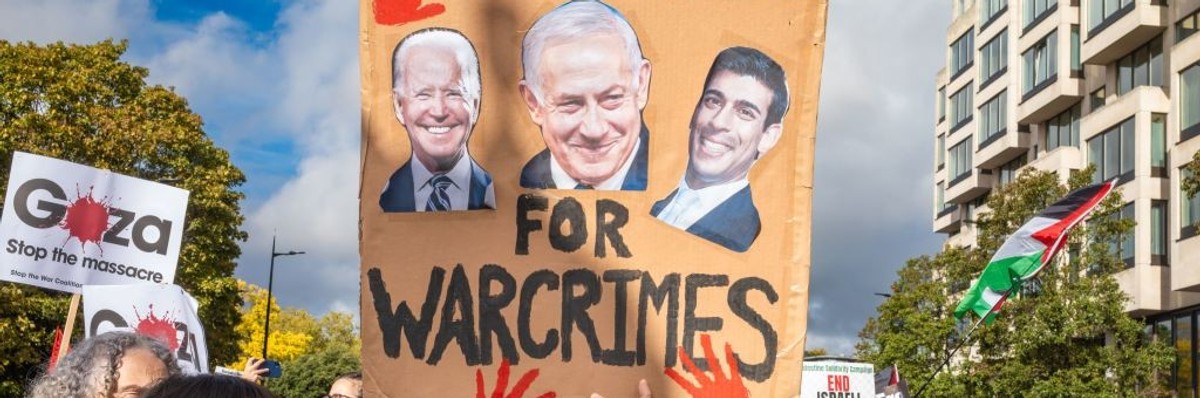
A pro-Palestinian protester holds a placard accusing Biden, Sunak and Netanyahu of war crimes at a demonstration against Israeli attacks on Gaza in central London, UK. (Photo by: Andy Soloman/UCG/Universal Images Group via Getty Images)
The word ‘hypocrisy’ here does not even begin to describe what is taking place, and the repercussions of this moral failure will be felt around the world for years to come.
On October 20, Secretary-General of the United Nations, Antonio Guterres, stood on the Egyptian side of the Rafah crossing, between Egypt and besieged Gaza.
Guterres was not the only international figure to travel to the Gaza border, hoping to mobilize the international community in the face of an ongoing genocide, in an already impoverished and besieged Strip.
“Behind these walls, we have two million people that is suffering (sic) enormously,” Guterres said.
These efforts, however, paid little dividends.
The spokesperson for the Ministry of Health in Gaza, Ashraf al-Qudra, said in a statement on October 24, that the flow of humanitarian aid into Gaza is “too slow (for it to) change the reality” on the ground.
Never again should the West be allowed to play the role of the mediator, the impartial politician, the judge, or even the self-serving humanitarian.
This means that the seemingly endless UN Security Council debates, General Assembly resolutions and calls for action did little to alter the tragic situation in Gaza in any meaningful way.
This begs the question, what is the use of the elaborate international political, humanitarian and legal systems, if they are unable to stop, or even slow down a genocide that is being aired live on TV screens all across the world?
In previous genocides, whether those accompanying the Great Wars or that of Rwanda in 1994, various justifications were offered to explain the lack of immediate actions. In some cases, no Geneva Conventions existed and, as in Rwanda, many pleaded ignorance.
But, in Gaza, no excuse is acceptable. Every international news company has correspondents or some presence in the Strip. Hundreds of journalists, reporters, bloggers, photographers and cameramen are documenting and counting every event, every massacre and every bomb dropped on civilian homes. It is important here to note that scores of journalists have already been killed in Israeli attacks.
Scientific approximations are telling us, for example, that nearly 25,000 tons of explosives have been dropped on Gaza by Israel in the first 27 days of war. It is equivalent to two atomic bombs, like those dropped by the US on Hiroshima and Nagasaki in 1945.
When US President Joe Biden callously tried to question the numbers of the Palestinian dead, the Gaza medical staff, who are forced to perform life-saving surgeries on the dirty grounds of hospitals, took the time to prove him wrong. On October 26, they produced a list containing the names of 6,747 Palestinian casualties who were killed in the first 19 days of war.
Thousands have been killed and wounded since then, yet Washington and its Western allies insist that “Israel has the right to defend itself” even if this comes at the expense of a whole nation.
The Israelis are not masking their language in any way. The New York Times reported on October 30 that “in private conversations with American counterparts, Israeli officials referred to how the United States and other allied powers resorted to devastating bombings in Germany and Japan during World War II … to try to defeat those countries.” A few days later, Israeli Minister Amichai … has openly declared that nuking Gaza is an option in his country’s genocidal war on the Palestinian people.
On the day the NYT report appeared, Karim Khan, the Prosecutor of the International Criminal Court (ICC), arrived at the Egyptian side of the Rafah border.
He still used the same guarded language, as if not to offend the sensibilities of Israel and its Western allies. “Crimes allegedly committed in both places have to be looked into,” he said, referring to both Israel and Gaza.
One could excuse Khan by arguing that legal jargon must be restrained until a thorough investigation is conducted. But thorough investigations are rarely conducted when it comes to Israeli crimes in Gaza or anywhere else in Palestine.
When an investigation is carried out, international judges frequently find themselves accused by the US and Israel of bias or worse, anti-Semitism. In the case of the investigation spearheaded by a respected South African judge, Richard Goldstone in 2009, the man was forced to retract part of his report.
Khan knows this too well because he is currently sitting on a large and growing file of Israeli war crimes in Palestine, insisting on delaying the procedure under various excuses. Obviously, the US does not favorably view ICC judges who advance war crime cases against Israel. The anti-ICC sanctions imposed by the Trump Administration in 2020 are an example.
Many officials in Western institutions are becoming aware of this hypocrisy. On October 28, Craig Mokhiber resigned from his position as the Director of the New York office of the UN’s High Commissioner for Human Rights in protest of the UN’s failure to stop “a genocide unfolding before our eyes in Gaza.”
On October 20, around 850 members of the EU staff signed a letter to EU Commission President, Ursula von der Leyen, criticizing her “unconditional support” for Israel.
The letter was polite and diplomatic, considering the horrendous moral failure of Von der Leyen, especially when her gung-ho approach to the Russian war in Ukraine is compared to her blind support of Israeli crimes in Gaza. “Only if we acknowledge Israel’s pain, and its right to defend itself, will we have the credibility to say that Israel should react … in line with international humanitarian law,” she said.
The International Olympic Committee, which insists on separating between politics and sports, has no problem meddling in politics when the enemy is a Palestinian.
The IOC issued a statement on November 1, warning any participant in the Paris Olympics, scheduled for 2024, from engaging in any “discriminatory behavior” against Israeli athletes, because “athletes cannot be held responsible for the actions of their governments.”
The word ‘hypocrisy’ here does not even begin to describe what is taking place, and the repercussions of this moral failure will be felt around the world for years to come. Never again should the West be allowed to play the role of the mediator, the impartial politician, the judge, or even the self-serving humanitarian.
This is not a difficult conclusion to reach. Gaza has been turned into a Hiroshima as a result of Western bombs and the blank political check handed to Israel by Western governments and leaders from the onset of the war, in fact, 75 years prior.
Nothing will ever alter this fact, and no ‘strongly worded’ future statements will ever help the West redeem its collective moral failure.
New areas for oil and gas development on the UK’s North Sea continental shelf are to be made available through annual licensing rounds subject to net zero tests. These proposals by the UK government, outlined in the 2023 king’s speech to parliament, fly in the face of recommendations by the Climate Change Committee – the government’s own independent advisers.
The move should not be summarily dismissed as “political posturing” ahead of a general election, however. It may cause significant damage, not least because it distracts from critical questions surrounding how the UK will transition to low carbon energy.
Licences, under the 1998 Petroleum Act, are how the UK government grants companies exclusive rights “to search and bore for, and get, petroleum”. Companies are invited to bid for access to areas on the UK continental shelf which are pre-selected by the regulator (in consultation with industry).
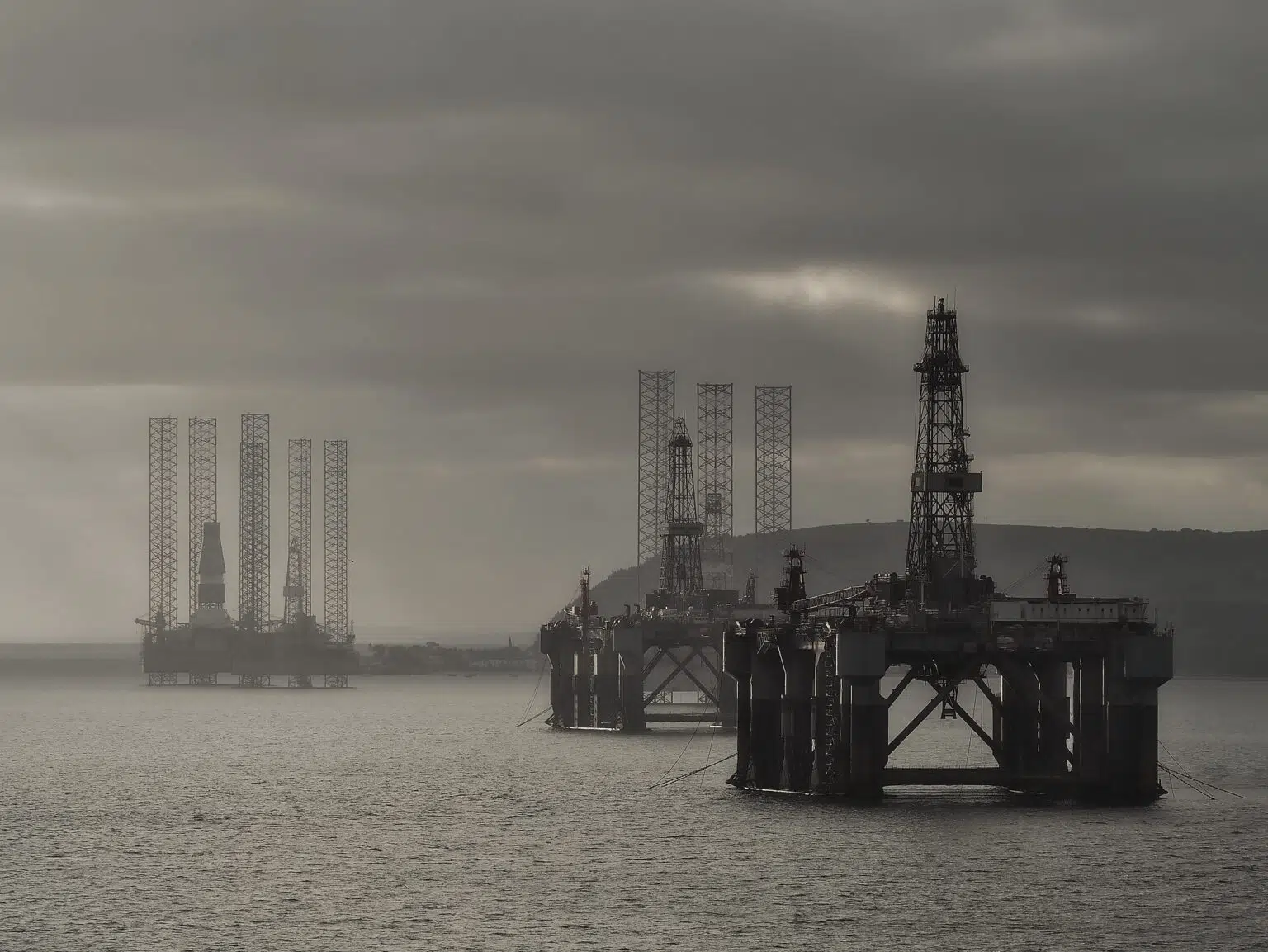
The government plans to introduce a bill aimed at granting new oil and gas drilling licences in the North Sea. Henk Honing/Shutterstock
Wrong answer, wrong question
The licensing system in place has arguably done the job of allocating access to the UK’s oil and gas. What’s questionable is whether, considering the climate emergency, annual licensing rounds will revive interest in what has long been a declining basin.
Handing out licences on its own is insufficient to attract investment. There is growing recognition among financial analysts of the risks of stranded assets in oil and gas. Shell’s withdrawal from the Cambo oil field northwest of Shetland in 2021 showed licence holders are willing to withhold their final investment decision if deemed economic or politically expedient.
The government’s focus on new licences is a red herring, as the bulk of remaining resources are in areas that are already licensed. It will be regulatory approval of field development plans, via a process known as consents, that will allow these existing licences to actually start producing oil or gas.
The recent decision to approve Rosebank (an oil field first licensed in 2001) is a case in point.
Annual licensing rounds will not ensure the UK’s energy security either. Recent licensing rounds have yielded relatively small volumes of gas that do not substantially add to UK reserves. Any oil and gas developed as a consequence of new licences is unlikely to come to market quickly and will be sold at international market prices. Producing oil and gas domestically has not insulated the UK from high prices.
The energy secretary, Claire Coutinho, has acknowledged that UK production “wouldn’t necessarily bring energy bills down”. The Skidmore Review of the UK’s net zero plans and the Climate Change Committee have made clear that the most effective method of helping households afford energy is to “cut fossil fuel consumption … improving energy efficiency, shifting to a renewables-based power system and electrifying end uses in transport, industry and heating”.
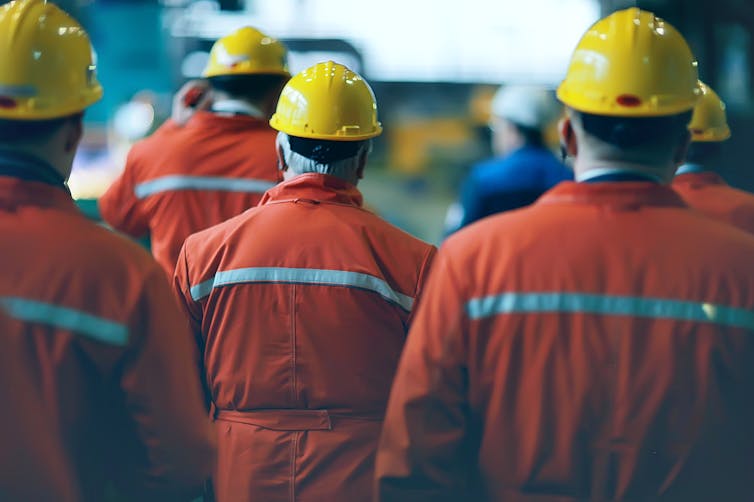
Offshore workers need training and support to transition to green jobs. Kichigin/Shutterstock
The government’s claim that two new “tests” will ensure the compatibility of new licences with the government’s net zero goal, too, does not bear scrutiny.
The first, whether oil and gas imports are projected to be larger than domestic production, is a very weak test as it captures the UK’s default position and will lock in dependence on fossil fuels rather than accelerate the transition.
The second, “that the carbon emissions associated with the production of UK gas [must be] lower than the equivalent emissions from imported liquefied natural gas (LNG)”, ignores the emissions associated with burning gas (known as scope 3 under the international accounting protocol for greenhouse gases).
These scope 3 emissions account for 65%-85% of the total emissions and are often omitted from statements about the lower carbon content of UK gas. Instead of comparing the carbon footprint of UK gas with imported LNG, pipeline gas from Norway would be a more appropriate (and lower-carbon) comparison.
In any case, the UK oil and gas industry’s targets for decarbonisation set out in the North Sea transition deal signed in 2021 have been criticised by the Climate Change Committee as insufficiently ambitious.
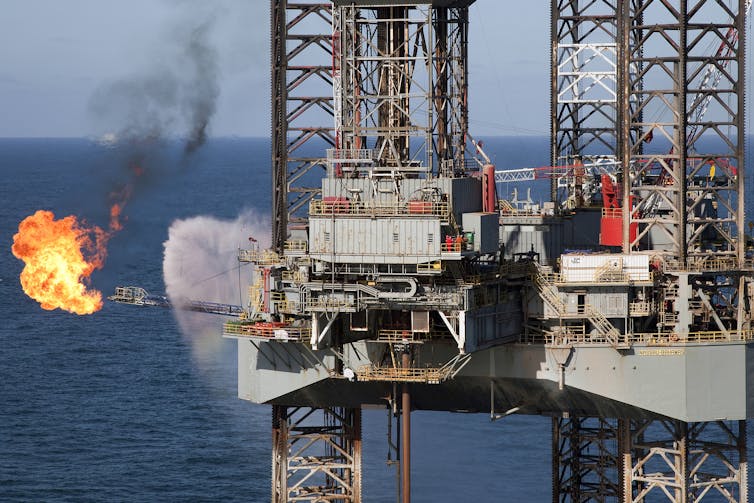
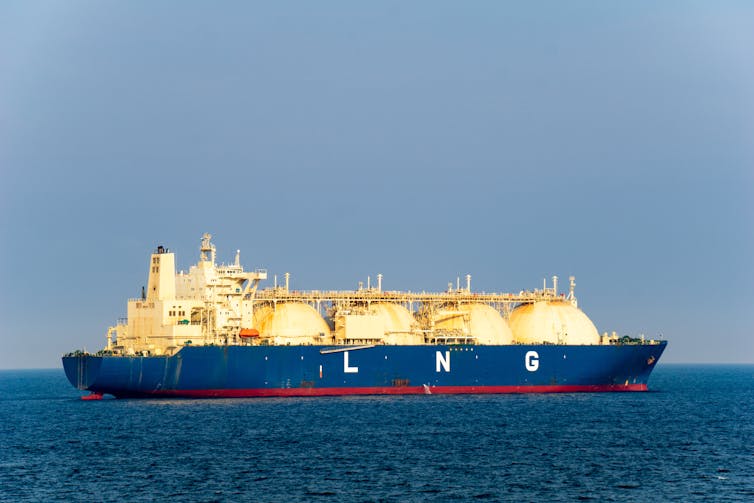
The government plan proposes the carbon emissions of producing UK gas be compared with those of imported LNG. The Mariner 4291/Shutterstock
The prominence of oil and gas licensing in the government’s legislative plans is striking. Fossil fuel licensing is a potent political symbol, and not only for campaigners who have worked for years to get licensing onto the agenda. Sunak and Starmer are now harnessing that symbolism for political ends.
A fixation on new licensing, however, is a distraction. It offers comfort in the possibility of conserving oil and gas production through developing new fields, rather than grasping the challenge of a rapid transition.
It leaves untouched the pressing issue of how to phase down oil and gas production from existing licences in a just and equitable way. It deflects from the enormous challenge of decommissioning offshore infrastructures, and the questions that need to be asked about what the North Sea is for and how it can sustain our collective future.
Don’t have time to read about climate change as much as you’d like?