Palestinians try to rescue a girl stuck under the rubble of a destroyed building following Israeli airstrikes in Nusseirat refugee camp, central Gaza Strip, Tuesday, Oct. 31, 2023.
APUBLIC health catastrophe is imminent in Gaza, the World Health Organisation (WHO) warned today as supplies of water, food and fuel reach critical lows.
Hospitals are also running out of medicine and power.
WHO spokesperson Christian Lindmeier called for fuel to be allowed into Gaza to allow a water desalination plant to operate.
He said: “It’s an imminent public health catastrophe that looms with the mass displacement, the overcrowding, the damage to water and sanitation infrastructure.”
It came after the head of the United Nations agency for Palestinian refugees said that an immediate humanitarian ceasefire in Gaza has become “a matter of life and death for millions of people.”
UN relief agency commissioner-general Philippe Lazzarini accused Israel of exacting “collective punishment” on Palestinians and forcibly displacing civilians.
Labour leader Sir Keir Starmer delivers a speech on the situation in the Middle East at Chatham House in central London. Picture date: Tuesday October 31, 2023.
Labour leader refuses to back ceasefire despite revolt
FLOUNDERING Sir Keir Starmer declared that war is peace today in an Orwellian speech trying to retrieve Labour’s position on the Gaza crisis.
Defying mounting opposition within the party, the Labour leader asserted that a ceasefire in Gaza would encourage further violence and that only a “humanitarian pause” could be considered.
But his pose for peace was further undermined by the suspension of MP Andy McDonald from the Labour whip in the Commons.
Mr McDonald’s offence was to have told a ceasefire rally at the weekend that “we won’t rest until we have justice, until all people, Israelis and Palestinians, between the river and the sea can live in peaceful liberty.”
A Labour spokesperson called the remarks “deeply offensive” but the Labour Muslim Network attacked the suspension as “obscene.”
…
Palestine Solidarity Campaign called the idea of a pause “a wholly inadequate response” to the “humanitarian catastrophe” in Gaza, where over 8,000 have already died in the latest Israeli attack.
PSC director Ben Jamal said Sir Keir’s “words and actions render him complicit in Israel’s ongoing commission of war crimes.
“Those who believe in the primacy of international law and respect for all civilian life should condemn his remarks and demand a reversal of the Labour Party position.”
A Momentum spokesperson argued that “Keir Starmer hasn’t shifted one inch: his speech today still backs Israel’s war on Gaza and opposes the ceasefire demanded by everyone from the UN to Save the Children.
Just Stop Oil at Parliament Square protest 30 October 2023. Police issued and made arrests under a Section 7 order. Image: Just Stop Oil.
65 Just Stop Oil marchers were arrested at Parliament Square on Monday after 10 minutes marching. Unlike previous Just Stop Oil slow marches which were policed using Section 12 orders, they issued a Section 7 order which criminalises members of the public based on alleged interference with ‘the use or operation of key national infrastructure’.
“Just in the last week, seven people have died in the UK as a result of extreme weather and scientists are telling us it will only get worse. Neither major political party is serving the interests of the country- they are serving the mass murderers profiting while the world burns. There is no real opposition.
“In times of crisis, it is down to ordinary people to take a stand against the rich and powerful by disrupting business-as-usual. We know it works. A mass road blocking campaign has just forced the Dutch government to halt oil and gas subsidies. That’s why people are coming together from all over the UK to march day after day in London from today. Its People vs Oil! Sign up at JustStopOil.org”
One of the participants, Dr Ian Chapman, 52, a GP from Bury St Edmunds said:
“20 or 30 years from now, I won’t look back and regret having taken direct action, but I will regret it if I don’t. I expect to get arrested today, whilst the people in the building I’m marching past are making decisions that will kill millions. I will get off the road when the police take action against the real criminals.”
“We’re running out of time, and we all need to do what we can, right now. I don’t see how you can say you care about future generations, or your nieces and nephews or your grandchildren – I don’t see how you can say you love your children – if you do nothing to stop the destruction of the world they are going to grow up in.”
Imogen May, 24, a food producer from Halesworth said:
“I’m marching with Just Stop Oil because I have a six month old nephew, and I am so scared to think what his world will look like in five or ten years’ time. I’d love to live a normal life, without worrying about climate collapse. I know that to have a chance at having a normal life later, we have to take action now.”
“We’re simply demanding that the UK government does what its own advisors are asking it to do; the same thing as the United Nations, the Climate Change Committee and the Independent Panel on Climate Change. We must halt all new licences for fossil fuel production in the UK.”
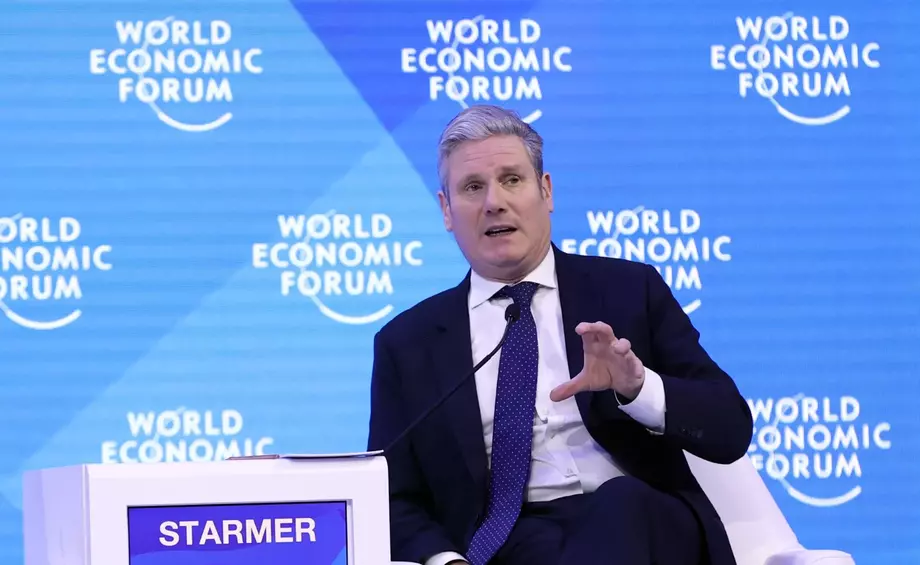
The Labour leader Keir Starmer has reaffirmed his opposition to a ceasefire in Gaza in a major speech today. Starmer made the speech to set out the Labour Party’s position on the ongoing situation in the Middle East amidst deep divisions in his party.
…
Starmer’s speech has received a mixed response.
A spokesperson for Labour’s left wing faction Momentum said: “For all the fine words, Keir Starmer hasn’t shifted one inch: his speech today still backs Israel’s war on Gaza and opposes the ceasefire demanded by everyone from the UN to Save the Children.
“Thus Starmer backs a pause in hostilities – then a resumption of Israeli bombing which has already killed more than 3,000 children. To call this ‘humanitarian’ is an insult to the Palestinian people.”
Deputy leader of the Green Party Zack Polanski said: “Keir Starmer siding with the Conservatives by refusing to call for a ceasefire. He says that he’s not saying this to start “a new round of arguments or hand wringing.” If there’s any justice, they won’t get away with this. The UK population calling: we need a ceasefire now.”
If humanity wants to have a 50-50 chance of limiting global warming to 1.5°C, we can only emit 250 another gigatonnes (billion metric tonnes) of CO₂. This effectively gives the world just six years to get to net zero, according to calculations in our new paper published in Nature Climate Change.
The global level of emissions is presently 40 gigatonnes of CO₂ per year. And, as this figure was calculated from the start of 2023, the time limit may be actually closer to five years.
Our estimate is consistent with an assessment published by 50 leading climate scientists in June and updates with new climate data many of the key figures reported by the Intergovernmental Panel on Climate Change (IPCC) in August 2021.
How much CO₂ can still be emitted while remaining under a certain level of warming is referred to as the “carbon budget”. The carbon budget concept works because the increase in Earth’s global mean surface temperature has increased in a linear fashion with the total amount of CO₂ people have emitted since the industrial revolution.
The other side of this equation is that, roughly speaking, warming stops when CO₂ emissions stop: in other words, at net zero CO₂. This explains why net zero is such an important concept and why so many countries, cities, and companies have adopted net zero targets.
We revised the remaining carbon budget down from the 500 gigatonnes reported by the the IPCC from the start of 2020. Some of this revision is merely timing: three years and 120 gigatonnes of CO₂ emissions later, the world is closer to the 1.5°C threshold. Improvements we made to the method for calculating budget adjustments shrank the remaining budget further.
Clearing the air
Alongside CO₂, humanity emits other greenhouse gases and air pollutants that contribute to climate change. We adjusted the budget to account for the projected warming caused by these non-CO₂ pollutants. To do this, we used a large database of future emissions scenarios to determine how non-CO₂ warming is related to total warming.
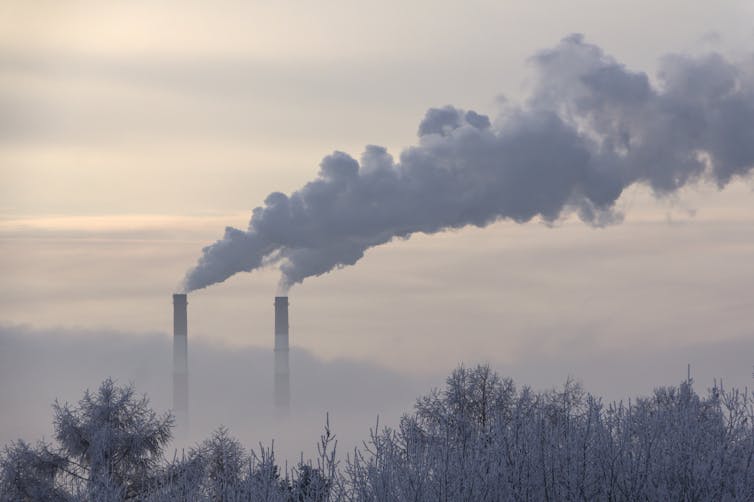
Some of the warming caused by greenhouse gases is offset by cooling aerosols such as sulphates – air pollutants that are emitted along with CO₂ from car exhausts and furnaces. Almost all emissions scenarios project a reduction in aerosol emissions in the future, regardless of whether fossil fuels are phased out or CO₂ emissions continue unabated. Even in scenarios where CO₂ emissions increase, scientists expect stricter air quality legislation and cleaner combustion.
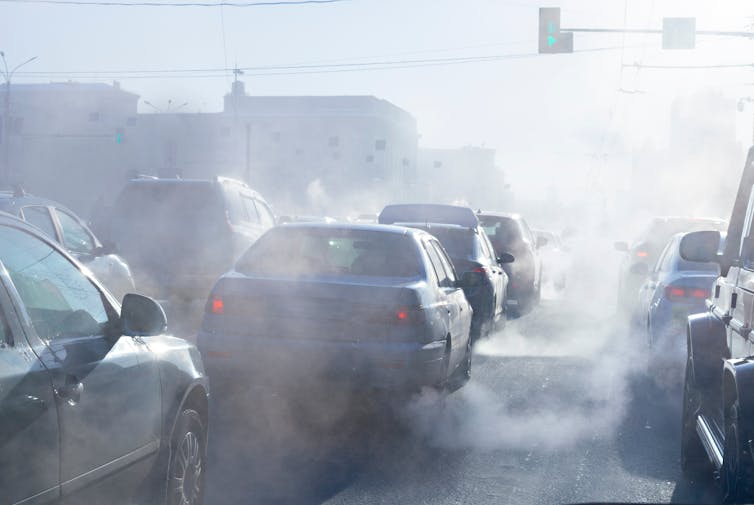
Scientists predict air pollution which cools the climate will decline in future. NadyGinzburg/Shutterstock
In its most recent report, the IPCC updated its best estimate of how much air pollution cools the climate. As a result, we expect that falling air pollution in future will contribute more to warming than previously assessed. This reduces the remaining 1.5°C budget by about another 110 gigatonnes.
Other updates we made to the carbon budget methodology tend to reduce the budget even more, such as projections of thawing permafrost that were not included in earlier estimates.
All is not lost
It is important to stress that many aspects of our carbon budget estimate are uncertain. The balance of non-CO₂ pollutants in future emissions scenarios can be as influential on the remaining carbon budget as different interpretations of how the climate is likely to respond.
We also do not know for sure whether the planet will really stop warming at net zero CO₂ emissions. On average, evidence from climate models tends to suggest it will, but some models show substantial warming continuing for decades after net zero is reached. If further warming after net zero is the case, the budget would be further reduced.
These uncertain factors are why we quote a 50/50 likelihood of limiting warming to 1.5°C at 250 gigatonnes of CO₂. A more risk-averse assessment would report a two-in-three chance of staying under 1.5°C with a remaining budget of 60 gigatonnes – or one-and-a-half years of current emissions.
Time is running out to limit global heating to 1.5°C above pre-industrial levels. While we have revised the remaining carbon budget, the message from earlier assessments is unchanged: a dramatic reduction in greenhouse gas emissions is necessary to halt climate change.
It looks less likely that we will limit warming to 1.5°C, but this does not mean that we should give up hope. Our update also revised the budget for 2°C downwards relative to the IPCC’s 2021 estimate, but by a smaller amount – from 1,350 to 1,220 gigatonnes, or from 34 to 30 years of current emissions. If current national climate policies are fully implemented (admittedly, an optimistic scenario), this may be enough to hold warming below 2°C.
The risks of triggering tipping points such as the dieback of the Amazon rainforest increase – sometimes sharply – with increasing warming, but 1.5°C itself is not a hard boundary beyond which climate chaos abounds.
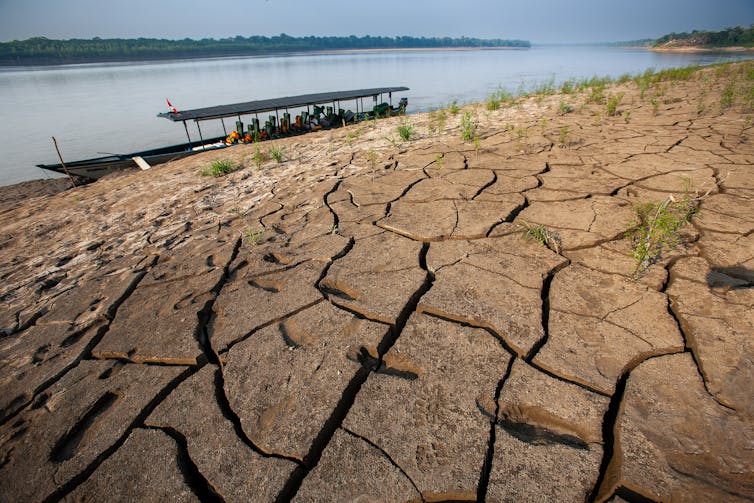
Tipping points in the Earth system could dramatically accelerate climate change. Beto Santillan/Shutterstock
With effective action on emissions, we can still limit peak warming to 1.6°C or 1.7°C, with a view to bringing temperatures back below 1.5°C in the longer term.
This is a goal absolutely worth pursuing.
Don’t have time to read about climate change as much as you’d like?