PALESTINE rights campaigners have urged Labour to “confront the reality” of Israel’s crime of apartheid rather than to avoid naming it following the party’s decision to censor the terminology.
Labour administrators refused to allow Palestine Solidarity Campaign (PCS) to use the word apartheid in the group’s annual party conference stall or fringe meeting description in the event brochures, the group said today.
PCS said that when it asked why, Labour replied it would not publish content that “we believe to be detrimental to the party.”
PCS director Ben Jamal said that injustice “cannot be tackled unless you are prepared to name it.”
He said: “A Labour government should be fully committed to the upholding of international law and the principle that respect for human rights should be central to all relations with foreign states, including trade relations.
…
Author: dizzy
Palestine campaigners censored from using ‘apartheid’ in Labour conference
“The show can’t go on”- Just Stop Oil supporters cause ‘Les Mis’ to be abandoned
Five Just Stop Oil supporters have disrupted a staging of the iconic musical ‘Les Misérables’ at the Sondheim Theatre in Westminster last night. Just like revolutionaries featured in the story, they are calling on everyone to take a stand against the government’s criminal plans to “max out our oil and gas reserves” and to join in civil resistance against new fossil fuels.
During the performance of ‘Do You Hear The People Sing?’, five Just Stop Oil supporters entered the stage carrying orange banners reading ‘Just Stop Oil’ and ‘The Show Can’t Go On’. They emerged during the song’s crescendo, amongst actors bearing revolutionary red flags. At around 8:50pm they locked themselves to the set using flexible bicycle locks, which theatre technicians were unable to remove. The performance was halted, and the theatre was evacuated by 9:10pm.
23 year old community worker Hannah Taylor is one of those who took action today. They said:
“The show starts with Jean Valjean stealing a loaf of bread to feed his sister’s starving child. How long before we are all forced to steal loaves of bread? How long before there are riots on the streets? The show cannot go on. We are facing catastrophe. New oil and gas means crop failure, starvation and death. It is an act of war on the global south and an utter betrayal of young people.”“Rishi Sunak has just approved Rosebank, a new oil project in the north sea which will produce as much carbon as the annual emissions of the 28 lowest-income countries combined. It will lead to hundreds of thousands of deaths due to starvation as crops fail in the increasingly extreme weather conditions.”
“Am I not, like Jean Valjean, justified in breaking the law to oppose this criminal government and its murderous policies? Ask yourself, will you, like the citizens of Paris in the play, stand by and watch, or will you stand up against our governments’ criminal plans and call for an end to new oil and gas?”
Exclusive: Braverman faces court challenge for forcing through anti-protest law
Original article by Anita Mureithi republoished from Open Democracy under a Creative Commons Attribution-NonCommercial 4.0 International licence.
Liberty is taking the home secretary to court for ‘unlawfully’ passing legislation Parliament had already rejected

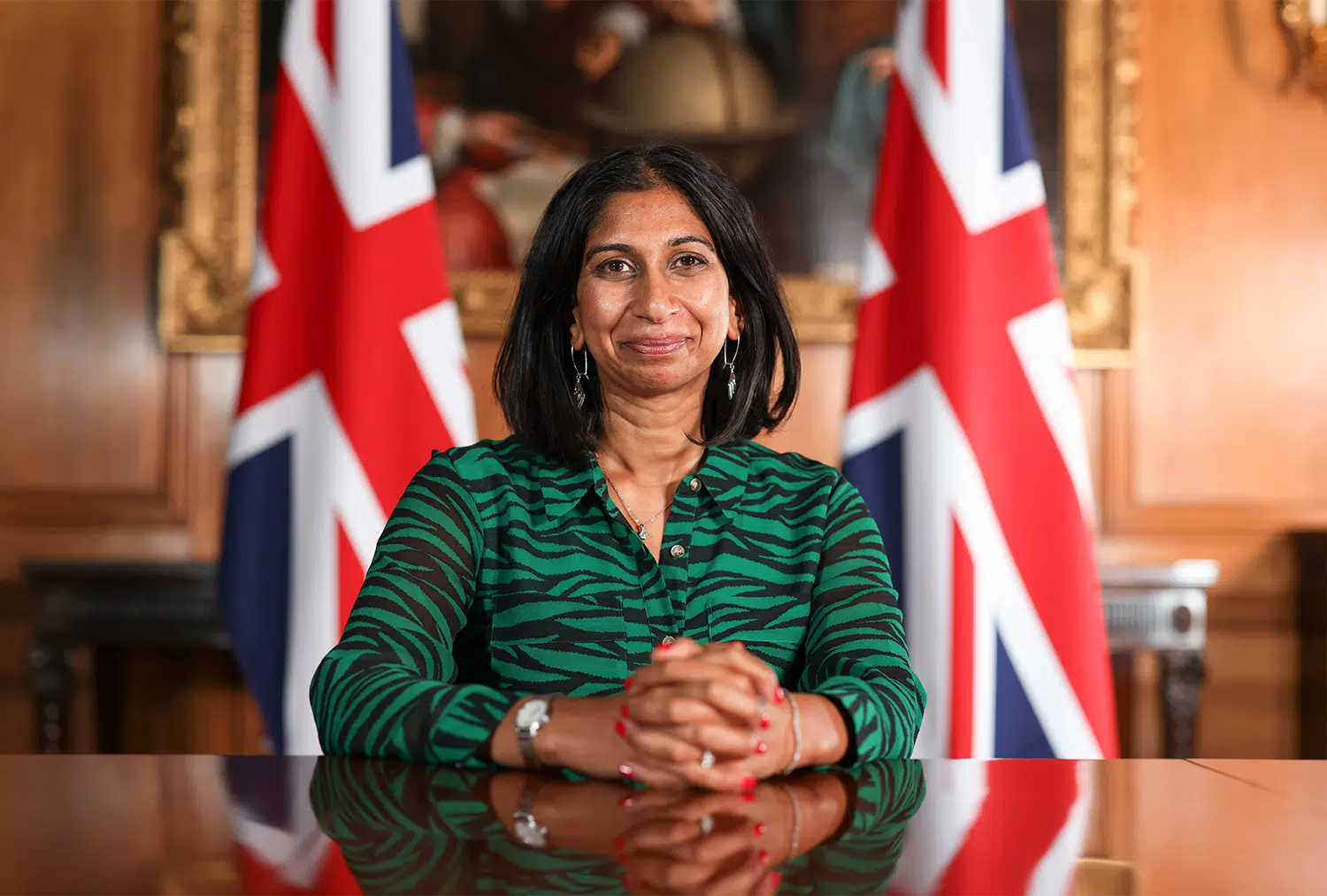
Image of Home Secretary Suella ‘Sue-Ellen’ Braverman A human rights campaign group is taking Suella Braverman to court for “unlawfully” forcing draconian anti-protest legislation through Parliament, openDemocracy can reveal.
Liberty has received permission from the High Court to sue the home secretary after she introduced new police powers that the House of Lords had already rejected months earlier.
In June, Braverman used secondary legislation – which is subject to less parliamentary scrutiny – to allow police to restrict or shut down any protest that they believe could cause “more than minor disruption to the life of the community”.
A cross-party parliamentary committee said this is the first time secondary legislation has been used to make changes to the law that have already been rejected by Parliament. Akiko Hart, interim director of Liberty, which launched initial legal action in June, described the move as “the latest power grab from this government”.
The government previously tried to insert the new powers into the Public Order Act 2023 in January, but was blocked by the Lords. Liberty’s lawyer, Katy Watts, accused Braverman of “sneak[ing] in new legislation via the back door, despite not having the power to do so”.
Hart said: “We all want to live in a society where our government respects the rules – but the home secretary has deliberately done the opposite. The home secretary’s actions have enabled the government to circumvent the will of Parliament.”
She continued: “This is just the latest power grab from this government, which has shown it is determined to erode the ways people can hold it to account, whether that’s in Parliament or on the streets. The home secretary’s actions give the police almost unlimited powers to stop any protest the government doesn’t agree with – and the way she has done it is unlawful.”
The home secretary has long called for more police powers to tackle peaceful methods of protests by climate activists, such as road blocking, ‘locking on’, and slow marching, which she said “bring misery and chaos to the law-abiding majority”.
One supporter of Insulate Britain previously told openDemocracy that protest is “our only legitimate means to achieve the changes needed within the time frame we have”.
Another of the group’s supporters said that the criminalisation of protest – in particular, of environmental protest – “is an example of attempting to shoot the messenger” and that elected politicians “obviously don’t really care about protecting people’s democratic rights”.
Watts, Liberty’s lawyer leading the case, said Braverman’s circumventing of the Lords’ rejection is “a flagrant breach of the separation of powers that exist in our constitution”.
She added: “The wording of the government’s new law is so vague that anything deemed by police to cause ‘more than a minor’ disturbance could have restrictions imposed upon it. This same rule was democratically rejected earlier this year, yet the home secretary has gone ahead and introduced it through other means regardless.
“It’s really important the government respects the law and that the home secretary’s decision is reversed immediately.”
Liberty has also claimed the new legislation was not consulted on fairly. It has accused the government of only consulting parties it knew would support the amendments, such as the police.
Original article by Anita Mureithi republoished from Open Democracy under a Creative Commons Attribution-NonCommercial 4.0 International licence.

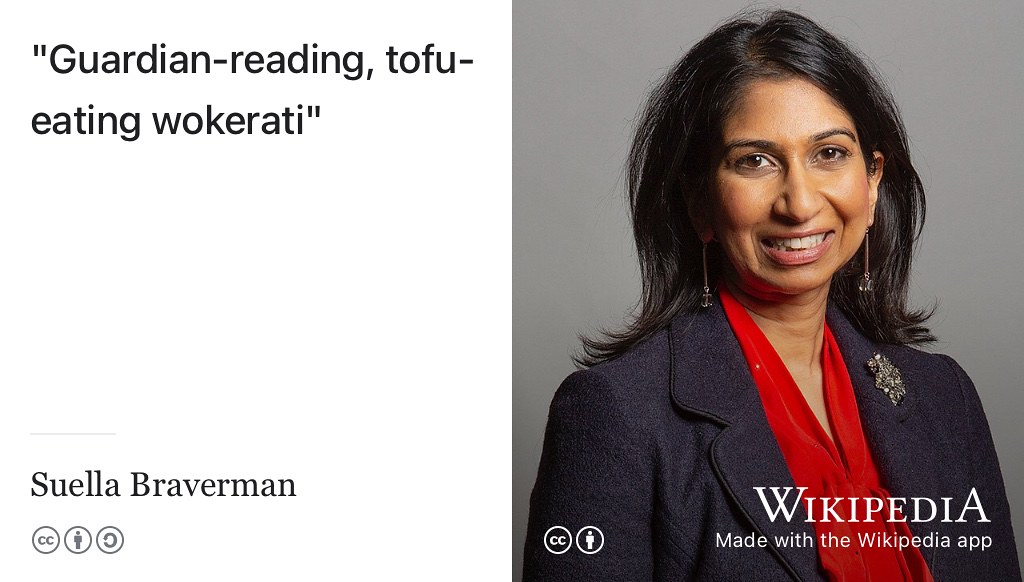
Image quoting Suella ‘Sue’Ellen’ Braverman reads ‘Guardian-reading, tofu-eating wokerati’. Rishi Sunak wants you to forget the last 13 years
Original article by Ruby Lott-Lavigna republished from Open Democracy under a Creative Commons Attribution-NonCommercial 4.0 International licence.

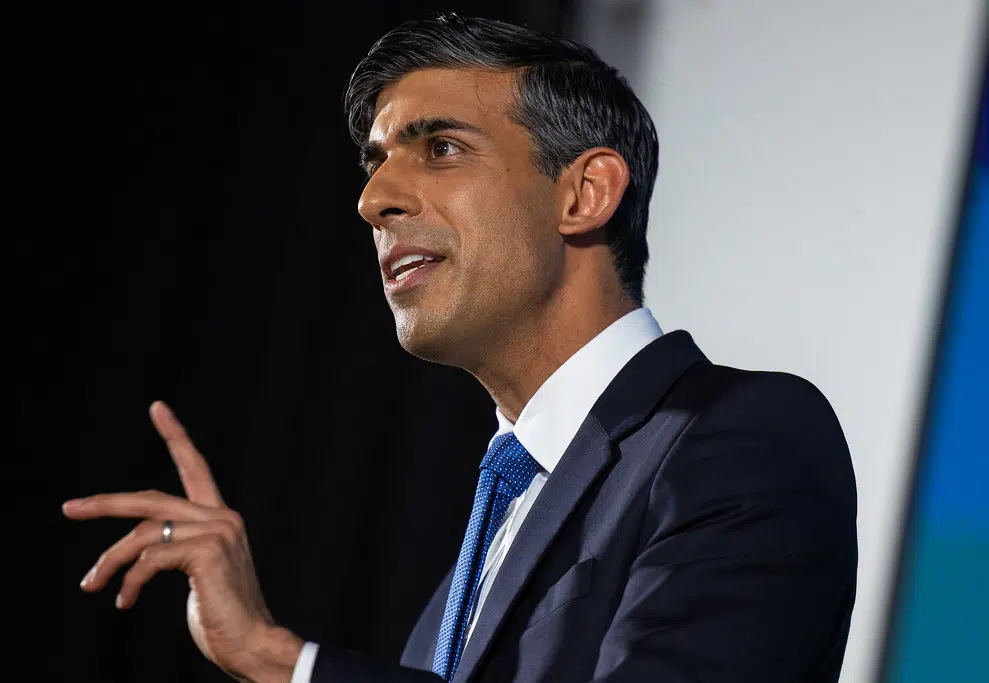
Rishi Sunak used the word change 30 times in his conference speech. His party has been in power for 13 years Listening to the PM in Manchester, you’d be forgiven for thinking a different party has been running the country
Moments before Rishi Sunak took to the stage at the Conservative Party Conference, a video flashed on a screen. Images of fields, children, roads and vaccines appeared above the heads of the hundreds waiting for the PM’s speech. “Change is…” the words read. “Change is…the Conservatives.”
In his address in Manchester, the prime minister told his party: “It is time for a change.” He confirmed his intention to scrap HS2, Europe’s largest infrastructure project, claiming “the right thing to do when the facts change, is to have the courage to change.” And speaking about his decision to U-turn on manifesto net zero pledges, he added: “Change is difficult, particularly for those who disagree.”
Altogether, Sunak used the word change 30 times. You would be forgiven for thinking another party has been in power for the last 13 years.
The PM, who also served as chancellor for two and a half years, and before that was a senior minister in the Treasury, seems to be running a re-election strategy on the potential amnesia of the country.
This is someone who governs a party focused on conserving, asking voters to believe that another term of Conservative rule will change what has been a reality for the last 13: rising homelessness, a cost of living crisis, crippling rents, spiralling mortgage rates, attacks on minority communities, months of waiting for essential NHS treatment, and a system that puts corporate interest over workers.
While hoping you’ll forget his impact, the speech also hit some key Tory attack lines. Sunak demonised trans people, in an attempt to curry favour through division, and to outsource blame from those in power to those with none. He attempted to rewrite his own history, painting himself as someone with humble beginnings, rather than as someone who attended a £60,000 a year private school. He also bashed striking workers, pretending to care about a National Health Service he’s admitted to not using.
And then there’s everything that was left out. Housing, arguably one of the most important long-term strategies any government needs to form, was mostly absent from the speech. Sunak briefly mentioned housebuilding, which would have been helpful if he hadn’t ditched housebuilding targets in April. Otherwise, the biggest issue facing most young voters was ignored. Rents are rising at their fastest rate since records began, and no-fault evictions, which were meant to be banned under the delayed Renters Reform Bill, are still a leading cause of homelessness. The absence was deafening.
Ultimately, these contradictory threads of Sunak’s speech could cause his downfall. He offers no solution, just buzzwords. It speaks to an underestimation of the British people, to think that you can tell them you care about long-term decisions while scrapping long-term projects. He even deployed his wife, Akshata Murthy, to introduce him with a gushing speech, but refuses to speak about his family when challenged on things like their non-dom status.
Without a coherent pledge, voters may well feel unsure. Sitting in the hall and listening to him deliver his speech, there was a quiet sense of confusion.
It’s easy for Sunak to forget that we’re in a cost of living crisis. He is, after all, the richest Prime Minister we’ve ever had and is wealthy enough to buy himself out of problems. He sends his children to private schools, uses private healthcare to avoid waiting lists, and flies in a helicopter to avoid train cancellations.
Unfortunately for him, most of the country can’t forget.
Original article by Ruby Lott-Lavigna republished from Open Democracy under a Creative Commons Attribution-NonCommercial 4.0 International licence.
‘Absolutely Gobsmackingly Bananas’: Early Data Shows September 2023 Hottest on Record
Original article by OLIVIA ROSANE republished from Common Dreams under Creative Commons (CC BY-NC-ND 3.0).

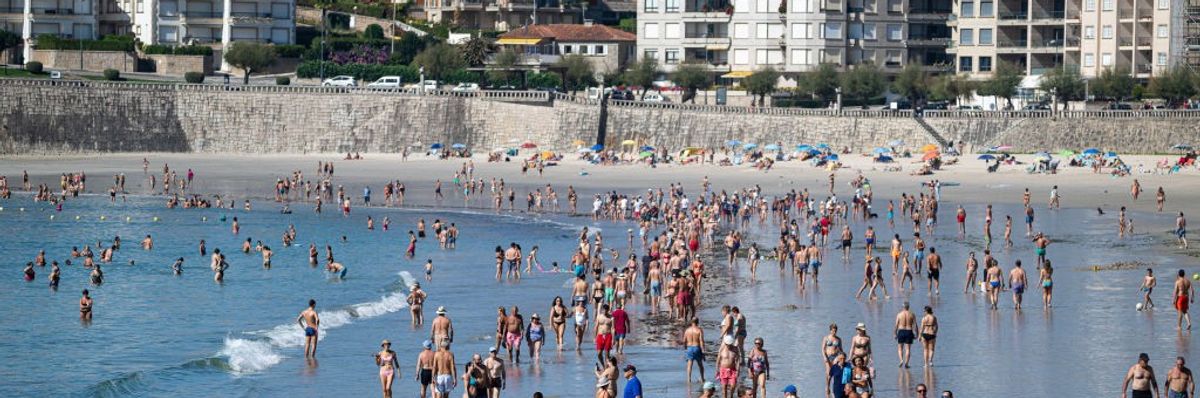
Dozens of people spend time at Silgar beach, on 30 September, 2023, in Sanxenxo, Pontevedra, Galicia, Spain.
(Photo: Elena Fernandez/Europa Press via Getty Images)“We’ve never seen a record smashed by anything close to this margin,” one climate scientist said.
In another sign of the climate crisis, September of 2023—following the hottest summer ever recorded over June, July, and August—also seems to be one for the record books.
A data set out of Japan found that September 2023 was 0.5°C warmer than the previous warmest September on record and around 1.8°C warmer than temperatures in the preindustrial era, climate scientist Zeke Hausfather wrote on Tuesday on the social media site formerly known as Twitter.
“This month was, in my professional opinion as a climate scientist—absolutely gobsmackingly bananas,” he said.
Hausfather was looking at the the Japanese 55-year Reanalysis (JRA-55), which draws on a wide range of weather observations dating back to 1958. The more than half-a-degree jump from the previous September record is the steepest increase between monthly records to date, The Washington Post reported.
“We’ve never seen a record smashed by anything close to this margin,” Hausfather told the Post.
“This September would not have been out of place as a typical July this decade in terms of global temperatures,” he added on X, formerly Twitter.
Another data set, the European Centre for Medium-Range Weather Forecasts’ ERA5, also shows September shattering the previous record by around the same margin, according to Hausfather.
“I’m still struggling to comprehend how a single year can jump so much compared to previous years,” Finnish Meteorological Institute researcher Mika Rantanen tweeted of the ERA5 data. “Just by adding the latest data point, the linear warming trend since 1979 increased by 10%.”
The JRA-55 and ERA5 data sets are more immediately available than the monthly analyses from NOAA and NASA, which take longer to complete, The Washington Post explained. The satellite-based data from the University of Alabama in Huntsville is also showing a record September.
2023 has been a record-breaking year in part because an El Niño weather pattern emerged in June, but the primary driver is atmospheric warming caused by the burning of fossil fuels and the destruction of natural carbon sinks. This year has been much hotter than the previous El Niño years in 2015 and 2016.
On a local and regional level, many countries experienced their hottest Septembers on record, among them Austria, Belgium, France, Germany, Poland, and Switzerland, according to The Guardian. France’s September beat the previous record by more than 1°C, and Belgium’s September was even hotter than its July and August for the first time since 1961.
“Belgium has never experienced a month of September this warm,” David Dehenauw of the Belgian Royal Meteorological Institute told The Guardian.
On the other side of the world, Japan also had its hottest September at 2.66℃ higher than normal.
“We can’t believe just how high temperatures got,” a representative from the Japan Meteorological Agency toldJapan Today. “It became a record-breaking phenomenon after multiple factors overlapped on top of climate change.”
September also saw a number of extreme weather events, from deadly flooding in Libya to record-breaking rainfall in New York. Warmer temperatures are linked to heavy rainfall, as warmer air can hold more moisture. Separate studies also said the climate crisis made both events more extreme.
So far, October looks set to continue the historic weather trend. The central U.S. began the month with record heat, according to The Washington Post. And Spain had its warmest start to October on record, Reuters reported.
“The bad news is that we don’t see any sign of global temperatures reverting to what is normal for this time of year,” Hausfather tweeted. “They remain close to to the highest anomalies we saw in the month of September as we go into October.”
Original article by OLIVIA ROSANE republished from Common Dreams under Creative Commons (CC BY-NC-ND 3.0).