Author: dizzy

  • ‘Pinkwashing’: Just Stop Oil Blocks London Pride Parade in Sponsorship Protest

    Spread the love

    Original article republished from Common Dreams under Creative Commons (CC BY-NC-ND 3.0).

    ‘These partnerships embarrass the LGBTQ+ community at a time when much of the cultural world is rejecting ties to these toxic industries’
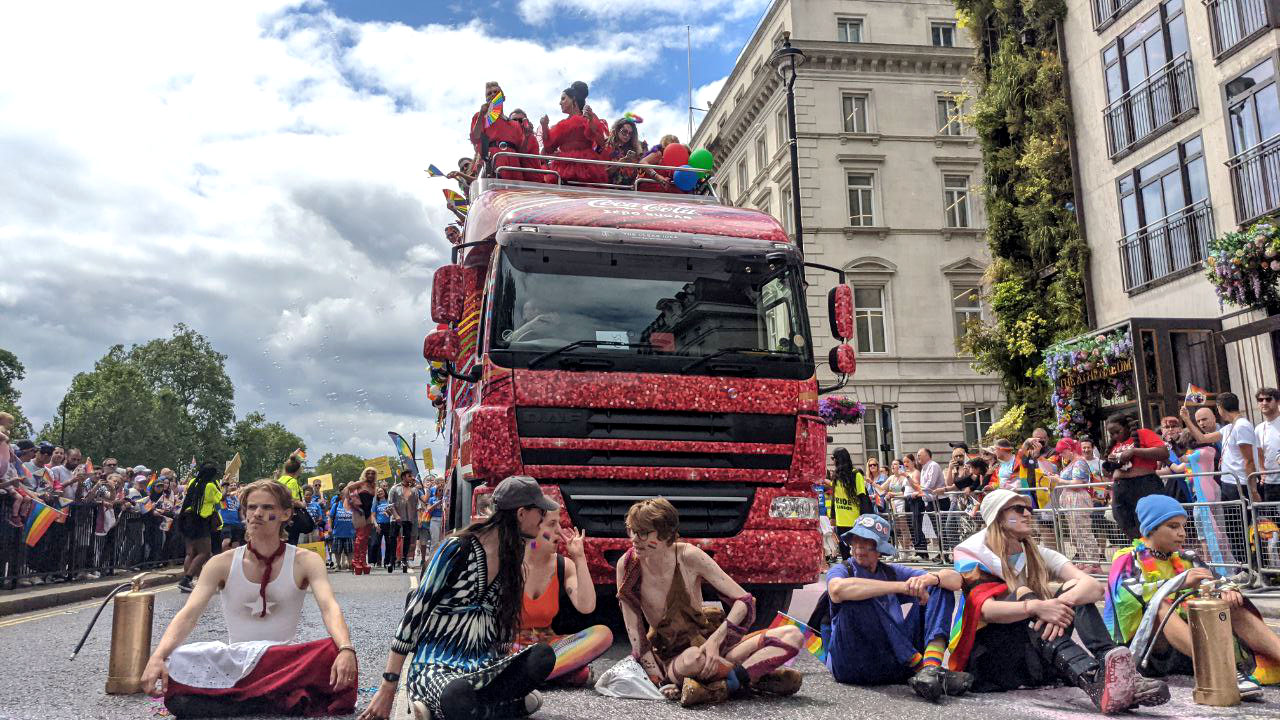
    Just Stop Oil disrupt London Pride 2023.
    ‘Pinkwashing’: Just Stop Oil activists from the LGBTQ community sprayed pink paint and blocked the Pride In London Parade by sitting in front of a Coca-Cola truck taking part in the parade, in protest against Pride working with industries linked to the climate crisis and in protest against Coca-Cola, seen as the world’s biggest plastic polluter, Saturday, July 1, 2023. Image by Just Stop Oil.

    Just Stop Oil protesters temporarily blocked London’s Pride Parade Saturday afternoon to protest the event accepting sponsorship money from “high-polluting industries.”

    Pride faced accusations of “pinkwashing” over its decision to make United Airlines the headline sponsor of this year’s event.

    Seven protesters were arrested at 1:30 pm after blocking the road in front of a Coca-Cola truck. Coca-Cola is seen as the world’s biggest plastic polluter.

    LGBTQ+ members of Just Stop Oil called on organizers to condemn new oil, gas, and coal licenses and stop allowing the inclusion of floats from these corporations in the parade.

    James Skeet, a Just Stop Oil spokesperson, said in a statement:

    “Pride was born from protest. It speaks to how far we’ve come as a community, that high-polluting industries and the banks that fund them, now see Pride as a useful vehicle for sanitizing their reputations, waving rainbow flags in one hand whilst accelerating social collapse with the other. It is queer people, and particularly queer people of color in the global south, who are suffering first in this accelerating social breakdown. What would those who instigated the gay liberation movement during the Stonewall riots in 1969, make of the corporatized spectacle Pride has now become?”

    “These partnerships embarrass the LGBTQ+ community, at a time when much of the cultural world is rejecting ties to these toxic industries. We call on Pride to remember the spirit in which it was founded and to respect the memory of all those who fought and died to secure the rights we now possess whilst taking the necessary steps to protect our community long into the future.”

    London Mayor Sadiq Khan speaking before the parade said:

    “I agree with protesting in a way that is lawful, safe, and peaceful. I think that Extinction Rebellion and Just Stop Oil are really important pressure groups trying to put power on those who have power and influence.”

    “I fully support the right to protest. It’s really important to recognize the joy of democracy is protest.”

    “I am somebody who feels quite passionately that we have to tackle the climate emergency. And I feel quite passionately about encouraging people to join the movement to tackle the climate emergency. In my view, protest should be peaceful, lawful, and safe.”

    Peter Tatchell, the legendary LGBTQ+ rights campaigner, and prominent member of the Gay Liberation Front and the civil resistance group OutRage! Said:

    “I helped organize the first Pride in the UK in 1972 and have attended every Pride London march since then. Pride was always meant to be both a celebration and a protest. From the outset, we stood in solidarity with other struggles for freedom and social justice, against corporate pinkwashing and all forms of exploitation. We saw queer liberation as just one aspect of a wider liberation movement.”

    “Climate destruction is destroying communities, jobs, homes and lives across the world, especially in poorer countries. Fossil fuels are endangering the survival of humanity – including LGBTQ+ people. Our community must not collude with environment, species and climate destroying companies.”

    [4 twitter threads that twitter is refusing to embed, see Original article ]

    Original article republished from Common Dreams under Creative Commons (CC BY-NC-ND 3.0).
  • How Thames Water came to be flooded with debt – and what it means for taxpayers

    Spread the love

    Filipchuk Maksym/Shutterstock

    Kate Bayliss, SOAS, University of London

    Thames Water is reportedly on the brink of collapse. The UK’s largest water company, well known for its high levels of water leakage, sewage spills, executive pay and dividend payments, now appears to be flooded with debts that it cannot afford to pay.

    Those debts have reached more than £14 billion, leading to fears the government – or UK taxpayers to be precise – may have to bail the company out.

    The news of Thames Water’s difficulties may have shocked some of its 15 million customers. But as someone who has researched the finances of water companies, I was not entirely surprised. These issues have been a long time in the making, and I raised concerns publicly over five years ago.

    When the water and sewage companies of England and Wales were privatised in 1989, the intention was to bring fresh finance and innovation to create efficiency. But in the 2000s, a new kind of financial investor began to dominate the sector.

    Our recent research found that by 2021, of 15 English water and sewage companies, nine were owned by “special purpose companies”. These are organisations set up for the purpose of buying water utilities, with owners consisting of a range of private equity funds, pension funds and sovereign wealth funds.

    These kinds of investors were then able to use water company revenue to generate significant returns to shareholders. And one way this happens is by hiking up company debts.

    Newly privatised water companies had started out with zero debt in 1989. Yet by the end of March 2022, total debt in the sector was at £60.6 billion. In part, the increased debt was used to refinance the companies so that investors could repay themselves part of the original cost of buying the water utility.

    Our research shows that Thames Water was the archetype of this model. When it was taken over in 2007 by a consortium led by Macquarie, an Australian investment bank, debts increased over the next ten years from £3.2 billion to £10.7 billion. The proportion of assets funded by borrowing increased to over 80%, while the company paid out dividends of £2.5 billion. The company has previously said that it has a “strict, performance-linked dividend policy monitored by Ofwat”.

    Perfect storm

    But such high debts are problematic for a water company. First there is the issue of inequality, where customers’ water bills are used to pay down debts that have increased to pay dividends to its owners. And second, as we see with Thames Water, these highly indebted companies are potentially unstable in the event of cost pressures.

    What we have now is a perfect storm in which Thames Water’s finances may collapse. A key pressure is inflation, which is pushing up the value of some of the company’s debt at the same time as it pushes up costs. More than half of Thames Water’s debt is linked to inflation, contributing to the uplift in debt value.

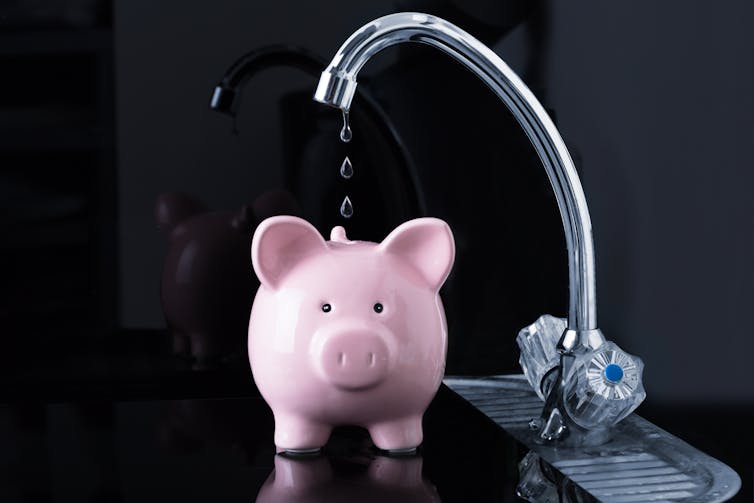
    Water tap filling piggy bank.
    Drip effect.
    Andrey_Popov/Shutterstock

    Then there is the cost of improving performance. This has become more urgent after Ofwat, the water company regulator, was given new powers (effective from April 2025) to prevent companies paying dividends if these weaken financial resilience or are not linked to performance.

    In 2022, the government set out a plan to tackle the rapidly growing issue of sewage discharge in a £56 billion investment plan. All of this adds up to intense pressure on the company’s finances.

    If those finances do unravel, it is likely that the company will be underwritten by the government to keep the taps flowing while a rescue package is put together (as happened with the energy company Bulb).

    However, this situation also creates the opportunity for a new public model of water supply, one that treats water not as a private commodity but as part of the wider ecosystem, providing social equity as well as environmental sustainability.

    Public ownership need not be a step back to the 1970s. In fact, it would bring the UK into step with most of the modern world, including most of Europe. In Paris, where water provision was made public in 2009 after years of outsourcing, the change is widely considered a success story.

    The last 34 years have revealed the fundamental problems with the current system. This crisis is a chance to direct England’s water in a new direction. The Conversation

    Kate Bayliss, Research Associate, Department of Economics, SOAS, University of London

    This article is republished from The Conversation under a Creative Commons license. Read the original article.

  • Water bosses caught colluding with Labour in bid to avoid nationalisation

    Spread the love
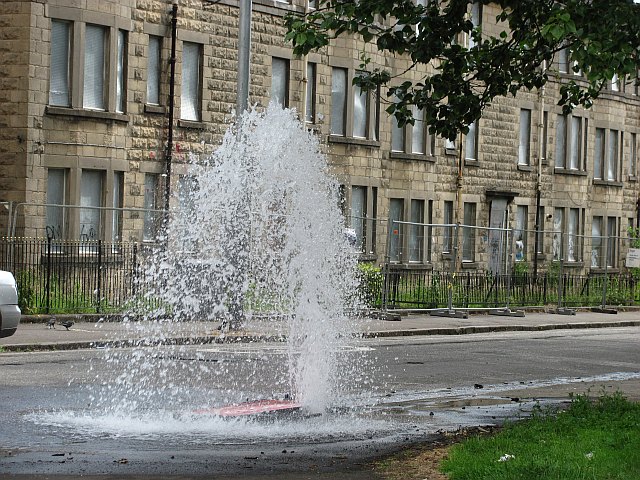
    Image of a burst water main.
    Image of a burst water main.

    https://morningstaronline.co.uk/article/b/water-bosses-caught-colluding-labour-bid-avoid-nationalisation

    THE boss of water giant Severn Trent was caught colluding with Labour’s increasingly right-wing leadership to stave off calls for nationalisation today.

    In a leaked email marked “highly confidential,” Liv Garfield invited other bosses from across England’s privatised system to a “off-the-record roundtable” discussion on how to maintain the “status quo” amid the potential collapse of Thames Water.

    …

    Labour leader Sir Keir Starmer committed to state-run utility firms when he ran for the party leadership in 2020, but he has now largely abandoned the pledges, calling for better regulation instead.

    Ms Garfield wrote: “While it is clear Labour will not include nationalisation in its next manifesto, they are also not keen on championing the status quo.

    “The leadership thinks there is room for improvement and, politically, there is significant pressure to ‘do something’ about utilities.

    “Labour is aware we are soft testing various ideas but have asked us to keep it highly confidential so please don’t forward this email.”

    …

    https://morningstaronline.co.uk/article/b/water-bosses-caught-colluding-labour-bid-avoid-nationalisation

  • Sue Gray Set To Join Keir Starmer’s Team As Watchdog Gives Green Light

    Spread the love

    https://www.politicshome.com/news/article/acoba-green-lights-sue-gray-keir-starmers-chief-staff

    The Advisory Committee on Business Appointments (ACOBA), which oversees appointments of senior civil servants after they leave their roles, has given the green light for former senior civil servant Sue Gray to join Labour as leader Keir Starmer’s chief of staff.

    Wonder if she’s any good at anything & Starmer seems to be poor at spelling, ei? I sometimes wonder if he’s just a bit intellectually challenged tbh but undecided as yet.