Author: dizzy
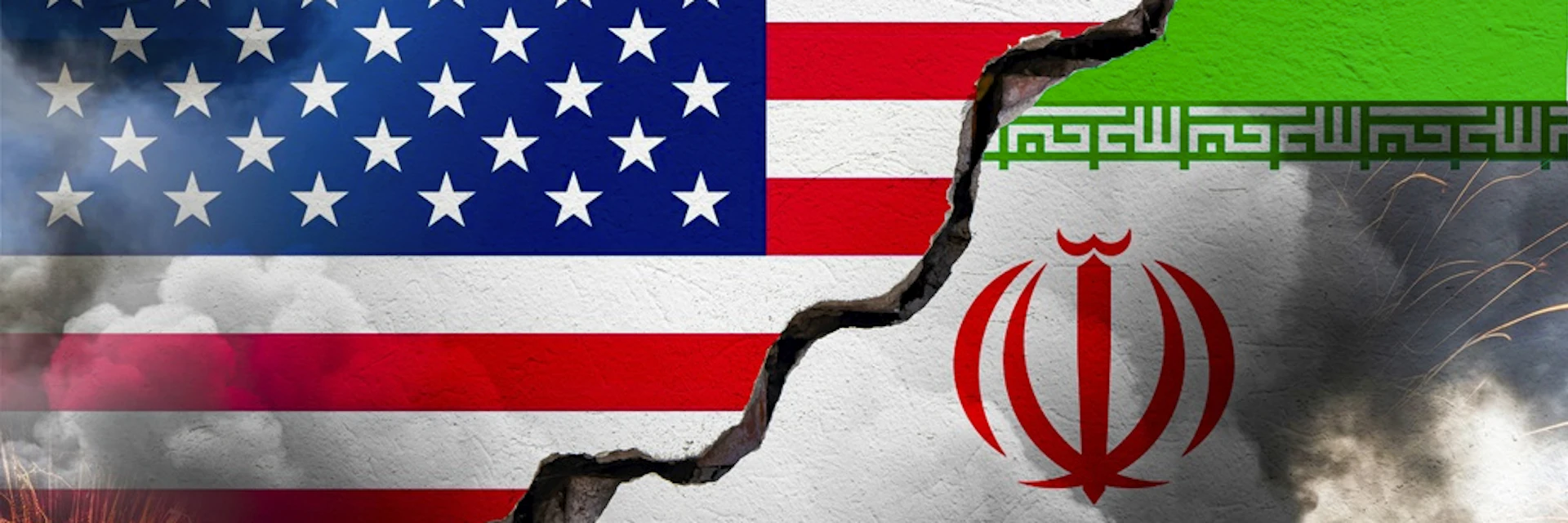
Iran is turning into the sort of ‘forever war’ that Donald Trump promised to avoid

Savvapanf Photo#Shutterstock Bamo Nouri, City St George’s, University of London and Inderjeet Parmar, City St George’s, University of London
When Donald Trump returned to the White House, he promised to avoid another Middle Eastern “forever war”. After the costly experiences of Iraq and Afghanistan, that pledge resonated with an American public weary of prolonged military intervention.
For a brief moment, it appeared that this promise might be realised. The memorandum of understanding (MoU) signed by the US and Iran on June 17 seemed to offer a pathway away from escalating confrontation. Markets stabilised, regional tensions eased and there was cautious optimism that Washington and Tehran had stepped back from the brink.
That optimism has proved remarkably but unsurprisingly short-lived. US military strikes have resumed and Iran has retaliated against American and its allies across the Gulf. Iran’s proxy allies, the Houthis, have declared themselves ready to close the Red Sea chokepoint at the Bab-el-Mandeb Strait, which has provided an alternative transit route for some oil exports, particularly from Saudi Arabia.
Washington continues to combine military pressure with calls for renewed negotiations. But rather than representing the collapse of an isolated peace initiative, these developments may confirm the reality of grey zone conflict – where diplomacy manages war rather than ends it.
When Americans think of forever wars, Iraq and Afghanistan understandably dominate the discussion. Those conflicts were characterised by invasions, prolonged occupations, attempts at nation-building and the deployment of hundreds of thousands of troops over many years. Their enormous political, financial and human costs eventually became impossible to sustain.
The confrontation with Iran is fundamentally different. It is unlikely to require occupation of territory and no serious or sustained attempt directly to remake the Iranian state. Instead, it is fought through air strikes, cyber operations, sanctions, maritime confrontation, intelligence activity and proxy warfare. Military escalation is followed by diplomacy, diplomacy gives way to renewed confrontation, and each episode is presented as a separate crisis.
Viewed collectively, these episodes are better understood as the latest phase of a strategic confrontation that began with the 1979 Iranian Revolution rather than as isolated crises. The conflict has evolved over the years through sanctions, proxy warfare, covert operations and cyber conflict into a more direct military confrontation.
The repeated breakdown of de-escalation efforts is often attributed to mistrust or diplomatic failure. Both undoubtedly matter, but they do not fully explain why the MoU has unravelled so quickly.
Many of its core provisions have become sources of dispute. Israel has continued military operations in Lebanon, despite expectations that regional hostilities would subside. Washington initially signalled greater economic flexibility towards Iran, including easing restrictions on oil exports and discussions surrounding Iranian assets. Yet sanctions have subsequently expanded and further economic measures have been introduced.
From Tehran’s perspective, these actions represent a breach of the spirit – and, in some cases, the letter – of the agreement. From Washington’s perspective, they are responses to continued Iranian activity that it considers destabilising.
The Strait of Hormuz illustrates how quickly ambiguity can become renewed confrontation. Article 5 of the MoU envisaged Iran facilitating the safe passage of commercial shipping through the waterway. Commercial traffic initially increased following the agreement.
But disagreement soon emerged after Oman – in coordination with the International Maritime Organization and with US backing – established a temporary maritime corridor closer to the Omani coast. Tehran viewed this as inconsistent with the agreed framework and argued that it undermined Iranian responsibility for administering safe passage. Washington rejected that interpretation, maintaining that additional security measures were necessary to protect international shipping.
The competing interpretations rapidly became another source of escalation.
The conflict itself has also evolved. What began largely as strikes against military infrastructure has increasingly extended to facilities with direct consequences for civilian life. This has included energy infrastructure and desalination plants that are essential to freshwater supplies across parts of the Gulf.
Transport infrastructure, including bridges, has also been targeted. This has prompted debate among military analysts about whether operational objectives are expanding beyond coercive signalling – using limited military force to pressure or influence an opponent’s behaviour – towards broader military aims. It has also raised questions about whether some attacks could violate international humanitarian law and, depending on the circumstances, amount to war crimes.
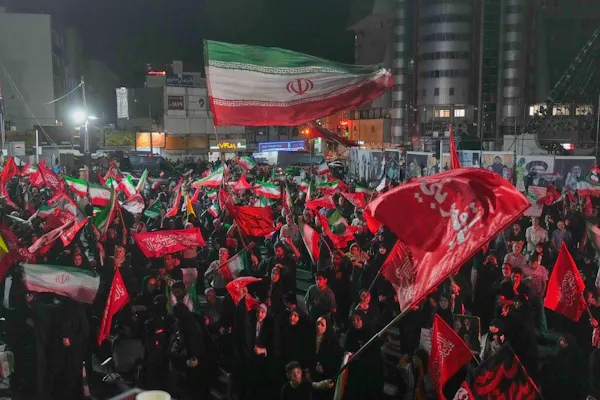
Despite huge anti-government protests in January, the war with the US has prompted many Iranians to rally round the flag. AP Photo/Vahid Salemi While the expansion of US strikes in this way does not in itself demonstrate that a US ground offensive is imminent, it reflects a widening conflict whose effects increasingly reach civilian populations.
Diplomacy is managing conflict, not resolving it
The deeper problem is that the strategic objectives of main players here remain fundamentally incompatible. The US continues to insist that Iran’s nuclear programme and regional influence must be constrained. Iran regards those same capabilities as essential to its security and deterrence. Israel continues to view a strategically stronger Iran as an unacceptable security threat.
These objectives cannot all be achieved simultaneously. As a result, diplomacy struggles – not because negotiators lack skill, but because they are attempting to reconcile goals that remain at odds. The MoU temporarily reduced tensions, but it did not alter the structural realities driving the conflict.
This has important implications for how the current crisis should be understood. Much of the debate focuses on whether the latest escalation will produce a wider regional war. That possibility cannot be dismissed. Yet another scenario may be equally, if not more, plausible. The US and Iran are settling into a prolonged cycle of calibrated confrontation that lasts far longer than many currently anticipate.
Trump promised to end America’s forever wars. Ironically, his presidency may instead come to symbolise the evolution of a new kind of forever war without a clearly defined beginning or end. The greatest danger may therefore not be another Iraq. It may be the gradual normalisation of an enduring conflict that repeatedly disappears from the headlines, only to return in new forms because the political conditions necessary for genuine peace have yet to emerge.
This is a new normal for a US foreign policy establishment that retains militarist mindsets, a massive global military capacity and footprint, and values global primacy in an age of power shifts towards a more multi-polar world.
Bamo Nouri, Honorary Research Fellow, Department of International Politics, City St George’s, University of London and Inderjeet Parmar, Professor in International Politics, City St George’s, University of London
This article is republished from The Conversation under a Creative Commons license. Read the original article.

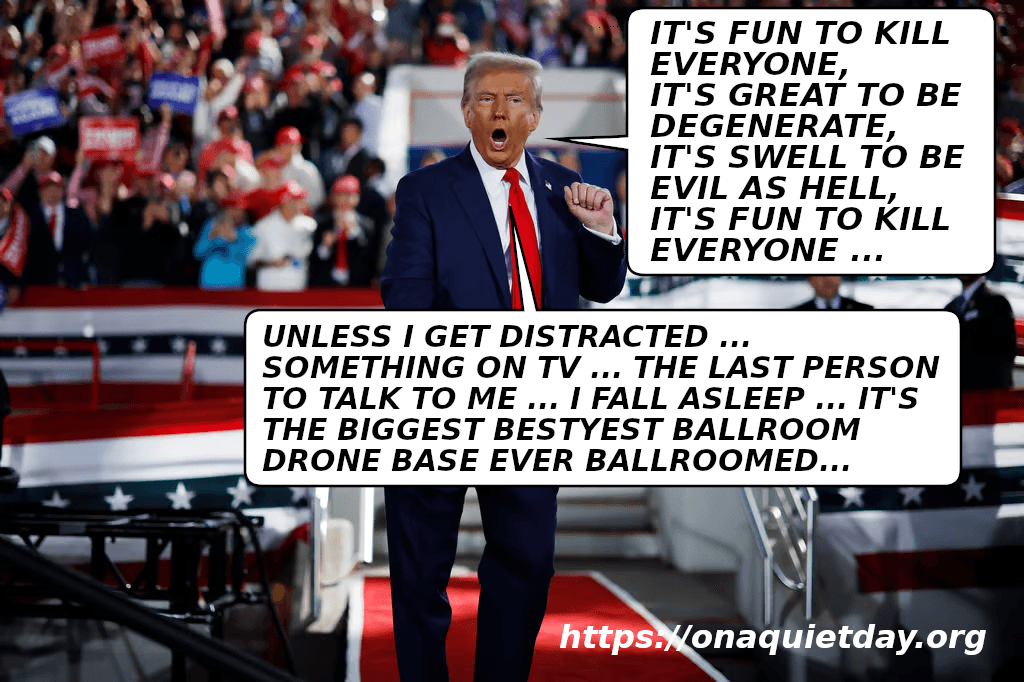
Donald Trump sings and dances, says that it’s fun to kill everyone … unless he gets distracted or falls asleep. 
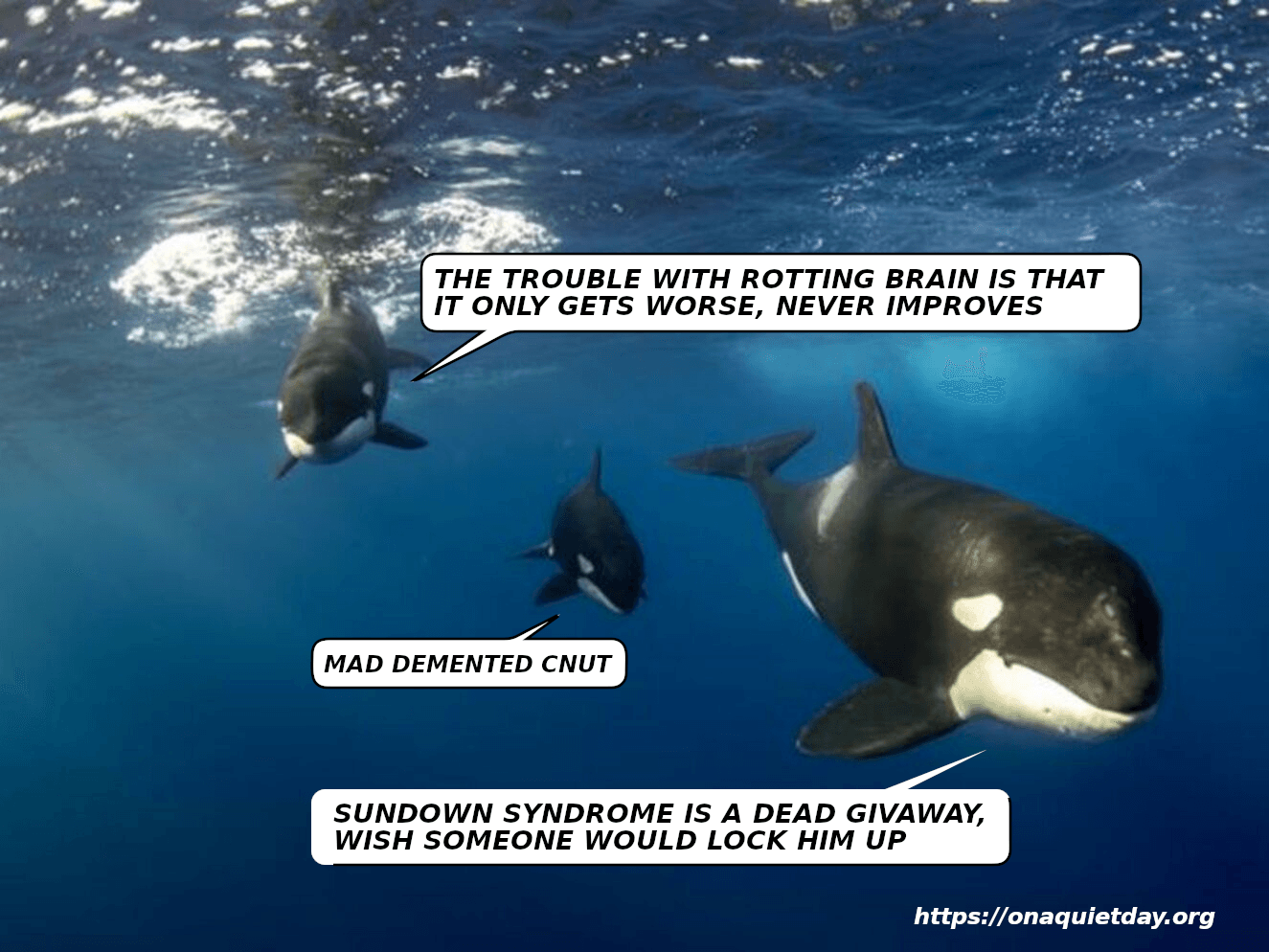
Orcas discuss rotting brain, front Orca says Sundown Syndrome is a dead givaway and he wishes someone would Lock Him Up. Arctic sea ice decline seemed to be slowing – until two record‑breaking low‑ice winters
Hector John Periquin / unsplash, CC BY-SA Duo Chan, University of Southampton and Alessandro Silvano, University of Southampton
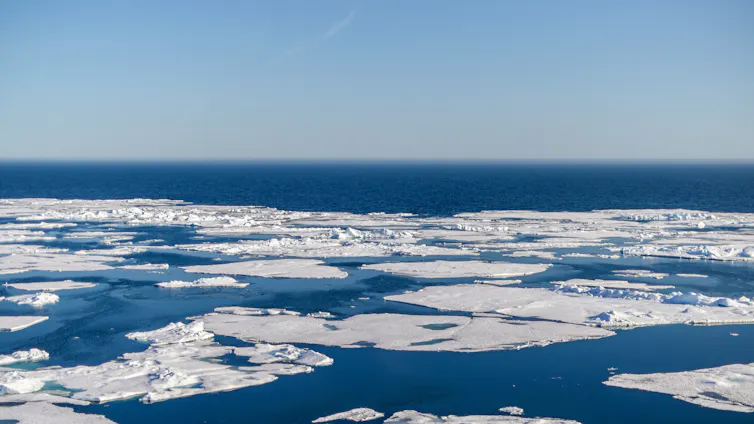
Arctic sea ice appeared to be entering a new phase. In the early 2020s, the rapid decline seen over previous decades seemed to ease, leading scientists to ask whether winter sea ice loss had slowed.
Our new study suggests that conclusion was premature. After two exceptionally low-ice winters in 2025 and 2026, the recent slowdown disappears. The almost 6% drop between 2024 and 2025 was the largest single-year decline on record. The latest observations restore a statistically significant downward trend, showing how a few unusual years can quickly change the overall picture.
Sea ice is a crucial indicator of climate change in the Arctic. As the planet warms, the Arctic is warming even faster, and satellite observations have shown that sea ice has declined in every month of the year since the late 1970s. The loss is largest at the end of summer, when the Arctic reaches its annual minimum ice cover, but winter sea ice has also been shrinking.
Arctic Sea Ice near Greenland. Isabelle White, University of Southampton However, this decline has not been smooth. In the early 2020s, Arctic sea ice loss appeared to slow across much of the year. This did not mean the ice had recovered to what it was before modern global warming. But compared with the rapid losses seen in earlier decades, the trends seemed weaker, raising an important question: had Arctic sea ice decline begun to slow?
Exceptional winters
Our study examines why these two winters changed things. Until 2024, the recent 20-year decline in winter sea ice extent was not statistically significant – meaning the data is consistent with no decline over the past 20 years.
The record low of ice in 2025, followed by another near-record low in 2026, should rewrite the overall narrative. Using the February–March average, which we use to represent winter sea ice extent, 2025 recorded the largest single-year decline in the satellite record.
Including these latest observations changes the picture of a weakened decline. Once the 2025 and 2026 winters are included, the 20-year trend in Arctic winter sea ice extent returns to a statistically significant decline. We can now be much more confident that the trend is real, and the decline is still ongoing.
How Arctic winter sea ice extent has changed since 1980:
A fall of nearly 6% in one year also raises an obvious question: can Arctic winter sea ice really drop this quickly under current climate conditions? To answer this question, we examined climate model simulations of Arctic climates warmed by a similar amount to today, and asked whether they ever produce a one-year winter sea ice drop as large as the one seen in 2025.
They do, although only rarely.
In simulations where the Arctic has warmed by a similar amount to today, about 3°C since 1980, a one-year winter sea ice drop of this size occurs in roughly one out of every 100 simulated years. This suggests that the 2025 drop was unusual, but still physically plausible. It does not require a new explanation. Instead, it is consistent with a warming Arctic in which year-to-year variability can produce abrupt changes. From one winter to the next, the extent of sea ice can decline sharply, remain stable, or even increase.
So what should we expect in the coming years?
If warming continues, the same model simulations suggest that winter sea ice is unlikely to rebound to the higher levels seen in the early 2020s. This does not mean every coming winter will set a new record low. Arctic sea ice will continue to fluctuate from year to year. But under continued warming, these recent low-ice winters may mark a shift towards winter ice fluctuating around a lower average level.
The lesson, at least for winter, is that Arctic sea ice loss has not stopped. The apparent slowdown of the early 2020s looked real at the time, but now looks more like a pause than a lasting change. Short-term variability can temporarily mask decline, but it does not remove the underlying pressure from Arctic warming.
The open question is whether the same pattern will emerge in summer, which has also shown a recent slowdown in sea ice retreat. So far, the renewed winter decline has not yet translated into an equally clear renewed decline in summer.
Winter and summer sea ice are connected. Low winter ice may help precondition the ice cover for stronger spring and summer melt. But the connection is not automatic: Arctic sea ice does not simply move in the same direction, in every season, at the same time. Spring weather, clouds, snow cover, winds, ocean heat and ice thickness all affect how much ice survives to the summer minimum.
Understanding how these factors evolve in a changing climate will be crucial for answering whether, and when, summer sea ice decline re-emerges from its recent slowdown.
Duo Chan, Lecturer in Climate Sciences, University of Southampton and Alessandro Silvano, NERC Independent Research Fellow in Oceanography, University of Southampton
This article is republished from The Conversation under a Creative Commons license. Read the original article.
‘We need to be a cost-of-living government’
https://morningstaronline.co.uk/article/we-need-be-cost-living-government
New PM slashes fuel bills and culls Starmer deadwood, but peace activists warn that placing John Healey as new Chancellor shows ‘beyond doubt that the military industrial complex is in charge of Burnham’s economic policy’
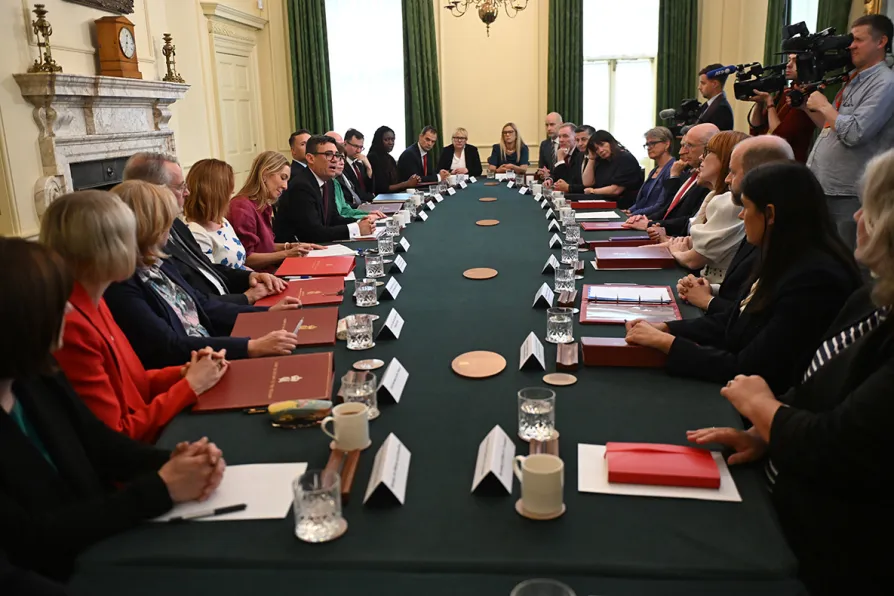
Prime Minister Andy Burnham hosts his first Cabinet meeting at 10 Downing Street, London, July 21, 2026WE ARE a cost-of-living government, Prime Minister Andy Burnham told his new Cabinet today after slashing energy bills for millions.
Mr Burnham acted to cut VAT on energy bills at a cost of £850 million as his first major move in Downing Street after naming a new team purged of deadwood from Sir Keir Starmer’s government.
However, anti-war campaigners warned that his choice of inveterate warmonger John Healey as new Chancellor presaged a further attack on welfare, health and education.
In a joint statement, Stop the War Coalition and the Campaign for Nuclear Disarmament said: “To hand the Treasury purse strings to a man who demanded a £197 billion increase in arms and nuclear weapons spending demonstrates beyond doubt that the military industrial complex is in charge of Burnham’s economic policy.
“The arms dealers and generals are undoubtedly now in the cabinet. John Healey’s appointment as chancellor will inevitably mean huge fights over welfare, health and housing to come.
“None of the social and economic ambitions — tackling the cost-of-living crisis in particular — that Burnham claims to aspire to will be possible if an ever-growing portion of the economy is devoted to war and destruction,” the two campaigns stated.
…
https://morningstaronline.co.uk/article/we-need-be-cost-living-government

 Prime Minister Andy Burnham hosts his first Cabinet meeting at 10 Downing Street, London, July 21, 2026