Riots and looting has commandered the attention of corporate media.
Take a look at how armoured and defended these riot policemen are.
They’ve got armouring at their forearms, their elbows, their backs, their shoulders, their chests, their privates, their hips, their upper legs, their knees, their shins and their feet. They have crash helmets with visors. W(here)TF are they not protected? As well as that they have shields and big truncheons that they are most definitely not scared to use against democratic non-violent protestors.
Are we supposed to belive that this vallant police force is not able to despatch a few hundred involved in rioting and looting although they are well capable of intimidating and harassing thousands of democratic demonstrators?
[Had terrible trouble editing out “thir chests,” that appeared twice. This is only a draft ~ watch out tomorrow (later today)]
In Bristol there were 19 arrests for offences, including having a balaclava in your possession.
Conservative election poster 2010
A recent news article about the UK’s Conservative and Liberal-Democrat coalition government – the ConDem’s – brutal attack on the National Health Service.
The NHS needs more specialist maternity doctors to prevent mothers dying due to “substandard care”, experts have said.
An editorial in the British Medical Journal written by six obstetricians says most maternal deaths are now caused by treatable medical conditions.
The Royal College of Obstetricians and Gynaecologists says too few doctors means warning signs can be missed.
…
Increasing numbers of women with often complex medical conditions are now becoming pregnant or seeking fertility advice. And with more women delaying starting a family, doctors are now seeing more older women with complicated pregnancies.
The latest review of UK maternity services – the Confidential Enquiry into Maternal Deaths report – found that although the overall maternal death rate has been declining, there has been an increase in maternal deaths associated with existing medical conditions, like diabetes, epilepsy, asthma or heart failure.
And many of these are linked with substandard care, meaning more could have been done by healthcare professionals.
In a third of these cases, different care might have actually prevented the death of the mother.
Media attention is on the riots and looting mainly in London areas rather than the NHS.
Conservative election poster 2010
A recent news article about the UK’s Conservative and Liberal-Democrat coalition government – the ConDem’s – brutal attack on the National Health Service.
Hundreds of jobs are to be axed by health bosses over the next five years.
NHS trusts across the county are battling to save millions of pounds while facing one of the biggest shake-ups in the organisation’s history.
Managers say they are unable to rule out redundancies although they are hoping to make savings by cutting back on expensive agency staff and not filling vacant posts.
Unions believe the cuts are just the tip of the iceberg.
The Sussex Community NHS Trust has revealed it wants to reduce its staff numbers by 10% – the equivalent of about 430 positions, by 2015.
The trust runs specialist community and rehabilitation services for adults and children across Brighton and Hove and West Sussex.
Its work covers district nurses, podiatrists, nurses specialising in skin problems like eczema and support for stroke patients.
The losses could affect different parts of the trust but it is hoped they will be covered through not filling vacancies, retirements, staff moving on to other jobs and cutting back on agency and staff spending.
The changes are down to the way the trust plans to provide services in the future while it tackles the same financial pressures as the rest of the NHS.
Western Sussex Hospitals NHS Trust, which runs Worthing Hospital, Southlands in Shoreham and St Richard’s in Chichester, is also planning to cut the amount it spends on staff this year by the equivalent of 128 posts.
Brighton and Sussex University Hospitals NHS Trust, which runs the Royal Sussex in Brighton and the Princess Royal in Haywards Heath, maintains it has no plans to reduce positions, despite having to save £21 million this year.
The hospital trust has called in an independent financial expert at a cost of £143,000 in an effort to get its spending under control.
East Sussex Healthcare NHS Trust, which runs Eastbourne District General Hospital and the Conquest in St Leonards, is working with accountants Ernst and Young to try to clear a £6 million deficit and has not ruled out the possibility of job losses in the future.
More than 170 jobs have already been lost at the county’s primary care trusts ahead of their planned axing in two years time as part of the government’s shake up of the NHS.
A report confirms that the NHS is incredibly efficient and successful.
The decision to force the NHS to support Circle Health’s luxurious hospital in Bath provides a real insight into the Con-Dems’ NHS ‘reforms’. It is all about destroying the NHS and supporting expensive crap, getting those donations in and having grand lunches.
Conservative election poster 2010
A few recent news articles about the UK’s Conservative and Liberal-Democrat coalition government – the ConDem’s – brutal attack on the National Health Service.
Report in the Journal of the Royal Society of Medicine finds health service second only to Ireland for cost-effectiveness
The NHS is one of the most cost-effective health systems in the developed world, according to a study (pdf) published in the Journal of the Royal Society of Medicine.
The “surprising” findings show the NHS saving more lives for each pound spent as a proportion of national wealth than any other country apart from Ireland over 25 years. Among the 17 countries considered, the United States healthcare system was among the least efficient and effective.
Researchers said that this contradicted assertions by the health secretary, Andrew Lansley, that the NHS needed competition and choice to become more efficient.
“The government proposals to change the NHS are largely based on the idea that the NHS is less efficient and effective than other countries, especially the US,” said Professor Colin Pritchard, of Bournemouth University, who analysed a quarter of a century’s data from 1980.
“The results question why we need a big set of health reform proposals … The system works well. Look at the US and you can see where choice and competition gets you. Pretty dismal results.”
The study will be a blow for Lansley, who argues that patients should choose between competing hospital services and GPs.
Pritchard’s last academic paper, which argued that surgeons were being distracted from frontline work by “unfunded” targets in the NHS, was used by Lansley to justify government reforms.
Using the latest data from the World Health Organisation, the paper shows that although Labour’s tax-and-spend strategy for the NHS saw health spending rise to a record 9.3% of GDP, this was less than Germany with 10.7% or the US with 15%.
Not only was the UK cheaper, says the paper, it saved more lives. The NHS reduced the number of adult deaths a million of the population by 3,951 a year – far better than the nearest comparable European countries. France managed 2,779 lives a year and Germany 2,395.
A union boss has hit out against job cuts at a Bradford health trust which she warned means “work simply won’t get done”.
A major national restructure of the NHS will see Primary Care Trusts disappear by April, 2013, when commissioning of services will be taken over by local clinical commissioning groups and national bodies such as Public Health England.
NHS Bradford and Airedale, which says it needs to save £2.9 million in management costs this year, has approved 34 applications for voluntary redundancy or early retirement but has warned that some staff are still at risk of losing their jobs.
Drawing a comparison with troubled care home company Southern Cross, Jackie Smith, Unison’s Bradford health branch secretary, said: “If you have a commissioning organisation that is so crippled by the Government’s cuts that we cannot be guaranteed that it is commissioning the right services and that it cannot police those services that they have commissioned because of lack of resources, you will end up with a Southern Cross scenario in health care.
“The restructure that we have been consulted on also looks very top heavy with lots of managers and fewer workers.”
…
cash-strapped East Sussex Healthcare NHS Trust is walking a financial tightrope which could have a major impact on frontline services.
It has been ordered to identify £30 million in savings by the end of the year – and so far only £18 million has been found. And the trust’s board was told at a recent meeting the organisation’s ‘run rate’ shows it spending out around £1million a month more than it is bringing in.
The situation has not been helped by a drop in income from patients being referred by GPs, which has piled more pressure on the trust’s already beleaguered purse. And in a further blow the trust is having to fork out £115,000 to pay for extra Microsoft licences for IT equipment across its sites – a cost which up until now has been met at a national level under an NHS deal.
…
NHS Wiltshire has been rapped for imposing a minimum waiting time of 15 weeks for people to receive hospital treatment.
The health trust imposed the 15-week limit to save money, to ensure patients are treated strictly in order and to prevent unfair competition on waiting times. But the move has been criticised by the Co-Operation and Competition Panel (CCP), an independent watchdog that advises the NHS.
In a report published last week, the CCP said: “The conduct of Wiltshire Primary Care Trust in setting uniform minimum waiting times, which in effect become minimum waiting times, restricts competition and distorts patient choice and this imposes material costs on patients and taxpayers.”
…
The operator of a private hospital near Bath has won a ruling from a Government watchdog that the NHS is unfairly holding back potential patients.
Health Secretary Andrew Lansley will have to decide what sanctions should be taken against health chiefs in Wiltshire over their imposition of a minimum waiting time for patients in negotiations with Circle Health, over its hospital at Peasedown St John.
The row threatens to turn the Bath area into a test-bed for how far the Government is prepared to push the idea of increasing the private sector’s involvement in treating NHS patients.
Both the area’s biggest NHS hospital, the Royal United Hospital, and commissioning body NHS B&NES insist that no such minimum wait operates in the immediate Bath area.
But the ruling by the Cooperation and Competition Panel quango underlines the tension between patient choice and finite NHS budgets, and between private and specialist treatment centres performing routine surgery and acute hospitals such as the RUH which have to support emergency and intensive care.
Circle Health, which opened its hospital at the beginning of last year, had complained to the CCP that NHS Wiltshire – which commissions services for the county and in some cases for B&NES – was breaking health service rules on competition and co-operation.
…
A Government quango has ordered health chiefs across two counties to send more patients to a private hospital which is owned by two major donors to the Conservative Party.
Union bosses said the decree ‘stinks of cronyism’ and has demanded questions be asked about the relationship between the private hospital firm and the Government.
The Government’s new Co-operation and Competition Panel (CCP) was given the job of enforcing new competition rules within the NHS, which campaigners say is a ‘back door’ way of privatising the health service.
Earlier this year, CircleBath, a private hospital in Peasedown St John, near Bath, complained to the CCP that local health trusts weren’t sending enough patients to it for routine operations.
Circle said NHS Bath & North East Somerset and NHS Wiltshire, which commission services jointly at the Royal United Hospital in Bath, weren’t playing fair in setting a cap of £6 million on operations it would fund at the new private hospital, while it spent £160 million at the RUH.
The CCP has now ruled in Circle’s favour, saying the two NHS trusts had breached the new competition rules by favouring NHS hospitals like the RUH over private hospitals like Circle. It has now given health bosses in Bath and Devizes a fortnight to respond to the ruling and outline what they are going to do.
CCP director Andrew Taylor said setting a maximum spend on using private hospitals was unfair to CircleBath, and meant a worse deal for patients. “The panel considers that the majority of the aspects of conduct raised in this complaint impose costs on patients and taxpayers that are not outweighed by any of the benefits that may arise from such behaviour. We are now keen to consult on what would be an appropriate remedy to the conduct in question,” he said.
…
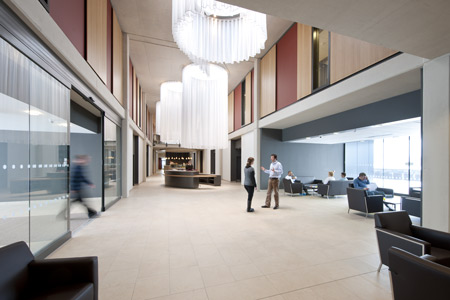
CircleBath is Foster + Partners’ first hospital and represents a radical departure from orthodox approaches to hospital planning. The three-storey building is set into the hills on the edge of protected green belt nine kilometres south east of Bath and its compact arrangement provides a ‘corridor-less’ environment, encouraging a sense of community and well-being.
…
“We wanted a building that looked more like a five-star hotel than a hospital,” says Ali Parsa, the managing partner of health provider Circle, the scheme’s client. “We’ve forgotten what the word ‘hospital’ means. It comes from ‘hospitality’ and visiting a hospital is a very important time in your life. To make it drab is really wrong.”
If you think this is the glossy prelude to a megabudget luxury spa-type experience for the super-rich, think again. Circle is hoping to capitalise on the government’s promise to allow NHS patients to choose where they go for non-emergency specialist treatment, as long as the provider meets NHS standards, and, crucially, costs (see box). [edit: I think that is incorrect & that it is not necessary to compete on cost.]
So does the building live up to its boutique hotel billing? With just 28 beds, it is certainly boutique in scale, and it cuts a strikingly cosmopolitan figure in the mundane surroundings.
…