I’ve got a little distracted here. I did intend to anounce some coming soon exclsive content about a flea or two in my head. Anyway you’ve ended up with some Cerys and Catatonia and two different verions of Hallelujah. I was looking for a version of Hallelujah by Cerys. I hope that perhaps she’ll do one.
I heard there was a secret code … but you don’t really care for magick, do you? It goes like this … Hallelujah.
While I am very proud of my Welsh origin, culture and traditions, I have respect for others and appreciate and embrace divesity.
Opendemocracy has a particularly enlightening article on the progression of privatisation of the NHS from the era of Tony Blair’s New Labour. This lecture, given at Goldsmiths College, is based on the book The Plot Against the NHS, by Colin Leys and Stewart Player, published on April 14th.
This very condensed account omits several major issues that are covered in the book Stewart Player and I have been working on. Among other things it omits the way the shift to a market has already been anticipated by the Department of Health, in dozens of initiatives and ‘pilots’. It omits the development of the private health industry, which is now on the verge of a dramatic expansion at the expense of the NHS budget. It omits fraud, which is so much part of the history of many of the companies involved, and which seems bound to become as endemic here as it is in the US and other healthcare markets.
But one question can’t be entirely omitted from even this brief account: how could the NHS be abolished as a public service without a debate and without the public knowing? The answer is really the story of what has become of democracy in the neoliberal age, condensed into a single case. Spin, of course, has played a big part – secrecy, misrepresentation, manipulation of statistics, lies and the suppression of criticism. But even more important has been a radical change in the nature of government: in effect, the state itself has been privatised.
First, in terms of personnel, the boundary between the Department of Health and the health industry has become so permeable as to be almost non-existent. By 2006 only one career higher civil servant was left in the Department’s senior management team. The rest came chiefly from backgrounds in NHS management or the private sector. In addition, senior positions in the department were filled with personnel recruited directly from the private sector, while former department personnel (including two Secretaries of State) moved out to firms in the private sector. The revolving door has revolved faster in the Department of Health than in any other part of government except perhaps the Department of Defence. Conflict of interest has become so routine as to be almost unremarked. The idea of a boundary between the public and private sectors, which civil servants and ministers police in the public interest, has gone out of fashion.
Second, policy-making has been outsourced. This is an oversimplification, but not much. A so-called health policy community developed, structured especially around two main think tanks, the Kings Fund and the Nuffield Trust. The current Chief Executive of the Kings Fund was formerly director of strategy at the Department of Health, and so was the current vice chair of the board. Their governing bodies also have strong private sector representation and their seminars and conferences are where the market plans have been developed and disseminated. And this has been done partly at public expense, as these and many other think tanks, some of them militantly neoliberal, are charities, and so tax-funded.
Third, and particularly important in the run-up to the 2010 election, is the health industry lobby. Tamasin Cave and David Miller at Spinwatch have made a remarkable short film on the health lobby, called ‘The Health Industry Lobbying Tour’ which you can watch online at Spinwatch.org. When you have seen it you understand a lot more about Andrew Lansley and where his ideas are coming from.
I’ll leave it there. But just in case you are not convinced of the design behind this, and don’t think it is fair to call it a plot, let me add just one more item. In January there was a discussion on Radio 4 between Matthew Taylor, who was once Blair’s chief of staff, and Eamonn Butler, the Director of the Adam Smith Institute, where Tim Evans also works – same Tim Evans who negotiated the concordat with Milburn and looked forward to the NHS becoming just a kitemark. They were asked if they thought the NHS was really going to become ‘a mere franchise’. Butler replied, quite casually, ‘It’s been 20 years in the planning. I think they’ll do it.’
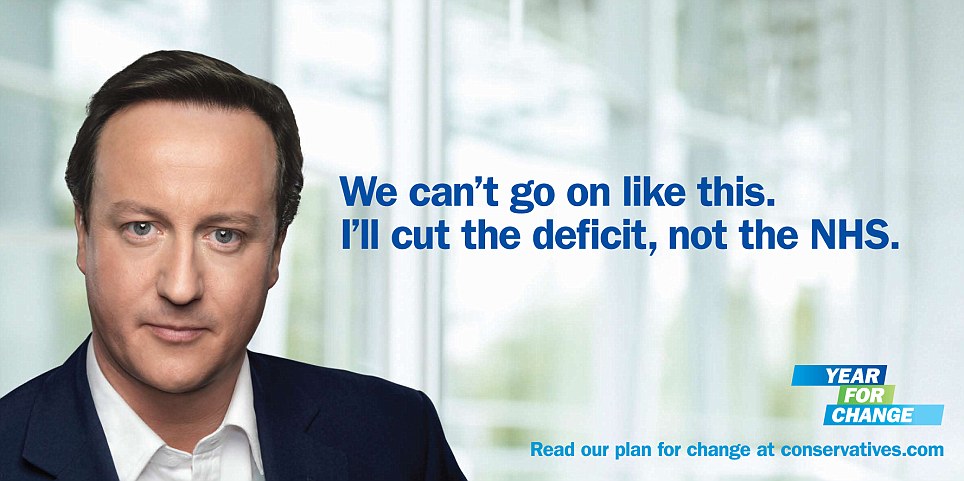
Conservative election poster 2010
A few recent news articles concerning the UK’s Conservative and Liberal-Democrat coalition government – the ConDem’s – brutal attack on the National Health Service.
The farrago over NHS reforms risks making the government look impetuous and incompetent rather than bold
A POLITICAL scientist, John Kingdon, once listed three elements needed for bold policy-making. The right political leaders must be in place; they must have the right plan; and—vitally—they must agree on a problem that needs fixing. The confusion surrounding the government’s ambitious bid to reshape the National Health Service (NHS) offers ample evidence for the Kingdon thesis.
The Conservative-led government is in a bind over its proposals, which have run into opposition from health professionals and some Liberal Democrats (the Tories’ coalition partners). On April 6th a grave-faced David Cameron, flanked by his Lib Dem deputy Nick Clegg and the Tory health secretary Andrew Lansley, announced a two-month “listening exercise”, in which the government would seek suggestions for improving the plans.
The policy itself has proved predictably divisive since it was unveiled last summer. Though the individual changes are evolutionary, building on market-based reforms stretching back more than two decades, their cumulative impact and complexity stunned medical leaders. Sir David Nicholson, the health service’s chief executive, joked that the package was so ambitious “you could probably see it from space”. Yet the Conservatives fought the 2010 general election on a pledge to oppose further top-down reorganisations of the NHS, after years of disruptive management changes.
Mr Lansley’s plan would abolish a whole tier of NHS management, known as Primary Care Trusts (PCTs), transferring control over 60% of the NHS budget to consortiums of GPs (family doctors). One underlying political goal is to hand hard decisions about the rationing of care to GPs, the most trusted part of the health service.
A second big plank of the Lansley reforms would extend the scope of competition within the NHS’s internal market, launched in 1990 and expanded since to let private providers bid for work alongside state-run hospitals. Responding to complaints from the health sector and voters’ anxiety about “privatisation by the back door”, the government has pledged changes to stop private companies “cherry-picking” the easiest or most profitable cases, leaving NHS hospitals the expensive conditions and the cost of training doctors. Further concessions could tweak the membership of the spending bodies to be run by GPs, to include other clinicians and perhaps elected representatives.
David Cameron and Nick Clegg, together with Andrew Lansley, started listening at Frimley Park Hospital in Surrey on Wednesday. At least – in their colour-coordinated dark suits with ties in shades of violet at three matching white lecterns – that’s what they said they were doing. They had come to a highly successful foundation trust hospital (close to London) at less than 24 hours’ notice to talk about the health and social care bill that nobody loves. During a “natural pause” in the progress of the bill through parliament, they want to listen, reflect and improve on the bill, they said.
Do they really? At Frimley Park, they did listen to the questions put to them mostly by consultants, all of which revealed genuine anxieties about the government plans. But the answers they gave suggested no hint of movement. This was a defence of the proposals – not a discussion of what might be wrong with them, let alone undertakings to change them substantially.
From my position in the audience, it looked as though Cameron and Clegg had decided that Lansley just needed help in explaining and selling the package. Every question was fielded first by Cameron and then Clegg, who both answered with reassuring generalities, before letting Lansley loose on the details – which he does in such a technical fashion that nobody can follow him. It was Clegg who homed in on the issue that most upset the Liberal Democrats ahead of their vote at the spring conference – privatisation. “There will be no privatisation of the NHS. The fact is that the private sector, charities, social enterprises, have always had a role in the health service … ever since it was founded,” he said. It was no, he added, “to allowing private companies to cherry-pick services”. It was no, too, to “a US-style health system where they check your credit card before they check your pulse”.
Andrew Lansley’s promise to “listen” to health professionals over his plans to reform the NHS was last night branded a sham after it emerged that he had turned down an invitation to attend the nurses’ annual conference.
Mr Lansley is expected to become the first Secretary of State or Prime Minister in eight years not to address the Royal College of Nurses Congress when it takes place next week in Liverpool.
Instead the Government plans to send the most junior minister of the Health Department – Anne Milton – to represent it.
I consider this posting to comply with copyright laws since
a. Only a small portion of the original article has been quoted satisfying the fair use criteria, and / or
b. This posting satisfies the requirements of a derivative work.
Please be assured that this blog is a non-commercial blog (weblog) which does not feature advertising and has not ever produced any income.
An analysis published at Socialist Economic Bulletin confirms that the Liberal-Democrat coalition government – the ConDem’s – brutal attack on the National Health Service is indeed a brutal attack. Some highlights:
To take the current FY, spending is set to rise by 2.0% compared to the spending in FY 2010/11, even though RPI inflation is currently running at 5.5%. In fact, the total level of spending on the same measure under the last Labour government in the FY 2009/10 was £103bn (Treasury, Budget 2010, Table 2.2, p.43). By the end of the current FY this government will have been in office for just under two years. Over that time spending on the NHS will have risen from £103bn to just £105.9bn, or 2.8%. According to the Office of Budget Responsibility, RPI inflation will have risen by a cumulative 10% over the same period (OBR, Economic and Fiscal Outlook, March 2011, Table 4.3, p.95). This represents a decline in real spending of 7.2% in just two years.
This continues so that over five years nominal NHS spending is projected to rise from £103bn to £114.4bn, or fractionally over 11%. At the same time, the OBR projects that inflation will have risen by 22%, representing a real decline of 11%.
According to the OECD health spending tends to increase internationally by around 1.5% per year over the long run, because of growing and ageing populations as well as the higher inflation rate of medical processes. If that long-run international pattern applies to Britain overt the 5-year period, the additional real spending required would increase by 7.7%.
The Tory-led cuts to the NHS are therefore nearly 19% in real terms compared to normal trends over the lifetime of this Parliament.
…
Much more than the real cuts in spending, which are not fully appreciated, the government has drawn fire for its plans to restructure the health service. It is intended that the Primary Care Trusts (PCTs) will be abolished and replaced with consortia of GPs to commission medical services, with much talk of local devolution of decision-making. As elsewhere the reactionary utopia of patients (or students) becoming ‘customers’ who choose their service-provider gives way to the reality that it is the professional entity which does the choosing (GPs, school governors, etc).
PCTs themselves are a New Labour half-way house, designed to continually introduce private sector providers among the rosters of legitimate ‘NHS’ service providers – indeed they were obliged to do so. But this piecemeal privatisation of health services- while maintaining the NHS brand – is insufficient for the Tory-led government. It intends a wholesale transfer of provision to the private sector, and a variety of mechanisms may be deployed.
These include insisting the GP consortia allocate to the lowest bidder, or rewarding them financially for doing so. The option of removing the NHS from British and EU competition law is also considered, which allows ‘social providers’ to be excluded from lowest-bidder regulations. Any of these would have the effect of allowing the private sector firms to provide services in only the most routine and simple procedures- but remove the equivalent funds from the NHS which would increasingly struggle to cope with more complex, difficult procedures or chronic conditions. The costs of the public sector would rise and be increasingly unable to cope against a backdrop of continuous and deep real cuts. The private sector could increasingly win a greater proportion of formerly NHS provision, leaving it to wither.
NHS news is still about listening but possibly not doing anything beyond listening. There is a suggestion that the campaign group 38 degrees is having an effect after compiling a huge petition.
I was mistaken when I wrote this yesterday: “There are claims that drastic changes are necessary to the NHS because of UK’s ageing population. I suspect that this justification has surfaced over the past few days and that previously alleged necessary change was presumed to be self-evidently true and no justification beyond “Doing nothing is not an option” was necessary.” Cameron presented proposed changes to the NHS on 17 January 2011. It’s reported that he “said the health service would start to collapse in two years without an overhaul to cope with the new pressures of obesity, an ageing population and costly new drugs.” That’s as well as saying that “doing nothing is not an option” and that critics should “grow up”.
Conservative election poster 2010
A few recent news articles concerning the UK’s Conservative and Liberal-Democrat coalition government – the ConDem’s – brutal attack on the National Health Service.
Health experts and union leaders took part in a panel debate on their vision for the NHS on the last day of Unison’s health conference today.
In a bid to pick apart Health Secretary Andrew Lansley’s Health and Social Care Bill, NHS journalist Roy Lilley, Unison assistant general secretary Karen Jennings and British Medical Association GP committee chairman Laurence Buckman spoke out about where the health service would find itself in years to come.
Mr Buckman said the “main thing I want to see scrapped from these reforms” was Monitor, the body that regulates foundation trusts.
“It should not enforce competition between people who should be healing the sick.”
He also warned that the Health and Social Care Bill would see the NHS turned into a purchaser of healthcare rather than a practitioner.
David Cameron and Nick Clegg pledged today to listen to concerns about NHS reforms but warned “no change is not an option”.
Launching the Government’s listening exercise on the Health and Social Care Bill, the Prime Minister stressed the NHS was the nation’s most precious asset.
But he admitted the Government had been “charging ahead” with the reforms and must now pause to address worries coming from many quarters, including patient groups, Royal Colleges and unions.
The Deputy Prime Minister accepted it was an “unusual” move to launch a listening exercise when the Bill had already passed its Commons committee stage but said it was “extraordinarily important” the Government got it right.
The pair were joined by Health Secretary Andrew Lansley in addressing about 100 doctors and nurses at Frimley Park Hospital in Surrey.
Commenting on the launch of a listening exercise and the creation of a ‘Future Forum’ to advise the government on changes to its reforms of the NHS in England, Dr Hamish Meldrum, Chairman of Council at the BMA, said:
“We see it as positive that the government is committed to listening. How serious it is about making real changes remains to be seen, but we welcome the acknowledgement that NHS staff and many others in the healthcare world have genuine concerns. The BMA will co-operate to get across the views of doctors, and to work to ensure we get the best outcome for patients.
“While we share the objectives of improving services for patients and empowering staff, we believe the Bill as it is currently written is taking the NHS in England in the wrong direction. We have particular concerns about the emphasis on a statutory duty to promote competition in the NHS – with the accompanying risk of fragmentation of care, the proposed new model for the delivery of education and training, and the detail of how commissioning will work.”
A two-month “listening exercise” in which medical professionals will be asked to contribute to a review of changes to the NHS has been thrown into doubt by a confidential memo highlighting a series of government red lines that must be maintained.
As David Cameron and Nick Clegg joined the health secretary, Andrew Lansley, on Wednesday to launch the exercise at a hospital in Surrey, the memo by NHS chief executive David Nicholson indicated there may be little room for manoeuvre in reworking the health and social care bill.
The memo drew a red line beneath the fundamental planks of the bill that are not for changing: GP consortiums, an independent commissioning board to oversee them, every hospital to become a foundation trust, and Healthwatch and primary care trusts to be abolished by 2013.
The memo said there would be delays in setting up Monitor, a regulatory body for bringing competition in the NHS, to which many object, which will slip to July 2012, and the abolition of strategic health authorities will also be delayed to the same date.
The memo is likely to be seized on by Labour which says that the “listening exercise” is more of a PR exercise.
A Tory grandee in the Commons has explained to me why Conservative MPs – and particularly the 2010 intake – have got the jitters over the Government’s NHS reforms.
I can reveal that the Tory wobble is the result of a lobbying campaign by a pressure group called 38 DEGREES, which has launched an internet petition which already has more than 252,000 signatures.
Never heard of them?
No, nor had I, until my grandee friend told me it’s the same pressure group that was largely responsible for frightening Tory MPs into demanding a Government U-turn on the forest sell-off fiasco.
The group’s website tells me it was launched in 2009 and its members voted this month on its next big campaign priority: “Work together to protect the NHS.”
A Cabinet show of unity over the Government’s controversial health reforms was undermined when the Department of Health declined to confirm that a “listening exercise” would change the plans.
David Cameron, Nick Clegg and the Health Secretary Andrew Lansley joined forces in an attempt to woo health professionals into supporting Mr Lansley’s plans to transfer 60 per cent of the NHS budget to GPs. But cracks emerged only an hour after their carefully-choreographed appearance at Frimley Park Hospital in Surrey, where they promised to “pause, listen and reflect” but insisted the status quo is not an option.
Downing Street sources endorsed Mr Clegg’s pledge that the rethink would be followed by “substantive changes”. Mr Cameron is expected to order Mr Lansley to give councillors a role on the GP-led consortia that will commission services instead of primary care trusts (PCTs)—a key Liberal Democrat demand. More health professionals such as hospital doctors and nurses will be added to the commissioning bodies and limits imposed on competition to allay fears about “back door privatisation.”
I consider this posting to comply with copyright laws since
a. Only a small portion of the original article has been quoted satisfying the fair use criteria, and / or
b. This posting satisfies the requirements of a derivative work.
Please be assured that this blog is a non-commercial blog (weblog) which does not feature advertising and has not ever produced any income.
NHS news is dominated by claims that Cameron, Clegg and Lansley are “listening” to concerns about the bill to destroy the NHS. Labour have condemned the initiative as an “expensive PR stunt” and I agree.
There are claims that drastic changes are necessary to the NHS because of UK’s ageing population. I suspect that this justification has surfaced over the past few days and that previously alleged necessary change was presumed to be self-evidently true and no justification beyond “Doing nothing is not an option” was necessary.
Conservative election poster 2010
A few recent news articles concerning the UK’s Conservative and Liberal-Democrat coalition government – the ConDem’s – brutal attack on the National Health Service.
“Good morning Conference. It’s great to be here with you in Liverpool. A great city and a great conference. Our Health Conference – the biggest gathering of Health workers in the United Kingdom. Our big society coming together from all parts of the land. Our people who work in the NHS because they believe in it. A coalition who do not believe in our NHS. But a coalition with no democratic mandate.
“A coalition reporting its definition of democracy to the rest of the world but not giving the people of this country a say in the future of our NHS. Yesterday evening I had the privilege of attending the fringe meeting on our NHS. Blood and Transfusion Service. A centre of excellence. Our big society at work. Millions of donors willing to give their blood for the benefit of others. Blood for the benefit of others. No money changing hands.
“Donating organs with no money changing hands. Now we are told that the transport and storage of blood and organs are to be privatised looking at ways in which “commercialisation can be exploited”. Private companies to come in and extract blood money. It’s unethical. It’s immoral.
“And I want to make it clear from this platform to our NHS BT branch representatives in the hall today, that you will receive the full support of our national union and our Conference here today. To anyone who is listening, this union, our union will do everything in its power to stop the privatisation of NHS Blood.
Shadow health secretary John Healey joined delegates at Unison’s health conference today in calling for an end to Tory cuts and reforms.
Hot on the heels of his attack on Health Secretary Andrew Lansley’s NHS reforms in parliament on Monday evening Mr Healey attended the conference in Liverpool to speak out against the government’s reckless, ideological and politically motivated health policy.
The former TUC campaign director hailed some of Labour’s achievements before admitting that the party did make mistakes in securing the best PFI deals.
He went on to lay into the government’s NHS reforms as being steeped in “chaos” and “confusion.
Unison leader Dave Prentis delivered a rousing speech to furious health workers today, vowing to fight tooth and nail to protect their pensions from Tory-driven NHS cuts.
The general secretary pledged to delegates at the Unison conference in Liverpool that he would support industrial action if pension schemes were targeted.
“If there’s money to bail out the banks, if there’s money to protect their bonuses, if there’s money for war, then there’s money available for the NHS,” he said.
“It’s the rich in the city, some paying less tax than one of our cleaners in a hosptial, who should be doing more for less.”
Hundreds of health workers swept out of Liverpool’s conference hall today for a lunchtime rally amid a fanfare of horns and placards demanding: “Hands off our NHS.”
Speakers at Unison’s annual conference called for solidarity in protecting the NHS and the crowd jeered “tossers” as the Con-Dem’s plans for cuts and reforms were attacked.
North West regional secretary Frank Hont introduced speakers as he praised the NHS as a “shining beacon for health care.”
He reeled off a lengthy list of other NHS workers stating that the service is “not just about GPs.
“If the health service was just about GPs we would be in a sorry state,” said Mr Hont.
“It’s also about patients and their families who depend on it and those who work for it. The NHS may not be perfect but it’s the best thing that the government in this country ever did.”
Health workers unanimously backed an emergency motion today to step up the fight against privatising parts of the NHS blood and transplant service.
Delegates at Unison’s health group conference in Liverpool were united in opposing any Department of Health dealings to hive off the running of parts of NHS blood and transplant service to private companies.
The plans have attracted interest from private firms Capita and DHL, which could stand to take over parts of the service including testing, processing and transport of blood products.
Transplant ward worker in Oxfordshire Stephen Parkinson said: “I’m proud to be working for a service that is truly life-changing and life-saving.
“It’s crucial that the service is one that remains for donors a gift of life given freely.
Government plans to reshape public health services in England are flawed and could ‘damage the NHS beyond repair’, the BMA has warned.
The association said the proposals outlined in the government’s public health White Paper, Healthy Lives, Healthy People, could lead to a ‘further fragmentation of the NHS’ and were causing ‘great anxiety among doctors’.
The warning came as the NHS Confederation said plans to financially reward areas that successfully reduce health inequalities could penalise the areas most in need of extra investment and, in fact, worsen health inequalities.
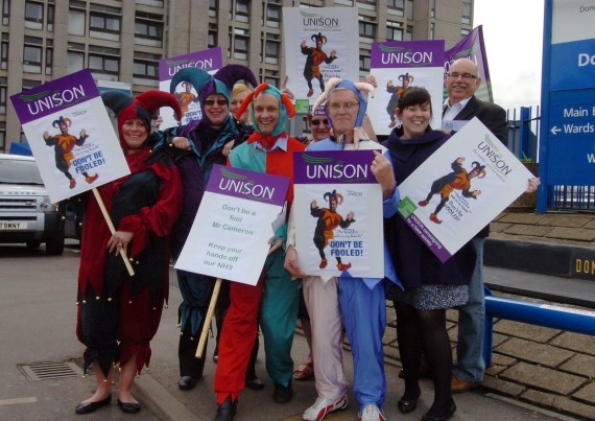
PROTESTERS at Doncaster Royal Infirmary donned jester costumes to voice their opposition to Government plans to reform the NHS.
Members of the trade union Unison targeted the borough’s biggest hospital to make their position clear to the borough MP Rosie Winterton, who was visiting during their protest.
Ms Winterton is also the Labour Party’s chief whip.
A spokesman for Unison confirmed the protest was held to tie in with Ms Winterton’s visit.
She said: To coincide with her visit, nurses and health care workers from Doncaster and Bassetlaw Hospital are protesting against the Health and Social Care Bill outside DRI main entrance.”
The protesters dressed in jesters outfits holding signs saying: “Don’t be a fool Mr Cameron – leave the NHS alone”.
David Cameron today warned NHS staff that modernisation of the service was “essential” if it was to cope with the demands of a rapidly ageing population.
Launching the Government’s “listening” exercise on its controversial reform programme, the Prime Minister insisted he remained “passionately” committed to a health service free at the point of delivery.
But addressing NHS workers in Frimley, Surrey, with Deputy Prime Minister Nick Clegg and Health Secretary Andrew Lansley, he said they could not afford to carry on in the way they were doing.
“The status quo is not an option,” he said.
At the same time he insisted that ministers were committed to taking staff with them as they made the reforms that were needed.
Ahead of this morning’s Cameron, Clegg, Lansley event on the NHS, it is worth reminding ourselves of what Nick Clegg was saying about these reforms back at the start of the year. On January 23rd, he went on the Andrew Marr show and had this exchange:
‘ANDREW MARR:
Huge change to the NHS just coming down the line. Was that in the Liberal Democrat manifesto?
NICK CLEGG:
Actually funnily enough it was. Indeed it was. We were one of the primary critics in opposition of what we felt was a top …
ANDREW MARR:
(over) I don’t remember you saying you were going to get rid of Primary Care Trusts and pass it down to GPs.
NICK CLEGG:
We certainly said we were going to get rid of Primary Care Trusts.’
I consider this posting to comply with copyright laws since
a. Only a small portion of the original article has been quoted satisfying the fair use criteria, and / or
b. This posting satisfies the requirements of a derivative work.
Please be assured that this blog is a non-commercial blog (weblog) which does not feature advertising and has not ever produced any income.