Author: dizzy

  • Net-zero scenario is ‘cheapest option’ for UK, says energy system operator

    Spread the love

    Original article by Simon Evans republished from Carbon Brief under a CC license. 
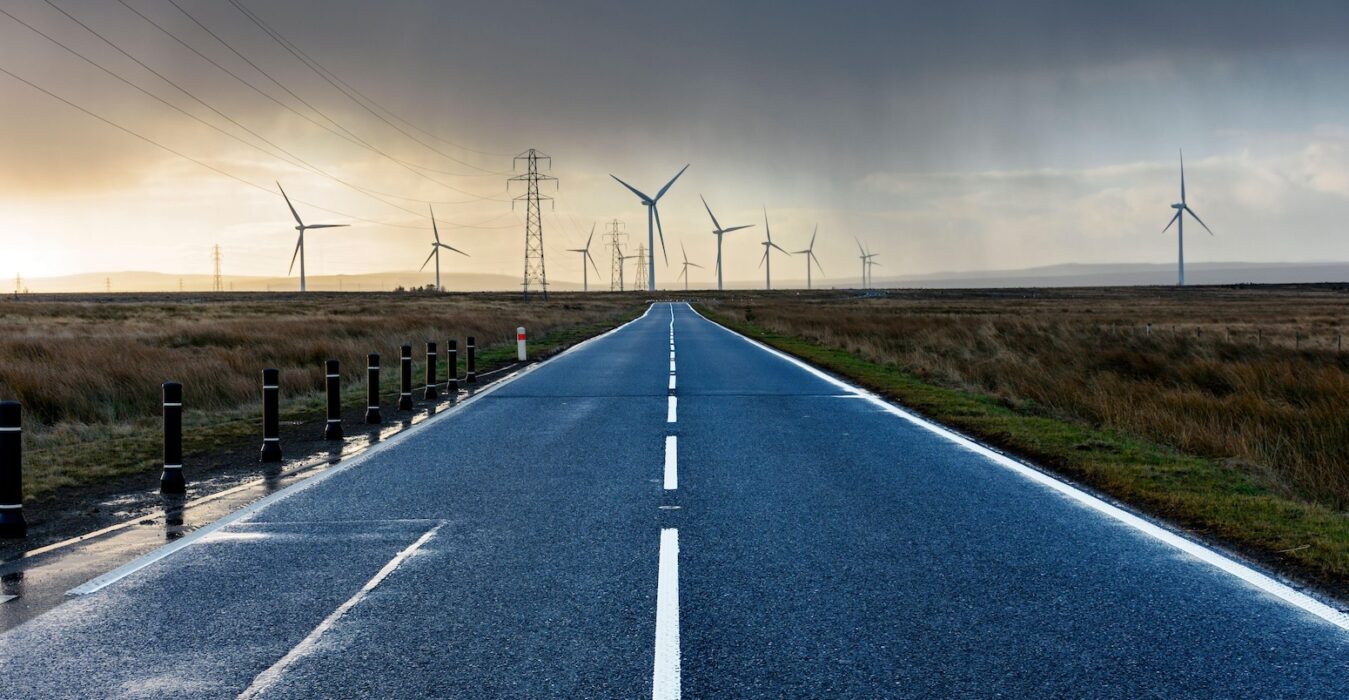
    Wind mills along the A9 trunk road in Caithness, Scotland. Credit: Vincent Lowe / Alamy Stock Photo

    A scenario that meets the “net-zero by 2050” goal would be the “cheapest” option for the UK, according to modelling by the National Energy System Operator (NESO).

    In a new report, the organisation that manages the UK’s energy infrastructure says its “holistic transition” scenario would have the lowest cost over the next 25 years, saving £36bn a year – some 1% of GDP – compared to an alternative scenario that slows climate action.

    These savings are from lower fuel costs and reduced climate damages, relative to a scenario where the UK fails to meet its climate goals, known as “falling behind”.

    The UK will need to make significant investments to reach net-zero, NESO says, but this would cut fossil-fuel imports, support jobs and boost health, as well as contributing to a safer climate.

    Slowing down these efforts would reduce the scale of investments needed, but overall costs would be higher unless the damages from worsening climate change are “ignored”, the report says.

    In an illusory world where climate damages do not exist, slowing the UK’s efforts to cut emissions would generate “savings” of £14bn per year on average – some 0.4% of GDP.

    NESO says that much of this £14bn could be avoided by reaching net-zero more cheaply and that it includes costs unrelated to climate action, such as a faster rollout of data centres.

    Notably, the report appears to include efforts to avoid the widespread misreporting of a previous edition, including in the election manifesto of the hard-right, climate-sceptic Reform UK party.

    Overall, NESO warns that, as well as ignoring climate damages, the £14bn figure “does not represent the cost of achieving net-zero” and cannot be compared with comprehensive estimates of this, such as the 0.2% of GDP total from the UK’s Climate Change Committee (CCC).

    Net-zero is the ‘cheapest option’

    Every year, NESO publishes its “future energy scenarios”, a set of four pathways designed to explore how the nation’s energy system might change over the coming decades.

    (Technically the scenarios apply to the island of Great Britain, rather than the whole UK, as Northern Ireland’s electricity system is part of a separate network covering the island of Ireland.)

    Published in July, the scenarios test a series of questions, such as what it would mean for the UK to meet its climate goals, whether it is possible to do so while relying heavily on hydrogen and what would happen if the nation was to slow down its efforts to cut emissions.

    The scenarios have a broad focus and do not only consider the UK’s climate goals. In addition, they also explore the implications of a rapid growth in electricity demand from data centres, the potential for autonomous driving and many other issues.

    With so many questions to explore, the scenarios are not designed to keep costs to a minimum. In fact, NESO does not publish related cost estimates in most years.

    This year, however, NESO has published an “economics annex” to the future energy scenarios. It last published a similar exercise in 2020, with the results being widely misreported.

    In the new annex, NESO says that the UK currently spends around 10% of GDP on its energy system. This includes investments in new infrastructure and equipment – such as cars, boilers or power plants – as well as fuel, running and maintenance costs.

    This figure is expected to decline to around 5% of GDP by 2050 under all four scenarios, NESO says, whether they meet the UK’s net-zero target or not.

    For each scenario, the annex adds up the total of all investments and ongoing costs in every year out to 2050. It then adds an estimate of the economic damages from the greenhouse gas emissions that primarily come from burning fossil fuels, using the Treasury’s “green book”.

    When all of these costs are taken into account, NESO says that the “cheapest” option is a pathway that meets the UK’s climate goals, including all of the targets on the way to net-zero by 2050.

    It says this pathway, known as “holistic transition”, would bring average savings of £36bn per year out to 2050, relative to a pathway where the UK slows its efforts on climate change.

    The overall savings, illustrated by the dashed line in the figure below, stem primarily from lower fuel costs (orange bars) and reduced climate damages (white bars).
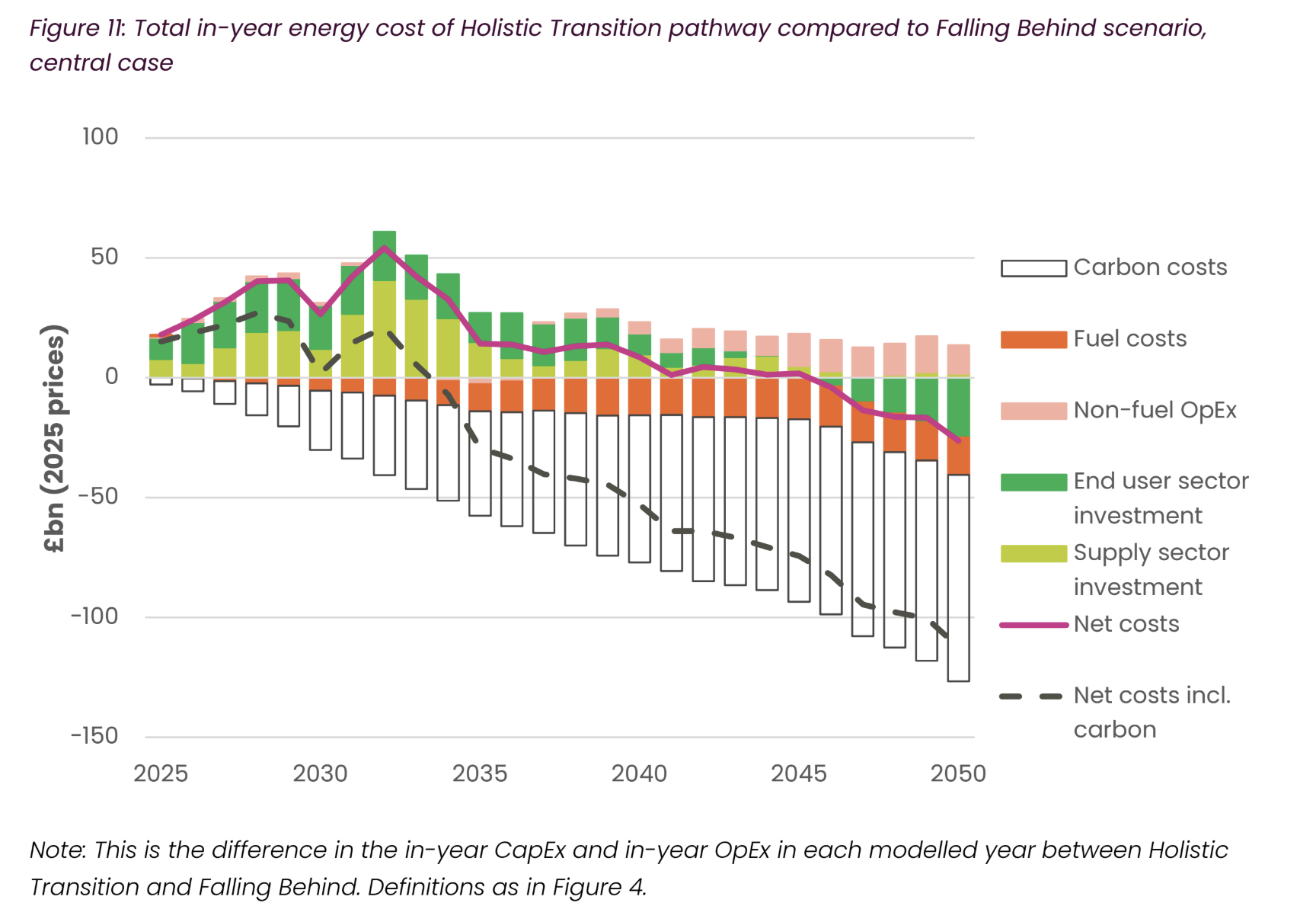
    In-year energy costs of the “holistic transition” pathway relative to “falling behind”
    In-year energy costs of the “holistic transition” pathway relative to “falling behind”, £bn in 2025 prices and assuming central estimates for future fossil-fuel prices. Credit: NESO.

    Note that the carbon pricing that is already applied to power plants and other heavy industry under the UK’s emissions trading system (ETS) is excluded from running costs in the annex, appearing instead within the wider “carbon costs” category. 

    This makes the running costs of fossil-fuel energy sources seem cheaper than they really are, when including the ETS price.

    Net-zero requires significant investment

    While NESO says that its net-zero compliant “holistic transition” pathway is the cheapest option for the UK, it does require significant upfront investments.

    The scale of the additional investments needed to stay on track for the UK’s climate goals, beyond a pathway where those targets are not met, is illustrated in the figure below.

    This shows that the largest extra investments would need to be made in the power sector, such as by building new windfarms (shown by the dark yellow bars). This is followed by investment needs for homes, such as to install electric heat pumps instead of gas boilers (dark red bars).

    These additional investments would amount to around £30bn per year out to 2050, but with a peak of as much as £60bn over the next decade.

    These investments would be offset by lower fuel bills, including reduced gas use in homes (pale red) and lower oil use in transport (mid green).

    Notably, NESO says it expects EVs to be cheaper to buy than petrol cars from 2027, meaning there are also significant savings in transport capital expenditure (“CapEx”, dark green).

    Detailed breakdown of in-year energy costs of the “holistic transition” pathway relative to “falling behind”
    Detailed breakdown of in-year energy costs of the “holistic transition” pathway relative to “falling behind”, £bn in 2025 prices and assuming central estimates for future fossil-fuel prices. Credit: NESO.

    Again, the biggest savings in “holistic transition” relative to “falling behind” would come from avoided climate damages – described by NESO as “carbon costs”.

    Net-zero cuts fossil-fuel imports

    In addition to avoided climate damages, NESO says that reaching the UK’s net-zero target would bring wider benefits to the economy, including lower fuel imports.

    Specifically, it says that climate efforts would “materially reduce” the UK’s dependency on overseas gas, with imports falling to 78% below current levels by 2050 in “holistic transition”. Under the  “falling behind” scenario, imports rise by 35%”, despite higher domestic production.

    This finding, shown in the figure below, is the opposite of what has been argued by many of those that oppose the UK’s net-zero target.

    Annual gas imports to the UK
    Annual gas imports to the UK, billion cubic metres (bcm) 2024-2050, under different NESO scenarios. Credit: NESO.

    NESO goes on to argue that the shift to net-zero would have wider economic benefits. These include a shift from buying imported fossil fuels to investing money domestically instead, which “could bring local economic benefits and support future employment”.

    The operator says that there is the “potential for more jobs to be created than lost in the transition to net-zero” and that there would be risks to UK trade if it fails to cut emissions, given exports to the EU – the UK’s main trading partner – would be subject to the bloc’s new carbon border tax.

    Beyond the economy, NESO points to studies finding that the transition to net-zero would have other benefits, including for human health and the environment.

    It does not attempt to quantify these benefits, but points to analysis from the CCC finding that health benefits alone could be worth £2.4-8.2bn per year by 2050.

    Investment is higher for net-zero than for ‘not-zero’

    It is clear from the NESO annex that its net-zero compliant “holistic transition” pathway would entail significantly more upfront investment than if climate action is slowed under “falling behind”.

    This idea, in effect, is the launchpad for politicians arguing that the UK should walk away from its climate commitments and stop building new low-carbon infrastructure.

    As already noted, the NESO analysis shows that this would increase costs to the UK overall.

    Still, NESO’s new report adds that “falling behind” would “save” £14bn a year – relative to meeting the UK’s net-zero target – as long as carbon costs are “ignored”.

    Specifically, it says that ignoring carbon costs, “holistic transition” would cost an average of £14bn a year more out to 2050 than “falling behind”, which misses the net-zero target. This is equivalent to 0.4% of the UK’s GDP and is illustrated by the solid pink line in the figure below.

    In-year energy costs of the “holistic transition” pathway relative to “falling behind”
    In-year energy costs of the “holistic transition” pathway relative to “falling behind”, £bn in 2025 prices and assuming central estimates for future fossil-fuel prices. Credit: NESO.

    Some politicians are indeed now willing to ignore the problem of climate change and the damages caused by ongoing greenhouse gas emissions. These politicians may therefore be tempted to argue that the UK could “save” £14bn a year by scrapping net-zero.

    However, NESO’s report cautions against this, stating explicitly that the “costs discussed here do not represent the cost of achieving net-zero emissions”. It says:

    “Our pathways cannot provide firm conclusions over the relative costs attached to the choices between pathways…We reiterate that the costs discussed here do not represent the cost of achieving net-zero emissions.”

    It says that the scenarios have not been designed to minimise costs and that it would be possible to reach net-zero more cheaply, for example by focusing more heavily on EVs and renewables instead of hydrogen and nuclear.

    Moreover, it says that some of the difference in costs between “holistic transitions” and “falling behind” is unrelated to climate action. Specifically, it says that electricity demand from data centres is around twice as high in “holistic transitions”, adding some £5bn a year in costs in 2050.

    In addition, NESO says that most of the “saving” in “falling behind” would be wiped out if fossil fuel prices are higher than expected – falling from £14bn per year to just £5bn a year – even before considering climate damages and wider benefits, such as for health.

    Finally, NESO says that failing to make the transition to net-zero would leave the UK more exposed to fossil-fuel price shocks, such as the global energy crisis that added 1.8% to the nation’s energy costs in 2022. It says a similar shock would only cost 0.3% of GDP in 2050 if the country has reached net-zero – as in “holistic transition” – whereas costs would remain high in “falling behind”.

    Original article by Simon Evans republished from Carbon Brief under a CC license. 

    Nigel Farage urges you to ignore facts and reality and be a climate science denier like him and his Deputy Richard Tice. He says that Reform UK has received £Millions and £Millions from the fossil fuel industry to promote climate denial and destroy the planet.
    Nigel Farage urges you to ignore facts and reality and be a climate science denier like him and his Deputy Richard Tice. He says that Reform UK has received £Millions and £Millions from the fossil fuel industry to promote climate denial and destroy the planet.
    Donald Trump urges you to be a Climate Science denier like him. He says that he makes millions and millions for destroying the planet, Burn, Baby, Burn and Flood, Baby, Flood.
    Donald Trump urges you to be a Climate Science denier like him. He says that he makes millions and millions for destroying the planet, Burn, Baby, Burn and Flood, Baby, Flood.
    Elon Musk urges you to be a Fascist like him, says that you can ignore facts and reality then.
    Elon Musk urges you to be a Fascist like him, says that you can ignore facts and reality then.
  • Seasonal message

    Spread the love
    Keir Starmer warns against following the https://onaquietday.org blog.
    Keir Starmer warns against following the https://onaquietday.org blog.

    It’s that time again. Season’s greeting. This blog unfortunately doesn’t really do good news, it’s more about exposing cnuty Fascist plutocrat politicians and impending planetary destruction caused by the filthy rich. Bah, kids singing atrociously and other bad songs. Best wishes and have a good passing the middle of winter break.

    There are plenty of good causes if you have a spare tenner or ten thousand, don’t worry if not. Greenpeace, Just Stop Oil, Declassified UK, Common Dreams, Roger Hallam, Amnesty, Oxfam and plenty of others can all use some spare cash.

    Donald Trump warns against following the Onaquietday.org blog, says that he's heard that she's a witch with a black cat and a dangerous kitchen.
    Donald Trump warns against following the Onaquietday.org blog, says that he’s heard that she’s a witch with a black cat and a dangerous kitchen.

  • Yale Historian Warns Trump Is Putting US on Path to World War III

    Spread the love

    Original article by Brad Reed republished from Common Dreams under Creative Commons (CC BY-NC-ND 3.0).

    President Donald Trump stands and salutes troops during the celebration of the Army’s 250th birthday on the National Mall on June 14, 2025 in Washington, DC. (Photo by Doug Mills – Pool/Getty Images)

    Historian Greg Grandin argued that Trump’s foreign policy will likely result in “more confrontation, more brinkmanship, more war.”

    Yale historian Greg Grandin believes that President Donald Trump’s foreign policy is putting the US on a dangerous course that could lead to a new world war.

    Writing in The New York Times on Monday, Grandin argued that the Trump administration seems determined to throw out the US-led international order that has been in place since World War II.

    RECOMMENDED…

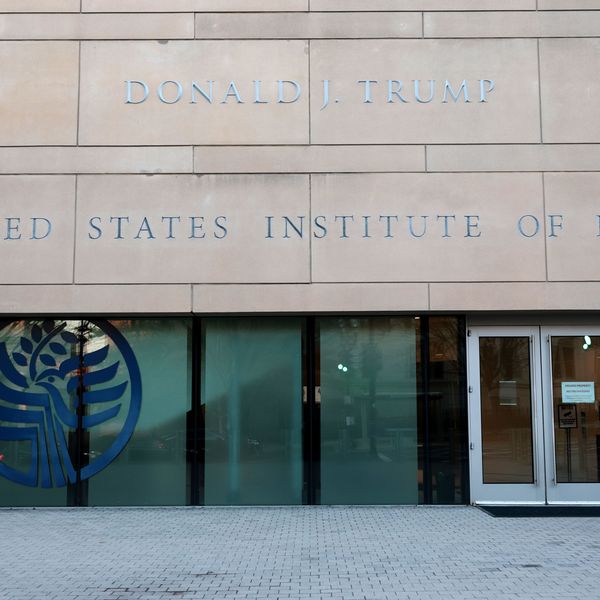
    President Donald Trumps Name Added To The US Institute of Peace Building

    Genocide Backer and Narcissist Donald J. Trump Puts His Name on ‘US Institute of Peace’

    Donald Trump

    Trump Says Ground Attack on Venezuela Imminent—Plus Colombia, Mexico Also in US Crosshairs

    In its place, Grandin said, is “a vision of the world carved up into garrisoned spheres of competing influence,” in which the US has undisputed control over the Western Hemisphere.

    As evidence, he pointed to the Trump White House’s recently published National Security Strategy that called for reviving the so-called Monroe Doctrine that in the past was used to justify US imperial aggression throughout Latin America, and that the Trump administration is using to justify its own military adventures in the region.

    Among other things, Grandin said that the Trump administration has been carrying out military strikes against purported drug smuggling boats in the Caribbean and the Pacific Ocean, and has also been “meddling in the internal politics of Brazil, Argentina, and Honduras, issuing scattershot threats against Colombia and Mexico, menacing Cuba and Nicaragua, increasing its influence over the Panama Canal, and seizing an oil tanker off the coast of Venezuela.”

    Most ominously, Grandin said, is how the US Department of Defense has been “carrying out a military buildup in the Caribbean that is all but unprecedented in its scale and concentration of firepower, seemingly aimed at effecting regime change in Venezuela.”

    A large problem with dividing the globe into spheres controlled by major powers, Grandin continued, is that these powers inevitably come into violent conflict with one another.

    Citing past statements and actions by the British Empire, Imperial Japan, and Nazi Germany, Grandin argued that “as the world marched into a second global war, many of its belligerents did so citing the Monroe Doctrine.”

    This dynamic is particularly dangerous in the case of Trump, who, according to Grandin, sees Latin America “as a theater of global rivalry, a place to extract resources, secure commodity chains, establish bulwarks of national security, fight the drug war, limit Chinese influence, and end migration.”

    The result of this policy shift, Grandin concluded, “will most likely be more confrontation, more brinkmanship, more war.”

    Original article by Brad Reed republished from Common Dreams under Creative Commons (CC BY-NC-ND 3.0).

    Donald Fuhrump says that Amerikkka doesn't bother with crimes or charges anymore, not being 100% Amerikkkan and opposing his real estate intentions is enough.
    Donald Fuhrump says that Amerikkka doesn’t bother with crimes or charges anymore, not being 100% Amerikkkan and opposing his real estate intentions is enough.
  • Egypt asks US to rein in Netanyahu amid Gaza “yellow line” dispute

    Spread the love

    This work by Middle East Monitor is licensed under a Creative Commons Attribution-NonCommercial-ShareAlike 4.0 International License.

    US President Donald Trump and Egyptian President Abdel Fattah el-Sisi meet within the Sharm El-Sheikh Peace Summit in Sharm El-Sheikh, Egypt on October 13, 2025. [Egyptian Presidency / Handout – Anadolu Agency]

    Relations between Israel and Egypt have entered a new phase of tension, with Cairo reportedly asking the United States to intervene to curb the actions of Israeli Prime Minister Benjamin Netanyahu, according to Israel’s Channel 14.

    The channel cited Israeli Middle East analyst Yoni Ben-Menachem, who said the dispute centres on Israeli military activity along the so-called “yellow line” inside the Gaza Strip and on changes Israel is making to the area’s geography. Egypt, he said, views these moves as a direct threat to its strategic and regional interests.

    Ben-Menachem warned that Israeli-Egyptian relations are deteriorating rapidly and revealed that Washington recently attempted to organise a trilateral summit involving US President Donald Trump, Egyptian President Abdel Fattah el-Sisi and Netanyahu in an effort to contain the crisis.

    According to the report, Egypt set several preconditions for the meeting that Israel rejected. These included a full Israeli withdrawal from the Philadelphi Corridor, the reopening of the Rafah crossing in both directions, and immediate approval of a major gas agreement involving imports from Israel’s Leviathan gas field.

    Ben-Menachem said Egypt has formally complained to Washington, accusing Israel of seeking to divide the Gaza Strip into two parts and of altering its demographic and topographical landscape—moves Cairo believes could undermine regional stability.

    Egyptian concerns have reportedly intensified following comments by Israeli Chief of Staff Eyal Zamir, who described the “yellow line” as a new defensive and offensive military line. These remarks, Ben-Menachem said, were taken very seriously in Cairo.

    Israeli military operations in the area, including the destruction of tunnel infrastructure and the demolition of homes, are being interpreted by Egypt as preparations for a long-term Israeli military presence in Gaza. This perception has prompted Cairo to pursue urgent diplomatic engagement with Washington.

    Channel 14 added that while the United States did attempt to convene a trilateral summit in Washington, the initiative ultimately collapsed after Egypt insisted on conditions Israel deemed unacceptable.

    READ: UN warns newborns in Gaza at risk of freezing during winter storm due to Israeli aid restrictions

    This work by Middle East Monitor is licensed under a Creative Commons Attribution-NonCommercial-ShareAlike 4.0 International License.

    Orcas discuss Genocide-supporting and complicit Zionists. Donald Trump, Keith Starmer, David Lammy, Rachel Reeves, Angela Rayner and Wes Streeting are acknowledged as evil genocide-complicit and supporting cnuts.
    Orcas discuss Genocide-supporting and complicit Zionists. Donald Trump, Keith Starmer, David Lammy, Rachel Reeves, Angela Rayner and Wes Streeting are acknowledged as evil genocide-complicit and supporting cnuts.
    Keir Starmer objects to criticism of the IDF. He asks how could anyone object to them starving people to death, forced marches like the Nazis did, bombing Gaza's hospitals and universities, mass-murdering journalists, healthworkers and starving people queuing for food, killing and raping prisoners and murdering children. He calls for people to stop obstructing his genocide for Israel.
    Keir Starmer objects to criticism of the IDF. He asks how could anyone object to them starving people to death, forced marches like the Nazis did, bombing Gaza’s hospitals and universities, mass-murdering journalists, healthworkers and starving people queuing for food, killing and raping prisoners and murdering children. He calls for people to stop obstructing his genocide for Israel.
    Orcas discuss Donald Trump and the killer apes' concept of democracy. Front Orca warns that Trump is crashing his country's economy and that everything he does he does for the fantastically wealthy.
    Orcas discuss Donald Trump and the killer apes’ concept of democracy. Front Orca warns that Trump is crashing his country’s economy and that everything he does he does for the fantastically wealthy.
  • White House sent ‘stern’ warning to Netanyahu over Gaza ceasefire violation: Report

    Spread the love

    This work by Middle East Monitor is licensed under a Creative Commons Attribution-NonCommercial-ShareAlike 4.0 International License.

    United States President Donald Trump (L) meets with Israeli Prime Minister Benjamin Netanyahu (R) in the White House in Washington DC., United States on April 7, 2025 [Avi Ohayon (GPO)/Handout/Anadolu Agency]

    The White House sent “stern” private messages to Israeli Prime Minister Benjamin Netanyahu stressing that an Israeli strike in Gaza constituted a violation of the ceasefire agreement brokered by President Donald Trump, Anadolu Agency reported on Monday.

    Sources speaking to Axios said the message followed Israel’s killing of Raed Saad, the deputy commander of Hamas’ military wing, in a strike in Gaza City over the weekend that killed four people in total.

    According to the report, a senior US official said the White House message to Netanyahu was, “If you want to ruin your reputation and show that you don’t abide by agreements be our guest, but we won’t allow you to ruin President Trump’s reputation after he brokered the deal in Gaza.”

    US officials reportedly said the Israeli government did not notify or consult Washington ahead of the attack.

    In a televised speech, Hamas chief in Gaza Khalil al-Hayya confirmed that Saad lost his life in the Israeli attack.

    Saad was the target of several Israeli assassination attempts until he lost his life in an airstrike on Saturday.

    The attack came despite a ceasefire agreement that took effect in Gaza on Oct. 10.

    The Israeli army has repeatedly violated the ceasefire, killing at least 391 Palestinians and injuring 1,063 others since the deal.

    Israel has killed more than 70,600 people, mostly women and children, and injured over 171,100 others in attacks in Gaza since October 2023, which have continued despite the truce.

    This work by Middle East Monitor is licensed under a Creative Commons Attribution-NonCommercial-ShareAlike 4.0 International License.

    Orcas discuss Genocide-supporting and complicit Zionists. Donald Trump, Keith Starmer, David Lammy, Rachel Reeves, Angela Rayner and Wes Streeting are acknowledged as evil genocide-complicit and supporting cnuts.
    Orcas discuss Genocide-supporting and complicit Zionists. Donald Trump, Keith Starmer, David Lammy, Rachel Reeves, Angela Rayner and Wes Streeting are acknowledged as evil genocide-complicit and supporting cnuts.
    Keir Starmer objects to criticism of the IDF. He asks how could anyone object to them starving people to death, forced marches like the Nazis did, bombing Gaza's hospitals and universities, mass-murdering journalists, healthworkers and starving people queuing for food, killing and raping prisoners and murdering children. He calls for people to stop obstructing his genocide for Israel.
    Keir Starmer objects to criticism of the IDF. He asks how could anyone object to them starving people to death, forced marches like the Nazis did, bombing Gaza’s hospitals and universities, mass-murdering journalists, healthworkers and starving people queuing for food, killing and raping prisoners and murdering children. He calls for people to stop obstructing his genocide for Israel.
    Orcas discuss Donald Trump and the killer apes' concept of democracy. Front Orca warns that Trump is crashing his country's economy and that everything he does he does for the fantastically wealthy.
    Orcas discuss Donald Trump and the killer apes’ concept of democracy. Front Orca warns that Trump is crashing his country’s economy and that everything he does he does for the fantastically wealthy.