Prime Minister Andy Burnham (left) with Chancellor of the Exchequer John Healey on the main stage during the Labour Party Conference at the ACC Liverpool, September 28, 2026
If ministers fail to bring bills down, ‘people will get ill and some will die,’ campaigners warn. ‘Every one of those avoidable cases will be on this Chancellor’s watch’
CAMPAIGNERS and unions have demanded the government cap killer energy prices amid predictions of a 16 per cent hike in fuel bills in the new year.
The demand came as a 4 per cent increase to energy regulator Ofgem’s price cap — equivalent to an extra £5 a month kicked-in — bringing the typical annual bill to £1,723.
Experts have now warned the hike could be just the tip of the iceberg, as US President Donald Trump and Israel’s Prime Minister Benjamin Netanyahu’s attacks on Iran continue to send international energy prices — and oil giants’ profits — soaring.
Energy analysts at Cornwall Insight say the bills could be set for the biggest rise in three years with a 16 per cent hike on January, bringing the typical annual bill to an eye-watering £1,999.
With over 10 million UK households spending more than 10 per cent of their incomes on domestic fuel, and prices having already soared by a staggering 27 per cent this year, the End Fuel Poverty Coalition called on Chancellor John Healey to use his budget to enforce an “emergency heat tariff.”
Taking at swipe at the energy profiteers, End Fuel Poverty Coalition co-ordinator Simon Francis said: “Households did not cause this crisis and cannot escape it, yet a handful of energy firms have announced over £6 billion in profits on UK operations in this year alone.
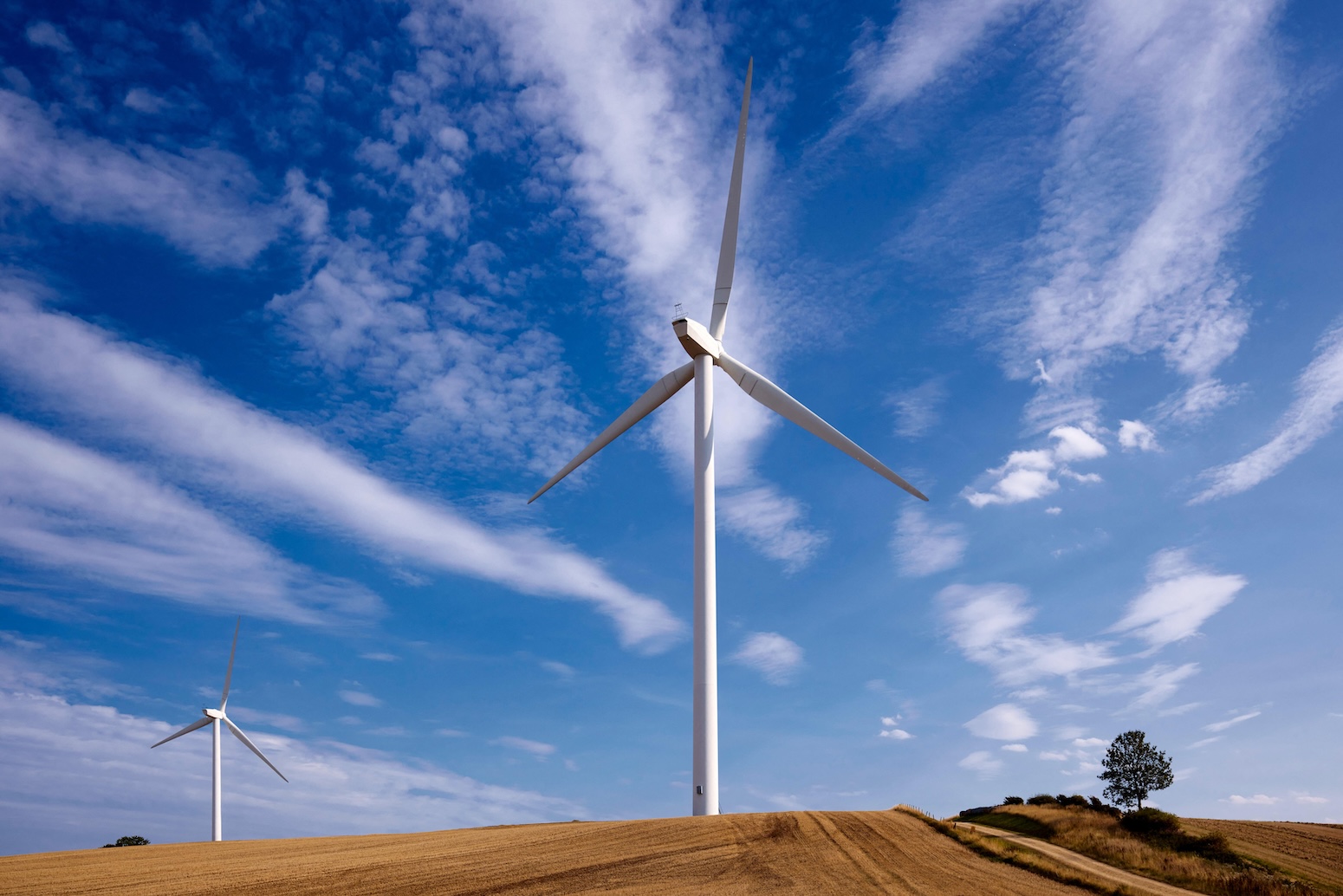
Wind turbines in a field. Credit: Alamy / Chris Rout.
The UK has avoided the need for gas imports worth £5.9bn since the start of the Hormuz crisis as a result of record generation from wind and solar, reveals Carbon Brief analysis.
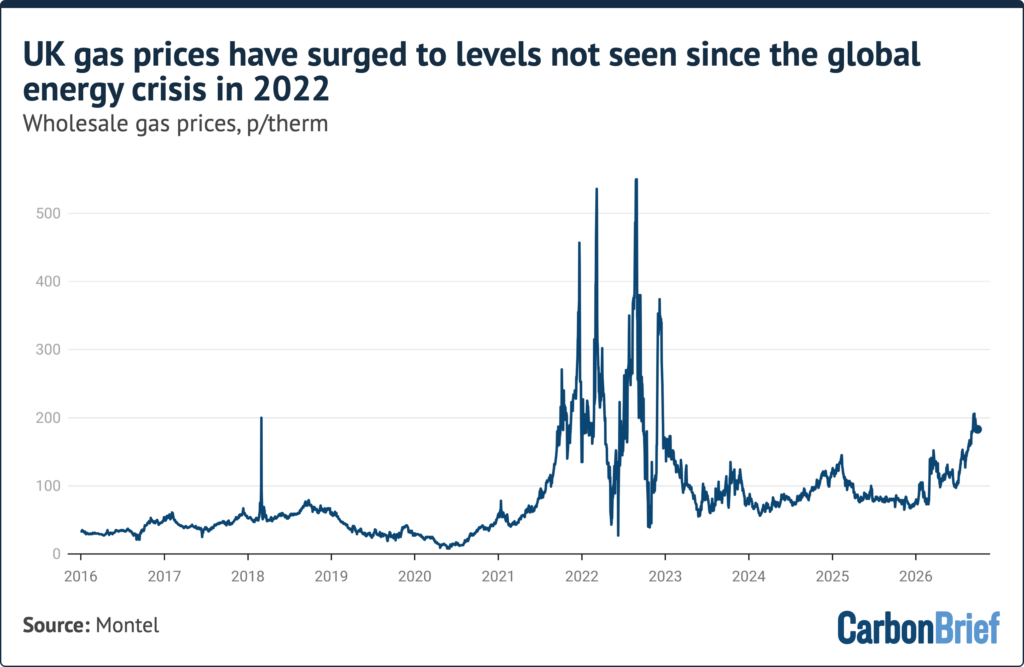
While gas prices are surging to levels not seen since the 2022 energy crisis, the UK has been generating record amounts of power from wind and solar, up 14% year-on-year.
This unprecedented clean-power generation is directly cutting the need for gas-fired electricity, which is down by nearly 10% year-on-year in 2026 to date.
In total, wind and solar have generated a record 41% share of the UK’s electricity needs in 2026 to date, compared with 25% from gas, according to Carbon Brief’s analysis.
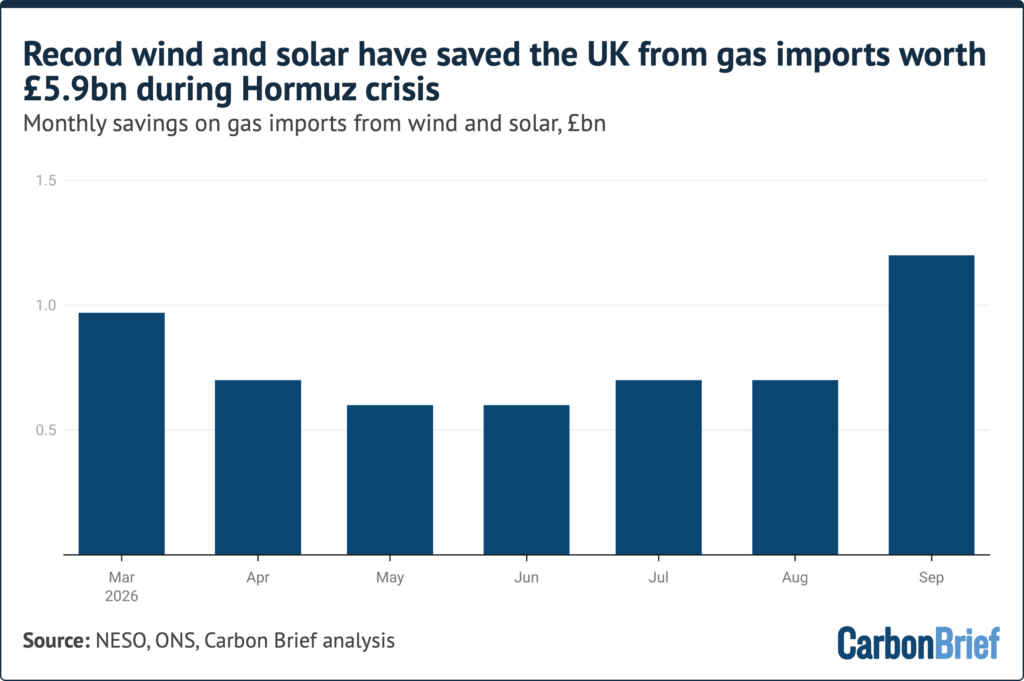
The figure below shows that wind and solar has avoided the need for UK gas imports worth £5.9bn, since the outbreak of war between the US and Iran in February 2026.
These avoided gas imports would have required the UK to secure the equivalent of more than 100 additional tanker deliveries of liquefied natural gas (LNG).
The £1.3bn import saving in September 2026 to date is the result of record wind and solar output, at nearly 10 terawatt hours (TWh), combined with surging gas prices.
The latest analysis updates figures published by Carbon Brief in April and May.
Wholesale gas prices in the UK have remained elevated ever since Russia cut off supplies to Europe in the wake of its invasion of Ukraine in 2022.
Gas averaged 90p per therm from 2023 until the start of this year, roughly three times above 2019 prices, before the Covid and Ukraine crises.
Since the outbreak of war in the Middle East in March, gas prices have climbed higher still, averaging 134p per therm or nearly four times the level seen in 2019.
In September 2026 to date, gas prices have averaged 189p per therm, reaching their highest level since the global energy crisis in 2022, as shown in the figure below.
UK gas prices are spiking again because winter is approaching – meaning higher demand for heating – and there is no end in sight for the Hormuz crisis.
At the same time, European gas stocks are low. This means Europe will have to compete with Asia to secure the cargoes of LNG needed to keep warm.
In the UK, high wholesale gas prices are hitting household gas bills under the price cap set by energy regulator Ofgem, whereas electricity bills have barely increased.
From this Thursday, 1 October, typical household gas bills will be 33% higher than they were in April, some £200 per year, according to thinktank Nesta.
In contrast, household electricity bills will only have risen 4%, according to Nesta’s analysis, as a result of growing generation from clean-energy sources.
Andrew Sissons, director for sustainable future at Nesta, explained in a social media post that “the link between electricity and gas prices has already begun to break”.
The UK and other fossil-fuel importing nations are being hit not only by high gas prices, but also by high prices for oil, diesel and other refined fuels.
The EU has reportedly had to pay an extra €100bn for fossil-fuel imports since the start of the crisis. Higher import bills have fallen particularly hard on low and middle-income countries, according to separate analysis.
In the UK, diesel prices have hit record levels of around £2 per litre. In contrast, recent Carbon Brief analysis shows that electric cars are up to nine times cheaper to drive.
In her speech to the Labour party conference, energy secretary Miatta Fahnbulleh said that energy bills were high because the UK is “exposed to global fossil-fuel markets”.
In his own conference speech, prime minister Andy Burnham said the expansion of clean energy was easing the impact of high gas prices on electricity bills. He said:
“We are already taking more control of our electricity prices with a massive expansion of home-grown renewables and nuclear. I have asked Miatta to speed up the breaking of the link between what we pay for power at home and the international gas market, to get bills down.”
This work by Middle East Monitor is licensed under a Creative Commons Attribution-NonCommercial-ShareAlike 4.0 International License.
A large billboard depicting an armed member of Iran’s Islamic Revolutionary Guard Corps (IRGC) standing with one foot on American REMUS 600 autonomous underwater vehicle (AUV) at Venek Square in central Tehran, Iran, on September 28, 2026. [Fatemeh Bahrami – Anadolu Agency]
Tehran said on Wednesday it had received a US response to its proposal to end the war and reopen the Strait of Hormuz, days after US President Donald Trump said he had rejected the plan.
Iranian government spokeswoman Fatemeh Mohajerani said Foreign Minister Abbas Araghchi presented the US response to President Masoud Pezeshkian during a cabinet meeting.
Iran submitted the proposal last week, calling for reciprocal steps to be taken within seven days. These included the United States lifting its blockade of Iranian ports in return for Tehran reopening the Strait of Hormuz to shipping.
Trump said on Sunday that he had rejected the Iranian proposal, but Araghchi said at the time that Tehran had not received an official response.
Reuters quoted a source familiar with the talks as saying Qatari mediators briefed Araghchi on the US response on Tuesday during a stop in Doha on his way back from New York.
The source said the two sides broadly agreed on the steps required, but still disagreed over the order in which they should be implemented.
Pezeshkian said any agreement should be based on a “win-win” strategy.
An Iranian official said the main disagreement between Iran and the United States concerned the sequence of the steps, rather than the elements of the seven-day plan.
Axios, citing informed sources, reported that there had been no tangible progress in Monday’s talks, with neither the United States nor Iran showing a willingness to make concessions.
US officials told Axios that Trump could order a return to large-scale military operations after the midterm elections.
Iranian officials stressed that Tehran would consider making concessions only after Washington agreed to return to the memorandum of understanding.
Ed Miliband says that he and the Labour Party are full of shit criminalising people holding signs as terrorists despite anything he says.Orcas discuss rotting brain, front Orca says Sundown Syndrome is a dead givaway and he wishes someone would Lock Him Up
This work by Middle East Monitor is licensed under a Creative Commons Attribution-NonCommercial-ShareAlike 4.0 International License.
People gather to commemorate Lebanese children who lost their lives in Israeli attacks during an event titled “The bloodiest September for children in Lebanon” at Martyrs’ Square in downtown Beirut, Lebanon, on September 23, 2026. [Houssam Shbaro – Anadolu Agency]
261 children have been killed and 1,056 injured in Israeli attacks on Lebanon since the escalation began in March, The United Nations Children’s Fund (UNICEF) said on Wednesday, warning of the impact of the worsening crisis on the future of children and young people.
In a report titled An Enduring Nightmare, UNICEF said about 436 schools had been damaged or destroyed, putting nearly 100,000 children at risk of dropping out of education. It added that 86 teachers had been killed or injured.
UNICEF said the economic and humanitarian crisis was pushing more families into being unable to meet basic needs, with four in five families in Lebanon struggling to provide them.
The report said 22 per cent of surveyed families reported that their children had gone to bed hungry during the previous two weeks.
Meanwhile, 31 per cent of families said they had been unable to provide their children with necessary healthcare because they could not afford it.
UNICEF also warned of the psychological impact of the crisis on children, saying about 770,000 children in Lebanon had experienced psychological distress over the past six months.
UNICEF Representative in Lebanon Marcoluigi Corsi said children and young people were bearing burdens “no child should have to carry”, warning that if the crisis continued without urgent and sustained action, it could have long-term effects on an entire generation.
Ed Miliband says that he and the Labour Party are full of shit criminalising people holding signs as terrorists despite anything he says.Orcas discuss rotting brain, front Orca says Sundown Syndrome is a dead givaway and he wishes someone would Lock Him Up
This work by Middle East Monitor is licensed under a Creative Commons Attribution-NonCommercial-ShareAlike 4.0 International License.
Smoke rises after Israeli forces carried out air and artillery attacks on towns in Nabatieh, southern Lebanon, despite a ceasefire, on September 21, 2026. [Ramiz Dallah – Anadolu Agency]
The Israeli army launched airstrikes early Sunday on several areas in southern Lebanon amid Tel Aviv’s continued violations of a US-brokered framework agreement signed in June, Anadolu reports.
The attacks targeted several towns in Tyre, Nabatieh, Marjayoun and Bint Jbeil, including Mansouri, Wadi Zibqin, Nabatieh al-Fawqa, Kfar Tibnit, Mayfadoun, Kafr Rumman, Mazraat al-Shomeriya, Al-Qusayr, Beit Yahoun, Safarin and Hadatha, the state news agency NNA reported.
Israeli forces demolished several homes in Mansouri in the Tyre district, while Wadi Zibqin came under artillery fire, accompanied by heavy-machine-gun fire, the outlet said.
In Nabatieh, Israeli warplanes carried out a series of airstrikes overnight, hitting Nabatieh al-Fawqa twice, as well as the outskirts of Kfar Tibnit and the town of Mayfadoun, where one strike completely destroyed a house.
The Doha Kafr Rumman area was also targeted by artillery fire. In the Marjayoun district, Israeli artillery shelled the outskirts of Mazraat al-Shomeriya and the town of Al-Qusayr.
Israeli forces conducted machine-gun fire toward Beit Yahoun and Safarin in Bint Jbeil, while an Israeli tank fired four shells at Hadatha before Israeli forces moved toward the center of the town and set fire to the area.
In a statement posted on the US social media company X, the Israeli army claimed the attacks were in response to a Hezbollah explosive-laden drone launched Saturday toward its forces in what it called the “security zone” in southern Lebanon.
Hezbollah had not commented on the Israeli claim.
Since March 2, Israel has been conducting military operations in Lebanon, killing at least 4,386 people, injuring 12,407 others and displacing more than 1 million, according to Lebanese authorities.
The attacks came despite a US-mediated framework agreement signed in June, which provides for gradual Israeli withdrawal from occupied Lebanese territory in return for the deployment of the Lebanese army and the disarmament of Hezbollah.
Ed Miliband says that he and the Labour Party are full of shit criminalising people holding signs as terrorists despite anything he says.Orcas discuss rotting brain, front Orca says Sundown Syndrome is a dead givaway and he wishes someone would Lock Him Up

 Prime Minister Andy Burnham (left) with Chancellor of the Exchequer John Healey on the main stage during the Labour Party Conference at the ACC Liverpool, September 28, 2026