Author: dizzy

  • Venezuelan youth train to “defend the Homeland and construct the future” amid US escalation

    Spread the love

    Original article by Pablo Meriguet republished from peoples dispatch under a Creative Commons Attribution-ShareAlike 4.0 (CC BY-SA) license.
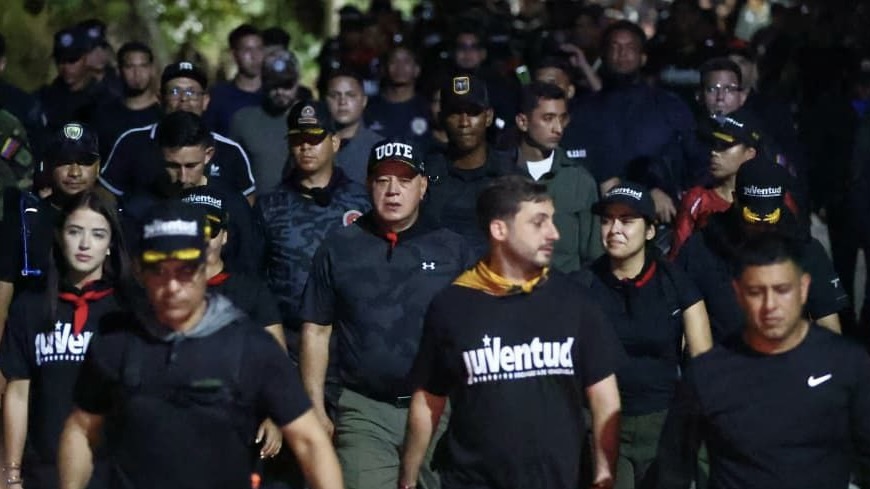
    Youth of the PSUV carried out a week of training, culminating in a 10k night march led by Diosdado Cabello. Photo: Con el Mazo Dando

    As the US escalates its threats against Venezuela, youth of the PSUV engaged in a week-long “Basic Revolutionary Resistance Training”

    The youth wing of the United Socialist Party of Venezuela (PSUV) carried out “Basic Revolutionary Resistance Training” over the past week in the Venezuelan state La Guaira. On the evening of August 28, the youth participated in a 10 kilometer night march led by Secretary General of PSUV, Diosdado Cabello.

    The training took place amid rising tensions between Washington and Caracas. The situation flared up when the administration of US President Donald Trump reiterated accusations that the Venezuelan government plays a major role in drug trafficking, increasing the bounty on the head of President Nicolás Maduro, and at the same time deploying troops to the Caribbean to support the US “war on drugs”.

    Read more: Trump’s smokescreen on Venezuela: Exposing the “narco-state” accusation

    “The socialist youth, with its morale and rebelliousness, is ready for the defense of the Homeland and the construction of the future,” said Cabello who also serves in the administration of the Bolivarian Republic. 

    The Chavista leader expressed that these trainings seek to build a combative youth in view of recent events that increased pressures on the South American country: “Chávez dreamed it and we are making it a reality, a combatant corps of the youth of the United Socialist Party of Venezuela.”

    The activities are taking place after Venezuelan President Nicolás Maduro, called on all branches of the Armed Forces, including the militia, and the PSUV to be on high alert and prepared for a potential US attack.

    Read more: Venezuela mobilizes 4.5 million militia members as US deploys troops to the Caribbean

    Meanwhile, the military enlistment days organized by Chavismo continue to advance throughout Venezuela. According to Venezuelan authorities, “thousands of people have responded to the government’s call to join the ranks of the national defense.”

    Vice President Delcy Rodríguez said in this regard: ‘’The workers are highly conscious of what it means to defend our homeland; today we heed the call of President Nicolás Maduro to defend our nation…We are ready to defend the social happiness of our people, to defend the future, to defend Venezuela’s right to exploit and develop its productive capacities.”

    The United States continues to reinforce military and diplomatic positions.

    On August 14, US Secretary of State Marco Rubio announced the deployment of several military vessels in the southern Caribbean Sea after declaring that Maduro is the alleged leader of the so-called Cartel de los Soles.

    This organization has already been designated as a terrorist organization by Washington, which many analysts have seen as a tactic to attack Venezuela and thus overthrow the Chavista government.

    In addition, several US allies in South America, Ecuador, Paraguay and Argentina, have also declared the Cartel de los Soles as an international terrorist organization, which can be interpreted as a form of alignment behind Washington’s geopolitical pretensions.

    However, other countries in the region such as Colombia and Mexico, led by progressive presidents Gustavo Petro and Claudia Sheinbaum respectively, have expressed that they will not support a military intervention on Latin American soil as they consider that it goes against the principle of non-intervention that characterizes the foreign policy of several countries in the region.

    “We will never be in favor of intervention by a foreign country.”

    🇲🇽In her daily morning press conference, Mexican President Claudia Sheinbaum responded to a question by a journalist about a possible US military intervention in Venezuela. pic.twitter.com/XJ3DUJCmJF

    — Peoples Dispatch (@peoplesdispatch) August 27, 2025

    Washington continues to reinforce its military positions in the Caribbean, specifically in Curacao and Guyana, countries that have granted permission to the US military to dock in their coasts.

    Meanwhile, US Secretary of State Marco Rubio, has begun a tour of Latin America and the Caribbean to seek greater support for the Trump administration’s position on Venezuela and to rally more support for his regional strategy. Mexico and Ecuador will be part of Rubio’s tour. 

    Original article by Pablo Meriguet republished from peoples dispatch under a Creative Commons Attribution-ShareAlike 4.0 (CC BY-SA) license.

    Donald Fuhrump says that Amerikkka doesn't bother with crimes or charges anymore, not being 100% Amerikkkan and opposing his real estate intentions is enough.
    Donald Fuhrump says that Amerikkka doesn’t bother with crimes or charges anymore, not being 100% Amerikkkan and opposing his real estate intentions is enough.
    Elon Musk urges you to be a Fascist like him, says that you can ignore facts and reality then.
    Elon Musk urges you to be a Fascist like him, says that you can ignore facts and reality then.

  • Treaties like the ECHR protect everyone in the UK, not just migrants

    Spread the love
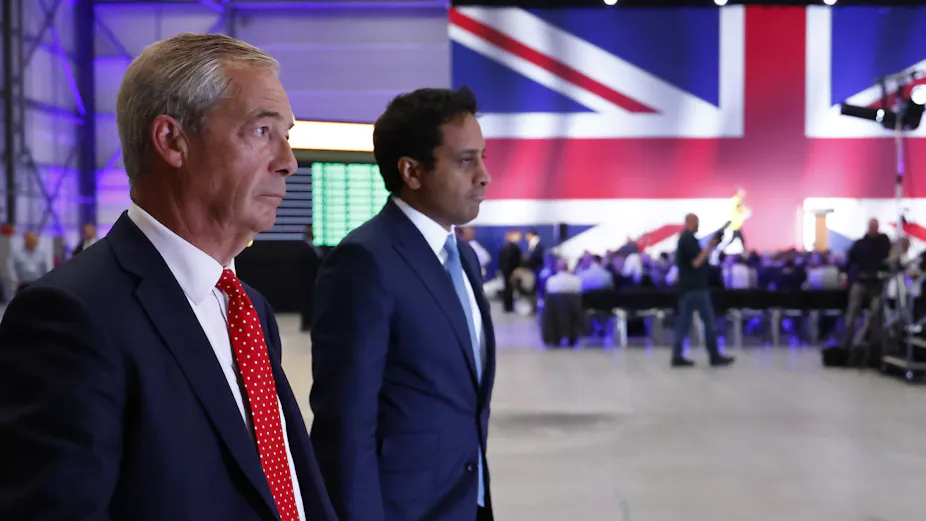
    Reform’s Nigel Farage and Zia Yusuf arrive at an airplane hangar to lay out their deportation plans. Tolga Akmen/EPA-EFE

    Alice Donald, Middlesex University and Joelle Grogan, University College Dublin

    Reform UK has laid out plans for an “emergency programme” to address illegal immigration. The party argues its plans, which include expanding immigration detention capacity from the current roughly 2,200 places to 24,000, would enable the deportation of up to 600,000 people over a parliamentary term.

    The plans would require removing legal protections against mass deportation without due process. Specifically, Reform has called for repealing the Human Rights Act (HRA) 1998 and permanently withdrawing the UK from the European Convention on Human Rights (ECHR). Nigel Farage has also proposed disapplying for five years the 1951 Refugee Convention, the UN Convention against Torture and the Council of Europe anti-trafficking convention, although these treaties do not, in fact, allow for temporary suspension.

    Beyond the apparent logistical challenges are serious political repercussions. The Good Friday Agreement requires the rights and freedoms in the ECHR and recourse to the European Court of Human Rights to be part of the law in Northern Ireland. Withdrawing would require a renegotiation of the agreement. A showdown would also ensue with the devolved assemblies in Wales, Scotland and Northern Ireland.

    Reform has touted its plan as a “legal reset”. But it is better understood as a total rejection of the UK’s postwar international commitments to protect the human rights of everyone within its jurisdiction.

    These commitments, and others, have cemented the UK at the heart of the rules-based international order. This is the foundational idea that countries are bound by the legal commitments they make to each other and everyone within their jurisdiction. Successive governments have viewed this as both a moral imperative and a core aspect of the UK’s foreign and defence policies.

    Reform’s plan would be an unprecedented and drastic rupture with almost eight decades of commitment to human rights protections. It would have far-reaching implications for all people in the UK, not just refugees.

    How the ECHR protects everyone

    If the UK withdrew from the ECHR, everyone living in the UK would lose the ability to take cases to the European Court of Human Rights if they fail to get justice domestically.

    ECHR rights have been invoked to protect victims of domestic abuse, children and disabled people. The right to private and family life, the application of which has been (inaccurately) criticised for preventing deportation, is the same right relied on to protect privacy in the workplace or from surveillance, to uphold the dignity of older and disabled people in residential care, and to secure legal protection for LGBTQ+ people.

    The ECHR alone has provided redress to victims of crime who have been failed by state investigations, like the survivors and bereaved families of the Hillsborough disaster or the victims of the “black cab rapist” John Worboys. Ironically, Reform UK has repeatedly argued for protection of free speech, which is protected primarily by the ECHR.

    The wider cost of UK withdrawal from international treaties would be the loss of influence and reputation. These treaties are benchmarks for international cooperation, and foundational to international order. Pulling out of the UN convention against torture and the anti-trafficking convention would signal the UK’s abandonment of global principles to combat torture, modern slavery, sexual exploitation and trafficking, including the illegal trade in human organs.

    Far from enabling the UK to control migration, a do-it-alone stance would harm the ability of future governments to do so. Removing the UK from the negotiating table would forfeit the opportunity to shape and benefit from cooperation to tackle a global challenge. We have seen this before: UK withdrawal from the EU took it out of the Dublin system and ongoing EU-wide efforts to manage migration and returns, just as small boat arrivals increased.

    Beyond this, removals require treaties with other countries. Treaties require political will, mutual benefit, time and trust that the signatories will hold to their commitments. Where these are lacking, as evidenced by the failed and costly Rwanda policy, receiving countries can extract a very high price from the UK.

    Could the rights be replaced?

    To implement these plans, a Reform government would need to pass legislation through parliament to repeal the Human Rights Act (HRA). If successful, this would pave the way for the UK to give notice to the Council of Europe to withdraw from the ECHR.

    Without the HRA, there is no equivalent protection to the ECHR elsewhere in UK law. The common law, a body of law developed over centuries by judicial decisions as distinct from laws passed by parliament, would continue to provide some protection for rights, including personal liberty, access to justice, the right to a fair trial and the prohibition of torture.

    Common law principles would still guide British judges when making decisions about mass detention and deportation without due process. It is also possible that a new bill of rights could be enacted, containing a similar or identical catalogue of rights to the ECHR.

    The most important difference would be how rights would be protected in practice. Would any replacement, like the HRA, oblige public authorities and the government to uphold rights in their decisions and actions? And would it allow higher courts to declare a law incompatible with human rights, flagging to parliament that the law should be reconsidered?

    Human rights protections are invisible to most people living in the UK. The expectation that police and your local council must treat you fairly, that health and care services must respect your dignity, and that there will be legal remedy if the state fails you, is so normalised that it would be inconceivable to think it could disappear within the UK.

    But it is the invisible integration of individual rights within the UK system that makes this both a lived and legal reality. Stripping away these protections would leave us all naked.


    Want more politics coverage from academic experts? Every week, we bring you informed analysis of developments in government and fact check the claims being made.

    Sign up for our weekly politics newsletter, delivered every Friday.


    Alice Donald, Professor, Middlesex University and Joelle Grogan, Senior Visiting Research Fellow, UCD Sutherland School of Law, University College Dublin

    This article is republished from The Conversation under a Creative Commons license. Read the original article.

    Climate science denier Nigel Farage explains that it's simple to blame asylum-seekers or Muslims for everything.
    Climate science denier Nigel Farage explains that it’s simple to blame asylum-seekers or Muslims for everything.
    Nigel Farage reminds you that he's the man that brought you Brexit and asks what could possibly go wrong.
    Nigel Farage reminds you that he’s the man that brought you Brexit and asks what could possibly go wrong.

  • Coming soon: behind the Tories support for destroying the climate

    Spread the love
    UK Conservative Party leader Kemi Badenoch explains her reality that the Earth is flat, the Moon is made of cheese and that she was born from Unicorn horn dust
    UK Conservative Party leader Kemi ‘not a genocide’ Badenoch explains her reality that the Earth is flat, the Moon is made of cheese and that she was born from Unicorn horn dust

    It will mostly review financial support for the Conservatives from fossil-fuel interests.

  • If not by small boats, how CAN people seek asylum in the UK?

    Spread the love
    Climate science denier Nigel Farage explains that it's simple to blame asylum-seekers or Muslims for everything.
    Climate science denier Nigel Farage explains that it’s simple to blame asylum-seekers or Muslims for everything.

    https://www.solidaritee.org.uk/post/if-not-by-small-boats-how-can-people-seek-asylum-in-the-uk

    Recent UK immigration politics has focused largely on ‘getting numbers down’ by reducing the number of so-called ‘illegal’ entries, which usually involve people crossing the channel on small boats or on the backs of lorries. The government often refuses to acknowledge that the high number of ‘illegal’ entries is intrinsically linked to the lack of official routes provided for coming to the UK to claim asylum. And whilst those travelling by unofficial means may not abide by UK immigration law and documentation processes, international law states that asylum seekers cannot be punished or criminalised for the way they enter.

    The 1951 Refugee Convention states that asylum seekers should not be discriminated against for their mode of entry into another country. People fleeing persecution have the right to travel to any country via any route possible in order to claim asylum, provided they inform the authorities of their presence upon arrival and have a good reason for seeking asylum.

    Despite this, arrival in the UK by small boat crossings or other ‘clandestine’ routes across the Channel are frequently referred to as ‘illegal’ because the person entering does not have a valid visa in place. This is where the UK asylum system is deeply contradictory: it is not possible to claim asylum from outside the UK, and it is also not possible to obtain a visa before travelling to the UK to claim asylum.

    …

    Article continues at https://www.solidaritee.org.uk/post/if-not-by-small-boats-how-can-people-seek-asylum-in-the-uk

    dizzy: I suggest that people referring to small boat migrants as being illegal reflects more on their intolerance and prejudices that anything else.

    Nigel Farage reminds you that he's the man that brought you Brexit and asks what could possibly go wrong.
    Nigel Farage reminds you that he’s the man that brought you Brexit and asks what could possibly go wrong.
    Keir Starmer refuses to be outcnuted by Nigel Farage's chasing the racist bigot vote.
    Keir Starmer refuses to be outcnuted by Nigel Farage’s chasing the racist bigot vote.