Exclusive: Martha Dalton worked closely with Burnham’s team on byelection that secured his return to parliament
A recent lobbyist for the controversial $450bn US tech company Palantir played a senior role in helping Andy Burnham become prime minister, it has emerged.
Martha Dalton, whose company Lodestone worked for Palantir in 2024 and 2025, campaigned for Burnham in the Makerfield byelection that secured his return to parliament. She worked closely with his team on strategic communications and rebuttals, and was among supporters who clapped him into Downing Street in July.
Lodestone, which Dalton co-founded, worked for Palantir on projects including promoting its software at events in parliament where its engineers demonstrated AI-powered systems for use in British public services to MPs.
Dalton previously worked on the autumn 2025 deputy leadership campaign for the current education secretary, Lucy Powell, a few months after Lodestone stopped working for Palantir.
Her role emerged as Palantir fights to retain its £330m contract with NHS England to run the federated data platform, a national medical data system.
A new study found AI-driven fossil fuel productivity could increase emissions. Here are examples of companies already using AI to boost production.
When United Nations Secretary-General António Guterres warned world leaders last week in his UN address about the unchecked power of both Big Oil and artificial intelligence, he treated them as two of the defining challenges facing governments.
At the same time, the technology companies providing these AI tools are not generally held accountable for the additional fossil fuel production and emissions their products may enable.
“The danger is not technology,” Guterres told the UN General Assembly. “The danger is technology without accountability.”
A DeSmog review of company announcements, industry presentations, and other publicly available information found that, across major fossil fuel companies — Aramco, Chevron, Equinor, ExxonMobil, Shell, TotalEnergies and others — AI is increasingly being integrated into fossil fuel operations, from seismic exploration and drilling to equipment monitoring and field development.
The examples provide a real-world look at the mechanism behind a recent study published inNature: that AI can increase emissions not only because of the electricity required to run data centers, but because it can make fossil fuel production more productive and profitable.
The study found that AI-driven productivity gains in fossil fuel production accounted for most of the modeled increase in global energy-related carbon dioxide emissions. It estimated that AI could increase global energy-related carbon dioxide emissions by between 1.2 and 4.8 percent, with productivity gains in fossil fuel production accounting for most of that increase.
In one example of AI gains, Norwegian energy company Equinor re-scanned the Norwegian continental shelf with “new seismic technology and AI,” resulting in 27 new discoveries of oil, Hege Skryseth, the company’s executive vice president, chief technology officer, said during a June presentation for Equinor’s Capital Market Day.
“By reprocessing the data, the seismic image became much sharper, leading to the discoveries,” Skryseth said. “AI was key here, from automated data interpretation to efficient well planning.”
Chevron is also using AI to produce oil that was “previously considered unreachable.”
In the oil company’s recently launched podcast — in which racing driver Tanner Foust and Chevron Chief Technology and Engineering Officer Ryder Booth chat from a pickup truck tailgate — Booth said that breakthroughs at Anchor, an oil and gas development, represented the “first time unlocking kind of a new horizon around the world.”
“AI, it’s attracted to big data and big opportunities, and the oil and gas industry has big data,” Booth said. Last year, Chevron said it had improved drilling and fracking efficiency in the Permian Basin by over 30 percent.
The value of these productivity gains is significant. A recent McKinsey & Co. report estimated that, for the upstream oil and gas sector, AI can generate $65 billionin profitsannually in the short term, which could increase to $230 billion when the technology is deployed at its “full potential.”
AI-driven efficiency gains have already reduced operational costs by up to 18 percent; and industry executives attribute about 5 percent of their current revenue to “AI-driven initiatives,” according to a 2025 report from IBM, which has multiple partnerships with oil and gas companies.
‘Done in seconds and live-streamed’
At Equinor’s enormous Johan Sverdrup oil field in the North Sea, “data flows up from the ground faster than the oil,” the company’s site states, at the rate of “10,000 Netflix movies a second.”
The company is also using AI to optimize the placement of subsea equipment and wells.
“What used to take 2-3 weeks and involved flying hard disks to shore with helicopter for analysis can now be done in seconds and live-streamed,” Equinor said.
ExxonMobil is also embracing enormous datasets. In 2019, ExxonMobil partnered with Microsoft to use AI in its Permian Basin operations, a move Exxon said would “generate billions of dollars in value” and produce up to an additional “50,000 oil-equivalent barrels a day by 2025.”
The oil giant also said that gains in efficiency from advanced technologies, including AI, “is a first step” towards letting systems respond to events without human intervention.
Holly Alpine, a coauthor of the Nature study, said the significance of such partnerships is easy to miss when attention focuses on the emissions produced by powering AI systems.
“For some reason, tech companies are exempt from accountability for the tech they are creating,” she told DeSmog.
Alpine and her husband, Will Alpine, another author of the Nature study, previously worked for Microsoft, but left after coming to the conclusion thatthe company hid how its products were harming the climate. The couple then founded the Enabled Emissions Campaign, a nonprofit that calls attention to tech’s role in fossil fuel production and advocates for better regulations.
She said that now, oil companies like Exxon pumping 50,000 barrels a day is “actually quite a small deal.”
“The deals have only grown in size, and we realized that that was not part of Microsoft’s accountability whatsoever, even though they are the company creating the technology that is making this happen.”
A recent Reuters article about Exxon’s use of automated drilling in the Permian Basin, which said the company plans to increase production in the region to 2.5 million barrels a day, didn’t mention if Microsoft was still involved with the project; on Exxon’s website, references to Microsoft partnerships still link to the announcement from 2019.
Microsoft did not confirm whether it’s still partnering with Exxon on those operations, but the tech company is the leading cloud provider for the oil and gas industry, according to Kimberlite Research, followed by Amazon and Google.
Data CentersAreIntertwined with AI
Just two years ago, fossil fuels’ share of the world’s energy supply was projected to decline in coming years. Then, AI data centers began expanding rapidly, and with them, the argument that fossil fuels must scale up, too, for the U.S. to win the “AI arms race.”
At the same time, the fossil fuel and technology industries are becoming increasingly intertwined. AI data centers require enormous amounts of electricity, and natural gas supplies more than 40 percent of the power used by U.S. data centers, according to the International Energy Agency (IEA).
“AI’s advance will depend not only on the design labs of Silicon Valley, but also on the gas fields of the Permian Basin,” Mike Wirth, Chevron’s chairman and CEO, said in 2024.
In the face of power grid constraints, some data centers are turning to natural-gas power plants built onsite, a setup known as “behind-the-meter” generation, like Chevron’s Kilby project with Microsoft. U.S. data centers’ investments in new gas turbines recently surpassed the total investments of every country except the U.S., according to an IEA report.
Meanwhile, the oil and gas companies are benefiting both from using AI to increase efficiency, and from supplying the additional energy that its data centers demand.
AI and Net Zero Aims
Online, Microsoft promotes AI tools as a way to “accelerate the energy transition,” “reduce emissions,” and “accelerate climate innovation.”
Instead, AI may be having the opposite effect, prolonging our reliance on fossil fuels and delaying a broader transition to cleaner energy.
“In the absence of continuous reinvestment, oil and gas production would fall by approximately 8 percent annually,” the Nature paper says, quoting IEA reports, and “technological progress has repeatedly delayed ‘peak oil’ forecasts by unlocking resources previously considered un-viable.”
Equinor’s website recognizes the growing scarcity of oil reserves, noting that undersea oil and gas discoveries have dramatically declined in recent decades. “Even with planned projects, the (production) trend is downward,” it states. “Gently at first, but more noticeably if we don’t act fast to create new resource opportunities. This will affect value creation across Norway.”
Chevron’s Booth, meanwhile, says there’s still enough oil, “and technology and innovation will unlock that,” though he also admitted we would need all forms of energy to meet the world’s demand.
In spite of concerns about future scarcity, wartime windfalls and beneficial policies have recently brought record profits for major oil and gas companies, news reports show.
After the August Nature article showing that AI helps the fossil fuel industry create more pollution, Johanna Fornberg, a Greenpeace senior research specialist, said in a statement that, while Big Tech continues to promise that AI technologies will benefit humanity and offer climate solutions, “what is hidden from that story is the aggressive support tech companies provide to fossil fuel companies to continue producing oil and gas that harms communities and the climate.”
Microsoft’s 2025 Responsible AI Transparency Report also said that its enterprise contracts “incorporate our AI Services Code of Conduct, which requires our customers to implement responsible practices (such as human oversight and access controls) and prohibits using our AI services in ways that inflict harm on individuals, organizations, or society, or affects individuals in any way that is otherwise prohibited by law.”
Alpine said very little action is being taken to regulate the use of AI’s climate impacts. Microsoft announced in 2022 that it would only work in certain capacities with companies with net zero targets, she said, but “they don’t follow any standards for net zero.”
That principle, which is listed on Microsoft’s website, says the company may provide “technical or engineering resources to develop or co-develop specialized subsurface exploration and extraction services” or provide products at no cost to energy customers with goals to reach net zero Scope 1 and 2 carbon emissions by 2050.
Exxon and Chevron have both walked back their plans to reach net zero by 2050, saying that necessary advancements in technology and policy that are beyond their control haven’t materialized. Exxon now says it’s on track to achieve net zero across its Permian Basin operations by 2035, while Chevron “continues to have the aspiration” to achieve net zero, but without a timeline.
Microsoft did not respond to a question about whether the changes to Exxon’s and Chevron’s net zero goals has affected the companies’ agreements. Chevron, Equinor, and Exxon also did not respond to requests for comment.
Equinor says it intends to become net zero by 2050 “as part of its commitment to do zero harm to people, the environment, and material assets.”
UK Prime Minister Andy Burnham says ignore facts and reality and be a climate science denier like him. He says that he’s delayed the go-ahead for Jackdaw and Rosebank North Sea oil and gas extraction until after the Holborn and St. Pancras by-election – don’t want democracy interfering with Capitalism.Donald Trump urges you to ignore facts and reality and be a Climate Science denier like him. He says that he makes millions and millions for destroying the planet, Burn, Baby, Burn and Flood, Baby, Flood.Nigel Farage urges you to ignore facts and reality and be a climate science denier like him and his Deputy Richard Tice. He says that Reform UK has received £Millions and £Millions from the fossil fuel industry to promote climate denial and destroy the planet.
This work by Middle East Monitor is licensed under a Creative Commons Attribution-NonCommercial-ShareAlike 4.0 International License.
A view of Universal Pictures logo displayed on a digital screen and an artificial intelligence (AI) illustration shown on a mobile phone screen in Ankara, Turkiye on August 20, 2025. [Erçin Ertürk – Anadolu Agency]
Much is being said right now about the dangers posed by AI and the possibility that it could ultimately wipe out humanity. Some experts, such as Evan Hubinger, Anthropic’s Alignment Science Lead and one of the AI industry’s leading safety researchers, have gone much further, warning publicly that there is more than a 10 percent chance that AI could kill all humans within the next decade.
When senior executives from some of the world’s leading AI companies met in San Francisco for Salesforce’s Dreamforce conference, held 15th–17th September 2026, they differed sharply over the seriousness of the risks posed by increasingly powerful AI and over how those risks should be managed. They did, however, share a fundamental belief: that the industry itself is capable of developing safeguards, testing systems, monitoring their behaviour and preventing or correcting dangerous failures. Where they differed was over how much restraint was necessary, who should impose it, and whether governments should intervene through new legislation and regulation.
The leading AI developers’ position is aligned with that of President Donald Trump, He wants AI to realise its full potential as quickly as possible and supports the industry’s drive to keep the AI race moving. Trump’s position is essentially this: let AI run; give developers the time, resources and freedom they need to take the technology to the next level. Trump, whose country is currently leading the AI race, has dismissed warnings about AI’s potential to destroy humanity as a “HOAX,” just as he has dismissed warnings about climate change despite the scientific evidence. He has also repeatedly argued that the US cannot afford to slow the development of AI while China is racing on. Just yesterday, before the United Nations he said: “I’m not going to stifle growth of something that will be bigger than the Industrial Revolution.”
To Trump, AI is another strategic opportunity that his country cannot miss: develop it, exploit its economic and strategic potential, and make sure China stays behind. In that sense, it fits a broader strategic logic in which Washington seeks to secure control or advantage over resources and technologies considered vital to American power, rather than leave them available to rivals.
Simply put, the logic sounds like this: let the flock of sheep spend the night with a pack of hungry wolves, and see what happens in the morning.
What is striking about the latest discussion among the leaders of the AI industry in San Francisco is that, while some of them referred to the possibility of AI causing catastrophic harm to humanity, few, if any, pointed to a specific, real-world example of what that danger could already look like. More striking still, no one used Gaza as the obvious real-world example: how AI has already been incorporated into warfare and how technology supplied by some of their own companies has been used by the Israeli military in its war on Gaza.
Some of those present know, from the experience of their own companies, that their technologies have been used extensively in support of the Israeli military.
Commercial AI models from both Microsoft and OpenAI have been deployed by the Israeli military, along with Microsoft’s Azure cloud services, while Google and Amazon have provided cloud computing and other AI services to the Israeli occupation military under Project Nimbus.
The Associated Press has documented how these technologies have been used to process intelligence, translate and analyse intercepted communications, and support the identification of targets in Gaza and Lebanon. The question, therefore, is not whether AI could one day become a danger to humanity. In Gaza, the question is what it is already doing when placed in the hands of a military at war.
The human consequences are before the world. More than 75,000 Palestinians have been killed since October 2023, while the destruction of housing alone has affected some 1.7 million people, with more than 320,000 homes damaged. The United Nations estimates that 1.98 million people—94 percent of Gaza’s population—required shelter assistance in its latest assessment. Gaza’s infrastructure has been devastated, while essential services, including health, water and sanitation, remain severely compromised.
This is not a hypothetical future in which an uncontrolled machine decides to destroy humanity. It is a real war, taking place now, in which AI is increasingly being incorporated into systems of surveillance, intelligence and targeting. Yet no one at the summit appears to have asked the obvious question: if these companies know what their AI is doing in Gaza, why is Gaza not the first example they cite when discussing the dangers of this technology?
And if AI can already contribute to this scale of destruction in Gaza, what happens when the technology becomes even more powerful, more autonomous and more deeply embedded in warfare elsewhere in the world?
In addition to this, there is now documented evidence that Israel has sought to interfere with the information on which AI systems train, by flooding the online environment with misleading and fabricated material designed specifically to influence what AI models tell users. Israel funded the creation of a fake American think tank called the Hanover Institute for Public Policy, whose stated purpose appeared to be legitimate research but which had no apparent legal existence, physical address, named researchers or bylines on its reports. Created on behalf of Israel’s Government Advertising Agency through the US public-relations firm Piro Inc., the institute produced more than 560,000 words across 124 reports in just nine days, much of it focused on Israel, Palestine and Gaza. The material was deliberately structured and optimised for discovery and citation by AI systems, effectively attempting to make propaganda look like credible research and feed it into the information environment from which AI systems generate answers.
This goes far beyond the conventional hacking of communications or the gathering of intelligence. It represents an attempt to manipulate the information environment itself—to establish databases and bodies of supposedly authoritative knowledge built partly on fabrication, distortion and selective framing, so that AI systems encounter and potentially reproduce those claims as they become increasingly capable of simulating human reasoning. In other words, Israel is not only using AI in the war in Gaza for surveillance, intelligence, communications and the identification of targets; it is also seeking to interfere with the informational foundations on which AI systems operate, attempting to shape what they learn, what they retrieve and ultimately what they tell human beings.
Michael Smith from Beaver Dam, Utah reacts as the Box Elder County Commission announces approval of a large data center near the north shore of the Great Salt Lake, in Tremonton, Utah, on May 4, 2026. (Photo by Natalie Behring/Getty Images)
One expert asserted that “the tax breaks are a windfall rewarding Big Tech companies for building what they would build anyway.”
The Trump administration is considering construction of at least a dozen artificial intelligence data centers on thousands of acres of public land across six Western states, reporting revealed Friday, while a separate analysis found that Big Tech is receiving tens of billions of dollars in tax breaks for AI investments they were already likely to make.
The US Bureau of Land Management (BLM) is reviewing proposals for at least 12 data centers and related infrastructure projects on 17,600 acres of public land across Arizona, Idaho, Nevada, Oregon, Utah, and Wyoming, according to an investigation published Friday by The Washington Sun’s Mara Hoplamazian and Jade Lozada. Many of the proposals had not previously been publicly reported.
The Sun’s report came on the heels of an Institute on Taxation and Economic Policy (ITEP) analysis published Thursday that found that five major technology companies—Amazon, Alphabet, Meta, Microsoft, and Oracle—received approximately $70 billion in federal tax breaks in 2025.
The Trump administration is considering proposals for at least 12 data centers and data center-related infrastructure projects to be built on federal public lands — far more than previously known.
Matthew Gardner, who authored the ITEP analysis, wrote that “AI leaders have acknowledged that the demand from other companies for data centers is ‘insatiable,’ suggesting that the tax breaks are a windfall rewarding Big Tech companies for building what they would build anyway.”
According to Gardner:
Few investments in the American economy look less in need of encouragement right now than the hundreds of billions of dollars the world’s largest technology companies are already racing to spend on AI. And it’s hard to think of an investment that American taxpayers value less: Polling shows that Americans dislike data centers, distrust AI, and are concerned about the economic and environmental effects it may bring.
At the same time, Interior Secretary Doug Burgum has directed BLM officials to identify federal lands “ripe for data center development,” according to the Sun. State BLM officials were reportedly given only three days to compile lists, with the effort described as a “top priority.”
Burgum has also been meeting with Big Tech executives about accelerating data center development, an effort stemming from an executive order President Donald Trump signed in July 2025 directing the federal government to identify lands that could be used for data centers.
Mary Jo Rugwell, president of the Public Lands Foundation—a nonprofit advocacy group—and a former BLM state director, recently accused the Trump administration of “bending [the] knee to the tech oligarchs and letting them do whatever they need to do” without adequate consideration for the impact of data centers on public lands.
Environmentalists warn that building on public land would help tech companies skirt growing public opposition to data centers, which is increasingly transcending the political divide. It would also have outsized consequences for Western states where public lands comprise a disproportionate share of total land area.
“In Oregon, this would be a really bad precedent,” Ben Brint , the senior climate program director at the Oregon Environmental Council, told the Sun. “Some very large percentage of the state is public lands, and if we’re starting to allow that, that’s large swaths of the state that really could be at risk of further development.”
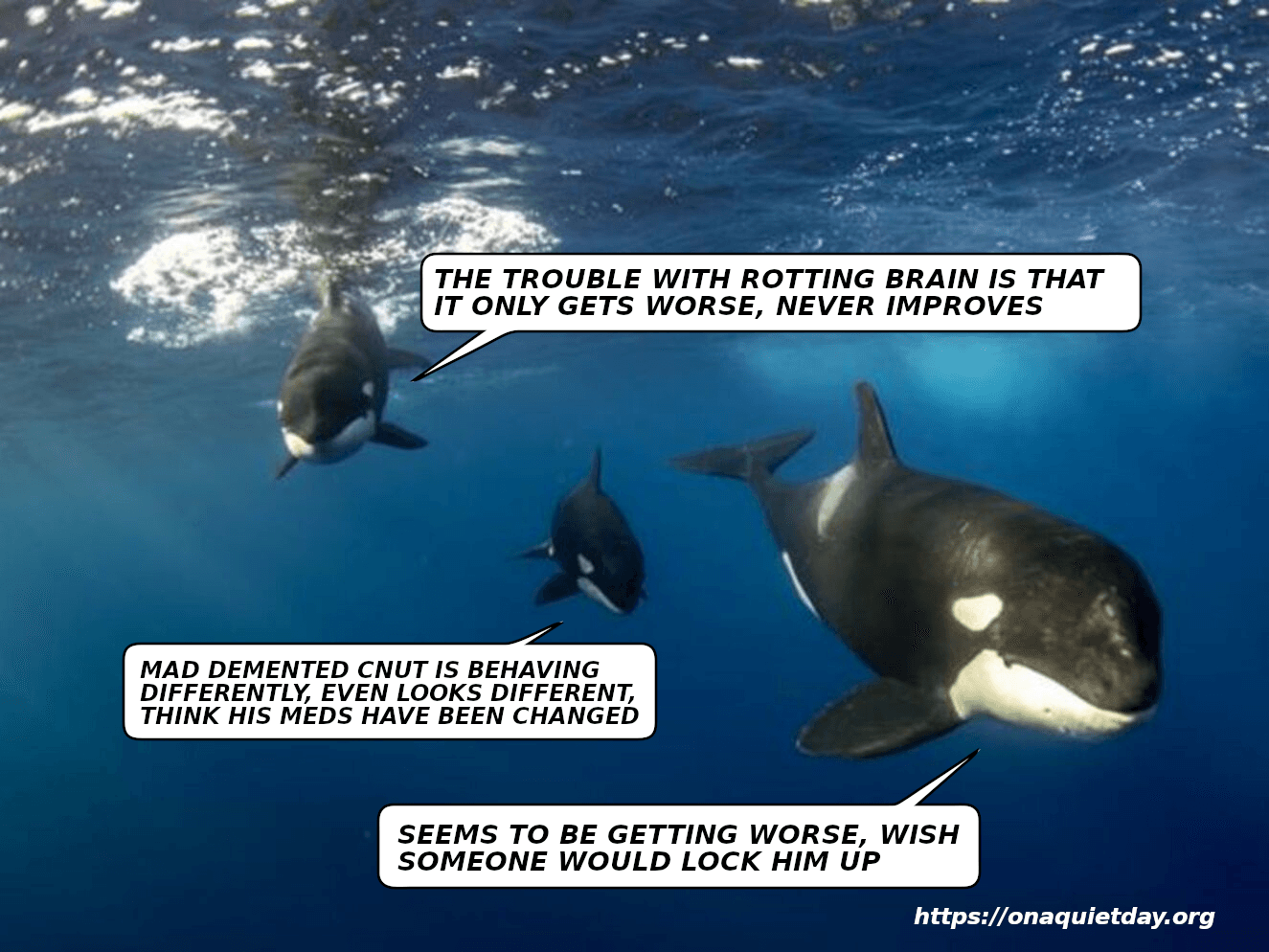
Orcas discuss Donald Trump and the killer apes’ concept of democracy. Front Orca warns that Trump is crashing his country’s economy and that everything he does he does for the fantastically wealthy.
Donald Trump, the strong and smart (High IQ!) president in spades also explains that he’s a dancing fool but that YMCA is not gay young man. He says that you don’t really need Artficial Intelligence, you could ask him instead and use his Hyper Intelligence.
Climate catastrophe is on our doorstep – yet Labour’s impending approval of further drilling will bring more pain for negligible gains
Pinch yourself, it’s happening again. Here is a Labour government spending a vast amount of political capital to earn tiny material gains while risking huge political losses. It occurred repeatedly under Keir Starmer, and now – with the impending decision to approve further gas and oil drilling in the North Sea – it is happening under Andy Burnham. You rack your brains to explain it, but no rational explanation comes.
…
the two greatest threats to the global economy might now be climate breakdown, which, as a wide range of economists and eminent organisations forecast, threatens comprehensive economic collapse, and the AI bubble, which the governor of the Bank of England warns could burst with dire consequences. Then people will really be struggling. Yet our government and others cheerfully accelerate both forces – claiming, as ever, that the industries driving them will unleash “growth”. Growth in home repossessions, perhaps.
…
The sense in almost every nation is of governments failing to take seriously the most serious of issues, while spending immense political resources on topics that scarcely affect our welfare (such as a few thousand people crossing the Channel in small boats). Or even – as is the case with North Sea oil and gas – using their scarce political capital to make things worse for everyone, including themselves.
Our government is not a doomsday cult like the Trump government, creepily fascinated by the “end times”, as the US vice-president seems to be. But in terms of outcome, is there much difference?
UK Prime Minister Andy Burnham says that he’s going to permit the Jackdaw and Rosebank North Sea fossil fuel projects. He urges you to ignore facts and reality and be a climate science denier like himRapture, dah, dah, dah, dah, dah-da, it’s the final countdown (actually a pre-final countdown).Donald Trump urges you to be a Climate Science denier like him. He says that he makes millions and millions for destroying the planet, Burn, Baby, Burn and Flood, Baby, Flood.