‘A blow to staff, patients, and local communities’

Spread the love

https://morningstaronline.co.uk/article/blow-staff-patients-and-local-communities

 A taped off section inside a school which has been affected with sub standard reinforced autoclaved aerated concrete (Raac)

Campaigners dismayed as government plans to replace hospitals built with Raac delayed again

FURTHER delays in replacing hospitals built with Raac concrete are a “blow” to NHS staff, as campaigners wanted to prevent the “severe risk of collapsing floors and ceilings.”

The government’s spending watchdog announced today that a pledge to deal with reinforced autoclaved aerated concrete (Raac) in seven hospitals by 2030 would not be met.

A report from the National Audit Office (NAO) found that the infrastructure plans, drawn up by the previous Conservative government, would only be completed by 2032 and 2033.

Despite the new timeline, the NAO also claimed that some new building projects are already facing pressure to finish for their revised deadline.

The watchdog also said that by the end of 2025, works to alleviate the risks of Raac have already cost more than £500 million.

Campaigners and unions hit back, warning that longer delays will mean “greater risks” for patients and NHS staff, and will mean  “higher costs” to fix the issues plaguing NHS hospitals.

Raac is a lightweight material which was used widely in the 1960s and ’80s to build public buildings such as hospitals and schools.

Continues at https://morningstaronline.co.uk/article/blow-staff-patients-and-local-communities

Continue Reading‘A blow to staff, patients, and local communities’

A generation at risk: Labour’s proposed war on disabled youth

Spread the love

https://morningstaronline.co.uk/article/generation-risk-labours-proposed-war-disabled-youth

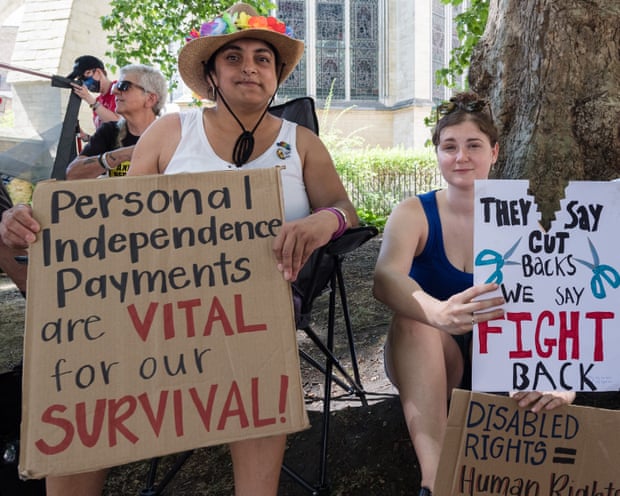
Plans to delay access to the universal credit health element until age 22 have triggered fierce opposition from disabled people’s groups, who warn it would deepen poverty and entrench discrimination against young disabled people under the guise of ‘encouraging work.’ DYLAN MURPHY reports

IN A MOVE that has sent shockwaves through disabled communities across the country, the Labour government is considering a policy that would slash vital financial support for young disabled people aged 18 to 21.

As the campaign group Benefits and Work has pointed out, “One of the proposals in the Pathways to Work green paper was to delay access to the UC [universal credit] health element until age 22, meaning that younger people would not be eligible. The claim is that this would make it less likely that young people would be trapped in a life on benefits. The proposal is pencilled in for 2027/28.”

This has sparked a firestorm of criticism from disabled people’s organisations (DPOs), which warn of a “devastating financial impact” that will push a vulnerable generation further into poverty and away from the very employment opportunities the government claims to be promoting.

The government’s rationale for this drastic measure is to prevent young people from being “trapped in a life on benefits.” However, this narrative has been widely condemned as a gross misrepresentation of the reality faced by young disabled people.

https://morningstaronline.co.uk/article/generation-risk-labours-proposed-war-disabled-youth

Keir Starmer confirms that he's proud to be a red Tory continuing austerity and targeting poor and disabled scum.
Keir Starmer confirms that he’s proud to be a red Tory continuing austerity and targeting poor and disabled scum.
Keir Starmer explains the moral case for cutting disability benefits. He says work will set you free.

Continue ReadingA generation at risk: Labour’s proposed war on disabled youth

Austerity and alignment to Washington: Two years of President Javier Milei

Spread the love

Original article by Pablo Meriguet republished from peoples dispatch under Creative Commons Attribution-ShareAlike 4.0 (CC BY-SA) license.

Argentina President Javier Milei. Photo: Javier Milei / X

In this article, we review some of the general trends and attitudes of Milei’s government two years into his term.

Thousands of Argentines endured high temperatures as they took to the streets on December 18 to protest the labor reform of Javier Milei’s far-right government. The call to action by the General Confederation of Labor (CGT) was supported by several trade unions, which claimed that the measure seeks to destroy workers’ rights to benefit big business: “This reform will only deepen poverty, social exclusion, and job insecurity. We will not give up our fight for decent work,” the CGT said in a statement.

The government has justified the measure by citing an alleged need to modernize labor relations: “The text also incorporates specific incentives for the formalization of employment, new rules for the platform economy, more efficient employer contribution schemes, and mechanisms that reduce litigation, providing the system with greater predictability and long-term stability.”

However, organized workers claim that this is a labor flexibility project that aligns with President Milei’s neoliberal agenda. Cristian Jerónimo, leader of the CTE, said: “[The labor reform] does nothing to benefit the world of work; it is written in favor of Argentina’s large corporations and does not favor small and medium-sized enterprises.”

But for the protesters, this reform comes as no surprise. Long before becoming president, Milei announced that it was imperative to reform the entire structure of the Argentine state in order to put it on the “path to freedom,” which means neoliberalizing the economy, reducing state participation in the economy to a minimum, strengthening the apparatus of repression, and aligning the South American country geopolitically with Washington’s interests. In short, to return to the path of the Washington Consensus.

After the day of mass mobilization, the government announced that the debate on the reform would be postponed until February, an initial sign that Milei is feeling the pressure of the popular demonstrations. Yet, after two years in office, Milei has done everything possible to push forward his neoliberal agenda even amid many rounds of mass demonstrations. A series of laws, executive decrees, and international diplomatic engagements have been the clearest signs of the path taken by the right-wing libertarian leader who governs a country that, despite his promises, is once again returning to the path of economic crisis and political instability.

Economy: fiscal adjustment and social tension

In line with neoliberal orthodoxy, Milei has implemented a series of fiscal adjustments to eliminate the deficit, even though this has been at the expense of the material stability of the most disadvantaged sectors, who have taken to the streets to protest against cuts in health, education, and other areas that the Argentine state now refuses to cover in full or adjust in line with the current economic reality. Students, teachers, researchers, and university workers have also taken to the streets consistently, demanding improvements in higher education funding, funding for science and health research, and defending free and public education.

Repression of mass protests, ordered by Security Minister Patricia Bullrich, has been severe. Hundreds have been arrested and injured, including Pablo Grillo, a journalist who was nearly killed when a tear gas canister struck him in the head.

Nevertheless, Milei did not slow down. The elimination of subsidies, wage freezes, and widespread privatization of public companies generated the long-awaited fiscal surplus in more than a decade. Year-on-year inflation, which stood at around 211% at the end of 2023, was reduced to 3% at some point in 2025.

Despite this, several analysts have stated that the 2.3% increase in inflation in October 2025 reflects the shortcomings of a neoliberal model in sustaining a long-term surplus.

Furthermore, it is important to remember that this year, Donald Trump’s administration bailed out Argentina with a record payment of more than USD 20 billion, in addition to the IMF’s generous granting of USD 20 billion to Argentina.

In other words, the surplus that the executive branch promotes as its great economic success has been achieved thanks to enormous support from its international allies, who demand neoliberal macroeconomic change not only in Argentina but throughout the region. This, of course, comes at a price that Argentines will have to pay for decades to come. Argentina has the largest IMF debt in the world. Its debt of more than USD 64 billion is “the price of freedom.”

Politics: reduction of the state and open confrontation

Following his economic model, Milei’s government has pushed radical downsizing. More than 10 ministries and 200 government departments were eliminated in one fell swoop. This meant the dismissal of almost 50,000 people who suddenly found themselves thrown into unemployment and precarity.

These decisions were made abruptly and aggressively, political attitudes that the president has adopted as part of his communication strategy. Bypassing parliamentary approval whenever possible, Milei always sought to govern unilaterally whenever possible.

But Milei has also achieved significant legislative victories. At the beginning of his administration, he had the support of only 39 deputies and six senators; however, he managed to pass several laws, such as the Bases Law (which allowed for the radical privatization of the Argentine state) and tax reforms.

He achieved this thanks to the support of the PRO, a right-wing party led by former president Mauricio Macri, and certain dissident Peronists. The formation of the so-called “May Pact,” a major agreement between Argentina’s right-wing parties and governors, allowed him to negotiate and agree on several reforms desired by right-wing libertarianism.

This pact prevented an increase in pensions for the elderly, who have regularly protested to demand more money to buy medicine and food, which are now major obstacles in their lives. Despite this, the Pact has not budged and continues with its neoliberal drift.

Political and judicial scandals

Milei’s administration has also been marked by several scandals. Very early on, he began a dispute with Victoria Villarruel, his vice president, whom he accused of playing into the hands of his political enemies.

He was also involved in the “$LIBRA” scandal, in which he is accused of being part of an international fraud scheme related to the sale of cryptocurrencies. A parliamentary commission concluded that Milei did use his position as president to promote the scam, which caused millions in losses to investors around the world.

But the event that probably had the greatest impact on Milei’s popularity involved his sister. Karina Milei, who serves as Secretary to the President, is accused of participating in a bribery ring that operated through the National Disability Agency (ANDIS). Many saw the emergence of this scandal as the reason for his resounding defeat in the Buenos Aires Province elections on October 26.

Despite this, Milei managed to recover and his party, La Libertad Avanza (LLA), won the next legislative elections and increased its number of seats in the legislature. His strategy was the usual one: accusing Peronism of destroying Argentina and presenting himself as the only one capable of saving the country. However, this messianic communication strategy has begun to be questioned precisely because of the corruption and fraud scandals that have plagued his government.

Alignment with Washington

Milei has made a significant shift in the country’s foreign policy. Argentina’s vote against the UN resolution condemning the US economic and trade blockade of Cuba reflects an important change. Historically, Argentina has maintained a diplomatic position against any act of imperialism due to its claim over the Malvinas Islands, which, despite being off its coast, are governed by the United Kingdom. The dispute has escalated to military levels despite repeated claims by the Argentine authorities.

Photo Javier Milei Donald Trump
Donald Trump-signed photo of him and Javier Milei. Photo: Javier Milei / X

But the change is much more than nominal. Argentina has become the Trump administration’s greatest ally in South America. Milei has praised Trump’s personality, and Trump has publicly supported him, like when, in the last legislative elections, he suggested an end to cooperation between Buenos Aires and Washington if Milei lost. In response, the Argentine president has repeatedly declared his loyalty to Trump’s geopolitical project and has supported all of his initiatives both within and outside the region.

In this way, Milei has become a sort of archetype for the leaders of the new Latin American right. With radical fiscal adjustment at the expense of the most impoverished sectors, open confrontation with their opponents, and an international policy fully aligned with Washington (which has initiated a new chapter of the Monroe Doctrine), far-right governments are beginning to gain ground in the region: Kast in Chile, Paz in Bolivia, etc., are examples of an ideological and geopolitical shift in the region that is impossible to understand without the figure of Javier Milei.

Original article by Pablo Meriguet republished from peoples dispatch under Creative Commons Attribution-ShareAlike 4.0 (CC BY-SA) license.

Continue ReadingAusterity and alignment to Washington: Two years of President Javier Milei

Scrapping juries risks ‘damaging politicisation’ say Greens

Spread the love
Green Party MP for Brighton Pavilion Siân Berry. Image by Kelly Hill, Wikimedia CC BY-SA 4.0.

Responding to the announcement from the Justice Secretary, David Lammy, that jury trials in England and Wales for crimes that carry a likely sentence of less than three years are set to be scrapped, Green Party MP, Siân Berry, said:

“The focus on victims’ rights is appreciated, but this Labour Government is taking the wrong steps to try to serve us better, and laying the groundwork for further crackdowns on dissent, whistleblowing and protest if it removes juries from so many charges that have state or corporate victims.

“Juries are also a safeguard against creeping bias and discrimination. Judges are not currently representative of our wider communities and, under these plans, individual decisions will be at risk of damaging politicisation, while individual judges who are women or from minoritised communities risk attacks from the far right.

“More than fifteen years of continuing austerity has caused a backlog in the courts, not juries. Instead of dismantling a centuries-old fundamental legal right, the Government must reverse the neglect and cuts that created this mess in the first place.”

Continue ReadingScrapping juries risks ‘damaging politicisation’ say Greens

Cutting home insulation funding will imperil UK’s climate goals, Reeves told

Spread the love

https://www.theguardian.com/environment/2025/nov/08/cutting-home-insulation-funding-imperil-uk-climate-goals-reeves-told

In a letter to the chancellor, more than 60 groups and companies said slashing funding for energy-efficient homes would be a damaging ‘short-term fix’. Photograph: Justin Tallis/AFP/Getty Images

Energy firms and charities urge chancellor to avoid short-term fix that could also harm low-income households

Rachel Reeves has been told that cutting funding for home insulation at the budget would risk the UK’s climate goals and hurt low-income households in a joint intervention by energy firms, fuel poverty charities and environmental groups.

In a letter to the chancellor, more than 60 groups and companies urged Reeves not to take such a damaging “short-term fix” to slash funding for more energy-efficient homes to pay for a reduction in energy bills.

The Guardian revealed this week that Reeves is finalising a multibillion-pound energy support package that is likely to cut green levies paying for energy efficiency as she looks to save as much as £170 from the average bill.

In particular, the Treasury has been looking at cutting or getting rid of the energy company obligation (ECO), which pays to improve energy efficiency for low-income and vulnerable households.

In their letter, the dozens of organisations – from Age UK and Citizens Advice to Friends of the Earth – called for the Treasury to reconsider cuts to the ECO programme, saying it would “call into question the ability to meet both the UK’s fuel poverty and carbon budget targets”. They also warned that it was putting thousands of jobs at risk in the £20bn energy efficiency industry and supply chain.

Article continues at https://www.theguardian.com/environment/2025/nov/08/cutting-home-insulation-funding-imperil-uk-climate-goals-reeves-told

Continue ReadingCutting home insulation funding will imperil UK’s climate goals, Reeves told