Category: benefits

  • The UK doesn’t work for Disabled people. Neither Labour or the Conservatives will change that

    Spread the love

    Original article by Mikey Erhardt republished from Open Democracy under a Creative Commons Attribution-NonCommercial 4.0 International licence. 

    Neither Keir Starmer nor Rishi Sunak has any real plan to improve the lives of Disabled people | Jonathan Hordle – ITV via Getty Images

    So far, we’ve heard more about Starmer and Sunak’s parents than the UK’s 16 million Disabled people

    “This election is about who our country works for — the patriotic belief that Britain can be better and must be better,” said Kier Starmer concluding the first leaders’ debate earlier this month.

    There are at least 16 million Disabled people in the UK – we make up a quarter of the population. We know this country doesn’t work for us, we’ve known that our entire lives. We disproportionately live in poverty, achieve poorer outcomes in education, and are more likely to be unemployed or earn less.

    Yet every leadership debate so far has given more time to talking about Starmer and Rishi Sunak’s parents than these problems, which face millions of Disabled people up and down the country.

    The general election campaign has solidified that neither the Labour leader nor his rival, incumbent Conservative prime minister Rishi Sunak, has any interest in improving our lives.

    It is not as if the Conservatives or Labour don’t know about the issues we face. A United Nations report published in April confirmed that the UK is violating our human rights; a parliamentary committee last month found that “Disabled people undeniably encounter unnecessary and severe barriers to accessing suitable housing in England”; and the Department of Work and Pensions is under investigation by the Equality and Human Rights Commission over its treatment of Disabled claimants.

    Disabled people in the UK are not a homogenous group. Some of us experience greater injustice than others. But we also have many things in common. We all want to live in an inclusive society where everyone has a fulfilling life and feels connected and valued.

    We know politicians do not place the same worth on our lives as others; every day we experience discrimination, oppression and barriers to our inclusion and full participation in society because they won’t take the action needed to change it.

    Years of deep cuts to services and neglect mean societal infrastructure, such as housing, transport and street environment, consistently fails to meet our needs. This structural decline has coincided with anti-migrant, anti-trans and racist policies, leaving ever-increasing numbers of us in poverty, homeless, incarcerated or dead.

    The UN report was clear: “There has been no significant progress for Disabled people throughout the UK concerning their right to living independently and being included in the community.

    “While some reforms and policies have been undertaken to provide financial support, accessible housing, and transport, this has been inadequate considering the cost-of-living crisis.”

    One would expect this damning conclusion to be a key feature of the election campaign. But over the past four weeks, Labour and the Tories have both failed to provide anything of substance to help Disabled people.

    Sunak’s Conservatives have instead pledged to shave £12bn a year from the cost of benefits, much of which would come from a crackdown on the personal independence payment (PIP) given to people with extra care or mobility needs. The party also seeks to tighten the work capability assessment (WCA), which would see more Disabled people declared fit to work and denied their benefit.

    Labour’s manifesto, meanwhile, is notable for what it lacks. Previous promises to overhaul the welfare system, end punitive sanctions and co-produce disability-related policy with Disabled people are all missing – as are commitments to end care charges, increase carers’ allowance and ensure better provision of accessible housing.

    Labour’s vows to improve SEN (special education needs) provision in schools and introduce changes to support Disabled people to gain and retain jobs are sticking plasters at best. Its manifesto sports a glaring lack of immediate investment in disability and carer benefits and social care – and we all know you can’t fix things without investment.

    With so little real change on offer, Disabled people must unite and fight back. We can draw inspiration from the experiences of UK-based Disabled activists and the radical disabled resistance of the past 40 years. No changes affecting us have come through without collective struggle and organising.

    As part of the DPO Forum England, a collective of Disabled people’s organisations in England, we are committed to joining forces nationwide and unifying our demands. That’s why we came together to create the Disabled People’s Manifesto, which contains radical policy demands for systemic overhaul and transformation. 

    We, as Disabled people, must now come together and demand our politicians take up the manifesto and commit to creating a country that values equity, dignity, respect, trust, and support as much as we value anything else. Our political system should be focused on supporting Disabled people to live the lives we have a right to, which no candidate sweating under the bright studio lights can deliver on their own.

    Together, we can create space for ourselves and our ideas, and integrate the energy, dedication and skills of our community to create a new future.

    Original article by Mikey Erhardt republished from Open Democracy under a Creative Commons Attribution-NonCommercial 4.0 International licence. 

    Jeremy Hunt’s benefit crackdown will worsen an already terrible system

    The government’s insulting Disability Action Plan won’t deliver any change

    How the DWP fought to withhold evidence its policies kill disabled people

  • How the UK’s social security system stopped tackling poverty

    Spread the love
    Ultraskrip/Shutterstock

    Sharon Wright, University of Glasgow

    The cost of living is the most important issue for many voters this election. It’s no surprise why. In 2022, nearly 4 million people in the UK experienced destitution, meaning they could not meet their basic physical needs such as having enough to eat and staying warm.

    The UK’s social security system is failing in its core purpose to prevent poverty. And yet the Conservatives have promised more crackdowns on welfare, with the prime minister linking this with his pledge to lower taxes.

    When the Conservative-Liberal Democrat coalition government came to power in 2010, they inherited a social security system in radically better shape than it is now. What happened?

    During the previous Labour governments (1997-2010), 2.4 million people were lifted out of poverty, including 700,000 children. This was done during favourable economic conditions, but was also the result of progressive social security measures such as tax credits and child benefits.


    Want more election coverage from The Conversation’s academic experts? Over the coming weeks, we’ll bring you informed analysis of developments in the campaign and we’ll fact check the claims being made. Sign up for our new, weekly election newsletter, delivered every Friday throughout the campaign and beyond.


    People received working-age benefit payments for different needs: jobseeker’s allowance, income support for single parents and incapacity benefit for long-term illness and disability. Housing benefit went directly to landlords to cover claimants’ rent.

    Enter the global financial crisis. The Conservative-led government’s response was austerity cuts: cutting back on welfare to tackle the budget deficit.

    Lowering the value of benefits is the biggest austerity cut to have affected incomes. In 2010, the government switched from uprating the value of benefits each year in line with the retail price index to using a different measure of inflation, the consumer price index, instead. This is usually lower and effectively makes payments worth less.

    This was expected to save the government around £6 billion pounds a year. In 2012, the value of benefits was capped to increase at 1% while inflation was forecast at 5.2%.

    Benefit sanctions and caps

    In 2012, the government introduced a new system of tougher rules and sanctions on people receiving benefits. Conservative politicians said this would end “the ‘something for nothing’ culture”, but the change has had lasting negative effects.

    Benefit sanctions were always part of the system, but became extreme in 2012. If, for example, someone misses one Jobcentre appointment their benefit could be reduced or removed for 28 days.

    Woman looking worried and tired sat by window with toddler
    Many people receiving benefits have been penalised with sanctions. Bricolage/Shutterstock

    Nearly a quarter of all jobseeker’s allowance claimants were sanctioned between 2010 and 2015. Research shows that sanctions have “profoundly negative outcomes”, including on people’s mental health.

    Other cuts to incomes followed the Welfare Reform Act 2012. The “bedroom tax” penalised social housing tenants who had “extra” bedrooms. The idea was to reduce renters’ housing benefit so they would downsize to a smaller home. However long-term housing shortages mean that smaller properties are rarely available.

    In 2013, the household benefit cap was introduced to limit the maximum amount a family could receive in benefits payments. It had the most impact on families with children and those with high rents.

    Universal credit

    Universal credit, introduced in 2013, was billed as the biggest shake-up of benefits in 70 years. It promised to make work pay and simplify the system. It replaced separate tax credit, unemployment, lone parent, disability and housing payments with a single payment.

    Research from think tank the Resolution Foundation suggests that universal credit provides more support for working people who rent their homes than the previous system. But disabled people who cannot work are likely to be much worse off than under the old system.

    There are other problems with universal credit. Unlike under the previous system that gave housing benefit straight to landlords, claimants have to pay their rent from a pot of money provided by the government that is almost certainly too small to cover all their costs.

    The first universal credit payment takes around five weeks to arrive, meaning people may fall into rent arrears. A result is that some landlords take legal action to evict those receiving universal credit.

    Further cuts

    In 2015, the Conservatives abandoned targets set by Labour to reduce child poverty. Then in 2016, new legislation slashed spending again. Benefits were frozen for four years.

    The two-child limit was applied to tax credits and universal credit in 2017 to remove income for third or subsequent children. Large families faced increased poverty as a result.

    In 2020, the pandemic hit. Universal credit and tax credits were raised by £20 per week, but this ended in late 2021. The cost of living crisis has since widened the gap between benefits and prices.

    Today, the value of universal credit falls £890 per month short of the cost of living for single people over 25. This is because of the changes to uprating and the benefit freeze.

    In Feburary 2024, charity the Trussell Trust published research showing that over half of people on universal credit had run out of money for food in the previous month.

    What can the next government do?

    The next UK government must make emergency repairs to social security to halt harrowing declines in health and life expectancy. This should ensure a minimum acceptable standard of living, including restoring the value of benefits such as universal credit to cover the costs of living.

    Since 71% of children living in poverty are in working families, employers should be required to pay the real living wage. In-work universal credit also needs to top up wages enough to make work pay.

    Repairing the social safety net is an enormous challenge, but public support for it has been on the rise for years. In 2010, many people thought benefit claimants didn’t deserve any help. But from 2015 there has been a growing preference to help people receiving benefits.

    Sharon Wright, Professor of Social Policy, University of Glasgow

    This article is republished from The Conversation under a Creative Commons license. Read the original article.

  • Farage said Andrew Tate was ‘important voice’ for men in podcast interview

    Spread the love
    Image of Nigel Farage
    Image of Nigel Farage

    https://www.theguardian.com/politics/article/2024/jun/20/nigel-farage-andrew-tate-important-voice-men-podcast-interview

    Reform UK leader has also argued against diversity quotas and said people on benefits were ‘too stupid’ to work in appearances over past year

    Nigel Farage has praised the misogynist influencer Andrew Tate for being an “important voice” for the “emasculated” and giving boys “perhaps a bit of confidence at school” in online interviews that appear to be aimed at young men over the past year.

    The Reform UK leader spoke in favour of Tate for defending “male culture” in a Strike It Big podcast that aired in February, while acknowledging that the influencer had gone “over the top” and elsewhere that he had said some “pretty horrible” things.

    Since December 2022, Tate has been facing charges in Romania of human trafficking, rape, and forming a criminal gang to sexually exploit women, which he denies.

    Many politicians and teachers have spoken out against Tate’s influence on young boys in the UK, after the self-proclaimed misogynist said women belonged in the home and were a man’s property. “There’s no way you can be rooted in reality and not be sexist,” Tate said in one video.

    …

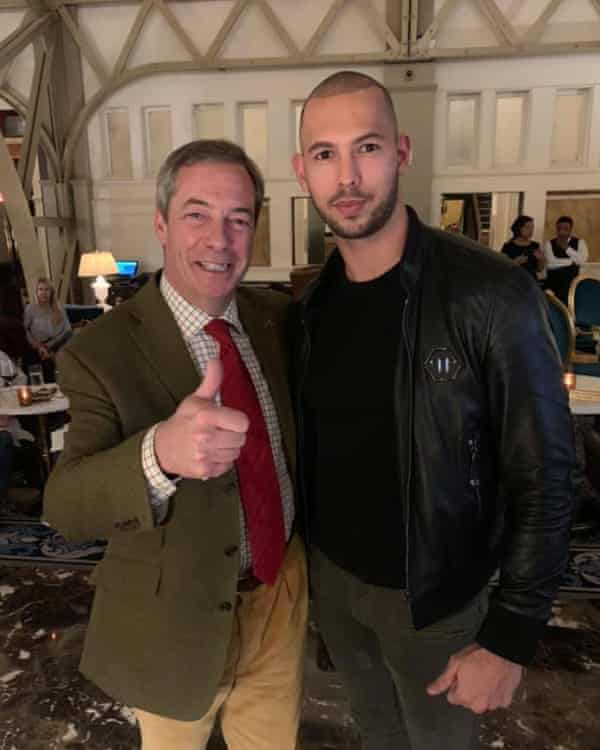
    Andrew Tate pictured with Nigel Farage in a Facebook post by Tate from March 2019. The caption read: ‘Brexit baby.’ Photograph: Emory Andrew Tate/Facebook

    Farage’s interview comments

    February 2023
    “‘I’m too fat, I’m too stupid, I’m too lazy, I don’t get out of bed in the morning. I smoke drugs, give me money’ … That’s what we’re saying. ‘I don’t need to work, the state will provide for me’ … We cannot afford it.

    “I welcomed much of [Liz Truss’s] budget. I think if there is a criticism, they tried to do too much, too quickly, without prior explanation … What happened here is the backbenches wobbled really quite quickly because a lot of Conservative backbenchers are basically globalists and listened to those big noises from the multinationals and the IMF. As soon as she sacked Kwarteng, it was all over … I would much have preferred her to hold her nerve, keep making those arguments and see if the party dared get rid of them.”

    August 2023
    “I think Andrew Tate is a fascinating figure. I think his speaking to men, who because of the woke agenda were told they couldn’t be male in any way at all, was an important thing. But I feel some of his comments were pretty horrible.”

    …

    April 2024
    Javier Milei is “Thatcherism on steroids – this is incredible, cutting and slashing public expenditure, doing all the things he’s done … That’s leadership … He is amazing.”

    …

    https://www.theguardian.com/politics/article/2024/jun/20/nigel-farage-andrew-tate-important-voice-men-podcast-interview

  • Scrap to the two-child benefit cap urge Greens

    Spread the love
    Green Party Co-leader Adrian Ramsay. Wikipedia CC.
    Green Party Co-leader Adrian Ramsay. Wikipedia CC.

    The IFS (The Institute for Fiscal Studies) have today warned that 250,000 children will be hit by the two-child benefit cap next year, rising to an extra half a million by 2029. Green Party Co-Leader, Adrian Ramsay, responded saying, 

    “Greens have unequivocally pledged to scrap the two-child benefit cap in our fully costed manifesto.

    “Today I am urging the Labour Party to show real strength and conviction and join us in making this pledge.

    “This one decision could lift 250,000 children out of poverty.

    “The power to do this will be in Labour’s hands.

    “But I want to be very clear.

    “If they fail to do this, elected Green MPs will not let this rest.

    “We will push them every day of the next parliament demanding that they do what is right.

    “That is what a Green vote will enable – voices in parliament to keep Labour honest on these important issues.”

  • Andrew Feinstein: what’s wrong with the Labour manifesto

    Spread the love

    Andrew Feinstein is challenging Keir Starmer by standing as the independent candidate for Holborn & St Pancras.

    https://morningstaronline.co.uk/article/andrew-feinstein-whats-wrong-labour-manifesto

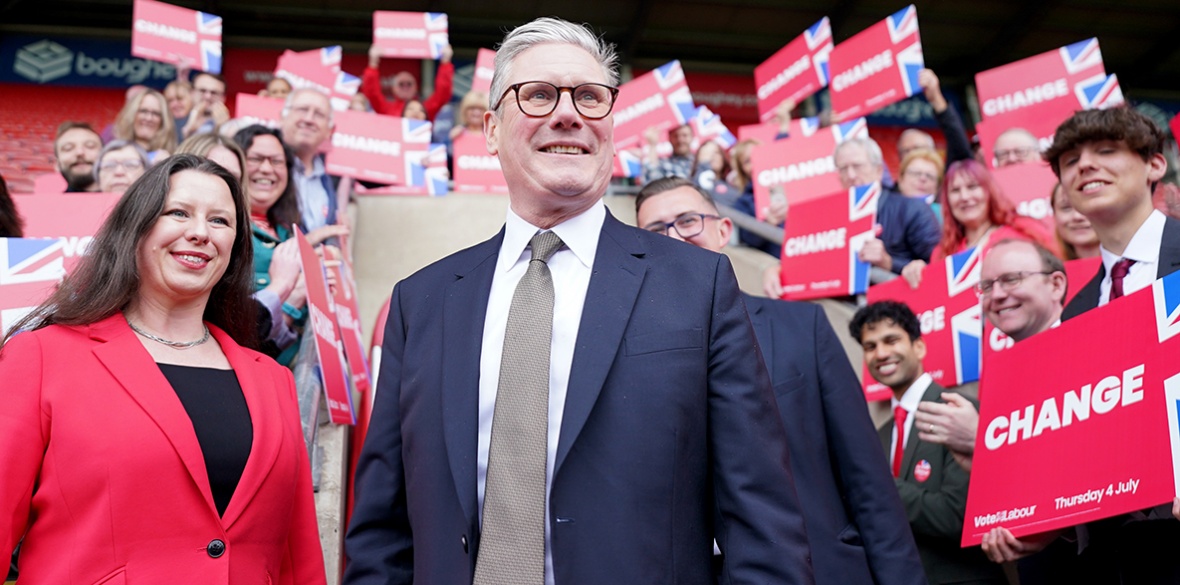
    Labour Party leader Sir Keir Starmer at the Mornflake Stadium, home to Crewe Alexandra while on the General Election campaign trail, June 13, 2024

    From muzzling Palestinian rights to embracing austerity and outsourcing the NHS, Labour’s ‘tough choices’ always seem to hurt normal people while sparing wealthy donors — that’s why I am running to unseat Keir Starmer on July 4

    …[T]he Labour Party launched its election manifesto — a dispiriting Thatcherite promise to continue endless austerity, soaring inequality and forever wars.

    I announced my bid to become the independent MP for Holborn and St Pancras three weeks ago. Then, I was convinced that Keir Starmer’s Labour Party would offer little to improve the lives of this constituency’s amazing and diverse communities, or meaningfully restrain Israel’s genocide of Gaza. Having read this manifesto, I am more convinced than ever.

    Starmer’s election campaign has traded on a series of stock phrases, all of which are profoundly misleading. Starmer promises to bring about “change,” but repeats tired economic shibboleths of the George Osborne variety.

    He also claims to have remade the party “in the service of the working people.” In fact, the party is financially reliant on donations from big business and billionaires and its MPs rake in donations from the private-sector companies who circle the NHS.

    The party’s long-feted New Deal for Working People is so disappointing that the party’s largest affiliated union, Unite, has refused to endorse the Labour Party manifesto.

    But the most galling of all of the current Starmerisms is his invocation of “tough choices.” Starmer deploys the line to explain why the country cannot afford to pull half a million children out of poverty by ending the two-child benefit cap: a decision now confirmed by the manifesto.

    Liz Truss’s mini-Budget, Starmer sadly explains, has made it impossible for the sixth-richest country in human history to lift children out of poverty at a cost little under £2 billion a year, a relatively measly sum in a country with a GDP of £2,274 trillion.

    As the Labour Party manifesto makes clear, there have been plenty of hard choices made by the party — but all of them to the detriment of the poor and to the benefit of the mega-rich and big business.

    Starmer makes the “tough choice” not to substantially increase funding the NHS, to end child poverty or reverse the swingeing cuts of the last decade; but only because he fails to make the “tough choice” to tax billionaires marginally more, even though the 10 richest people in the country are now richer than they have ever been.

    …

    I’m especially angry that the Labour Party, like the Tories, has promised to increase defence spending to 2.5 per cent of GDP: a real-term £7bn a year increase by 2029. This is almost double the entire £4.7bn a year the party intends to spend on its Green Prosperity Plan to tackle the imminent existential threat of climate change.

    What sort of security does this really buy? The party’s offer on Palestine is, frankly, an outrage; the manifesto speaking out of both sides of its mouth. So while it recognises that “Palestinian statehood is the inalienable right of the Palestinian people,” it then makes Palestinian statehood contingent on a meaningless word salad.

    “We are committed to recognising a Palestinian state as a contribution to a renewed peace process which results in a two-state solution with a safe and secure Israel alongside a viable and sovereign state.”

    So much for an inalienable right, which requires Israel to feel “safe” before Palestinians get statehood — just as Israeli leaders claim that Israel will only feel safe when Gaza is cleansed of its citizens because there are “no uninvolved.”

    This offer significantly dilutes the party’s previous commitment to recognising Palestinian statehood on the first day of government — something first brought in by Ed Miliband, appearing in the 2017 and 2019 manifestos. If there was any hope that Labour would be any better than the Tories on Gaza once in power, this should dispel it once and for all.

    Both the Lib Dems and the Green Party, by comparison, have committed to immediately recognising Palestine. The Labour Party now joins the ignominious company of the Tories and Reform in refusing to do so.

    …

    https://morningstaronline.co.uk/article/andrew-feinstein-whats-wrong-labour-manifesto