Netanyahu to Press for ‘Another Round of War With Iran’ in Meeting With Trump This Week
Original article by Stephen Prager republished from Common Dreams under Creative Commons (CC BY-NC-ND 3.0).
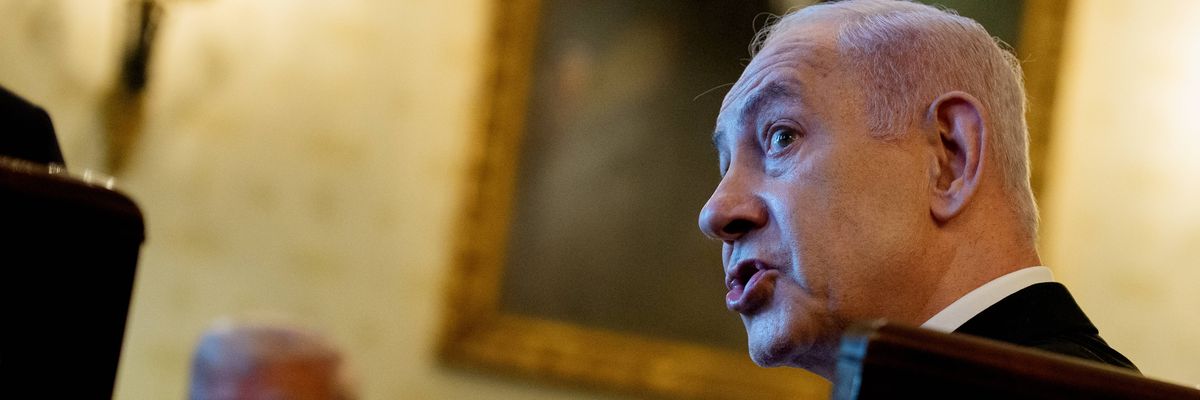
Amid a growing rift between Israel and the White House, one foreign policy analyst says the meeting “will signal whether Washington is prepared to continue underwriting open-ended escalation.”
As Israeli Prime Minister Benjamin Netanyahu heads to Mar-a-Lago to meet with US President Donald Trump on Monday, amid a growing rift with the president and his advisers, reports say he’ll seek to push the US back toward war with Iran.
Last week, NBC News reported that at the meeting, “Netanyahu is expected to make the case to Trump that Iran’s expansion of its ballistic missile program poses a threat that could necessitate swift action” and that “the Israeli leader is expected to present Trump with options for the US to join or assist in any new military operations.”
RECOMMENDED…
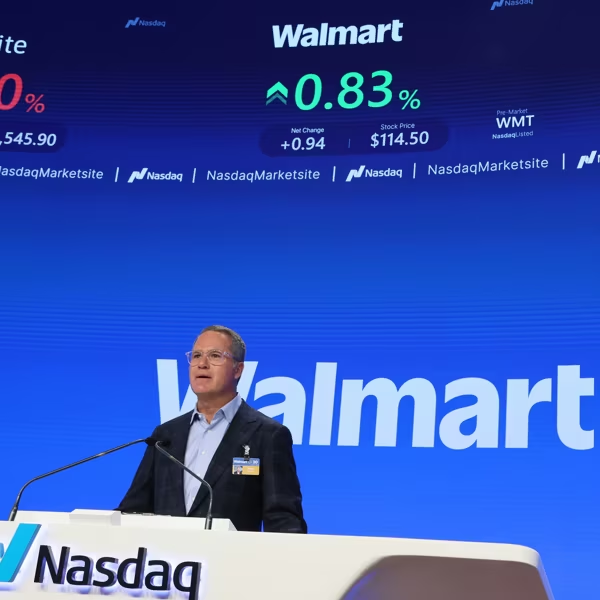
As Wage Growth Slows and Unemployment Rises, Trump Tax Cuts Deliver Big for Mega-Rich Retail CEOs

Investigation Shows How Decades of Corporate Consolidation Have Devastated US Cattle Ranchers
“Netanyahu plans to press Donald Trump for US backing for another round of war with Iran, now framed around Iran’s ballistic missile program,” said Sina Toossi, a senior fellow at the Center for International Policy. “Netanyahu’s pivot to missiles should therefore be read not as the discovery of a new threat, but as an effort to manufacture a replacement casus belli after the nuclear argument collapsed.”
He noted criticisms levied against Netanyahu by Yair Golan, chair of the Democrats, a center-left party in Israel, earlier this week: “How is it possible that last June, at the end of the war with Iran, Benjamin Netanyahu solemnly declared that ‘Israel had eliminated Iran’s nuclear threat and severely damaged its missile array’; and that this was a ‘historic victory’—and today, less than six months later, he is running to the president of the United States to beg for permission to attack Iran again?” Golan said.
Iran is just one of several areas the two will likely discuss on Monday. According to Israeli officials who spoke to the Washington Post, Netanyahu also reportedly wants Trump to “take a tougher stance on Gaza and require that Hamas disarm before Israeli troops further withdraw as part of the second phase of Trump’s 20-point peace plan.”
The chief of Israel’s armed forces suggested earlier this week that its occupation of more than half of Gaza would be permanent, but walked those comments back after reported behind-the-scenes outrage in the White House. Meanwhile, Trump—invested in his image as a peacemaker—has reportedly balked at Israel’s routine violations of the ceasefire agreement he helped to broker in October.
Near-daily strikes have resulted in the death of at least 418 Palestinians, according to the Gaza Media Office. Meanwhile, Israel’s continued blockade of humanitarian aid has left hundreds of thousands of people—displaced from homes destroyed by Israeli bombing—to languish in the cold without tents. Desperately needed fuel, food, and medicine have entered the strip at far lower numbers than the ceasefire agreement required.
As Axios reported on Friday, Trump’s advisers increasingly fear that Netanyahu is intentionally slow-walking and undermining the peace process in hopes of resuming the war.
Netanyahu also seeks Trump’s continued backing of Israel’s territorial expansion in Syria. Earlier this month, the Israel Defense Forces (IDF) pushed through a UN-monitored demilitarized zone between Israeli and Syrian-held positions in the Golan Heights, which Israel illegally occupies.
This push into southern Syria went against the wishes of the Trump administration, which feared it could destabilize the Western-backed government that rules in Damascus following the ouster of former President Bashar al-Assad.
Israel has also routinely struck Lebanon in violation of the US-brokered ceasefire it signed with Hezbollah in late 2024, with bombings becoming a near-daily occurrence in December. Last month, the UN reported that at least 127 civilians, including children, had been killed in Israeli strikes since the ceasefire began.
“Netanyahu’s visit unfolds against a backdrop of unresolved fronts, with widening disputes with Washington over the second phase of the Gaza ceasefire, including postwar governance, reconstruction, and Turkish involvement,” Toossi said. “At the same time, Israel is seeking greater latitude to escalate again against Hezbollah in Lebanon, an end to US accommodation of Syria’s new leadership, and firm assurances on expanded military aid.”
“Taken together, Netanyahu’s visit is less about resolving any single crisis than about postponing strategic reckoning,” he continued. “The outcome will signal whether Washington is prepared to continue underwriting open-ended escalation, or whether this meeting marks the beginning of clearer limits on Israel’s regional strategy.”
Original article by Stephen Prager republished from Common Dreams under Creative Commons (CC BY-NC-ND 3.0).
Netanyahu ‘Wanted’ posters plastered across London
This work by Middle East Monitor is licensed under a Creative Commons Attribution-NonCommercial-ShareAlike 4.0 International License.
Activists have plastered “Wanted” posters of Israeli Prime Minister Benjamin Netanyahu across London’s buses, streets and busy landmarks in a protest highlighting his role in war crimes and genocide linked to the Gaza conflict, Anadolu reports.
The campaign, staged by pro-Palestine campaigners, depicts images of Netanyahu alongside text referencing an International Criminal Court (ICC) arrest warrant issued in November 2024, accusing him of war crimes and crimes against humanity committed in Gaza since October 2023.
The Israeli army killed over 71,000 Palestinians, mostly women and children, in Gaza over a two-year period. Although a ceasefire took effect on Oct. 10, Israel has not stopped its attacks.
Living conditions have also not significantly improved, as requirements such as agreed quantities of food, aid, medical supplies, and mobile housing into the enclave have not been met.
READ: Netanyahu plans New York visit despite mayor’s arrest threat
This work by Middle East Monitor is licensed under a Creative Commons Attribution-NonCommercial-ShareAlike 4.0 International License.


Egypt asks US to rein in Netanyahu amid Gaza “yellow line” dispute
This work by Middle East Monitor is licensed under a Creative Commons Attribution-NonCommercial-ShareAlike 4.0 International License.

Relations between Israel and Egypt have entered a new phase of tension, with Cairo reportedly asking the United States to intervene to curb the actions of Israeli Prime Minister Benjamin Netanyahu, according to Israel’s Channel 14.
The channel cited Israeli Middle East analyst Yoni Ben-Menachem, who said the dispute centres on Israeli military activity along the so-called “yellow line” inside the Gaza Strip and on changes Israel is making to the area’s geography. Egypt, he said, views these moves as a direct threat to its strategic and regional interests.
Ben-Menachem warned that Israeli-Egyptian relations are deteriorating rapidly and revealed that Washington recently attempted to organise a trilateral summit involving US President Donald Trump, Egyptian President Abdel Fattah el-Sisi and Netanyahu in an effort to contain the crisis.
According to the report, Egypt set several preconditions for the meeting that Israel rejected. These included a full Israeli withdrawal from the Philadelphi Corridor, the reopening of the Rafah crossing in both directions, and immediate approval of a major gas agreement involving imports from Israel’s Leviathan gas field.
Ben-Menachem said Egypt has formally complained to Washington, accusing Israel of seeking to divide the Gaza Strip into two parts and of altering its demographic and topographical landscape—moves Cairo believes could undermine regional stability.
Egyptian concerns have reportedly intensified following comments by Israeli Chief of Staff Eyal Zamir, who described the “yellow line” as a new defensive and offensive military line. These remarks, Ben-Menachem said, were taken very seriously in Cairo.
Israeli military operations in the area, including the destruction of tunnel infrastructure and the demolition of homes, are being interpreted by Egypt as preparations for a long-term Israeli military presence in Gaza. This perception has prompted Cairo to pursue urgent diplomatic engagement with Washington.
Channel 14 added that while the United States did attempt to convene a trilateral summit in Washington, the initiative ultimately collapsed after Egypt insisted on conditions Israel deemed unacceptable.
READ: UN warns newborns in Gaza at risk of freezing during winter storm due to Israeli aid restrictions
This work by Middle East Monitor is licensed under a Creative Commons Attribution-NonCommercial-ShareAlike 4.0 International License.

Big tech and the architecture of the Israeli genocide against Palestinians: From execution to media whitewashing
This work by Middle East Monitor is licensed under a Creative Commons Attribution-NonCommercial-ShareAlike 4.0 International License.

History is filled with examples of corporations fueling war machines and global colonisation. IBM supplied technology used in Nazi death camps; shipping and trading companies played central roles in the Transatlantic trafficking of Africans; and multinational firms helped bankroll South Africa’s apartheid regime. The companies that once profited from South Africa’s pass laws, today empower Israel’s biometric checkpoints. Silicon Valley giants are repeating that history by providing the digital tools and propaganda that enable and whitewash Israel’s genocide in Gaza.
The collaboration between Israel and Silicon Valley goes far beyond hardware and algorithms, encompassing narrative control. According to Drop Site News, Google signed a six-month, $45 million contract with the office of Prime Minister Benjamin Netanyahu to promote government disinformation and downplay the humanitarian crisis in Gaza. Signed in late June, the agreement made Google a “key entity” in Netanyahu’s PR strategy.
The PR campaign was launched in response to international outrage after Israel violated the ceasefire on 2 March and blocked food, medicine, and fuel from entering Gaza. The Google contract was part of Israel’s digital disinformation effort claiming “there is no hunger” in Gaza. In other words, while Palestinian babies were starving to death, Google was fattening its checkbook, serving as Netanyahu’s pernicious digital PR machine to obscure the crime.
In 2021, Microsoft (MS) signed a $133 million contract that made the Israeli military its second-largest defence customer after the United States, describing the Israeli army as a “top priority” client. The deal includes more than 600 separate Azure subscriptions linked to military units such as Mamram, its central tech hub, and Unit 8200, its elite cyber-intelligence wing.
READ: Hamas warns against attempts to ‘re-engineer’ Gaza Strip, displace Palestinians
According to the Associated Press, MS’s support team fielded 130 direct requests from the military in the first ten months of the Gaza genocide. Its data centers outside Tel Aviv store more than 13.6 petabytes of data, or 350 times the size of the Library of Congress. At least nine MS employees, including some ex-unit 8200 Israeli officers, coordinated MS AI genocide with the Israeli army.
MS centers supplied raw data for Israel’s AI kill lists. Since 2021, these facilities were used to deploy “Gospel” and “Lavender,” algorithms that ranked Palestinians by the likelihood of being militants. Lavender, for example, assigns scores from 0 to 100 based on criteria as family history, friends or intercepted phone calls and messages.
Known as “AI hallucination,” these systems often generate information that appears convincing but is, in fact, fabricated. “Hallucinating” AI models can extrapolate from incomplete or misleading inputs, such as intercepted phone data, mistranslated language, ambiguous signals, or distorted realities, and combine them with unscientific assumptions about family history to produce what appear to be credible “kill” targets.
AI doesn’t make war cleaner. It is a resourceful utility to murder, efficiently. Inside the tech companies, workers who did not sign to murder, protested. In response, MS fired the staff who organised a vigil for Palestinian refugees. One, Hossam Nasr, leading the campaign: No Azure for Apartheid, said, “cloud and AI are the bombs and bullets of the 21st century.” The digital targeting has taken war to a new barbaric level fusing US corporate power and Israeli malevolent occupation.
Google is also deeply enmeshed in Project Nimbus, a $1.2 billion joint venture with Amazon to supply Israel’s government and military with cloud computing, artificial intelligence services, and data centers. This is not an abstract “infrastructure;” cloud storage and AI have become the backbone of modern warfare, powering surveillance systems, analysing targeting data, and sustaining Israel’s military operations from the “River to the Sea.”
READ: Microsoft faces legal action over role in Israel’s genocide in Gaza
Like MS, when workers raised alarms and protested against the Nimbus contract, instead of engaging the employees, Google summoned the police and fired 28 of its staff. A company engineer described Google’s contract to build a “sovereign cloud” exclusively for the Israeli government whereby they can use it with no regards to international law.
Instead of investigating ways to ensure, AI products are not used to murder and starve children, AI companies formalised the ethical violations. OpenAI, for instance, changed its policies to allow military use of its models. Google removed language that barred using AI to weapons or surveillance. Palantir’s CEO, Alex Karp, a Zionist by all means, urged Silicon Valley to build the “drone swarms and robots that will dominate the coming battlefield.”
Over a year ago, Col. Racheli Dembinsky, head of the army’s computing unit, stood before a giant screen displaying the logos of Israeli genocide partners: Microsoft Azure, Google Cloud, Palantir, and Amazon Web Services. She hailed the “very significant operational effectiveness” of this partnership in the Gaza genocide.
The challenge is whether the world will hold accountable not only the state dropping the bombs but also the companies engineering the algorithms to deliver murder and the PR machines that conceal it. Israel is not the only party guilty of genocide; but the corporations reaping blood profit from synthesising and enabling its war crimes.
Big Tech does more than make war “efficient.” It creates the digital fog that enables mainstream media to wash massacres into sanitised narratives. Algorithms are weaponised not just on the battlefield, but across social media. In a clear example of this insidious subversion of the truth, META hired an ex-Israeli embassy staff as “Israel & the Jewish Diaspora policy chief,” Jordana Cutler, who spoke proudly before the Jewish National Fund of her role to silence pro-Palestinian and anti-Israeli activities across META’s platforms.
META, owner of the major social media outlets: Facebook, Instagram, WhatsApp, Messenger, Threads … etc., is one of Netanyahu’s new weapons, suppressing images of Israeli atrocities while amplifying Zionist disinformation. In doing so, Big Tech firms are playing a dual role in the architecture of the Israeli genocide against Palestinians: facilitating its execution on the ground, and whitewashing it in the media.
OPINION: Ceasefire is “holding”: So long as only non-Israeli-Jews are murdered
The views expressed in this article belong to the author and do not necessarily reflect the editorial policy of Middle East Monitor.
This work by Middle East Monitor is licensed under a Creative Commons Attribution-NonCommercial-ShareAlike 4.0 International License.