THE government’s “independent” adviser on political violence and disruption has received funding from pro-Israel groups while pushing for a crackdown on pro-Palestine protests, Declassified UK revealed today.
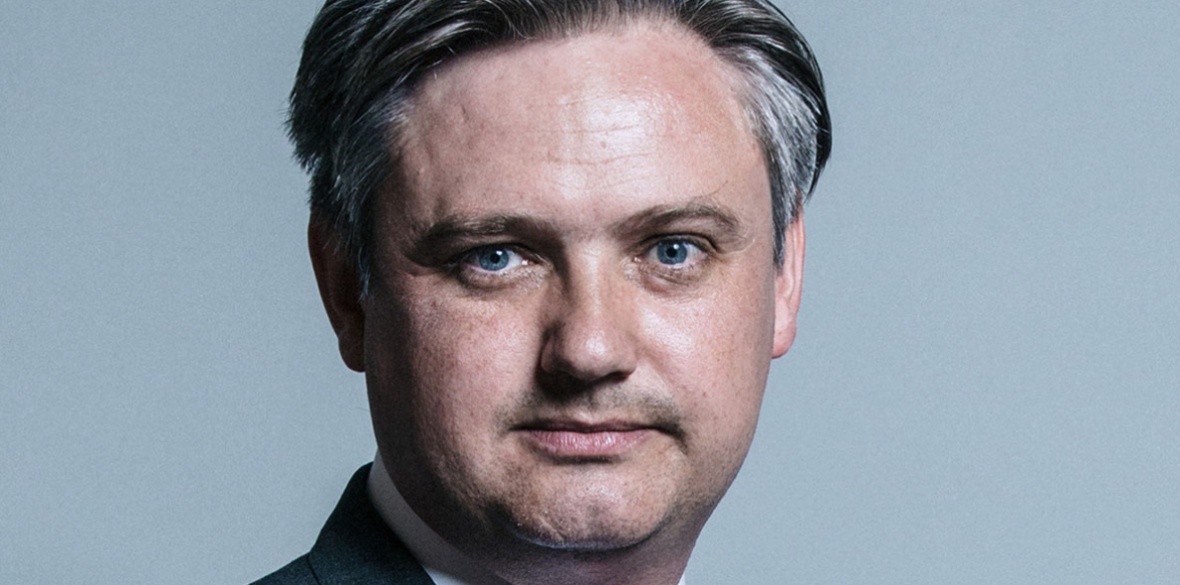
Former Labour MP John Woodcock — ennobled as Lord Walney for backing Boris Johnson in the 2019 election — was assigned in 2021 to produce a report investigating “the extreme fringes on both ends of the political spectrum” in Britain.
…
During his time as a Labour MP, he was appointed chairman of Labour Friends of Israel (LFI) in 2011. He embarked on a trip funded by LFI, the Israeli Ministry of Foreign Affairs and the Portland Trust the same year.
Lord Walney also accepted funding from the Australia-Israel Cultural Exchange during his time as an MP.
In January this year, while preparing to deliver his report concerning Palestine protests in Britain, Lord Walney visited Israel as part of a parliamentary delegation organised by the European Leadership Network, with flights and accommodation paid for by the organisation. He kept the trip under wraps and did not post about it on social media.
IF THERE was one thing that British listeners should have picked up from Vladimir Putin’s interview last week, it was the intervention by Britain’s then prime minister Boris Johnson over Easter 2022.
Putin confirmed that, just prior to Johnson’s visit, a signed agreement had been reached ratified by the representatives of both Ukraine and Russia and counter-signed by France and Germany.
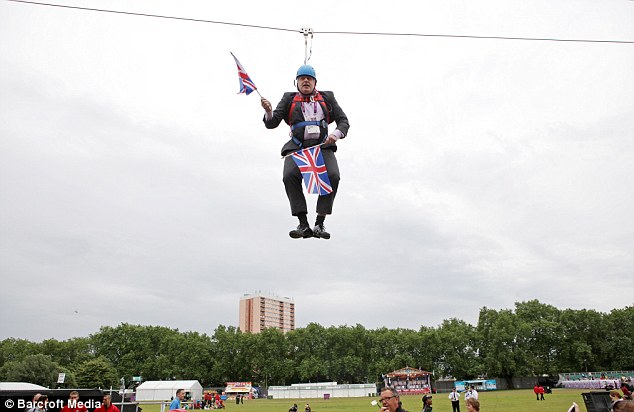
Johnson’s intervention caused Volodymyr Zelensky to back out of the agreement. Whether Johnson acted alone or on behalf of the US government, or elements within it, we do not know. But it is unlikely that Johnson would have acted without some sort of US sanction.
What we do know are the human consequences. According to the UN, just over a thousand civilians had lost their lives by April 2022. Since then 10 times that number have been killed and the same ratio is likely for the much higher level of military casualties.
…
Jeremy Hunt’s May 2023 Budget found an extra £11bn for defence. For the forthcoming Budget still more money was being proposed over the weekend “to strengthen Britain’s defences in the Red Sea.” Britain remains the second biggest contributor to Nato after the US.
Yet Britain is a country that can no longer afford the basic infrastructure needed for clean water, rail transport or a national grid capable of connecting existing renewable capacity — let alone a viable health service and effective schooling.
Scotland’s first minister also said information would often arrive ‘minutes before the meeting’
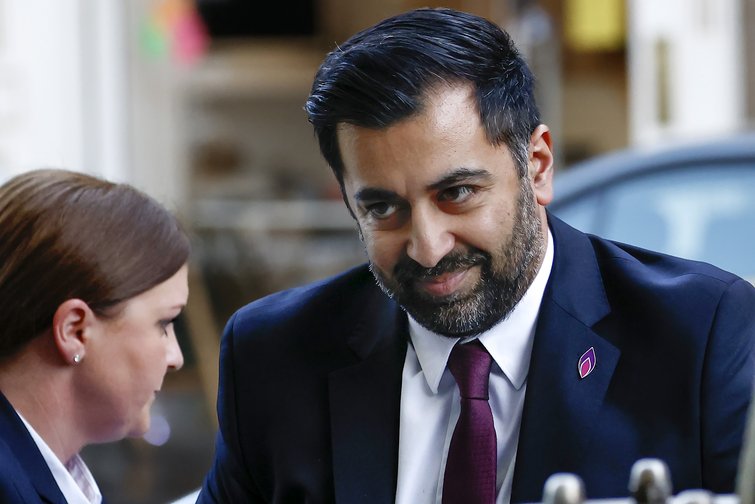
Humza Yousaf said he was “deeply frustrated” by the Boris Johnson government’s failure to collaborate with the Scottish government during the pandemic.
Scotland’s first minister, who served as both justice secretary and health secretary in the devolved government during the pandemic, told the Covid inquiry information was often arriving “at the absolute last minute before a meeting”.
“Five, ten minutes before the meeting was to start,” he explained. “Or we were reading about an announcement of a decision already been made by the UK government.”
Yousaf also criticised Alister Jack, the UK government’s secretary of state for Scotland.
“When we were on these phone calls [with the UK government], his [Jack’s] engagement was very limited and there would often be meetings where he wouldn’t say anything at all. Perhaps he was there to observe what was said on the meetings as opposed to necessarily contributing,” Yousaf said.
Jack and the Scottish government have had frequent run-ins, most notably around the Scottish government’s decision to reform gender recognition laws. Jack used his role to block the progressive legislation using unprecedented powers.
The UK’s Covid inquiry is currently focusing on how the Scottish government handled the crisis. Jack is due to give evidence next week.
The inquiry was also shown WhatsApp messages exchanged between Yousaf, while health secretary, and senior health adviser Jason Leitch.
The messages show Leitch advising Yousaf to keep a drink in his hands at all times when attending a function, so he didn’t have to wear a mask. Leitch also wrote “literally no one” was following the government advice, which at the time stated that you must wear a mask when not seated at a dinner.
Jamie Dawson, counsel to the inquiry, pushed Yousaf on whether he was being given a “workaround”.
Yousaf responded: “I never asked for a workaround or how not to comply and neither would I suggest that he was giving that.”
The inquiry saw another exchange of messages between Leitch and Yousaf where the pair discussed Nicola Sturgeon’s decision-making process.
Leitch and Yousaf were discussing a rise in cases in Glasgow in May 2021, when Yousaf became health secretary. The pair also discussed a meeting held between Leitch and Sturgeon relating to the rise in cases.
Leitch wrote: “There was some FM [First Minister] keep it small shenanigans as always, she actually wants none of us.”
Yousaf was asked at the inquiry whether Sturgeon frequently took decisions without full cabinet discussion.
“There were times when the former First Minister needed a tighter cast list[…] But I think this was a classic example of [Leitch] perhaps overspeaking,” he said.
Yousaf also apologised for the Scottish government’s failure to preserve WhatsApp messages and made reference to an announcement made earlier today to the Scottish parliament that there will be an external review into the use of mobile messaging apps.
Nicola Sturgeon called Boris Johnson “a fucking clown” in a private message when he announced a further Covid lockdown on 31 October 2020, the inquiry has heard.
Tory idiot Boris Johnson
As PA Media reports, at a hearing in Edinburgh this morning the inquiry highlighted WhatsApp messages between Sturgeon and Liz Lloyd, her chief of staff. PA says:
Sturgeon said his address was “fucking excruciating” and that the UK communications were “awful”. Sturgeon also told Lloyd: “His utter incompetence in every sense is now offending me on behalf of politicians everywhere.”
Lloyd said she was “offended” on behalf of special advisers everywhere. Sturgeon replied: “He is a fucking clown.”
Lloyd told Sturgeon she wanted a “good old-fashioned rammy” with the UK government so she could “think about something other than sick people” in WhatsApp messages.
Asked about the messages, Lloyd said the Scottish government were “clearly not complimentary about [the UK government’s] communications handling”.
She said: “We had to mitigate the chaos that appeared around some of the decisions they took.”
Junior counsel to the inquiry Usman Tariq asked Lloyd if the relationship between the then first minister and then prime minister had “broken down”.
Lloyd replied: “That overstates what was there to break.”
Commening on Johnson, she said: “He didn’t want to be on those calls, he wasn’t well briefed, he wasn’t listening, engagement with him became slightly pointless. They didn’t get us anywhere. We started with the approach we should work together, in co-ordinated fashion, but a substantive discussion isn’t what we got. The prime minister was reading a script and would largely ignore points made.”
She said Sturgeon’s strong language showed her “frustration” towards Johnson.
Labour accuses government of holding back data on use of official alcohol stock between March 2020 and 2022
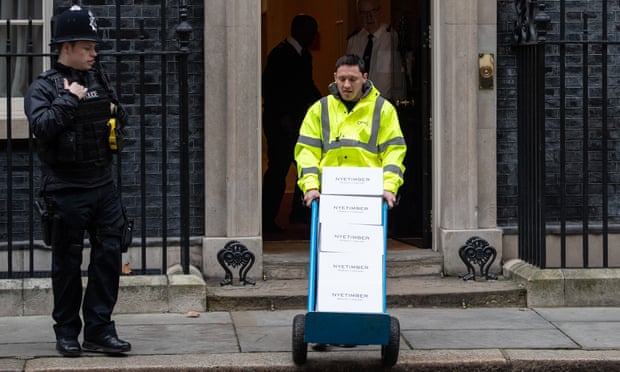
Crates of wine being delivered to No 10 in January 2020. The last official statement on the ‘usage, value, costs and stock levels of the wine cellar’ was made in July 2021. Photograph: Leon Neal/Getty Images
Ministers have been asked to explain why a report on the UK government’s consumption of wine during the Covid pandemic has been delayed four times over the last year.
Labour said the Foreign Office, which holds the government’s wine collection, should publish the data on its stocks for 2020 to 2022 immediately, as the delay was causing suspicion about how much had been used.
The stock list was originally meant to be published in “early 2023”, was subsequently scheduled for July and then ministers later said it would appear in the autumn.
The last update was from Andrew Mitchell, a Foreign Office minister, who answered a parliamentary question saying it would be published “before the Christmas recess” – but it never materialised by the end of the parliamentary term.
The delays mean it is now two and a half years since the last official statement on the “usage, value, costs and stock levels of the wine cellar” was made in July 2021.
The yet-to-be-published data should cover the period March 2020 to March 2022 – the whole course of the pandemic. Given the cellar is supposed to be used only “to provide guests of the government, from home and overseas, with wines of appropriate quality at reasonable cost”, the report would be expected to show a decline in consumption, given the curbs on indoor gatherings and international travel caused by the Covid pandemic.