Extinction Rebellion (XR) and Just Stop Oil have stormed multiple insurance offices today (28 October 2024) in their latest round of protests.
The action has seen XR occupy the lobby of the Walkie Talkie building in Fenchurch Street, which is home to insurers such as Tokio Marine Kiln. Protesters from the group also said they had occupied one of Hiscox’s offices.
🚨 HAPPENING NOW
XR Faith & Global Justice activists have occupied @HiscoxUK demanding they cut ties w/ the East Africa Crude Oil Pipeline!
DeSmog review of company data shows North Sea’s leading oil and gas producer downgraded estimates for CO2 stored at Sleipner gas field by almost a third.
This story is the fifth part of a DeSmog series on carbon capture and was developed with the support of Journalismfund Europe.
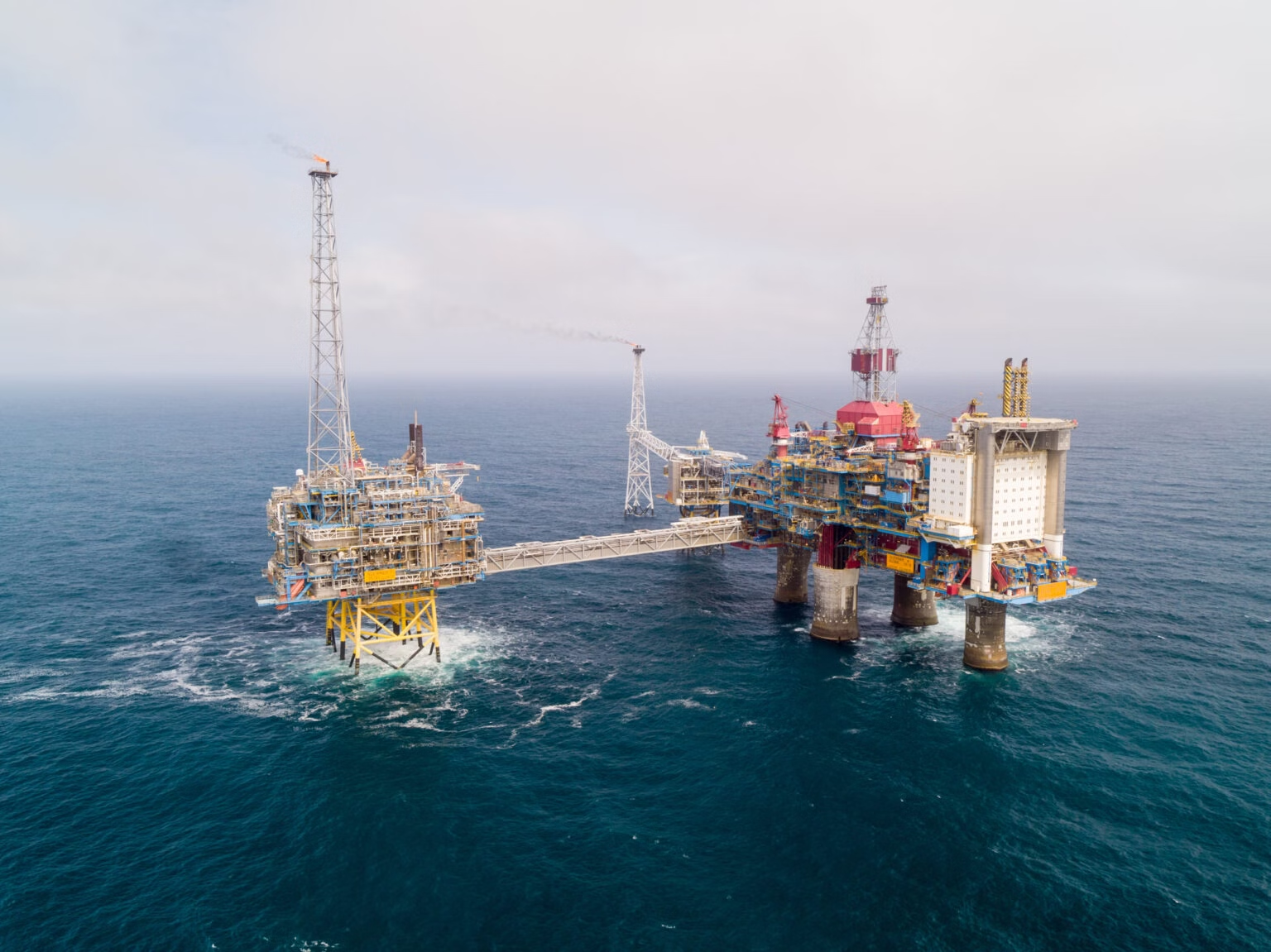
Norwegian oil and gas company Equinor has admitted over-reporting the performance of a flagship carbon capture and storage project by about 30 percent due to defective monitoring equipment, underscoring risks associated with plans to scale the technology as a climate solution, DeSmog can reveal.
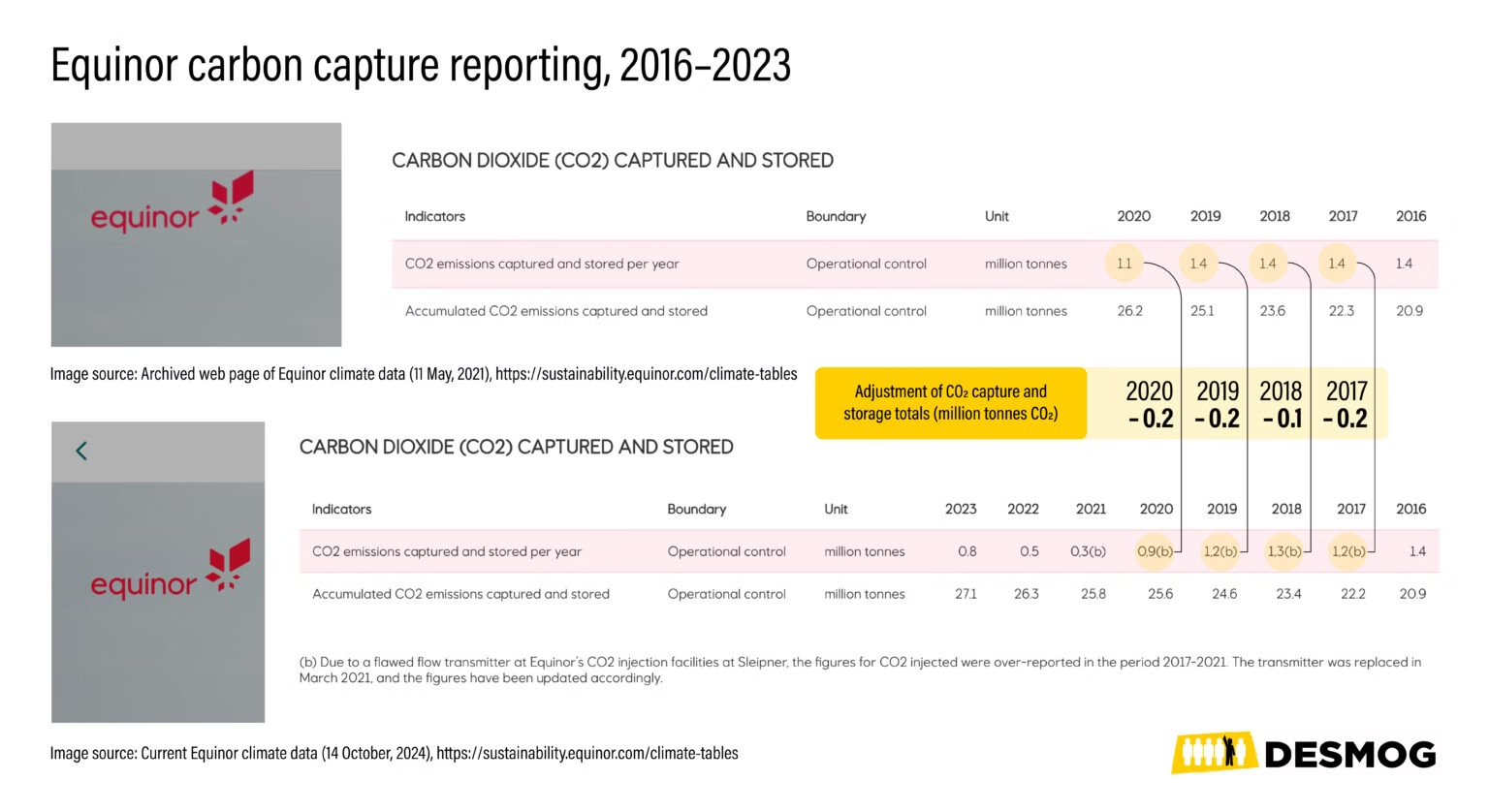
In a footnote in its latest sustainability data, Equinor said a malfunction in equipment used to measure the amount of gas flowing through a pipeline at its Sleipner gas field in the North Sea had caused it to over-report the amount of carbon dioxide (CO2) stored from 2017 to 2021.
“Due to a flawed flow transmitter at Equinor’s CO2 injection facilities at Sleipner, the figures for CO2 injected were over-reported in the period 2017-2021,” the footnote said. “The transmitter was replaced in March 2021, and the figures have been updated accordingly.”
Equinor did not quantify the extent of the over-estimates in the footnote on Sleipner. The 28-year-old project is often cited by carbon capture advocates as proof that it’s technically feasible to trap and store large quantities of CO2 underground.
A DeSmog review of publicly available company data suggests that Equinor captured and stored a cumulative total of 1.6 million tonnes of CO2 at Sleipner from 2017-2019, compared to its initial estimate of 2.1 million tonnes — implying that it had previously over-reported the amount of gas stored during that three-year period by about 30 percent. [See note on methodology at the end of this story].
A lack of comparable data made it harder to estimate how much the company may have over-estimated CO2 capture at Sleipner in 2020 and early 2021, although partial numbers suggested that the figure was also about 30 percent.
Equinor declined to say when the broken equipment at Sleipner was first detected, or how the company arrived at its revised estimates for CO2 capture. A spokesperson referred DeSmog to the company’s website and sustainability reports for further information on its carbon capture projects.
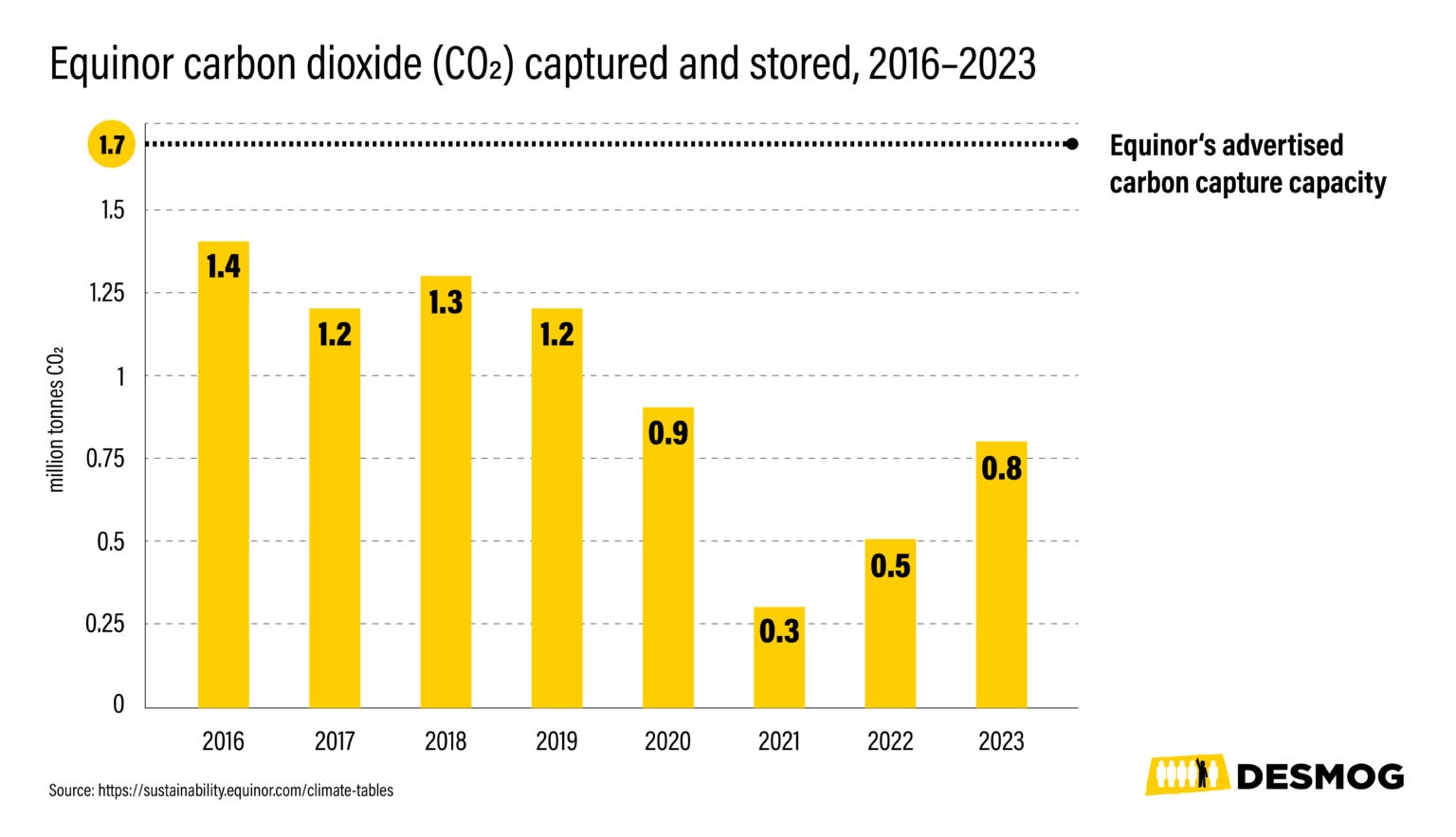
Equinor says on its website that it captures 1.0 million tonnes of CO2 at Sleipner each year, and a further 0.7 million tonnes from a similar project at the Snøhvit gas field in the Barents Sea. Figures in the company’s sustainability reports, however, suggest that it is routinely failing to achieve this level of capture.
In 2021, with the Snøhvit facility shut down due to a fire at the associated Hammerfest LNG (liquified natural gas) plant, Equinor captured and stored a total of 0.3 million tonnes of CO2, all at Sleipner, according to its annual sustainability report — less than 20 percent of the total advertised on its website.
Last year, with both CCS sites operational, Equinor captured and stored a total of 0.8 million tonnes of CO2, according to the company’s online sustainability data — about half the advertised total.
The drop in CO2 capture and storage could be linked to waning natural gas production at Sleipner, said Grant Hauber, a researcher for the Institute for Energy Economics and Financial Analysis think tank, who wrote a 2023 report on Norway’s carbon capture projects.
“As production from the Sleipner field declines, the quantity of CO2 being handled declines,” Hauber said. “Equinor has not disclosed if there is a practical minimum where the processing facilities are no longer effective in handling CO2.”
Separately, Hauber’s 2023 report showed that Sleipner and Snøhvit encountered unforeseen issues with CO2 storage, with Equinor having to drill a new CO2 injection well at Snøhvit between 2010-2016, and unpredictable underground CO2 migrations at Sleipner. The company says that its CO2 storage is now fully operational.
The downward revision of capture estimates at Sleipner and Equinor’s frequent failure to run its two carbon capture projects at full capacity echo a long history of missed targets, cost-overruns and economic problems at CCS projects in North America and Australia. These challenges have convinced many environmental groups that fossil fuel companies primarily see the technology as a cover for continued expansion of oil and gas production, rather than a viable tool for curbing emissions on a global scale.
Nevertheless, Equinor has leveraged its experience at Sleipner and Snøhvit to position itself as a key player in the UK’s plans to ramp up carbon capture capacity with the support of £22 billion of subsidies announced by the new Labour government this month.
The Norwegian company is also partnering with France’s TotalEnergies and the UK’s Shell on the Northern Lights carbon storage project in the North Sea — a key component of the European Union’s target to boost carbon capture to meet its climate goals.
Equinor says that it aims to increase its CO2 storage capacity to 30 to 50 million tonnes by 2035 from projects planned in Norway, the UK, Denmark and the United States. That would require a massive build-out: Today, the world’s combined CCS capacity amounts to about 50 million tonnes of CO2 a year.
Although the Paris-based International Energy Agency (IEA) sees a significant roll-out of carbon capture to meet net zero targets, it has also warned of the dangers of over-reliance on the technology.
“The [fossil fuel] industry needs to commit to genuinely helping the world meet its energy needs and climate goals — which means letting go of the illusion that implausibly large amounts of carbon capture are the solution,” wrote Fatih Birol, IEA executive director, in the introduction to a report on clean energy transitions for oil companies published in November.
Oslo-based think tank Bellona, which also sees a role for carbon capture, emphasised the importance of companies providing reliable capture data.
“Bellona believes that reliable monitoring, reporting and verification is important. It is clear we need CCS, and we need to be able to trust that the system works as it should,” said Olav Øye, the organisation’s senior advisor for industry and climate.
Venting CO2 into the Atmosphere
Equinor (then known as Statoil) began capturing carbon in 1996 at the CO2-rich Sleipner field in the North Sea as a way to reduce its exposure to a new Norwegian tax on CO2 emissions.
The company promotes its carbon capture operations as a key part of its clean energy strategy, with CCS featuring in its advertising campaigns. Nevertheless, Equinor’s records indicate that its Sleipner facility did not capture and store the majority of the field’s CO2 emissions in recent years, but rather vented them into the atmosphere.
Emissions from operations at the Sleipner field amounted to about 0.7 million tonnes of CO2 in 2023. That same year, in 2023, Equinor captured and stored a combined total of about 0.8 million tonnes of CO2 at Sleipner and Snøhvit, implying that the Sleipner field released more CO2 than was stored.
In 2021, the year that Sleipner stored a reported 0.3 million tonnes of CO2, about 0.8 million tonnes of CO2 were vented into the atmosphere from operations at the site, more than double the amount captured, the data showed.
Sleipner was also one of the dirtiest offshore projects in Norway last year, when measured in terms of “CO2 intensity” – the amount of carbon dioxide released from oil and gas production per unit of energy.
Equinor lists the combined CO2 intensity of Sleipner and the nearby Gudrun gas field at 19.1 kilograms of CO2 per barrel of oil equivalent, which was the third highest among 19 listed oil and gas production sites operated by Equinor in Norway.
According to Equinor’s 2023 reporting, Sleipner emitted 658,000 tonnes of CO2, 41 times higher than Gudrun’s 16,000 tonnes — despite only producing about a third more natural gas — meaning the Sleipner field’s individual CO2 intensity would be much higher if reported individually.
The Snøhvit gas field has also proved highly CO2-intensive, even when its carbon capture facility has operated at maximum capacity, due to the energy needed to liquefy natural gas for export at the associated Hammerfest LNG facility on Melkøya Island.
Equinor reported 0.9 million tonnes of CO2 emissions from its Hammerfest LNG facility last year, making it the company’s third most polluting project overall, behind its Mongstad oil refinery and Oseberg gas field.
In August 2023, the Norwegian government approved the “Snøhvit Future” project, which includes plans to electrify operations at the LNG export plant with an approximate $1.2 billion investment announced from Equinor and project partners Petoro, TotalEnergies, Neptune Energy and Wintershall Dea.
The developers say that the new infrastructure will reduce emissions by an estimated 850,000 tonnes of CO2 per year by 2030.
While additional CCS infrastructure was considered to reduce emissions at the LNG export plant, Trond Bokn, head of project development for Equinor, wrote in an article in the company’s online magazine that expanding carbon capture at Snøhvit to meet that target would have cost at least $3.4 billion — about three times the electrification plans.
While Equinor says that carbon capture would be too costly for the LNG export facility at Snøhvit, the company aims to apply the approach in other sectors in Norway and abroad, where government subsidies are available.
In September, Equinor inaugurated the Northern Lights offshore carbon transport and storage project near Bergen, its joint venture with TotalEnergies and Shell, which it says will store 1.5 million tonnes of industrial CO2 emissions a year from a cement works and waste-to-energy plant on the Norwegian mainland.
The majority of the project is financed by $1.19 billion in funding from the Norwegian government and an additional $141 million grant from the European Union’s Connecting Europe Facility fund.
Even if Equinor reaches its 2035 goal of storing 50 million tonnes of CO2 a year — a more than 50 times increase over the CO2 the company captured and stored in 2023 — it would only offset about a fifth of the 262 million tonnes of CO2 emitted from its operations and burning its oil and gas last year, according to company data reviewed by DeSmog.
Methodology and Sources
Equinor initially reported that it had captured and stored a cumulative total of 4.2 million tonnes of CO2 over 2017-2019 according to a tally of yearly data from the company’s online sustainability data (see initial report: “Carbon Dioxide (CO2) Captured and Stored”; see current report for comparison).
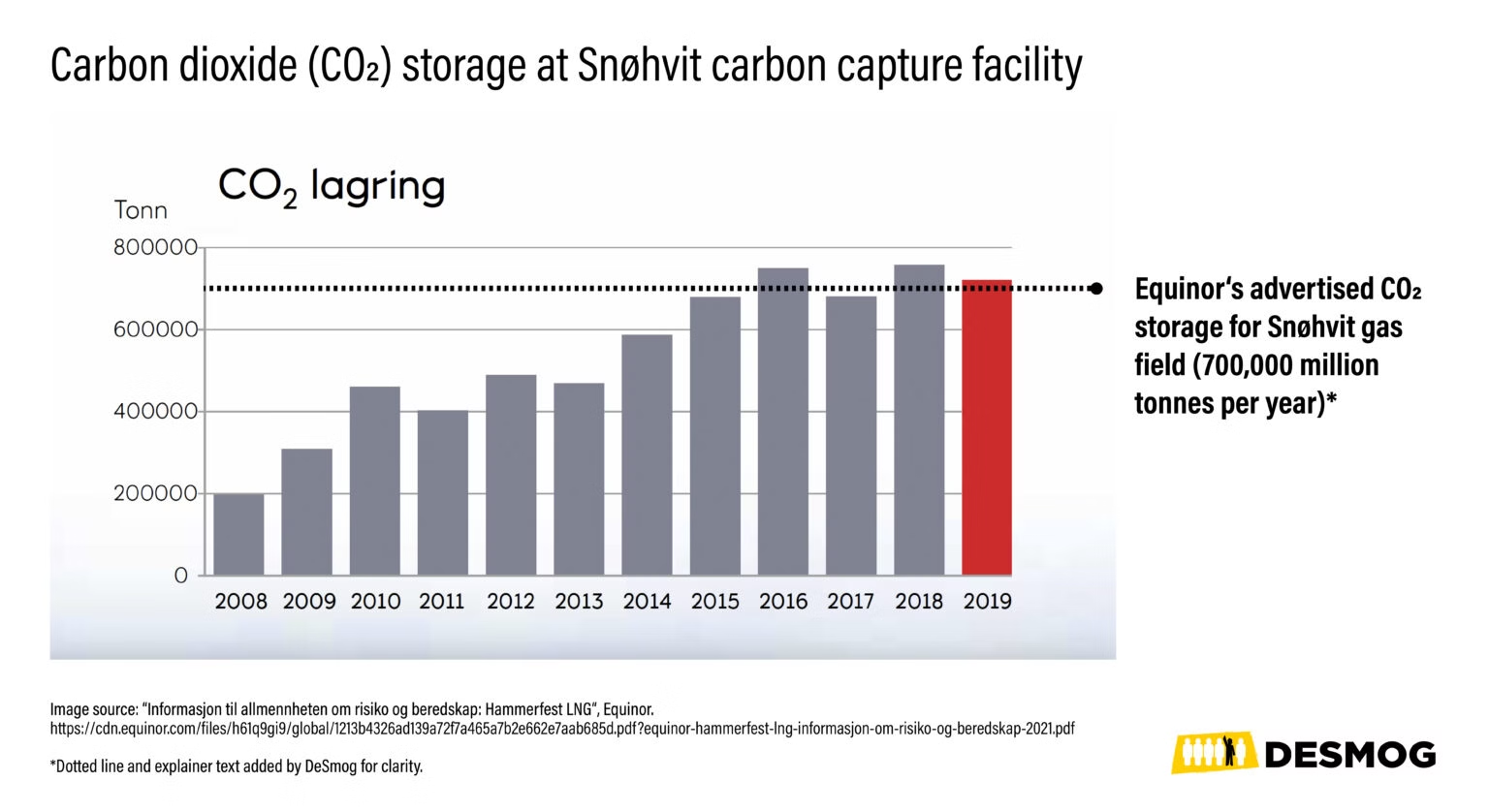
The company does not break down the amount of CO2 captured and stored from its two active CCS facilities at the Sleipner and Snøhvit gas fields in its sustainability data, but DeSmog was able to estimate the amount using a separate Equinor document related to the Snøhvit project. (see: “Informasjon til allmennheten om risiko og beredskap: Hammerfest LNG”, page 4).
A chart in this document (“CO2 Lagring” or “CO2 Storage”) indicates that Snøhvit was operating at a capacity of about 0.7 million tonnes of CO2 a year over the period 2017-2019, which equates to a cumulative total of 2.1 million tonnes of CO2 stored. Subtracting that figure from the total of 4.2 million tonnes of CO2 that Equinor reported storing during the period gives the remainder stored at Sleipner, also 2.1 million tonnes.
Equinor later revised its estimate for the cumulative total of CO2 stored over the period 2017-2019 for both sites down to 3.7 million tonnes, with all changes attributed to the flawed flow transmitter at Sleipner. That implies that Snøhvit would have still captured a total of 2.1 million tonnes of CO2 during this period, but Sleipner would have only captured a revised 1.6 million tonnes.
The difference between the 2.1 million tonnes of stored CO2 initially attributed to Sleipner and the revised figure of 1.6 million tonnes suggest that Equinor initially over-reported CO2 storage by about 31 percent during the period 2017-2019. Given that the company provided figures rounded to the hundred thousand, it was impossible to arrive at a more precise percentage.
DeSmog was not able to obtain specific CO2 capture and storage totals for Sleipner or Snøhvit in 2020, when Equinor initially reported 1.1 million tonnes of total CO2 stored, before revising that figure to 0.9 million tonnes. However, the total amount of over-estimation attributable to Sleipner — 0.2 million tonnes of CO2 — suggests a similar percentage of over-reporting as the period 2017-2019.
Equinor’s sustainability dataset also indicated over-reporting for Sleipner in early 2021, but DeSmog was unable to find comparable data to calculate the size of the overestimate. The company appears to have revised the totals sometime in 2022, based on a comparison of its yearly sustainability reports.
Equinor’s webpage “CCS: Carbon capture and storage — making net zero possible” says that the company captures and stores about 1 million tonnes of CO2 a year at Sleipner and its webpage “Snøhvit” indicates that the company captures and stores about 0.7 million tonnes of CO2 a year at the field.
Equinor’s yearly emissions total of 262 million tonnes of CO2 was calculated by adding up the company’s Scope 1, Scope 2, and Scope 3 emissions reported in its 2023 sustainability data.
DeSmog shared its calculations with Equinor. The company did not respond.
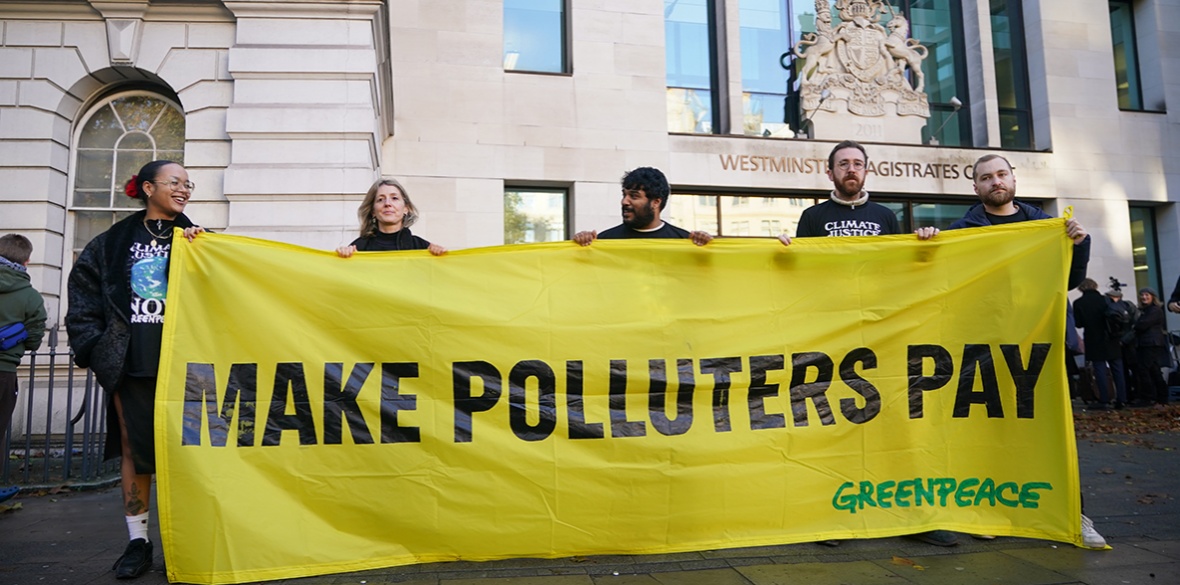
Greenpeace activists outside Westminster Magistrates’ Court, London, where environmental campaigner Greta Thunberg is due to appear charged with failing to comply with a condition imposed under Section 14 of the Public Order Act, November 15, 2023
ENVIRONMENTAL campaign Greenpeace UK has called for Westminster action after a United Nations report said governments are abjectly failing to meet carbon emissions targets.
The UN report covers 196 countries that were part of the 2016 Paris Agreement on climate change, warning: “Current national climate plans fall miles short of what’s needed to stop global heating from crippling every economy and wrecking billions of lives and livelihoods across every country.”
Greenpeace called on the government to take action. Policy director Dr Doug Parr said: “Together with ending all new oil and gas licences, the Labour government must at least triple renewables and double home energy efficiency rates by 2030, as well as properly support workers to transition away from polluting industries.
“Failure is not an option.”
The UN said its report must be a turning point, with “much bolder new national climate plans from every country.”
Original article by Brett Wilkins republished from Common Dreams under Creative Commons (CC BY-NC-ND 3.0).
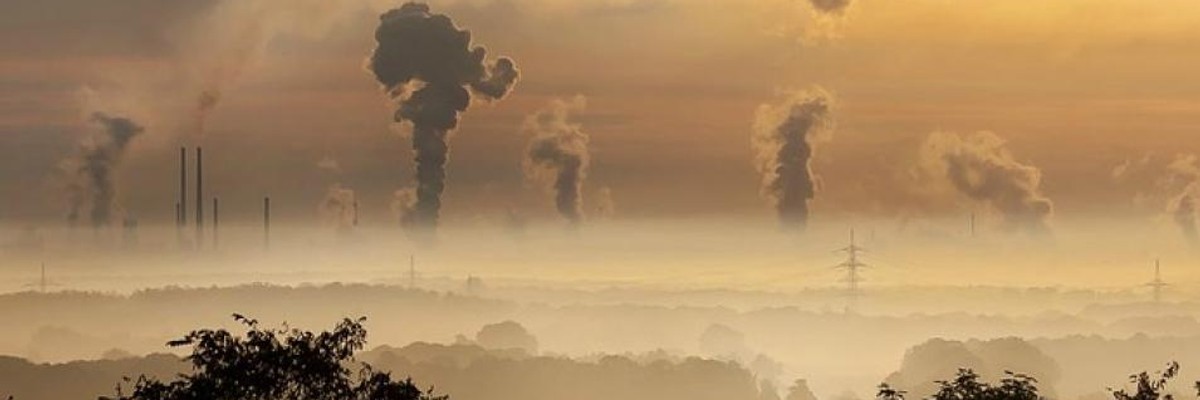
Carbon emissions and haze are seen near factories and a power plant. (Photo: Pixabay/Creative Commons)
“Closing the emissions gap means closing the ambition gap, the implementation gap, and the finance gap,” said U.N. Secretary-General António Guterres. “Starting at COP29.”
The world’s nations must commit to dramatically slashing greenhouse gas emissions in the near future or risk a “catastrophic” rise in global average temperatures, a key United Nations climate report published Thursday warned.
“It is still technically possible to meet the 1.5°C goal” set out in the Paris agreement, “but only with a G20-led massive global mobilization to cut all greenhouse gas emissions, starting today,” the United Nations Environmental Program (UNEP) said in a summary of its annual Emissions Gap Report.
“Nations must collectively commit to cutting 42% off annual greenhouse gas emissions by 2030 and 57% by 2035 in the next round of Nationally Determined Contributions (NDCs)—and back this up with rapid action—or the Paris agreement’s 1.5°C goal will be gone within a few years,” UNEP warned.
“Failure to increase ambition in these new NDCs and start delivering immediately would put the world on course for a temperature increase of 2.6-3.1°C over this century,” the agency said. “This would bring debilitating impacts to people, planet, and economies.”
New UNEP emissions gap report highlights a "massive gap between rhetoric and reality" and calls for a "quantum leap" in ambition to deliver Paris goals, as the world is way off-track today.
UNEP said “solar, wind, and forests” have the potential to help the world “get on a 1.5°C pathway.” However, “sufficiently strong NDCs would need to be backed urgently by a whole-of-government approach, measures that maximize socioeconomic and environmental co-benefits, enhanced international collaboration that includes reform of the global financial architecture, strong private sector action, and a minimum six-fold increase in mitigation investment.”
“G20 nations, particularly the largest-emitting members, would need to do the heavy lifting,” the agency added.
The task is daunting—according to the report, human emissions of greenhouse gases—CO2, methane, nitrous oxide, and fluorinated gases—reached a record 57.1bn tons of CO2 equivalent (GtCO2e) last year.
“The emissions gap is not an abstract notion,” U.N. Secretary-General António Guterres stressed in a video message on the UNEP report. “There is a direct link between increasing emissions and increasingly frequent and intense climate disasters.”
“Around the world, people are paying a terrible price,” he continued. “Record emissions mean record sea temperatures supercharging monster hurricanes; record heat is turning forests into tinder boxes and cities into saunas; record rains are resulting in biblical floods.”
“Today’s Emissions Gap report is clear: We’re playing with fire; but there can be no more playing for time,” Guterres added. “We’re out of time. Closing the emissions gap means closing the ambition gap, the implementation gap, and the finance gap. Starting at COP29.”
Annual greenhouse gas emissions reached an all-time high last year.
The U.N. chief was referring to the United Nations Climate Change Conference, which is set to take place next month in Baku, Azerbaijan—a nation that is “aggressively” expanding fossil fuel production.
UNEP Executive Director Inger Andersen said in a statement:
Climate crunch time is here. We need global mobilization on a scale and pace never seen before—starting right now, before the next round of climate pledges—or the 1.5°C goal will soon be dead and well below 2°C will take its place in the intensive care unit. I urge every nation: No more hot air, please. Use the upcoming COP29 talks in Baku, Azerbaijan, to increase action now, set the stage for stronger NDCs, and then go all-out to get on a 1.5°C pathway.
Even if the world overshoots 1.5°C—and the chances of this happening are increasing every day—we must keep striving for a net-zero, sustainable, and prosperous world. Every fraction of a degree avoided counts in terms of lives saved, economies protected, damages avoided, biodiversity conserved, and the ability to rapidly bring down any temperature overshoot.
Climate scientists and green groups expressed alarm over the UNEP report.
“The Emissions Gap Report is yet another clear warning about what needs to be done and fast,” Andreas Sieber, associate director of policy and campaigns at 350.org, said in a statement. “Last year at COP28, nations agreed to transition away from fossil fuels. The report makes it crystal clear that governments must translate this decision into action in their national climate pledges if they are serious about the just energy transition.”
Greenpeace International climate politics expert Tracy Carty said that “for 15 years, the UNEP has been sounding the alarm on the great chasm between political will for climate action and the worsening emissions trajectory fuelling rising temperatures.”
“These reports are a historical litany of negligence from the world’s leaders to tackle the climate crisis with the urgency it demands, but it’s not too late to take corrective action,” Carty continued. “We challenge leaders to embark on wholesale change in their 2035 climate plans, to come to COP29 prepared to finance climate action and to make up for lost time.”
The UNEP Emissions Gap Report 2024 is out, and it highlights the urgency for countries to raise their 2030 climate targets and act swiftly.
Rachel Cleetus, policy director and a lead economist in the Climate and Energy Program at the Union of Concerned Scientists, issued a statement arguing that the new UNEP report “forcefully confirms that nations’ efforts to cut heat-trapping emissions have been grossly insufficient to date.”
“Global heating records are being topped year after year, and people and ecosystems worldwide are suffering the devastation of unrelenting climate change disasters and increasingly irreversible impacts,” she noted. “To put it bluntly, decades of inadequate action have put the 1.5°C goal further out of reach and world leaders are failing their people. The consequences are profound—but the policy choices decided now are as crucial as ever to limit future harm.”
Cleetus continued:
The best way forward is to implement sweeping changes to the global energy system by phasing out the destructive products fossil fuel companies are peddling and investing big in renewable energy solutions to sharply curtail heat-trapping emissions. Also urgent are scaled-up investments in climate resilience to cope with impacts already locked in. Rich, high-emitting nations—including the United States—are most responsible for these calamitous circumstances. Those living in climate-vulnerable, low-income countries that contributed very little to the fossil fuel pollution driving this crisis need more than hollow words; they need wealthy countries and other major emitters to live up to their responsibilities.
“At the upcoming U.N. climate talks, wealthy nations must significantly grow the amount of climate financing available to ensure all countries can slash their global warming emissions and prepare for the more frequent and severe climate impacts that are the punishing consequence of a warming world,” Cleetus added.
Original article by Brett Wilkins republished from Common Dreams under Creative Commons (CC BY-NC-ND 3.0).