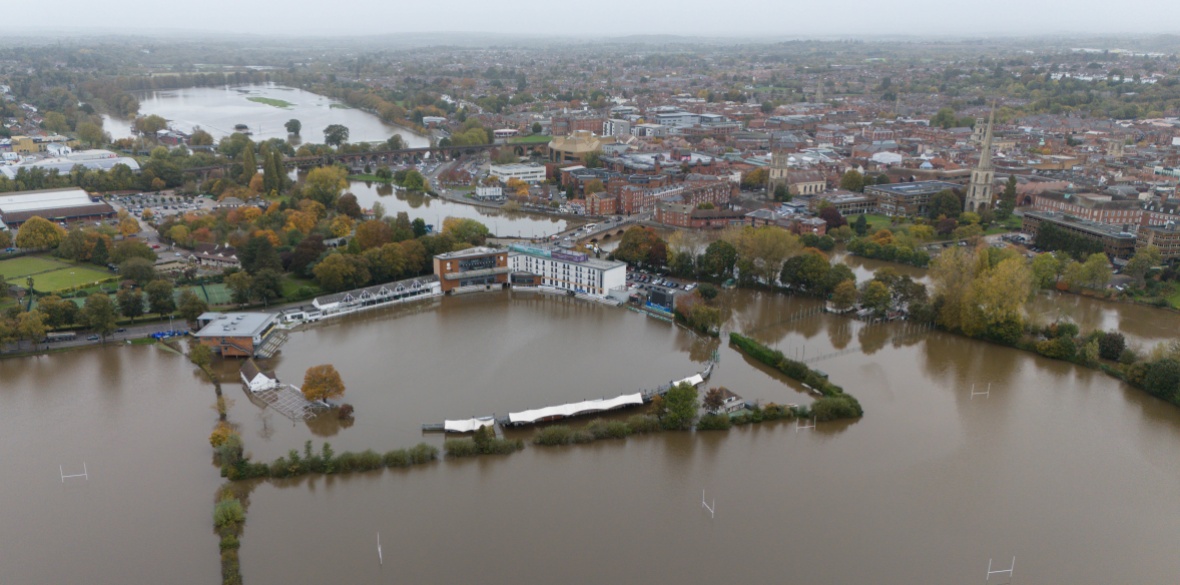
An aerial view showing a flooded New Road Cricket ground in Worcester, home of Worcestershire CCC. Flood warnings remained in place across the UK on Monday after Storm Ashley made its presence felt, October 21, 2024
THE “climate emergency” is not in the future. It is now, and each severe weather event exposes the fragility of systems we rely on on a daily basis.
Serious floods in western England caused by Storm Ashley are no anomaly: every year sees more such incidents. The State of the UK Climate report shows that Britain is getting wetter as well as hotter: five of the 10 wettest years on record have been in the 21st century, and rainfall over the last decade is 9 per cent higher than in the 1960s.
The consequences of such changes cannot be ignored indefinitely. England suffered its second-worst harvest on record this year, with the wheat crop down by more than a fifth, winter barley (primarily important for animal feed, but also for brewing) by more than a quarter and rapeseed (used for animal feed, cooking oil and many processed foods) by almost a third.
Britain imports about half its food: but then, climate change is a global phenomenon. France’s wheat harvest this year is nearly a fifth lower than usual. Drought has played havoc with olive oil harvests in Greece and Spain.
…
A serious government would be addressing the impact of climate change through mitigation. It would be ready to spend money on flood defences, to protect cities and to protect agriculture. It would not leave vital systems like water in the hands of a private sector that continues to pay its executives millions in bonuses even while paying millions in fines for polluting and poisoning our rivers.
It would, in short, be treating climate change as an emergency: a process which requires us to rethink the way we live from city planning to transport to food production.
The continued failure of politicians to acknowledge that is a case of system failure.
Capitalism cannot sacrifice short-term profit even facing a crisis of this scale. But that puts the responsibility on us to demand better.
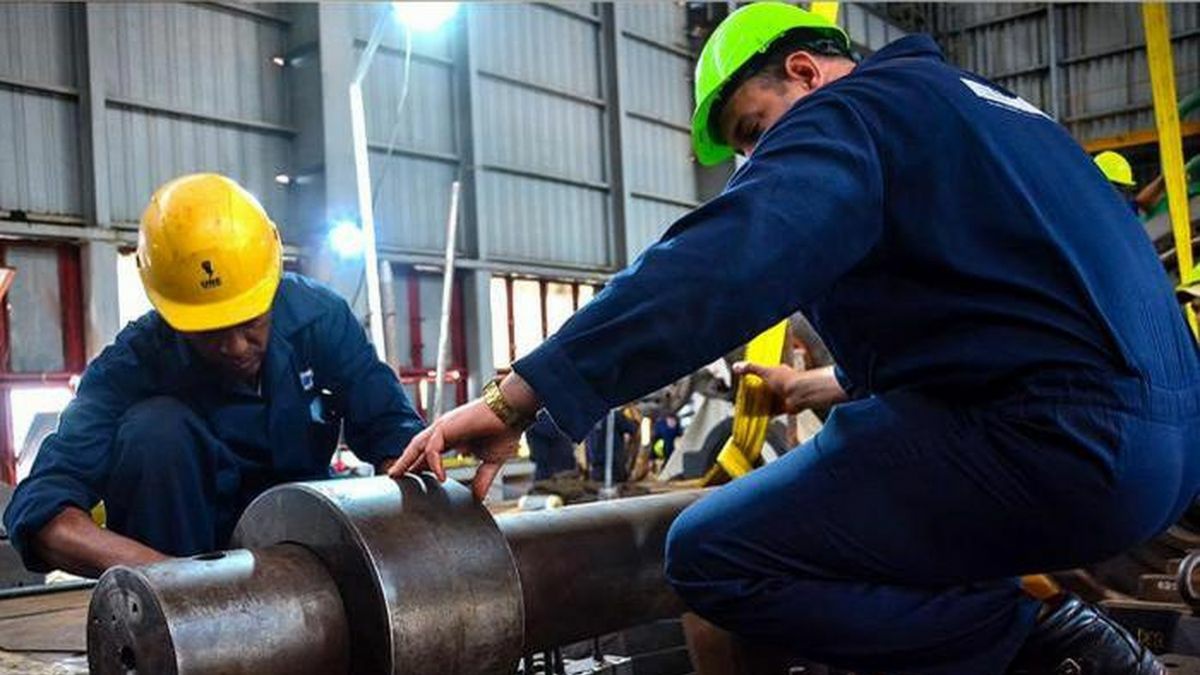
Workers in Cuba have worked to gradually restore the power grid. Photo: Minister of Energy and Mines
After several false starts over the weekend, the efforts to recover Cuba’s electrical system began to make headway on October 21. Meanwhile, authorities have declared that Oscar has become a tropical storm.
In this regard, President Miguel Dïaz-Canel said “We were at the National Load Dispatch since very early in the morning. The microsystems in the country are being strengthened and Havana is gradually receiving energy. It is a complex job, but we are taking sure steps. We said that we will not rest until the total reestablishment.”
In other parts of the country, reconnections continue while attempts are made to repair the damages suffered by the thermoelectric power plants, which, due to the difficulties of access to spare parts and technological elements that help to repower the system (caused fundamentally by the criminal economic blockade suffered by Cuba on the part of the US government), the repair tasks are very complicated.
Tropical Storm Oscar
Amid the critical situation with the collapse of the power grid, Hurricane Oscar made landfall on the Caribbean Island late on Sunday. Fortunately for the inhabitants of eastern Cuba, the storm downgraded its intensity and hit the island as a tropical storm, though still unleashing heavy rains and wind in the eastern region. The level of damage that Oscar can produce is still uncertain.
La tormenta tropical Oscar transita lentamente por el Oriente de #Cuba. Se trabajan intensamente para proteger al pueblo y minimizar las afectaciones. Son múltiples las muestras de solidaridad entre nuestra gente. Como se explicó existe un grupo de recursos para la recuperación. pic.twitter.com/26LzX5Qhqw
According to experts, the storm is now headed to the Bahamas, though authorities have called on the population to not lower their guard and to be alert to official communication channels.
The world stands with Cuba
Amid Cuba’s blackout, the member states of the Bolivarian Alliance of the Peoples of Our America (ALBA-TCP), expressed in a communiqué their support to the Cuban government and offered their help to overcome the difficult times the island is going through: “The complex situation that [Cuba] is experiencing today is a consequence of the economic war, financial persecution and [the refusal to sell] fuel supplies by the US administration, which seeks to asphyxiate Cuba in its commitment to the well-being of the Cuban people”.
Furthermore, the communiqué adds “The policy of maximum pressure through unilateral coercive measures and the blockade against the nation is cruel and inhuman and has been categorically rejected by the majority of the countries of the world, since […] it only seeks a change of regime, in open violation of the purposes and principles of the United Nations Charter and the norms of International Law.”
In a press conference on October 21, the spokesperson of the Ministry of Foreign Affairs of China, Lin Jian, also expressed support to Cuba as it faces unprecedented challenges, “[The] US blockade on Cuba has been catastrophic for Cuba’s socioeconomic development and people’s lives. China once again calls on the US to fully lift the blockade and sanctions on Cuba at once and remove Cuba from the list of ‘state sponsors of terrorism.’”
In a statement, the platform of social movements of Latin America and the Caribbean, ALBA Movimientos, categorized the current situation on the island as one of “anguish and tension, a product of the suffering induced by the criminal blockade.” ALBA Movimientos argues that the US-imposed blockade ultimately seeks to “undermine the role of the Cuban State in satisfying the basic needs of the population, while trying to privilege an incipient private sector, incapable by its condition of providing the levels and extent of social justice achieved by the Revolution.”
In the statement, the movements also warn that this latest episode of blockade-induced hardship on the island could be seized upon by reactionary, counter-revolutionary forces. “At this moment, all the psychological pressure apparatus is being used to induce a social outburst of unforeseeable consequences, using as a basis and pretext the legitimate expressions of social unrest resulting from the current situation, its accumulated and possible solutions,” it warns.
The only viable solution which would respect the sovereignty of Cuba and guarantee the possibility of dignified life, is the immediate and irreversible lifting of the blockade on Cuba, concludes ALBA.
Meanwhile, the White House spokesperson Karine Jean-Pierre claimed in a press conference on October 21, that the US is “not to blame for the blackouts on the island or the overall energy situation in Cuba.”
JAILED: Eco-protesters support Anna Holland and Phoebe Plummer as they are sentenced on September 27 2024 for throwing tinned soup over Vincent van Gogh’s Sunflowers in the National Gallery in 2022
Just Stop Oil has been criticised for targeting the work of Van Gogh, but it’s inaction on climate that’s putting great paintings at risk, argues LINDA PENTZ GUNTER
ON the occasions when activists from Just Stop Oil have targeted works of art or historical landmarks, there has been an outcry, both from horrified onlookers at the time and later in the press and the courtroom.
The British government is intent on cracking down on protest, even if it’s an action intent on trying to save us all from the ravages of runaway climate chaos.
Keir Starmer confirms that his government is cnutier than Suella Braverman on killing the right to protest. This image does not appear in the original article.
“They are pathetic, they are self-defeating, and they need to feel the full force of the law,” pronounced Keir Starmer of Just Stop Oil activists in June. “That is what will happen if we have an incoming Labour government.”
The fact that these “antics,” as Starmer referred to them, had continued was “a failure to grip criminal justice,” he said. Now Starmer and his version of the Labour Party are in power, and climate protesters are being duly gripped, tried and sentenced.
Because in today’s world, climate activists are criminals. As one of Just Stop Oil’s self-described foot soldiers put it, “Slow-walking across Waterloo Bridge becomes an offence that goes to crown court.”
Throwing soup at glass-enclosed paintings by Van Gogh is just the most high-profile of the various direct actions being carried out to demand immediate and effective measures to drastically reduce carbon emissions.
A sensible government should have arrived at such a realisation on its own, thus obviating the need for Just Stop Oil not only to toss soup but to exist at all.
Instead, the Starmer government’s latest move is to squander £22 billion on one of the most useless (along with nuclear power) of all the supposedly “green” climate solutions — carbon capture and storage (CCS).
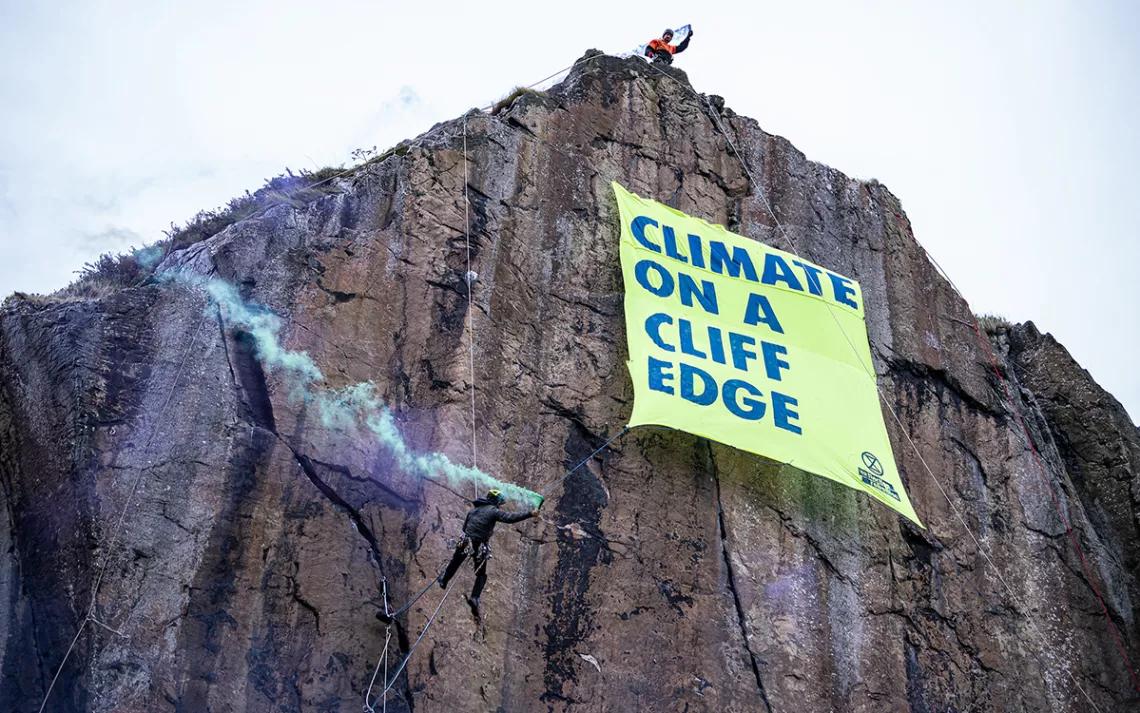
Experienced climbers scale a rock face near the historic Dumbarton castle in Glasgow, releasing a banner that reads “Climate on a Cliff Edge.” One activist, dressed as a globe, symbolically looms near the edge, while another plays the bagpipes on the shores below. | Photo courtesy of Extinction Rebellion and Mark Richards
Funds could insulate all draughty homes, fund free bus travel, and retrain millions of workers for a green future
A TEMPORARY tax on the super-rich could generate enough money to fix every poorly insulated home, fund free bus travel and retrain three million workers in green industries, Greenpeace revealed today.
A new report commissioned by the climate group proposes introducing an annual 2.5 per cent tax on all individual wealth above £10 million over the next five years.
This “national renewal tax” would impact less than 75,000 people — 0.1 per cent of the population — and raise up to £183 billion for the Treasury.
…
An analysis by Oxfam found that the richest 1 per cent emit as much carbon as two-thirds of all humanity.
Greenpeace UK’s climate campaigner Georgia Whitaker said: “The oversized carbon footprint of the super-rich is a clear rationale for ensuring that they play an oversized role in fixing the crisis that they have an oversized role in creating.
…
Patriotic Millionaires member Julia Davies, who wrote the report’s foreword, said: “This report highlights that a small, temporary tax on our wealth could transform the lives of millions, while tackling the greatest threat humanity has ever faced — the climate crisis — all while investing in a strong forward-facing economy with quality stable jobs for the British people.”
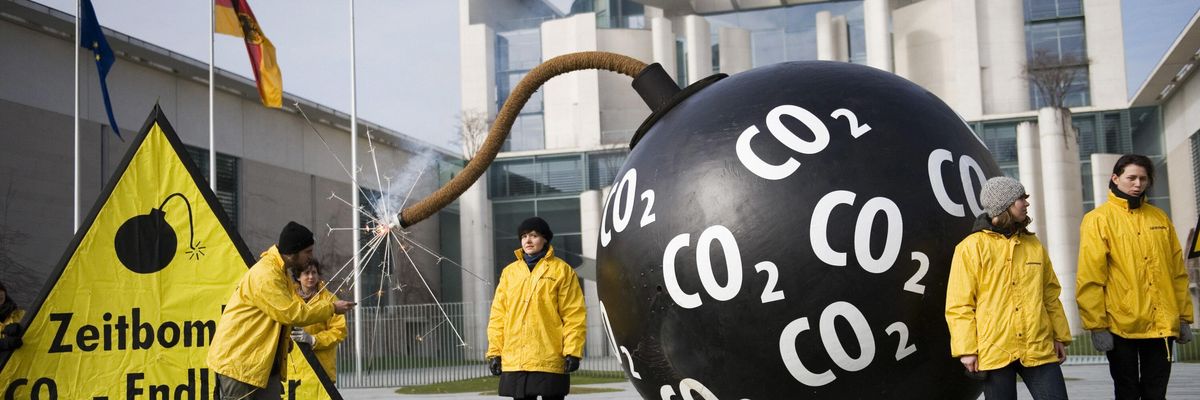
Greenpeace activists light up a mock bomb labeled “CO2” during a campaign in front of the German Chancellery in Berlin on March 25, 2009. (Photo: Michael Gottschalk/DDP/AFP via Getty Images.
As attendees gathered in the south of France Thursday for the start of a European Union-hosted summit on carbon capture and storage, an international coalition of green groups warned against funding “reckless, unscientific, and lobbyist-driven” false climate solutions and instead urged investment in “a just transition that prioritizes renewable energy, energy demand reduction, and energy efficiency.”
“Today the Industrial Carbon Management Forum (ICMF) kicks off in Pau, France,” 43 organizations wrote in a letter to the European Commission. “This forum has been revealed to be dominated by fossil fuel interests to the exclusion of civil society stakeholders and other expert voices with critical views.”
🚨 As the #ICMForum kicks off, civil society groups blow the whistle on the Europen Union’s reckless, unscientific, lobbyist-led Carbon Capture and Storage plans!
— Center for International Environmental Law (@ciel_tweets) October 10, 2024
The letter points to a report published Thursday by the Institute for Energy Economics and Financial Analysis (IEEFA), which concluded that “most of Europe’s planned carbon capture and storage (CCS) applications are too expensive to work on a commercial basis and are nowhere near ready to be rolled out.”
According to the report, Europe’s planned CCS projects will cost an estimated €520 billion ($569 billion), which IEEFA energy finance analyst and report author Andrew Reid said “will force European governments to introduce eye-wateringly high subsidies to prop up a technology that has a history of failure.”
The green groups’ letter also notes widespread criticism of CCS, which has been panned by Food & Water Watch—whose European branch signed the letter—as a “false climate solution” and a “lifeline for the fossil fuel industry.”
The signers wrote that the United Nations Intergovernmental Panel on Climate Change “has labeled CCS as one of the most costly and least effective emissions reduction methods, and an Oxford study found high-CCS pathways could cost $30 trillion more globally than renewable alternatives,” the signers wrote, referring to the United Nations Intergovernmental Panel on Climate Change.
The letter continues:
As well as being prohibitively expensive, plans for carbon capture and storage (CCS) at scale face overwhelming technical challenges and the records show 50 years of failure. Even with $83 billion in investment since the ’90s, research found that nearly 80% of large-scale projects fail. The industry itself has acknowledged that for all these efforts, only 52 metric tons of carbon dioxide have ever been stored long-term, highlighting the unlikeliness of achieving the E.U.’s stated goal of storing 280 metric tons of CO2 by 2040…
The union has already spent over €3 billion ($3.3 billion) on CCS and hydrogen projects—hydrogen is often paired with CCS to attempt to capture the carbon dioxide emissions released during hydrogen production from fossil fuels in order to label hydrogen a low-carbon fuel. However, this ignores the ineffectiveness of CCS to reduce emissions and the continued use of fossil fuels in the process.
“We cannot afford to give further investments to the fossil fuel industry to gamble with our future and our tax money,” the green groups stressed. “Money allotted to CCS would be better spent on the communities and countries that need it most and on ensuring a full and fair phaseout of fossil fuels.”
In stark contrast, E.U. Energy Commissioner Kadri Simson said during the opening session of the CCS summit that the 27-nation bloc’s climate target plan “underlines that industrial carbon management is not just an alternative, it is a vital complement to renewable energy and energy efficiency.”
The letter’s signers are calling on E.U. policymakers to:
Stop wasting money on CCS projects and commit to a full phaseout of fossil fuels;
Reject the influence of the fossil fuel industry;
Commit to a full consideration of the scientific and real-world evidence of CCS’ failures, limitations, and challenges; and
Invest instead in real climate, health, and nature solutions that deliver a transition to a clean, healthy, and safe economy.
“The current fossil fuel industry influence on the E.U.’s carbon capture policy undermines the E.U.’s ability to meet its climate goals and responsibilities, and is damaging its reputation and leadership,” the groups asserted. “Rejecting the influence of the fossil fuel industry and investing in climate action that can actually deliver emissions cuts and steer a just transition from the fossil fuel economy is crucial if the E.U. is to deliver real solutions for climate, nature, and people.”