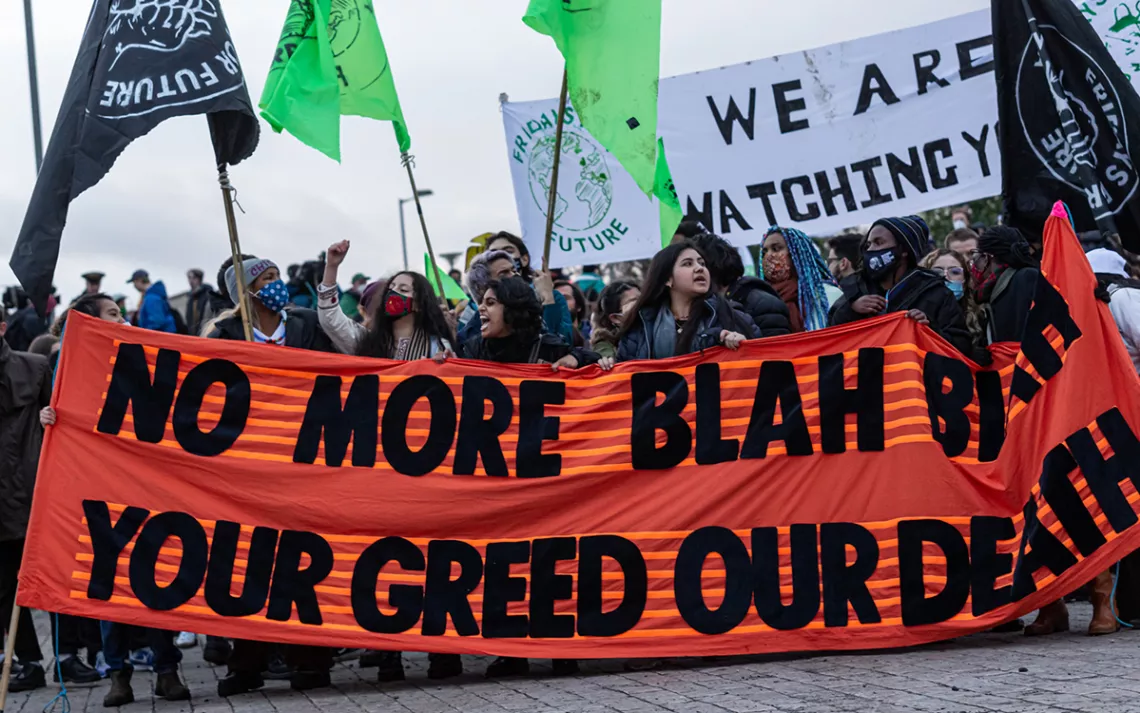
Climate activists protested against BP at the energy giant’s annual general meeting in Aberdeen, Scotland on May 21, 2019. Karen Murray / Friends of the Earth Scotland.
Oil major BP has scrapped its goal of reducing oil and gas production by the end of the decade, angering environmental groups who say the company is prioritizing profits over the planet.
According to three sources who have knowledge on the matter, BP CEO Murray Auchincloss scaled back the company’s energy transition plans in order to regain investor confidence, reported Reuters.
“As Murray said at the start of the year in our fourth-quarter results, the direction is the same but we are going to deliver as a simpler, more focused and higher-value company,” a spokesperson for BP said, as The Times reported.
In 2020, BP unveiled an ambitious strategy to reduce its production by 40 percent, while quickly ramping up renewables by 2030, reported Reuters. In February of 2023, the London-based company pared back the reduction goal to 25 percent, as investors concentrated on near-term profits instead of the energy transition.
In 2022, the oil giant recorded record profits of $28 billion, The Guardian reported.
“It’s clear that Auchincloss is hell-bent on prioritising company profits and shareholder wealth above all else as extreme floods and wildfires rack up billions of dollars in damages, destroying homes and lives all over the world,” said Philip Evans, senior climate campaigner of Greenpeace UK, as reported by The Guardian.
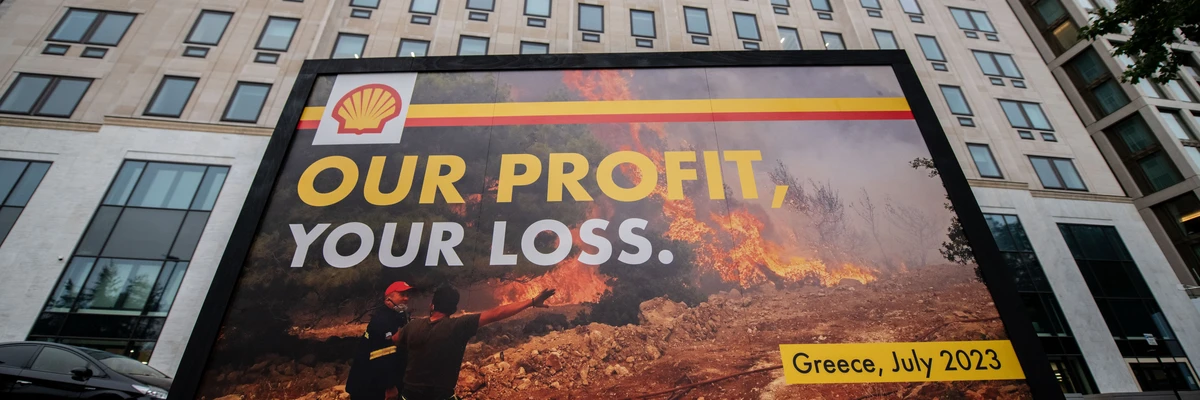
Greenpeace activists display a billboard during a protest outside Shell headquarters on July 27, 2023 in London. (Photo: Handout/Chris J. Ratcliffe for Greenpeace via Getty Images)
“The failure by our political class to deal with this completely solvable issue is staggering and shameful,” wrote one journalist.
As Hurricane Milton’s 145 mile-per-hour winds began closing in on Southwest Florida on Wednesday and people crowded into makeshift shelters across the state, climate advocates and other observers said the life-threatening storm and massive disruption to millions of people’s lives should make Americans “furious” at those who have helped make extreme weather more frequent and dangerous.
As Nathan J. Robinson wrote in Current Affairs, climate scientists and meteorologists have unequivocally told oil companies and policymakers that fossil fuel extraction is causing planetary heating, which has led to higher temperatures in oceans and bodies of water including the Gulf of Mexico, where the rapidly strengthening hurricane formed.
But despite the knowledge that fossil fuel giants like ExxonMobil and Shell had decades ago that drilling for oil and gas would cause “violent weather” and “potentially catastrophic events,” the industry’s profits have only grown as the U.S. has continued to subsidize their pollution-causing activities.
“The failure by our political class to deal with this completely solvable issue is staggering and shameful,” wrote Robinson. “Many of them have children and grandchildren. Presumably they would like their descendants to inherit a world worth living in. And they could make that happen. Unfortunately, it would require challenging the power and profits of some of America’s most influential corporations.”
In the Substack newsletter Heated, Arielle Samuelson explained on Wednesday how fossil fuel extraction and planetary heating “mutated” Hurricane Milton, which stunned weather experts this week as its wind speeds grew at a record-breaking pace, from 60 miles per hour to 180 miles per hour in just 36 hours.
It was the second time in recent weeks that a hurricane in the region has intensified quickly; areas that are expected to take a direct hit from Milton are still overwhelmed by the destruction left by Hurricane Helene.
Hot temperatures in the planets’ oceans and gulfs fuels hurricanes, and as Samuelson noted, scientists say the “extremely hot” Gulf of Mexico “was made far more likely by heat-trapping pollutants from the fossil fuel, agriculture, chemical, and cement industries.”
She continued:
In the past two weeks, ocean temperatures in the Gulf of Mexico were about 30-31° Celsius (86-88°F)—about 1 to 2° Celsius above average. The climate crisis made these extraordinarily high ocean temperatures at least 400 to 800 times more likely over the past two weeks, according to a rapid attribution study from Climate Central.
[…]
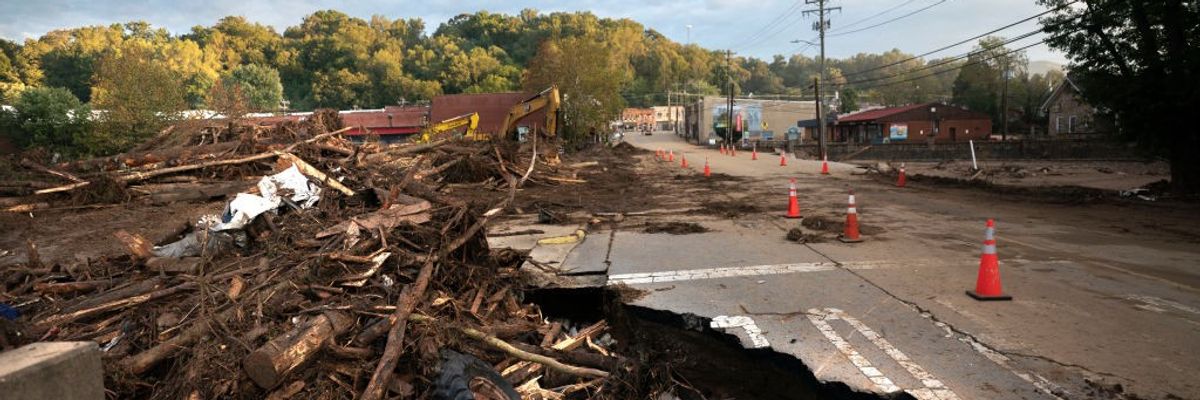
The science is also extremely clear that heat-trapping pollution causes sea-level rise and heavier rainfall, both of which make hurricanes more dangerous. Rainfall rates for tropical cyclones are expected to rise with the planet’s temperature, causing deadly flash floods like those found in Asheville, North Carolina. Sea level rise also means that coastal communities, and communities further inland, are more likely to be flooded during a storm.
That’s an objectively scary reality. But we know the primary source of greenhouse gas pollution, scientists note, so we also know how to slow the problem.
The lingering destruction of Helene and the impending landfall of Milton come, noted Fossil Fuel Media director Jamie Henn, weeks after three Democrats in Congress introduced legislation to require fossil fuel companies and oil refiners that do business in the U.S. to pay into a $1 trillion Polluters Pay Climate Fund, with their contributions based on a percentage of their global emissions.
The fund would be used to finance climate adaptation and other efforts to confront the impacts of the climate crisis.
There is a bill in Congress *right now* that would fund FEMA and resiliency efforts by making Big Oil pay for climate damages.
The Polluters Pay Climate Fund Act would provide at least $15 billion to FEMA to "address climate related disasters." https://t.co/cza3eiGZCn
In a press briefing on Wednesday, President Joe Biden noted how the damage done by Helene and the rapidly evolving news about Milton has left overwhelmed Americans vulnerable to misinformation, with some urging them to direct their anger at the White House or the Federal Emergency Management Agency (FEMA).
Republican presidential nominee Donald Trump has made baseless claims that FEMA funds were spent on funding for immigrant shelters, while U.S. Rep. Marjorie Taylor Greene (R-Ga.) wrote on social media that an unnamed “they” can control the weather and suggested the federal government is deliberately keeping emergency aid from people in states controlled by Republicans.
As fossil fuel firms and political leaders march “us toward the tipping points,” wrote Robinson, “many people won’t understand what is happening to them.”
“In a chaotic information environment filled with endless falsehoods, they’ll conclude that the president is manipulating the weather, or FEMA is trying to kill people,” he wrote. “The real story, however, is straightforward: We have a political class that is vastly more committed to sending weapons to war criminals than funding emergency management, and which will not acknowledge the basic facts of the problem (and the known solutions) because some large economic actors benefit in the short run from the destruction of the planet.”
“Truly, it’s revolting,” he added. “What an absolute disgrace our failure to deal with climate change is.”
Candice Fortin, U.S. campaigns manager for 350.org, said that fossil fuel executives and the politicians that support them have “blood on their hands” and called on Biden to unequivocally stand on the side of hurricane victims by declaring a climate emergency.
“This is a climate emergency,” said Fortin. “Every time we repeat that, countless more lives have been lost or upended by the fossil fuel industry. How many more times will it take? We call on President Biden to use his executive power to declare a climate emergency so we can finally protect frontline communities.”
At Newsweek, organizer and attorney Aaron Regunberg wrote that oil companies’ contributions to the climate emergency have been compounded by their vast efforts to spread misinformation and hide their knowledge that fossil fuel extraction was heating the planet.
Exxon CEO Darren Woods, he wrote, pushed for a surge in the company’s extractive activities while “overseeing a substantial portion of the company’s climate deception efforts,” and received $198.9 million for his “climate crimes” from 2015-23, as well as owning Exxon shares worth $371.1 million.
“Regular people are paying the ultimate price for this sociopathic greed,” wrote Regunberg. “The families made homeless, the wives and husbands and parents and children who lost loved ones to Helene—these victims deserve justice no less than victims of street-level crimes, and the companies and corporate executives responsible for their pain and suffering deserve criminal punishment at least as much as, if not far more than, the average street-level offender.”
“Climate victims have paid so much for Big Oil’s reckless conduct,” he added. “It’s time to make the polluters pay.”
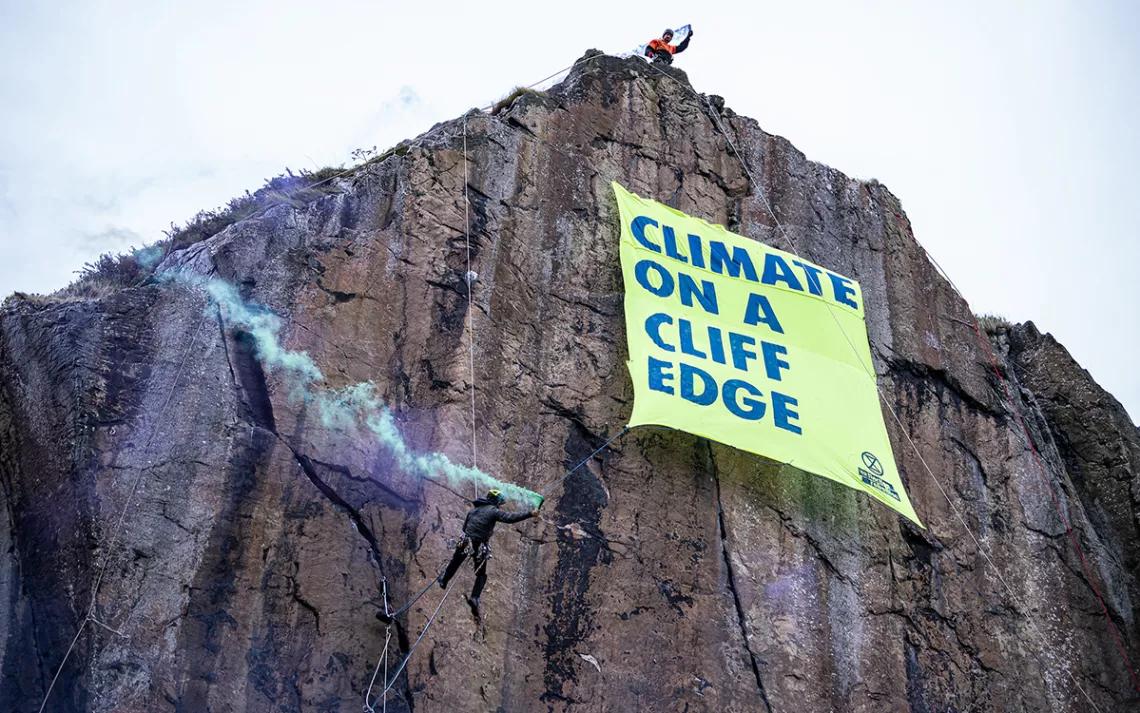
Experienced climbers scale a rock face near the historic Dumbarton castle in Glasgow, releasing a banner that reads “Climate on a Cliff Edge.” One activist, dressed as a globe, symbolically looms near the edge, while another plays the bagpipes on the shores below. | Photo courtesy of Extinction Rebellion and Mark Richards
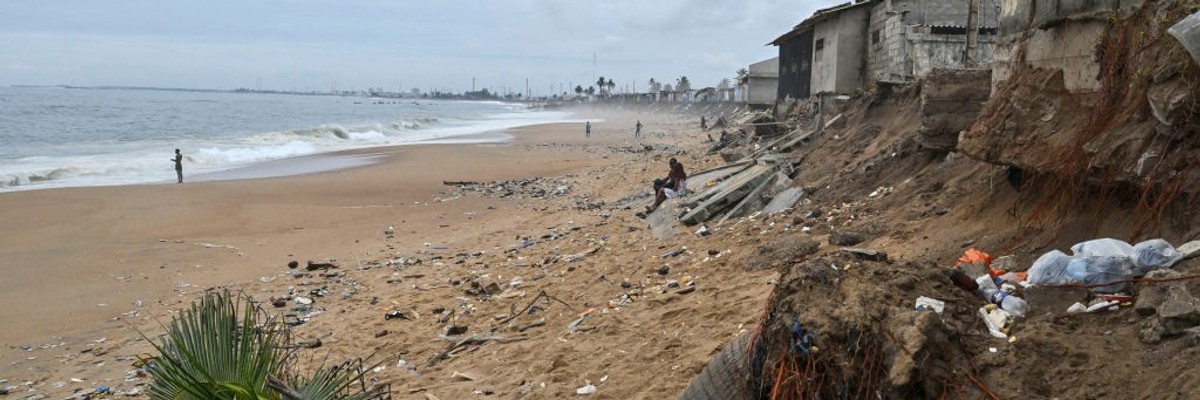
Houses destroyed by the rising sea level are shown at the Port-Bouet beach in Abidjan, Côte d’Ivoire on September 2, 2024. (Photo by Issouf Sanogo/AFP via Getty Images)
“Only by doing much more in this critical decade to bring emissions down and peak temperatures as low as possible, can we effectively limit damages.”
Just over a month away from the next United Nations climate summit, a study out Wednesday warns that heating the planet beyond a key temperature threshold of the Paris agreement—even temporarily—could cause “irreversible impacts.”
The 2015 agreement aims to limit global temperature rise this century to 1.5ºC, relative to preindustrial levels.
“For years, scientists and world leaders have pinned their hopes for the future on a hazy promise—that, even if temperatures soar far above global targets, the planet can eventually be cooled back down,” The Washington Postdetailed Wednesday. “This phenomenon, known as a temperature ‘overshoot,’ has been baked into most climate models and plans for the future.”
“The earlier we can get to net-zero, the lower peak warming will be, and the smaller the risks of irreversible impacts.”
As lead author Carl-Friedrich Schleussner said in a statement, “This paper does away with any notion that overshoot would deliver a similar climate outcome to a future in which we had done more, earlier, to ensure to limit peak warming to 1.5°C.”
“Only by doing much more in this critical decade to bring emissions down and peak temperatures as low as possible, can we effectively limit damages,” stressed Schleussner, an expert from Climate Analytics and the International Institute of Applied Systems Analysis who partnered with 29 other scientists for the study.
The paper, published in the peer-reviewed journal Nature, states that “for a range of climate impacts, there is no expectation of immediate reversibility after an overshoot. This includes changes in the deep ocean, marine biogeochemistry and species abundance, land-based biomes, carbon stocks, and crop yields, but also biodiversity on land. An overshoot will also increase the probability of triggering potential Earth system tipping elements.”
“Sea levels will continue to rise for centuries to millennia even if long-term temperatures decline,” the study adds, projecting that every 100 years of overshoot could lead seas to rise nearly 16 inches by 2300, on top of more than 31 inches without overshoot.
The scientists found that “a similar pattern emerges” for the thawing of permafrost—ground that is frozen for two or more years—and northern peatland warming, which would lead to the release of planet-heating carbon dioxide and methane. They wrote that “the effect of permafrost and peatland emissions on 2300 temperatures increases by 0.02ºC per 100 years of overshoot.”
A paper in @Nature raises concerns about the growing use and acceptance of climate overshoot scenarios, in which warming is allowed to temporarily increase past the Paris 1.5 °C limit. https://t.co/OYaLS2BZo9pic.twitter.com/IM2zR2UdVU
“To hedge and protect against high-risk outcomes, we identify the geophysical need for a preventive carbon dioxide removal capacity of several hundred gigatonnes,” the authors noted. “Yet, technical, economic, and sustainability considerations may limit the realization of carbon dioxide removal deployment at such scales. Therefore, we cannot be confident that temperature decline after overshoot is achievable within the timescales expected today. Only rapid near-term emission reductions are effective in reducing climate risks.”
In other words, as co-author and Climate Analytics research analyst Gaurav Ganti, put it, “there’s no way to rule out the need for large amounts of net negative emissions capabilities, so we really need to minimize our residual emissions.”
“We cannot squander carbon dioxide removal on offsetting emissions we have the ability to avoid,” Ganti added. “Our work reinforces the urgency of governments acting to reduce our emissions now, and not later down the line. The race to net-zero needs to be seen for what it is—a sprint.”
While the paper comes ahead of COP29, the U.N. conference in Azerbaijan next month, co-author Joeri Rogelj looked toward COP30, for which governments that have signed the Paris agreement will present their updated nationally determined contributions (NDCs) to meet the climate deal’s goals.
“Until we get to net-zero, warming will continue. The earlier we can get to net-zero, the lower peak warming will be, and the smaller the risks of irreversible impacts,” said Rogelj, a professor and director of research for the Grantham Institute at Imperial College London. “This underscores the importance of countries submitting ambitious new reduction pledges, or so-called ‘NDCs,’ well ahead of next year’s climate summit in Brazil.”
New study: “blowing past climate goals is more dangerous than it originally seemed”. My sense is that they are right. There are many tipping points in the climate system that might become irreversible except on very long timescales. https://t.co/8gHJpnlEaI
The U.N. said last November that countries’ current emissions plans would put the world on track for 2.9°C of warming by 2100, nearly double the Paris target. Since then, scientists have confirmed that 2023 was the hottest year in human history and warned that 2024 is expected to set a new record.
The study in Nature was published as Hurricane Milton—fueled by hot waters in the Gulf of Mexico—barreled toward Florida and just a day after another group of scientists wrote in BioScience that “we are on the brink of an irreversible climate disaster. This is a global emergency beyond any doubt. Much of the very fabric of life on Earth is imperiled.”
Those experts emphasized that “human-caused carbon dioxide emissions and other greenhouse gases are the primary drivers of climate change. As of 2022, global fossil fuel combustion and industrial processes account for approximately 90% of these emissions, whereas land-use change, primarily deforestation, accounts for approximately 10%.”
Experienced climbers scale a rock face near the historic Dumbarton castle in Glasgow, releasing a banner that reads “Climate on a Cliff Edge.” One activist, dressed as a globe, symbolically looms near the edge, while another plays the bagpipes on the shores below. | Photo courtesy of Extinction Rebellion and Mark Richards
Britain ended more than 140 years of coal power when it closed its last generator in September.
Coal emits more heat-trapping gas to the atmosphere than any other fossil fuel, so its demise as a source of electricity is an unalloyed good for the climate. Yet, with another announcement a week later, the UK government has helped extend the reign of fossil fuels well into the 21st century.Read more: How mainstream climate science endorsed the fantasy of a global warming time machine
Less than six months from polling day, the UK Labour party (then the official opposition) scrapped a campaign commitment to provide an annual stimulus of £28 billion (US$36.6 billion) for green industries.
Six billion pounds shy of this figure will now be raised over 25 years, Keir Starmer’s Labour government has revealed, but for a specific purpose: carbon capture and storage.
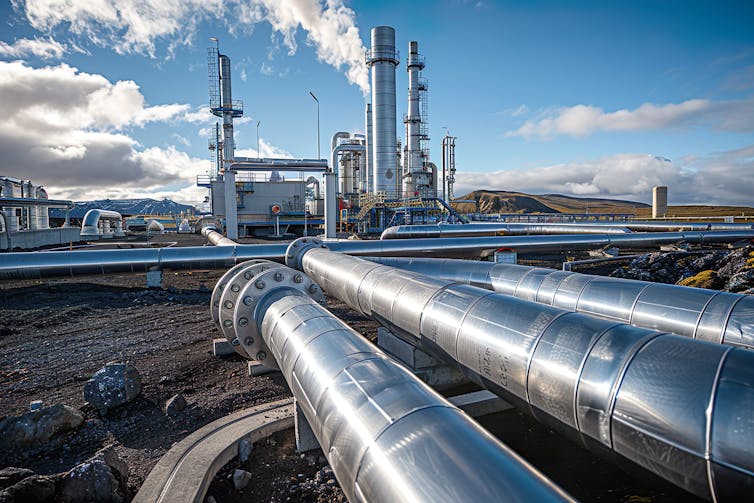
“The technology works by capturing CO₂ as it is being emitted by a power plant or another polluter, then storing it underground,” says Mark Maslin, a professor of natural sciences at UCL.
The Guardian reports that oil companies BP and Equinor will invest in a cluster of carbon capture and storage installations in Teesside, north-east England. Eni, an Italian oil company, is expected to develop sites in north-west England and north Wales. In each case, emissions will probably be pumped via gas pipes beneath the seabed.
Starmer anointed “a new era” for green jobs when announcing this funding, but experts claim he is actually offering symbolic and strategic support to climate-wrecking energy sources that have dominated for centuries.
“The Climate Change Act mandates the UK should achieve net zero emissions by 2050, yet this will be impossible if carbon capture leads to the UK building new gas power stations instead of wind and solar farms.”
Maslin was one of several scientists who wrote to energy secretary Ed Miliband criticising the plans. As he sees it, the government would not fund these projects if it did not see a future for fossil fuels beyond the middle of this century, by which time scientists have said our interference in the climate must end.
The message is clear: expensive imports of natural gas (essentially methane, a potent greenhouse gas) are here to stay. Even successful deployment of carbon scrubbers at the point of burning this gas would not erase its climate impact, Maslin says, as it leaks at all stages of its production and use.
But Maslin also doubts carbon capture and storage can siphon off the emissions of gas-fired power plants without adding to climate change. This is why climate scientists often describe carbon capture and storage as an unproven technology for decarbonising electricity and heavy industry: most of its applications have been in natural gas processing facilities where CO₂ is extracted for commercial uses.
“The track record of adding carbon capture to power plants is much worse, with the vast majority of projects abandoned,” Maslin explains.
More damning still, almost 80% of all the CO₂ captured by existing installations has been reinjected into oil fields – to pump more oil.
Could carbon capture and storage tech turn natural gas into zero-carbon hydrogen, as some hope? Again, Maslin is dubious. Water is a cleaner source for hydrogen and using this fuel to heat homes or decarbonise factories is a second-rate solution compared with renewable electricity, he says.
The fruits of appeasement
Maslin and his co-signatories say that carbon capture and storage should be limited to reducing emissions from existing fossil power plants or steel furnaces while these emission sources are rapidly phased out.
Marc Hudson at the University of Sussex is a historian of climate politics and policy in Australia, the US, UK and internationally. He has encountered policy proposals for carbon capture dating back to the 1970s and in his view, their overwhelming effect has been to prolong the use of fossil fuels by justifying investment in their expansion.
When trying to explain why rational climate policies like the mass insulation of draughty homes tends to lose out to investment in carbon capture and storage, Nils Markusson, a lecturer in environmental politics at Lancaster University, found something similar:
In other words, appeasing the fossil fuel industry is a proviso of policies drafted to address climate change. This limitation has also infiltrated scientific assessments of the climate.
A new report shows that “overshoot” scenarios – that is, projections of future climate change which accept the global target of 1.5°C will be at least temporarily breached – are rife in mainstream climate science.
This is despite evidence of the permanent damage such a breach would cause – and our doubtful ability to reverse warming once it has exceeded these dangerous levels using speculative carbon removal technology.
There is not enough land or energy to rapidly restore the carbon we have emitted. Oksana Bali/Shutterstock
What has led us here? Comprehending the climate crisis and its solutions on terms favourable to the fossil fuel industry say Wim Carton and Andreas Malm, political ecologists at Lund University.
“Avoiding climate breakdown demands that we bury the fantasy of overshoot-and-return and with it another illusion as well: that the Paris targets can be met without uprooting the status-quo.
“One limit after the other will be broken unless we manage to strand the necessary fossil assets and curtail opportunities for continuing to profit from oil and gas and coal.”
Flood damage is shown at a bridge across Mill Creek in the aftermath of Hurricane Helene on September 30, 2024 in Old Fort, North Carolina. (Photo: Sean Rayford/Getty Images)
“We are on the brink of an irreversible climate disaster. This is a global emergency beyond any doubt.”
As Hurricane Milton barreled toward Florida’s Gulf Coast, demonstrating the dangers of global warming, international scientists on Tuesday published a terrifying annual analysis that highlights the need to swiftly phase out planet-heating fossil fuels.
“Our aim in the present article is to communicate directly to researchers, policymakers, and the public,” the coalition wrote in BioScience. “As scientists and academics, we feel it is our moral duty and that of our institutions to alert humanity to the growing threats that we face as clearly as possible and to show leadership in addressing them.”
“We are on the brink of an irreversible climate disaster. This is a global emergency beyond any doubt. Much of the very fabric of life on Earth is imperiled. We are stepping into a critical and unpredictable new phase of the climate crisis,” warned the 14 experts from Australia, Brazil, China, Denmark, Germany, Switzerland, the United Kingdom, and the United States.
Their latest edition, “The 2024 State of the Climate Report: Perilous Times on Planet Earth,” shows that 25 of the 35 “planetary vital signs” the team uses to track the climate emergency are at record extremes. They include U.S.-heat related mortality, fossil fuel subsidies, coal and oil consumption, carbon dioxide equivalent emissions, per capita meat consumption, global tree cover loss due to fires, ocean acidity and heat content change, glacier thickness change, and ice mass change in Antarctica and Greenland.
“Ecological overshoot, taking more than the Earth can safely give, has pushed the planet into climatic conditions more threatening than anything witnessed even by our prehistoric relatives.”
The report emphasizes that “human-caused carbon dioxide emissions and other greenhouse gases are the primary drivers of climate change. As of 2022, global fossil fuel combustion and industrial processes account for approximately 90% of these emissions, whereas land-use change, primarily deforestation, accounts for approximately 10%.”
“For many years, scientists, including a group of more than 15,000, have sounded the alarm about the impending dangers of climate change driven by increasing greenhouse gas emissions and ecosystem change,” the publication notes. “For half a century, global warming has been correctly predicted even before it was observed—and not only by independent academic scientists but also by fossil fuel companies.”
“Despite these warnings, we are still moving in the wrong direction; fossil fuel emissions have increased to an all-time high, the three hottest days ever occurred in July of 2024, and current policies have us on track for approximately 2.7°C peak warming by 2100,” the article adds. “Tragically, we are failing to avoid serious impacts, and we can now only hope to limit the extent of the damage. We are witnessing the grim reality of the forecasts as climate impacts escalate, bringing forth scenes of unprecedented disasters around the world and human and nonhuman suffering.”
Oregon State University professor William Ripple, who led the team with Christopher Wolf of Terrestrial Ecosystems Research Associates, said in a Tuesday statement that “ecological overshoot, taking more than the Earth can safely give, has pushed the planet into climatic conditions more threatening than anything witnessed even by our prehistoric relatives.”
“We’re already in the midst of abrupt climate upheaval,” Ripple stressed. “For example, Hurricane Helene caused more than 200 deaths in the southeastern United States and massive flooding in a North Carolina mountain area thought to be a safe haven from climate change.”
“Since the publication of our 2023 report, multiple climate-related disasters have taken place, including a series of heatwaves across Asia that killed more than a thousand people and led to temperatures reaching 122°F in parts of India,” he continued. “Climate change has already displaced millions of people, with the potential to displace hundreds of millions or even billions. That would likely lead to greater geopolitical instability, possibly even partial societal collapse.”
To avoid that dark future, the article argues, “we need bold, transformative change: drastically reducing overconsumption and waste, especially by the affluent, stabilizing and gradually reducing the human population through empowering education and rights for girls and women, reforming food production systems to support more plant-based eating, and adopting an ecological and post-growth economics framework that ensures social justice.”
Devastating hurricanes, heatwaves, floods, and wildfires – we are entering uncharted waters, and cannot exclude environmental chaos as the 2024 State of the Climate Report shows. Important new report out now. https://t.co/tyE7ZUekq4
The assessment—whose authors include Michael Mann of the University of Pennsylvania, Naomi Oreskes of Harvard University, and Stefan Rahmstorf and Johan Rockström of the Potsdam Institute for Climate Impact Research—comes just over a month away from the next United Nations Climate Change Conference, COP29, which is scheduled for November 11-22 in Azerbaijan.
Pointing to previous summits, Wolf said Tuesday that “despite six reports from the International Panel on Climate Change, hundreds of other reports, tens of thousands of scientific papers, and 28 annual meetings of the U.N.’s Conference of the Parties, the world has made very little headway on climate change.”
“Humanity’s future depends on creativity, moral fiber, and perseverance,” he warned. “If future generations are to inherit the world they deserve, decisive action is needed, and fast.”
Experienced climbers scale a rock face near the historic Dumbarton castle in Glasgow, releasing a banner that reads “Climate on a Cliff Edge.” One activist, dressed as a globe, symbolically looms near the edge, while another plays the bagpipes on the shores below. | Photo courtesy of Extinction Rebellion and Mark Richards