Category: Climate Crisis
Campaigners Demand Global Ban on Deep-Sea Mining
Original article by JESSICA CORBETT republished from Common Dreams under Creative Commons (CC BY-NC-ND 3.0).

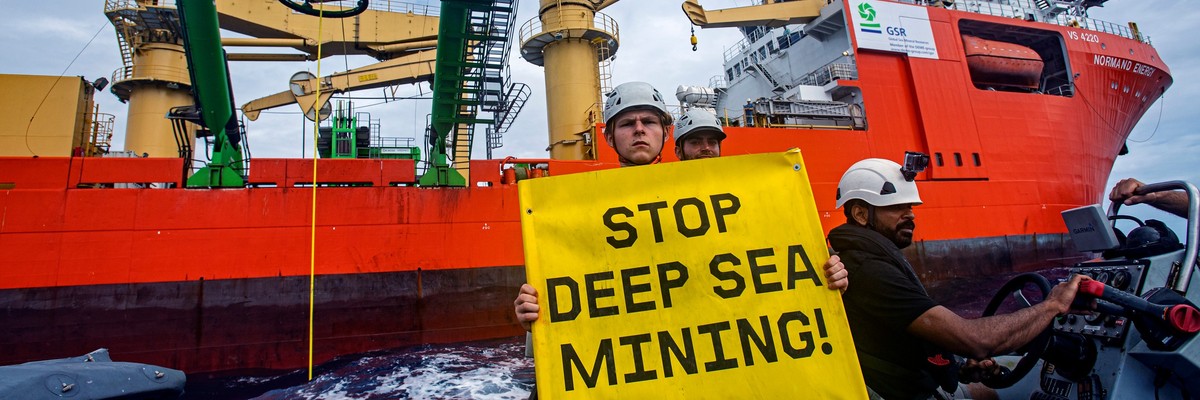
Greenpeace International activists attach a flag reading “Stop Deep Sea Mining” to the cable holding the prototype robot, Patania II, to disturb a deep-sea mining impact test by the company Global Sea Mineral Resources. (Photo: © Marten van Dijl / Greenpeace) As talks resume, supporters of a moratorium are also calling for the ouster of the International Seabed Authority’s leader, who faces an election on July 29.
As talks to establish global policies on deep-sea mining resumed in Jamaica on Monday, Greenpeace International renewed its demand for a moratorium on the practice, the path also backed other civil society and Indigenous groups, at least hundreds of science and policy experts, and 27 countries.
“The science is clear—there can’t be deep-sea mining without environmental cost and the only solution is a moratorium. The more we know about deep-sea mining, the harder it is to justify it,” said Greenpeace campaigner Louisa Casson, who is attending the United Nations-affiliated International Seabed Authority’s (ISA) 29th session in Kingston.
“Governments at the ISA must not dance to the tune of the industry and approve rushed regulations for the benefit of a few over the interests of Pacific communities and the opinion of scientists,” Casson argued, as companies and countries see chances to cash in on the clean energy transition by extracting metals including cobalt, copper, and nickel.
“The deep ocean sustains crucial processes that make the entire planet habitable, from driving ocean currents that regulate our weather to storing carbon and buffering our planet against the impacts of climate change.”
The Associated Press reported Monday that although the ISA has not allowed any extraction during debates, it “has granted 31 mining exploration contracts,” and “much of the ongoing exploration is centered in the Clarion-Clipperton Fracture Zone, which covers 1.7 million square miles (4.5 million square kilometers) between Hawaii and Mexico.”
The Mexican government last year endorsed a moratorium and Democratic Hawaii Gov. Josh Green last week signed a bill banning seabed mining in state waters, citing “environmental risks and constitutional rights to have a clean and healthy environment.”
Ahead of the meeting in Jamaica, Deep Sea Conservation Coalition campaign lead Sofia Tsenikli highlighted that “gouging minerals from the seafloor poses an existential threat that goes far beyond the immediate destruction of deep-sea wildlife and habitats.”
“The deep ocean sustains crucial processes that make the entire planet habitable, from driving ocean currents that regulate our weather to storing carbon and buffering our planet against the impacts of climate change,” Tsenikli said. “States must now protect the ocean and not allow any more damage.”
The ISA was established under the 1982 U.N. Convention on the Law of the Sea and a related 1994 agreement, and is responsible for waters not under the control of specific nations. As Common Dreams reported earlier this month, some diplomats have accused British lawyer Michael Lodge, its current secretary-general, of trying to speed up the start of mining.
“The rush to complete the mining code was triggered by the Pacific island state of Nauru, which is expected to submit a mining license application on behalf of Canada’s the Metals Company (TMC) later this year, regardless of whether or not regulations are complete,” Reuters noted Monday.
After ISA’s 36-member Council negotiates the “Mining Code” over the next two weeks, its full Assembly is scheduled to meet on July 29 to vote on the next secretary-general, with Lodge facing a challenge from Brazil’s Leticia Carvalho for the top post.
“It is time for change at the ISA,” Casson of Greenpeace declared Monday. “A third term for Michael Lodge would not only put the oceans under threat but also risk further damaging public trust in the regulator. Mining companies are impatient to get started and mounting evidence indicates that Lodge is overstepping his supposedly-neutral role to align with commercial interests.”
“The ISA must listen to millions of people and the growing number of governments calling for a halt to deep-sea mining,” she added. “It is time to put conservation at the heart of the ISA’s work.”
In preparation for the talks in Kingston, Environment Oregon Research & Policy Center, U.S. Public Interest Research Group (PIRG) Education Fund, and Frontier Group last month released a report showing that not only would deep-sea mining destroy “a vibrant, biodiverse place, teeming with complex ecosystems and thousands, possibly millions of species,” but also it isn’t necessary.
“Disposable electronic devices are creating a toxic e-waste mess. Now, some mining companies are trying to convince policymakers that we need to wreak havoc on the ocean to source the materials to make more,” said Charlie Fisher of the Oregon State PIRG Foundation. “This report shows that we don’t need to ruin the deep sea to make the products we need. There is a more sustainable path: Make long-lasting, fixable electronics and recycle them when they no longer work.”
Original article by JESSICA CORBETT republished from Common Dreams under Creative Commons (CC BY-NC-ND 3.0).
- ’Shameful’: Norwegian Government Backs Deep-Sea Mining ›
- British Head Of Deep Sea Authority Accused Of Pushing For ‘Reckless’ Mining ›
- Norway ‘Failed The World’ With Vote In Favor Of Deep-Sea Mining ›
- At The International Seabed Authority, It’s Out Of Sight, Out Of Min(E)D ›
- Greenpeace Says Ban Deep-Sea Mining, Not Our Right To Protest Against It ›
Climate activists shuts down Aberdeen incinerator choking working-class kids
Climate activists outside an incinerator in Aberdeen, July 13, 2024 Photo: Climate Camp Scotland SOME 100 climate activists have shut down an Aberdeen incinerator in the heart of the city’s most deprived community, Torry.
A £150 million waste-to-energy plant sited just 300 yards from a primary school and burning a staggering 150,000 tonnes of unrecycleable waste a year was brought to a standstill on Saturday as Climate Camp Scotland and local campaigners stood together on the picket line.
Demanding an end to private profiteering from pollution, the residents renewed their opposition to the plant, a joint project between Acciona Ltd, its operator Indaver UK, and Aberdeen City, Aberdeenshire and Moray councils which opened, to local fury, in December despite a national moratorium on new incinerators.
Karryghan, an Edinburgh climate activist who joined the action, said: “Whether this is the Scottish government missing its ‘world-leading’ targets, or the continuing oil and gas projects from UK governments, this system makes promises but never puts words into action.
“The system that allows energy companies to make record billion-pound profits from polluting communities like Torry must be replaced. A fair world must have the interests of everyday people and their communities at the heart of it.”
…
Contempt, gagging and UN intervention: inside the UK’s wildest climate trial
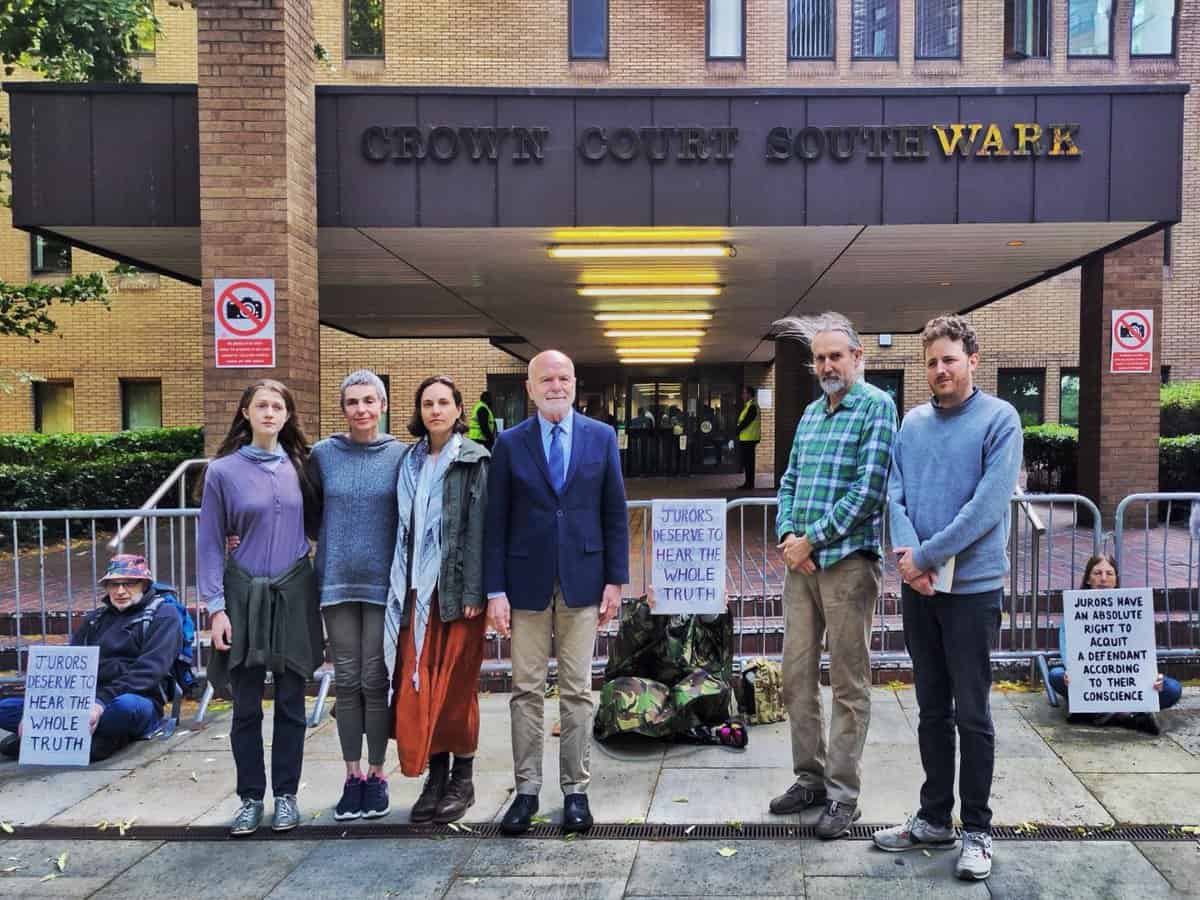
UN Special Rapporteur on Environmental Defenders under the Aarhus Convention Michel Forst attended the trial of five Just Stop Oil supporters at Southwark Crown Court. He attended as an observer because of his serious concerns. Prosecution of five Just Stop Oil activists over M25 protest led to chaotic scenes in court and concerns about ‘judicial persecution’
As part of his role as UN rapporteur for environmental defenders, Michel Forst has been watching proceedings against climate activists at courts across Europe.
But he may not have seen anything like what unfolded at Southwark crown court in London over the past two and a half weeks, where five Just Stop Oil activists were convicted for conspiring to cause gridlock on the M25 in November 2022.
On the days Forst visited, he witnessed three of the five defendants being arrested in court and dragged to the cells, protesters outside attempting to warn jurors they were not hearing the full case and a judge desperately trying to maintain control over his courtroom.
The judge, Christopher Hehir, had ruled that information about climate breakdown could not be entered into evidence, and could only be referred to by defendants briefly as the “political and philosophical beliefs” that motivated them – which he would tell the jury were in any case irrelevant to their deliberations.
But the defendants had other plans. They sought to turn Hehir’s court into a “site of civil resistance”, causing as much disruption as necessary to ensure that if the jury could not see their evidence on climate breakdown, then the jurors could at least be in no doubt it was being kept from them.
By the time the jury retired to consider a verdict, police had been called into court no fewer than seven times, four of the five defendants had been remanded to prison and 11 others were facing contempt of court proceedings for protests outside the courtroom.
…
By the end of the trial, Whittaker De Abreu, the only one who had not represented herself, was the only defendant left in court.
As a punishment for their “persistent disruption”, Hehir slashed the time given to each defendant from one hour to 20 minutes. He further prohibited any mention of the climate crisis, the legal defences he had disallowed or the principle of jury equity – the idea that jurors can acquit based on their conscience.
As Hallam, Shaw, Lancaster and Gethin gave their speeches from behind the reinforced glass screen of the dock, they each proceeded to flout Hehir’s prohibitions, arguing they had been denied a right to a fair trial.
Hallam told jurors: “It’s blindingly obvious to us here first that you have not been given all the evidence you need. You cannot be sure of our guilt if you are not sure that you have not been given the evidence … we have received no good reason why we are not allowed to tell you what is blindingly obvious, namely what I’m not allowed to speak about. If you are not allowed to hear the blindingly obvious then it’s not a fair trial is it?”
It took just a day’s deliberations for the jury to unanimously find them guilty.
Given the recent history of UK climate protest trials, in which defendants have been sentenced to jail for merely mentioning the words “climate change”, and notwithstanding the dramatic arrests in court, Forst said he was surprised the judge gave them an opportunity to mention climate breakdown at all.
“But the little latitude they had to mention climate change was in the meantime emptied of its very meaning by the fact that, overall, the jury was told to ignore most of it,” he added.
…
Green MP Carla Denyer calls on Ed Miliband to ban new drilling in the North Sea

Green Party’s co-leader and Bristol Central MP Carla Denyer on BBC Question Time. In the wake of unfounded reports that Ed Miliband will announce a ban on new drilling in the North Sea, Green Party co-leader and MP for Bristol Central, Carla Denyer, has urged the energy secretary to do just that, and “send a clear signal to the fossil fuel industry that they have no future in the UK.” Denyer said:
“It didn’t take long for the right wing press to come out waving the banner for the fossil fuel industry together with the usual round of scare stories about a dent to the economy and tax revenues if we don’t continue to burn oil and gas. Those cheerleading for oil and gas corporations must not be allowed to derail us from the path towards a green transition. That is where our future prosperity and thousands of good new jobs lies. We need to seize the opportunities that greening the economy will bring.
“This is a test to see how brave and bold Labour will be and whether they will send a clear signal to the fossil fuel industry that they have no future in the UK. Ed Miliband certainly should ban all future licences for new North Sea oil and gas fields, and do so immediately.
“The Green Party would like to see him go further by revoking the licence for Rosebank which has the potential for producing around 500 million climate-wrecking barrels of oil. We would also like to see a carbon tax on polluters to help drive the transition to cleaner and cheaper renewable sources of energy.”