An oil refinery is shown at dusk in Thailand. (Photo: credit: Suriyapong Thongsawang/Getty Images)
Climate campaigners said the “brilliant and disturbing” publication “shows the crucial need for increased awareness of the delaying tactics of fossil fuel companies.”
Echoing years of academic, congressional, and journalistic research, a U.K.-based think tank on Thursday released a report detailing how top fossil fuel industry trade groups have “used a playbook of narratives and arguments to systematically oppose, weaken, and delay the transition to renewables and electric vehicles (EVs) since at least 1967.”
The new InfluenceMap analysis focuses on the American Petroleum Institute (API), FuelsEurope, and Fuels Industry U.K.—whose spokespeople responded to the report by insisting to SustainableViews that the oil and gas industry is playing an “essential” role in the transition and it is necessary to harness “vast energy resources, from oil and natural gas to renewables.”
Meanwhile, InfluenceMap’s report calls out the organizations for their use of three narratives over the past five decades that “has likely contributed to delaying the energy transition and continues to pose a serious threat to policy progress on climate change.”
“Between 1950 and 2022, the members of these associations have a combined contribution of approximately 350 billion tons of greenhouse gas emissions, accounting for approximately 18% of the world’s total cumulative CO2 emissions from fossil fuels and industry,” the report notes.
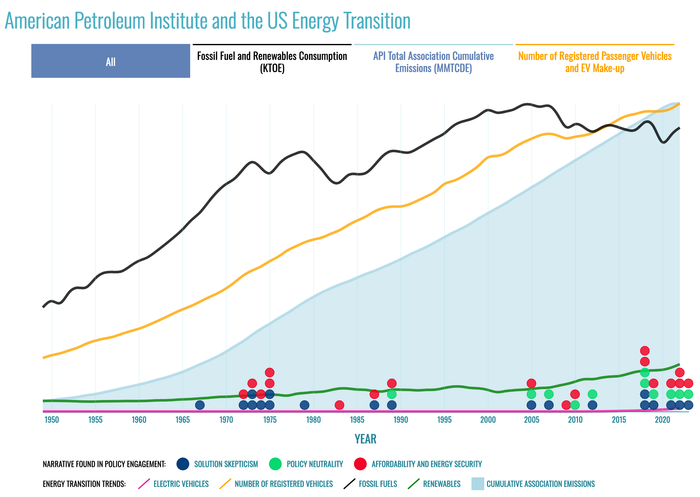
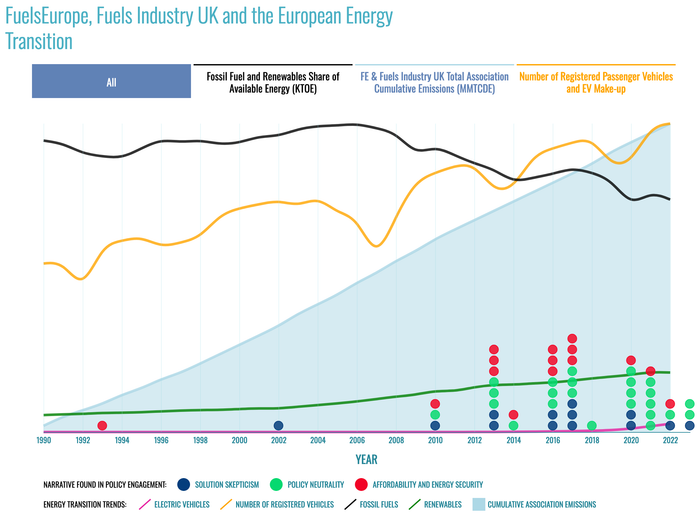
InfluenceMap traced the narratives “across 51 separate instances of the associations’ advocacy against fossil fuel alternatives between 1967 and 2023,” the publication explains. “These narratives include ‘Solution Skepticism,’ which has been in use for 56 years, ‘Policy Neutrality’ for 34 years, and ‘Affordability and Energy Security’ for 51 years.”
The group defined the narratives as follows:
Solution Skepticism: downplays the impact and viability of alternative energy.
Policy Neutrality: promotes consumer choice, market solutions, and minimal government intervention.
Affordability and Energy Security: paints fossil fuel alternatives as a risk to cost-effective and secure energy.
“Despite advancements in understanding the threats posed by the climate crisis, these narratives persist as of 2023,” the report says. It also emphasizes that the narratives contradict science-based policy recommendations from the United Nations’ Intergovernmental Panel on Climate Change (IPCC) and the International Energy Association (IEA).
Some examples identified by InfluenceMap include API comments on the Clean Air Act and amendments in 1967, 1970, and 1989 as well as the association’s remarks on the Inflation Reduction Act of 2022 and pollution standards for heavy-duty vehicles last year. The publication also points to FuelsEurope’s 2021 comments on European Union Performance Standards and the group’s participation in a 2022 letter about the Energy Performance of Buildings Directive.
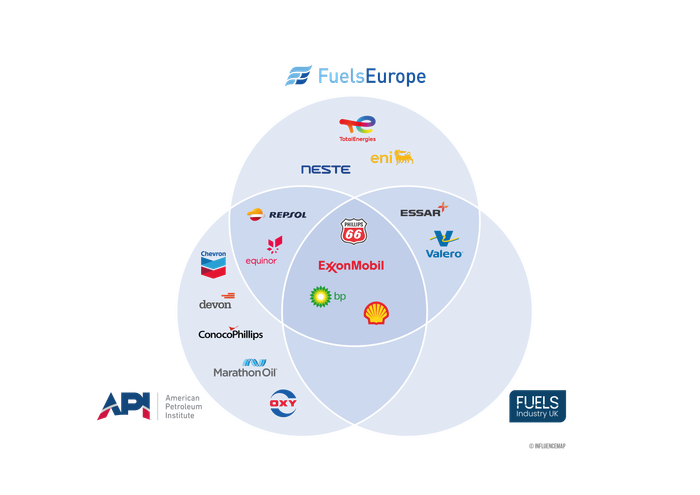
InfluenceMap produced graphics to display its findings, including one that shows key members of each association as of March. Members of all three include BP, ExxonMobil, Shell, and Phillips 66.
“Some of the world’s largest oil and gas companies are still paying a high premium to participate in industry associations that may no longer represent them on climate policy,” the report states, pointing to how associations’ actions contrast with public positions taken by some major fossil fuel corporations. “Meanwhile, Shell, Chevron, and Exxon have disclosed that they pay between $5 million and $12.5 million per year to hold a membership with the API.”
The think tank also made a pair of graphics showing how the trade associations’ documented use of the three narratives aligns with fossil fuel and renewables consumption, association members’ cumulative emissions, and the number of EVs compared with the total number of registered passenger vehicles since the 1950s.
“This report shows that even faced with mounting scientific evidence over decades, the oil and gas industry have pushed ahead with a damaging messaging strategy they developed as early as the 1960s,” said Tessa Khan, founder and executive director of Uplift, which supports a rapid and fair transition away from fossil fuel production in the U.K.
“It shows the crucial need for increased awareness of the delaying tactics of fossil fuel companies from policymakers if they are to successfully drive the energy transition forward at the pace we need,” Khan added.
Calling the report “brilliant and disturbing,” the U.K.-based Fossil Free Parliament said that “this is exactly why we need to remove the industry’s seat at the table in Westminster.”
In the United States, Democratic federal lawmakers recently concluded a probe into BP, Chevron, ExxonMobil, Shell, API, and the U.S. Chamber of Commerce for decades of spreading climate disinformation, after which they urged the U.S. Department of Justice to investigate all six.
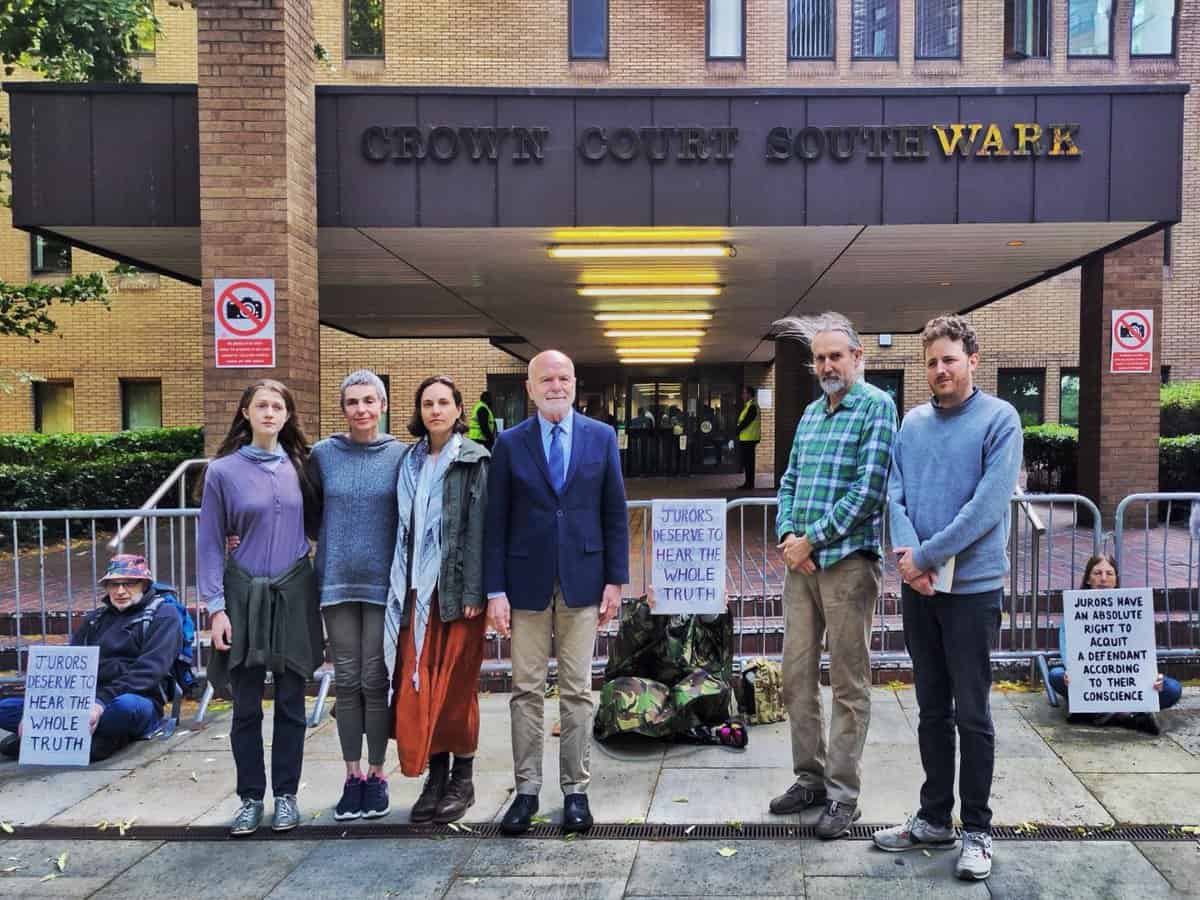
UN Special Rapporteur on Environmental Defenders under the Aarhus Convention Michel Forst attended the trial of five Just Stop Oil supporters at Southwark Crown Court. He attended as an observer because of his serious concerns.
JUST STOP OIL (JSO) supporters convicted of causing public nuisance by planning to disrupt the M25 to demand an end to new oil and gas licencing have been found guilty.
JSO co-founder Roger Hallam, Daniel Shaw, Lucia Whittaker De Abreu, Louise Lancaster and Cressida Gethin have been remanded until their sentencing hearing next Thursday and face lengthy prison sentences, despite the United Nations’ condemnation of the trial.
The jury entered guilty verdicts against all defendants yesterday, ruling that the climate crisis was “irrelevant” to the trial.
Rishi Sunak on stopping Rosebank says that any chancellor can stop his huge 91% subsidy to build Rosebank, that Keir Starmer is as bad as him for sucking up to Murdoch and other plutocrats and that we (the plebs) need to get organised to elect MPs that will stop Rosebank.
“We will not issue new licences to explore new fields because they will not take a penny off bills, cannot make us energy secure, and will only accelerate the worsening climate crisis. In addition, we will not grant new coal licences and will ban fracking for good.”
UK Government Denies Claims Ed Miliband Has Banned New North Sea Oil Licences
The Department for Energy Security and Net Zero has denied reports that Ed Miliband has banned the North Sea oil regulator from issuing any outstanding drilling and exploration licences, calling them “a complete fabrication”.
Earlier today, The Telegraph claimed that the new energy security and net zero minister had overruled his officials to stop the North Sea Transition Authority (NSTA) from issuing new licences, even those that were in the final round of approval with the regulator.
But Miliband’s department hit back at the claims, telling City A.M.: “This piece is a complete fabrication – it invents meetings and decisions that have not taken place.
…
Were Miliband to have withdrawn the licences, it could have left some North Sea oil firms millions of pounds out of pocket having prepared bids before the general election was called that were in the final throes of being approved.
…
It would appear that they are incompatible positions: The manifesto says “We will not issue new licences to explore new fields … ” but yet it’s a complete fabication that Ed Miliband has banned the North Sea oil regulator from issuing any outstanding drilling and exploration licences and licences yet to be approved are going to be granted? So, which is it?
Former Secretary of State Michael Gove gave permission for the mine near Whitehaven in 2022
The government will no longer defend a decision, made by the previous government, to allow a controversial new coalmine in Cumbria.
The new Secretary of State for Housing, Communities and Local Government, Angela Rayner, has accepted there was an “error of law” in the decision to grant planning permission for the mine in December 2022.
Consequently, the government will not now be defending two legal challenges next week against the mine – by Friends of the Earth and South Lakes Action on Climate Change (SLACC).
It has instead informed the court that the decision to grant planning permission should be quashed.
BBC News has contacted West Cumbria Mining, the company behind the proposed mine, for comment.
The mine has been heavily criticised by climate campaigners and the government’s independent advisors on climate.
Two legal challenges over the climate impacts of burning the coal will be heard at the High Court in London next week.
It comes after the court ruled in June that permission for an oil drilling project in Surrey should not have been granted because the climate impacts of burning the fossil fuels had not been considered.
The government referred to that ruling in its decision on Thursday to withdraw support.
Right-wing groups are peddling false claims that the heavy rainfall that led to the region’s disastrous flooding in May is not related to climate change.
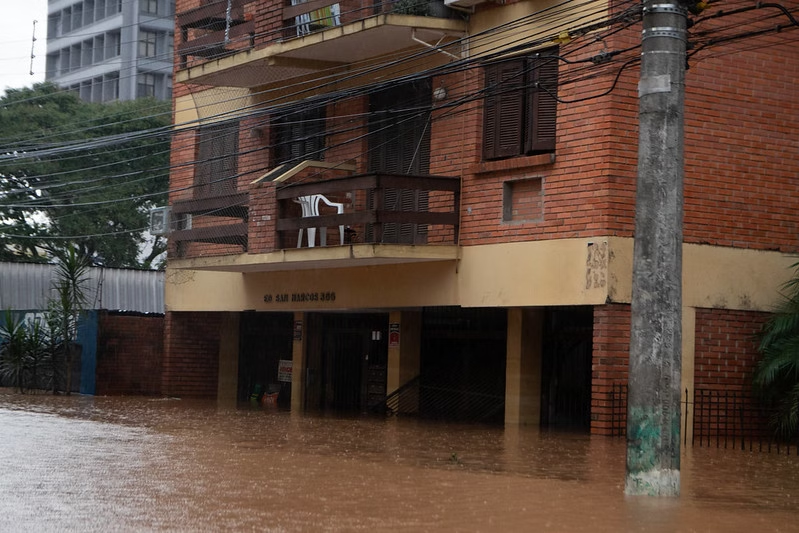
On May 9, volunteers and emergency workers were still rescuing people and animals who remained stranded on the sixth day of flooding on the streets of Rio Grande do Sul’s capital, Porto Alegre. Social media images of the rooftop rescue of a horse named Caramelo shocked the world.
A day before the dramatic rescue, Porto Alegre’s deputy mayor, Ricardo Gomes, appeared on a livestream wearing a cap with the Brasil Paralelo logo. Brasil Paralelo is a far-right media company with a streaming platform focusing on “journalism, entertainment, and education,” as its website states. The company was founded in Porto Alegre in 2016 and serves as a main channel of climate denialism among right-wing groups in Brazil. By wearing the Brasil Paralelo logo, Gomes associated himself with an institution that experts say is a purveyor of climate denialism, at the height of a climate-related disaster.
Some days later, Ricardo Felício, a professor of Brasil Paralelo’s education wing who has also appeared on many of the platform’s documentaries, wrote that climate change did not cause the extreme rainfall in South Brazil. He published his opinions in the Revista Oeste (West Magazine), a print and online publication that caters to far-right followers of former President Jair Bolsonaro, saying “CO2 has nothing to do with it!”
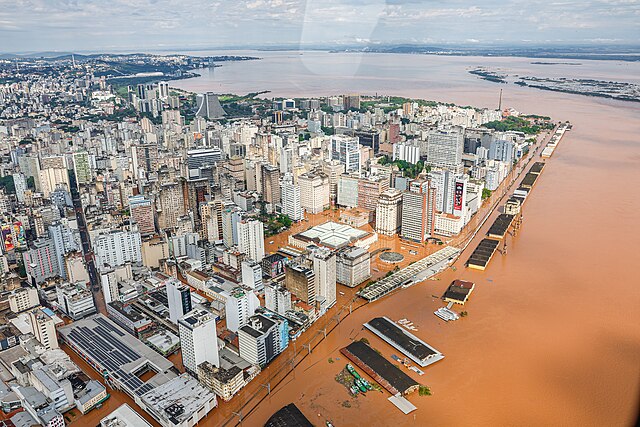
Southern Brazil was under water for the entire month of May, and two months later, it’s still facing the consequences of the worst flood in its history. Hundreds of thousands have been displaced – 180 have died, and 32 are still missing.
Flooded rivers swept away entire communities in a disaster on par with 2005’s Hurricane Katrina. The town of Estrela, located on the banks of Taquari River, was more than 70 percent submerged. In recent years, the region has experienced more and more extreme rainfall. Residents of towns on the Taquari River are still feeling the impacts of their third consecutive flood in a six-month period.
Porto Alegre, with 1.4 million inhabitants, was flooded for four weeks between May and June due to swelling water from the Guaiba River and failures of the city’s anti-flood system. The region’s main airport, Salgado Filho International Airport, is not expected to operate again until December.
Porto Alegre’s mayor, Sebastião Melo, and Deputy Mayor Gomes have led its city council since 2021. Both were elected in the wake of Bolsonarism and won decisive victories. And both have faced media criticism for failures in managing the city’s emergency responses to the flood and for failing to update its anti-flood system.
Gomes has participated in events run by Atlas Network, an extensive global collective of more than 500 think tanks, many known to have a history of working against climate action. He attended Atlas Network’s 2019 CEO Summit of the Americas, where leaders of right-wing think tanks gathered to exchange ideas. He appeared at the summit as president of RELIAL, a network of right-wing Latin American research organizations. He is a member of Atlas Network’s Global Council of CEOs team.
Gomes also participated in Atlas Network’s 2020 Latin America Liberty Forum online, again representing RELIAL. The politician is also a long-standing ally, teacher, and host of a political series on Brasil Paralelo’s YouTube channel. His political connections reveal an intricate network that links Brazilian far-right organizations that deny climate change with international think tanks.
Brasil Paralelo’s Roots
In the months after the center-left Brazilian president Dilma Rousseff was impeached in 2016, far-right proponents established Brasil Paralelo, which arose from the growth of far-right ideas that gained ground in the country at the time. Its five founders, who were students, claimed that mass media was overwhelmingly left-wing, and they wanted to challenge mainstream public opinion about the nation’s political crisis after Rouseff’s impeachment.
Three of the original founders, Lucas Ferrugem, Henrique Viana, and Filipe Valerim, now run the company. Experts interviewed for the platform’s first documentaries included names from Instituto Millenium, Instituto Liberal, and Instituto Mises, partner think tanks of Atlas Network in Brazil in 2016.
A panel titled “Entrepreneurship for Common Good” by Atlas Network partner Acton Institute used Brasil Paralelo’s founding and development as a case study in 2021. The panel explored how “entertainment can shape a society’s culture,” and Brasil Paralelo’s role within the “prevailing cultural winds to point Brazil towards pillars of freedom and virtue through a holistic approach to education and entrepreneurship,” as the video states.
Alejandro Chafuen, president of Atlas Network between 1991 and 2018 and a Mont Pelerin Society member, taught a Brasil Paralelo course about faith and free-market ideas in 2019. Chafuen also mentioned the media company in his Forbes magazine column in 2023, in which he compared the Brazilian organization to the U.S. nonprofit conservative media group PragerU. He made the same comparison to his YouTube subscribers (over 3.38 million) and Instagram followers (2.5 million), indicating that Brasil Paralelo surpassed PragerU’s audience levels with more than 300,000 subscribers on YouTube and around 400,000 on Instagram.
Chafuen compares the popularity of Brasil Paralelo to widespread support for Olavo de Carvalho, the deceased influential far-right philosopher who was also known for his strident scientific denialism, including climate denialism. Chafuen also wrote in Forbes that “Brasil Paralelo is planning to land in the United States and replicate its success with U.S.-focused topics, teams, and profiles.”
In August 2023, Brasil Paralelo ran an article raising doubts about the effects of climate change stemming from a speech by UN Secretary Antonio Guiterrez claiming that “the era of global boiling has arrived”. According to the article,”It is not a question of denying climate change, but of discussing whether or not humankind influences this process and to what degree the planet will warm up (or cool down).”
Chafuen’s article promoted a 2021 Brasil Paralelo documentary called “Cortina de Fumaça” (“Smoke Screen”). It stated that the documentary seeks to answer questions such as, “How does the environmental movement affect the economy in Brazil and other countries? What lies behind some of the main environmentalist misinformation?”
Patrick Moore, a known climate science denier, is presented in the documentary as a co-founder of Greenpeace. Years before, DeSmog had reported that this claim was false. Moore stated in the documentary that Greenpeace is “a conspiracy organization, spreading junk science around the world.”
One of the sections in “Smoke Screen,” which is available on YouTube, is titled “Environmental apocalyptic predictions that are false.” The journalist Augusto Nunes, one of the founders of Revista Oeste, said in the segment that the Amazon rainforest is not being destroyed, contradicting official data from 2021. Other sources in Brazil, including Aldo Rebelo, former minister of defense during Rousseff’s government, supported the same argument.
According to the documentary, environmental campaigners’ criticisms and so-called “lies” about the Amazon rainforest’s deforestation are attempts to protect the U.S. and European agricultural markets.
In another article in September 2023, Brasil Paralelo defended the idea that global warming legitimizes NGOs’ actions pushing international actions such as the Paris Agreement, which the platform claims keeps developing countries producing less while first-world countries maintain their production.
In an interview with The Intercept Brasil, researcher Renata Nagamine from the Brazilian Center of Analysis and Planning (Cebrap) said Brasil Paralelo’s “Smoke Screen” uses a “scientific repertoire on the margins of climate science.”
When contacted by DeSmog, representatives for Brasil Paralelo did not respond to requests for comment.
“CO2 Has Nothing to Do With It!”
Climate change boosted the rainfall volume in Rio Grande do Sul by 15 percent, according to a study by the website Clima Meter, which confirmed the influence of climate change on the recent flooding disaster in the region.
Clima Meter is “an experimental rapid framework for understanding extreme weather events in a changing climate based on looking at similar past weather situations.” From the analysis of the patterns of local precipitation and the ElNiño-Southern Oscillation, the researchers interpreted the “Brazil floods as an event whose local characteristics can mostly be ascribed to human driven climate change.”
Flooding in South Brazil on May 5. Credit: Ricardo Stuckert/Wikimedia Commons
Davide Faranda, a researcher of the Laboratory for Sciences of Climate and Environment at the Institute Pierre Simon Laplace and coauthor of Clima Meter’s study on Brazil’s flooding, said in an interview with the local newspaper, GaúchaZH, that floods have been intensified by the burning of fossil fuels and have a major impact on vulnerable communities, which bear the brunt of climate change.
However, Ricardo Felício, who teaches courses at Brasil Paralelo and is a professor of geography at the University of São Paulo (USP), offered a contradictory explanation for the disaster.
“It is confusing to relate the climate to a meteorological scenario of large dimensions, which is the case here,” wrote Felício in his May 12 weekly column in Revista Oeste. “CO2 has nothing to do with it!”
In addition to writing for Revista Oeste, Felício is a well-known climate denier in Brazilian politics. DeSmog uncovered an interview with Felício on a once-popular Brazilian TV show, where Felício stated in 2012, “There is no scientific proof of global warming.” Brazil’s ex-president Bolsonaro tweeted an interview between Nando Moura, a well-known right-wing influencer, and Felicio in 2017.
Between 2017 and 2021, Felício gave several lectures at universities and trade associations across the country denying climate change after the Aprosoja Mato Grosso (an association of soybean growers) sponsored his talks, according to a BBC investigation.
Journalists and media executives founded Revista Oeste in 2020. It is a self-proclaimed conservative outlet and claims the problems of capitalism should be solved with more capitalism.
The magazine’s print cover in June 2024, a month after the tragedy in Rio Grande do Sul, showed the planet resting on a palm, followed by the headline “The global warming hoax.” The periodical also published other articles on the floods in Rio Grande do Sul, denying climate change had a part in the disaster.
“Historically, apocalyptic predictions about the climate have not come close to coming true. Now, activists are blaming climate change for the floods in Rio Grande do Sul,” wrote the journalist Myllena Valença. The piece claimed that “facts overturn the delirious prophecies of environmental activists, who for decades have been announcing disasters caused by global warming.” Felício is a leading source in the report.
The June print edition also featured an interview with the president of Environmental Progress, Michael Shellenberger, a well-known nuclear energy enthusiast and a Republican witness in climate hearings in the U.S. Congress. In the interview, he pointed out he is optimistic about the environment and pessimistic about civilization. “I’m worried about the hysteria around global warming,” Shellenberger said.
When contacted by DeSmog, representatives for Revista Oeste did not respond to requests for comment.
A Well-Connected Deputy Mayor
Donations poured into Rio Grande do Sul in the aftermath of the flooding disaster to help people who had lost everything. Brasil Paralelo asked for donations for an organization called Instituto Cultural Floresta (ICF).
Porto Alegre’s Deputy Mayor Gomes also requested donations to the same organization, even though his City Hall made its own donation channel available, an Agência Públicainvestigation revealed last month.
The ICF is a nonprofit organization based in Porto Alegre, and according to its website, it focuses on providing security forces with military equipment. Leaders and members of the organization are connected to the Instituto de Estudos Empresariais (IEE), an Atlas Network think tank partner in Brazil that promotes the right-wing annual meeting, Liberty Forum, which is sponsored directly by Atlas Network, and boosts right-wing political candidates.
Leonardo Fração is president of the ICF and a former IEE president. He spoke at the Liberty Forum in 2018 and in 2010.
Other ICF members are affiliated with IEE, including Bruno Zaffari, the owner of real estate and supermarket companies, and Wilson Ling, the director of the plastic packaging and forestry company Évora S.A.
Gomes held various positions, including president of the IEE from 2009 to 2012. But his relations with right-wing think tanks stretch much further. Between 2016 and 2020, he served as the president of RELIAL, and he also is a member of the Mont Pelerin Society. DeSmog research found that Mont Pelerin Society members are affiliated with over 100 organizations that also appear on the membership list of the Atlas Network.
Atlas Network also quoted Gomes in a report about the Latin America Liberty Forum in 2021.
RELIAL presents itself as a network of brain trusts that “disseminate and implement liberal principles as their flag.” Agustín Etchebarne, a member and a former director of RELIAL, is also the general director of the Fundación Libertad y Progreso, an Argentinian Atlas-affiliated think tank that supported the election of far-right Argentinian President Javier Gerardo Milei.
Atlas Network awarded Fundación Libertad y Progresoa a grant in 2024. The organization spent the money to promote an international summit in partnership with the Cato Institute for the six-month anniversary of the inauguration of Milei. The event took place June 11-12 in Buenos Aires, and Milei attended.
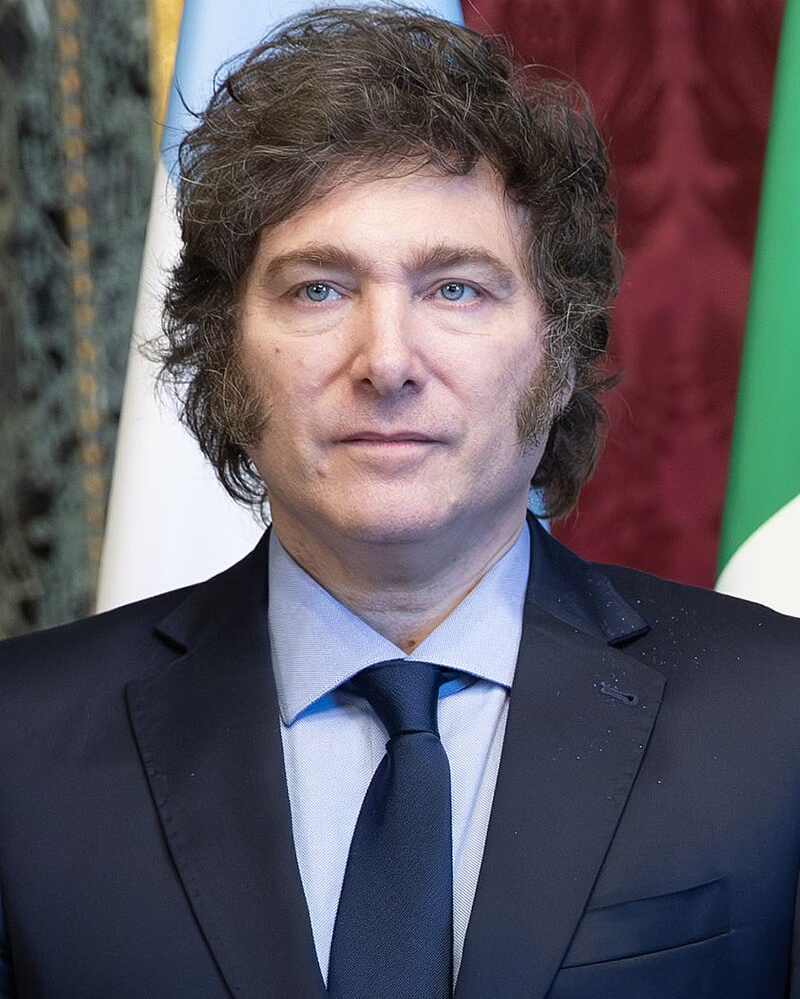
Fundación Libertad y Progresoa promoted an international summit in partnership with the Cato Institute for the six-month anniversary of the inauguration of Argentininan President Javier Milei. Credit: Wikipedia
When contacted for comment, Atlas Network said in a statement that the organization “has no grant programs related to climate change and makes no policy prescriptions to its partners on the subject of climate change.” It also stated that it “does not fund initiatives advocating against the existence of climate change.”
The organization stated that it “has no partnerships with candidates, parties, or government officials,” and that its “partners are independent, nonprofit organizations engaged in public policy issues.”
Atlas also asserted that “there are no ‘Atlas Network groups’ in Brazil,” but instead “independent partner organizations that apply to receive training, grants, and networking opportunities from Atlas Network.” The think tank network also stated that its partners are “each governed independently and are not managed by our organization.”
Political Negligence and Climate Denialism
The media has widely criticized Porto Alegre’s Mayor Melo for his crisis management issues and his administration’s low budget for flood prevention. To defend against the criticism, Melo claimed online that, “I’m not a denialist on anything, much less on the climate issue.”
Porto Alegre suffered two severe floods in 2023, including its biggest flood since 1941. However, since 2021, the city council reduced its investment in flood protection, and added no additional protection in 2023.
Experts also condemned the city’s failure to maintain its anti-flooding system, which was designed in the 1970s. The Municipal Department of Water and Sewage, which operates the system, has laid off more than half of its employees since 2013. In addition, Melo’s term in office has included environmental scandals and conflicts with environmentalists and indigenous people.
When contacted by DeSmog, Porto Alegre’s City Hall Press Office, which represents Melo and Gomes, did not respond to requests for comment.
When the flooding crisis deepened in Porto Alegre, Melo used a Bolsonarist style, applying the motto that every person looks out for his own, which summarizes his way of doing politics. “If you have a house on the beach and can afford to leave, I recommend that you leave and go to the beach,” he said, talking about wealthier families who have second homes at the beach. This comes from the mayor of a city where inequality is so entrenched that many people don’t have one home, let alone a second beach house.
Gomes has said he will not seek reelection with Melo this year, but that he will continue supporting Melo against “the radical left.” Everything suggests, however, that the Brasil Paralelo cap will officially be part of his uniform.