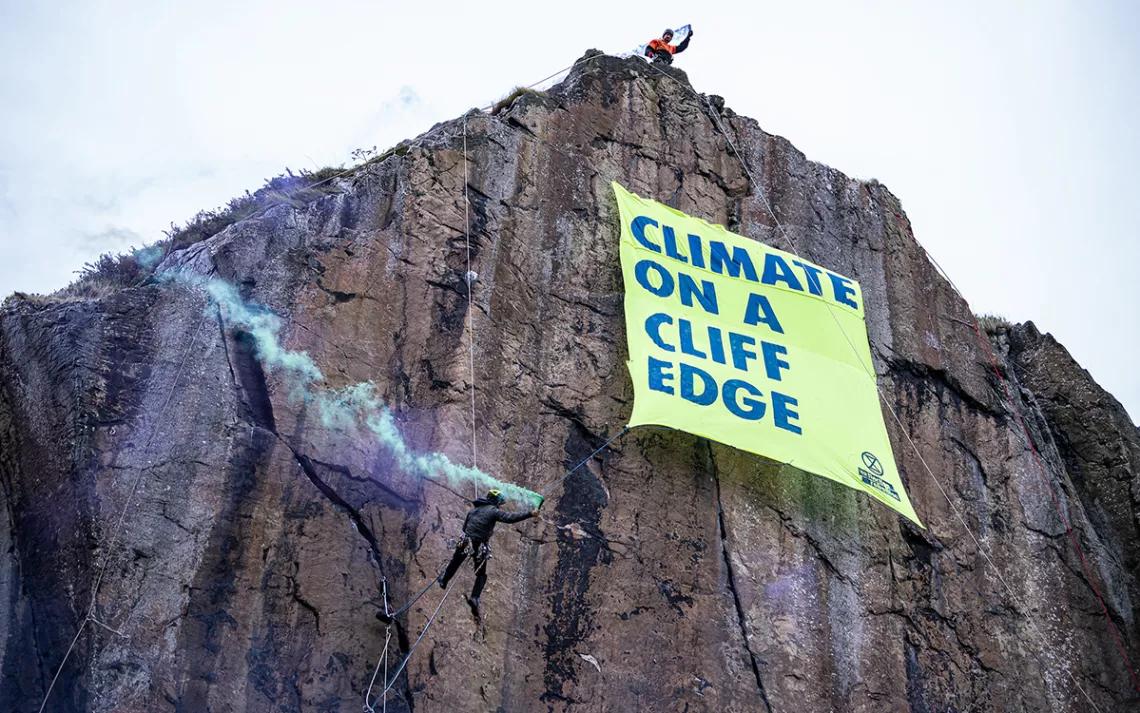
Experienced climbers scale a rock face near the historic Dumbarton castle in Glasgow, releasing a banner that reads “Climate on a Cliff Edge.” One activist, dressed as a globe, symbolically looms near the edge, while another plays the bagpipes on the shores below. | Photo courtesy of Extinction Rebellion and Mark Richards
Hundreds of deaths have been attributed to heatwave that saw temperatures approaching 50C in Delhi
The unprecedented heatwaves that scorched northern and central India in May were made 1.5 degrees Celsius hotter by the climate crisis, a new scientific assessment has found.
In the last week of May, India experienced a spell of severe heatwaves, with 37 cities recording temperatures above 45C, prompting warnings of heatstroke. The capital Delhi saw a record temperature of 49.1C.
The heatwaves led to hundreds of deaths, including one voter and several workers conducting the mammoth national election, which ended after six weeks on 1 June.
The heatwaves were nearly 1.5C warmer than the hottest heatwaves the country had seen previously despite occurring later in the typical summer season, according to a report published by ClimaMeter, a research project funded by the European Union and the French National Centre for Scientific Research, or CNRS.
The study found that the heatwaves were “a largely unique event whose characteristics can mostly be ascribed to human driven climate change”.
Graham Stringer, Labour MP for Blackley and Broughton, on GB News. Credit: GB News / YouTube
It’s “a scandal” that the party continues to support Graham Stringer, campaigners say.
The Labour Party has been criticised by campaigners after a board member of the UK’s leading climate science denial group was reselected as a candidate at the upcoming general election.
Graham Stringer, a Labour MP since 1997, has been reselected as the party’s candidate for Blackley and Broughton in Greater Manchester. Since 2015, Stringer has been a director of the Global Warming Policy Foundation, a group founded to contradict established climate science and advocate against policies to limit greenhouse gas emissions.
The GWPF has in the past expressed the view that carbon dioxide has been mis-characterised as pollution, when in fact it is a “benefit to the planet”. GWPF director Benny Peiser has said “it’s extraordinary that anyone should think there is a climate crisis”.
Staff members at the GWPF and its sister group Net Zero Watch have been given a regular platform on the right-wing broadcaster GB News in recent months, during which they have claimed that the climate emergency is simply “scaremongering”, that “net zero is doing enormous damage to the economy”, and that “the lights will go out” if we divest from fossil fuels.
“It’s a scandal that Labour is allowing Graham Stringer to stand again,” said Carys Boughton of the Fossil Free Parliament campaign group. “To keep a forthright, prominent climate denier in the fold is to suggest that the party doesn’t understand the urgency of the crisis we are facing. We need Labour to actively stand against the forces that are compromising good climate policy, be they external or within their own ranks.”
The GWPF is based in 55 Tufton Street, Westminster, which has housed a number of libertarian groups that are opposed to clean energy policies and climate science.
Stringer has vocally questioned climate science and policies to achieve net zero emissions. At a Battle of Ideas event in 2023, he said that the policies adopted by the UK to address emissions “make China stronger, make us vulnerable to supply chains that we have no control over, and cost large amounts of money.”
In 2014, Stringer was one of only two MPs on Parliament’s Energy and Climate Change Committee to vote against accepting the conclusion of the UN’s Intergovernmental Panel on Climate Change (IPCC) that humans are the dominant cause of global warming.
Stringer and Conservative MP Peter Lilley said that they did “not dispute the science of the greenhouse effect”, but that “there remain great uncertainties about how much warming a given increase in greenhouse gases will cause, how much damage any temperature increase will cause and the best balance between adaptation to versus prevention of global warming.”
Stringer also planned to join Reform UK’s Nigel Farage and Richard Tice for their launch of a net zero referendum campaign in 2022 (though he later pulled out of the event). Reform wants to scrap the UK’s 2050 net zero target, while both Farage and Tice are critics of climate science. Tice has claimed that “CO2 isn’t poison. It’s plant food”.
Speaking on GB News about his initial decision to campaign alongside Farage and Tice, Stringer said that “I’ve argued for a long time against the extra costs being placed on people to achieve net zero.”
Energy price rises triggered by Russia’s invasion of Ukraine in 2022 were exacerbated in the UK – the worst hit country in western Europe – due to its over-reliance on gas. The Office for Budget Responsibility, the government’s independent spending watchdog, has said that “the costs of failing to get climate change under control would be much larger than those of bringing emissions down to net zero”.
Conservative peer Lord David Frost is a director of the GWPF alongside Stringer. Tory and Reform donor Terence Mordaunt is also a director of the GWPF, while Conservative politician Andrea Jenkyns is a director of Net Zero Watch.
“Labour can claim a serious commitment to environmental and climate policy. Or it can select as an MP a candidate who is on the board of a Tufton Street climate science denial think tank. But it can’t do both,” said Jolyon Maugham, director of the Good Law Project.
Labour and Climate Change
The Labour Party has this week been finalising its list of candidates for the general election, with its full slate set to be submitted on Friday (7 June) ahead of the 4 July vote.
The party has been campaigning prominently on the issue of clean power, pledging to create a state-owned renewable energy investment vehicle, GB Energy, that it says will help to “speed up and scale the deployment of new technologies”.
Labour has also said that it plans to remove fossil fuels from UK electricity production by 2030, five years earlier than current government plans, and to ban new North Sea oil and gas licences.
Reports suggest that the party views climate change as a key dividing line of the election campaign, with Rishi Sunak’s Conservative government having overseen the watering down of several net zero policies over the last year. Sunak launched the election campaign by claiming that he had “prioritised energy security and your family finances over environmental dogma”.
However, Labour has been criticised for dropping its plan to invest £28 billion a year in green infrastructure to reach net zero. On announcing that the policy would be scaled down, Labour leader Keir Starmer said that “fiscal rules come first”, adding that higher interest rates meant that financing the plan would be more expensive. The pledged investment has now been reduced to £15 billion a year.
Labour did not respond to DeSmog’s request for comment, but a spokesperson previously told The Guardian: “The choice at this election is clear: a Conservative government that pollutes our rivers with record levels of toxic sewage, is led by and funded by climate deniers and fails to meet our climate and nature targets; or a Labour government that will restore nature, deliver the largest investment in clean energy in our history so we can cut bills for families, make Britain energy independent and tackle the climate crisis to protect our home for our children and grandchildren.”
Just Stop Oil supporters disrupt Duke of Westminster’s wedding
Two Just Stop Oil supporters have disrupted the ‘society wedding of the year’ between the Duke of Westminster and Olivia Henson. The pair of Just Stop Oil supporters are taking action to demand an emergency plan to end the extraction and burning of oil, gas and coal by 2030.
At around 12:30 pm, two Just Stop Oil supporters used fire extinguishers to project powder paint near the entrance to Chester Cathedral, whilst billionaire aristocrat Hugh Grosvenor and his new wife Olivia Henson made their way towards a waiting luxury 8-Litre Bentley, after leaving their wedding service and standing for photos. Police quickly intervened and arrested the two ladies.
One of those taking action today is Polly, 73, a care worker from Norfolk, who said:
“Weddings are a time of coming together in celebration to make a commitment to the future. However, for countless millions around the world there is no future unless we come together to stop oil and gas. That’s why we are demanding that the next UK government work with other countries to phase out fossil fuels by 2030.”
Experienced climbers scale a rock face near the historic Dumbarton castle in Glasgow, releasing a banner that reads “Climate on a Cliff Edge.” One activist, dressed as a globe, symbolically looms near the edge, while another plays the bagpipes on the shores below. | Photo courtesy of Extinction Rebellion and Mark Richards
Also taking action today is Sheila, 69, from Bristol, who worked as an NHS nurse for 50 years. She said:
“What do we value most? The wealth of billionaires like the Duke of Westminster OR the lives of the billions who are being destroyed by the fossil fuel industry? Extreme wealth and the climate crisis are both symptoms of a broken system that is not serving most ordinary people.”
“I am asking my fellow citizens to peacefully, but determinedly, demand an emergency plan to stop the drilling and burning of oil, gas and coal by 2030. My grandchildren, all our children and all future generations’ lives are dependent on what we all do right now.”
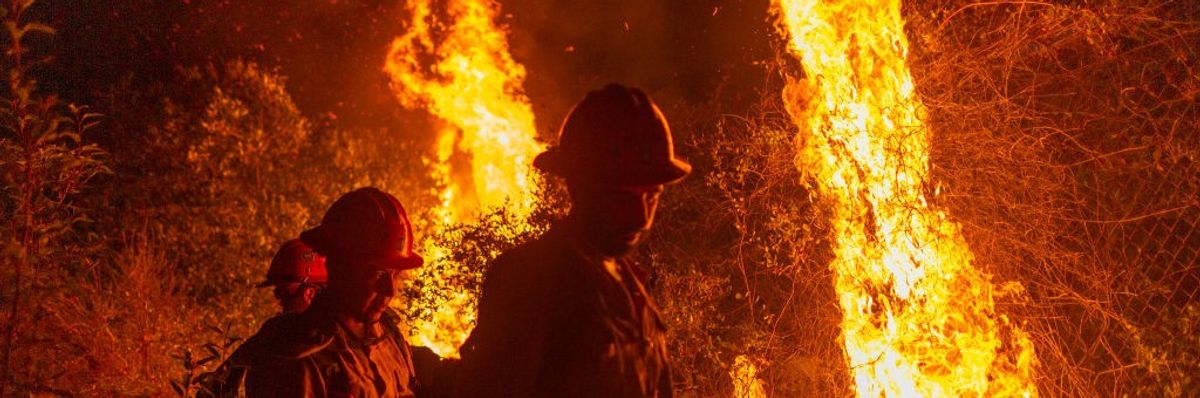
Firefighters set a backfire to protect homes during a wildfire in California in September 2020. (Photo: David McNew/Getty Images)
“The devastation wrought by wildfires, drought, flooding, and heatwaves the world saw in 2023 must not become the new normal,” the report’s author said.
Climate scientists published a report Wednesday showing that the rate of global warming reached an all-time high in the 10 years up to and including 2023 and that the record-breaking heat of last year was primarily due to that human-caused heating rather than other factors such as El Niño.
The scientists found that from 2014 to 2023, the Earth warmed 0.26°C—higher than any previous 10-year period. The report, published in Earth System Science Data, was completed by 57 scientists who used the methods of the United Nations Intergovernmental Panel on Climate Change (IPCC), which produces major reports only every five to 10 years, with the next one expected in 2027. The report authors sought to fill the gap and, at least in one case, to galvanize climate action.
“Rapidly reducing emissions of greenhouse gases towards net zero will limit the level of global warming we ultimately experience. At the same time, we need to build more resilient societies,” lead author Piers Forster, a climate physicist at the University of Leeds in the U.K. and an IPCC author, said in a statement. “The devastation wrought by wildfires, drought, flooding, and heatwaves the world saw in 2023 must not become the new normal.”
Over the course of 2023, temperatures were on average 1.43°C above preindustrial levels, Forster and co-authors found, with an estimated 1.31°C of that due to human-caused global warming, and the relatively small remainder due to variability from events such as El Niño and La Niña.
The report also shows that the Earth’s remaining “carbon budget”—how much can be emitted before reaching 1.5°C of warming, the Paris agreement target—is now roughly 200 gigatonnes, which will take only five years or so for the global population to use. This is down from the 500 gigatonnes that the IPCC estimated remained in the budget as of 2020.
Adam Vaughan, environment editor at The Times, a U.K. newspaper, drew attention to the short time period in which humanity has to act, writing on social media that the 1.5°C target could be “blown” if emissions didn’t go down.
Global warming is advancing at its fastest since modern records began 174 years ago, according to a leading team of climate scientists inc @piersforster. They also found the carbon budget for 1.5C will be blown in around 5 years if emissions stay at current record level pic.twitter.com/7ziiNng0Ok
In a guest post in Carbon Brief, Forster and another co-author explained that their report was “nothing short of alarming, yet it does contain some encouraging news.”
“Greenhouse gas emissions have not yet risen beyond pre-pandemic levels and there is evidence that the rate of increase in CO2 emissions over the past decade has slowed compared to the 2000s,” they said.
Forster, who also led the annual report in its first iteration last year, spoke to reporters in such a way as to avoid doomsday rhetoric.
“If you look at this world accelerating or going through a big tipping point, things aren’t doing that,” he told TheAssociated Press. “Things are increasing in temperature and getting worse in sort of exactly the way we predicted.”
However, the climate news remains dire: Researchers working with even more up-to-date data—through May—have found that the average temperature increase above preindustrial levels is now 1.6°C, and each of the last 12 months has been the hottest on record for that month. Those findings are from data released by the European Union’s Copernicus Climate Change Service and reported by The Washington Post.
“The UN Secretary-General has reiterated today that the climate crisis is here and it’s hitting us hard. He made clear that if we are to have a liveable future we need to act with extreme urgency.
“Yet the Conservatives are in denial, being reckless with our future, pushing to extract more fossil fuels. And Labour are tinkering at the margins, ditching their green investment plan and will leave the UK limping towards its climate targets.
“Only the Green Party is offering real hope and real change when it comes to the climate crisis.
“Green MPs will push the next government to stop all new fossil fuel extraction projects, cancel recently issued fossil fuel licences, including Rosebank, one of the largest undeveloped oil and gas fields in the UK.
“They will also press for significant investment in the green economic transformation – something that will be good not just for our environment, but also the economy, creating thousands of new jobs. This investment makes good economic sense as the cost of inaction far outweighs the cost of climate action.
“This is an emergency. We don’t have long to act. Only the Green Party are offering the policies for a fairer greener country.”