Category: Climate Crisis

  • Is Carbon Capture Just Climate Delusion?

    Spread the love

    Original article by BASAV SEN | JIM WALSH republished from Common Dreams under Creative Commons (CC BY-NC-ND 3.0).
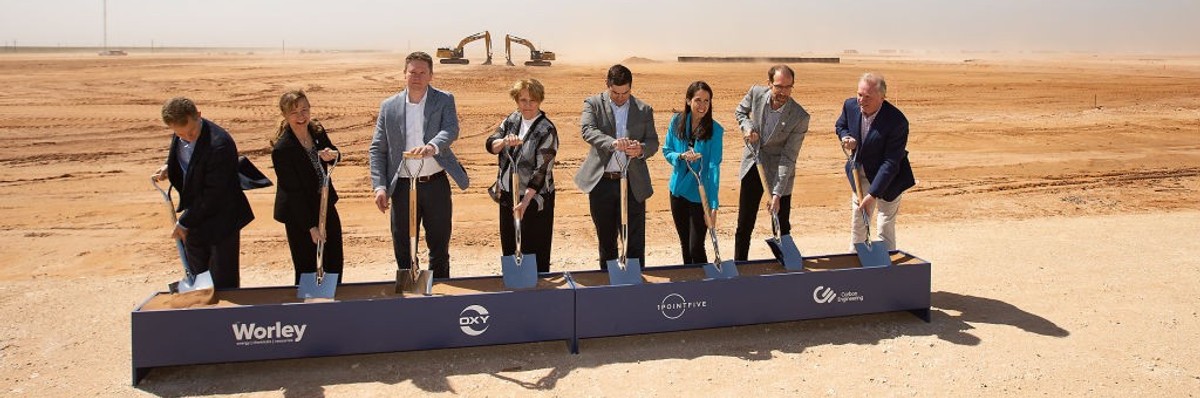
    Officials pose with shovels for a photo opportunity for the groundbreaking ceremony for Oxys Direct Air Capture facility called Stratos in West Texas on Friday, April 28, 2023.  (Photo: Elizabeth Conley/Houston Chronicle via Getty Images)

    Direct air capture and similar technologies come with glossy brochures and lofty promises but we must not be fooled. They are a distraction and a scam orchestrated by the fossil fuel industry.

    A newly opened facility in Iceland that will remove carbon dioxide from the atmosphere has been heralded as a hopeful turning point in the urgent fight to stop climate catastrophe. In reality, it is further evidence of a new type of techno-optimism that is not quite old-fashioned climate denial, but something you might call climate delusion.

    On its face, the technology known as direct air capture (DAC) seems like a plausible, painless solution to the climate crisis: Giant machines pull greenhouse gasses out of the air, and they are either injected underground or integrated into consumer products.

    For years, we have been hearing that a massive breakthrough is just around the corner. The clamor grew much louder when the Climeworks facility in Iceland came online. It is the world’s largest DAC facility—and yet is designed to capture just 36,000 tons of CO2 annually—which is, for the sake of comparison, just one percent of the pollution generated by a single coal power plant. There are much larger DAC plans in the works: Occidental Petroleum is part of a group building a facility in Texas that they claim will capture 500,000 tons of CO2 per year.

    Handing out free money to polluters is not only broadly unpopular, it is also terrible public policy. Congress must stop the public funding and support for these climate scams.

    And while that theoretical capability sounds impressive, it is still less than 0.01 percent of annual U.S. carbon emissions. And these projections become even less impressive when we consider the track record of carbon removal so far. Another recent Occidental project, the Century carbon capture facility, failed to capture more than a third of its capacity before they liquidated this asset.

    There is another more fundamental problem with most of these carbon removal technologies: When the captured carbon is used to squeeze out oil from existing wells (a process known as enhanced oil recovery), is it of any climate benefit at all? There is no doubt that Occidental sees direct air capture as a tool to help it continue extracting fossil fuels; when they are touting ‘net zero oil,’ one cannot escape the conclusion that the goal is to greenwash oil extraction as a climate solution.

    Breaking ground on the world’s largest DAC facility

    www.youtube.com

    To hear proponents of DAC explain it, science tells us this technology is a necessity at this stage in the race to stop climate catastrophe. This is misleading; there is a wide range of modeled pathways for slowing down the rate of global temperature increase, and they do not all rely on carbon removal that have not been shown to work.

    Even if DAC was shown to be effective, its costs are astronomical. The Intergovernmental Panel on Climate Change (IPCC) estimates that the cost range of early-stage DAC plants is $600-$1,000/ton of carbon dioxide; and operating DAC at a meaningful scale would consume an estimated one-sixth of the world’s energy output.

    By promoting the adoption of technologies they insist will eventually work as advertised, fossil fuel giants can delay the transition away from fossil fuels.

    Instead of viewing techno fixes like DAC as a necessity, many in the scientific community warn that reliance on DAC is a risky move that could “obstruct near-term emissions reduction efforts.” This is exactly what makes DAC and carbon capture so appealing to major polluters: By promoting the adoption of technologies they insist will eventually work as advertised, fossil fuel giants can delay the transition away from fossil fuels.

    Unfortunately, U.S. taxpayers are funding these false climate solutions; billions of dollars in subsidies are available through the Infrastructure Investment and Jobs Act, and similarly lucrative corporate tax credits are a major part of the Inflation Reduction Act. There is ample evidence that this is a poor investment. A 2020 Treasury Department Inspector General investigation found that nearly 90 percent of tax credits claimed for carbon capture operations were done so with no accompanying verification that any carbon was actually being captured.

    Instead of taking corrective action, Congress massively expanded these tax credits, making this scam even more lucrative than before. To make matters worse, the IRS will not release information about which companies are benefiting from this billion dollar taxpayer-funded boondoggle.Handing out free money to polluters is not only broadly unpopular, it is also terrible public policy. Congress must stop the public funding and support for these climate scams. Continuing to encourage the expansion of direct air capture will waste precious money and time and perpetuate further harms on communities most affected by fossil fuel pollution.

    Original article by BASAV SEN | JIM WALSH republished from Common Dreams under Creative Commons (CC BY-NC-ND 3.0).

    UN Chief Calls for Global Ban on Fossil Fuel Advertising

    ‘Dystopian’: UAE Used Global Climate Summit to Push $100 Billion in New Oil Deals

    Climate Groups Call for Rich to Pay More as International Meetings Begin

  • ‘Dystopian’: UAE Used Global Climate Summit to Push $100 Billion in New Oil Deals

    Spread the love

    Original article by JULIA CONLEY republished from Common Dreams under Creative Commons (CC BY-NC-ND 3.0). 

    United Arab Emirates’ minister of industry and CEO of the Abu Dhabi National Oil Company, Sultan Ahmed Al Jaber, speaks at an event in Houston on March 6, 2023.  (Photo: Mark Felix/AFP via Getty Images)

    “Make no mistake, COP28 was hijacked by the interests of the fossil fuel industry,” said one campaigner.

    A new analysis released by human rights and anti-corruption group Global Witness on Wednesday left no room for doubt, said one campaigner, that the host country of last year’s United Nations climate summit, the United Arab Emirates, prioritized fossil fuel interests over the planet.

    “Make no mistake, COP28 was hijacked by the interests of the fossil fuel industry,” said Patrick Galey, senior investigator for Global Witness, referring to the 28th Conference of the Parties of the United Nations Framework Convention on Climate Change (UNFCCC).

    The analysis showed that the UAE’s Abu Dhabi National Oil Company (ADNOC) used the COP28 presidency of its CEO, Sultan Ahmed Al Jaber, to seek deals worth nearly $100 billion with oil, gas, and petrochemical companies in at least 12 countries.

    Fossil fuel firms, said Galey, “weren’t content simply to block or stall genuine climate policy but used the opportunity to pursue more climate-wrecking oil and gas deals.”

    Al Jaber previously denied that ADNOC used COP28 to further its business interests after a leak of briefing documents that instructed the company to discuss fossil fuel deals with at least 16 states that were present at the talks.

    According to Global Witness, the company sought deals with at least 11 of those countries and at least one other that had not been included in the leaked documents.

    The group’s investigation found that the UAE redoubled its investment in oil and gas in Egypt in 2023, the year Al Jaber presided over COP28. ADNOC finalized a deal with TotalEnergies Marketing Egypt, purchasing a 50% stake in the company for a reported $200 million—resulting in the UAE now jointly operating 240 service stations across the country and contributing to its record profits posted in 2023.

    Other deals sought by ADNOC with COP28 participants include a joint venture with BP to buy a 50% stake in NewMed Energy in Israel and multiple bids for a stake in Braskem, the largest petrochemical producer in Latin America. The company is part-owned by Brazil’s state-run oil and gas producer Petrobas.

    ADNOC also finalized deals worth an estimated $17 billion with Lukoil in Russia and Wintershall in Germany to develop the Hail and Ghasha gas field in the UAE.

    Global Witness’ findings bolstered a report by the Center for Climate Reporting and the BBC in November, which showed Al Jaber used his position at COP28 to push for fossil fuel deals with foreign governments.

    The report confirms the worst fears of climate campaigners, who were incensed in early 2023 when Al Jaber was named the president of the U.N.’s largest annual climate conference and warned of conflicts of interest due to his position at the helm of ADNOC.

    As it turns out, said Galey, “the UAE knew exactly what it was doing and was not let down—COP28 seems to have been molded towards the benefit of its state oil company.”

    “As depressing as it is dystopian, climate talks must never be allowed to create more climate chaos,” he added.

    The analysis was released weeks after U.S. Sen. Jeff Merkley (D-Ore.) and Rep. Jan Schakowsky (D-Ill.) led 24 Democratic lawmakers in writing to Secretary of State Antony Blinken and White House Senior Advisor John Podesta, urging them to support conflict of interest guidelines ahead of COP29, which is scheduled to take place in November in Baku, Azerbaijan.

    With Mukhtar Babayev, the country’s ecology and natural resources minister who worked for a state-owned oil and gas company for more than 20 years, set to preside over the conference, Galey said that “COP28 seems to have provided other petrostates with a sinister playbook to copy and paste from.”

    “As the UAE passes the baton onto Azerbaijan, we are now looking at the possibility of consecutive COPs being hijacked for the interests of big polluters and their profits,” said Galey, noting that scientists have warned the planet is “dangerously close” to heating that exceeds 1.5°C.

    Global Witness pointed to recently announced plans to partially privatize the State Oil Company of Azerbaijan (SOCAR) ahead of COP29, “with its downstream and petrochemical subsidiaries made available to help attract foreign investments.”

    Rep. Rashida Tlaib (D-Mich.), who signed the letter spearheaded by Merkley and Schakowsky, said Global Witness’ report “is a disturbing warning about the potential for further fossil fuel corruption at COP29, which incredibly will also be hosted by another fossil fuel executive.”

    “I will continue urging the U.S. and UNFCCC to adopt new policies to prevent these absurd conflicts of interest that frustrate the international community’s work to address the urgent threats of climate change,” she said.

    Global Witness reached out to ADNOC, SOCAR, and COP29 for comment regarding its investigation, and was told that ADNOC is working to “secure, reliable, and responsible supply of energy to support a just, orderly, and equitable global energy transition and that allegations regarding Al Jaber’s deal-making at COP28 are “false, not true, incorrect, and not accurate.”

    A COP29 spokesperson said Azerbaijan is “100% committed to bringing countries together with the ambition of keeping the 1.5° target within reach.”

    Rep. Barbara Lee (D-Calif.), said in a statement Wednesday that Babayev should be removed “from any leadership role at COP29.”

    “It is an absolute scandal that the UNFCCC has two years running put an oil and gas executive in charge of this event,” she said, “thus putting foxes in charge of the henhouse.”

    Original article by JULIA CONLEY republished from Common Dreams under Creative Commons (CC BY-NC-ND 3.0). 

  • ‘Victory’: Gas Drilling Project Paused After Greenpeace Occupies Platform in North Sea

    Spread the love

    Original article by EDWARD CARVER republished from Common Dreams under Creative Commons (CC BY-NC-ND 3.0). 

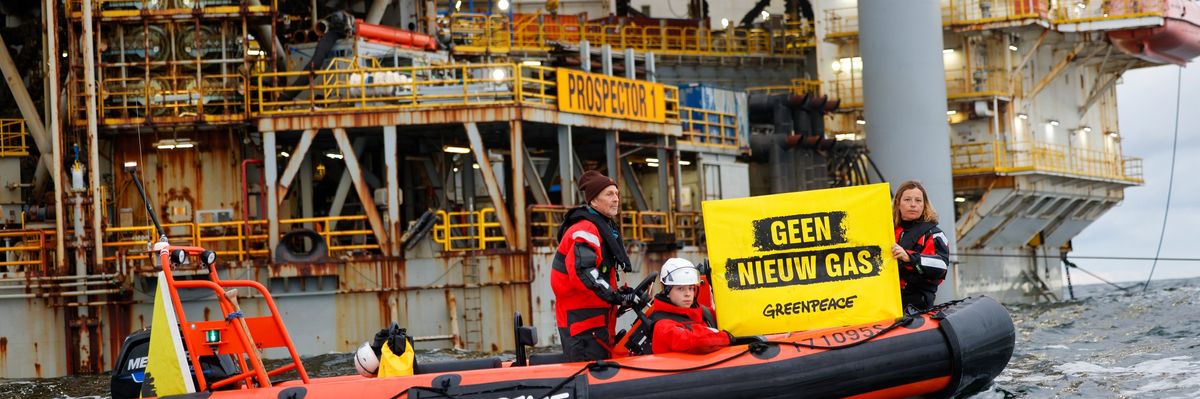
    Greenpeace activists from Germany and the Netherlands hold up a “No New Gas” placard next to an gas drilling platform that they occupied on June 4, 2024. 
    (Photo: Axel Heimken/Greenpeace)

    “Today’s events show that people power works!” a campaigner said. “Whether it is occupying a gas rig or challenging it in court, people will not be silent, we are standing up to the fossil fuel industry.”

    A Dutch court on Tuesday ordered a pause to a gas drilling initiative in the North Sea after Greenpeace activists occupied a platform owned by the company behind the project, leading the environmental group to declare “victory” as it pushes for an end to new fossil fuel infrastructure in Europe.

    The activists sought to disrupt the work of Dutch energy company ONE-Dyas, which had just received the go-ahead for offshore drilling from the Dutch government last week and quickly sent the drilling platform to the site, which is about 12 miles from the German island of Borkum and straddles Dutch and German waters.

    “The science is clear, we must stop digging and drilling for fossil fuels if we are to avoid the worst of climate chaos,” Mira Jaeger, energy expert from Greenpeace Germany, said in a statement released earlier on Tuesday, before the court decision. “We cannot afford any new fossil fuel extraction projects. Not in the North Sea or anywhere else.”

    “Today’s events show that people power works!” Jaeger said in another statement following the ruling. “Whether it is occupying a gas rig or challenging it in court, people will not be silent, we are standing up to the fossil fuel industry.”

    Greenpeace, an environmental group that engages in nonviolent direct action, has previously occupied oil and gas rigs in the North Sea and elsewhere. Last year, the group’s campaigners occupied a platform contracted by Shell, a multinational oil and gas company, as it made its way to work in U.K. waters.

    The planned Borkum drilling project, which Greenpeace has said would threaten rocky reefs and a local nature reserve, has been the subject of a legal and regulatory fight in recent years. Environmental and community groups filed a lawsuit against it in Dutch court, and a judge halted the project for over a year starting in April 2023. However, following court-ordered changes, the Dutch state secretary for economic affairs and climate approved the project last week. On Monday, Offshore Energy, a trade publication, declared that the project, which it said involves an investment of more than $500 million, had “no more legal woes” and would produce gas by the end of the year. A Dutch official noted the importance of a domestic supply of natural gas in approving the project, Offshore Energy reported.

    With the company moving quickly, Greenpeace activists aimed to block the installation of the platform on Tuesday. Five of the 21 who went to sea for the action occupied the platform, called Prospector 1, and tied themselves to pillars, according to Greenpeace. The occupation lasted 8 hours, ending when news came of the court ruling.

    Tuesday’s ruling suspended the approval granted by the Dutch state secretary for economic affairs, and is to be followed by a hearing on June 12. The decision came at the request of environmental and community groups, which submitted an application on Friday for “provisional relief.” The groups aim to block the drilling initiative entirely, arguing that ONE-Dyas should abandon its “legal tricks” and “accept reality and abandon the project.”

    Greenpeace, which was one of the plaintiffs in the application, reiterated its demand on Tuesday that the project be permanently canceled, while calling for the E.U. to abandon all fossil fuel infrastructure projects.

    “The Borkum project is just the tip of the iceberg: in Europe, fossil fuel companies are pushing European states into such massive, unnecessary investments just like TotalEnergies’ LNG terminal in France, or OMV’s Neptun Deep gas drilling project in Romania,” the first Greenpeace statement said. “But the European Union can and must put its member states on a path away from fossil fuels, by banning new fossil fuel projects and investing in an energy system based on renewables and energy sufficiency.”

    Original article by EDWARD CARVER republished from Common Dreams under Creative Commons (CC BY-NC-ND 3.0). 

  • Climate Groups Call for Rich to Pay More as International Meetings Begin
    Spread the love

    Original article by EDWARD CARVER republished from Common Dreams under Creative Commons (CC BY-NC-ND 3.0). 

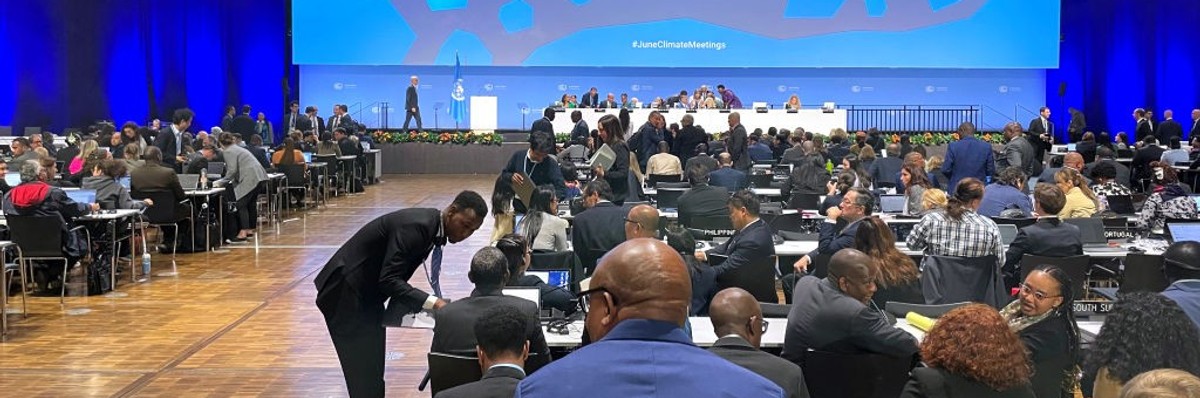
    Delegates from around the world meet at an annual climate change conference in Bonn, Germany, on June 3, 2024, in preparation for the COP29 conference in November in Azerbaijan. (Photo: Christoph Driessen/Getty Images)

    “We have to put the social justice element upfront,” an architect of the 2015 Paris agreement said as the world’s climate delegates gathered in Germany.

    Advocates on Tuesday issued strong calls to action on climate finance for developing countries and an international agency released a report on the need to ramp up renewable energy production as the Bonn Climate Change Conference continued in Germany and G7 nations prepared to meet in Italy next week.

    At the conference in Bonn, Friends of the Earth International pushed for more rich-country financing to pay for the rising costs of climate impacts in the Global South, while Laurence Tubiana, head of the European Climate Foundation and an architect of the 2015 Paris agreement, called for the global rich to pay their share through taxes and consumption levies.

    Meanwhile, two organizations warned that countries aren’t on track to meet targets they set just last year. Oil Change International (OCI) published a briefing showing that G7 nations are expanding oil and gas commitments that undermine goals set at the United Nations Climate Change Conference (COP28) meeting in Dubai, and the International Energy Agency (IEA) issued a report showing that the world’s nations are not on track to meet their Dubai pledge to triple renewable energy production by 2030.

    “The world is on fire because of decades of inaction by rich countries on reducing emissions, and their failure to pay the climate finance they owe to developing countries to transition to renewable energy systems for all, and to pay for rising costs for loss and damage and adaptation,” Sara Shaw, Friends of the Earth International program coordinator, said in a statement. “What is on the table to date is scales of magnitude away from what it needed. This year must be a year of breakthrough on climate finance.”

    Climate representatives are meeting in Bonn this week and next to prepare for COP29 in November in Azerbaijan, where a key agenda item is expected to be financing for a green transition in the Global South. COP negotiations are conducted under the aegis of the United Nations Framework Convention on Climate Change (UNFCCC). At COP21 in 2015, nations signed the Paris agreement, a treaty that sought to limit global warming to less than 2°C above preindustrial levels.

    Tubiana, an architect of that deal, said Tuesday that tackling climate change requires centering global justice in order to avoid conflict and gain public acceptance of climate measures.

    “We have to put the social justice element upfront,” Tubiana, a French economist and diplomat, told The Guardian.

    Tubiana said that raising the funds required for low-income nations will require holding both rich nations and people to account, via taxes and consumption levies, given that inequities exist not just between nations but also within them.

    “This inequality is true not only between developed countries and developing ones, but within each country—the 1% of rich Chinese, or the 1% of very rich Indians, or the U.S. citizen—they have a lifestyle which is very, very similar, in terms of overconsumption,” she said.

    The world’s richest and most powerful nations are not taking responsibility for climate action as they should, the new OCI briefing argues.

    “Some G7 countries are massively expanding fossil fuel production at home, while others are investing in more fossil fuel infrastructure abroad,” the briefing states. “Both are catastrophic failures of leadership.”

    OCI cites the United States, Italy, and Japan as particularly bad climate actors. The U.S. is the largest oil and gas producer in the world and has plans for massive expansions of the industry, despite President Joe Biden’s climate promises, the briefing notes. Italy has announced plans to double natural gas production. And both the U.S. and Japan have financed billions of dollars worth of oil and gas production in other countries just since the end of 2022, the document states, citing earlier OCI findings.

    The IEA also spelled out unfulfilled commitments, while detailing progress that has been made on the energy transition. The agency looked at the domestic policies and targets of 150 countries to see how far along they were toward reaching the international target of tripling renewable power generation by 2030. It found that once added together, the nations’ domestic plans would get them about 70% of the way toward the 11,000 gigawatts of additional capacity required to meet the goal.

    “There is a gap, but the gap is bridgeable,” Heymi Bahar, a senior energy analyst at the IEA and co-author of the report, toldThe Guardian.

    Governments have not in most cases written these domestic plans into their Nationally Determined Contributions (NDCs) under the Paris agreement. The IEA report says that countries need to “bring their NDCs in line with their current domestic ambitions” and scale those ambitions up further still, to get from 70% to 100%. Moreover, they must follow through with their promises and achieve the targets they’ve set.

    “This report makes clear that the tripling target is ambitious but achievable—though only if governments quickly turn promises into plans of action,” Fatih Birol, the IEA’s executive director, said in a statement.

    The world added about 560 gigawatts of renewable capacity in 2023, a record increase, more than half of which came from China, according to the IEA. About half of planned capacity increases are in solar, with a quarter from wind power, the IEA report states.

    Original article by EDWARD CARVER republished from Common Dreams under Creative Commons (CC BY-NC-ND 3.0). 

  • Nigel Farage’s Anti-Climate Record

    Spread the love

    Original article by Sam Bright republished from DeSmog

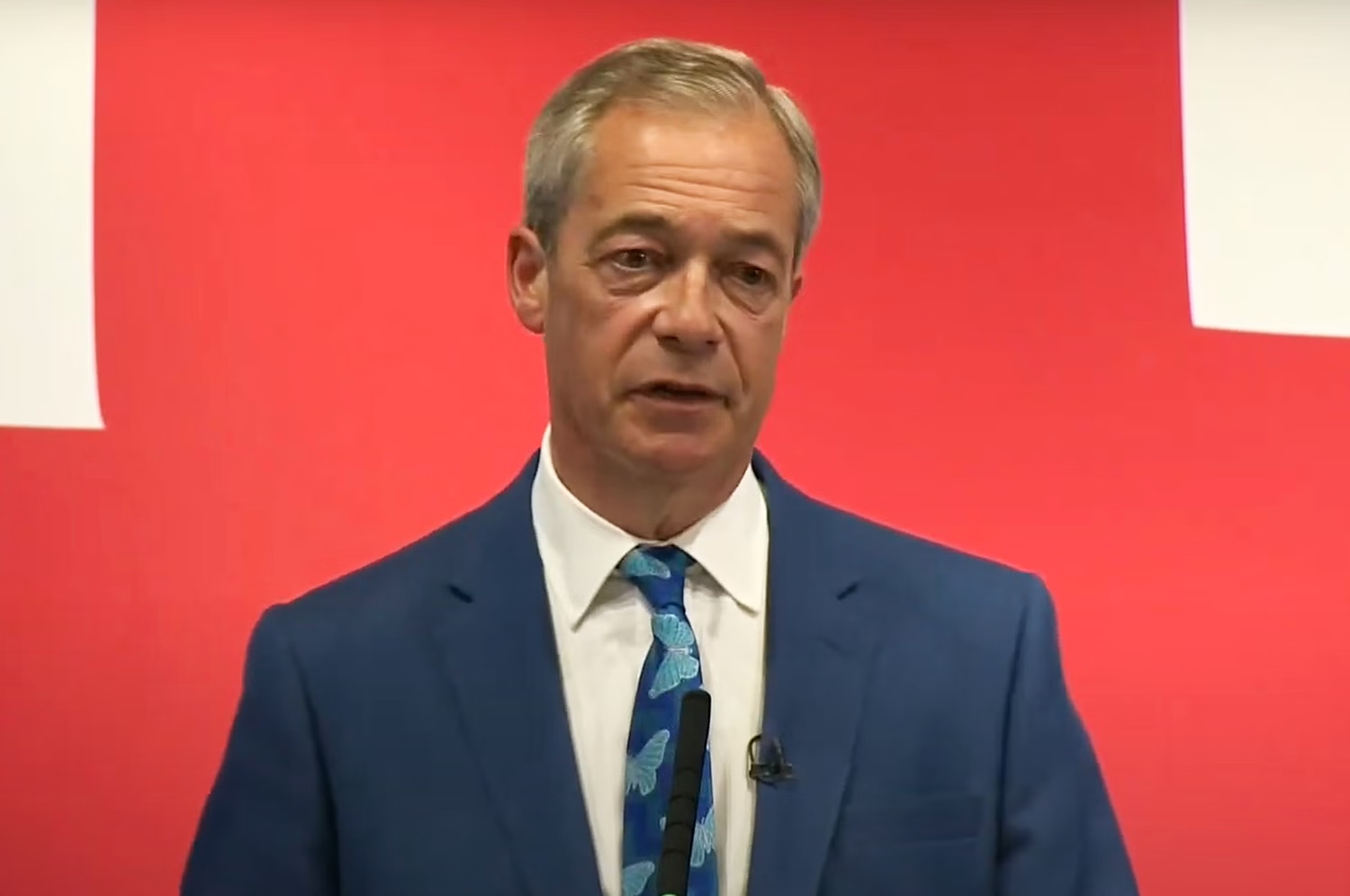
    Reform UK Leader Nigel Farage speaking at a Reform UK press conference on 3 June 2024. Credit: Reform UK / YouTube

    The Reform UK leader is a vocal opponent of net zero policies, and has questioned the basis of established climate science

    Pro-Brexit campaigner Nigel Farage has announced that he will be standing to be an MP at the upcoming general election and will be replacing Richard Tice as leader of the populist party Reform UK. 

    Farage, who says that he hopes to become “the voice of opposition” in Parliament, has long been a vocal opponent of climate action and a critic of climate science – campaigning for a referendum on the UK’s 2050 net zero emissions target.

    When he was the leader of the UK Independence Party (UKIP), the party’s 2015 and 2017 election manifestos pledged to rip up green measures, repeal the UK’s Climate Change Act, withdraw from the 2015 Paris Agreement – the flagship deal to tackle global emissions – and support fossil fuel extraction.

    These reflected Farage’s personal views on climate action. In 2015, he told the libertarian website Spiked: “I think wind energy is the biggest collective economic insanity I’ve seen in my entire life. I’ve never seen anything more stupid, more illogical, or more irrational.”

    Farage is a presenter on GB News, the right-wing broadcaster that has regularly provided a platform to climate science denial and attacks on green reforms since it launched in June 2021. 

    Speaking on GB News in August 2021, Farage said that he was “very much an environmentalist” and that he couldn’t “abide things like plastics in our seas, pollution in our rivers.” However, on the issue of climate change, he added: “What annoys me though, is this complete obsession with carbon dioxide almost to the exclusion of everything else, the alarmism that comes with it, based on dodgy predictions and science.”

    The world’s foremost climate science body, the UN’s Intergovernmental Panel on Climate Change (IPCC), has stated it is “unequivocal that human influence has warmed the atmosphere, ocean and land”, while scientists at NASA have found that the last 10 years were the hottest on record. Earth’s average surface temperature in 2023 was the warmest since records began in 1880.

    The IPCC has also stated that carbon dioxide “is responsible for most of global warming” since the late 19th century, which has increased the “severity and frequency of weather and climate extremes, like heat waves, heavy rains, and drought”.

    Farage has been a vocal critic of net zero. He has claimed that the policy is an “act of self harm” and has called for it to be scrapped. 

    He has said: “It will not bring economic benefits. It will make everybody a whole lot poorer. And yet the lemmings in Parliament are taking us towards an economic cliff,” adding: “I can’t think of an issue on which the public and politicians are more divided.”

    In fact, politicians are markedly less in favour of climate action than the general public. New polling by YouGov for the Energy and Climate Intelligence Unit (ECIU) has shown that almost two-thirds (62 percent) of the public believe the best way to achieve energy security is to reduce the use of fossil fuels and instead expand the use of renewable energy, compared to 48 percent of MPs. 

    The Climate Change Committee, which advises the government on its net zero policies, has estimated that the cost of achieving net zero will be less than 1 percent of UK GDP, while the government independent spending watchdog – the Office for Budget Responsibility – has said that, “the costs of failing to get climate change under control would be much larger than those of bringing emissions down to net zero”.

    Farage has also claimed that, “If green technology is going to work, it ought to work without ordinary folk subsidising it” – referring to the government grants and investment dedicated to developing clean energy sources. The UK government has given £20 billion more in support to fossil fuel producers than their renewable energy peers since 2015.

    Farage has also spread conspiracy theories about anti-pollution measures being used to control people’s lives. 

    In a video posted on Twitter, he argued that Mayor of London Sadiq Khan’s calls to reduce air pollution by cutting car engine use would pave the way to “climate lockdowns”. 

    He said: “Mark my words this isn’t going to end with 20mph zones and low-traffic neighbourhoods. No no. This is the beginning of climate lockdowns. We will have, in years to come, days where we’re told we can’t drive, we can’t do this, you can’t do that while Sadiq Khan is leading the way. Remember you heard it here first. Climate lockdowns.”

    The Institute for Strategic Dialogue has highlighted how climate lockdown claims are part of “a conspiratorial narrative which claims that global elites are using climate change as a pretext to restrict individual freedoms and civil liberties.”

    Farage and Reform UK

    Farage used his announcement to state his belief that Labour will win the general election, which will be held on 4 July, and that the Conservative Party has “crushed itself”. With the Tories predicted to lose in a landslide, Farage appears to believe that he can lead a new right-wing movement.

    The Reform leader was already a key figure in the party prior to today’s announcement, effectively owning the party as well as serving as its president. Reform operates as a private company without a democratic structure, so Farage’s majority shareholding meant that could have appointed himself as leader at any time. 

    Despite Farage failing to be elected as an MP when he stood in seven previous general elections, and Reform only winning two councillors in May’s local elections, polls indicate that Farage may succeed in becoming the MP for Clacton.

    If this is the case, Farage will be advocating in Parliament for the anti-climate policies that have been proposed by his party. 

    Reform has called for the UK’s net zero emissions target to be scrapped, and has proposed holding a referendum on the policy – a campaign launched by Farage in 2022. 

    The party’s policy agenda states that: “Westminster’s net zero plans send our jobs and money overseas, making us net poorer and net colder”, adding that net zero policies are “net stupid”. 

    The party’s former leader Tice, who will now become its chairman, is a prominent climate science denier. Tice has claimed that “there is no climate crisis”, and has also expressed the view that “CO2 isn’t a poison. It’s plant food”.

    Of the £2.5 million that Reform UK has received in donations since the 2019 election, around 92 percent (£2.3 million) of that income has been given by fossil fuel interests, polluting industries, or climate science deniers.

    Original article by Sam Bright republished from DeSmog