Global efforts to slow a runaway climate catastrophe may have reached a critical milestone in the last year with the peak of global carbon emissions from energy use, according to experts.
A growing number of climate analysts believe that 2023 may be recorded as the year in which annual emissions reached a pinnacle before the global fossil fuel economy begins a terminal decline.
The milestone is considered a crucial tipping point in the race to drive emissions to net zero. But for many climate experts it’s an inflexion point that was due years ago and which, although encouraging, falls far short of the rapid reduction the world needs.
The world’s leading climate scientists have consistently warned that the buildup of carbon dioxide in the Earth’s atmosphere means it is critical to drive down emissions before 2030 if leaders hope to keep global heating to a maximum of 1.5C above pre-industrialised levels. The rate at which emissions would need to be reduced will require, most experts agree, global transformation on a scale not yet in the pipeline.
“We can take a small pause to celebrate this tipping point,” said Dave Jones, a director at the climate thinktank Ember. “But in a way it’s worrying that we are still talking about when emissions might peak. The reality of the situation is that we need deep and fast reductions in emissions if we hope to stay within the vanishingly small budget for carbon which remains.”
The International Energy Agency (IEA) raised hopes earlier this year of an end to the fossil fuel era when it predicted for the first time that the consumption of oil, gas and coal would peak before 2030 and begin to fall as climate policies took effect.
“It’s not a question of ‘if’, it’s just a matter of ‘how soon’ – and the sooner the better for all of us,” said Fatih Birol, the head of the IEA.
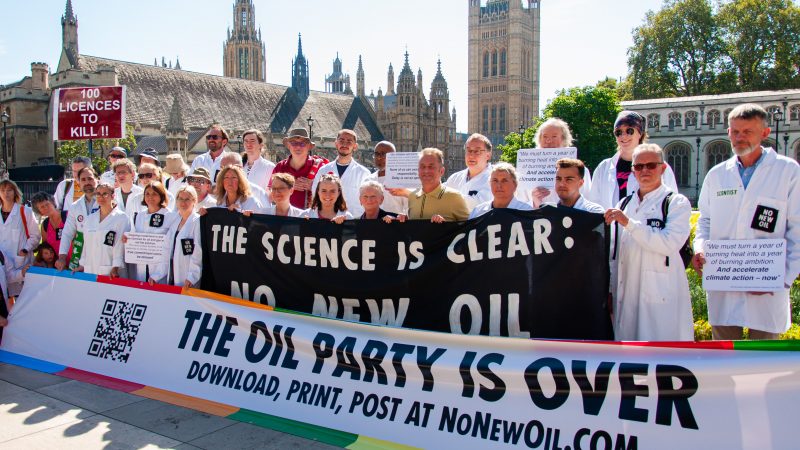
Scientists protest at UK Parliament 5 September 2023.
dizzy: I’m expecting huge disinvestment and consequent disempowerment of the fossil fuel sector. The longer investors stay in fossil fuels, the larger their lossses will be. later elaboration: Plutocrats are losing control of the narrative, activists are aware of and highlighting huge fossil fuel subsidies and fossil fuel lies like CCS, renewables becoming much cheaper, court cases, greater acceptance and recognition of role of fossil fuels in destroying the planet, green parties achieving much higher vote share, it’ll hit the fan. later still elaboration: All the increasingly extreme and more often weather events that we’re experiencing attributed to fossil fuels caused climate crisis.
The hottest year in recorded history casts doubts on humanity’s ability to deal with a climate crisis of its own making, senior scientists have said.
As historically high temperatures continued to be registered in many parts of the world in late December, the former Nasa scientist James Hansen told the Guardian that 2023 would be remembered as the moment when failures became apparent.
“When our children and grandchildren look back at the history of human-made climate change, this year and next will be seen as the turning point at which the futility of governments in dealing with climate change was finally exposed,” he said.
“Not only did governments fail to stem global warming, the rate of global warming actually accelerated.”
After what was probably the hottest July in 120,000 years, Hansen, whose testimony to the US Senate in 1988 is widely seen as the first high-profile revelation of global heating, warned that the world was moving towards a “new climate frontier” with temperatures higher than at any point over the past million years.
Now director of the climate programme at Columbia University’s Earth Institute in New York, Hansen said the best hope was for a generational shift of leadership.
“The bright side of this clear dichotomy is that young people may realise that they must take charge of their future. The turbulent status of today’s politics may provide opportunity,” he said.
Severe conditions brought turmoil across the world, impacting small towns and major cities, as storms, heatwaves, floods, and droughts claimed many lives and destroyed communities.
A bearded seal on ice off the coast of Alaska. | John Jansen / National Oceanic and Atmospheric Administration’s Alaska Fisheries Science Center
The Arctic is rapidly heating up, and that’s already spelled trouble for other parts of the world. 2023 has become the warmest year since 1900, and now, at the Earth’s southernmost point, an iceberg three times the size of Manhattan has broken away—and it’s on the move. When it comes to the ravaging effects of global warming, the world’s poles have proven themselves to be Exhibit A.
On Dec. 12, the annual Arctic Report Card was released by the National Oceanic and Atmospheric Administration. It found that the Arctic is warming four times more quickly than the world’s average, chiefly as a result of climate change caused by the burning of fossil fuels. The effect of that has already been felt south of the region, with Juneau, Alaska, stricken by a glacial outburst flood and Canada enduring a record year of devastating wildfires. Experts say the changes in the Arctic are early signs of what to expect globally as the planet’s temperature continues to increase.
And then there’s A23a. That’s what scientists have called the icy behemoth that was dislodged from an Antarctic ice shelf and—since 2020—has been wending its way through the sea; as of November, it was observed moving past the Antarctic Peninsula’s northern tip and approaching the Southern Ocean. The iceberg is about 1,500 square miles in size. It and other ice shelves are breaking off at rapidly increasing rates due to the climate crisis, and experts are concerned about the implications of its movement.
“It’s just astonishingly big, and it’s a reminder of how much risk we’re at from sea level rise,” said sea scientist Robbie Mallett, an honorary research fellow at the University of College London. “Antarctica has historically been quite a small contributor to sea level rise, but it is growing, and it is taking up a bigger and bigger share of the sea level rise that we see every year. So, it’s a symbol of the growing dominance of Antarctica in the sea rise equation.”
This is such a critical matter because it’s a symptom of a much larger and more worrying issue. The World Meteorological Organization (WMO) described it as a “deafening cacophony” of record-breaking that is fueled by global warming, and said that it was putting mankind in jeopardy of losing the fight to control sea level rise.
WMO Secretary-General Professor Petteri Taalas remarked, “We risk losing the race to save our glaciers and to rein in sea level rise. We cannot return to the climate of the 20th century, but we must act now to limit the risks of an increasingly inhospitable climate in this and the coming centuries. Extreme weather is destroying lives and livelihoods on a daily basis, underlining the imperative need to ensure that everyone is protected by early warning services.”
Gail Whiteman, professor of sustainability at the University of Exeter, described it this way: “The Antarctic used to be seen as this sleeping giant, nothing was happening. It was just big and really cold – that’s my non-scientific way of saying it. And now it’s clear based on the sea ice that it is actually destabilizing. The discussion here should be about the polar regions because they are flipping first, and once they do, the issue of adaptation becomes that much more critical.”
Back up north, ice sheets are causing just as much concern; in Greenland, they’re melting. That nation lost an amount of ice in 2022 that could have covered West Virginia in a foot of water, according to reports. The vanishing ice is also creating an unfortunate self-perpetuating cycle: sea ice reflects solar energy back into space, but as it melts, the dark water of the ocean absorbs that heat – meaning that the more it melts, the more quickly the entire process accelerates.
These simultaneous events are, at the end of the day, proof of one thing: “Climate change is not something that’s coming down the pipe somewhere in the future,” said Daniel Schindler, an ecologist at the University of Washington. “Whether you’re talking about fish, or people, or birds, there are going to be real impacts that we need to deal with right now.”
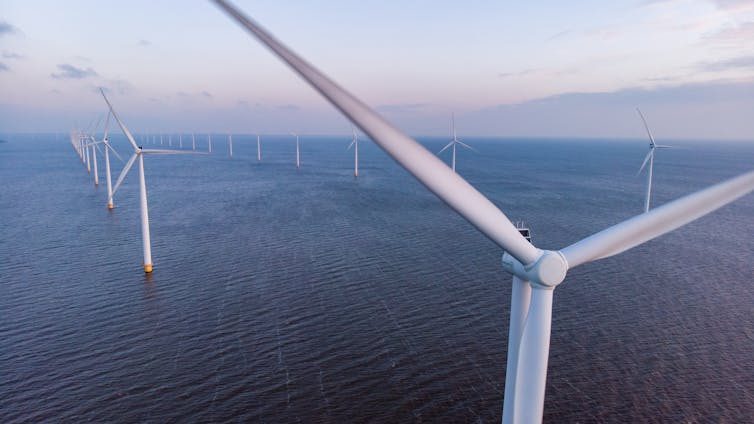
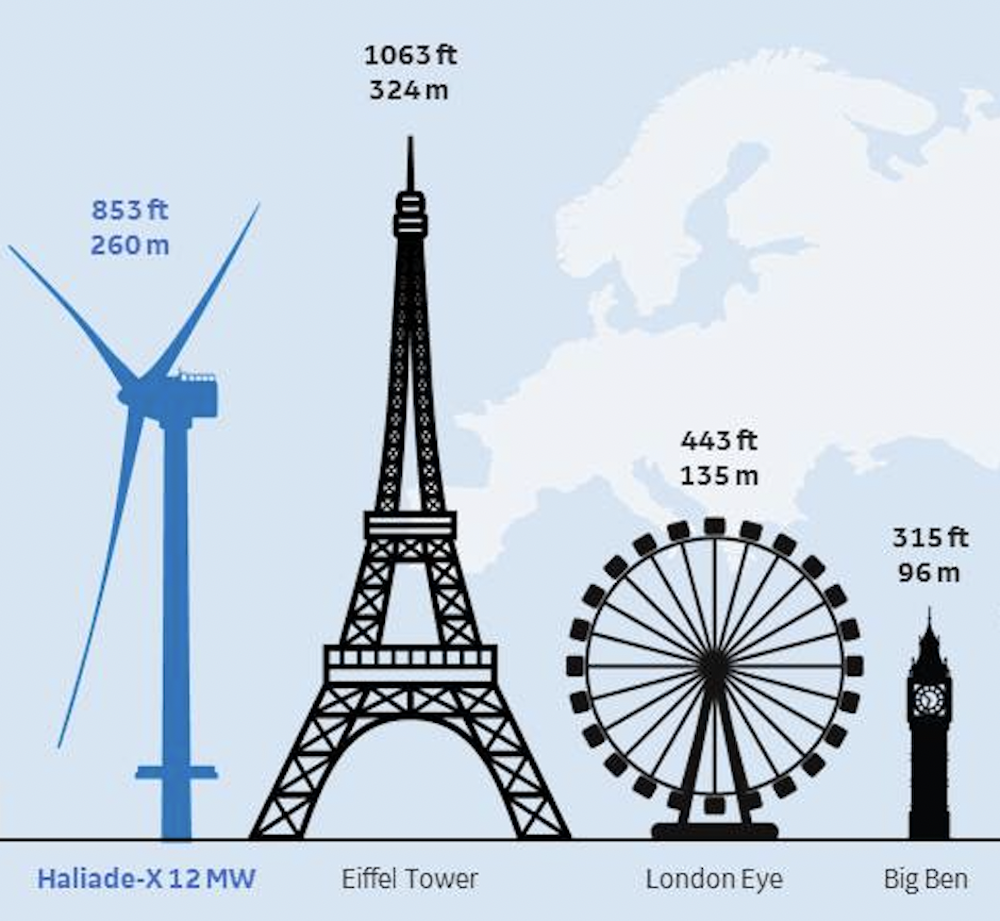
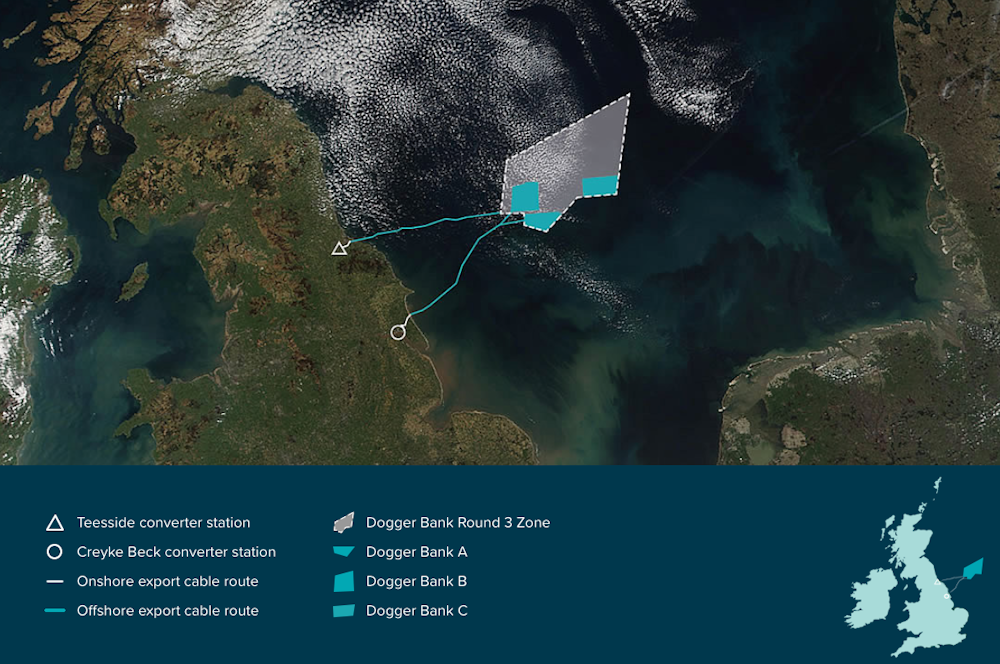
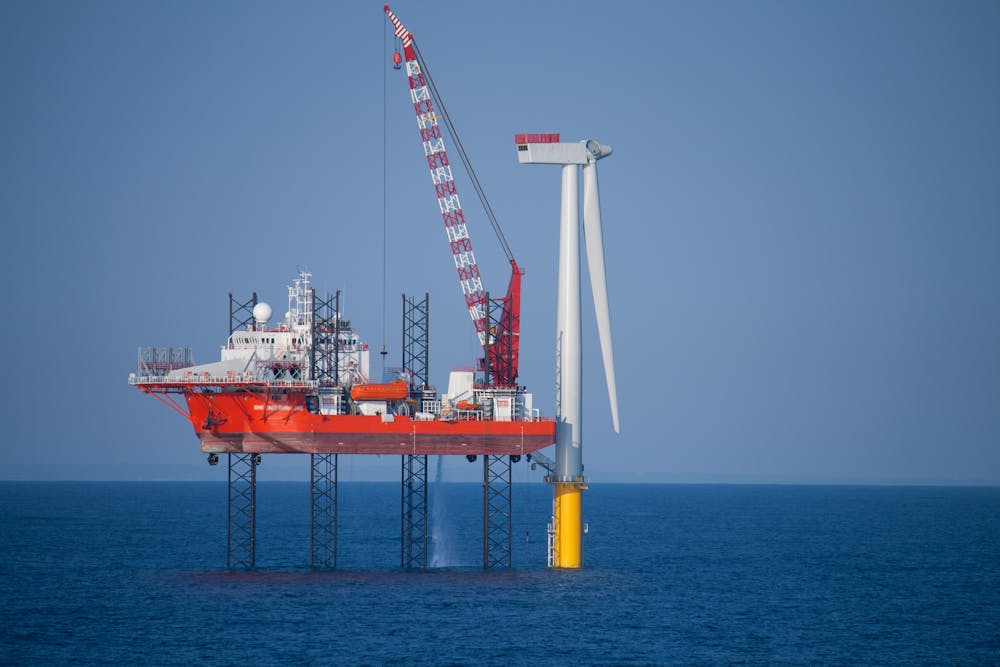
In 2023, some 100 miles off the coast of north-east England, the world’s largest wind turbines will start generating electricity. This first phase of the Dogger Bank offshore wind farm development uses General Electric’s Haliade X, a turbine that stands more than a quarter of a kilometre high from the surface of the sea to the highest point of the blade tip.
If you placed one in London, it would be the third-tallest structure in the city, taller than One Canada Square in Canary Wharf and just 50 metres shorter than the Shard. Each of its three blades would be longer than Big Ben’s clock tower is tall. And Dogger Bank will eventually have nearly 300 of these giants.
Just two decades have passed since the UK’s first proper offshore wind farm was built off the coast of north Wales. Its turbines were each able to produce 2 megawatts (MW) of electricity in ideal conditions – considered huge at the time. In contrast, the Haliade X is able to produce 13MW of electricity, and 15MW turbines are only another year or two away.
So why are turbines increasing in size at such a rapid rate, and is there a limit to how big they can go? In short, the first answer is to reduce the cost of energy and the second is that there must be a limit – but nobody has put a number on it yet.
Big turbines, cheap electricity
Just five years ago, the offshore wind industry hoped to reduce its energy pricing to below £100 per megawatt-hour by 2020 from new projects in UK waters. Even at that level, projects would still have relied on government subsidies to make them economically viable, compared with other types of electricity generation.
But in fact, costs quickly reduced to the extent that offshore wind farm developers were soon committing to selling their electricity at much lower prices. Today, developers are building wind farms such as Dogger Bank where they have committed to prices below £50 per megawatt-hour. This makes offshore wind competitive with other forms of power generation, effectively removing the need for subsidy.
The major factor in reducing these costs was turbine size. Ever-larger turbines came to market faster than virtually everybody in the sector had expected.
Dogger Bank is ideal for offshore wind as the water is very shallow. When complete, the project will power 6 million UK homes. Dogger Bank Wind Farm
Blades cannot spin too fast
In theory, turbines can keep getting bigger. After all, a bigger blade extracts energy from the wind over a greater area as it rotates, which generates more electricity.
But there are some engineering constraints. One concerns erosion of the blades caused by them colliding with raindrops and sea spray. For current designs, the speed of the blade tips must be limited to 90 metres per second (which works out at just under 200mph) in order to avoid erosion. Therefore, as turbines get bigger and blades get longer, their rotors have to turn more slowly.
A consequence of having to slow the rotor down is that, to produce the same amount of power, the blades must deflect the wind to a greater extent. This results in greatly increased forces on the whole turbine. We can address these high forces, but only by increasing both turbine weight and cost. And that means the point at which the turbine becomes unprofitable – the point at which the extra cost is no longer worth it for the value of extra electricity generated – is reached much sooner than if the blade tips were allowed to go faster.
Also, as blades get longer they become more flexible. This makes it more difficult to keep the aerodynamics of the wind flow around them fully under control, and harder to ensure the blades do not strike the turbine tower under extreme wind conditions.
Logistical constraints
Engineering challenges like these can perhaps be solved in the longer term, though. This will mean that wind turbines are more likely to be limited in size by manufacturing, installation and operational issues, rather than any physical limit on the design of the turbine.
Just transporting blades and towers from factory to site and assembling the turbine when you get there presents huge challenges. Each of those Big Ben-sized blades must be shipped in one piece. This requires huge ports, giant vessels, and cranes that can operate safely and reliably far offshore. This is where the limit is most likely to come from.
Needed: huge ships, ports and cranes.DJ Mattaar / Shutterstock
You can see these limits in practice in the UK, which is surrounded by windy and shallow seas that are perfect for generating energy. Despite this, the UK is likely to miss its ambitious target to more than treble its offshore wind capacity by 2030.
This is not because of technology or lack of offshore sites. Rather, the industry will not be able to manufacture turbines quickly enough, and the port infrastructure and number of installation vessels, suitable cranes and workers with requisite skills is unlikely to be sufficient.
So if the UK is to maximise the benefit to its economy from what is, so far, a fantastic success story, the focus now needs to switch from pure cost reduction to developing workers’ skills and the offshore wind supply chain.
Turbines will get bigger, I am sure, but I suspect at a slower rate than we have seen in recent years. And if the turbines are deployed 100 miles offshore, will anybody care? After all, the public will not be there to see them.
Don’t have time to read about climate change as much as you’d like?
There are many milestones to pass in the transition from a high to low-carbon sustainable energy system. There is the first hour without coal, or oil, or gas generation (or all of them together) and the point when the last coal, oil or gas power plant (or all of them together) are finally retired.
Another milestone that feels important is the first year when renewables generate more electricity than fossil fuels. For the past three months we have been tracking the data for Great Britain (not Northern Ireland, which shares an electricity grid with the Republic of Ireland) and we believe it is on track to pass this milestone in 2023, but it will be very close.
Using the broadest definition, renewables actually first overtook fossil fuels in the odd, COVID-affected year of 2020 (although not in the subsequent years of 2021 and 2022). However, that includes 5% or so of Britain’s electricity that is generated through “biomass” plants (which burn wood pellets, often imported from forests in America).
Trees can of course be regrown, so biomass counts as renewable. But the industry has its critics and it’s not globally scalable in the same way as the “weather-dependent” renewables: wind, solar and to a certain degree hydro power.
When we use this narrower, weather-dependent definition that is more appropriate for a global transition, then there is a very good chance these renewables will overtake fossil fuels for the first time ever in 2023. Once this milestone has been passed, we also think it is unlikely (though not impossible) that gas and coal will ever again generate more of Britain’s electricity than wind, solar and hydro over a full year.
Whether Britain passes the milestone in 2023 will come down to the final few days of the year (from here on we’ll use “renewables” to refer to the tighter, biomass-excluding definition).
The chart above can be used to track progress and will update with the latest data each day. The lines show the running total of the difference between how much electricity has been generated by renewables and fossil fuels.
When the line is increasing, this shows more renewables than fossil fuels for that period. The horizontal axis shows the day of the year, so, if at any point the line is above the zero axis, that indicates that the year so far has had more renewable than fossil fuel generation. If the red line ends the year above zero, then Britain will have achieved the milestone.
(One caveat is that we know from the official statistics published later that there are some differences from “missing” and estimates for embedded generation; this typically only accounts for around 1%-2% of the final total.)
It depends on the weather
As we write this, with ten days of data left in 2023, renewables are very slightly ahead (by just over 1000 GWh – about the same level as a peak day of electrical demand). However if they are to stay ahead it will depend on the weather – especially the wind.
The reasoning here is that Britain uses less electricity over the holiday period due to less industrial and commercial demand. As wind power is clean and has become cheaper, it tends to be used first, meaning when demand is low or it is sufficiently windy there is less need to generate electricity with fossil fuels.
There are nuances around this such as where the generation is located, and the amount of electricity imported from other countries, but the general principle of renewables taking market share away from fossil fuels is a factor of Britain’s electrical market.
An important area to also highlight is the continued drop in electrical demand. 2023 is on track to have a lower demand than 2022, which itself was lower than the COVID-impacted year of 2020 (against our predictions) due to record prices. The drop in electrical demand means that additional generation was not needed, much of it inevitably from fossil fuels.
Additional milestone also likely to be passed
However 2023 could be the first year where renewable generation exceeds domestic electricity demand (homes comprise 36% of total electrical demand). This means the annual electricity generated by Britain’s wind turbines, solar panels and hydro resource will now be greater than that consumed over the year by its 29 million households.
The above bar chart demonstrates the trend towards this point since 2009. In the first half of 2023, renewable output was less than domestic electrical demand by 1.5 TWh (1500 GWh), but strong renewable performance since then means it is likely to end the year with total generation in excess of household demand.
If either of the milestones described here do not happen for 2023, then they will almost certainly occur in 2024, during which another 1.7 GW of offshore wind capacity will begin generating and Britain’s last coal-fired power station is scheduled to cease producing electricity altogether.