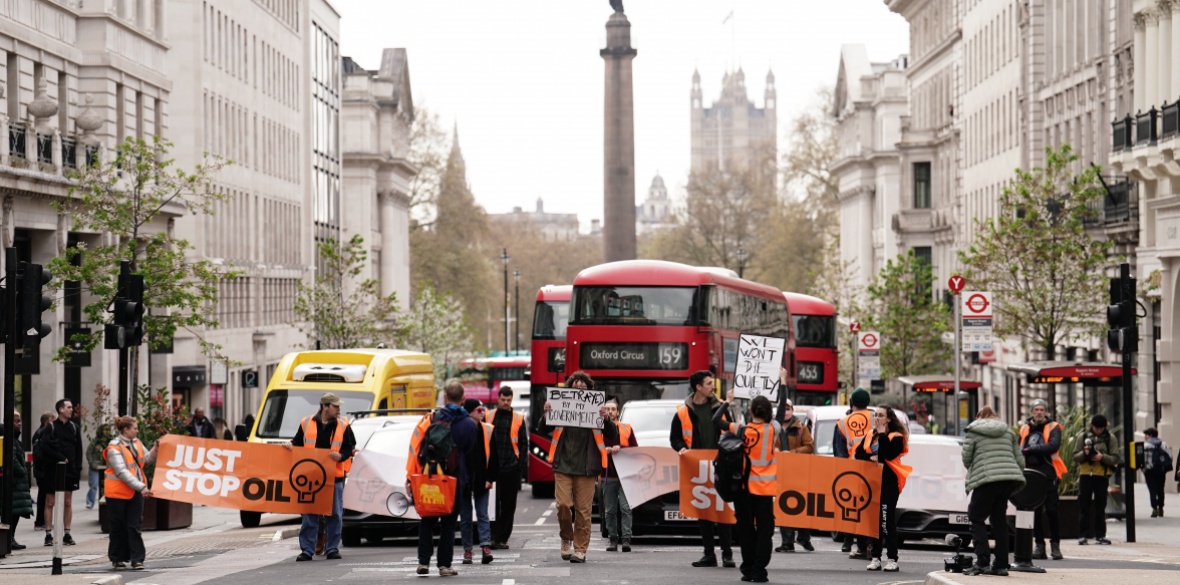
Just Stop Oil protesters as they take part in a slow march protest through London as part of the group’s campaign to convince the government to end all new oil and gas projects in the UK, April 24, 2023
THE government’s draconian anti-protest laws have been used to give a shocking six-month prison sentence to a climate activist for taking part in a peaceful slow march.
Just Stop Oil supporter Stephen Gingell, 57, was sentenced at Manchester magistrates’ court on Thursday.
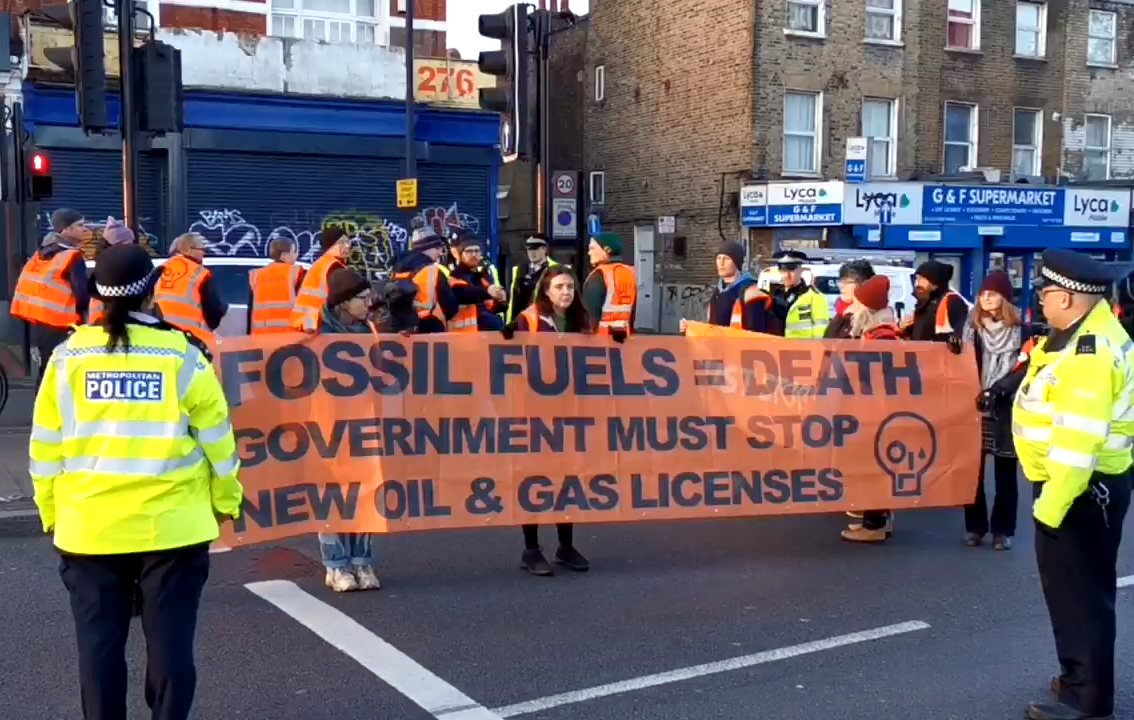
The father-of-three was arrested on November 13 after taking part in a slow march in north London for about half an hour.
Mr Gingell pleaded guilty to breaching section seven of the Public Order Act, which bans any act “which interferes with the use or operation of any key national infrastructure in England and Wales.”
Passed in May, the widely condemned legislation allows police to ban peaceful protests merely on the grounds that they might become disruptive.
“It seems this government has now made walking down the road, walking on the public highway, an illegal act that is worthy of imprisonment,” a Just Stop Oil spokesperson said.
UK lender is a major European funder of oil and gas projects and university has said it does not want to back fossil fuel expansion
Cambridge University could cut ties with Barclays after more than 200 years over the bank’s refusal to stop financing new oil and gas projects, according to the Financial Times.
It reported that Cambridge is looking for an institution with robust climate policies to manage “several hundred million pounds” in cash and money market funds – a mandate expected to cover more than £200m in assets and generate about £10m in fees a year.
The university said it was “exploring opportunities to find financial products that do not finance fossil fuel expansion” as part of its “net zero engagement strategy with the banking sector”.
Though Barclays has provided financing to the university for centuries, the bank was also the top European funder of fossil fuels between 2016 and 2022, according to a report by the Rainforest Action Network.
The milestone, one campaigner said, should “give hope to folks that we are making an impact.”
An earlier version of this story said that 16,000 institutions had divested. The correct number is 1,600 and it has been updated to reflect that.
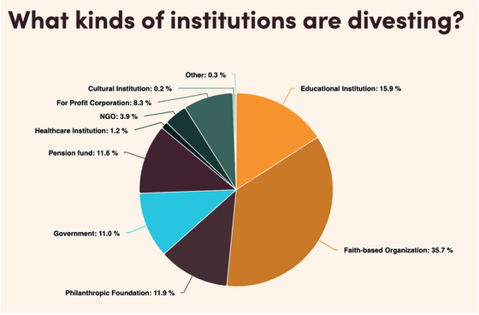
More than 1,600 institutions like universities, pension funds, and governments that hold more than $40.6 trillion in assets have now divested from fossil fuels, the Global Fossil Fuel Divestment Movement announced Friday.
The announcement comes days after the 28th United Nations Climate Change Conference wrapped with a call for “transitioning away from fossil fuels” but stopped short of agreeing to the stronger “phaseout” of oil, gas, and coal backed by climate advocates and frontline communities.
“This number is huge,” Amy Gray, Stand.earth climate finance associate director and coordinator of the Climate Safe Pensions Network, told Common Dreams. To put it in perspective, $40.6 trillion is equal to a little less than half of global gross domestic product.
The scale of the divestments to date, said Gray, “should show and give hope to folks that we are making an impact and we are making a difference and changing things for the better, regardless of these elitist events where the everyday person and the folks in the Global South and other places are discounted.”
A Decade of Divestment
Friday’s update to the Global Fossil Fuel Divestment Commitments Database reflects around a decade of organizing, Gray said. Organizers at 350.org started tracking divestment commitments when Gray and current Stand.earth climate finance director Richard Brooks worked there. When the pair moved to launch a climate finance team at Stand.earth, they brought the database with them.
While the divestment movement has seen ups and downs over that decade, Gray said it had picked up momentum over the last five or six years. In less than two years, the number of institutions divesting jumped by 120, holding a combined $1.4 trillion in assets.
“We’ve definitely seen a massive increase in divestment commitments as the divestment movement has built itself out and gotten stronger,” Gray said.
“This milestone follows years of attempted shareholder engagement, now a proven futile strategy, with fossil fuel corporations hell-bent on our destruction.”
Notable victories in 2023 included PMT, the largest private pension in the Netherlands; New York University, the National Academy of Medicine, and the Church of England.
The Church of England divestment was especially notable, Gray said, because of the statement that accompanied it. The church emphasized that it had tried to engage with the oil and gas companies it was invested in and urged them to adopt policies in line with the Paris agreement, but the companies did not change.
“The decision to disinvest was not taken lightly,” Alan Smith, first church estates commissioner, said at the time. “Soberingly, the energy majors have not listened to significant voices in the societies and markets they serve and are not moving quickly enough on the transition. If any of these energy companies come into alignment with our criteria in the future, we would reconsider our position. Indeed, that is something we would hope for.”
Gray remembered thinking at the time that it was the best divestment statement she’d ever read.
“It was really powerful,” she said.
The Church of England wasn’t the only institution that thought it could persuade Big Oil to change its ways without divesting.
“This milestone follows years of attempted shareholder engagement, now a proven futile strategy, with fossil fuel corporations hell-bent on our destruction,” Brooks said in a statement. “Instead of financing climate chaos-causing fossil fuels, violence, and extraction, financial institutions like big banks and pension funds must protect people and planet alike, cutting ties with fossil fuels and reinvesting in proven community-led climate-safe solutions.”
People vs. Fossil Fuels
The success of the divestment movement has been driven by “people power, 100%,” Gray said.
This includes larger organizations like Stand.earth or the Sierra Club and big-name activists like Bill McKibben or former New York Comptroller Tom Sanzillo, but ultimately comes down to smaller grassroots efforts.
“It’s the little group in Wisconsin that’s working on divesting their pension fund,” Gray said. “It’s a small group in the Bay Area who is pressuring Citi or one of the big banks, and it’s the kids at the colleges.”
“Oil companies are finding it increasingly difficult to raise financing amid rising ESG and sustainability concerns.”
There’s evidence that all this activism is making a difference for the industry. The “cost of capital” for funding new fossil fuel projects has risen steeply in the last decade, from 8% to 10% to around 20% as of 2021, according to Bloomberg.
During the same time, the cost for financing renewables has dropped from that same 8% to 10% to between 3% and 5%.
Bloomberg Intelligence analyst Will Hares laid the divergence at the feet of the push for environmental and social governance (ESG) in investing.
“Oil companies are finding it increasingly difficult to raise financing amid rising ESG and sustainability concerns, while banks are under pressure from their own investors to reduce or eliminate fossil-fuel financing,” Hares said.
Gray also added that Indigenous-led movements such as the Wet’suwet’en struggle against the Coastal GasLink pipeline in Canada have had a material impact on the industry.
The pipeline’s costs have more than doubled during that time from an estimated $6.6 billion to $14.5 billion, CBC News reported this month.
At the same time, divesting from fossil fuels is actually a financial win for pension funds and other institutions: A study released this year by the University of Waterloo found that six U.S. pension funds would actually be $21 billion richer today if they had quit fossil fuels 10 years ago.
The Next 1,600
In the context of a disappointing outcome at COP28, President Joe Biden’s greenlighting of drilling projects, and the specter of a second Trump presidency, the success of the divestment movement offers hope that climate campaigners can shift the world away from fossil fuels without needing to rely on international agreements or national legislation.
“It’s not necessary to enact the change we need to see,” Gray said. “We can change these systems of oppression from within.”
Looking ahead to 2024, Gray thinks there’s a good chance that California will finally pass legislation to divest its two pension funds, CalPERS and CalSTRS, from fossil fuels. The two funds, the largest public pensions in the country, control a total of $685 billion, including more than $42 billion in fossil fuels.
“Even the person with the smallest amount of investments can get involved.”
If California does pass the legislation, it will “cause a massive ripple effect,” Gray said.
“If we’re able to divest the two largest pension funds in the country, there’s nothing we can’t divest.”
Another thing Gray expects to see is more coordination between the efforts to divest from both fossil fuels and the weapons industry, as more and more people react with shock watching U.S.-made and -funded arms devastating the people of Gaza.
“War is a climate issue,” Gray said.
For people not yet involved in the divestment movement, Gray recommends signing up for email updates from Stand.earth or the Climate Safe Pensions Network and looking up local climate groups and going to a meeting.
“Even the person with the smallest amount of investments can get involved,” Gray said. “Anybody can join the climate movement, and we’re always ready to help folks take that step.”
The deal was hailed as historic as it was the first citing of fossil fuels, the root cause of the climate crisis, in 30 years of climate negotiations. But scientists said the agreement contained many loopholes and did not match the severity of the climate emergency.
“The lack of an agreement to phase out fossil fuels was devastating,” said Prof Michael Mann, a climatologist and geophysicist at the University of Pennsylvania in the US. “To ‘transition away from fossil fuels’ was weak tea at best. It’s like promising your doctor that you will ‘transition away from doughnuts’ after being diagnosed with diabetes.”
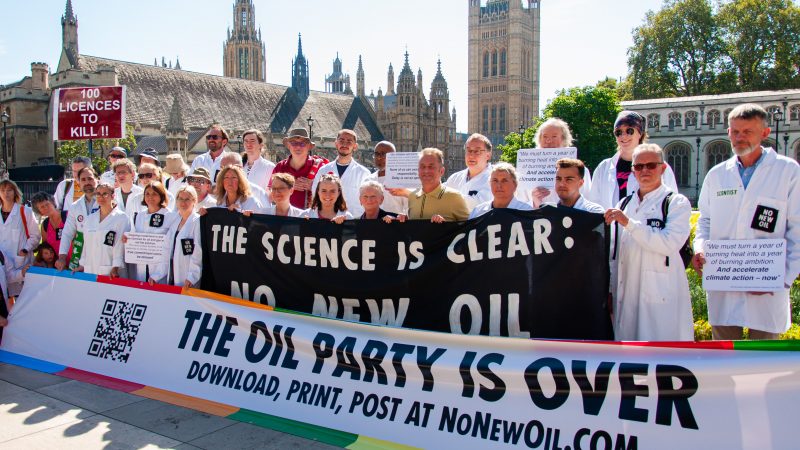
Dr Magdalena Skipper, the editor in chief of the science journal Nature, said: “The science is clear – fossil fuels must go. World leaders will fail their people and the planet unless they accept this reality.”
Scientists protest at UK Parliament 5 September 2023.
An editorial in Nature said the failure over the phase-out was “more than a missed opportunity”, it was “dangerous” and ran “counter to the core goals laid down in the 2015 Paris climate agreement” of limiting global heating to 1.5C (2.7F) above preindustrial levels.
“The climate doesn’t care who emits greenhouse gases,” the editorial continued. “There is only one viable path forward, and that is for everybody to phase out almost all fossil fuels as quickly as possible.”
Sir David King, the chair of the Climate Crisis Advisory Group and a former UK chief scientific adviser, said: “The wording of the deal is feeble. Ensuring 1.5C remains viable will require total commitment to a range of far-reaching measures, including full fossil fuel phase-out.”
There was a chasm between the stark statement of the emissions cuts needed and the action proposed to deliver those reductions, he said: “The Cop28 text recognises there is a need for ‘deep, rapid and sustained reductions in greenhouse gas emissions’ to stay in line with 1.5C. But then it lists a whole bunch of efforts that don’t have a chance of achieving that.”
…
Just Stop Oil protesting in London 6 December 2022.
Two scientists locked-on at the Museum of Sciences in Valencia, Spain on December 9, 2023 as the COP28 climate talks took place in Dubai, UAE. (Photo: Courtesy of Scientist Rebellion)
This disastrous COP28 must be the end of vague political promises. The people of Earth are on to the lies.
Wealthy countries have once again manipulated the climate summit in order to advance their ecocidal colonialism. Rich nations have been pillaging the natural resources of poorer ones for centuries and have used their fuels to emit far more than their share of CO2. They bear the lion’s share of responsibility to decarbonize first and fastest and provide much-needed funding to poorer nations, which are already heavily impacted by the escalating climate crisis. Instead, rich countries are racing in the opposite direction: the US, Canada, and just three other countries are responsible for more than half of planned oil and gas expansion. UN governance failure is also to blame here, however, and urgently needs addressing. Even if COP had succeeded in a commitment to phase out fossil fuels, it could not be implemented without a binding treaty and enforcement mechanisms. Additionally, COP must demand reporting of any conflicts of interest and ban fossil fuel executives and lobbyists from tainting any more climate summits.
The Loss & Damage Fund could be an important first step, but without proper financing, it is condemned to fail. Loss and damage already costs more than $400 billion annually, but COP28 has only pledged $429 million in initial funding—a mere 0.1% of what is needed just for this year. By contrast, governments are using $7 trillion of our money every year to subsidize fossil fuels (despite the 1 in 5 deaths—12 million people annually—caused by air pollution alone) while the oil industry rakes in obscene profits.
That said, even a fully-financed Loss and Damage Fund can never fix a dysfunctional economic system which is fundamentally flawed, is based on endless growth, overconsumption, and extractivism, and is guaranteed to accelerate the global crisis. Studies have demonstrated that greenhouse gas emissions are firmly linked to resource exploitation and GDP growth. We have no choice but to create an economic system which aligns with the goals of a fair and equal transition, because the current one has failed both humans and all other 10 million life forms on this planet. Implementing a low-carbon economy is cheaper than sustaining the catastrophic costs of climate change, but the need to maintain and grow profit is preventing any progress. Profit will never fix what profit has created.
We cannot entrust the fight for all life to the very politicians, companies, and markets that forced us into this existential crisis in the first place and who are right now brutally marching us off the cliff. This disastrous COP28 marks the end of vague political promises. The people of Earth are on to the lies. It is time to listen to the scientists, hundreds of whom have been driven out of their labs and into the streets to engage in civil disobedience: if we want to avoid condemning both this generation and all that follow to the worst outcomes of the climate crisis, we must all rise together in order to keep fossil fuels in the ground. The time is now.
Scientist Rebellion Scientist Rebellion is a member-led organization of scientists from around the world advocating for action on the climate crisis. With no centralized leadership they have local groups in over 30 countries who perform advocacy, organize demonstrations, and take part in civil disobedience.