Category: Climate Crisis

  • Relying on Carbon Capture and Storage Could Unleash ‘Carbon Bomb’

    Spread the love

    Original article by JESSICA CORBETT republished from Common Dreams under Creative Commons (CC BY-NC-ND 3.0).

    Activists protest against fossil fuels on the sidelines of the United Nations Climate Change Conference in Dubai, United Arab Emirates on December 5, 2023.  (Photo: by Karim Sahib/AFP via Getty Images)

    “We need to cut through the smoke and mirrors of ‘abated’ fossil and keep our eyes fixed on the goal of 1.5°C,” said a co-author of a new analysis.

    While the United Nations climate summit continued in the Middle East, researchers in Germany warned Tuesday that depending on technology to trap and sequester planet-heating pollution could unleash a “carbon bomb” in the decades ahead.

    Specifically, the new briefing from the Berlin-based think thank Climate Analytics states that reliance on carbon capture and storage (CCS) could release an extra 86 billion metric tons of greenhouse gases into the atmosphere between 2020 and 2050.fcv

    “The climate talks at COP28 have centered around the need for a fossil fuel phaseout,” the publication notes, referring to the United Arab Emirates-hosted U.N. conference. “But some are calling for this to be limited to ‘unabated’ fossil fuels.”

    “The term ‘abated’ is being used as a Trojan horse to allow fossil fuels with dismal capture rates to count as climate action.”

    Over 100 countries at COP28 support calling for “accelerating efforts toward phasing out unabated fossil fuels,” or operations that don’t involve technological interventions such as CCS,” as Common Dreamsreported earlier Tuesday.

    The new briefing highlights the risks of targeting only unabated fossil fuels. Contrary to claims that significant oil and gas consumption can continue thanks to new tech, it says, “pathways that achieve the Paris agreement’s 1.5°C limit in a sustainable manner show a near complete phaseout of fossil fuels by around 2050 and rely to a very limited degree, if at all, on fossil CCS.”

    Additionally, “there is no agreed definition of the concept of abatement,” and “a weak definition of ‘abated’—or even no definition at all—could allow poorly performing fossil CCS projects to be classed as abated,” the document explains. The report’s authors suggest that the focus on unabated fossil fuels is driven by polluters who want to keep cashing in on wrecking the planet.

    “The term ‘abated’ is being used as a Trojan horse to allow fossil fuels with dismal capture rates to count as climate action,” declared report co-author Claire Fyson. “‘Abated’ may sound like harmless jargon, but it’s actually language deliberately engineered and heavily promoted by the oil and gas industry to create the illusion we can keep expanding fossil fuels.”

    Climate Analytics CEO Bill Hare, who also contributed to the document, said that “the false promises of ‘abated’ fossil fuels risks climate finance being funneled to fossil projects, particularly oil and gas, and will greenwash the ‘unabatable’ emissions from their final use, which account for 90% of fossil oil and gas emissions.”

    Report co-author Neil Grant stressed that “we need to cut through the smoke and mirrors of ‘abated’ fossil and keep our eyes fixed on the goal of 1.5°C. That means slashing fossil fuel production by around 40% this decade, and a near complete phaseout of fossil fuels by around 2050.”

    As a Tuesday analysis from the Civil Society Equity Review details, a “fair” phaseout by mid-century would involve rich nations ditching oil and gas faster than poor countries, and the former pouring billions of dollars into helping the latter. The United States, for example, should end fossil fuel use by 2031 and contribute $97.1 billion per year toward the global energy transition.

    The United States is putting money toward what critics call “false solutions” like carbon capture, and it is not alone. An Oil Change International (OCI) report from last week notes that “governments have spent over $20 billion—and have legislated or announced policies that could spend up to $200 billion more—of public money on CCS, providing a lifeline for the fossil fuel industry.”

    OCI found that rather than permanently sequestering carbon dioxide, 79% of the global CCS capacity sends captured CO2 to stimulate oil production in aging wells, which is called “enhanced oil recovery.” The group also reviewed six leading plants in the United States, Australia, and the Middle East, and concluded that they “overpromise and underdeliver, operating far below capacity.”

    Lorne Stockman, OCI’s research director, asserted last week that “governments need to stop pretending that fossil fuels aren’t the problem. Instead of throwing a multibillion-dollar lifeline to the fossil fuel industry with our tax dollars, they should fund real climate solutions, including renewable energy and energy efficiency. Fossil fuel phaseout must be the central theme of COP28, not dangerous distractions like CCS propped up with public money.”

    Underscoring Stockman’s point that such projects are incredibly expensive, the University of Oxford’s Smith School of Enterprise and the Environment on Monday published research showing that a high carbon capture and storage pathway to net-zero emissions in 2050 could cost at least $30 trillion more than a low CCS pathway.

    “Relying on mass deployment of CCS to facilitate high ongoing use of fossil fuels would cost society around a trillion dollars extra each year—it would be highly economically damaging,” said Rupert Way, an honorary research associate at the school.

    “Any hopes that the cost of CCS will decline in a similar way to renewable technologies like solar and batteries appear misplaced,” he added. “Our findings indicate a lack of technological learning in any part of the process, from CO2 capture to burial, even though all elements of the chain have been in use for decades.”

    Original article by JESSICA CORBETT republished from Common Dreams under Creative Commons (CC BY-NC-ND 3.0).
    COP28 Stocktake Draft Reveals Vital Battle Over ‘Unabated’ Fossil Fuels

    Big Oil Stifling Democracy to Keep Burning Fossil Fuels

    ​’Shameful’: Norwegian Government Backs Deep-Sea Mining

    US Must Stop Extracting Fossil Fuels by 2031 for Fair Road to 1.5°C

    Republicans Advance Boebert Plan Forcing Taxpayers to Foot Bill for Big Oil’s Mess

  • Fossil CO₂ emissions hit record high yet again in 2023

    Spread the love

    Pep Canadell, CSIRO; Corinne Le Quéré, University of East Anglia; Glen Peters, Center for International Climate and Environment Research – Oslo; Judith Hauck, Universität Bremen; Julia Pongratz, Ludwig Maximilian University of Munich; Philippe Ciais, Commissariat à l’énergie atomique et aux énergies alternatives (CEA); Pierre Friedlingstein, University of Exeter; Robbie Andrew, Center for International Climate and Environment Research – Oslo, and Rob Jackson, Stanford University

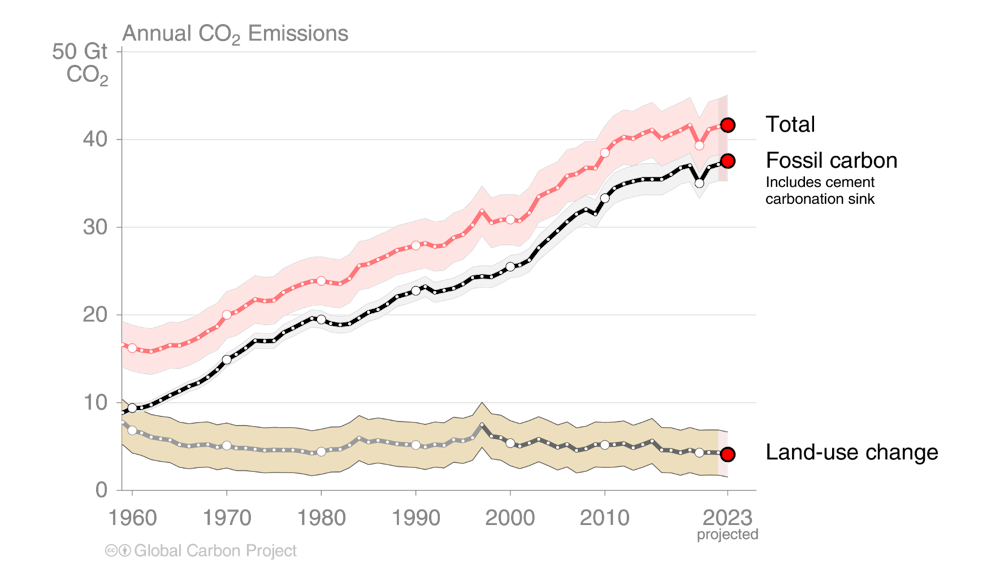
    Global emissions of fossil carbon dioxide (CO₂), in yet another year of growth, will increase by 1.1% in 2023. These emissions will hit a record 36.8 billion tonnes. That’s the finding of the Global Carbon Project’s 18th annual report card on the state of the global carbon budget, which we released today.

    Fossil CO₂ includes emissions from the combustion and use of fossil fuels (coal, oil and gas) and cement production. Adding CO₂ emissions and removals from land-use change, such as deforestation and reforestation, human activities are projected to emit 40.9 billion tonnes of CO₂ in 2023.

    The world’s vegetation and oceans continue to remove about half of all CO₂ emissions. The rest builds up in the atmosphere and is causing increasing warming of the planet.

    At current emission levels, the remaining carbon budget for a one-in-two chance to limit warming to 1.5°C will likely be exceeded in seven years, and in 15 years for 1.7°C. The need to cut emissions has never been so urgent.

    Emissions from every fossil source are up

    Fossil CO₂ emissions now account for about 90% of all CO₂ emissions from human activities. Emissions from every single fossil source increased this year compared to 2022:

    • coal (41% of global CO₂ emissions) up 1.1%
    • oil (32%) up 1.5%
    • natural gas (21%) up 0.5%
    • cement (4%) up 0.8%.
    Line graph showing emissions from fossil fuels, land-use changes and total emissions from 1960 to 2023
    All fossil fuel sources are driving the increase in total CO₂ emissions.
    Global Carbon Budget 2023/Global Carbon Project, CC BY

    Although global emissions have increased, the picture for individual countries is more diverse. There are some signs of progress towards decarbonisation.

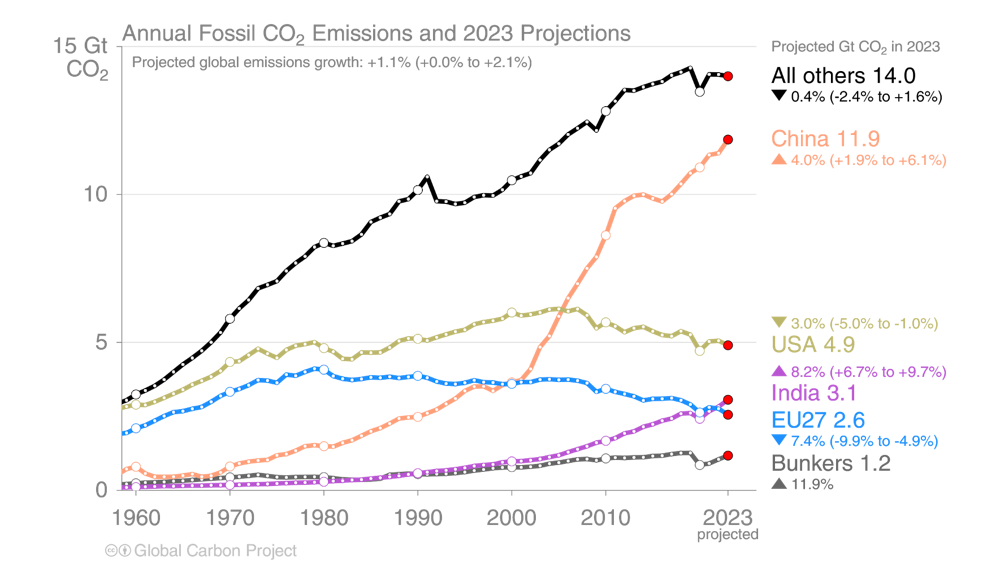
    China’s emissions (31% of the global total) increased by 4% with growth in all fossil fuel sources. The highest relative growth was from oil emissions. This was in part due to the transport sector’s recovery after COVID-19 pandemic shutdowns.

    The United States’ emissions (14% of global) are down by 3%. The rapid retirement of coal-fired power plants drove most of this decline. US coal emissions are the lowest since 1903.

    India’s emissions (8% of global) increased by 8.2%. Emissions for all fossil fuels grew by 5% or more, with coal the highest at 9.5%. India is now the world’s third-largest fossil CO₂ emitter.

    European Union emissions (7% of global) are down by 7.4%. This decline was due to both high renewable energy penetration and the impacts on energy supply of the war in Ukraine.

    During the decade of 2013-2022, 26 countries had declining fossil CO₂ emission trends while their economies continued to grow. The list includes Brazil, France, Germany, Italy, Japan, Portugal, Romania, South African, United Kingdom and USA.

    Emissions by individual countries from 1960 to 2023
    Individual country performances vary widely, but there are some signs of progress towards decarbonisation.
    Global Carbon Budget 2023/Global Carbon Project, CC BY

    Total CO₂ emissions are near a peak

    While fossil CO₂ emissions continue to increase, net emissions from land-use change, such as deforestation (CO₂ source), minus CO₂ removals, such as reforestation (CO₂ sink), appear to be falling. However, estimates of emissions from land-use change are highly uncertain and less accurate overall than for fossil fuel emissions.

    Our preliminary estimate shows net emissions from land-use change were 4.1 billion tonnes of CO₂ in 2023. These emissions follow a small but relatively uncertain decline over the past two decades.

    The declining trend was due to decreasing deforestation and a small increase in reforestation. The highest emitters are Brazil, Indonesia and the Democratic Republic of the Congo. These three countries contribute 55% of net global CO₂ emissions from land-use change.

    When we combine all CO₂ emissions from human activities (fossil and land use), we find very little trend in total emissions over the past decade. If confirmed, this would imply global CO₂ emissions from human activities are not growing further but remain at very high record levels.

    Stable CO₂ emissions, at about 41 billion tonnes per year, will lead to continuing rapid CO₂ accumulation in the atmosphere and climate warming. To stabilise the climate, CO₂ emissions from human activities must reach net zero. This means any residual CO₂ emissions must be balanced by an equivalent CO₂ removal.

    Nature’s a big help, with a little human help

    Terrestrial vegetation and ocean absorb about half of all CO₂ emissions. This fraction has remained remarkably stable for six decades.

    Besides the natural CO₂ sinks, humans are also removing CO₂ from the atmosphere through deliberate activities. We estimate permanent reforestation and afforestation over the past decade have removed about 1.9 billion tonnes of CO₂ per year.

    This is equivalent to 5% of fossil fuel emissions per year.

    Other non-vegetation strategies are in their infancy. They removed 0.01 million tonnes of CO₂.

    Machines (direct air carbon capture and storage) pulled 0.007 million tonnes of CO₂ out of the atmosphere. Enhanced weathering projects, which accelerate natural weathering processes to increase the CO₂ uptake by spreading certain minerals, accounted for the other 0.004 million tonnes. This is more than a million times smaller than current fossil fuel emissions.

    The remaining carbon budget

    From January 2024, the remaining carbon budget for a one-in-two chance to limit global warming to 1.5°C has been reduced to 275 billion tonnes of CO₂. This budget will used up in seven years at 2023 emission levels.

    The carbon budget for limiting warming to 1.7°C has been reduced to 625 billion tonnes of CO₂, with 15 years left at current emissions. The budget for staying below 2°C is 1,150 billion tonnes of CO₂ – 28 years at current emissions.

    Reaching net zero by 2050 requires total anthropogenic CO₂ emissions to decrease on average by 1.5 billion tonnes of CO₂ per year. That’s comparable to the fall in 2020 emissions resulting from COVID-19 measures (-2.0 billion tonnes of CO₂).

    Without additional negative emissions (CO₂ removal), a straight decreasing line of CO₂ emissions from today to 2050 (when many countries aspire to achieve net zero CO₂ or the more ambitious net zero for all greenhouse gases) would lead to a global mean surface temperature of 1.7°C, breaching the 1.5°C limit.

    Renewable energy production is at a record high and growing fast. To limit climate change fossil and land-use change, CO₂ emissions must be cut much more quickly and ultimately reach net zero. The Conversation

    Pep Canadell, Chief Research Scientist, CSIRO Environment; Executive Director, Global Carbon Project, CSIRO; Corinne Le Quéré, Royal Society Research Professor of Climate Change Science, University of East Anglia; Glen Peters, Senior Researcher, Center for International Climate and Environment Research – Oslo; Judith Hauck, Helmholtz Young Investigator group leader and deputy head, Marine Biogeosciences section a Alfred Wegener Institute, Universität Bremen; Julia Pongratz, Professor of Physical Geography and Land Use Systems, Department of Geography, Ludwig Maximilian University of Munich; Philippe Ciais, Directeur de recherche au Laboratoire des science du climat et de l’environnement, Institut Pierre-Simon Laplace, Commissariat à l’énergie atomique et aux énergies alternatives (CEA); Pierre Friedlingstein, Chair, Mathematical Modelling of Climate, University of Exeter; Robbie Andrew, Senior Researcher, Center for International Climate and Environment Research – Oslo, and Rob Jackson, Professor, Department of Earth System Science, and Chair of the Global Carbon Project, Stanford University

    This article is republished from The Conversation under a Creative Commons license. Read the original article.

  • Warning: the UK government’s hydrogen plan isn’t green at all, it’s another oil industry swindle

    Spread the love

    Kevin Anderson and Simon Oldridge

    Membrane type LNG tanker Puteri Firus Satu in Tokyo Bay. Author Tennen-Gas shares under GNU Free Documentation License.
    Membrane type LNG tanker Puteri Firus Satu in Tokyo Bay. Author Tennen-Gas shares under GNU Free Documentation License.

    https://www.theguardian.com/commentisfree/2023/dec/04/uk-government-hydrogen-plan-oil-industry-taxpayer-blue-hydrogen-climate-crisis

    A taxpayer-funded drive for ‘blue’ hydrogen is good news for fossil-fuel lobbyists, but bad news for the climate crisisMon 4 Dec 2023 12.25 CET

    With the impacts of the climate crisis so apparent for all to see, it is becoming ever harder for governments to fob off voters with promises of action tomorrow. At Cop28 we’ll see increasingly overt action by fossil fuel companies and petrostates to preserve their traditional power. But it is just as important to scrutinise emerging so-called green or low-emission solutions, which sound plausible, but are often simply big oil’s business-as-usual in a new guise.

    The UK’s much touted low carbon hydrogen standard (LCHS) is an example of this. While hydrogen can be a low-emission fuel, the UK’s plan is quite clearly a fig leaf for “blue” hydrogen – which is made from fossil fuels – and according to one study, is even more at odds with our commitment to limiting global temperature rises to 1.5C than burning coal.

    Today, the vast majority of the UK’s hydrogen production is made from natural gas (the marketing term for methane) in a very carbon-intensive process. Blue hydrogen would also be produced from methane, but with promises that the resulting CO2 emissions would be captured and buried underground. But even if most of the CO2 can be safely captured (a very big “if”), blue hydrogen’s full life-cycle emissions are likely still to be high.

    That is in part as a consequence of methane leaks across the vast North Sea supply chain. Methane is a very powerful warming gas, so even with relatively low leakage rates, blue hydrogen will be bad news for the climate. Currently, 84% of the UK’s misleadingly named “low carbon” hydrogen capacity under development is of this blue variety.

    Companies will be awarded substantial taxpayer funding for blue hydrogen plants that are certified compliant with the new LCHS – and here, the hallmarks of lobbying are only too apparent. The LCHS method for calculating life-cycle greenhouse gas emissions appears rigged to greenwash blue hydrogen.

    …

    https://www.theguardian.com/commentisfree/2023/dec/04/uk-government-hydrogen-plan-oil-industry-taxpayer-blue-hydrogen-climate-crisis

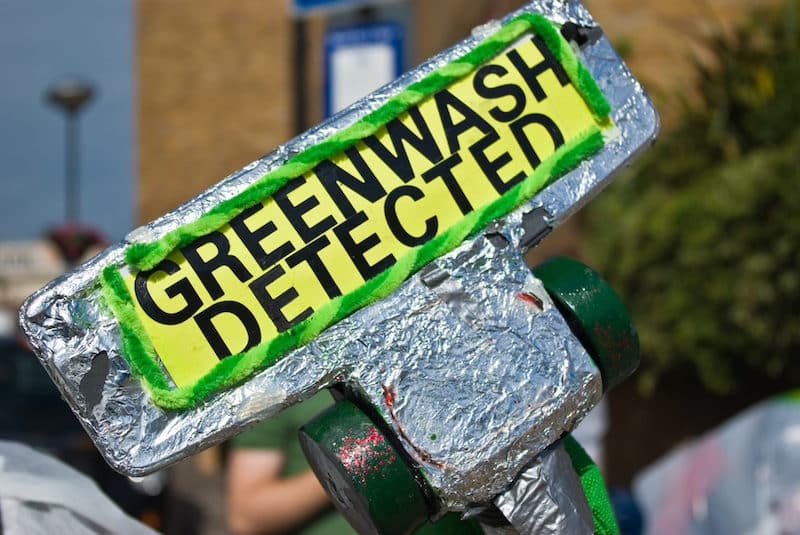
    Protest placard reads Greenwash detected
    Protest placard reads Greenwash detected
  • UK likely to miss Paris climate targets by wide margin, analysis shows

    Spread the love

    https://www.theguardian.com/environment/2023/dec/05/uk-miss-paris-climate-targets-emissions

    Exclusive: Under current policies, Britain could fall short of internationally agreed goal of 68% cut in emissions by 2030

    The UK government is likely to miss its targets under the Paris climate agreement by a wide margin, analysis shows, dealing a devastating blow to Britain’s standing on the international stage.

    Under current policies, the UK’s greenhouse gas emissions are likely to be 59% lower in 2030 than they were in 1990 – but the country’s internationally agreed target is for a 68% reduction by the end of this decade. The gap is likely to leave Britain in breach of these commitments.

    The 2030 emissions goal was agreed at Cop26, the UN climate summit hosted by the UK in Glasgow in 2021, and has been reaffirmed at Cop28, taking place in Dubai this week.

    Failure to meet the UK’s commitments would hinder international efforts to limit global temperature rises to 1.5C (2.7F) above pre-industrial levels.

    The estimate comes from analysis of publicly available and government data carried out by Friends of the Earth. It found that current policies would achieve just over half the emissions cuts needed by 2030.

    The gap had grown significantly under Rishi Sunak’s leadership, Friends of the Earth found.

    …

    https://www.theguardian.com/environment/2023/dec/05/uk-miss-paris-climate-targets-emissions

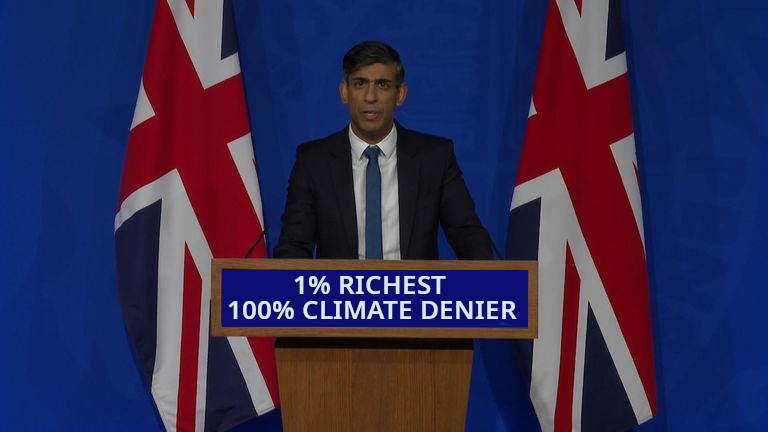
    Image of UK Prime Minister Rishi Sunak reads 1% RICHEST 100% CLIMATE DENIER
    Image of UK Prime Minister Rishi Sunak reads 1% RICHEST 100% CLIMATE DENIER
  • More than 1,000 climate scientists urge public to become activists

    Spread the love
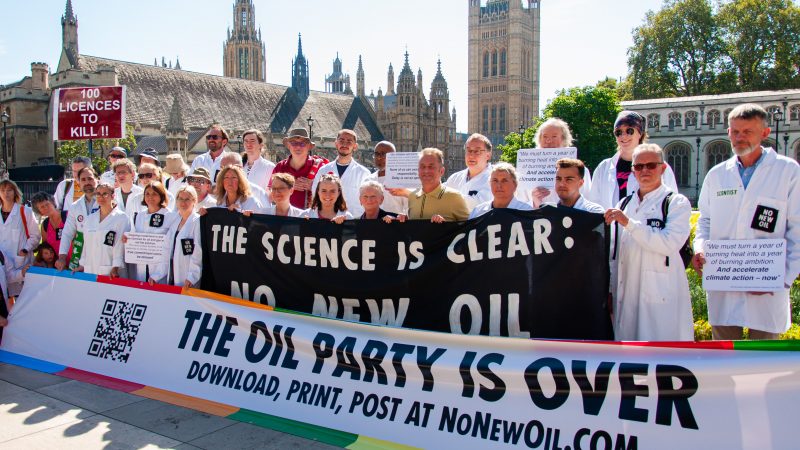
    Scientists protest at UK Parliament 5 September 2023.
    Scientists protest at UK Parliament 5 September 2023.

    https://www.theguardian.com/environment/2023/dec/04/more-than-1000-climate-scientists-urge-public-to-become-activists

    ‘We need you,’ says Scientist Rebellion, which includes authors of IPCC reports on climate breakdown, as diplomats meet for Cop28

    Wolfgang Cramer’s first involvement with the Intergovernmental Panel on Climate Change was in the 90s. He worked on the second assessment report, delivered in 1995, which affirmed the science of anthropogenic climate breakdown. At that point, no one could say they did not know what was happening.

    Almost three decades on, Cramer was part of the international scientific team that prepared the sixth IPCC report. Its conclusion, delivered in March, issued human civilisation a bleak “final warning” – the biosphere stands on the brink of irrevocable damage.

    Now, as diplomats meet in Dubai for the 28th round of the Cop climate talks, in a year predicted to be the hottest on record, and as carbon emissions continue to rise, Cramer is one of 33 IPCC authors among 1,447 scientists and academics in signing an open letter calling on the public to take collective action to avert climate breakdown.

    “We are terrified,” they warn. “We need you.”

    “Wherever you are, become a climate advocate or activist,” the letter, published on Monday by Scientist Rebellion, a climate activist group, implores. “Join or start groups pushing for policies that help secure a better future. Contact groups that are active where you are, find out when they meet and attend their meetings.

    “If we are to create a liveable future, climate action must move from being something that others do to something that we all do.”

    …

    https://www.theguardian.com/environment/2023/dec/04/more-than-1000-climate-scientists-urge-public-to-become-activists