Category: Climate Crisis

  • Extreme weather is outpacing even the worst-case scenarios of our forecasting models

    Spread the love

    Ravindra Jayaratne, University of East London

    In the wake of the destructive Hurricane Otis, we find ourselves at a pivotal moment in the history of weather forecasting. The hurricane roared ashore with 165mph winds and torrential rainfall, slamming into the coastal city of Acapulco, Mexico and claiming the lives of at least 48 people.

    The speed at which Otis intensified was unprecedented. Within 12 hours it went from a regular tropical storm to a “category 5” hurricane, the most powerful category and one which might occur only a few times worldwide each year.

    This rare and alarming event, described by the US National Hurricane Center as a “nightmare scenario”, broke records for the fastest intensification rate over a 12-hour period in the eastern Pacific. Otis not only caught residents and authorities off guard but also exposed the limitations of our current predictive tools.

    I specialise in the study of natural disasters with the goal of improving our ability to predict them and ultimately to save lives. It is critical that we address the pressing concerns related to the tools we use for forecasting these catastrophic events, all while recognising the significant influence of rapid climate change on our forecasting capabilities.

    The predictive tools we rely on

    At the core of weather forecasting are computer programs, or “models”, that blend atmospheric variables such as temperature, humidity, wind and pressure, with fundamental physics.

    Since the atmospheric processes are nonlinear, a small degree of uncertainty in initial atmospheric conditions can lead to a large discrepancy in final forecasts. That’s why the general practice now is to forecast a set of possible scenarios rather than predict the single scenario most likely to occur.
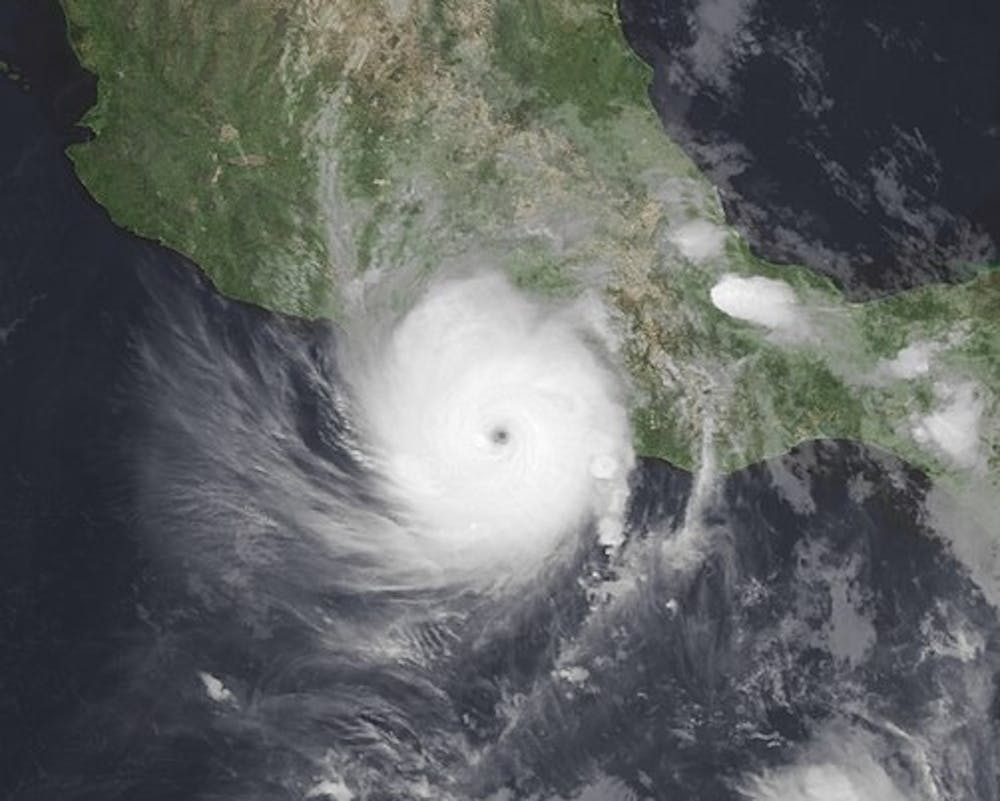
    Satellite map of hurricane
    Hurricane Otis reaches its maximum intensity just as it hits Acapulco on October 25.
    ABI / NOAA GOES-16 / wiki

    But while these models are instrumental in issuing early warnings and evacuation orders, they have fundamental limitations and carry a significant degree of uncertainty, especially when dealing with rare or extreme weather. This uncertainty arises from various factors including the fundamentally chaotic nature of the system.

    First, the historical data is incomplete, since a hurricane such as Otis might occur only once in several millennia. We don’t know when an east Pacific storm last turned into a category 5 hurricane overnight – if ever – but it was certainly before modern satellites and weather buoys. Our models struggle to account for these “one in 1,000-year events” because we simply haven’t observed them before.

    The complex physics governing the weather also has to be simplified in these predictive models. While this approach is effective for common scenarios, it falls short when dealing with the intricacies of extreme events that involve rare combinations of variables and factors.

    And then there are the unknown unknowns: factors our models cannot account for because we are unaware of them, or they have not been integrated into our predictive frameworks. Unanticipated interactions among various climatic drivers can lead to unprecedented intensification, as was the case with Hurricane Otis.

    The role of climate change

    To all this we can add the problem of climate change and its impact on extreme weather. Hurricanes, in particular, are influenced by rising sea surface temperatures, which provides more energy for storms to form and intensify.

    The connection between climate change and the intensification of hurricanes, coupled with other factors such as high precipitation or high tides, is becoming clearer.

    With established weather patterns being altered, it is becoming even more challenging to predict the behaviour of storms and their intensification. Historical data may no longer serve as a reliable guide.

    The way forward

    The challenges are formidable but not insurmountable. There are a few steps we can take to enhance our forecasting and better prepare for the uncertainties that lie ahead.

    The first would be to develop more advanced predictive models that integrate a broader range of factors and variables, as well as consider worst-case scenarios. Artificial intelligence and machine learning tools can help us process vast and complex datasets more efficiently.

    But to get this additional data we’ll have to invest in more weather monitoring stations, satellite technology, AI tools and atmospheric and oceanographic research.

    Since even world experts and their models can be caught out by sudden weather extremes, we also need to educate the public about the limitations and uncertainties in weather forecasting.

    We must encourage preparedness and a proactive response to warnings, even when predictions seem uncertain. And of course we still have to mitigate climate change itself: the root cause of intensifying weather events.

    Hurricane Otis provided a stark and immediate reminder of the inadequacies of our current predictive tools in the face of rapid climate change and increasingly extreme weather events. The urgency to adapt and innovate in the realm of weather forecasting has never been greater.

    It is incumbent upon us to rise to the occasion and usher in a new era of prediction that can keep pace with the ever-shifting dynamics of our planet’s climate. Our future depends on it.


    Imagine weekly climate newsletter

    Don’t have time to read about climate change as much as you’d like?

    Get a weekly roundup in your inbox instead. Every Wednesday, The Conversation’s environment editor writes Imagine, a short email that goes a little deeper into just one climate issue. Join the 20,000+ readers who’ve subscribed so far. The Conversation


    Ravindra Jayaratne, Reader in Coastal Engineering, University of East London

    This article is republished from The Conversation under a Creative Commons license. Read the original article.

  • Climate Groups Back Efforts to End Tens of Billions in Foreign Fossil Fuel Subsidies

    Spread the love
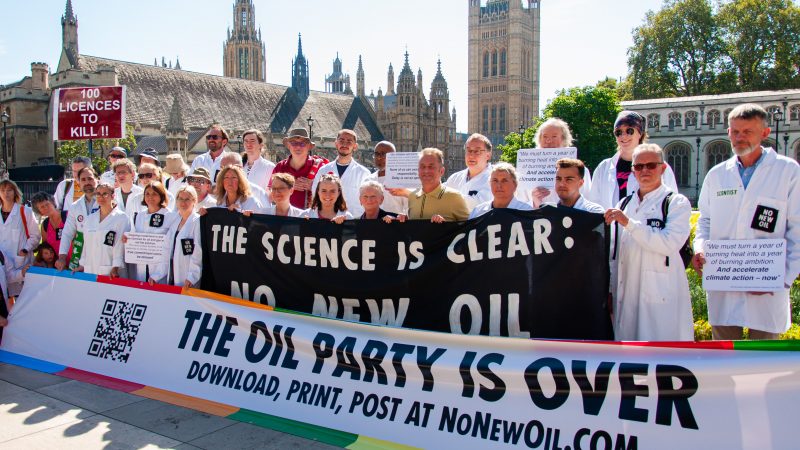
    Scientists protest at UK Parliament 5 September 2023.
    Scientists protest at UK Parliament 5 September 2023.

    Original article by JESSICA CORBETT republished from Common Dreams under Creative Commons (CC BY-NC-ND 3.0).

    “This is the moment where OECD countries can turn their words into action,” said an Oil Change International strategist. “All eyes are on them, the world is watching. Immediate action is necessary.”

    Over 250 climate groups from 30 countries published an open letter on Monday urging governments that endorsed a global pledge at the United Nations summit in Scotland two years ago to support new efforts to cut off subsidies for foreign fossil fuel projects.

    The coalition letter came a day after the Financial Timesreported that the European Union and United Kingdom—which left the E.U. in 2020—have proposals to end subsidies for foreign gas, oil, and coal projects that they plan to discuss at a closed-door Organization for Economic Cooperation and Development (OECD) meeting in France next month.

    “This is the moment where OECD countries can turn their words into action,” Oil Change International (OCI) strategist Nina Pusic said Monday. “Will they live up to the pledge most of them made in Glasgow in 2021 to end international public finance for fossil fuels at the OECD? All eyes are on them, the world is watching. Immediate action is necessary to align global financial flows with a habitable climate future, and this November represents a critical opportunity that we can’t afford to miss.”

    According to the Financial Times:

    People close to U.K. Export Finance, Britain’s credit agency, said that Canada had committed to backing the U.K.’s planned proposal to the OECD ahead of the meeting next month. Canada’s finance department said it “looked forward to working alongside like-minded partners at the OECD and in other international forums to grow and promote the clean economy around the world.”

    The E.U. has submitted its own proposal, according to one person familiar with the matter, after member states agreed on a draft proposal last month, according to another person familiar. It did not provide a comment.

    The coalition letter highlights that the 2021 Clean Energy Transition Partnership (CETP)—whose signatories agreed to align public finance institutions with the Paris agreement’s 1.5°C goal—is already shifting an estimated $5.7 billion a year to clean energy.

    As part of the CETP, countries committed to driving “multilateral negotiations in international bodies, in particular in the OECD, to review, update, and strengthen their governance frameworks to align with the Paris agreement goals,” the letter explains.

    “This November at the OECD Export Credits Forum, your country has a critical opportunity to fulfill this commitment. Your country can do this by joining forces with other CETP signatories to support restricting oil and gas export finance at the OECD,” wrote the coalition, which along with OCI includes Friends of the Earth (FOE) United States, Japan Center for a Sustainable Environment and Society (JACSES), and Environment Governance Institute (EGI) Uganda.

    “Ending OECD oil and gas support is critical to limit global heating to 1.5°C,” the coalition added, citing the International Energy Agency’s warning that new fossil fuel investments are incompatible with the goal. “And yet, the OECD export credit agencies (ECAs) currently provide five times as much financing for fossil fuels as for clean energy every year. By putting an end to their fossil fuel financing, governments have an opportunity to free up $41 billion USD per year to support the clean energy transition.”

    The OECD’s existing Arrangement on Officially Supported Export Credits has a prohibition from January 2021 that “shifts an estimated $4 billion per year out of highly polluting coal fired-power,” the letter notes, calling for an extension of that policy “to encompass all fossil fuels, including oil and fossil gas, without any loopholes.”

    Some leaders at groups behind the letter took aim at specific nations, such as the United States, which is among those that have come under fire this year for continuing to dump a collective $4.4 billion into fossil fuel projects abroad.

    “We have waited long enough for the United States, and other wealthy historical emitters, to be a force for good at the OECD,” said Kate DeAngelis, FOE’s senior international finance program manager. “The U.S. must turn away from its multibillion-dollar fossil financing and support the U.K. and Canada proposal, leading the push to finally end export credit agency support for fossil fuels.”

    JACSES program director Yuki Tanabe targeted Japan, which snubbed the Glasgow pledge but backed a similar one from the Group of Seven last year—and has since faced criticism for continued investments in fossil fuels.

    “Japan should not be a blocker at the OECD negotiations and should agree to end its public finance for fossil fuel projects,” Tanabe argued. “Ammonia and hydrogen co-firing should not be exempted as ‘abatement’ technologies, since the current co-firing development roadmap is not in line with the Paris goals.”

    EGI CEO Samuel Okulony stressed how decisions of nations like Japan affect communities where projects are based.

    “The impacts of climate change in Africa are a matter of life and death, and Japan, Korea, and other OECD countries should listen to the lived realities of global south communities, who have been devastated by the impacts of climate change for decades,” he said. “It is imperative that these countries make resolute commitments, support a resolution to stop public financing for fossil fuels at the OECD, and demand the global community align itself with the commitments to keep the 1.5°C target alive.”

    Original article by JESSICA CORBETT republished from Common Dreams under Creative Commons (CC BY-NC-ND 3.0).

    Extinction Rebellion NL image reads STOP FOSSIELE SUBSIDIES
    Extinction Rebellion NL image reads STOP FOSSIELE SUBSIDIES

    Related:

    The TRUTH about fossil fuel subsidies.

    Extinction Rebellion NL pauses daily A12 highway blockades awaiting a decision on government fossil fuel subsidies

    FFS: Huge Fossil Fuel Subsidies in UK and globally

  • Rishi Sunak to ‘double down’ on anti-green policies in king’s speech

    Spread the love
    One of the many occasions climate change denier and UK Prime Minister Rishi Sunak uses a private jet.
    One of the many occasions climate change denier and UK Prime Minister Rishi Sunak uses a private jet.

    https://www.theguardian.com/politics/2023/oct/28/rishi-sunak-to-double-down-on-anti-green-policies-in-kings-speech

    PM will announce a new system for awarding oil and gas exploration licences, and new pro-car legislation, sources say

    Rishi Sunak’s government will use next week’s king’s speech to advance expansion of North Sea oil and gas exploration, as well as pro-car policies, in the hope of opening up a clear divide over the green agenda with Labour, the Observer understands.

    Energy industry sources and senior figures in Whitehall say they expect ministers to announce legislation to usher in a new annual system for awarding oil and gas licences, despite the UK’s commitments to move away from fossil fuels and reach net zero carbon emissions by 2050.

    The king’s speech, the final legislative programme before the next general election, is also expected to include measures that will explicitly favour motorists, including making it more difficult for local authorities to introduce 20mph speed limits or supposedly unpopular schemes such as the ultra-low emission zone (Ulez), recently expanded in London.

    …

    Environmental campaigners point out that more oil and gas exploration licences are not only irresponsible, given the climate crisis, but that new laws are not needed to award more licences. This has been shown by the fact that the results of a new round of licences, launched just over a year ago during Liz Truss’s brief stint as PM, are due to be announced imminently.

    …

    https://www.theguardian.com/politics/2023/oct/28/rishi-sunak-to-double-down-on-anti-green-policies-in-kings-speech

  • Reports Expose US Billionaires and Corporate Profiteers Enabling Israel’s War on Gaza

    Spread the love

    Original article by JESSICA CORBETT republished from Common Dreams under Creative Commons (CC BY-NC-ND 3.0).

    Zionist president Joe Biden. 27 July 2021 image by Official White House Photo by Adam Schultz. Original public domain image from Flickr
    Zionist president Joe Biden. 27 July 2021 image by Official White House Photo by Adam Schultz. Original public domain image from Flickr

    “As the Biden administration attempts to deny the death toll of Israel’s campaign of mass murder in Gaza and sell genocide as a stimulus for the U.S. economy, these are the death merchants profiting from the war machine.”

    With more than 7,300 Palestinians killed so far in Israel’s three-week bombardment of Gaza, a series of reports this week have exposed how U.S. weapon-makers and billionaire donors are enabling what legal scholars say could amount to genocide.

    After Israel declared war in response to Hamas killing over 1,400 Israelis and taking around 200 hostages, the stocks of major American and European war profiteers soared. A Thursday report from Eyes on the Ties—the news site of LittleSis and Public Accountability Initiative—targets five U.S. firms with a record of providing weaponry to Israel.

    The outlet stressed that while announcing a supplemental funding request that includes $14.3 billion for Israel, U.S. President Joe Biden last week “invoked ‘patriotic American workers’ who are ‘building the arsenal of democracy and serving the cause of freedom,’ but it’s the defense company CEOs who rake in tens of millions a year, and Wall Street shareholders, who are the real beneficiaries of warmongering.”

    The five targeted industry giants collectively recorded $196.5 billion in military-related revenue last year, Eyes on the Ties reported. They are Boeing ($30.8 billion), General Dynamics ($30.4 billion), Lockheed Martin ($63.3 billion), Northrop Grumman ($32.4 billion), and RTX, formerly Raytheon ($39.6 billion).

    “The top shareholders in these five defense companies largely consist of big asset managers, or big banks with asset management wings, that include BlackRock, Vanguard, State Street, Fidelity, Capital Group, Wellington, JPMorgan Chase, Morgan Stanley, Newport Trust Company, Longview Asset Management, Massachusetts Financial Services Company, Geode Capital, and Bank of America,” the news outlet noted.

    Eyes on the Ties also highlighted how chief executives are handsomely compensated—and the CEOs’ ties to Big Pharma, the fossil fuel industry, Wall Street, and foreign policy think tanks such as the Council on Foreign Relations and Center for Strategic and International Studies.

    According to the report:

    • Boeing CEO David Calhoun took in over $64 million in total compensation from 2020-22 and as of February held 193,247 shares;
    • General Dynamics CEO Phebe N. Novakovic took in over $64 million in total compensation from 202-22 and as of March held 1,616,279 shares;
    • Lockheed Martin CEO Jim Taiclet took in over $66 million in total compensation from 2020-22 and as of February held 56,054 shares;
    • Northrop Grumman CEO Kathy J. Warden took in over $61 million in total compensation from 2020-22 and as of March held 161,231 shares; and
    • RTX CEO Gregory J. Hayes took in over $63 million in total compensation from 2020-22 and as of February held 801,339 shares.

    Other reporting this week has taken aim at those CEOs for their suggestions that Israel’s assault on Gaza is good for business.

    During Lockheed Martin’s latest earnings call, Taiclet correctly predicted Biden’s request last week, saying that “there continues to be the option… for supplemental requests related to support Ukraine, Israel, and potentially Taiwan.”

    In addition to the request for Israel—which already gets nearly $4 billion in annual U.S. military aid—Biden asked for $4 billion to counter Chinese influence in the Indo-Pacific region and $61.4 billion more for Ukraine, which is battling a Russian invasion.

    “We are all witnessing significant geopolitical tensions across the globe, including the ongoing war in Ukraine and the horrific attacks in Israel,” Warden said during Northrop Grumman’s Thursday earnings call, according toVICE. “As we saw last week, the [Biden] administration continues to make supplemental requests for urgent needs, including those in Ukraine and Israel, to include investments in weapons systems and defense industrial base readiness.”

    As The Lever reported:

    “The Israel situation obviously is a terrible one, frankly, and one that’s just evolving as we speak,” said Jason Aiken, chief financial officer and executive vice president at General Dynamics, on Wednesday. “But I think if you look at the incremental demand potential coming out of that, the biggest one to highlight and that really sticks out is probably on the artillery side.”

    He continued: “Obviously that’s been a big pressure point up to now with Ukraine, one that we’ve been doing everything we can to support our Army customer. We’ve gone from 14,000 rounds per month to 20,000 very quickly. We’re working ahead of schedule to accelerate that production capacity up to 85,000, even as high as 100,000 rounds per month, and I think the Israel situation is only going to put upward pressure on that demand.”

    Last week, roughly 100 activists gathered outside of General Dynamics’ weapons plant in Pittsfield, Massachusetts, to protest the Israeli war, holding signs with slogans like, “Genocide: Brought To You By General Dynamics.”

    Both The Lever and VICE also pointed out that during RTX’s Tuesday call, Hayes started by “acknowledging the tragic situation playing out in Israel” before turning to “an update on our end markets.”

    If Congress approves Biden’s request for Israel, VICE explained, “some of the money would be used to restock Israel’s Iron Dome rocket defense system, which RTX manufactured.” Hayes said: “I think really across the entire Raytheon portfolio, you’re going to see a benefit of this restocking. On top of what we think is going to be an increase in [U.S. Department of Defense] top line.”

    It’s not just defense executives enabling Israel’s mass slaughter of civilians in Gaza. As Eyes on the Ties reported, “Lobbying groups including the American Israel Public Affairs Committee (AIPAC) and Democratic Majority for Israel have been active in Washington, calling on lawmakers to send money and weapons to Israel.”

    The report names some billionaire donors to the lobbying groups, including New England Patriots and the Kraft Group CEO Robert Kraft, private equity investor Marc Rowan, venture capitalist Gary Lauder, hedge fund managers Daniel Loeb and Paul Singer, and Home Depot co-founder Bernard Marcus, who is also the founding president of the Israel Democracy Institute.

    U.S. Rep. Summer Lee (D-Pa.) said Wednesday that Americans “know that funneling billions more dollars into arms dealers’ pockets won’t keep our children safe from weapons of war at home or across the world. It won’t keep our loved ones safe from toxins in our air and drinking water. They know that lining the pockets of weapons manufacturers won’t help families struggling to afford housing, medicine, or grocery costs. They know defense contractors won’t safeguard Medicare and Social Security or shield our communities against the climate crisis.”

    Unlike the CEOs of firms like Lockheed Martin and RTX, “moms who can’t afford childcare, young folks who can’t pay off their debt, veterans who can’t keep up with housing costs, and children who go to school hungry don’t have million-dollar lobbying budgets,” added Lee, one of the few members of Congress pushing for a cease-fire in Gaza. “So it’s up to us to stand up for their needs.”

    Original article by JESSICA CORBETT republished from Common Dreams under Creative Commons (CC BY-NC-ND 3.0).

  • Cabinet Ministers Set to Speak at GB News Linked Conference Alongside Climate Science Deniers

    Spread the love

    Original article by Sam Bright republished from DeSmog.

    Cabinet ministers Michael Gove and Kemi Badenoch. Credit: Simon Dawson / No 10 Downing Street, CC BY 2.0
    Cabinet ministers Michael Gove and Kemi Badenoch. Credit: Simon Dawson / No 10 Downing Street, CC BY 2.0

    The Alliance for Responsible Citizenship, run by the owners of GB News, is hosting an event next week that it claims will be attended by 100 parliamentarians from across the world.

    Michael Gove and Kemi Badenoch are due to speak at a major event next week alongside leading critics of climate action, DeSmog can report.

    The three-day conference is being hosted in London by the Alliance for Responsible Citizenship, which shares its directors with the startup broadcaster GB News. 

    ARC was launched in March to address six “fundamental issues of our time”, including “energy and resources” and “environmental stewardship”. The group is fronted by psychologist Jordan Peterson and its advisory board includes senior politicians and academics from the UK and abroad.

    As revealed by DeSmog, a number of ARC advisers have a history of attacking net zero policies and questioning climate science, many of whom are speaking at next week’s conference.

    Levelling Up Secretary Gove and Business and Trade Secretary Badenoch will be speaking alongside these individuals at the conference, which culminates on 1 November in a public event at the 20,000-seat O2 arena.

    Peterson, who is headlining the O2 event, has regularly posted about “climate apocalypse insanity” and “eco fascists” to his millions of online followers. He claimed in a Telegraph article in October that “eco-extremists are leading the world towards despair, poverty, and starvation”. 

    Gove and Badenoch will also be speaking alongside Republican presidential hopeful Vivek Ramaswamy, who has called climate change a “hoax”, and former Australian prime minister Tony Abbott – a director of the Global Warming Policy Foundation, the UK’s leading climate science denial group.

    Badenoch has not always been supportive of climate action. During the 2022 Conservative leadership contest, she suggested that the UK government’s legally binding target of achieving net zero emissions by 2050 should be pushed back.

    ARC claims that over 1,000 people will be attending its conference, “including over 100 parliamentarians from across Europe, the UK, and Australia, as well as a delegation of congressional leaders from the USA”.

    This news comes after UK Prime Minister Rishi Sunak last month watered down a number of flagship policies designed to achieve net zero emissions – moves that were welcomed by climate science deniers. 

    ARC, the Department for Levelling Up, Housing and Communities, and the Department for Business and Trade were approached for comment.

    ARC’s Origins

    ARC has extensive ties to GB News, which has prominently platformed climate science denial since its launch in June 2021. 

    According to Companies House, the same five individuals who own GB News’s parent company are also the people who control the Alliance for Responsible Citizenship Limited: Paul Marshall, Alan McCormick, Richard Douglas, Mark Stoleson, and Christopher Chandler.

    McCormick, Chandler, and Stoleson are all executives at Legatum Group, the Dubai-based investment fund that, alongside Marshall, is a principal financial backer of GB News. 

    ARC’s CEO, Tory peer Baroness Stroud, formerly served as chief executive of the Legatum Institute think tank, founded by the Legatum Group. The institute received $77,000 in 2018 from the Charles Koch Foundation, funded by the proceeds of Koch Industries, one of the largest privately owned companies in the United States, which trades heavily in fossil fuels.

    Conservative peer Helena Morrissey, one of the directors of GB News’s parent company, is an ARC adviser, as is ex-GB News presenter Colin Brazier. Two Conservative MPs – Danny Kruger and Miriam Cates – are also ARC advisers. 

    Morissey, Marshall, Kruger and Cates are all set to speak at the ARC conference.

    GB News has been a prominent opponent of climate action since it launched in June 2021. A DeSmog investigation in May revealed that one in three GB News hosts spread climate science denial on air in 2022, while half attacked climate policies.

    Its presenters have claimed that net zero will cause “death by poverty and starvation”, that the policy “poses an existential threat to the free world”, and have called for the UK to “drill, baby, drill” for more fossil fuels. 

    ARC’s 44-member advisory board includes a number of climate science deniers and leading critics of climate action.

    Writer Douglas Murray, who will be speaking alongside Peterson at the O2, has suggested that climate policies will “impoverish” Brits, and has argued that “terrifying our children with doom-mongering propaganda on climate change is nothing less than abuse”. 

    ARC adviser Tony Abbott has previously said that “climate change is probably doing good” and is a long-standing advocate for coal power, the most carbon-intensive fossil fuel.

    Abbott is joined on the ARC advisory board by fellow ex-Australian prime minister John Howard, who told Sky News in March that he was “increasingly sceptic [sic]” about climate policies, adding that Australia should “continue to benefit” from coal and gas.  

    ARC adviser Vivek Ramaswamy, who will be speaking at the conference alongside Gove, Badenoch, Abbott and Howard, recently tweeted to his 1.3 million followers on X (formerly known as Twitter) that the “real emergency isn’t climate change, it’s the man-made disaster of climate change policies that threaten U.S. prosperity.”

    Tupy and Cato

    ARC also plans to publish regular research papers, which it claims will be “written by leading thinkers and researchers across the world” and “provide deep analysis and offer solutions to the problems we face”.

    The first papers were published earlier this month, including one from Cato Institute researcher Marian Tupy on the topic of “superabundance” – in other words, if the world and its natural resources can sustain population growth.

    In the report, Tupy suggests that critics of established climate science have been censored by the media. He claims that “Inconvenient questions about ‘sensitive’ issues, such as the extent of climate change and the long-term threats posed by global warming, are being silenced in the media, and their proponents are being condemned as ‘denialists’”. 

    In reality, climate science denial is given a significant platform in the press and via social media. DeSmog reported in September that otherwise fringe climate crisis deniers are being exposed to millions more people due to the promotional efforts of ARC’s Jordan Peterson.

    Tupy echoes Peterson’s language in his ARC study, claiming that the “precursors” to “extreme environmentalism” include “fascism and communism”. He claims that extreme environmentalism maintains a hold “on the public imagination, thus contributing to a sense of despair and decline”.

    Tupy has commented on the topics of natural resources and global warming for a number of years. 

    Interviewed in April 2021 about “the true risk of global warming”, Tupy said that “I’m more or less convinced that human economic activity contributes to slight increases in global warming that we are currently experiencing”. 

    However, he suggested that the planet was merely “lukewarming”, and that “it is not… an existential crisis”. Tupy argued that humanity would be able to “adapt and technologically innovate” its way out of the problem. He said this would happen by slowly lessening our reliance on fossil fuels and creating solutions that allow people to adapt to the consequences of climate change. 

    “We don’t need to do it immediately; we don’t need to do it in the scope of 10 or 20 years, but it would be nice if say in 40 years time most of the world’s energy was provided by energy sources that do not spew CO2 into the atmosphere,” he said.

    For 21 years, Tupy has worked at the Cato Institute, a libertarian think tank based in Washington, D.C.. He currently holds the position of senior fellow at the group’s Center for Global Liberty and Prosperity. 

    The Cato Institute was founded in 1977 by Charles Koch of Koch Industries. Charles Koch and his late brother David have channelled millions into right-wing organisations over recent decades, donating almost $9 million to the Cato Institute between 1997 and 2015. 

    The institute has downplayed the need to take urgent action on climate change and has in the past suggested that lawmakers shouldn’t pass any legislation to restrict the emissions of carbon dioxide.

    Tupy’s arguments around “lukewarming” and technological innovation reflect the statements of the Cato Institute towards global warming. 

    “Fortunately, and contrary to much of the rhetoric surrounding climate change, there is ample time to develop such technologies, which will require substantial capital investment by individuals,” claims the institute’s public statement on global warming. 

    In December 2015, Patrick J. Michaels and Chip Knappenberger wrote a Cato Institute “working paper” making the “case for lukewarming”.

    “[W]e conclude that future global warming will occur at a pace substantially lower than that upon which US federal and international actions to restrict greenhouse gas emissions are founded. It is high time to rethink those efforts,” they wrote.

    In 2009, Cato’s “Handbook for Policymakers” on global warming began with the suggestions that Congress should “pass no legislation restricting emissions of carbon dioxide”. In the same year, more than 100 scientists signed a statement, circulated by the institute, disputing the climate change “consensus”.

    A number of climate consensus studies conducted between 2004 and 2015 found that between 90 percent and 100 percent of experts agree that humans are responsible for climate change. A study published in 2021, which reviewed over 3,000 scientific papers, found that over 99 percent of climate science literature says that global warming is caused by human activity.

    The UN’s Intergovernmental Panel on Climate Change (IPCC), the world’s foremost climate science body, has stated it is “unequivocal that human influence has warmed the atmosphere, ocean and land”. 

    The IPCC also states that global warming will cause “increases in the frequency and intensity of hot extremes, marine heatwaves, heavy precipitation, and, in some regions, agricultural and ecological droughts; an increase in the proportion of intense tropical cyclones; and reductions in Arctic sea ice, snow cover and permafrost.”

    The IPCC’s chair, Jim Skea, has said that “Without immediate action to reduce emissions and adapt to continued warming, threats to planetary health and human systems are inevitable.”

    The Cato Institute and Marian Tupy were approached for comment.

    Original article by Sam Bright republished from DeSmog.

    Related: GOP Climate Denier Vivek Ramaswamy Headlining Jordan Peterson’s ARC Conference