Category: Climate Crisis

  • Drought in the Amazon: Understanding the causes and the need for an immediate action plan to save the biome

    Spread the love

    Lucas Ferrante, Universidade Federal do Amazonas (UFAM)

    The drought plaguing the Amazon is a worrying portrait of the climate challenges facing the world. The combination of the El Niño phenomenon and anthropogenic climate change has played a significant role in accentuating this extreme weather event. The Amazon region, known for its lush rainforest and flowing rivers, is facing a critical situation due to a lack of rainfall and rising temperatures.

    This phenomenon, never recorded at this intensity, has affected biodiversity and human life in eight Amazonian states. The drought has already killed more than 140 dolphins, including pink dolphins and tucuxis, also known as grey dolphins. The mortality of fish and other aquatic animals is also high. The low volume of the rivers affects the human supply, causing a lack of drinking water and food in all the small villages, even those located on the banks of the big rivers. Of the 62 municipalities in the state of Amazonas, 42 are in a state of emergency, 18 are in a state of alert and only two are in a normal situation.

    The El Niño phenomenon has a direct influence on the Amazon drought. It manifests itself in the abnormal warming of the surface waters of the Pacific Ocean, affecting the rainfall regime in various parts of the world. In the case of the Amazon region, the drought is exacerbated by a decrease in humidity and a lack of rainfall, damaging the vegetation, fauna and local communities that depend on natural resources.

    However, anthropogenic climate change is making the situation even worse. Rampant deforestation, driven by agricultural expansion and logging activity, reduces the Amazon rainforest’s ability to regulate the climate and retain moisture. In addition, the destruction of vast areas of vegetation contributes to rising temperatures, creating a cycle of even more accentuated droughts.

    Deforestation and mining, major factors

    Deforestation has been particularly devastating in the region of Highway BR-319, in the south of Amazonas state, driven by land grabbing which has provided cheap land to cattle ranchers from other states. In turn, this deforestation has increased the number of fires that feed back into the climate crisis. When they occur near riverbanks, deforestation also intensifies the phenomenon known as fallen land, which has drastically affected the draught of rivers and is already significantly jeopardising navigation and logistics, mainly affecting villages in the interior of the Amazon, which are already suffering from shortages.

    Another factor that has played a significant role in affecting navigation is mining activity. Disorganised mineral extraction has created banks of land that are harmful to navigation and which, in the critical scenario of drought, have caused many vessels to run aground.

    The impact of hydroelectric dams

    Hydroelectric dams also play a role in contributing to the drought scenario, especially on the Madeira River. This is mainly due to the decomposition of organic matter in reservoirs created by dams, which releases methane, a potent greenhouse gas, into the atmosphere. In addition, deforestation associated with the construction of dams, as well as soil degradation and erosion resulting from the alteration of aquatic and terrestrial ecosystems, can increase emissions of carbon dioxide (CO2) and other pollutants, contributing to the impact of hydroelectric dams on climate change.

    The Madeira River, now at its lowest level in almost 60 years, has been drastically affected and transformed by the Jirau and Santo Antônio hydroelectric dams. This was due to the drastic alteration of the river’s natural flow caused by the damming of water for power generation. When water is dammed, a reservoir is formed that retains part of the water that would normally flow along the river. This diversion of the flow directly affects the region’s aquatic and terrestrial ecosystems, since the basin’s hydrological cycle is interrupted. The reduction in the volume of water in the Madeira River, for example, can lead to prolonged periods of drought, affecting not only aquatic fauna and riparian habitats, but also local communities that depend on the river for their livelihoods.

    In addition, the construction and operation of hydroelectric dams in the Amazon often involves the clearing of significant areas of forest for the construction of dams and associated infrastructure. Deforestation contributes to a reduction in evapotranspiration, which is a crucial process for water balance in the region. With fewer trees to release water into the atmosphere, the Amazon becomes more susceptible to drought. The combination of these factors results in a significant impact on the region, making hydroelectric dams one of the causes of drought in the Amazon, particularly on the Madeira River, with worrying environmental and social consequences.

    What can still be done

    In order to combat the extreme drought in the Amazon and its devastating effects, it is essential to adopt strict measures to curb deforestation and illegal mining in the region, and for the federal government to review major undertakings such as hydroelectric dams and roads, such as the BR-319 motorway.

    Many politicians have argued that the road, if paved, could reduce the state’s isolation, especially during droughts. However, this is a fallacious argument, because connecting the most isolated municipalities would require hundreds of kilometres of side roads, which would further increase deforestation and aggravate the climate crisis.

    In addition, the BR-319 motorway has become a spearhead that cuts through one of the most conserved blocks of forest, linking the central Amazon, which is still preserved, to the “arc of Amazonian deforestation”, a region that concentrates most of the climate anomalies in the entire biome.

    Ecosystem on the edge

    In a recent study published in the renowned journal Conservation Biology, it was shown that deforestation in the Amazon is already impacting ecosystem services that are essential for Brazil, such as the Amazon’s flying rivers. This scientific data shows that we are already at the threshold of deforestation and environmental degradation tolerated by the Amazon, and more forceful action needs to be taken now.

    Part of this responsibility lies now in the hands of President Lula, in reviewing major developments in the Amazon, such as hydroelectric dams and highways like the BR-319. In addition, it is essential to institute a zero deforestation policy that should begin this year, and not in 2030, when it will be too late. Furthermore, it is crucial that the international community and local governments work together to reduce greenhouse gas emissions and tackle climate change effectively. Only with coordinated and decisive action will we be able to mitigate the impacts of drought in the Amazon and protect this unique ecosystem that plays a vital role in regulating the global climate. The Conversation

    Lucas Ferrante, Pesquisador Vinculado ao Programa de Pós-graduação em Zoologia, Universidade Federal do Amazonas (UFAM)

    This article is republished from The Conversation under a Creative Commons license. Read the original article.
  • Just signed up to march with Just Stop Oil

    Spread the love

    Having watched these 2 videos by some of the founders of Just Stop Oil, I’ve committed to join them marching from 29 October.

    Just stop oil

    Indigo Rumbelow at Green Gathering, Chepstow 5 August 2023
    Roger Hallam at Green Gathering, Chepstow 5 August 2023

    22/10/23 10.30pm Full disclosure: An imbecile in a car drove into me on my bicycle, expect that you cyclists are well aware that they often don’t pay attention of follow the rules of the road. I’m not seriously injured but injured enough that it is unlikely that I will be marching with JSO on this occasion.

  • Protesters occupy City Of London insurers’ offices demanding they reject climate-wrecking projects in UK and Africa

    Spread the love
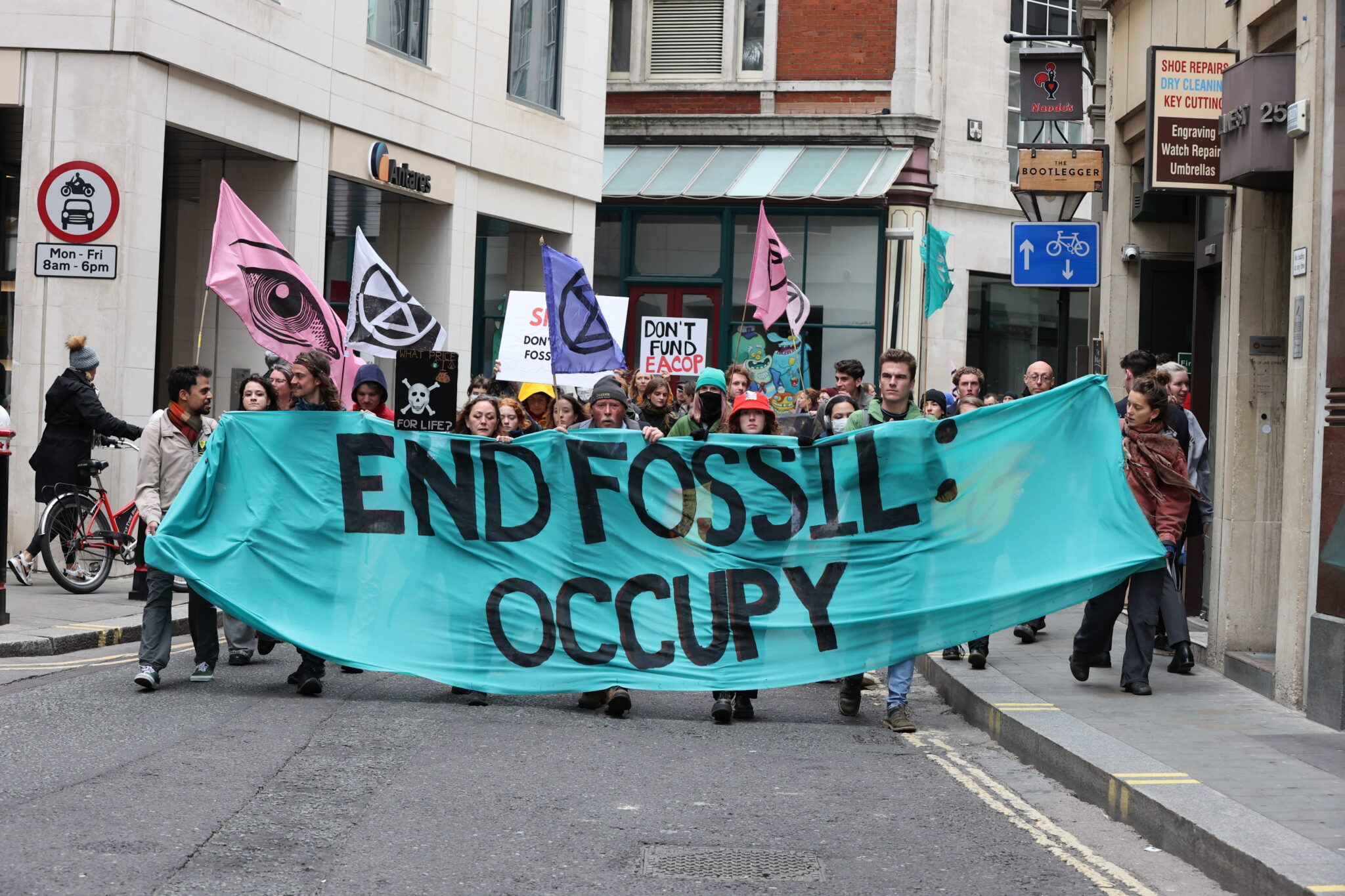
    Extinction Rebellion occupy Lloyds of London insurance companies 18 October 2023.
    Extinction Rebellion occupy Lloyds of London insurance companies 18 October 2023.

    Ten City of London insurance companies are targeted by activists calling on them to stop insuring West Cumbia coalmine and East Africa Crude Oil Pipeline NOW!

    Hundreds of protesters occupied City of London offices of ten Lloyd’s of London insurers demanding they rule out insuring the proposed West Cumbria coal mine and the East Africa Crude Oil Pipeline (EACOP).

    The occupations started as a huge crowd gathered outside Standard Bank. The protests are in collaboration with Fossil Free London’s “Oily Money Out” mass action – at which Greta Thunberg was arrested yesterday – and in solidarity with Extinction Rebellion Gauteng in South Africa.  In Johannesburg activists were recently met with brutality by security personnel hired by Standard Bank as they peacefully called for dialogue to end the financing of new coal projects.

    The protesters marched waving banners saying “Don’t Insure EACOP” and “Don’t Insure West Cumbria Mine” to three high profile buildings including the “Walkie Talkie” where in a coordinated swoop, activists occupied the office foyers of Ascot, Talbot, Chaucer, Markel, Allied World, CNA Hardy, Tokio Marine Kiln, Sirius International and Lancashire Syndicates. The activists are staging a sit-in and refusing to leave.

    Insurers from Lloyd’s of London have come under increasing pressure to rule out offering insurance to both the West Cumbria coal mine and EACOP, including protests at offices across the UK with hundreds of students entering the job market refusing to work for them.

    Claude Fourcroy, a spokesperson for Money Rebellion said: “We are calling on all the banks and insurers behind the West Cumbria mine and East Africa Crude Oil Pipelines to cut their ties now. Both of these projects will fuel climate breakdown. Lloyd’s of London and the insurers in its market sit at the centre of a web of climate wreckers in the City of London, alongside Barclays and HSBC.”

    Community members from Cumbria and Uganda joined the protests, sharing the united call to insurers and banks to stop underwriting fossil fuel projects.  The UK Climate Change Committee warned that the West Cumbria Mine would increase UK’s domestic emissions and make the government’s legally-binding domestic emissions budgets difficult to meet.

    The massive 1443 km East Africa Crude Oil Pipeline will wreak havoc on communities, jeopardise ecosystems and water supplies. and eliminate the possibility of Earth remaining habitable. There can be no new fossil fuels anywhere if global heating is to remain under 1.5C.

    Scientists say we are dangerously close to crossing the globally agreed threshold of 1.5C this year. Neither project will proceed without financial and insurance backing.

    Andrew Taylor, Coal Action Network said: “West Cumbria Mining Ltd wants to dig coal here right up until 2049 – when we’re supposed to have reached net zero by 2050! They’re not looking at the impact of how burning it would damage the climate and nature.  The UK government talks about us having energy security but the truth is, if the mine goes ahead, 85% of the coal would be exported.”

    Patience, a youth activist from Fridays for Future Uganda said: “We have gathered here today to demand that insurers cut ties with EACOP. By supporting this deadly fossil fuel project they undermine any climate commitments they have made. People in Uganda are facing human rights violations in the name of this project. This has to end.”

    Fossil Free London is simultaneously disrupting the Canary Wharf offices of Total Energies, a majority shareholder in EACOP.

    The protests come on the second day of the Fossil Free London “Oily Money Out” protests targeting the Energy Intelligence Forum at the InterContinental Park Lane Hotel in London, where fossil fuel corporations, including Shell, Total and Equinor, are talking to government ministers. The Forum is taking place in the run up to the COP28 Climate Conference, which has already been captured by the fossil fuel industry, with the appointment of Al Jaber, chief executive of the Abu Dhabi National Oil Company (ADNOC) as the COP28 President.

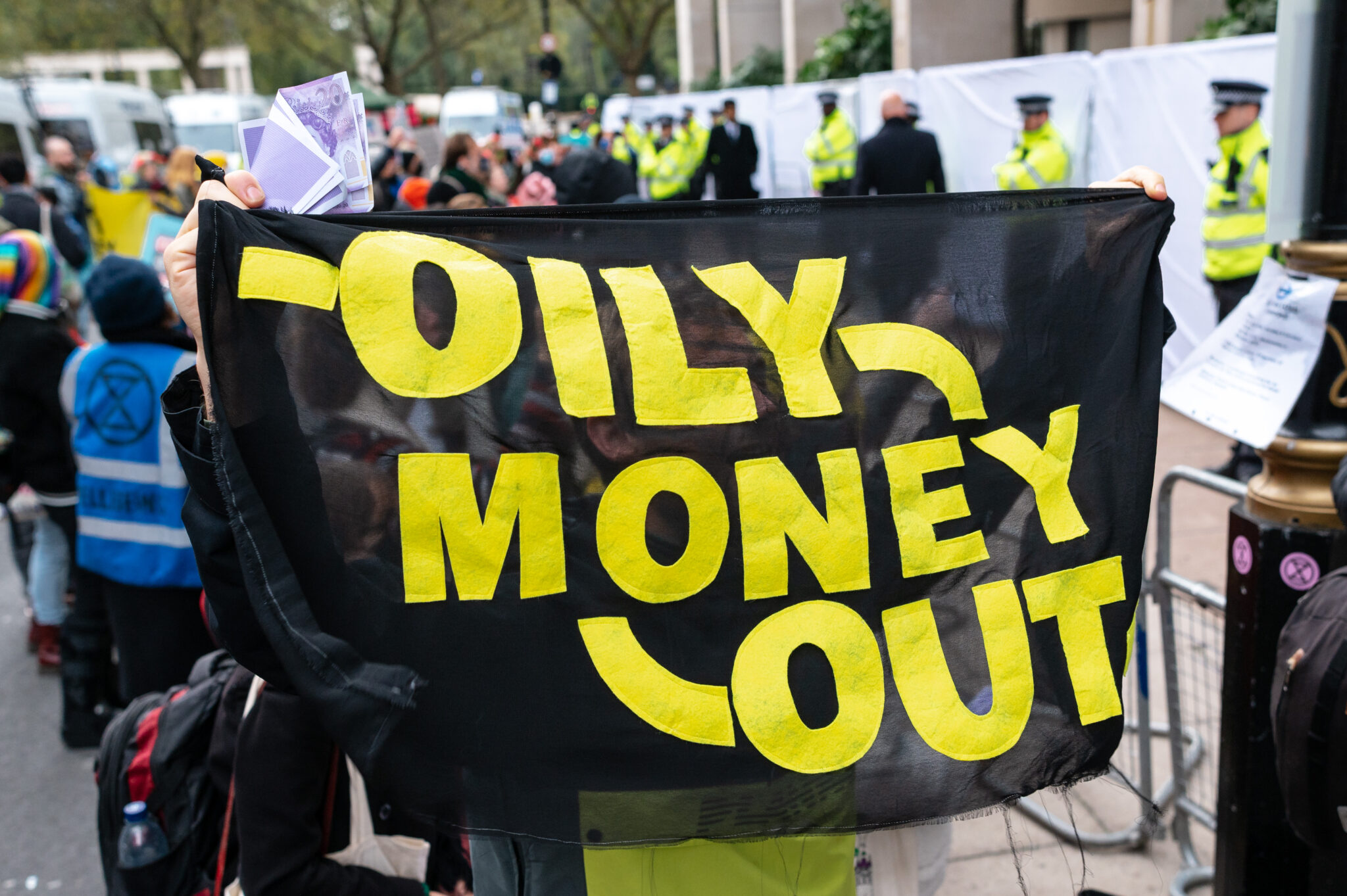
    Banner reads Oily Money Out. Protests London 18 October 2023.
    Banner reads Oily Money Out. Protests London 18 October 2023.


    Joanna Warrington, campaigner with Fossil Free London said: “We can’t allow London to welcome the climate-wrecking elite when droughts, floods, and wildfires rage across the world. London’s banks and finance sector have been ignoring all the warning signs while pouring billions into fossil fuel expansion. Their profit is our loss. Financing new fossil fuel developments is incompatible with a safe future.”

  • Just Stop Oil founders arrested in dawn raids

    Spread the love

    Just stop oil founders Indigo Rumbelow and Roger Hallam were arrested in separate raids this morning after police forced entry to their homes, searched belongings and confiscated papers. 

    Just Stop Oil protesting in London 6 December 2022.
    Just Stop Oil protesting in London 6 December 2022.

    Just Stop Oil said: 

    “We will not be intimidated by our criminal government. Not content with cheering on war crimes in Gaza, by maxing out our oil and gas reserves they are complicit in the greatest crime in human history. New oil and gas will result in unimaginable suffering and destroy the lives and livelihoods of billions of people. No one has ever voted for this, there has never been a democratic mandate to destroy the habitable world. 

    “Just Stop Oil supporters are deeply committed to stopping all new oil and gas. If our government refuses to do what is right to protect humanity, then people will step up to do what needs to be done. 

    “The painful truth right now is that our politicians and corporations have no intention of acting in accordance with the fundamental interests of either our young people or the country as a whole. Whether those in charge realise that they are committing the crime of genocide, is not the question. For this is how it will be seen by the next generation and all future generations. Our friends in police custody and languishing in prison understand this very well as do we.”

    Comment by dizzy: Roger Hallam appears to get arrested and imprisoned regularly.

    Video is from November 2022. Just Stop Oil are no longer blocking the M25 motorway.

    16.40 update: Just Stop Oil are claiming that Indigo Rumbelow and Roger Hallam were arrested as a result of short speeches they gave at a festival this summer. Here are those speeches.

    19.40 Uncertain why he was arrested over that speech, he didn’t seem to say anything outrageous. For example, he didn’t encourage people to engage in violence. Is it that the UK government is so intolerant? Are there some really nasty laws now prohibiting debate?

    Indigo Rumbelow’s speech …

    19.50 Indigo talks really well. Recommended.

    19/10/23 I’ve seen a video of Roger Hallam getting arrested where charges of conspiracy were discussed – so it would seem that they were not arrested for giving these speeches.

  • “Oily money out” : Greta Thunberg and 20 others arrested at London protest

    Spread the love

    https://morningstaronline.co.uk/article/greta-thunberg-and-20-others-arrested-in-protest-against-fossil-fuel-leaders-meeting

    CLIMATE activist Greta Thunberg was arrested along with 20 other protesters outside a central London hotel today in an action to disrupt the Energy Intelligence Forum.

    The InterContinental London hotel near Hyde Park was hosting the heads of major oil and gas companies at the event.

    Fossil Free London, which organised the protest, hit out at the companies for deliberately slowing the global energy transition to renewables in order to make more profits.

    The group highlighted how this year’s United Nations climate conference president is also the chief executive of an oil company.

    Dozens of protesters blocked Hamilton Place at both ends with banners and pink umbrellas with eyes painted on, chanting: “Oily money out” and “Cancel the conference.”

    Greenpeace activists abseiled down from the roof of the hotel to unfurl a banner reading: “Make big oil pay.”

    …

    later: A detailed, informative article: Oily Money Out: Greta Thunberg arrested at oil conference protest in London