Category: Climate Crisis

  • Here’s How the ‘Jet-Owning Oligarchy’ Harms Both Planet and Workers

    Spread the love

    Original article by KENNY STANCIL republished from Common Dreams under Creative Commons (CC BY-NC-ND 3.0).
    A new analysis catalogs alarming facts about the destructive private jet industry, which is emblematic of runaway economic and carbon inequality.

    Research published Monday details how the working class is paying the price, in more ways than one, for the “jet-owning oligarchy” to hop around the globe in their personal luxury planes.

    It’s well-established that private jet travel by the super-rich is worsening the fossil fuel-driven climate crisis. Adding insult to injury, this conspicuously carbon-intensive consumption is being subsidized by ordinary taxpayers, as the Institute for Policy Studies (IPS) and Patriotic Millionaires make clear in their new analysis.

    Entitled High Flyers 2023: How Ultra-Rich Private Jet Travel Costs the Rest of Us and Burns Up Our Planet, the report catalogs alarming facts about the private jet industry and makes recommendations about how to rein in this potent symbol and manifestation of escalating inequality.

    To begin with, “private jets emit at least 10 times more pollutants than commercial planes per passenger,” the report notes. “Unsurprisingly, approximately 1% of people are believed to be responsible for about half of all aviation carbon emissions.”

    Amid a surge in wealth inequality since the start of the Covid-19 pandemic, “private jet use has increased by about a fifth, and private jet emissions have increased more than 23%,” the report points out. “The private jet sector set industry records with regards to transaction and dollar volume in 2021 and 2022.”

    While a coronavirus-era boom is evident, the industry has been growing steadily alongside wealth inequality since the turn of the century. As the report states: “The size of the global fleet has increased 133% in the last two decades from 9,895 in 2000 to 23,133 in mid-2022. This bonanza was accompanied by an unprecedented number of business jet operations, 5.3 million in 2022.”

    “If we can’t ban private jets, we should at least tax them and require them to pay to offset their environmental damage and subsidies.”

    According to the report, “The median net worth of a full and fractional private jet owner is $190 million and $140 million respectively.” A minuscule 0.0008% of the global population belongs to the jet-owning class, which consists mostly of financial and real estate tycoons.

    Last year, billionaire Elon Musk, “the most active high flyer in the United States,” bought a new jet and took 171 private flights, or about one every other day, the report notes.

    In so doing, he single-handedly “contributed to the consumption of 837,934 liters of jet fuel,” states the report, and he “was responsible for 2,112 tons of carbon emissions”—132 times more than the entire carbon footprint of an average person in the United States.

    In a statement, report co-author Kalena Thomhave, a researcher with the Program on Inequality and the Common Good at IPS, called private jets “a microcosm of our system of wealth inequality even beyond their image of extravagance.”

    “Private flyers pay just 2% of the taxes that primarily fund the Federal Aviation Administration, yet nearly 17% of flights handled by the FAA are private,” said Thomhave. “Meanwhile, private jets contribute disproportionately to carbon emissions while often representing significant tax savings for their wealthy owners.”

    As the report observes: “Thousands of municipal airports in the U.S. are funded by the public, but many primarily serve private and corporate jets. These airports may not offer scheduled passenger service, but they still offer airport runways subsidized by taxes.”

    Such regressive taxation is the product of industry lobbying, the report explains:

    The largest player in the private jet lobby, the National Business Aviation Association, has spent an average $2.4 million each year since 2008 lobbying the federal government, primarily for tax giveaways. During the Covid-19 pandemic, the industry specifically lobbied for Covid relief, particularly “medium to long-term liquidity assistance and relief from air transportation excise taxes,” even though industry demand was quickly climbing.

    As wealth inequality soars, so too does the value of the private jet market, which grew from $32.3 billion in 2021 to $34.1 billion in 2022, the report notes. With wealth being concentrated in fewer and fewer hands and little to no downward redistribution on the horizon, the private jet industry is projected to expand further in the coming years.

    Report co-author Omar Ocampo, a researcher with the Program on Inequality and the Common Good at IPS, said that the private jet industry’s expected growth this decade “provides us with a great opportunity to levy a luxury transfer tax on private jet sales.” He added that “the revenue raised from this tax can be invested towards developing a green transportation system.”

    According to the report, “A 10% and 5% transfer fee on pre-owned and new private aircraft would have raised $2.4 billion in 2021 and $2.6 billion in 2022.”

    In addition to imposing a transfer tax on all private jet sales, IPS and Patriotic Millionaires recommend the following steps be taken:

    • Levy a private jet fuel tax;
    • Institute a “short hop” surcharge;
    • Resist efforts to increase passenger facility charges until private jet owners pay their fair share;
    • Create a sustainable transportation equity trust fund;
    • Increase TSA security oversight of private jets; and
    • Pass the Aircraft Ownership Transparency Act.

    According to the report, Musk would have paid nearly $4 million in additional taxes last year if a transfer fee and jet fuel tax had been in place.

    “Private jet travel by billionaires and the ultra-wealthy imposes a tremendous cost on the rest of us,” said Chuck Collins, another co-author of the report.

    “Not only do ordinary travelers and taxpayers subsidize the air space for private jets, but the high flyers also contribute considerably more pollution than other passengers,” said Collins. “If we can’t ban private jets, we should at least tax them and require them to pay to offset their environmental damage and subsidies.”

    Original article by KENNY STANCIL republished from Common Dreams under Creative Commons (CC BY-NC-ND 3.0).

  • Met Office confirms June as the hottest on record

    Spread the love

    Yet another record broken and governments do nothing … We need to get rid of the useless b’stards who are actually making the climate crisis worse by expanding the use of fossil fuels.

    https://www.metoffice.gov.uk/about-us/press-office/news/weather-and-climate/2023/fingerprints-of-climate-change-on-june-temperature-records

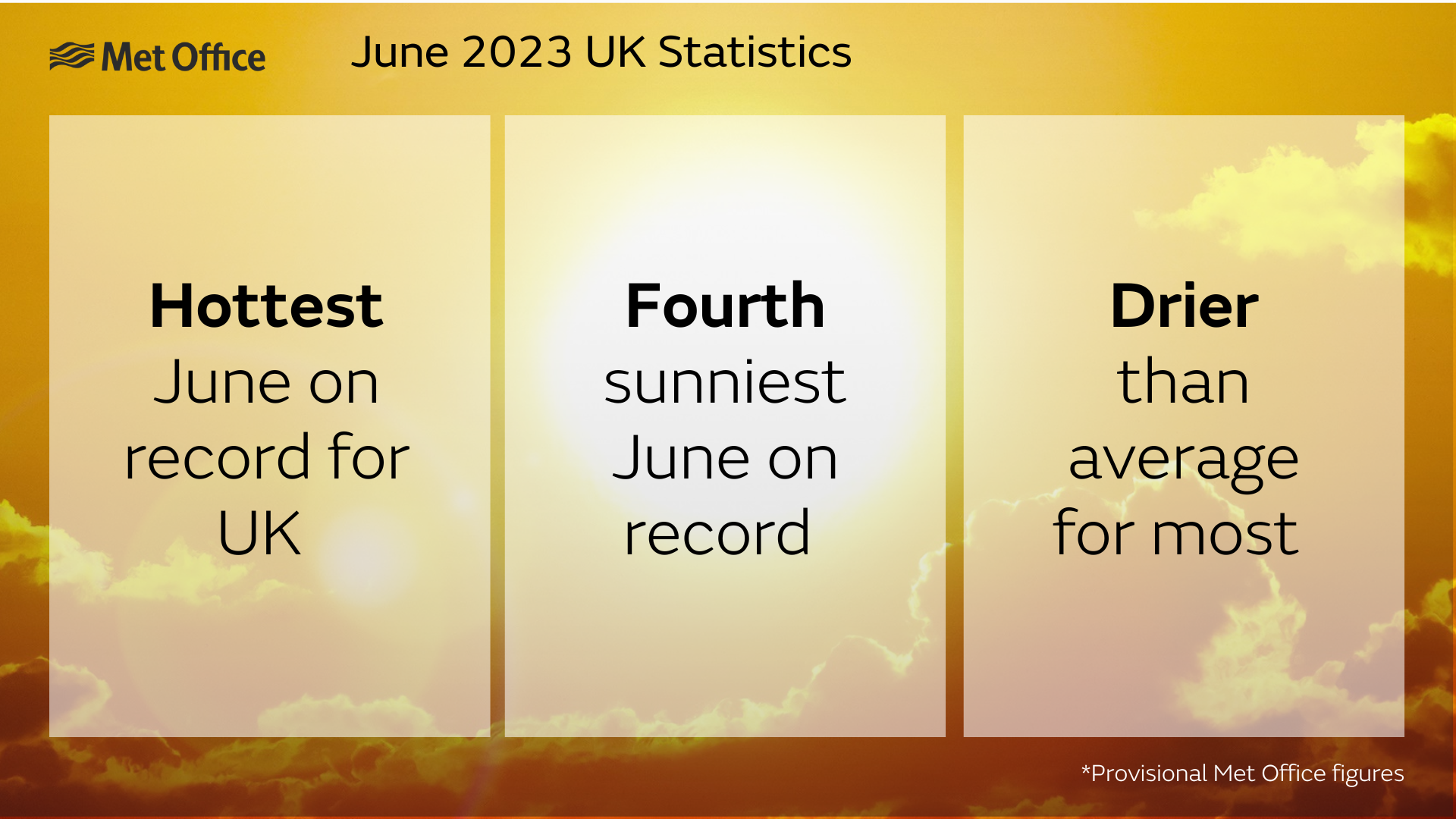
    June has been confirmed as the hottest on record for the UK.

    According to provisional Met Office figures, the average mean temperature of 15.8°C for June 2023 in the UK is the highest in a series since 1884, with England, Scotland, Wales and Northern Ireland also reporting their respective warmest June on record.

    This eclipsed the previous record by 0.9°C, while the previous top three Junes were separated by just 0.1°C.

    June 2023 UK provisional statistics. Hottest June on record for UK. Fourth sunniest June on record. Drier than average for most. This is according to provisional Met Office figures.

    Fingerprint of climate change

    A rapid study by Met Office scientists found the chance of observing a June beating the previous record of 14.9°C, like we have this year, has at least doubled since the period around 1940. The previous record of 14.9°C was recorded in 1940 and 1976.

    Paul Davies, Met Office Climate Extremes Principal Fellow and Chief Meteorologist, explains: “We found that the chance of observing a June beating the previous joint 1940/1976 record of 14.9°C has at least doubled since the 1940s. Alongside natural variability, the background warming of the Earth’s atmosphere due to human induced climate change has driven up the possibility of reaching record high temperatures.

    “Using our UKCP18 climate projections, we can also see that there is a difference in the frequency of these sort of extremes depending on the emissions scenario we follow in the future. By the 2050s the chance of surpassing the previous record of 14.9°C could be as high as around 50%, or every other year. Beyond the 2050s the likelihood is strongly governed by our emissions of greenhouse gasses, with the chance increasing further in a high emissions scenario but levelling off under mitigation.”

    The rapid study used the UK’s climate projections, UKCP18, comparing the chance of surpassing 14.9°C during the period 1925-1955 to that for 1991-2020.

    …

    https://www.metoffice.gov.uk/about-us/press-office/news/weather-and-climate/2023/fingerprints-of-climate-change-on-june-temperature-records

  • Top oil and gas companies have made “almost no progress” towards Paris Agreement goals: report 

    Spread the love

    https://www.energymonitor.ai/sectors/industry/oil-and-gas-companies-behing-on-paris-deal/

    The CDP’s Oil and Gas Benchmark report assessed 100 oil and gas companies on low-carbon transition and just transition indicators.

    Top oil and gas companies have made “almost no progress” in reaching the climate goals agreed as part of the 2015 Paris climate summit, environmental disclosure non-profit CDP said on Thursday.  

    The CDP’s Oil and Gas Benchmark report, published with the World Benchmarking Alliance (WBA), assessed 100 oil and gas companies. The assessment was based on low-carbon transition and social and just transition indicators.  

    While none of the companies perform well on all indicators, Finland-based Neste is ranked first, followed by French company Engie, oil giant TotalEnergies, Spain’s Naturgy Energy and Italy’s Eni. In May this year, TotalEnergies announced its plan to keep its scope 3 emissions below 400 million tonnes. However, the company scored 19.4 out of 60 on CDP’s low-carbon transition indicator, and 9.4 out of 20 on just transition.  

    According to the report, the operating emissions from the oil and gas sector added up to 5.1 gigatonnes (Gt) of CO₂ in 2022. None of the companies assessed by CDP can cut their emissions “at a rate sufficient to align with a 1.5°C pathway over the next five years”, it said. 

    The report observes that most companies fail to disclose their capital investment in low-carbon technologies. Currently Neste is the only one with investments sufficient to meet the climate goals. Further, despite seven major oil companies disclosing a profit of $380bn in 2022, investments in low-carbon transition fall short significantly.  

    …

    https://www.energymonitor.ai/sectors/industry/oil-and-gas-companies-behing-on-paris-deal/

  • Extinction Rebellion UK target Wood Group for “utter contempt” for UK taxpayers

    Spread the love
    Extinction Rebellion UK protest at Wood Group Aberdeen 3 July 2023
    Extinction Rebellion UK protest at Wood Group Aberdeen 3 July 2023

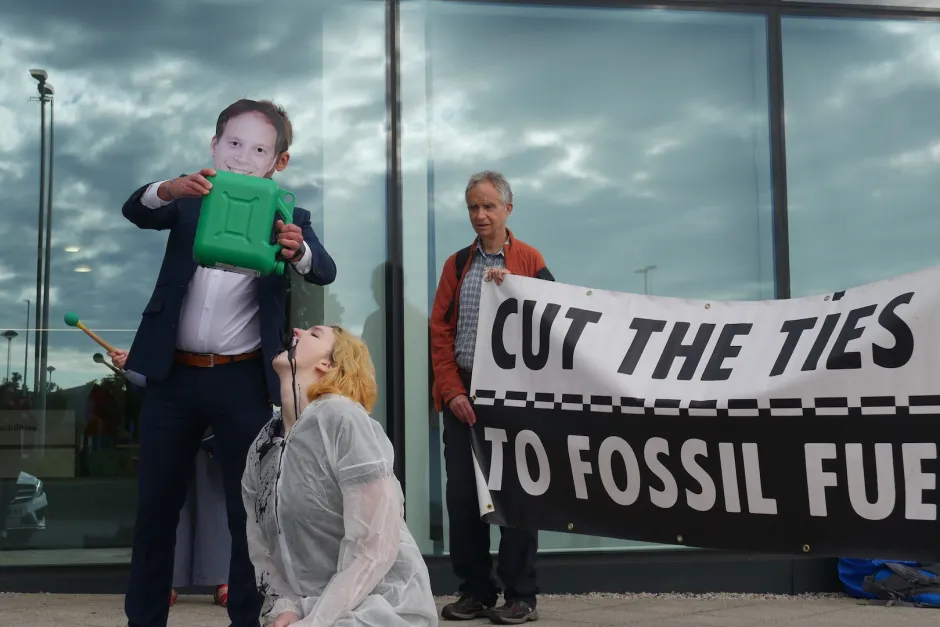
    Extinction Rebellion are protesting the Wood Group’s Aberdeen and Staines offices after Wood Group significantly reduced it’s renewables operations and expanded it’s fossil fuel operations weeks after receiving a £430m government-backed “green transition loan” in 2021.

    https://www.theguardian.com/environment/2023/jun/07/scottish-firm-expands-oil-and-gas-business-after-green-transition-loan

    … After receiving the £430m loan, Wood grew its upstream oil and gas business by 17% so that it accounted for more than $3bn (£2.4bn) in revenue in 2022, up from $2.6bn in 2021, according to an analysis of the company’s financial results by the Guardian and the investigative journalism organisation Point Source.

    Over the same period the company reduced the size of its renewable, hydrogen, and carbon capture business units by 35% so that they only accounted for revenues of $222.8m in 2022, down from $344.6m in 2021.

    The five-year loan, which was the first of its kind and was designed to help Wood transition away from fossil fuels, was announced in August 2021 by Liz Truss when she was international trade secretary.

    At the time, Truss said the engineering company had “already made great strides in repositioning its business for a low-carbon future”.

    After being awarded the loan, Wood announced a string of at least 20 major contract awards for work on oil, gas and petrochemical infrastructure.

    …

  • Future generations will regard climate inaction like sending children up chimneys, says Wildlife Trusts chief

    Spread the love
    Image contains protest banner readng You will die of old age, our children will die of climate change - Melbourne climate strike
    Craig Bennett says the way recent and current older generations have allowed environmental degradation will be viewed harshly by people in the future who will have to live with consequences that, in many cases, will be increasingly devastating. Image: A1Cafel Creative Commons Attribution-Share Alike 2.0 Generic via wikimedia.

    https://inews.co.uk/news/environment/future-generations-regard-climate-inaction-sending-children-up-chimneys-wildlife-trust-chief-2448662?ITO=newsnow

    Future generations will look at current older generations in the same way older generations now view those who sent children up chimneys, according to the head of The Wildlife Trusts.

    Craig Bennett says that the way that recent and current older generations have allowed environmental degradation – from climate change and nature degradation to plastic and air pollution – will be viewed harshly by people in the future who will have to live with consequences that, in many cases, will be increasingly devastating.

    “Future generations will look back at current older generations and the way we treat the environment in the way that we now all look back at Victorians and wonder how on earth they could send children up chimneys,” Mr Bennett told i.

    “I’ve no doubt that the way we treat the environment now, living in an utterly unsustainable manner will, before long at all, be seen for the true horror it is,” he said.

    …

    https://inews.co.uk/news/environment/future-generations-regard-climate-inaction-sending-children-up-chimneys-wildlife-trust-chief-2448662?ITO=newsnow