Category: Climate Crisis

  • Easter message

    Spread the love
    Image of a Great White Shark
    Image of a Great White Shark

    UK Extinction Rebellion’s ‘The Big One‘ starts on 21 April.

    There has been less activism over recent years which is often attributed to lockdown. I wonder whether it’s more to do with Corbyn i.e. it’s almost as if all those people who were supporting Corbyn and pursuing a better World have learned learned helplessness. It’s great that so many people supported Corbyn proving that there is a real demand for Socialism in UK. Please appreciate that it’s more than any one person and it’s more than one attempt – if you believe in something do it until you win.

    And so we are back to the normal situation in UK – that we have a Tory as leader of the Labour Party so that Socialists ideals and policies are denied expression. It’s worse that that really – since the ruling class got scared shitless that we could have a Socialist government Starmer has done his bestest to kill the left forever and Socialists in the Labour Party are taking it.

    Fight until you win.

  • Scotland generates record-breaking renewable energy

    Spread the love
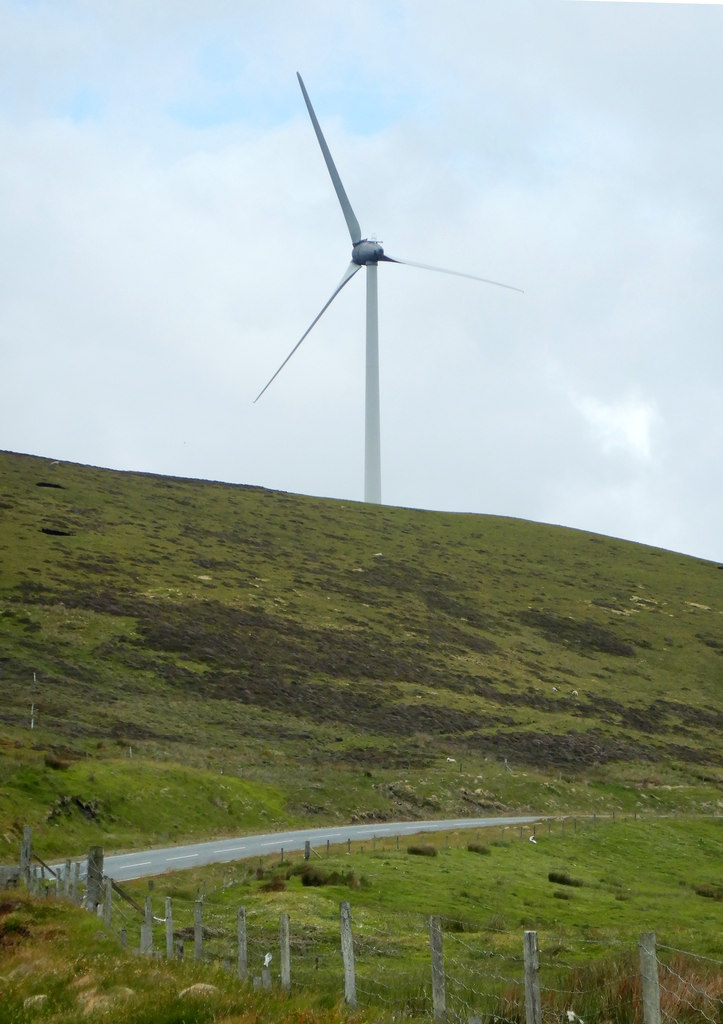
    Shetland’s biggest Wind Turbine Image © Copyright Andy Waddington and licensed for reuse under this Creative Commons Licence.

    https://energydigital.com/articles/scotland-generates-record-breaking-renew able-energy

    … According to official data, Scotland broke previous records by generating 35.3TWh of renewable electricity in 2022, marking a 28.1% increase from 2021 and 9.8% from 2020. This amount of electricity could power all households in Scotland for over three years. The fourth quarter of 2022 saw the largest increase in renewable electricity generation in Scotland’s history, rising by 14%.

    Between September and December 2022, the renewable electricity capacity grew from 13.6GW to 13.8GW. In addition, Scotland’s net electricity exports increased by 17% to 18.7TWh in 2022, with a wholesale market value of approximately £4 billion.

    Wind energy was the primary contributor to Scotland’s renewable electricity generation in 2022, accounting for 27.5TWh. Of this amount, 5.8TWh came from offshore wind, while 21.8TWh was generated from onshore wind.

    …

    https://energydigital.com/articles/scotland-generates-record-breaking-renewable-energy

  • Former ADF chief calls for release of secret report into security threat posed by climate crisis

    Spread the love

    https://www.theguardian.com/australia-news/2023/apr/05/former-adf-chief-calls-for-release-of-secret-report-into-security-threat-posed-by-climate-crisis

    Chris Barrie says global heating poses larger security threat than China, and Australians should be armed with this information

    A former Australian defence force chief has called on the government to release its assessment of the security threats posed by the climate crisis, which he says they received late last year.

    Guardian Australia understands the Office of National Intelligence’s “urgent climate risk assessment” looked at how global heating affected Australia’s national security, but relied in part on classified information.

    This means the government would have to decide whether, and how, the assessment is released publicly.

    The former ADF chief Chris Barrie said he was concerned climate security risks were “missing in action” in the public debate triggered by the Aukus nuclear-powered submarine announcement.

    Barrie said it was “rather surprising” that the Albanese government was continuing the previous Morrison government’s framing of China as the predominate security threat to Australia.

    “Climate change as a security threat seems to be totally overlooked,” he said.

    …

    https://www.theguardian.com/australia-news/2023/apr/05/former-adf-chief-calls-for-release-of-secret-report-into-security-threat-posed-by-climate-crisis

  • Getting real: what would serious climate action look like?

    Spread the love

    From Getting real: what would serious climate action look like?

    …

    So what would it look like? Let me sketch out just a few examples. An early win would be an immediate moratorium on airport expansion and a plan to deliver a fair 80 percent cut in all air travel by 2030. Also, no more new internal combustion engine cars would be built from 2025, and there would be a huge shift away from private cars in cities and urban environments coupled with a shift towards public transport and active travel. Maybe rural communities would continue to use EVs, but with a rental rather than ownership model. Also necessary would be the retrofit of existing homes, not just a pilot scheme but actually rolling it out street by street at mass scale. Passive house standards would be required on all new properties and also a maximum size threshold. Why are we building homes that are 200 to 400m2? Cut this to a maximum of 100 to 150m2, still large homes, but with much less resource and material use – and of course less land! And when we sell existing very large houses, have them carefully and creatively divided into normal sized homes. All of which would free up labour and resources to achieve the necessary decarbonisation agenda. On top of all of this we need a massive expansion of electrification in the energy system. This is an unprecedented scale and rate of change – pushing the productive capacity of society to its limit and consequently demanding the reallocation of labour and resources to deliver a decarbonised, sustainable and prosperous future.

    …

    [H]ow do we get the debate opened up? How can the silent majority, who will do really well out of these changes, have their voices heard without being twisted by those running the show? If the media, ‘the great and good’ experts and we high-emitters continue to have our way there will be no shift in business-as-usual until we’re hit by the climate chaos of inaction. If, however, enough voices can break through the stifling status quo, perhaps a more honest and inclusive debate can be catalysed. As we have progressed beyond the climate deniers, so now we need to move beyond the ‘mitigation deniers’ who greenwash business-as-usual. To me at least, the rise of civil society engagement on climate issues along with real-world technologies demonstrating what is already possible, suggest that we may be in the foothills of a social and technical tipping point. Of course, we can’t know this until we are actually living through it. But we can increase its likelihood and hasten the demise of the high-carbon status quo by repeatedly and coherently countering the ‘mitigation deniers’ wherever they may reside.
     

    Kevin Anderson is a Professor of Energy and Climate Change at the Universities of Manchester (UK) , Uppsala (Sweden) and Bergen (Norway). Kevin is also co-founder of the Climate Uncensored website – https://climateuncensored.com/about/ – where readers can find more detailed discussion of the issues covered in this article.

    From Getting real: what would serious climate action look like?

  • We must face up to neoliberalism’s flaws if we’re to halt climate breakdown

    Spread the love

    OPINION: Tackling the climate crisis effectively requires transition to a more fair and sustainable global economy

    Original article by Paul Rogers republished from OpenDemocracy under a Creative Commons Attribution-NonCommercial 4.0 International licence.

    The Climate Change Committee (CCC) delivered a report this week that is especially sobering in light of the fact that the committee is an independent, statutory body, established under the Climate Change Act 2008. The CCC is not just a think tank. Its function is “to advise the UK and devolved governments on emissions targets and to report to Parliament on progress made in reducing greenhouse gas emissions and preparing for and adapting to the impacts of climate change”.

    Funded by the government, the committee is developing a reputation for being surprisingly blunt when it comes to government policy.

    This was amply demonstrated in this week’s report, covered in some detail by the Environment Journal and neatly summed up by a single paragraph:

    Simply put, the National Adaptation Programme (NAP) – which should respond to the scale of the challenge – falls well short. According to the CCC, it lacks a clear vision for the future, is not underpinned by tangible targets, and is not driving policy changes or steps towards implementation. If this does not improve then wider measures, including the net zero journey and restoration of biodiversity and ecosystems, will also fail.

    Just a day later, the government delivered its revised plan to meet its climate change targets, with a heavy emphasis on carbon capture and nuclear power. It was received with relief by the oil and gas industry, but with a singularly large raspberry by environmental analysts.

    By coincidence, the week also saw a study published following research by Australian climate scientists. As reported in The Guardian, it predicted: “Melting ice around Antarctica will cause a rapid slowdown of a major global deep ocean current by 2050 that could alter the world’s climate for centuries and accelerate sea level rise.”

    This is just one of several reports on recent research showing that radical and rapid decarbonisation is now vital if climate breakdown and chaos are to be avoided. The reports raise two vital questions: What does rapid decarbonisation involve in practice? And what are the chances of success?

    Back in 2020, the Intergovernmental Committee on Climate Change (IGCC) estimated that to limit global temperature rises to 1.5°C, a 7% decline in carbon dioxide output was needed every year for the whole decade. That has already failed for the first three years of the 2020s and a per annum decrease of about 10% is now needed, equivalent to a 60% decrease overall.

    The likes of carbon capture and more nuclear power for the richer states are simply a non-starters

    On the question of how to achieve this, Kevin Anderson, professor of energy and climate change at the universities of Manchester (UK), Uppsala (Sweden) and Bergen (Norway), and co-founder of the Climate Uncensored website, spells out what is required in the Scientists for Global Responsiblity’s journal, Responsible Science.

    He writes that a starting point is that the world’s major emitters, the wealthier states, must get to zero carbon emissions by 2030 to 2035 to allow the poorer states extra time to follow suit. On this timescale, the likes of carbon capture and more nuclear power for the richer states are simply a non-starters. It would take far too long to reach net zero using these methods.

    So what would this involve for a country such as the UK? Anderson sketches out a few examples, starting off with an immediate moratorium on airport expansion and an 80% cut in air travel by 2030. No new internal combustion engine cars would be built after 2025, and there would be a huge shift away from private cars in urban areas and towards public transport and active travel (such as walking and cycling). There would be a nationwide retrofit on all existing housing stock “rolling it out street by street at mass scale”, and new housing would be built to “passive house” standards.

    Anderson underpins the whole process by a massive expansion of electrification across the entire energy system, with an obvious emphasis on wind, solar and other renewables, already cheaper than coal, oil or gas.

    There is much more to Anderson’s article, so you should read it yourself, but three elements stand out. The first is that what is required is, in effect, a ‘Marshall Plan’ for a greened world. He uses the term to indicate the ambition necessary rather than, as in the original, the US helping Europe.

    That brings us to the second element – the money to effect that change must come from the richer sectors of society right across the world. Although Anderson does not spell it out in detail, these cannot just be the super-rich, the ultra-high net worth individuals who now number close to 600,000 worldwide. It must also include the many millions more who are merely ‘high-net-worth’ people on a global scale.

    This questions the very basis of the current economic model, but that won’t come as a surprise to anyone who has looked in any detail at what needs to be done. A frequent conclusion is that neoliberalism just isn’t fit for purpose when it comes to wealth distribution, and it is also not able to respond to climate breakdown at anything like the speed that is needed.

    For his third point, Anderson points to some of the benefits that would follow in the wake of the changes. They include the elimination of fuel poverty; improved and warmer homes that are cheaper to run; better internal and external air quality; high-quality, reliable public transport; quieter urban spaces with more room for playing fields, parks and recreation; and plenty of skilled jobs supporting the green transition.

    We might add that it also means finally facing up to the deep flaws in neoliberalism, especially those market fundamentalist dimensions that simply cannot, by their nature, respond to climate breakdown .

    We might not meet Anderson’s timetable, but we will have no option over the next decade but to come very close to it, since the alternative of a chaotic global climate will be increasingly evident.

    In any case, look at it this way. Not only will we get on top of climate breakdown, but we will start the transition to a fair and sustainable global economy. That really is something worth aiming for.

    Original article by Paul Rogers republished from OpenDemocracy under a Creative Commons Attribution-NonCommercial 4.0 International licence.