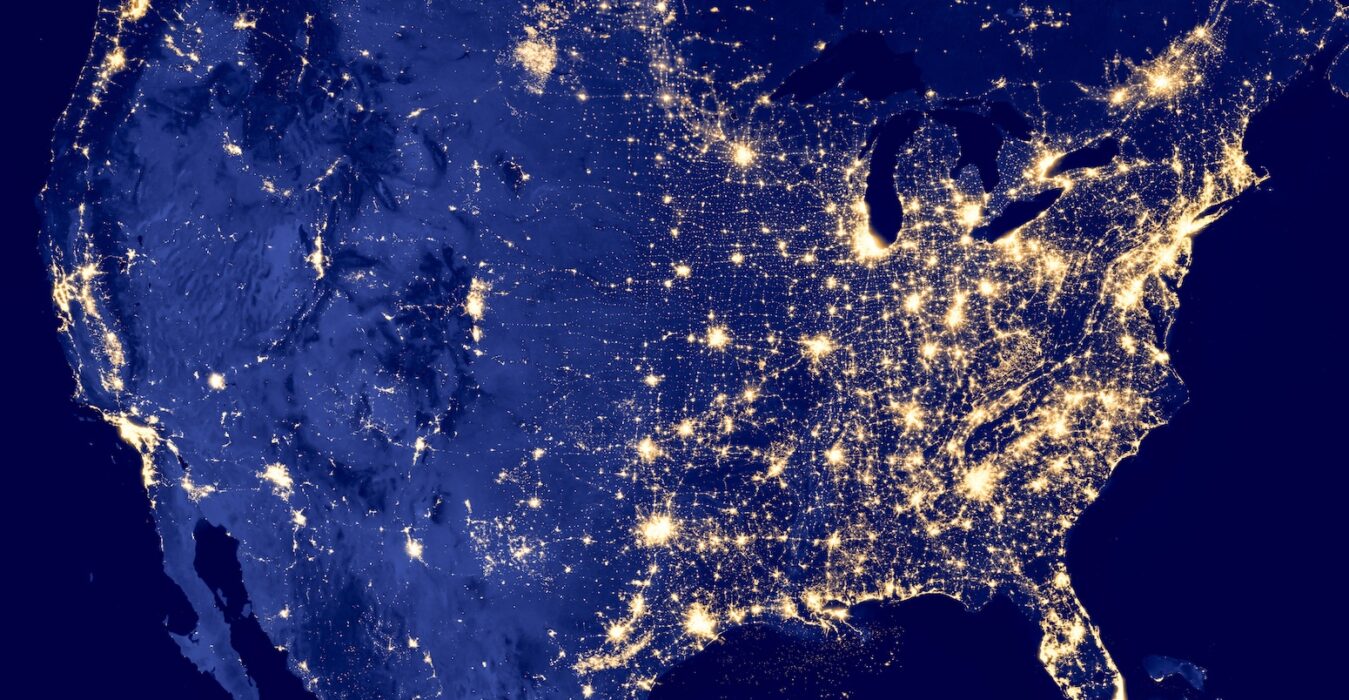
The US, which has announced plans to withdraw from the global climate treaty – the UN Framework Convention on Climate Change (UNFCCC) – is more historically responsible for climate change than any other country or group.
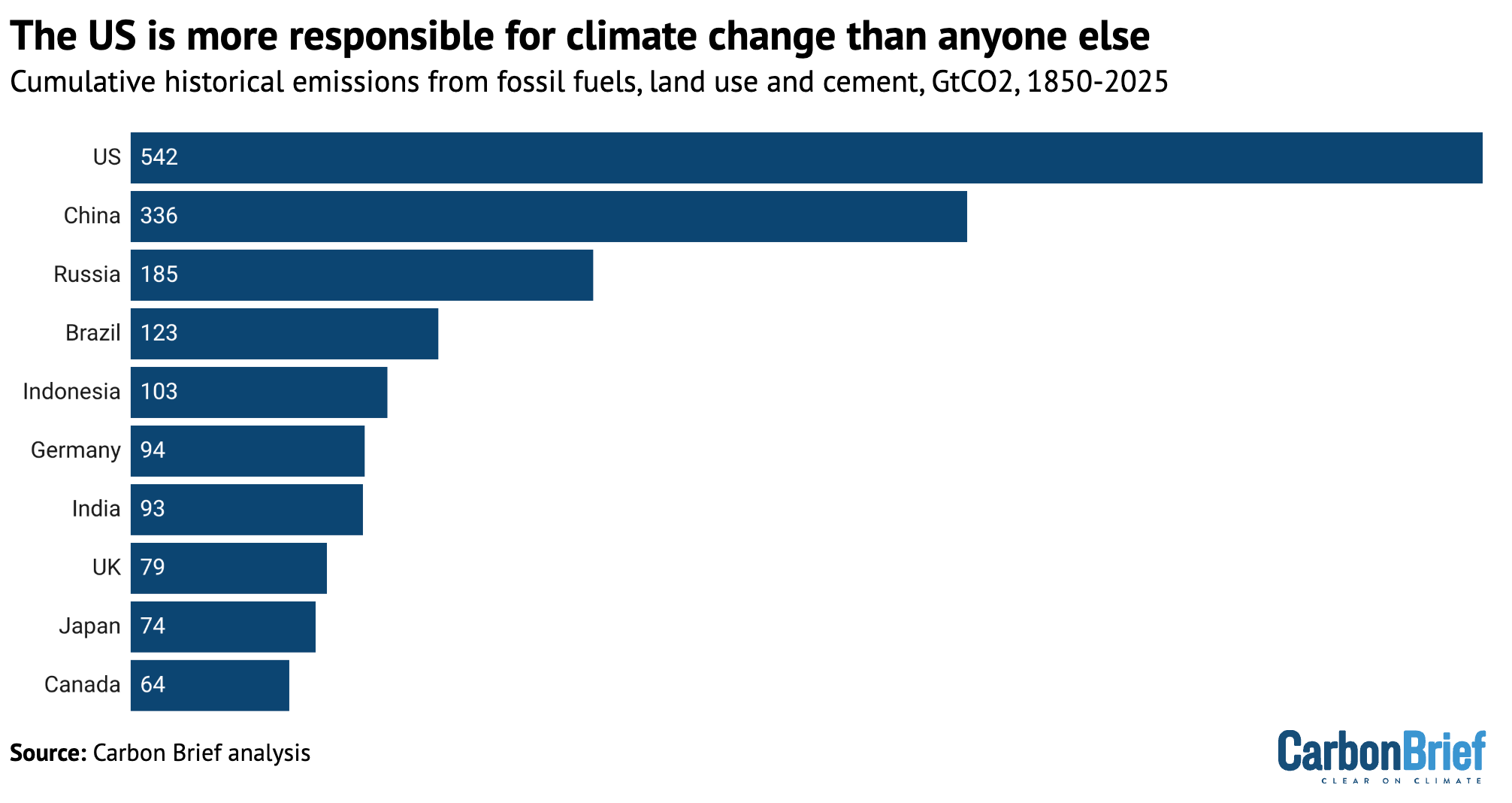
Carbon Brief analysis shows that the US has emitted a total of 542bn tonnes of carbon dioxide (GtCO2) since 1850, by burning fossil fuels, cutting down trees and other activities.
This is the largest contribution to the Earth’s warming climate by far, as shown in the figure below, with China’s 336GtCO2 significantly behind in second and Russia in third at 185GtCO2.
The US is responsible for more than a fifth of the 2,651GtCO2 that humans have pumped into the atmosphere between 1850 and 2025 as a result of fossil fuels, cement and land-use change.
China is responsible for another 13%, with the 27 nations of the EU making up another 12%.
In total, these cumulative emissions have used up more than 95% of the carbon budget for limiting global warming to 1.5C and are the predominant reason the Earth is already nearly 1.5C hotter than in pre-industrial times.
The US share of global warming is even more disproportionate when considering that its population of around 350 million people makes up just 4% of the global total.
On the basis of current populations, the US’s per-capita cumulative historical emissions are around 7 times higher than those for China, more than double the EU’s and 25 times those for India.
The US’s historical emissions of 542GtCO2 are larger than the combined total of the 133 countries with the lowest cumulative contributions, a list that includes Saudi Arabia, Spain and Nigeria. Collectively, these 133 countries have a population of more than 3 billion people.
See Carbon Brief’s previous detailed analysis of historical responsibility for climate change for more details on the data sources and methodology, as well as consumption-based emissions.
Additionally, in 2023, Carbon Brief published an article that looked at the “radical” impact of reassigning responsibility for historical emissions to colonial rulers in the past.
This approach has a very limited impact on the US, which became independent before the vast majority of its historical emissions had taken place.
Donald Trump urges you to be a Climate Science denier like him. He says that he makes millions and millions for destroying the planet, Burn, Baby, Burn and Flood, Baby, Flood.Orcas discuss Donald Trump and the killer apes’ concept of democracy. Front Orca warns that Trump is crashing his country’s economy and that everything he does he does for the fantastically wealthy.
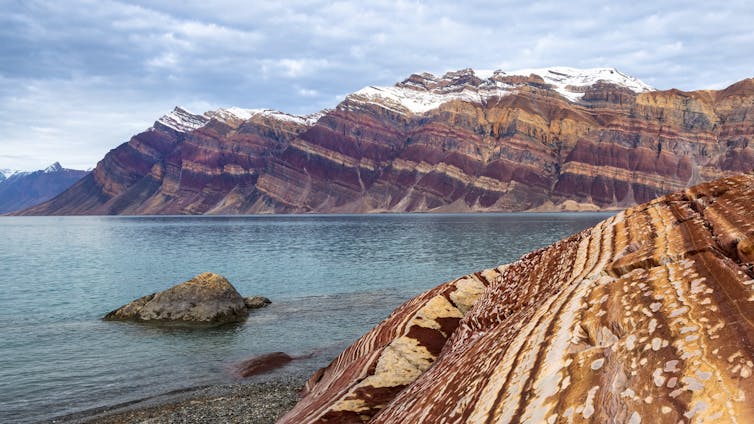
Greenland’s concentration of natural resource wealth is tied to its hugely varied geological history over the past 4 billion years. Jane Rix/Shutterstock
Greenland, the largest island on Earth, possesses some of the richest stores of natural resources anywhere in the world.
These include critical raw materials – resources such as lithium and rare earth elements (REEs) that are essential for green technologies, but whose production and sustainability are highly sensitive – plus other valuable minerals and metals, and a huge volume of hydrocarbons including oil and gas.
The scale of Greenland’s hydrocarbon potential and mineral wealth has stimulated extensive research by Denmark and the US into the commercial and environmental viability of new activities like mining. The US Geological Survey estimates that onshore northeast Greenland (including ice-covered areas) contains around 31 billion barrels of oil-equivalent in hydrocarbons – similar to the US’s entire volume of proven crude oil reserves.
But Greenland’s ice-free area, which is nearly double the size of the UK, forms less than a fifth of the island’s total surface area – raising the possibility that huge stores of unexplored natural resources are present beneath the ice.
Greenland’s concentration of natural resource wealth is tied to its hugely varied geological history over the past 4 billion years. Some of the oldest rocks on Earth can be found here, as well as truck-sized lumps of native (not meteorite-derived) iron. Diamond-bearing kimberlite “pipes” were discovered in the 1970s but have yet to be exploited, largely due to the logistical challenges of mining them.
Geologically speaking, it is highly unusual (and exciting for geologists like me) for one area to have experienced all three key ways that natural resources – from oil and gas to REEs and gems – are generated. These processes relate to episodes of mountain building, rifting (crustal relaxation and extension), and volcanic activity.
Greenland was shaped by many prolonged periods of mountain building. These compressive forces broke up its crust, allowing gold, gems such as rubies, and graphite to be deposited in the faults and fractures. Graphite is crucial for the production of lithium batteries but remains “underexplored”, according to the Geological Survey of Denmark and Greenland, relative to major producers such as China and South Korea.
But the greatest proportion of Greenland’s natural resources originates from its periods of rifting – including, most recently, the formation of the Atlantic Ocean from the beginning of the Jurassic Period just over 200 million years ago.
Greenland’s onshore sedimentary basins such as the Jameson Land Basin appear to hold the greatest potential of oil and gas reserves, analogous to Norway’s hydrocarbon-rich continental shelf. However, prohibitively high costs have limited commercial exploration. There is also a growing body of research suggesting potentially extensive petroleum systems ringing the entirety of offshore Greenland.
Metals such as lead, copper, iron and zinc are also present in the onshore (mostly ice-free) sedimentary basins, and have been worked locally, on a small scale, since 1780.
Difficult-to-source rare earth elements
While not as intimately related to volcanic activity as nearby Iceland – which, uniquely, sits at the intersection of a mid-ocean ridge and a mantle plume – many of Greenland’s critical raw materials owe their existence to its volcanic history.
REEs such as niobium, tantalum and ytterbium have been discovered in igneous rock layers – similar to the discovery (and subsequent mining) of silver and zinc reserves in south-west England, which were deposited by warm hydrothermal waters circulating at the tip of large volcanic intrusions.
Critically among REEs, Greenland is also predicted to hold sufficient sub-ice reserves of dysprosium and neodymium to satisfy more than a quarter of predicted future global demand – a combined total of nearly 40 million tonnes.
These elements are increasingly seen as the most economically important yet difficult to source REEs because of their indispensable role in wind power, electric motors for clean road transport, and magnets in high-temperature settings like nuclear reactors.
The development of known deposits such as Kvanefield in southern Greenland – not to mention those not yet discovered in the island’s central rocky core – could easily affect the global REE market, owing to their relative global scarcity.
An unfortunate dilemma
The global energy transition came about due to increasing public recognition of the manifold threats of burning fossil fuels. But climate change has major implications for the availability of many of Greenland’s natural resources that are currently blanketed by kilometres of ice – and which are a key part of that energy transition.
An area the size of Albania has melted since 1995, and this trend is likely to accelerate unless global carbon emissions fall sharply in the near future.
Recent advances in survey techniques, such as the use of ground-penetrating radar, allow us to peer with increasing certainty beneath the ice. We are now able to obtain an accurate picture of bedrock topography below up to 2 km of ice cover, providing clues as to the potential mineral resources in Greenland’s subsurface.
However, progress is slow in prospecting under the ice – and sustainable extraction is likely to prove even harder.
Soon, an unfortunate dilemma may need to be addressed. Should Greenland’s increasingly available resource wealth be extracted with gusto, in order to sustain and enhance the energy transition? But doing so will add to the effects of climate change on Greenland and beyond, including despoiling much of its pristine landscape and contributing to rising sea levels that could swamp its coastal settlements.
Currently, all mining and resource extraction activities are heavily regulated by the government of Greenland through comprehensive legal frameworks dating from the 1970s. However, pressures to loosen these controls, and to grant new licences for exploration and exploitation, may increase amid the US’s strong interest in Greenland’s future.
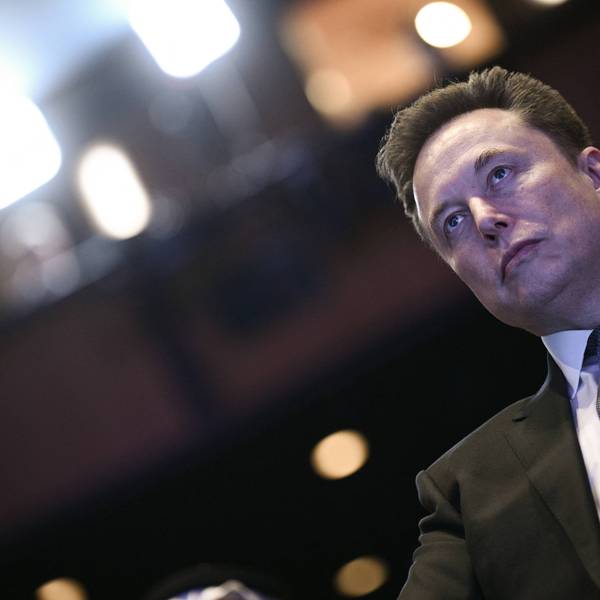
Demonstrators gather outside a Tesla showroom as part of “TeslaTakedown” protest against CEO Elon Musk in New York City on May 3, 2025. (Photo by Mostafa Bassim/Anadolu via Getty Images)
“If the monstrous political-economic system that is tearing our planet, the climate, and its people apart isn’t brought to its knees—then humanity will be,” warned one climate scientist.
Led by Big Tech billionaires including Jeff Bezos, Larry Ellison, and Elon Musk, the world’s 500 richest people added a record $2.2 trillion to their collective wealth in 2025, Bloombergreported as the year ended on Wednesday.
“Obscene greed! While billions of people live in poverty,” human rights campaigner Peter Tatchell responded on X—a social media platform now controlled by Musk, the richest person on Earth. “It’s why we need a global wealth tax.”
Musk—who could become the world’s first trillionaire thanks to his new controversial pay package as CEO of Tesla—is one of just eight ultrawealthy individuals who got around a quarter of all the gains recorded by the Bloomberg Billionaires Index.
The others are Amazon founder Bezos and Oracle chairman Ellison, as well as Michael Dell, Google co-founders Sergey Brin and Larry Page, Jensen Huang of Nvidia, and Meta‘s Mark Zuckerberg. The previous year, Bloombergnoted, “the same eight billionaires made up 43% of the total gains.”
According to Bloomberg, the gains that brought the combined net worth of all 500 people to $11.9 trillion “were turbocharged” by the 2024 election victory of President Donald Trump. The Republican and his relatives were among the “biggest winners” of 2025, gaining at least $282 million, for a net worth of $6.8 billion.
The “winners” also include Musk, who gained $190.3 billion for a net worth of $622.7 billion; Ellison, who gained $57.7 billion for a net worth of $249.8 billion; and Australian mining magnate Gina Rinehart, who gained $12.6 billion for a net worth of $37.7 billion.
After Trump’s electoral win, several Big Tech billionaires buddied up to him, with Bezos, Musk, Zuckerberg, Apple CEO Tim Cook, and Google CEO Sundar Pichai all attending his inauguration. Musk then spent several months spearheading the administration’s attack on federal workforce as the de facto leader of the Department of Government Efficiency (DOGE).
The world’s 500 richest people have total wealth of $11.9tn.Their wealth up by $2.2tn in 2025. 8 billionaires accounting for a 25% of the gains.No one becomes this rich by working.They fund right-wing parties, oppose worker/human rights, cause more pollution than normal people.
Sharing the Guardian‘s coverage of the findings on the social media network Bluesky, British climate scientist Bill McGuire warned that “if the monstrous political-economic system that is tearing our planet, the climate, and its people apart isn’t brought to its knees—then humanity will be.”
The Guardian pointed to Oxfam International’s November statement that $2.2 trillion “would have been more than enough to lift 3.8 billion people out of poverty,” which the humanitarian group highlighted ahead of the Group of 20 Summit hosted by South Africa, whose government used its G20 presidency to push for solutions to global inequality.
“Inequality is a deliberate policy choice. Despite record wealth at the top, public wealth is stagnating, even declining, and debt distress is growing,” Oxfam executive director Amitabh Behar said at the time. “Inequality rips away life opportunities and rights from the majority of citizens, sparking poverty, hunger, resentment, distrust, and instability.”
A June 2024 report from French economist and EU Tax Observatory director Gabriel Zucman—prepared for the G20’s Brazilian presidency—estimated that a global 2% minimum tax on the wealth of 3,000 billionaires could generate about $250 billion.
As seven Nobel laureates, including Joseph Stiglitz, noted in a July op-ed published by the French newspaper Le Monde, “By extending this minimum rate to individuals with wealth over $100 million, these sums would increase significantly.”
Orcas discuss Donald Trump and the killer apes’ concept of democracy. Front Orca warns that Trump is crashing his country’s economy and that everything he does he does for the fantastically wealthy.
The FEMA Colorado Task Force 1 navigates the Guadalupe River on a boat as search for victims continues on July 18, 2025 in Center Point, Texas. (Photo by Brenda Bazán / The Washington Post via Getty Images)
A former FEMA official said that the agency “can’t do disaster response and recovery without” the employees being terminated by the Trump administration.
The Trump administration this week made abrupt cuts to the top federal disaster response agency, even as US communities face increased threats from natural disasters caused by the global climate crisis.
Independent journalist Marisa Kabas reported on Wednesday that the Federal Emergency Management Agency (FEMA) “has begun issuing termination notices” to staff at the agency’s Cadre of On-Call Response and Recovery (CORE) that are effective as of January 2.
A FEMA staffer who spoke with Kabas described the terminations as “The New Year’s Eve Massacre,” and explained that “the driving force behind all CORE employees is supporting and enacting the mission of preparing for, responding to, and recovering from disasters.”
A Thursday report from CNN added some additional details to Kabas’ reporting, including that the decision to issue the layoffs was made by Acting Administrator Karen Evans, who was appointed to the role after former Acting Administrator David Richardson resigned in November.
One former FEMA official bluntly told CNN that the agency “can’t do disaster response and recovery without CORE employees” that are being laid off by the administration.
The former FEMA official added that regional agency offices throughout the US “are almost entirely CORE staff, so the first FEMA people who are usually onsite won’t be there,” which will mean that “states are on their own” when it comes to disaster response.
CNN also reported that there is anxiety among remaining FEMA staffers that these cuts could just be the start “of a larger effort” by Department of Homeland Security Secretary Kristi Noem “to shrink FEMA, potentially axing thousands of workers in the coming months who deploy during hurricanes, wildfires and other national emergencies.”
President Donald Trump has been targeting FEMA for potential termination for nearly a year now, and he said shortly after being inaugurated last January that a goal in his second term would be “fundamentally reforming and overhauling FEMA or maybe getting rid of FEMA,” while emphasizing that individual states should bear the cost of responding to natural disasters.
“I think, frankly, FEMA’s not good,” the president said. “I think when you have a problem like this, I think you want to go, and whether it’s a Democrat or Republican governor, you want to use your state to fix it and not waste time calling FEMA.”
The Trump administration’s deep cuts to FEMA come as the intensity of natural disasters is only projected to increase thanks to climate change.
According to a report published on Tuesday by the Yale School of the Environment, 2025 was the second hottest on record and was only surpassed by the previous year.
“The last three years have been, by a wide margin, the hottest ever recorded,” stressed the report. “Each of the last three years has measured more than 1.5°C warmer than preindustrial times, putting the world at least temporarily in breach of an international goal to limit warming below that level.”
Climate activists from Greenpeace and Uplift during a demonstration outside the Scottish Court of Session, Edinburgh, on the first day of the Rosebank and Jackdaw judicial review hearing, November 12, 2024
THE Scottish Greens called today for a year of climate action, starting with the rejection of Rosebank oil field project.
Net Zero spokesman Patrick Harvie urged both the Scottish and Westminster governments to reject the plans for further oil and gas extraction from the North Sea, instead committing to reaching their net zero targets.
The Labour government has not ruled out production from the Rosebank oil field, and all new exploration, despite numerous warnings from experts that the cost to our climate would be catastrophic.
Mr Harvie said: “We are trapped in a deepening climate crisis, and drilling for new oil and gas will do nothing but worsen the conditions and put unnecessary pressure on our climate already at breaking point.
“There is no going back and starting again. There is no planet B for us to go and live on.
“People cannot afford the rising costs of energy bills that are being made worse by maintaining a link between the cost of gas and electricity.”
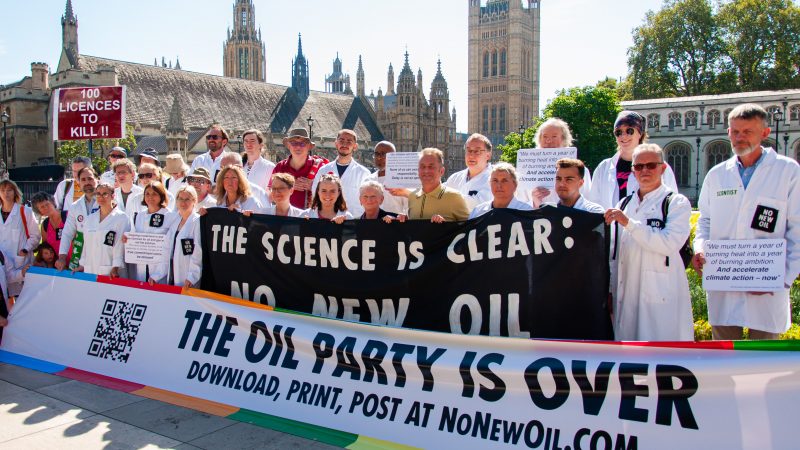
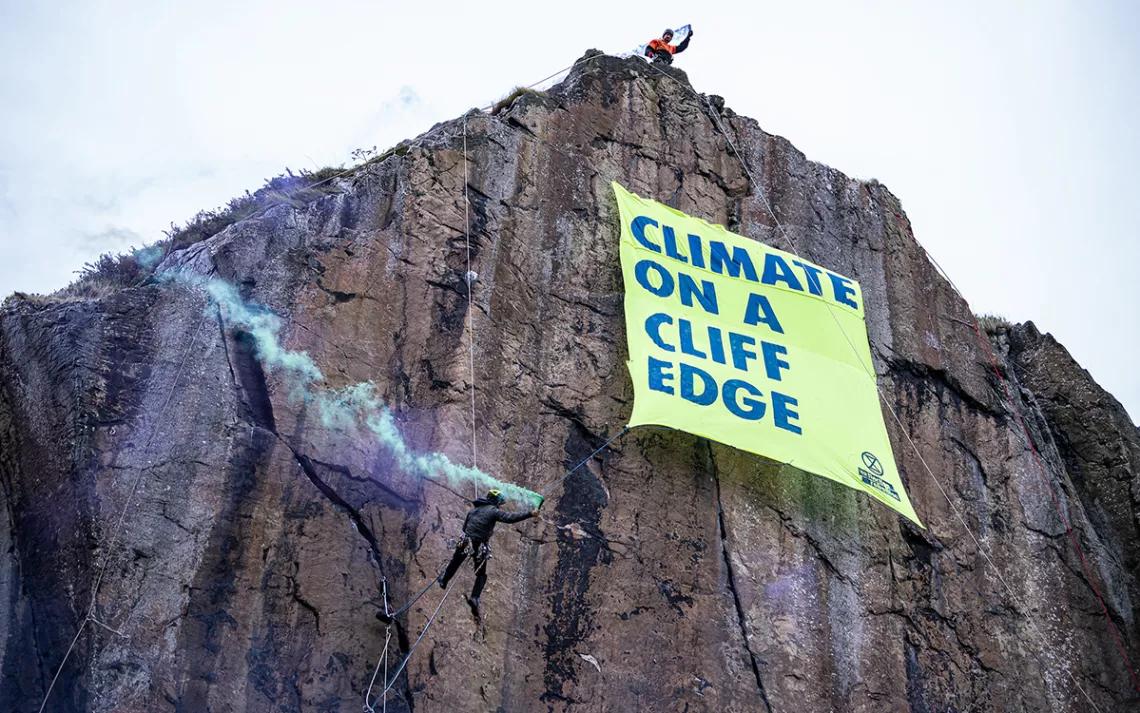
Campaigners take part in a Stop Rosebank emergency protest outside the U.K. Government building in Edinburgh, after the controversial Equinor Rosebank North Sea oil field was given the go-ahead Wednesday, September 27, 2023. (Photo: Jane Barlow/PA Images via Getty Images)Scientists protest at UK Parliament 5 September 2023.Experienced climbers scale a rock face near the historic Dumbarton castle in Glasgow, releasing a banner that reads “Climate on a Cliff Edge.” One activist, dressed as a globe, symbolically looms near the edge, while another plays the bagpipes on the shores below. | Photo courtesy of Extinction Rebellion and Mark Richards










 Climate activists from Greenpeace and Uplift during a demonstration outside the Scottish Court of Session, Edinburgh, on the first day of the Rosebank and Jackdaw judicial review hearing, November 12, 2024