As Biden Adviser Speaks at COP29, Green Groups Say Act Before Trump Takeover

Spread the love

Original article by Jessica Corbett republished from Common Dreams under Creative Commons (CC BY-NC-ND 3.0). 

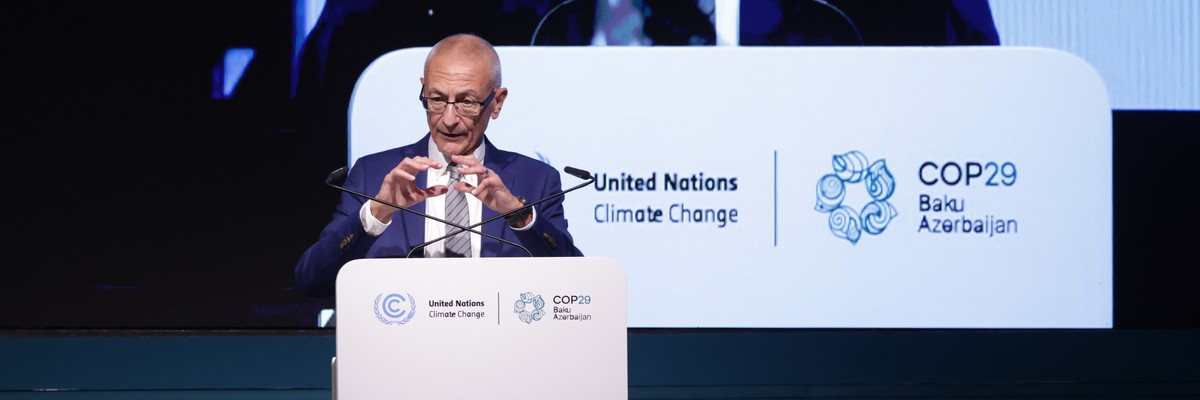
John Podesta, U.S. senior adviser to the president for international climate policy, speaks to the media during a United Nations climate summit on November 11, 2024 in Baku, Azerbaijan.  (Photo: Sean Gallup/Getty Images)

“President Joe Biden must reject all pending LNG export permits and stop the expansion of fossil fuels.”

As the U.S. senior adviser to the president for international climate policy addressed the United Nations summit in Azerbaijan on Monday, green groups urged the outgoing Democratic administration to do whatever it can to tackle the global crisis before Republicans seize control of the White House and likely both chambers of Congress.

“I want to address tonight a topic that is on everyone’s mind—the U.S. election,” John Podesta, President Joe Biden’s adviser, told the crowd in Baku on the first day of the United Nations Climate Change Conference (COP29), less than a week after President-elect Donald Trump defeated Vice President Kamala Harris.

Although votes are still being counted, Republicans have secured a majority in the U.S. Senate and are on track to retain control of the House of Representatives—paving the way for Trump’s plans to roll back the Biden-Harris administration’s progress on the climate emergency and “drill, baby, drill,” which would lead to a surge in planet-heating pollution.

“Podesta’s speech must be followed by swift action to limit U.S. fossil fuel expansion and achieve a strong COP29 outcome.”

“For those of us dedicated to climate action, last week’s outcome in the United States is obviously bitterly disappointing,” Podesta acknowledged, “particularly because of the unprecedented resources and ambition President Biden and Vice President Harris brought to the climate fight.”

Noting that Biden pledged to halve emissions this decade, rejoined the Paris agreement, signed the Inflation Reduction Act (IRA) and the Bipartisan Infrastructure Law, and promised $11 billion in international climate funds, Podesta warned that “the next administration will try to take a U-turn and reverse much of this progress.”

“As President Biden said in the Rose Garden last week, setbacks are unavoidable, but giving up is unforgivable. This is not the end of our fight for a cleaner, safer planet. Facts are still facts. Science is still science,” he continued. “This fight is bigger than one election, one political cycle, in one country. This fight is bigger still.”

“We can and will make real progress on the backs of our climate-committed states and cities, our innovators, our companies, and our citizens, especially young people, who understand more than most that climate change poses an existential threat that we cannot afford to ignore,” he added. “Failure or apathy is simply not an option.”

https://twitter.com/pass_blue/status/1855977029885173929?ref_src=twsrc%5Etfw%7Ctwcamp%5Etweetembed%7Ctwterm%5E1855977029885173929%7Ctwgr%5E5aeb2c3e442822bdef98b9b393761ae5e7d8f1c7%7Ctwcon%5Es1_c10&ref_url=https%3A%2F%2Fwww.commondreams.org%2Fnews%2Ftrump-and-climate-change

Sorry, this content could not be embedded.
X

Responding to the envoy’s remarks in a Monday statement, Collin Rees, United States program manager at Oil Change International, said that “if John Podesta and President Joe Biden are committed to doing everything possible to continue climate progress despite Donald Trump’s reelection, this moment demands a bold agenda that goes beyond locking in clean energy gains and takes real action toward a just transition off fossil fuels.”

“There is no shortage of critical work to be done before Biden leaves office,” Rees argued. “Here at COP29, the United States must support a new, transformative global finance goal in which rich countries pay their fair share in high-quality, grant-based finance and work to submit a Paris-aligned nationally determined contribution committing to do its fair share of climate action and phase out fossil fuels.”

In the United States, Rees argued, Biden must “finalize studies on the dangerous impacts” of new liquefied natural gas exports, “reject deadly projects like the Dakota Access oil pipeline and pending LNG facilities in the Gulf South,” and urge Congress to block the latest attempt by outgoing Sen. Joe Manchin (I-W.Va.) “to destroy bedrock environmental protections.”

Looking toward next week’s Organization for Economic Cooperation and Development (OECD) meeting, Rees said that “Biden’s administration must support a global agreement to end export credit finance for oil and gas projects, a process which could end tens of billions of dollars in international finance for fossil fuels every year. This agreement would limit the global climate damages Trump and his fossil fuel cronies are able to perpetrate.”

“Podesta’s speech must be followed by swift action to limit U.S. fossil fuel expansion and achieve a strong COP29 outcome,” he stressed. Leaders at other climate organizations—who have often argued that Biden hasn’t gone far enough to tackle the fossil fuel-driven crisis—issued similar demands on Monday.

https://twitter.com/benjamingoloff/status/1855964481316151781?ref_src=twsrc%5Etfw%7Ctwcamp%5Etweetembed%7Ctwterm%5E1855964481316151781%7Ctwgr%5E5aeb2c3e442822bdef98b9b393761ae5e7d8f1c7%7Ctwcon%5Es1_c10&ref_url=https%3A%2F%2Fwww.commondreams.org%2Fnews%2Ftrump-and-climate-change

Sorry, this content could not be embedded.
X

Emphasizing that “climate diplomacy on a boiling planet doesn’t stop for a climate denier,” Ben Goloff, senior campaigner at the Center for Biological Diversity’s Climate Law Institute, called on Biden officials to “use the next two months to set up a bulwark of protections and secure their climate legacy.”

“Beyond urgently getting IRA money out the door, John Podesta must commit the U.S.’s fair share of global climate finance and announce an ambitious NDC climate target,” Goloff said, referring to nationally determined contributions for the Paris agreement.

Biden, he added, “has to make good on last year’s agreement to transition away from fossil fuels by rejecting pending mega-polluting project,” and “should also act quickly to fill all federal judicial vacancies as a wall of defense to Trump’s rampage of legal attacks.”

Jamie Minden, acting executive director of the youth-led movement Zero Hour, also declared that “before Trump takes office, President Joe Biden must reject all pending LNG export permits and stop the expansion of fossil fuels.”

“Our climate is on the brink of collapse, and it is sheer madness that politicians continue to expand and subsidize deadly fossil fuels,” Minden said. “Young people are fighting for our planet because we are facing the worst consequences of the unrelenting greed of these selfish politicians.”

Original article by Jessica Corbett republished from Common Dreams under Creative Commons (CC BY-NC-ND 3.0). 

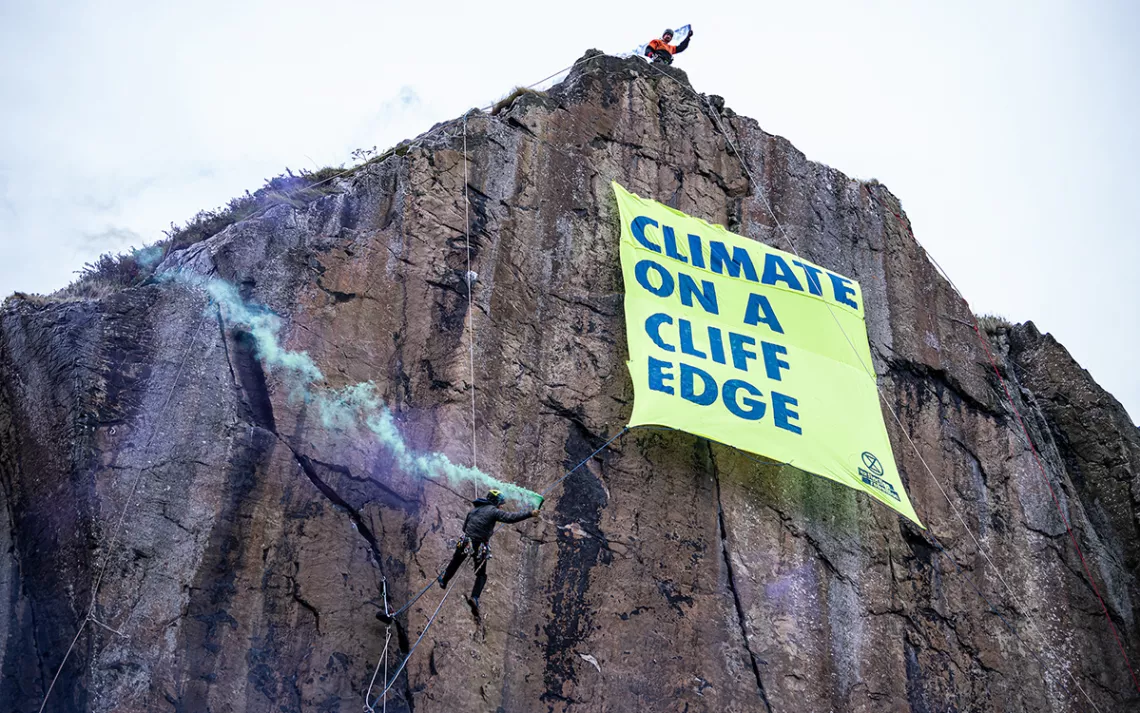
Experienced climbers scale a rock face near the historic Dumbarton castle in Glasgow, releasing a banner that reads “Climate on a Cliff Edge.” One activist, dressed as a globe, symbolically looms near the edge, while another plays the bagpipes on the shores below. | Photo courtesy of Extinction Rebellion and Mark Richards
Orcas comment on killer apes destroying the planet by continuing to burn fossil fuels. Second version, corrected text.
Continue ReadingAs Biden Adviser Speaks at COP29, Green Groups Say Act Before Trump Takeover

‘Our global political processes are being polluted’

Spread the love

https://morningstaronline.co.uk/article/our-global-political-processes-are-being-polluted

Protesters hit out at fossil fuel corporations fuelling the climate crisis and profiting from genocide in Gaza

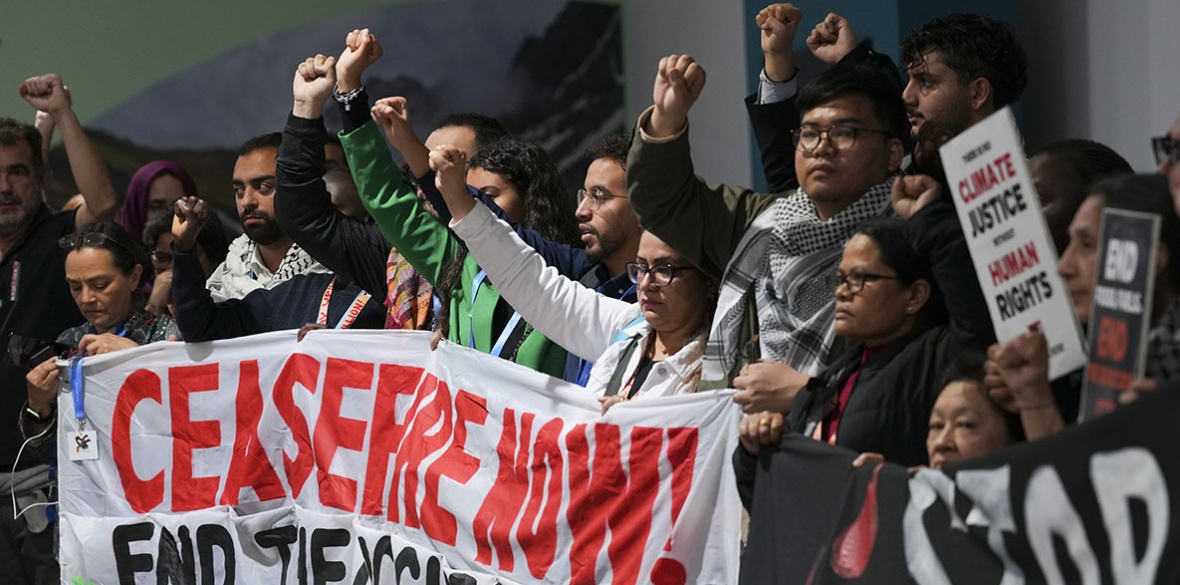
Activists demonstrate for climate justice and a ceasefire in the Israel-Hamas at the COP29 U.N. Climate Summit, November 11, 2024, in Baku, Azerbaijan

PROTESTERS hit out at oil giant BP “hijacking” Cop29 while profiting from the genocide in Gaza as the international climate summit kicked off in Azerbaijan today.

Palestine and climate campaigners protested outside the firm’s London headquarters as world leaders headed the latest round of international climate talks.

As the UN warned 2024 is set to be the hottest year on record, Fossil Free London activists held a banner reading “BP, stop fuelling genocide and climate breakdown.”

They demanded BP stop its oil and gas extraction, “hijacking” the Conference of the Parties (Cop) process in Azerbaijan’s capital Baku and “profiteering from genocide.”

Human rights experts have warned that countries and corporations supplying oil to Israeli armed forces may be complicit in war crimes and genocide following an International Court of Justice ruling on Israel.

Joanna Warrington, a campaigner with Fossil Free London, said: “It’s the very same fossil fuel giants that profit from the suffering of billions as our climate tips closer to collapse, which are fuelling and enabling Israel’s horrific colonial genocide.

https://morningstaronline.co.uk/article/our-global-political-processes-are-being-polluted

Continue Reading‘Our global political processes are being polluted’

Study Warns of ‘Irreversible Impacts’ From Overshooting 1.5°C, Even Temporarily

Spread the love

Original article by Jessica Corbett republished from Common Dreams under Creative Commons (CC BY-NC-ND 3.0). 

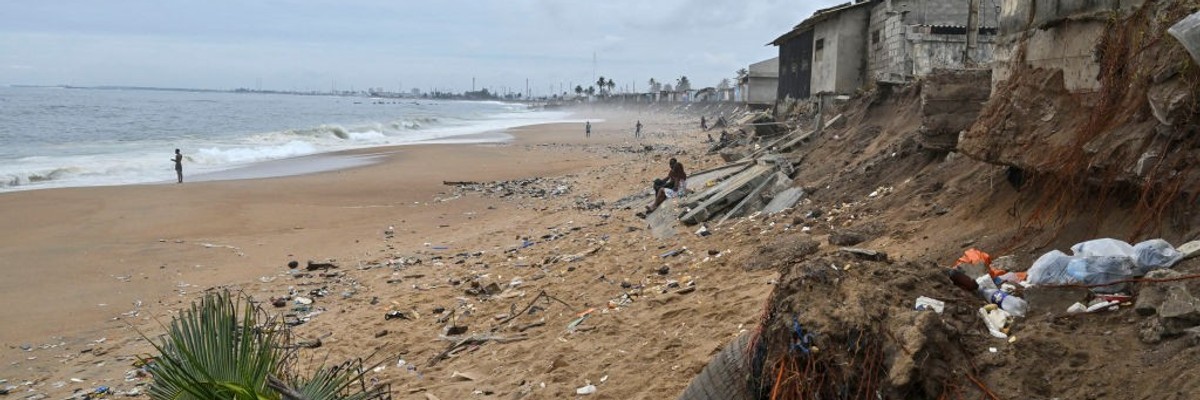
Houses destroyed by the rising sea level are shown at the Port-Bouet beach in Abidjan, Côte d’Ivoire on September 2, 2024. (Photo by Issouf Sanogo/AFP via Getty Images)

“Only by doing much more in this critical decade to bring emissions down and peak temperatures as low as possible, can we effectively limit damages.”

Just over a month away from the next United Nations climate summit, a study out Wednesday warns that heating the planet beyond a key temperature threshold of the Paris agreement—even temporarily—could cause “irreversible impacts.”

The 2015 agreement aims to limit global temperature rise this century to 1.5ºC, relative to preindustrial levels.

“For years, scientists and world leaders have pinned their hopes for the future on a hazy promise—that, even if temperatures soar far above global targets, the planet can eventually be cooled back down,” The Washington Postdetailed Wednesday. “This phenomenon, known as a temperature ‘overshoot,’ has been baked into most climate models and plans for the future.”

“The earlier we can get to net-zero, the lower peak warming will be, and the smaller the risks of irreversible impacts.”

As lead author Carl-Friedrich Schleussner said in a statement, “This paper does away with any notion that overshoot would deliver a similar climate outcome to a future in which we had done more, earlier, to ensure to limit peak warming to 1.5°C.”

“Only by doing much more in this critical decade to bring emissions down and peak temperatures as low as possible, can we effectively limit damages,” stressed Schleussner, an expert from Climate Analytics and the International Institute of Applied Systems Analysis who partnered with 29 other scientists for the study.

The paper, published in the peer-reviewed journal Nature, states that “for a range of climate impacts, there is no expectation of immediate reversibility after an overshoot. This includes changes in the deep ocean, marine biogeochemistry and species abundance, land-based biomes, carbon stocks, and crop yields, but also biodiversity on land. An overshoot will also increase the probability of triggering potential Earth system tipping elements.”

“Sea levels will continue to rise for centuries to millennia even if long-term temperatures decline,” the study adds, projecting that every 100 years of overshoot could lead seas to rise nearly 16 inches by 2300, on top of more than 31 inches without overshoot.

The scientists found that “a similar pattern emerges” for the thawing of permafrost—ground that is frozen for two or more years—and northern peatland warming, which would lead to the release of planet-heating carbon dioxide and methane. They wrote that “the effect of permafrost and peatland emissions on 2300 temperatures increases by 0.02ºC per 100 years of overshoot.”

“To hedge and protect against high-risk outcomes, we identify the geophysical need for a preventive carbon dioxide removal capacity of several hundred gigatonnes,” the authors noted. “Yet, technical, economic, and sustainability considerations may limit the realization of carbon dioxide removal deployment at such scales. Therefore, we cannot be confident that temperature decline after overshoot is achievable within the timescales expected today. Only rapid near-term emission reductions are effective in reducing climate risks.”

In other words, as co-author and Climate Analytics research analyst Gaurav Ganti, put it, “there’s no way to rule out the need for large amounts of net negative emissions capabilities, so we really need to minimize our residual emissions.”

“We cannot squander carbon dioxide removal on offsetting emissions we have the ability to avoid,” Ganti added. “Our work reinforces the urgency of governments acting to reduce our emissions now, and not later down the line. The race to net-zero needs to be seen for what it is—a sprint.”

While the paper comes ahead of COP29, the U.N. conference in Azerbaijan next month, co-author Joeri Rogelj looked toward COP30, for which governments that have signed the Paris agreement will present their updated nationally determined contributions (NDCs) to meet the climate deal’s goals.

“Until we get to net-zero, warming will continue. The earlier we can get to net-zero, the lower peak warming will be, and the smaller the risks of irreversible impacts,” said Rogelj, a professor and director of research for the Grantham Institute at Imperial College London. “This underscores the importance of countries submitting ambitious new reduction pledges, or so-called ‘NDCs,’ well ahead of next year’s climate summit in Brazil.”

The U.N. said last November that countries’ current emissions plans would put the world on track for 2.9°C of warming by 2100, nearly double the Paris target. Since then, scientists have confirmed that 2023 was the hottest year in human history and warned that 2024 is expected to set a new record.

The study in Nature was published as Hurricane Milton—fueled by hot waters in the Gulf of Mexico—barreled toward Florida and just a day after another group of scientists wrote in BioScience that “we are on the brink of an irreversible climate disaster. This is a global emergency beyond any doubt. Much of the very fabric of life on Earth is imperiled.”

Those experts emphasized that “human-caused carbon dioxide emissions and other greenhouse gases are the primary drivers of climate change. As of 2022, global fossil fuel combustion and industrial processes account for approximately 90% of these emissions, whereas land-use change, primarily deforestation, accounts for approximately 10%.”

Original article by Jessica Corbett republished from Common Dreams under Creative Commons (CC BY-NC-ND 3.0). 

Experienced climbers scale a rock face near the historic Dumbarton castle in Glasgow, releasing a banner that reads “Climate on a Cliff Edge.” One activist, dressed as a globe, symbolically looms near the edge, while another plays the bagpipes on the shores below. | Photo courtesy of Extinction Rebellion and Mark Richards
Continue ReadingStudy Warns of ‘Irreversible Impacts’ From Overshooting 1.5°C, Even Temporarily

‘Very Fabric of Life’ at Risk Without Urgent Action to End Fossil Fuel Era

Spread the love

Original article by Jessica Corbett republished from Common Dreams under Creative Commons (CC BY-NC-ND 3.0).
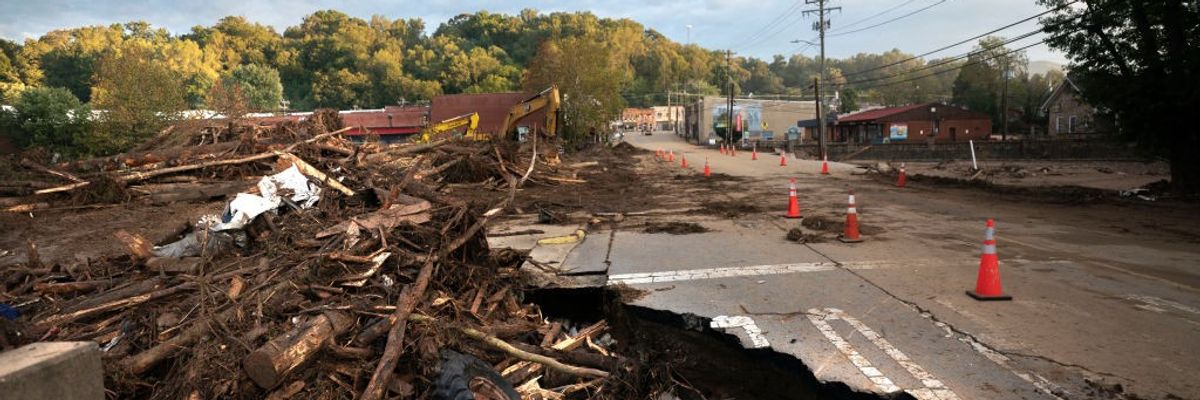
Flood damage is shown at a bridge across Mill Creek in the aftermath of Hurricane Helene on September 30, 2024 in Old Fort, North Carolina.
 (Photo: Sean Rayford/Getty Images)

“We are on the brink of an irreversible climate disaster. This is a global emergency beyond any doubt.”

As Hurricane Milton barreled toward Florida’s Gulf Coast, demonstrating the dangers of global warming, international scientists on Tuesday published a terrifying annual analysis that highlights the need to swiftly phase out planet-heating fossil fuels.

“Our aim in the present article is to communicate directly to researchers, policymakers, and the public,” the coalition wrote in BioScience. “As scientists and academics, we feel it is our moral duty and that of our institutions to alert humanity to the growing threats that we face as clearly as possible and to show leadership in addressing them.”

“We are on the brink of an irreversible climate disaster. This is a global emergency beyond any doubt. Much of the very fabric of life on Earth is imperiled. We are stepping into a critical and unpredictable new phase of the climate crisis,” warned the 14 experts from Australia, Brazil, China, Denmark, Germany, Switzerland, the United Kingdom, and the United States.

Their latest edition, “The 2024 State of the Climate Report: Perilous Times on Planet Earth,” shows that 25 of the 35 “planetary vital signs” the team uses to track the climate emergency are at record extremes. They include U.S.-heat related mortality, fossil fuel subsidies, coal and oil consumption, carbon dioxide equivalent emissions, per capita meat consumption, global tree cover loss due to fires, ocean acidity and heat content change, glacier thickness change, and ice mass change in Antarctica and Greenland.

“Ecological overshoot, taking more than the Earth can safely give, has pushed the planet into climatic conditions more threatening than anything witnessed even by our prehistoric relatives.”

The report emphasizes that “human-caused carbon dioxide emissions and other greenhouse gases are the primary drivers of climate change. As of 2022, global fossil fuel combustion and industrial processes account for approximately 90% of these emissions, whereas land-use change, primarily deforestation, accounts for approximately 10%.”

“For many years, scientists, including a group of more than 15,000, have sounded the alarm about the impending dangers of climate change driven by increasing greenhouse gas emissions and ecosystem change,” the publication notes. “For half a century, global warming has been correctly predicted even before it was observed—and not only by independent academic scientists but also by fossil fuel companies.”

“Despite these warnings, we are still moving in the wrong direction; fossil fuel emissions have increased to an all-time high, the three hottest days ever occurred in July of 2024, and current policies have us on track for approximately 2.7°C peak warming by 2100,” the article adds. “Tragically, we are failing to avoid serious impacts, and we can now only hope to limit the extent of the damage. We are witnessing the grim reality of the forecasts as climate impacts escalate, bringing forth scenes of unprecedented disasters around the world and human and nonhuman suffering.”

Oregon State University professor William Ripple, who led the team with Christopher Wolf of Terrestrial Ecosystems Research Associates, said in a Tuesday statement that “ecological overshoot, taking more than the Earth can safely give, has pushed the planet into climatic conditions more threatening than anything witnessed even by our prehistoric relatives.”

“We’re already in the midst of abrupt climate upheaval,” Ripple stressed. “For example, Hurricane Helene caused more than 200 deaths in the southeastern United States and massive flooding in a North Carolina mountain area thought to be a safe haven from climate change.”

“Since the publication of our 2023 report, multiple climate-related disasters have taken place, including a series of heatwaves across Asia that killed more than a thousand people and led to temperatures reaching 122°F in parts of India,” he continued. “Climate change has already displaced millions of people, with the potential to displace hundreds of millions or even billions. That would likely lead to greater geopolitical instability, possibly even partial societal collapse.”

To avoid that dark future, the article argues, “we need bold, transformative change: drastically reducing overconsumption and waste, especially by the affluent, stabilizing and gradually reducing the human population through empowering education and rights for girls and women, reforming food production systems to support more plant-based eating, and adopting an ecological and post-growth economics framework that ensures social justice.”

The assessment—whose authors include Michael Mann of the University of Pennsylvania, Naomi Oreskes of Harvard University, and Stefan Rahmstorf and Johan Rockström of the Potsdam Institute for Climate Impact Research—comes just over a month away from the next United Nations Climate Change Conference, COP29, which is scheduled for November 11-22 in Azerbaijan.

Pointing to previous summits, Wolf said Tuesday that “despite six reports from the International Panel on Climate Change, hundreds of other reports, tens of thousands of scientific papers, and 28 annual meetings of the U.N.’s Conference of the Parties, the world has made very little headway on climate change.”

“Humanity’s future depends on creativity, moral fiber, and perseverance,” he warned. “If future generations are to inherit the world they deserve, decisive action is needed, and fast.”

Original article by Jessica Corbett republished from Common Dreams under Creative Commons (CC BY-NC-ND 3.0).

Experienced climbers scale a rock face near the historic Dumbarton castle in Glasgow, releasing a banner that reads “Climate on a Cliff Edge.” One activist, dressed as a globe, symbolically looms near the edge, while another plays the bagpipes on the shores below. | Photo courtesy of Extinction Rebellion and Mark Richards
Continue Reading‘Very Fabric of Life’ at Risk Without Urgent Action to End Fossil Fuel Era

Ending Oil Subsidies, Taxing the Rich Could Help Free Up $5 Trillion a Year for Climate: Report

Spread the love

Original article by Jake Johnson republished form Common Dreams under Creative Commons (CC BY-NC-ND 3.0).

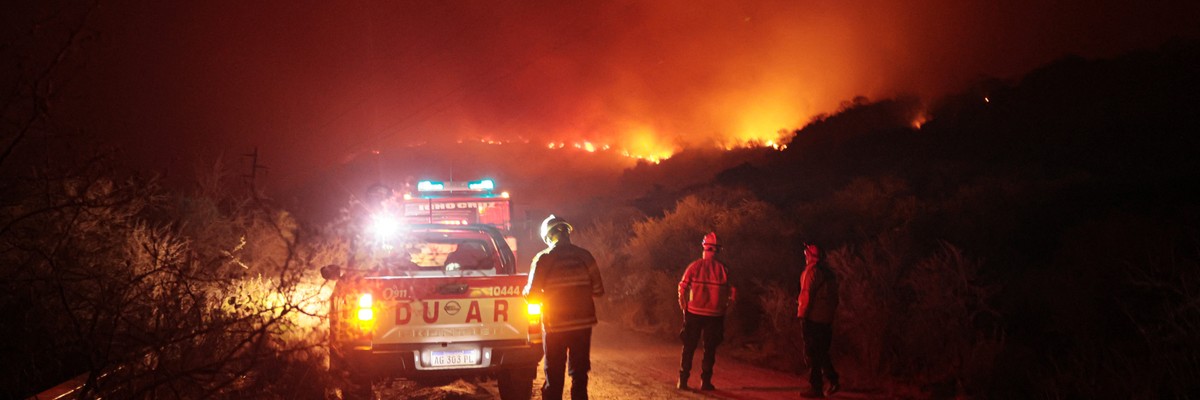
Wildfires are seen in San Marcos Sierra, Cordoba province, Argentina, on September 23, 2024. (Photo: Stringer/AFP via Getty Images)

“The real question isn’t whether we can afford to act, but whether we can afford not to.”

Research published Tuesday estimates that rich countries could mobilize over $5 trillion a year for climate action worldwide by cutting off subsidies to the oil and gas industry, imposing a levy on big polluters, and cracking down on tax evasion by large corporations and the rich.

The new report from Oil Change International (OCI) was released as world leaders gathered in New York City for high-level United Nations General Assembly talks, a meeting that comes less than two months before the COP29 climate summit in Azerbaijan.

OCI’s research, which includes a fact sheet outlining various proposals to raise funds for climate action, stresses that “there is no shortage of public money available for rich countries to pay their fair share on fair terms for climate action at home and abroad.”

“The urgency and extent of growing economic inequality, unfair sovereign debt crises, climate disasters, and fossil fuel profits have created significant momentum towards many of these measures in international and domestic policy spheres,” OCI’s research brief notes. “Finance has been in the spotlight in most major international political fora in the past few years in recognition that our current financial architecture is a major driver of these overlapping crises.”

Among the proposals laid out in OCI’s brief are an equitable end to “public finance, direct subsidies, and state-owned company investments in fossil fuels,” which could raise $846 billion a year globally; a “climate damages tax” on fossil fuel extraction, which could raise $618 billion a year; a 25% minimum corporate tax rate, which could raise $479 billion annually; and a wealth tax on billionaires, which could raise roughly $2.60 trillion a year in the Global North and over $5.6 trillion worldwide.

Laurie van der Burg, OCI’s public finance lead, said that the rich nations most responsible for the climate emergency “owe this money to Global South countries that have not caused this crisis and need fair finance to deliver strong climate plans next year that phase out fossil fuels.”

“This is essential to avoid climate breakdown and save lives,” she added.

The COP29 climate summit will take place a year after nations agreed at COP28 to transition “away from fossil fuels in energy systems” in a “just, orderly, and equitable manner.”

The success of that pledge, OCI said, depends on rich nations contributing massively to global climate finance after years of falling short of their pledges and continuing to expand fossil fuel extraction and handouts. Worldwide, environmentally harmful subsidies—including fossil fuel subsidies—have surged to $2.6 trillion a year, according to a report released last week.

“Global North countries have a responsibility to redirect their share of these subsidies in support of climate action,” OCI said Tuesday.

The new report comes on the heels of a record-hot summer and amid devastating extreme weather, from massive flooding across Europe and Africa to wildfires in South America.

Andreas Sieber, associate director of policy and campaigns at 350.org, said Tuesday that “the real question isn’t whether we can afford to act, but whether we can afford not to.”

“It is a bitter irony that rich nations hide behind claims of fiscal restraint, yet trillions are still spent on fossil fuel subsidies and militarization,” said Sieber. “The truth is simple: the money exists, but the political will does not. By treating climate finance as a zero-sum game, wealthy countries not only deepen global inequality but also undermine their own futures.”

“The energy transition isn’t charity—it’s an investment in global stability and security,” Sieber added. “Ignoring the need for support only worsens the climate crisis, which knows no borders.”

Original article by Jake Johnson republished form Common Dreams under Creative Commons (CC BY-NC-ND 3.0).

Continue ReadingEnding Oil Subsidies, Taxing the Rich Could Help Free Up $5 Trillion a Year for Climate: Report