‘We Need a Shift’: Climate Leaders Demand End of COP Dominated by Petrostates, Big Oil Lobby

Spread the love

Original article by Jake Johnson republished from Common Dreams under Creative Commons (CC BY-NC-ND 3.0). 

Activists protesting against fossil fuel lobbyists in attendance at COP29 hold a demonstration on November 15, 2024 in Baku, Azerbaijan. (Photo: Sean Gallup/Getty Images)

“It is now clear that the COP is no longer fit for purpose,” a coalition of scientists and advocates wrote as more than 1,700 fossil fuel lobbyists swarmed COP29 in Azerbaijan.

The crushing influence of petrostates and fossil fuel industry lobbyists has rendered the annual United Nations climate conference unfit to deliver the kinds of sweeping changes needed to avert catastrophic warming, a coalition of leading scientists, advocates, and policy experts warned in an open letter released Friday as the first week of the COP29 summit in Baku, Azerbaijan came to a close.

Acknowledging that the COP process has achieved “important diplomatic milestones” and “a remarkable consensus” on climate targets over nearly three decades of international negotiations, the coalition wrote that the policy framework produced by dozens of U.N. summits is not sufficient to solve the pressing crises facing humanity in an age of runaway warming and large-scale climate devastation.

“Science tells us that global greenhouse gas emissions must be reduced by 7.5% annually to have any chance of staying within the 1.5°C threshold, a prerequisite for the stability of our planet and a livable future for much of humanity. In 2024, the task is unequivocal: Global greenhouse gas emissions must be reduced by 4 billion tonnes,” reads the letter, whose signatories include former U.N. Secretary-General Ban Ki-moon, former U.N. Framework Convention on Climate Change executive secretary Christiana Figueres, Club of Rome global ambassador Sandrine Dixson-Declève, and Potsdam Institute for Climate Action Research director Johan Rockström.

“Twenty-eight COPs have delivered us with the policy framework to achieve this, but it is now clear that the COP is no longer fit for purpose,” the letter continues. “Its current structure simply cannot deliver the change at exponential speed and scale, which is essential to ensure a safe climate landing for humanity.”

The letter calls not for a complete abandonment of COP but rather “a fundamental overhaul” that would enable the U.N.-led summit “to deliver on agreed commitments and ensure the urgent energy transition and phase-out of fossil energy.”

The coalition of experts and advocates recommended a number of reforms for future COP summits, including “strict eligibility criteria to exclude countries who do not support the phase-out/transition away from fossil energy,” new “mechanisms to hold countries accountable for their climate targets and commitments,” and changes to limit the influence of fossil fuel lobbyists and ensure equitable representation.

“At the last COP, fossil fuel lobbyists outnumbered representatives of scientific institutions, Indigenous communities, and vulnerable nations,” Figueres said in a statement Friday. “We cannot hope to achieve a just transition without significant reforms to the COP process that ensure fair representation of those most affected.”

Rockström added that “there is still a window of opportunity for a safe landing for humanity, but this requires a global climate policy process that can deliver change at exponential speed and scale.”

“Planet Earth is in critical condition,” he said. “We have already crossed six planetary boundaries.”

“2024 marks yet another year at COP where we see those fighting the climate crisis outnumbered by those that have contributed to it the most—the fossil fuel industry.”

The open letter was released in the wake of a new analysis from the Kick Big Polluters Out coalition showing that at least 1,773 fossil fuel lobbyists have been granted access to the COP29 summit—giving the industry primarily responsible for the global climate emergency more representation than nearly every country present at the talks in Baku.

According to the Kick Big Polluters Out coalition, the fossil fuel industry has more representation at COP29 than the 10 most climate-vulnerable nations combined.

Additionally, The Guardian reported Friday that “at least 132 oil and gas company bosses and staff were invited” to COP29 as “guests” by Azerbaijan’s government and “given host country badges.”

“2024 marks yet another year at COP where we see those fighting the climate crisis outnumbered by those that have contributed to it the most—the fossil fuel industry,” said Joseph Sikulu of 350.org. “How can we achieve the ambition that is needed to save our homes when these negotiations are continually flooded with fossil fuel lobbyists? There is a ban on tobacco lobbyists from attending the World Health Organization’s summit, why is that not the case for the fossil fuel industry at COP?”

“We demand that the upcoming COP presidencies set clear rules against the presence of fossil fuel interests at the negotiating table,” Sikulu added. “Our lives depend on it.”

Al Gore, the former U.S. vice president, joined climate advocates on Friday in decrying Big Oil’s capture of the U.N. climate summit.

“It’s unfortunate that the fossil fuel industry and the petrostates have seized control of the COP process to an unhealthy degree,” said Gore.

Lamenting that the follow-through on COP28 commitments to transition away from fossil fuels has been “very weak,” Gore said he believes “one of the reasons for that is that the petrostates have too much control over the process.”

Original article by Jake Johnson republished from Common Dreams under Creative Commons (CC BY-NC-ND 3.0). 

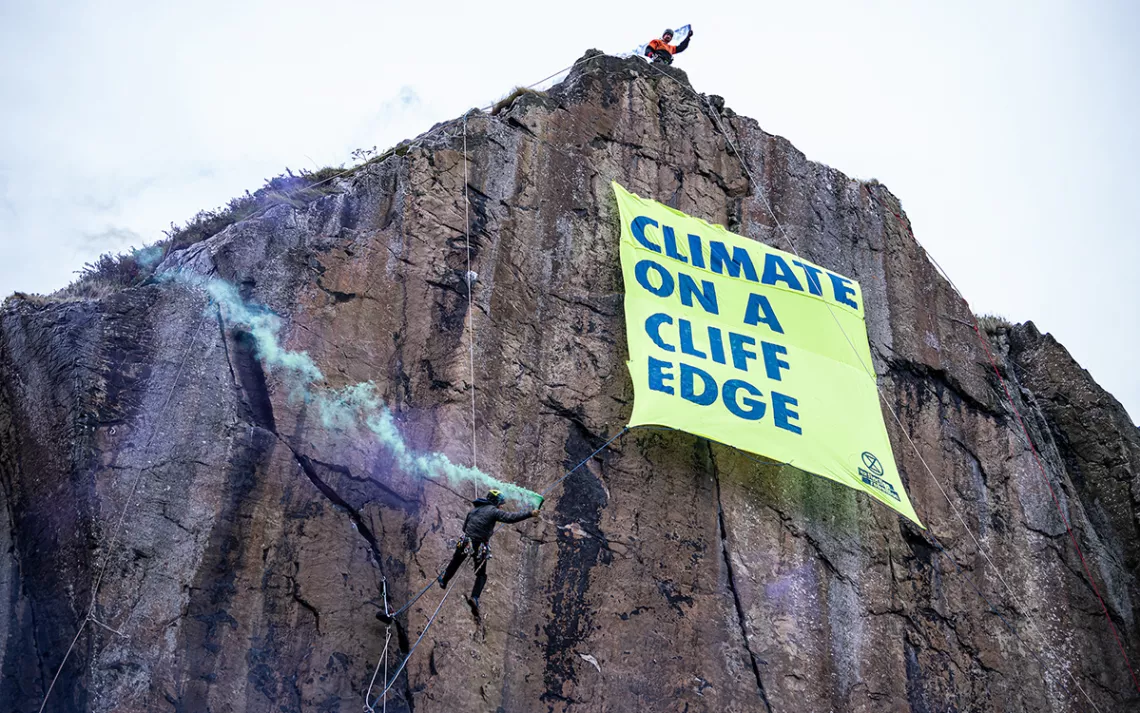
Experienced climbers scale a rock face near the historic Dumbarton castle in Glasgow, releasing a banner that reads “Climate on a Cliff Edge.” One activist, dressed as a globe, symbolically looms near the edge, while another plays the bagpipes on the shores below. | Photo courtesy of Extinction Rebellion and Mark Richards

Continue Reading‘We Need a Shift’: Climate Leaders Demand End of COP Dominated by Petrostates, Big Oil Lobby

Governments Must Tackle Climate Disinformation, Experts Urge

Spread the love

Original article by Joey Grostern republished from DeSmog.

Scientists and campaigners are calling on governments and tech companies to tackle climate disinformation. Credit: MauriceNorbert via Alamy

An open letter from climate scientists and campaigners warns of the dangers associated with false climate claims.

Governments around the world must take “immediate and decisive action” to tackle climate disinformation, scientists and campaign groups have urged as talks at the COP29 climate summit in Baku, Azerbaijan enter their fourth day. 

A coalition of 55 climate information integrity groups and 42 leading climate scientists and experts have signed an open letter urging countries to counter the risk of false and misleading claims that are wrecking efforts to slow climate change. 

It comes two days after UK Prime Minister Keir Starmer spoke at COP29 arguing that “there is no national security without climate security” – and a week after the election in the United States of Donald Trump, who has previously called climate change a “hoax”. 

The letter published today – signatories to which include Friends of the Earth, the Institute of Strategic Dialogue, and regional branches of Greenpeace and WWF – lists steps governments could take. 

These include adopting a universal definition of climate disinformation, such as the working definition proposed by the Climate Action Against Disinformation (CAAD) coalition, another signatory. 

According to the letter, the definition should cover anything that misrepresents scientific data or “falsely publicises” supposed solutions to climate change which in fact contribute to global warming, often referred to as “greenwashing”. 

Such a definition should cover “deceptive or misleading online behaviour” that undermines public understanding of climate change, the fact it is caused by human activity, and the need for urgent mitigation and adaptation action, the letter said. 

Signatories also urged governments to take action against organisations which give a platform to climate disinformation – including social media outlets, advertising technology providers, broadcasters, and publishing companies. 

“The spread of disinformation continues to undermine and delay our collective ability to act, jeopardising progress at crucial negotiations and the upcoming G20 Summit in Brazil”, the letter said.  

“Climate disinformation, waged by vested interests, undermines climate action and puts our collective future at risk. Our information ecosystem is being damaged, and those responsible must be held accountable.”

The letter ends by arguing that “by adopting these principles, governments can foster a healthier and safer online environment that supports informed decision-making and enables effective climate action.”

The world’s leading climate science group, the UN’s Intergovernmental Panel on Climate Change (IPCC), has warned that efforts to tackle climate change were being delayed by “rhetoric and misinformation that undermines climate science and disregards risk and urgency”.

“As disinformation continues to be an obstacle to vital climate action, the message from this open letter to decision makers globally is clear: protecting truth in the climate conversation is critical if we are to secure meaningful change”, said Max MacBride, Head of Counter-Disinformation at Roots Greenpeace, the NGO’s grassroots campaign initiative.

“At Roots, we see every day how climate disinformation stifles youth advocacy, and we join this call to hold governments and platforms accountable for enabling informed, equitable climate action”, he said.

Climate Disinformation Threats 

A CAAD report published earlier this week found that climate disinformation is widespread online, and is hobbling efforts to address climate change. 

The report said that social media platforms bear responsibility for allowing “super spreaders” to “pollute their platforms with debunked claims attacking renewable energy and electric vehicles”.

CAAD also found that fossil fuel companies were allowed to use digital advertising across Meta platforms to greenwash their reputations, by promoting false solutions or presenting fossil fuels as essential to the energy transition. 

A study published in February found that 14 percent of Americans don’t believe climate change is real – even as growing numbers of Americans say they are concerned about the climate.

“In the US, we’ve painfully experienced the role disinformation has played in thwarting disaster response and threats to the lives of responders”, Kate Cell, Senior Climate Campaign Manager at the Union of Concerned Scientists, told DeSmog.

“As climate-fueled disasters become more common around the world, governments can protect their residents by addressing the problem of climate disinformation systemically.” 

Another report released this week by the scrutiny NGO InfluenceMap found 2.500 cases of fossil fuel companies pushing arguments which contradict IPCC recommendations since COP28 last year. 

Thais Lazzeri, founder of educational group FALA, a signatory to the letter, told DeSmog: “The letter comes at a unique time for Brazil, which is hosting the G20 and the incoming COP30 Presidency. The alliance of so many Brazilian institutes and professionals shows the urgency for answers and the intersectoral power of this Brazilian network, willing to work together.”

She added: “At the opening of the Brazil space at CO29, Environment Minister, Marina Silva, said that denialism doesn’t fit. The Brazilian government can lead by example and guarantee information integrity policies and strategic, connected actions to change the game.”

DeSmog has previously reported on news media spreading false climate claims, with The Telegraph newspaper in the UK attacking climate solutions – a trend that has increasing since July’s general election. As revealed by DeSmog in 2023, one in three presenters on the right-wing broadcaster GB News had spread climate disinformation during the previous year. 

“It is much easier to pollute the waters of public discussion on climate change causes and consequences than it is to keep them clean and productive,” said Max Boykoff, signatory to the letter and professor of Environmental Studies at Boulder University in Colorado and founder of the Media Climate Change Observatory, a project which analyses mentions of climate change in news media.

“Therefore, more proactive, clear, accurate and effective communication efforts are consistently and repeatedly needed. That motivates this call for government action to curb disinformation about climate change.”

Original article by Joey Grostern republished from DeSmog.

Related: UK & Government Petitions: Run a public information campaign on the climate crisis

Continue ReadingGovernments Must Tackle Climate Disinformation, Experts Urge

‘We Don’t Give Up’: Climate Groups Resolute as Shell Wins Appeal Against Landmark Ruling
Spread the love

Original article by Jake Johnson republiahed form Common Dreams under Creative Commons (CC BY-NC-ND 3.0).

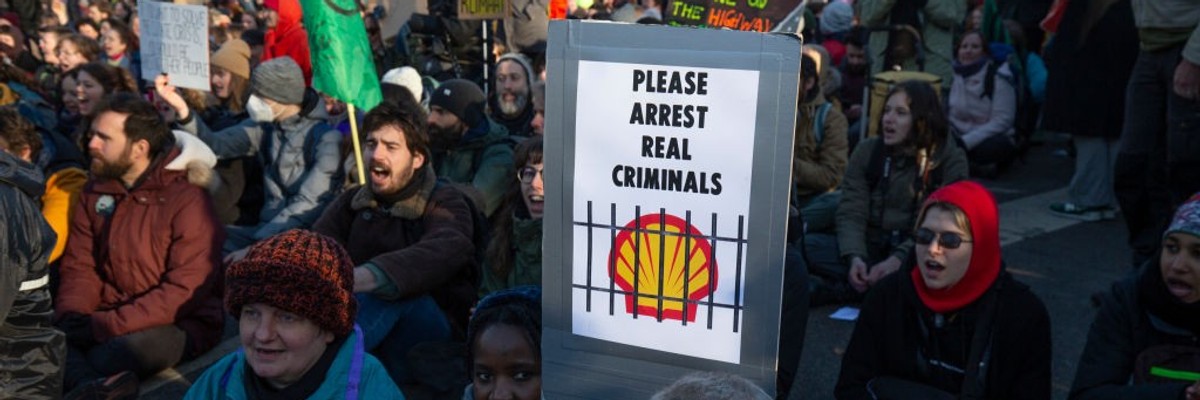
A protester holds a sign with a Shell logo during a demonstration on March 11, 2023 in The Hague, Netherlands. (Photo: Michel Porro/Getty Images)

“This setback will only help us grow stronger,” said the Dutch climate group that originally brought the case. “Large polluters are powerful. But united, we as people have the power to change them.”

Climate campaigners didn’t sugarcoat their reactions to a Dutch court decision on Tuesday that overturned a landmark 2021 ruling ordering the oil behemoth Shell to cut its planet-warming emissions nearly in half by the end of this decade.

“We are shocked by today’s judgment,” said Donald Pols, director of Milieudefensie, the Netherlands-based environmental group that originally filed suit against Shell in 2018.

“It is a setback for us, for the climate movement, and for millions of people around the world who worry about their future,” Pols said of Tuesday’s ruling by the Hague Court of Appeal. “But if there’s one thing to know about us, it’s that we don’t give up. This setback will only help us grow stronger. Large polluters are powerful. But united, we as people have the power to change them.”

The original 2021 ruling, as CNBC noted, marked “the first time in history that a company was found to have been legally obliged to align its policies with the Paris Agreement” and “sparked a wave of lawsuits against other fossil fuel companies.”

Despite acknowledging that Shell has “an obligation toward citizens to reduce CO2 emissions,” the appeals court on Tuesday scrapped a legal mandate compelling the company to slash its emissions by 45% by 2030 compared with 2019 levels, saying it was “unable to establish that the social standard of care entails an obligation for Shell to reduce its CO2 emissions by 45%, or some other percentage.”

“It is primarily up to the government to ensure the protection of human rights,” the court added.

Laurie van der Burg of Oil Change International said in response that “while we mourn today’s setback, the ruling establishes a responsibility for Big Oil and Gas to act that future litigation can build on.”

“The court ruled protection against climate change is a human right, and corporations have a responsibility to reduce their emissions,” she added. “As far as we know, this is the first case where a court has acknowledged that new investments in oil and gas are incompatible with international climate goals.”

“Today’s ruling underscores the importance of world leaders now negotiating at the U.N. Climate Summit in Baku taking responsibility.”

Shell, which is responsible for just over 2% of global CO2 emissions, said in a statement that it was “pleased” with the court’s ruling and claimed to be “making good progress in our strategy to deliver more value with less emissions.”

But research by the human rights organization Global Witness has found that Shell has consistently overstated the scale of its investments in green energy—including by characterizing fossil fuels as “renewable.”

“Even as Shell claims to be reducing its oil production, it is planning to grow its gas business by more than 20% over the next few years, leading to significant additional emissions,” Global Witness wrote in a complaint to the U.S. Securities and Exchange Commission last year.

Andy Palmen, the director of Greenpeace Netherlands, said Tuesday that while campaigners working toward a just phaseout of fossil fuel emissions are “disappointed that Shell is being allowed to continue polluting,” they “will not give up the fight.”

“This only motivates us more to take action against major polluters,” said Palmen. “It really gives hope that the court finds that Shell must respect human rights and has a duty to reduce its CO2 emissions.”

“Today’s ruling underscores the importance of world leaders now negotiating at the U.N. Climate Summit in Baku taking responsibility,” Palmen added, referring to the COP29 gathering that kicked off on Monday in Azerbaijan’s capital city. “The summit in Dubai last year marked the end of coal, oil, and gas, now governments must come up with concrete plans to move away from fossil fuels.”

The Dutch appeals court’s ruling came in the wake of new research showing that oil and gas production surged to an all-time high in 2023—the hottest year on record.

“The oil and gas industry is not transitioning,” the environmental group Urgewald and dozens of other NGOs found. “In fact, 95% of the upstream companies on [the Global Oil and Gas Exit List] are still exploring or developing new oil and gas resources. This includes the oil and gas producers TotalEnergies, Shell, BP, Eni, Equinor, OXY, OMV, and Ecopetrol, which all claim to be targeting net zero emissions by 2050.”

Nils Bartsch, head of oil and gas research at Urgewald, said Tuesday that the 2023 oil and gas production record is “deeply concerning.”

“If we do not end fossil fuel expansion and move towards a managed decline of oil and gas production,” said Bartsch, “the 1.5°C goal will be out of reach.”

Original article by Jake Johnson republiahed form Common Dreams under Creative Commons (CC BY-NC-ND 3.0).

Continue Reading‘We Don’t Give Up’: Climate Groups Resolute as Shell Wins Appeal Against Landmark Ruling

Thinks of the Day :: I don’t have much time for COPs

Spread the love

I used to cover COP climate conferences quite closely. Be good if they achieve something but I don’t have much time for them now.

COP29 is for oil deals

Experienced climbers scale a rock face near the historic Dumbarton castle in Glasgow, releasing a banner that reads “Climate on a Cliff Edge.” One activist, dressed as a globe, symbolically looms near the edge, while another plays the bagpipes on the shores below. | Photo courtesy of Extinction Rebellion and Mark Richards
Orcas comment on killer apes destroying the planet by continuing to burn fossil fuels. Second version, corrected text.
Continue ReadingThinks of the Day :: I don’t have much time for COPs

Young People Can’t Afford to Give Up on International Climate Action

Spread the love

Original article by Hailey Campbell republished from Common Dreams under Creative Commons (CC BY-NC-ND 3.0). 

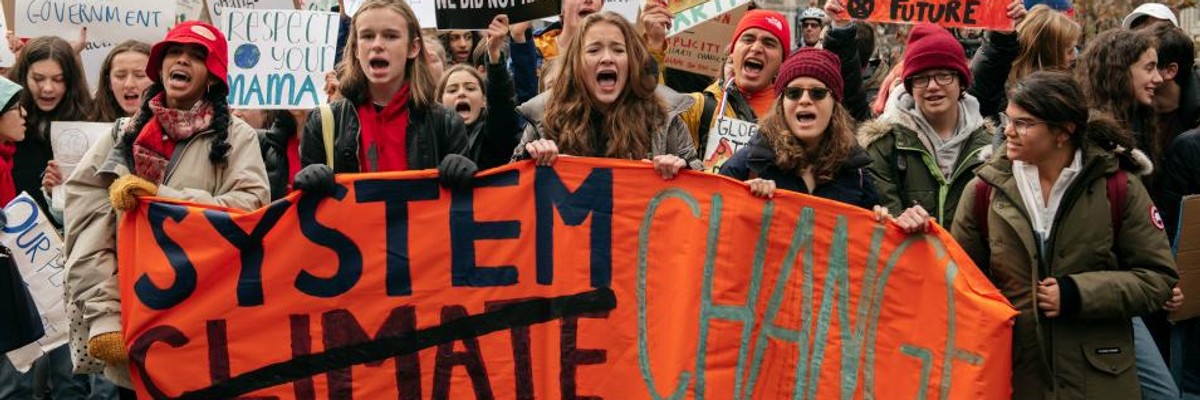
Demonstrators from several environmental groups including Extinction Rebellion and Sunrise Movement demand broad action at a youth-led climate strike near City Hall on December 6, 2019 in New York City. (Photo: Scott Heins/Getty Images)

Youth voices at COP represent the needs of the upcoming generations who will have to either assert our rights to a just climate future or figure out how to survive the catastrophic impacts that accompany a warmer planet.

Donald Trump is once again elected president of the United States only days before more than 30,000 people are expected to attend COP29 in Baku, Azerbaijan to negotiate new global commitments on protecting the planet not only for those inhabiting it today, but also for future generations. Trump’s victory is sounding alarm bells in the climate community as his administration has made their disregard for global climate action abundantly clear across their campaign, but the world recognizes we cannot afford inaction.

When Trump announced his plans in 2017 to withdraw the country from the Paris agreement, an international treaty to limit global temperature rises to 1.5°C, Gebru Jember Endalew, chair of the Least Developed Countries group, which represents 48 countries, stated “global climate momentum will continue with or without the U.S.” China also joined the E.U., Canada, and many more governments to reiterate their commitment to the agreement and global climate action.

Even if the Trump administration chooses to ignore the importance of investing in our planet, climate change will continue to affect our lives.

In 1995, the first Conference of the Parties (COP) was held in Berlin, Germany and subsequent COPs have produced targets to curb emissions, appropriate much-needed funds to tackle climate change, and build transparent reporting processes. The U.S. often sets the tone at COP as the country’s decisions around climate ambitions and climate finance have a global ripple effect. This year’s conference will be the fifth COP I’ve attended. It’s always been clear to me that youth climate activists and frontline communities are a crucial part of the COP process—pushing governments, like the U.S., which is the world’s largest historical polluter, to create and abide by ambitious targets and to address loss and damage so the planet is livable for all. And it’ll be no different this year, especially with a Trump win. Youth voices at COP represent the needs of the upcoming generations who will have to either assert our rights to a just climate future or figure out how to survive the catastrophic impacts that accompany a warmer planet.

We need all the help we can get. U.S. state and local officials are stepping up, as they did in 2017. A coalition of more than two dozen governors committed to achieving “the Paris agreement’s goal of keeping temperature increases below 1.5°C” as did large coalitions of U.S. mayors, county officials, and business leaders. In fact, I had the honor of being present as an intern for the City of San Antonio when my mayor signed a resolution with his commitment. The bipartisan group consists of governors from Washington state all the way to Puerto Rico who are committed to curbing emissions and accelerating climate action. States like California have also been working with other nations, such as China, to promote climate policy. Even if the U.S., at a national level, fails to act once again, it’s encouraging to see local and global communities committed to multilateral action.

My first COP was under the first Trump administration, and I remember feeling disappointed and embarrassed seeing my country failing to step up and lead on climate action. While everyone else had pavilions, announcements, and a large presence, the U.S. had a small office. Because of all the advantages the U.S. has gained by exploiting other communities, cultures, and nature, the U.S. had and still has so much historical and current responsibility to do better. Seeing national and global leaders reiterate their climate commitments gave me hope then and serves as a reminder today—efforts to tackle the climate crisis will continue regardless of the U.S. election results.

Even if the Trump administration chooses to ignore the importance of investing in our planet, climate change will continue to affect our lives. Attribution studies show human-induced climate change is making heatwaves, like the ones in the Southwest, hotter and more likely, while hurricanes and droughts have become more severe and destructive. Climate change is severely costing the environment and the economy. According to the World Economic Forum, “climate change is costing the world $16 million per hour.”

This horrific and costly reality isn’t inevitable. Phasing out fossil fuels, the biggest contributor to climate change, and investing in a greener and cleaner future for all are the antidotes. This is not the time to give up on climate cooperation, but rather strengthen the commitment to it. We cannot be paralyzed by fear. We’ll be at Baku calling for equitable and funded climate solutions, because if climate multilateralism is in jeopardy, so is our future, and we can’t afford to give up on either.

Original article by Hailey Campbell republished from Common Dreams under Creative Commons (CC BY-NC-ND 3.0). 

Continue ReadingYoung People Can’t Afford to Give Up on International Climate Action