‘Greenwashing’ banks raised 1 trillion dollars for fossil fuel giants

Spread the love

Original article by Josephine Moulds republished from TBIJ under a Creative Commons Attribution-NonCommercial-NoDerivs 3.0 Unported License.

NatWest among several banks in ‘net zero’ alliance continuing to support the fossil fuel industry

At a glance

  • Banks with net zero pledges helped raise $1 trillion for companies expanding fossil fuels
  • Among them is NatWest, which may have broken climate pledge by funding BP
  • BP is developing a ‘carbon bomb’ in Azerbaijan, host of COP climate talks

Less than a hundred miles from where world leaders are discussing how to meet their climate pledges, BP is drilling for gas.

The Shafag-Asiman project, a sprawling gas field off the Azerbaijani coast, could inject more than 1 billion tonnes of carbon into the atmosphere. That is more than the UK would emit over three years, striking a major blow to efforts to slow down global warming.

BP has said it intends to invest heavily in new oil and gas fields in the coming years. But it would be unable to pursue these dirty projects without billions in support from big banks. NatWest, for one, helped BP raise almost $500m last year in an apparent breach of its climate commitments.

Banks will be in focus at Cop29, currently underway in Baku, Azerbaijan, as world leaders discuss how to raise trillions of dollars for countries suffering the effects of climate change.

Although talks are unlikely to address their continued support for dirty energy, more than 140 banks worldwide have pledged to cut emissions associated with their lending and investments to almost zero by 2050.

In May 2021, the IEA, the global body coordinating countries’ energy policies, sounded the alarm. Any new oil and gas developments would make it inevitable that temperatures would rise by more than 1.5 degrees. In other words, they would devastate the planet.

https://flo.uri.sh/visualisation/20019523/embed

Meanwhile, at BP’s Shafag-Asiman field, engineers were celebrating after finding fossil gas several thousand metres under the seabed – a new discovery that could significantly increase its output from the region. And the bankers were preparing to raise billions more for BP.

That’s not all. Since May 2021, global banks that have committed to net zero have poured almost $1 trillion into companies pursuing expansion of oil and gas projects that would push the world beyond its survivable limits. Taken together these projects would produce almost seven times the annual emissions of the US.

“It’s indefensible,” said John Lang, founder of the Net Zero Tracker, which evaluates big companies’ green plans. “There’s no way we can meet the temperature goals of the Paris Agreement if we continue financing the exploration of oil and gas.”

He said banks with net zero commitments covering direct and indirect emissions could not fund oil and gas expansion. “It’s greenwashing, plain and simple.”

NatWest said it could not comment on specific customers. It said it had conducted a review into its relationships with a number of oil and gas companies “to ensure they had a credible transition plan aligned with the 2015 Paris Agreement”. It refuted the suggestion it had not met its public commitments.

BP said it is aiming to be a net zero company by 2050 or sooner and believes its strategy is consistent with the goals of the Paris Agreement.

‘Net zero’

It was at Cop26 three years ago that a number of major banks first pledged that by 2050 they would cut almost all the emissions from their lending and investments to zero and invest in financial products to offset the remaining emissions – which has come to be known as “net zero”. NatWest, for instance, promised to stop funding companies that do not have a credible plan to shift their business away from fossil fuels. Its support for BP suggests it may have broken that promise.

BP reported record profits in February last year and promptly announced it would scale back its climate commitments and increase investments in oil and gas. It then enlisted the help of NatWest and a host of other ‘net zero’ banks to raise a total of $5.3bn in 2023 – and went on to invest $4.8bn in its oil and gas operations in the first half of this year.

In April, BP announced the first oil to be extracted from a new platform off the coast of Azerbaijan, which is expected to be operating until at least 2049, just a year before the world is supposed to have cut its dependence on fossil fuels.

https://flo.uri.sh/visualisation/19957754/embed

The world-leading Grantham Research Institute assessed how credible the largest oil and gas companies’ transition plans were. It said BP’s fell short by a significant margin.

Many of the world’s biggest banks trumpet their net zero pledges to bolster their green credentials. But Nigel Topping, a member of the UK’s Climate Change Committee, explains that even when banks commit to cutting emissions associated with their financing in line with net zero, “it doesn’t stop them from financing companies who are continuing to expand [oil and gas production]”.

More than 180 companies expanding fossil fuel production have raised money from ‘net zero’ banks since May 2021, according to an analysis of data from the environmental campaign group, Rainforest Action Network. Their expansion projects are spread across the globe, from ConocoPhillips in the Arctic circle to Petrobras near the mouth of the Amazon river, and Shell in the UK’s North Sea.

A TBIJ analysis of the Global Oil and Gas Exit list, compiled by environmental campaign group Urgewald, shows these expansionary projects could produce almost 90 billion barrels of oil equivalent, which scientists say should stay in the ground. Around half of that is oil and half is gas, according to Urgewald, and calculations suggest it could generate more than 34 billion tonnes of CO2 emissions when burned.

Topping said: “The fundamental problem is that the transition is not driven by regulation … The only people who can make companies change are regulators, and the regulators are letting us down.”

Lead image: Offshore oil rigs at Baku Bay, near Baku, Azerbaijan. Anatoliy Zhdanov / Sipa US / Alamy Stock Photo

Reporter: Josephine Moulds
Environment editor: Rob Soutar
Deputy editors: Katie Mark & Chrissie Giles
Editor: Franz Wild
Production editor: Alex Hess
Fact checker: Somesh Jha

TBIJ has a number of funders, a full list of which can be found here. None of our funders have any influence over editorial decisions or output.

Original article by Josephine Moulds republished from TBIJ under a Creative Commons Attribution-NonCommercial-NoDerivs 3.0 Unported License.
Continue Reading‘Greenwashing’ banks raised 1 trillion dollars for fossil fuel giants

Fossil fuel supply: the elephant in the room at climate change conferences

Spread the love

Ded pixto/Shutterstock

Jordi Roca Jusmet, Universitat de Barcelona

“Natural resources … are a gift from God. Every natural resource, whether it’s oil, gas, wind, sun, gold, silver, copper, they are all natural resources. Countries should not be blamed for having them, and should not be blamed for bringing these resources to the market because the market needs them. The people need them.”

These were the words of Ilham Aliyev, president of Azerbaijan, at the opening of the recent United Nations COP29 convention on climate change in Baku. https://www.youtube.com/embed/4pqVwrMAGSc?wmode=transparent&start=0 Ilham Aliyev’s speech at COP29.

It seems completely inappropriate to sing the praises of fossil fuels at an international gathering that aims to radically reducing greenhouse gas emissions. Indeed, this goal is absolutely unachievable without drastic cuts to fossil fuel use, but Aliyev’s speech does have a positive, if indirect, impact – it points a spotlight at the elephant in the room, one that has remained virtually invisible throughout the United Nations Framework Convention on Climate Change’s (UNFCCC) long history.

COP agreements have never made commitments to limit fossil fuel extraction, even though this would be the most direct – and the only certain – way to rein in the leading cause of climate change.

Reducing demand but not supply: a pointless endeavour

Fossil fuels are key to climate change, but they are largely absent from COP agreements. The biggest achievement came in 2023, at COP28 in Dubai (United Arab Emirates), when an unspecified proposal was made to “transition away from fossil fuels”. This was not ratified at COP29, mainly due to pressure from Saudi Arabia.

In economic terms, the focus of climate agreements has always been on demand. It is expected that national measures, such as promoting renewable energy and public transport, or penalising the use of fossil fuels by putting a price on carbon emissions will indirectly lead to less fossil fuels being put on the market.

While these measures can be effective, they often end up lacking, or even non-existent, because they depend completely on the policies and reactions of the nations and companies who own, supply, and profit from these resources.

Commitments to supply-side agreements are not on the COP agenda, even though most of the fossil fuel reserves that are considered exploitable – and therefore economically valuable – cannot be burned if we are to even come close to the UNFCCC climate goals. They must be left in the ground.

However, global CO₂ emissions are not falling. On the contrary, the use of coal, petroleum and natural gas have hit record highs in 2024.

Evolution of global CO₂ emissions. Global Carbon Project, CC BY-SA

How can we restrict fossil fuel extraction?

Limits have been put forward in the past. In 2014, for instance, economists Paul Collier and Anthony J. Venables proposed a sequenced plan for phasing out coal, which would involve progressive measures not to start new operations and to close mines, with countries staggered in a fair order. “Fairness” would be determined by ability to pay, per capita emissions and historical responsibility.

We can also take inspiration from nuclear weapons treaties, as Professor of International Relations Peter Newell and political economist Andrew Simms have done. They advocate for a fossil fuel non-proliferation treaty along the lines of the nuclear non-proliferation treaty. Many states and cities around the world have already signed up to the initiative.

There have also been local initiatives, such as the commitment to stop extracting oil in an area of the Yasuní National Park in Ecuador due to its exceptional biodiversity and the existence of populations in voluntary isolation. This will also benefit the global climate by reducing emissions.

The proposal was initially taken up in 2007 by the then president Rafael Correa on the condition that the international community would financially compensate part of the sacrificed monetary income. However, scarce contributions to the compensation fund led Correa to renounce the initiative and allow oil exploitation.

Environmentalists, affected communities and academics demanded a referendum and, after years of litigation, the right to consultation was recognised by the courts. In August 2023, a large majority (almost 60 %) voted in favour of keeping the oil reserves “in the ground indefinitely”. Money does not always prevail, even in poor countries, though the Ecuadorian government has postponed its mandate to dismantle drilling sites, meaning many are still operational today.

A blessing for some, a curse for others

The above case and many others – such as the Niger Delta (Nigeria), where Shell has been extracting oil since 1958 – remind us that “God’s gift” of natural resources can also be a curse.

A gift for some – usually multinational companies or small numbers of wealthy people – can be a curse not only for the planet, but also for the local population who suffer the devastating environmental and social consequences of extracting these resources, and who face violent repression when they protest.

It was in places like Nigeria and Ecuador that the activist slogan “leave fossil fuels in the ground” was coined. Even if their motivation is primarily or solely to protect their territory, social movements opposing coal mining or hydrocarbon extraction undeniably contribute – from the supply side – to curbing climate change.

Together with social movements, academic and political work is key to defining the areas where preventing the exploitation of fossil fuels is a priority, and to establishing economic compensation. Martí Orta-Martínez, from the University of Barcelona, is doing just this. He is leading a project to geographically define the fossil fuel deposits that should not be burned, which was presented at a seminar in the framework of COP29.

It may sound utopian to seek supply-side international agreements, but the truth is that it is impossible to reduce global emissions and move towards decarbonisation without a rapid decrease in the extraction of fossil fuels. COPs should heed this evidence.

Given the magnitude of the climate challenge, it is not a question of deciding between demand or supply-side policies, but of using both, promoting them in each country, and reaching robust agreements at an international level.

Jordi Roca Jusmet, Catedrático de Economía, Universitat de Barcelona

This article is republished from The Conversation under a Creative Commons license. Read the original article.

Continue ReadingFossil fuel supply: the elephant in the room at climate change conferences

Green Party responds to  conclusion of COP29

Spread the love
Green Party Co-leader Adrian Ramsay October 2023.

Reacting to the conclusion of COP29, Green Party co-leader Adrian Ramsay MP said: 

“This COP has tested the patience of everyone who wants to see the devastating climate crisis tackled. 

“The final agreement is simply not good enough for the world’s poorest nations with too little money to deal with devastating impact of climate change, and the oil and gas lobby has succeeded in weakening the commitment made at the last COP to ‘transition away’ from fossil fuels. 

“We are half-way through a critical decade for action, and the devastation wrought through more floods, drought and wildfires is now obvious.  

“The moral and scientific case for doing everything possible to meet the demands of the Paris climate agreement becomes stronger as the damage caused by every 0.1 degree rise becomes ever clearer. 

“Now is the time for action. That means turning the limited financial pledges agreed at COP, which already fall far below the demands of the global South, into hard cash. 

“That money – in the form of grants, not loans – needs to be available right now for adaptation and mitigation, alongside funding to cover the loss and damage already experienced by the poorest countries. 

“The climate finance to fund the transition to a global green economy only makes sense if we move away from fossil fuels. Here, that means the Labour government ruling out the Rosebank development in the North Sea. 

“Prime Minister Keir Starmer has shown commitment to the COP process by being one of the few leaders of richer countries to attend. 

“Now, he needs to build on that foundation and take an international lead in defending the gains made through previous COPs in the face of what will be a relentless attack by fossil fuel companies backed by a climate denier in the White House from January next year. 

“He must also take seriously the need to make the UK more resilient to changes in the climate that are already affecting us here. 

“Climate action today is about creating a world tomorrow in which can meet people’s basic needs and enable people and nature to thrive. 

“The UK government should back the call from international leaders for a reformed COP process in which the powerful fossil fuel lobby is excluded. 

“The fossil fuel lobby has the self-interest to block the immediate action the people and planet need. They cannot be allowed to succeed. 

“COP must become the forum that holds governments to account and pushes forward change, including supporting countries to adapt to the impacts of the crisis already being felt. 

“A COP that excludes the fossil fuel companies and their lobbying arms while supporting representatives of countries and indigenous peoples most impacted by climate change can transform all our futures.” 

Continue ReadingGreen Party responds to  conclusion of COP29

COP29 puts world on course for more extreme weather – and more deaths

Spread the love

Original article by Paul Rogers republished from Open Democracy under a Creative Commons Attribution-NonCommercial 4.0 International licence.

After a disappointing COP29, we should prepare for more extreme weather events like the floods that hit Valencia last month
 | David Ramos/Getty Images

Summit proves change won’t come until floods and wildfires are killing tens of thousands in rich Global North cities

While COP29 in Baku narrowly avoided collapsing, its results were bitterly disappointing for delegations from across the Global South, who ended up with barely a quarter of the annual $1.3trn of support they were seeking by 2035 to respond to climate breakdown.

Quite apart from other factors, more than 1,500 pro-carbon lobbyists worked hard to limit progress and ensure that burning oil, gas and coal at profit continues for as long as possible whatever the global consequences. After all, the world’s fossil fuel industries rake in around a trillion dollars in profits a year.

Meanwhile, more and more examples are emerging of accelerating climate breakdown. The flooding in Valencia is just one, but scarcely noticed in Europe is the thoroughly weird weather being experienced in the eastern United States.

This autumn there have been over five hundred wildfires in New Jersey alone, a 5,000-acre fire has been burning for a week on the New York-New Jersey border prompting a voluntary evacuation, and New York City’s Fire Department was called out to deal with 271 brush fires in the first two weeks of November alone.

As if timed for that and certainly released with COP29 in mind, Carbon Brief, a website covering the latest developments in climate science, climate policy and energy policy, has mapped every published study on ‘impossible’ weather events – record heatwaves or storms that would not have happened without the overall global climate changes.

The first such study came in 2004, the year after weeks of extreme heat hit Europe and killed 70,000 people across the continent over several months. That early example of an ‘impossible’ weather event kick-started a new field of research known as ‘extreme event attribution’, which looks at how climate change has influenced extreme weather.

There are now 600 studies of 750 such extreme events spanning the past 20 years – a tiny fraction of the total number of these kinds of events. Of these 750, Carbon Brief found that scientists and researchers had concluded that 74% were made more likely or more severe because of climate change.

This has added to the growing sense of urgency right across the climate science community coupled with a highly critical view of the whole COP process. Even before the dismaying summit in the Azerbaijani capital, both last year’s COP in Abu Dhabi and the year before in Egypt were notable for their lack of progress even as the urgency of preventing climate breakdown was becoming more and more obvious.

There are other risks to global security including nuclear weapons, pandemics, cyber warfare, AI misuse and the progressive destruction of biodiversity, but climate breakdown is different from all of these. It is not a future risk, it is a current happening, it is accelerating, and we now have very few years left to get on top of it. If we don’t then a worldwide catastrophe with many hundreds of millions dying and societal collapse will become increasingly likely.

Does it have to be like that?

As things stand, in terms of changing attitudes, developments in renewables, resistance of the fossil carbon industries and, of course, Donald Trump’s looming presidency in the US, a reasonable prognosis for the next decade has three elements.

First, the use of renewable energy resources does continue to increase but not at anything like the rate required, so net carbon emissions will continue to rise, not fall, for most of the next ten years. Second, resistance to decarbonisation will continue from many quarters, no doubt now including the White House. Finally, severe weather events will become both more common and more destructive.

Eventually, and it might take more than a decade, the disasters will be so great, including sudden weather events in rich cities in the Global North killing many tens of thousands of people, that public pressure across the world will force governments to respond. There will be no alternative to engage in truly transformative change.

But what that means is that the task ahead by then will be hugely greater than if the transformation starts much sooner, so timescales become crucial, especially what can speed up the process.

There is, though, one thing to remember at a time of widespread pessimism. If nations had got their act together 25 years ago after the Kyoto Protocols, were signed we would be in a far more favourable position worldwide than we are now. We are acting more than two decades late.

But climate breakdown is not happening as a slow, steady process of change, creeping up almost unawares. If that had been the case then with all the reasons not to act, especially the global fossil carbon lobby, we would have been in an even worse position now. Instead, it is happening at variable rates in two respects, some parts of the world – such as the polar regions – are warming up much faster than others and extreme weather events are happening much more often.

We are therefore getting a foretaste of what will affect everyone a few years before it does, and this gives us just a little more time to act. It means that the next ten years, and perhaps even the five years to 2030, will be the key time for us to come to terms with the transformation in society that is essential for global well-being. That is possible, just.

Original article by Paul Rogers republished from Open Democracy under a Creative Commons Attribution-NonCommercial 4.0 International licence.

Continue ReadingCOP29 puts world on course for more extreme weather – and more deaths

Thoughts of the Day 25 November 2024

Spread the love

I apologise that I repeat myself.

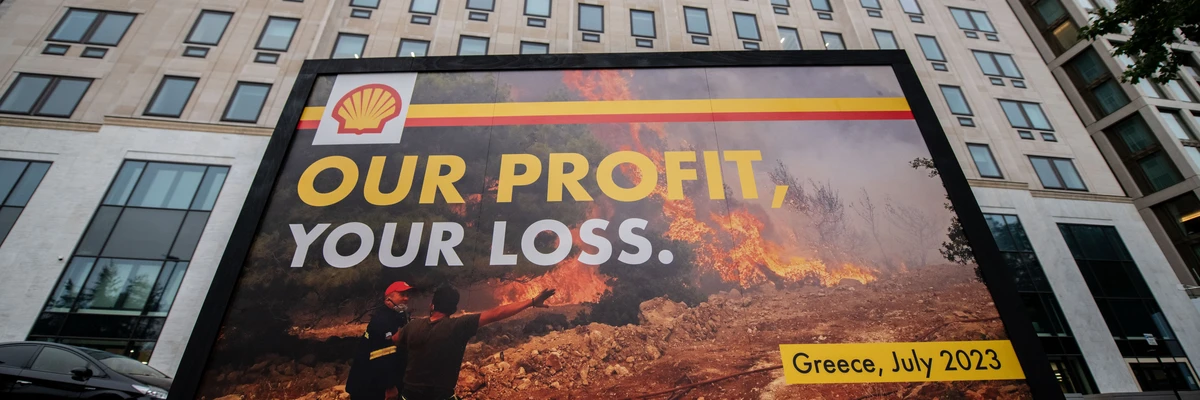
Greenpeace activists display a billboard during a protest outside Shell headquarters on July 27, 2023 in London.
Greenpeace activists display a billboard during a protest outside Shell headquarters on July 27, 2023 in London. (Photo: Handout/Chris J. Ratcliffe for Greenpeace via Getty Images)

Storm Bert caused serious flooding in UK, particularly in the South Wales town of Pontypridd. Gross Capitalists scum and governments scum refuse to accept responsibility for their actions in destroying the climate at COP29. Yet more false solutions pushed by the fossil fuel industry pursued by governments …

It seems like nothing changes. Our climate is fekked. The fossil fuel industry and politicians are responsible for it since they have known since the 1960s. Governments and politicians are supposed to protect their populations. Instead they are controlled and quite willingly work for the rich and powerful. Despite the UK government committing to radical action to address climate, they still pursue false solutions i.e. carbon capture and nuclear power.

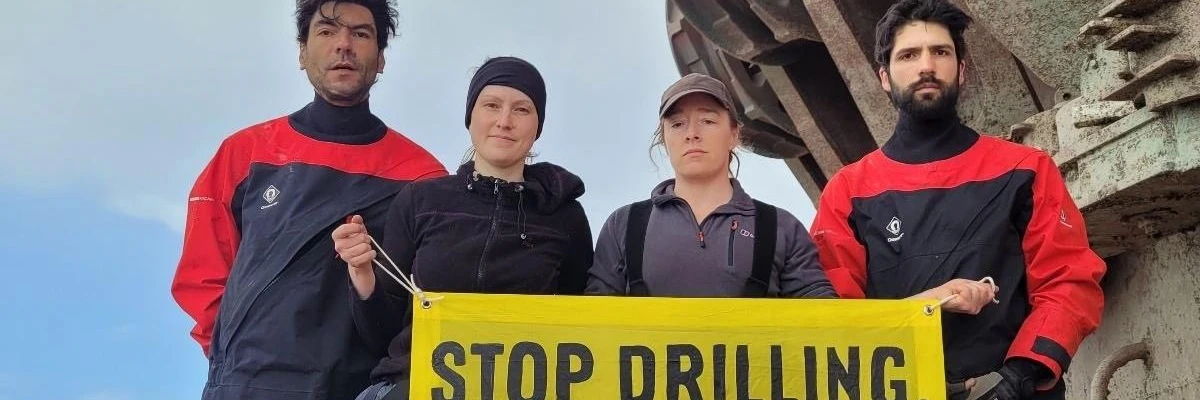
Four Greenpeace activists are pictured on a Shell vessel in the Atlantic Ocean on January 31, 2023.

ed: We are at 1.5C increase now, the limit proposed by the Paris Agreement. We’re flying past it because gross Capitalists and Capitalist politicians are refusing to address the climate crisis. We are on course to far more and far more severe extreme weather events because of these cnuts.

Continue ReadingThoughts of the Day 25 November 2024