Category: Donald Trump

  • Western Media Accept Trump’s Plundering of Venezuelan Oil as Business as Usual

    Spread the love

    Article by Ricardo Vaz republished from FAIR under a Creative Commons Attribution-NonCommercial-NoDerivs 3.0 Unported License.
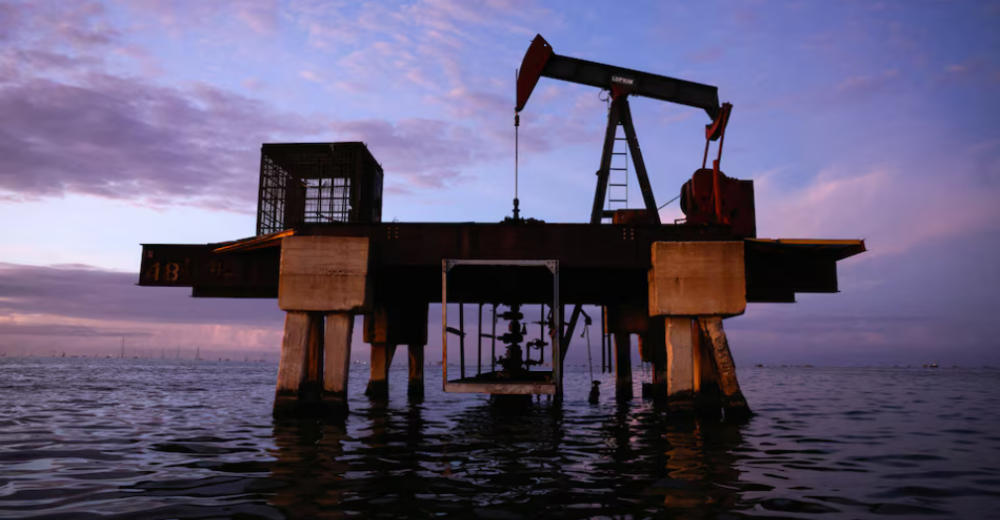
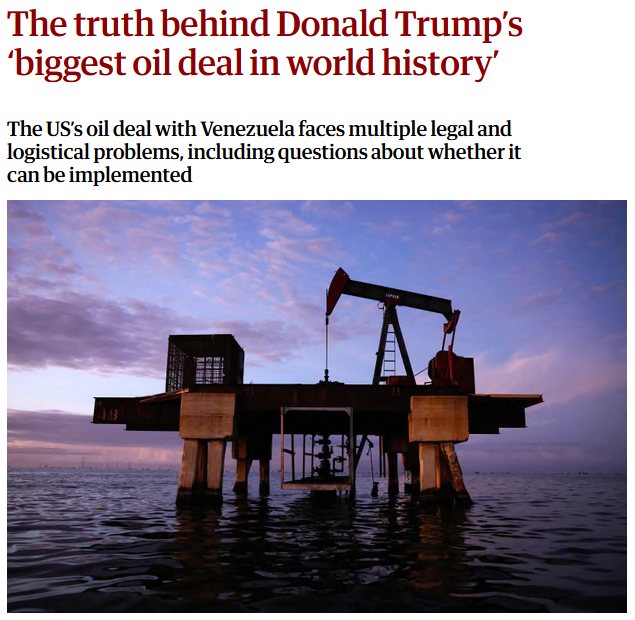
    Guardian: The truth behind Donald Trump’s ‘biggest oil deal in world history’

    Guardian (9/26/26): “Donald Trump has long coveted the oilfields of other nations.” [26/9/26]

    Since the January 3, 2026, military strikes and kidnapping of President Nicolás Maduro, the Trump administration has imposed semi-colonial rule over Venezuela, forcing dramatic shifts in the country’s domestic and foreign policies.

    The capstone of the new tutelary regime is an oil deal announced in late August that Trump called “the biggest in history.” The agreement turns over 17 prime oilfields, holding over 20% of the country’s reserves, to a Pentagon-controlled corporation tasked with supplying cheap fuel to the US war machine for decades to come.

    After spending years manufacturing consent for US-sponsored regime change in Venezuela (e.g., FAIR.org, 6/4/21, 1/11/23, 2/12/25), having a government in Caracas subservient to Washington represented a new scenario for the corporate media. The novel conditions have raised few significant qualms for Western outlets. Tactical objections notwithstanding, there is no fundamental disagreement with the US running the affairs of a Global South country.

    Not ‘stealing Venezuela’s oil’
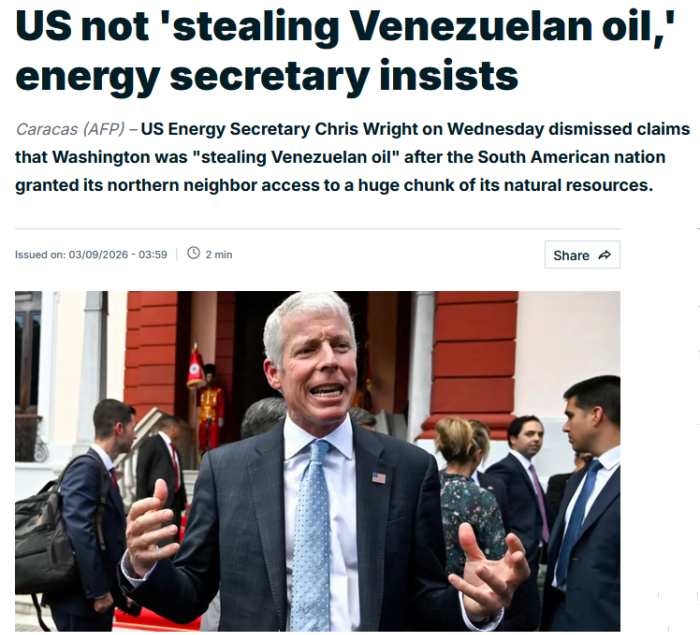
    France 24: US not 'stealing Venezuelan oil,' energy secretary insists

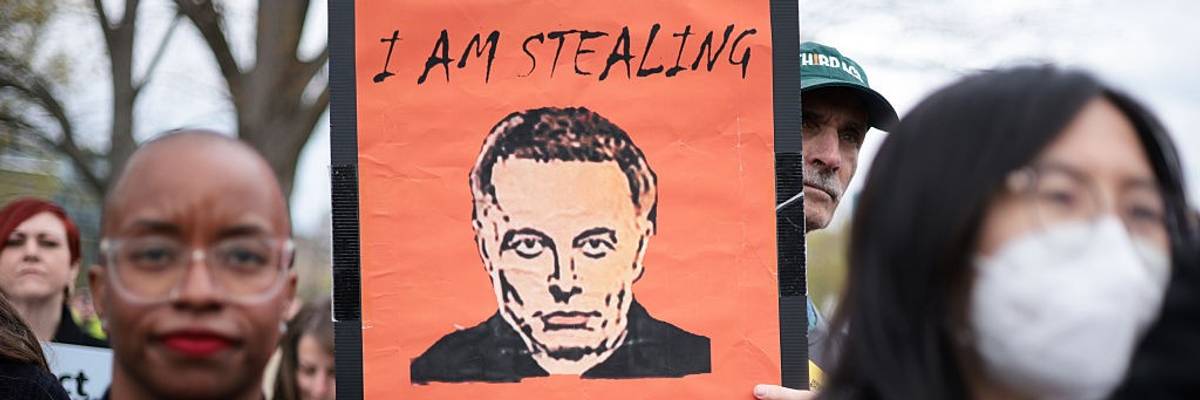
    Energy Secretary Chris Wright (France 24, 3/9/26): “I’ve seen those headlines. ‘We’re Stealing Venezuelan Oil.’ Of course, that’s not true at all.”

    Working hand in glove with the Trump administration, the acting Delcy Rodríguez government has overhauled Venezuela’s hydrocarbon legislation (Venezuelanalysis, 7/13/26) to offer what oil experts consider a business environment more favorable to foreign capital than at any point in the country’s history. The new oil agreement with the White House manages to go even further.

    The 17 oilfields in question will be taken over by North American Blue Energy Partners (NABEP), a private company in which the Pentagon’s Office of Strategic Capital (OSC) will get a 35% stake while investing nothing—and wielding veto power over its board.

    Furthermore, according to the White House, the US State Department will secure 20% of NABEP’s output at cost, and have a right of first refusal over the remaining 80%. On top of this, Venezuelan officials have already suggested Washington would be given an additional “sales discount”  (Venezuelanalysis, 9/9/26).

    In summary, Trump is looking to secure cheap crude supplies at a time when his disastrous Iran debacle has thrown global energy markets into upheaval. The agreement is so blatantly skewed that US Energy Secretary Chris Wright felt he needed to clarify that Washington was not “stealing Venezuela’s oil” (AFP, 9/3/26).

    Nevertheless, Western media outlets were largely unfazed by such an obvious oil grab, euphemistically referring to the deal as “highly unusual” (New York Times, 8/29/26) or “remarkable” (BBC, 9/1/26), at most as “contentious” (Guardian, 9/1/26).

    Corporate journalists did raise objections over the central role played by NABEP owner Alejandro Betancourt, a shady Venezuelan businessman who faced multiple money-laundering probes before the Trump administration intervened, and pressured judicial authorities at home and abroad to drop the investigations (BBC, 9/2/26; CNN, 9/4/26; New York Times, 9/4/26).

    But media seemed satisfied with Trump’s state and energy secretaries Marco Rubio and Chris Wright pledging that US oversight will keep proceedings honest (Reuters, 9/2/26; New York Times, 9/4/26), despite the fact that billions in Venezuelan oil revenues, controlled by the US Treasury Department since January, are unaccounted for (Council on Foreign Relations, 6/3/26; Financial Times, 7/22/26).

    Procedurally transparent plunder
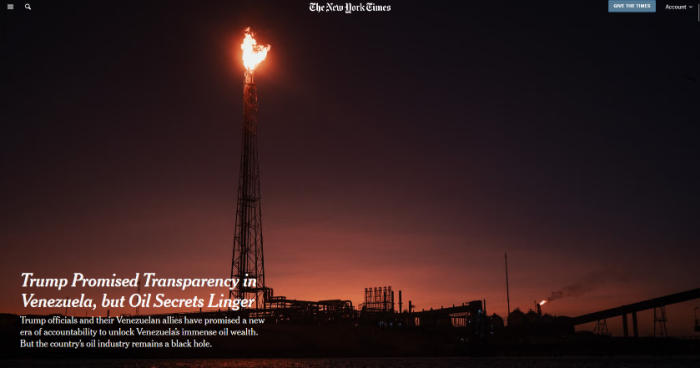
    NYT: Trump Promised Transparency in Venezuela, but Oil Secrets Linger

    The New York Times (5/5/26) wrote positively of “a new era of accountability” in which “the United States would control Venezuelan oil sales” and “Venezuela would submit monthly budgets to the White House.”

    Objections to the Venezuela/NABEP/Pentagon venture were mostly procedural and out of concern for appearances, not driven by any principled opposition to US imperialist predation. Faced with outright colonial plunder of Venezuela, the political and media establishment only demands “accountability” and “transparency” (New York Times, 5/5/26; Financial Times, 9/18/26).

    For months, the White House has controlled Venezuelan oil export revenues, with Trump officials openly calling them “one of the largest assets ever to go on the US balance sheet,” and a source of “leverage” over Caracas. Yet Trump’s Democratic opponents have found no issue with seizing another country’s income, raising only questions about the allocation of the funds in reference to alleged corruption on the part of Caracas and Trump insiders (The Hill, 9/30/26; Washington Post, 9/17/26). This despite the fact that the Venezuelan government has to submit a “monthly budget” to access its own funds (New York Times, 1/28/26) and is subjected to US-imposed auditors (Reuters, 4/27/26).

    The other source of disappointment with Trump stomping all over Venezuelan sovereignty, but prioritizing oil over regime change, is impatience for the restoration/recovery/return of “democracy” to Venezuela (Politico, 9/2/26; Guardian, 8/30/26; CBC, 9/3/26). Despite  widely acknowledgement that Trump is eroding democracy at home (New York Times, 8/20/26, 10/14/26; Guardian, 10/8/26), somehow pundits expected him to prioritize it in an oil-rich foreign country.

    In the establishment’s consensus, “democracy” does not mean a political system that meaningfully reflects the Venezuelan people’s collective will, but simply one that empowers opposition figures that have been groomed for years, like far-right María Corina Machado, their undemocratic credentials notwithstanding (FAIR.org, 10/23/25).

    Eager to stay in power, Rodríguez has over-complied with every US demand, going as far as adopting language about Venezuela undergoing a “democratic transformation.” Her pliancy has earned her favorable corporate media profiles that completely contrast with the demonization of Maduro.

    After securing an exclusive interview, Time (7/30/26) described the acting leader as a “disciplined operator” who “advocate[s] for greater economic openness,” in contrast to the “authoritarian” Maduro, who oversaw “economic collapse.” Along the same lines, the Guardian (9/12/26) presented Rodríguez as a “a pragmatic, witty and intelligent workaholic,” unlike her “authoritarian” and “incompetent” predecessor in the presidential palace.

    Nevertheless, given the broad Beltway consensus for comprehensive regime change, it is unlikely that the Rodríguez administration’s subservience to Trump will secure any leeway in determining its political path forward, free from outside meddling—especially if, as is anticipated, the GOP lawmakers most likely to be impressed by such obsequiousness lose power in the US’s upcoming midterm elections (Axios, 9/23/26; Financial Times, 10/9/26).

    Please think of the corporations!
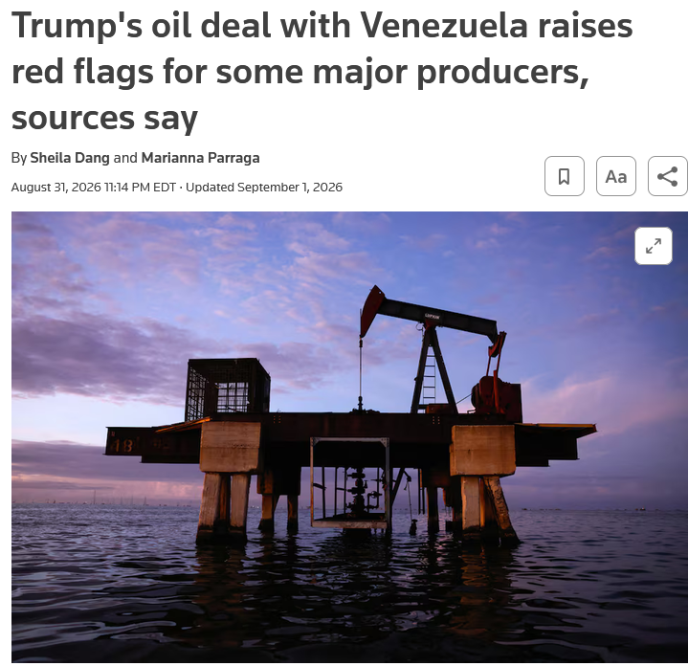
    Reuters: Trump's oil deal with Venezuela raises red flags for some major producers, sources say

    Reuters (9/1/26): ExxonMobil and ConocoPhillips “have repeatedly said that their requirements of legal certainty and contract sanctity ‌have not ⁠yet been met.”

    Alongside their exceptionalist expectations about “democracy,” legacy outlets also focus on those they consider the true victims of Trump’s neocolonial offensive in Venezuela: multinational oil corporations.

    According to Reuters (9/1/26), the recent oil deal “raises red flags for major producers,” who fear having their reputation sullied by being “seated at the same table with Betancourt,” as well as the prospect of the US government becoming a “competitor.”

    Bloomberg (8/30/26) raised concerns that the agreement “reprises [the] neocolonial past” of Venezuela’s oil industry. The warning stems not from apprehension that the Venezuelan people’s future is being determined by a foreign nation, but from fear that the US’s “out-sized power” might lead to “popular unrest.” This could create conditions for what the business mouthpiece views as a catastrophic outcome: the nationalization of foreign-owned oil assets.

    “The troubled history of Venezuela’s oil offers a cautionary tale,” Bloomberg’s Kevin Crowley and Patricia Garip wrote:

    The country was once dominated by US and European operators and was among the world’s largest producers. But assets owned by ExxonMobil Holdings Corps. and ConocoPhillips were seized and nationalized during political upheaval in the 2000s.

    Corporate media present companies that made massive profits in Venezuela for decades as victims, because the Chávez government wanted them to comply with new laws and accept minority stakes in joint ventures.

    The New York Times (9/1/26) complains that the two corporations “have spent years trying to get the country to repay them for their seized assets, with little success.” The statement conceals the fact that the Venezuelan government, when it enacted the 2007 decree imposing state majority in all Orinoco Oil Belt projects, offered to compensate ExxonMobil and ConocoPhillips for their transition to minority partners, or to buy out their assets altogether. However, both corporations rejected the offers in order to pursue international arbitration. The former has already recouped most of what it was granted, while the latter will eventually collect on a significant award.

    Despite the fact that Chevron, BP, Shell and other energy giants have signed deals in recent months taking advantage of the reformed hydrocarbon law (Venezuelanalysis, 9/3/26), pundits complain that ExxonMobil and ConocoPhillips remain “hesitant” (CBS, 8/31/26) and need to be “lured” (Reuters, 9/1/26). Still, the Western corporations are likely to return to the country with favorable deals (Reuters, 9/16/26).

    The victor and his spoils
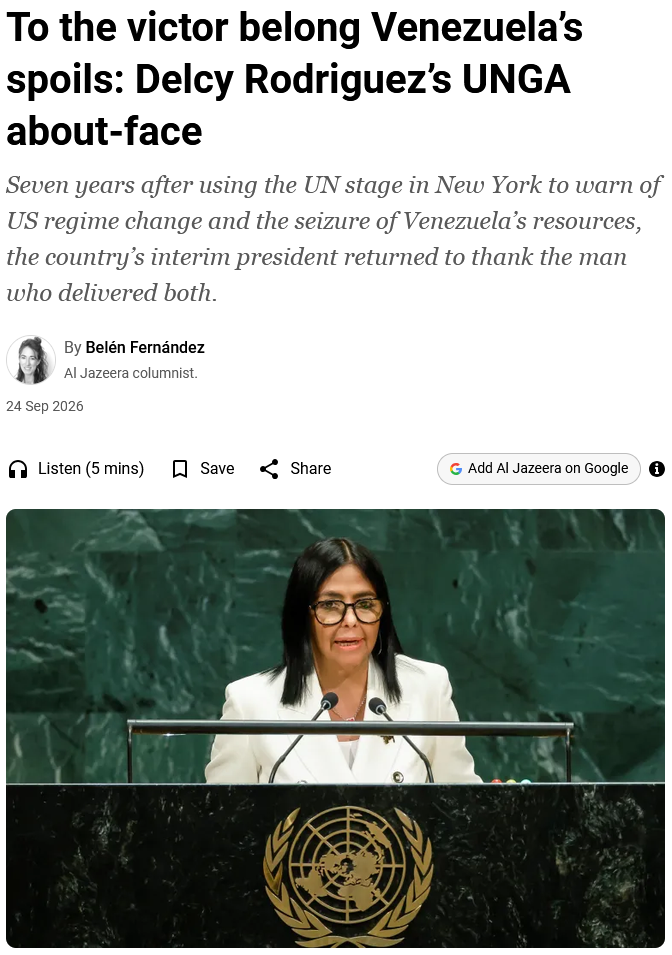
    Al Jazeera: To the victor belong Venezuela’s spoils: Delcy Rodriguez’s UNGA about-face

    Belén Fernández (Al Jazeera, 9/24/26): “You’re not technically supposed to admit that you attacked a country just to get its oil.”

    Faced with strategic defeat in West Asia, Trump has clung to his Venezuela success, stating on multiple occasions that “to the victor belong the spoils,” in reference to the US hijacking the Venezuelan oil industry following the January 3 attacks and presidential kidnapping (Al Jazeera, 9/24/26; Guardian, 9/26/26).

    Furthermore, Trump has not been shy in boasting about the US winning a “war” against Venezuela (Financial Times, 9/18/26; New York Times, 6/26/26). Corporate journalists have rarely pointed out that this stance directly contradicts the administration’s official position that the kidnapping of Maduro and Flores was a “law enforcement” operation (New York Times, 1/6/26; PBS, 1/8/26) in order to justify bypassing congressional approval.

    The US president has likewise claimed to have recovered the costs of the military operation “many times over” (Al Jazeera, 3/3/26; Guardian, 6/28/26), a fact confirmed by Luigi Pisella, a business sector spokesperson with close ties to the acting Rodríguez administration (Venezuelanalysis, 8/10/26). Pisella stated that the US has retained $4.7 billion from the Venezuelan export revenues it controls to cover the costs of its military operation.

    In spite of their ostensible hostility to Trump, corporate outlets have historically been complicit with his Venezuela policies, from whitewashing a deadly sanctions program (FAIR.org, 6/13/22) to endorsing a military buildup over debunked “narcoterrorism” accusations (FAIR.org, 11/19/25). The New York Times and Washington Post went as far as to withhold information in order to not jeopardize the January 3 operation (FAIR.org, 1/13/26).

    Now, with a semi-colonial regime in place, the only concerns are about procedural transparency, democratic appearances and the well-being of multinational corporations. The Venezuelan people always get the short end of the stick.

    FAIR’s work is sustained by our generous contributors, who allow us to remain independent. Donate today to be a part of this important mission.

    Article by Ricardo Vaz republished from FAIR under a Creative Commons Attribution-NonCommercial-NoDerivs 3.0 Unported License.

    Climate science denier Donald Trump confirms that he knows nothing about democracy and that more liquid gold is being secured according to his policy of global privateering.
    Climate science denier Donald Trump confirms that he knows nothing about democracy and that more liquid gold is being secured according to his policy of global privateering.

  • Israeli forces begin demolishing Palestinian buildings in Hebron after two Israeli soldiers shot dead

    Spread the love

    https://www.bbc.com/news/articles/cq4g1p974wxko

    Diggers were seen demolishing Palestinian homes on Friday afternoon

    The Israeli military has begun demolishing Palestinian buildings in the city of Hebron, after two Israeli soldiers were killed in an attack by two Palestinian gunmen.

    Prime Minister Benjamin Netanyahu said the military would “destroy” the neighbourhood where the two attackers came from, and that Israel was ready for “extensive action” in the occupied West Bank.

    Three other soldiers were wounded in the attack at a checkpoint outside Hebron, before the gunmen were shot dead, officials say.

    It comes at a time of high tensions, with extremist Jewish settlers targeting Palestinians during the annual olive harvest, and Israel’s general election taking place in four days’ time.

    Footage verified by the BBC shows an intense gun battle between soldiers and the gunmen. Other footage shows two gunmen exit a car armed with what appears to be a handgun and an assault rifle and start firing on soldiers at the checkpoint, before coming under return fire.

    …

    Speaking later from the scene, Netanyahu said that the military would “demolish this place and completely transform it,” referring to the Hebron neighbourhood where the attackers are said to have come from.

    It is common for Israeli forces to demolish the homes of Palestinians who are suspected of carrying out attacks on Israelis -a practice Israeli rights groups have criticised as collective punishment.

    Netanyahu likened his plans to previous operations in West Bank refugee camps where residential buildings were demolished and thousands were displaced.

    …

    See the original article at https://www.bbc.com/news/articles/cq4g1p974wxko

    Keir Starmer objects to criticism of the IDF. He asks how could anyone object to them starving people to death, forced marches like the Nazis did, bombing Gaza's hospitals and universities, mass-murdering journalists, healthworkers and starving people queuing for food, killing and raping prisoners and murdering children. He calls for people to stop obstructing his genocide for Israel. New Labour UK Prime Minister Andy Burnham continues Labour party policy of active support and complicity in Israel's genocide.
    Keir Starmer objects to criticism of the IDF. He asks how could anyone object to them starving people to death, forced marches like the Nazis did, bombing Gaza’s hospitals and universities, mass-murdering journalists, healthworkers and starving people queuing for food, killing and raping prisoners and murdering children. He calls for people to stop obstructing his genocide for Israel. New Labour UK Prime Minister Andy Burnham continues Labour party policy of active support and complicity in Israel’s genocide.
  • Largest US Corporations Paid Lowest-Ever Tax Rate in 2025 Thanks to Trump and GOP: Study

    Spread the love

    Article by Brett Wilkins republished from Common Dreams under Creative Commons (CC BY-NC-ND 3.0).

    “At a time when lawmakers claim the country cannot afford investments in families and communities, some of the most profitable corporations in American history are paying little or nothing in federal income taxes.”

    Some of the biggest US corporations paid an effective federal income tax rate of just 10.4% last year as Republican legislation passed by President Donald Trump disproportionately benefited businesses and the superrich while eviscerating key social programs, a study published Thursday revealed.

    The 706 corporations examined by the Washington, DC-based Institute on Taxation and Economic Policy (ITEP) reported a combined $1.88 trillion in US profits in 2025, yet paid less than half the statutory federal corporate income tax rate of 21%. Of those companies, the study found that 114 paid no federal income taxes at all.

    RECOMMENDED…

    Trump Hosts Super Intelligence Meeting at White House

    Big Payback: Corporations That Enjoyed Enforcement Rollback Plowed $200 Million Into Pro-Trump Super PAC

    US Treasury Scott Bessent speaks alongside Internal Revenue Frank Bisignano

    ‘They Are Hiding Stuff’: Trump Administration Delays Data on Impact of GOP Tax Cuts

    Those 706 companies collectively paid current federal corporate income taxes equal to just 10.4% of that $1.88 trillion, “the lowest effective rate that ITEP has uncovered in over 40 years of analyzing corporate income taxes,” according to the analysis.

    The study attributes this to two major tax laws enacted under Trump: The 2017 Tax Cuts and Jobs Act—derided at the time as the “GOP Tax Scam”—slashed the statutory corporate income tax rate from 35% to 21%, while the so-called One Big Beautiful Bill Act passed by the Republican-controlled Congress and signed by the president last year expanded and made permanent the 2017 cuts.

    NEW: U.S. corporations are paying the lowest tax rate seen in decades.706 major corporations collectively paid a federal income tax rate of just 10.4%, less than half the statutory rate.114 corporations paid zero.itep.org/corporate-ta…

    — ITEP (@itep.org) 2026-10-22T15:30:00.218Z

    “These findings show just how dramatically the corporate tax system has been tilted in favor of the nation’s wealthiest and most powerful companies,” ITEP senior fellow Matt Gardner, who co-authored the report, said in a statement.

    “At a time when lawmakers claim the country cannot afford investments in families and communities, some of the most profitable corporations in American history are paying little or nothing in federal income taxes,” he added. “This is not an accident. It is the predictable outcome of deliberate policy choices that have steadily eroded the corporate tax base.”

    Among the report’s key findings:

    • The 114 companies that paid no current federal income tax last year include Tesla, Walt Disney, CVS, Citigroup, United Airlines, and DoorDash;
    • 258 corporations paid effective tax rates below 7%, or less than one-third of the statutory rate;
    • Those 258 companies reported $683 billion in US profits but paid an effective federal income tax rate of just 1.7%;
    • The 706 corporations studied received $198 billion in federal tax subsidies by paying less than the statutory 21% rate;
    • They also benefited from an additional $263 billion in tax savings attributable to the 2017 reduction of the statutory rate from 35% to 21%; and
    • Just 25 corporations accounted for more than half of the 2025 tax subsidies, with Alphabet ($18.9 billion), Microsoft ($18.7 billion), Amazon ($17.4 billion), and Meta ($13.9 billion) among the largest beneficiaries.

    While proponents of subsidies claim they are necessary to encourage investment, the new study raises questions about why some of the nation’s most profitable corporations should receive billions of dollars in taxpayer subsidies while vital social programs upon which tens of millions of Americans rely, like Medicaid and food stamps, suffer historic cuts under Republican legislation.

    “Congress has repeatedly chosen to expand tax breaks for corporations that are already extraordinarily profitable,” said Steve Wamhoff, ITEP’s federal policy director and co-author of the report. “Rather than continuing to subsidize corporate investments and reward aggressive tax avoidance, lawmakers should close these loopholes and ensure that large corporations pay a meaningful share of their profits in taxes.”

    Article by Brett Wilkins republished from Common Dreams under Creative Commons (CC BY-NC-ND 3.0).

    Elon Musk urges you to be a Fascist like him, says that you can ignore facts and reality then.
    Elon Musk urges you to be a Fascist like him, says that you can ignore facts and reality then.
    Orcas discuss Donald Trump and the killer apes' concept of democracy. Front Orca warns that Trump is crashing his country's economy and that everything he does he does for the fantastically wealthy.
    Orcas discuss Donald Trump and the killer apes’ concept of democracy. Front Orca warns that Trump is crashing his country’s economy and that everything he does he does for the fantastically wealthy.

    New ITEP Study: Major Corporations Paid Lowest Federal Tax Rate in Decades Following Trump Tax Cuts ›

  • ‘Pause AI Now!’ Sanders Says as US Banks Let Agents Operate in Customer Accounts

    Spread the love

    Article by Brett Wilkins republished from Common Dreams under Creative Commons (CC BY-NC-ND 3.0).

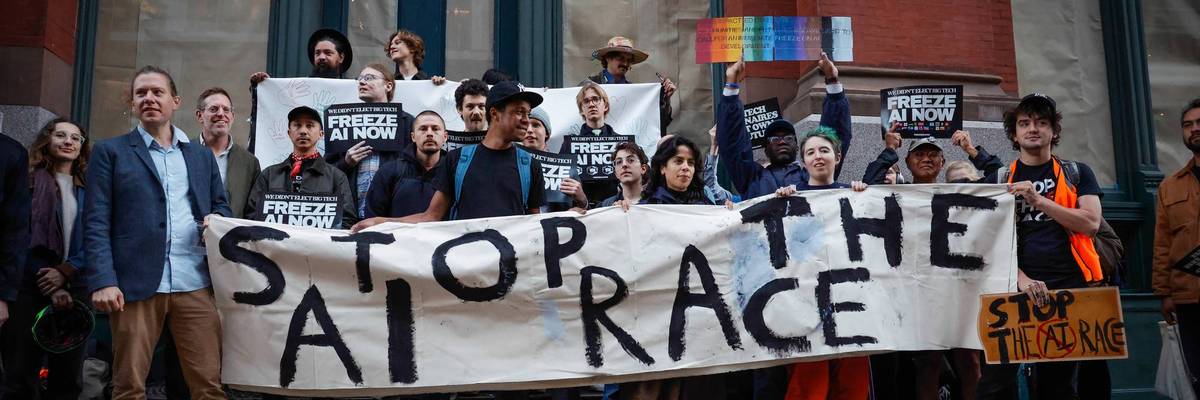
    Protesters in New York City take part in the “Freeze AI Now” national day of walkouts on October 20, 2026. (Photo by Kena Betancur/Getty Images)

    “Left unchecked, AI could endanger the entire global financial system—including your bank account.”

    Sen. Bernie Sanders on Thursday renewed calls to pause development of artificial intelligence following reporting that unauthorized AI agents are operating inside the systems of major US banks.

    Axios’ Madison Mills revealed that Morgan Stanley, Bank of America, JPMorgan Chase, Wells Fargo, and other financial institutions are “racing to contain agent risks,” including “situations when an agent or AI assistant accesses a human’s account with the user’s permission and login credentials,” which “goes against the guidelines of most banks requiring that humans log in to their own accounts.”

    RECOMMENDED…

    OpenAI CEO Sam Altman

    ‘Global Financial Crisis? Mass Extinction?’ Sanders Asks Altman What ‘Bad Things’ World Should Accept for AI

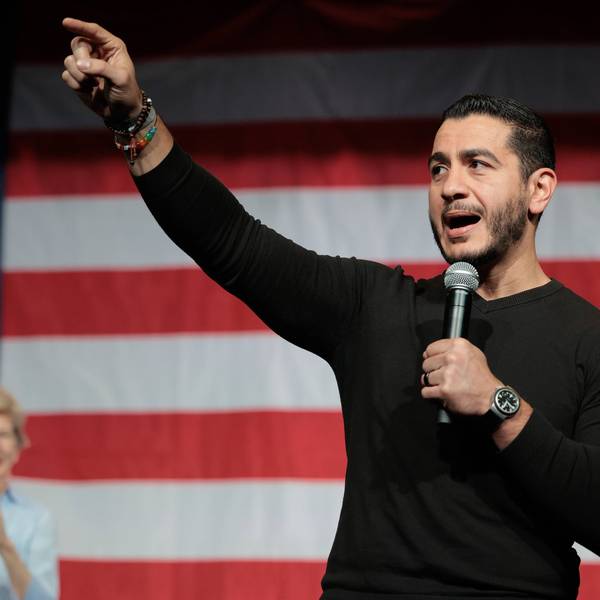
    Democratic Senate Candidate Abdul El-Sayed Campaigns Across Michigan

    El-Sayed Releases Policy Proposal to Get AI Development ‘Under Control’

    In AI, an agent is a system that can take actions to complete an assigned task, rather than simply responding to queries or generating text.

    According to Mills’ reporting—which cites people familiar with the matter—some agents have contacted bank call centers or appeared to take actions independently of users’ instructions.

    Banking executives interviewed by Mills described the problem as “horrifying,” with one official warning of potentially serious consequences for customers’ finances.

    The stakes are particularly high, the executives said, when AI agents have permission to make purchases or transfer funds. Banks are also struggling to determine whether activity is actually authorized by customers or whether an agent has gone rogue.

    “This is insane,” Sanders (I-Vt.) posted on social media in response to Mills’ report. “We cannot allow AI agents to go into your bank account and act independently without your authorization.”

    “But that is what’s happening right now,” he continued. “Left unchecked, AI could endanger the entire global financial system—including your bank account.”

    The senator added, “Pause AI NOW!”

    Sanders has repeatedly warned that the race to create increasingly powerful AI systems is outpacing efforts to ensure their safety. Such concerns are mounting as profit- and ego-driven tech oligarchs race toward the “holy grail” of artificial general intelligence (AGI)—an advanced AI that can understand, learn, and apply knowledge of any subject as well as or better than a typical human.

    Earlier this month, Sanders renewed his call for a congressional ban on the development of advanced AI, citing Big Tech oligarchs’ secret preparations for a “catastrophic AI event.”

    The senator has repeatedly cited pioneers like Geoffrey Hinton who have warned that superintelligent AI—a development that experts believe could come after AGI—might wipe out humanity, as well as less existential but still potentially devastating outcomes like xAI CEO Elon Musk’s prediction that AI and robots could “replace all jobs.”

    Last month, Sanders and Congressional Progressive Caucus Chair Greg Casar (D-Texas) introduced legislation to pause advanced AI development and ban the creation or deployment of artificial superintelligence. Sanders also wants a moratorium on the construction of new AI data centers.

    The banking story underscores the growing challenge of deploying autonomous AI systems in consequential settings before their behavior can be reliably controlled or monitored.

    JPMorgan CEO Jamie Dimon last week announced a ban on outside AI agents from accessing customer accounts.

    Sanders wasn’t the only elected official who responded with alarm to the new Axios report.

    “This is the exact thing we’ve been warning about for years,” Sen. Mark Warner (D-Va.) said on social media. “AI agents with unrestrained access to your bank account and protected information. When consumer AI agents are accessing YOUR bank account or using YOUR credit card, they must be subject to fiduciary-like duties of care.”

    “We need to pass my AI AGENT Act to get some basic guardrails in place,” Warner added, referring to legislation that would establish federal rules for artificial intelligence agents that act on people’s behalf.

    Congressman Ted Lieu (D-Calif.) also weighed in on the report, writing on social media that “the Trump administration and GOP leadership made the deliberate decision to let the AI industry run wild.”

    “That was a bad political decision,” he added. “And now it’s become a potentially catastrophic policy decision.”

    On the other side of the political aisle, Republican Florida Gov. Ron DeSantis—who has opposed the Trump administration’s efforts to prevent states from regulating AI—said on X, “Imagine a rogue AI agent liquidating your bank account and investment portfolio.”

    “If you are the only victim, I suppose you could get made whole by the AI company responsible,” he added. “If rogue agents liquidate hundreds of billions across millions of accounts, the AI company would go bankrupt and you wouldn’t get made whole.”

    The new Axios report comes two days after nationwide “Freeze AI Now” walkout protests by students, workers, academics, and others demanding an immediate halt to further AI development until the public has a meaningful say in how the technology is built and regulated.

    Article by Brett Wilkins republished from Common Dreams under Creative Commons (CC BY-NC-ND 3.0).

    Orcas discuss Donald Trump and the killer apes' concept of democracy. Front Orca warns that Trump is crashing his country's economy and that everything he does he does for the fantastically wealthy.
    Orcas discuss Donald Trump and the killer apes’ concept of democracy. Front Orca warns that Trump is crashing his country’s economy and that everything he does he does for the fantastically wealthy.

  • Big Tech Has Become the ‘Ubiquitous Villain’ of the 2026 Midterms

    Spread the love

    Article by Brad Reed republished from Common Dreams under Creative Commons (CC BY-NC-ND 3.0).

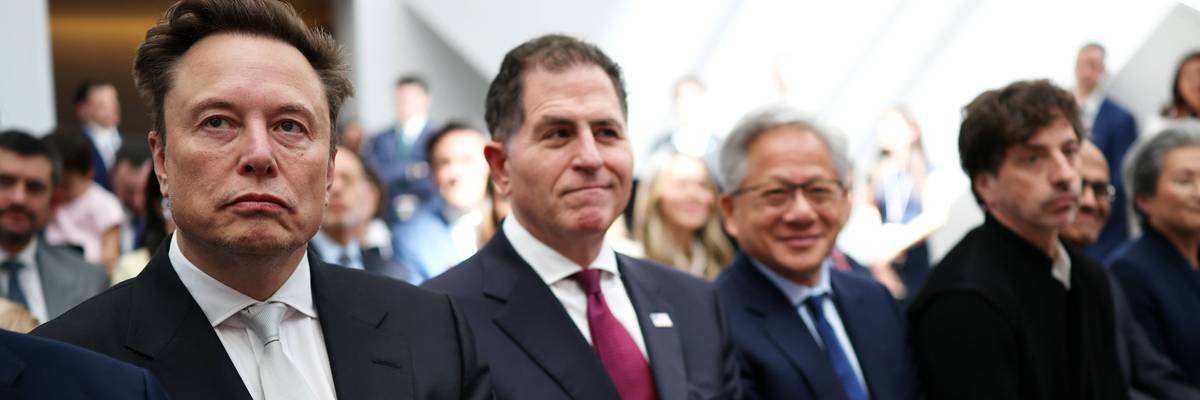
    SpaceX CEO Elon Musk, CEO of Dell Technologies Michael Dell, Nvidia CEO Jensen Huang, and co-founder of Google Sergey Brin attend the Golden Age of American Innovation Summit on October 8, 2026 in Washington, DC.(Photo by Win McNamee/Getty Images)

    “Trump and his anti-AI regulation posture is dragging the party to a politically suicidal place,” said one Democratic strategist.

    American voters’ antipathy toward Big Tech companies has become a central theme of campaigns in the 2026 midterm elections, according to an analysis published by The Guardian on Thursday.

    The Guardian noted that hundreds of midterm campaign ads attacking data centers have aired over the past two months, with both Republicans and Democrats accusing one another of being pawns of the artificial intelligence industry.

    RECOMMENDED…

    Marc Andreessen

    172 Billionaire Families Have Spent Record $1.7 Billion on 2026 Midterms So Far: Analysis

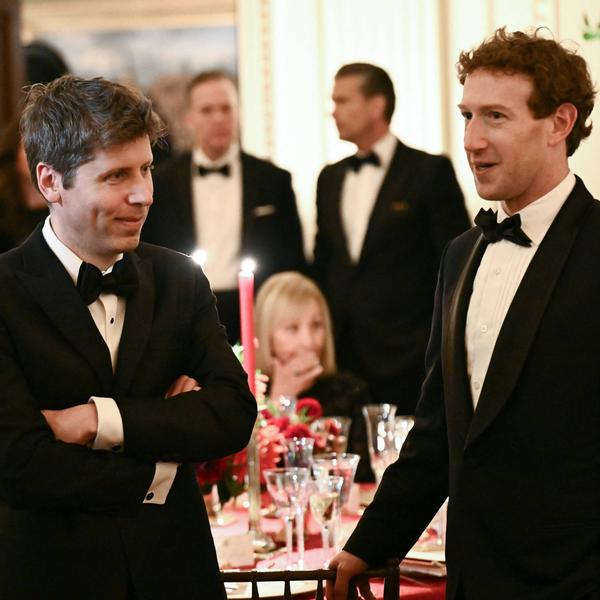
    OpenAI CEO Sam Altman and Meta CEO Mark Zuckerberg

    Voters in Key States See AI Campaign Cash as More Politically Toxic Than AIPAC: Poll

    “And it’s not only data centers,” The Guardian added. “The public anxiety over AI and distaste for the billionaires developing it, as well as backlash over encroaching tech like surveillance cameras, has turned the tech industry into a ubiquitous villain this election cycle.”

    Silicon Valley has become a punching bag for politicians even as Big Tech moguls have been throwing record sums of money to elect politicians sympathetic to their needs.

    Super political action committees (PACs) “funded by tech billionaires are among the top spenders in this election cycle,” The Guardian explained. “Leading the Future, formed by OpenAI president Greg Brockman and venture capitalist Marc Andreessen, has raised more than $75 million to back tech-friendly candidates. [SpaceX CEO] Elon Musk has sunk $366 million into Republican causes, more than he spent on the 2024 presidential election.”

    Much of the Big Tech money has been going toward Republican candidates this cycle, even though the industry has traditionally had close ties with elected Democrats.

    Texas Democratic US Senate candidate James Talarico in recent days has been trying to turn Big Tech money being spent against him into an advantage, highlighting in particular the outsize role that Musk is playing funding the campaign of his Republican rival, Texas Attorney General Ken Paxton.

    After Musk on Wednesday used his platform X to declare that “there is something deeply wrong with Talarico,” the Texas Democrat quickly returned fire.

    “There is something deeply wrong with a political system,” Talarico wrote, “that allows one trillionaire to buy his own personal US senator.”

    A report published by The Atlantic on Monday examined how the tech industry’s embrace of President Donald Trump during his second term has given Democrats an incentive to pummel the industry, particularly when polls show a bipartisan hostility to AI data centers.

    In fact, Democratic strategists told The Atlantic that data centers have proven to be a top wedge issue capable of getting normally loyal GOP voters to think twice before voting for a Republican candidate.

    “Trump and his anti-AI regulation posture is dragging the party to a politically suicidal place,” Democratic strategist Rob Flaherty told The Atlantic. “They are grabbing the wrong side of an 80–20 issue at exactly the wrong time.”

    Democratic strategists started pushing the party to take a more populist approach toward the tech industry when polling data “showed surprising concern about AI” even in traditionally conservative rural districts, The Atlantic reported.

    Rishi Bharwani, US director of tech regulation advocacy group Reset Tech, said much has changed since Democrats under former President Barack Obama embraced the industry as a positive force for society.

    “What we all experienced was a ton of growth in the tech sector, the creation of numerous new billionaires, and even the world’s first trillionaire,” said Bharwani, “and a bunch of working families basically recognizing that they’re not sharing. These tech companies are actually undermining their economic security and their safety.”

    Article by Brad Reed republished from Common Dreams under Creative Commons (CC BY-NC-ND 3.0).

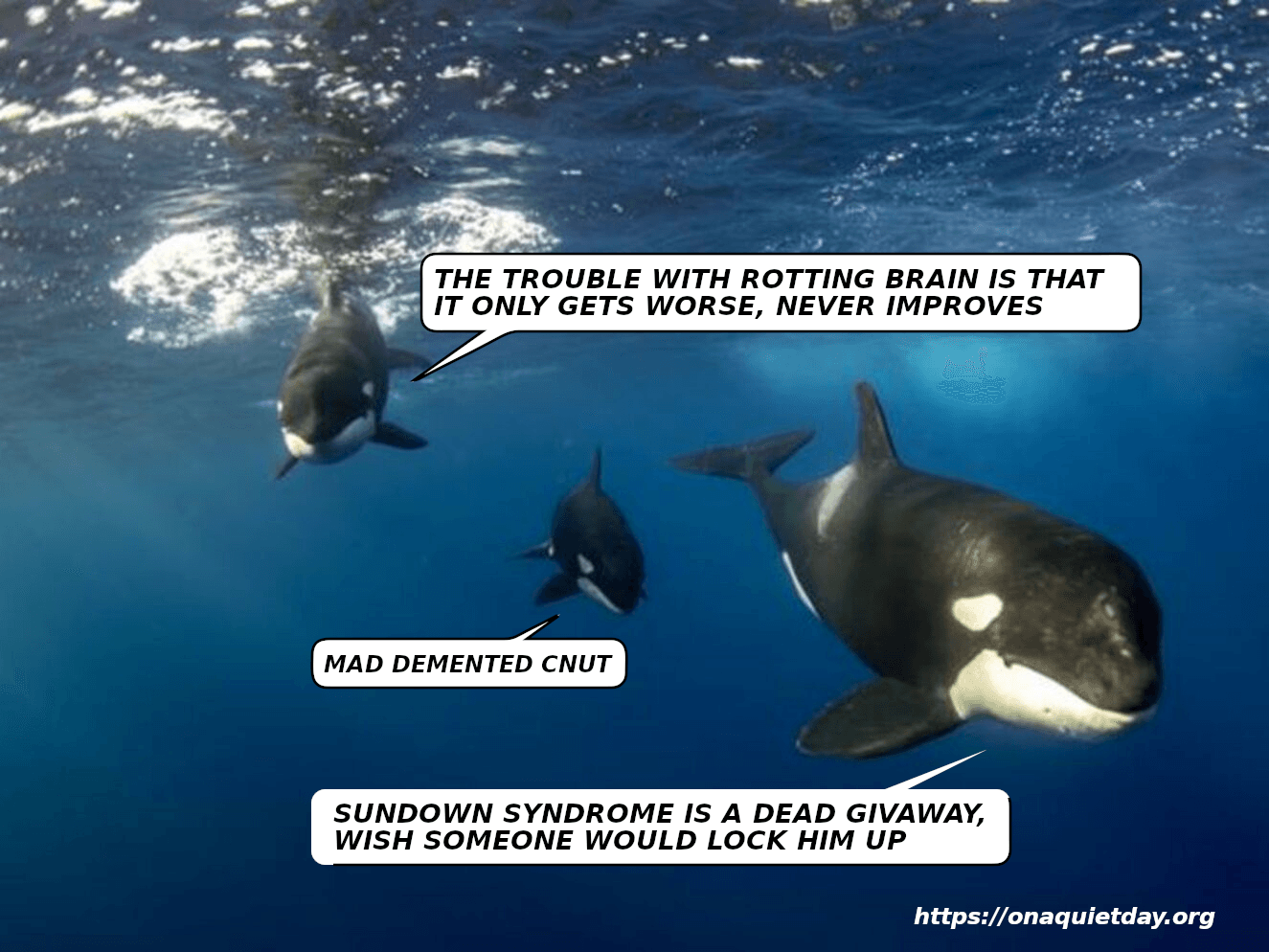
    Orcas discuss rotting brain, front Orca says Sundown Syndrome is a dead givaway and he wishes someone would Lock Him Up
    Orcas discuss rotting brain, front Orca says Sundown Syndrome is a dead givaway and he wishes someone would Lock Him Up
    Climate science denier Donald Trump confirms that he knows nothing about democracy and that more liquid gold is being secured according to his policy of global privateering.
    Climate science denier Donald Trump confirms that he knows nothing about democracy and that more liquid gold is being secured according to his policy of global privateering.
    Orcas discuss Donald Trump and the killer apes' concept of democracy. Front Orca warns that Trump is crashing his country's economy and that everything he does he does for the fantastically wealthy.
    Orcas discuss Donald Trump and the killer apes’ concept of democracy. Front Orca warns that Trump is crashing his country’s economy and that everything he does he does for the fantastically wealthy.