Darren Woods, the chief executive of Exxon Mobil, last year. Photograph: Gavin John/Bloomberg via Getty Images
The world is off track to meet its climate goals and the public is to blame, Darren Woods, chief executive of oil giant ExxonMobil, has claimed – prompting a backlash from climate experts.
As the world’s largest investor-owned oil company, Exxon is among the top contributors to global planet-heating greenhouse gas emissions. But in an interview, published on Tuesday, Woods argued that big oil is not primarily responsible for the climate crisis.
The real issue, Woods said, is that the clean-energy transition may prove too expensive for consumers’ liking.
“The dirty secret nobody talks about is how much all this is going to cost and who’s willing to pay for it,” he told Fortune last week. “The people who are generating those emissions need to be aware of and pay the price for generating those emissions. That is ultimately how you solve the problem.” *
…
Troves of internal documents and analyses have over the past decade established that Exxon knew of the dangers of global heating as far back as the 1970s, but forcefully and successfully worked to sow doubt about the climate crisis and stymie action to clamp down on fossil fuel usage. The revelations have inspired litigation against Exxon across the US.
“What they’re really trying to do is to whitewash their own history, to make it invisible,” said Robert Brulle, an environment policy expert at Brown University who has researched climate disinformation spread by the fossil-fuel industry.
A 2021 analysis also demonstrated that Exxon had downplayed its own role in the climate crisis for decades in public-facing messaging.
“The playbook is this: sell consumers a product that you know is dangerous, while publicly denying or downplaying those dangers. Then, when the dangers are no longer deniable, deny responsibility and blame the consumer,” said Naomi Oreskes, a Harvard historian of science and co-author of the 2021 paper.
* No, ultimately how you solve the problem is that you don’t create emissions through using sustainable, renewable energy. It’s also not accepted that renewable energy is any more expensive. I’d say that you’re just an evil climate destroyer for profit and fossil fuel BSter.
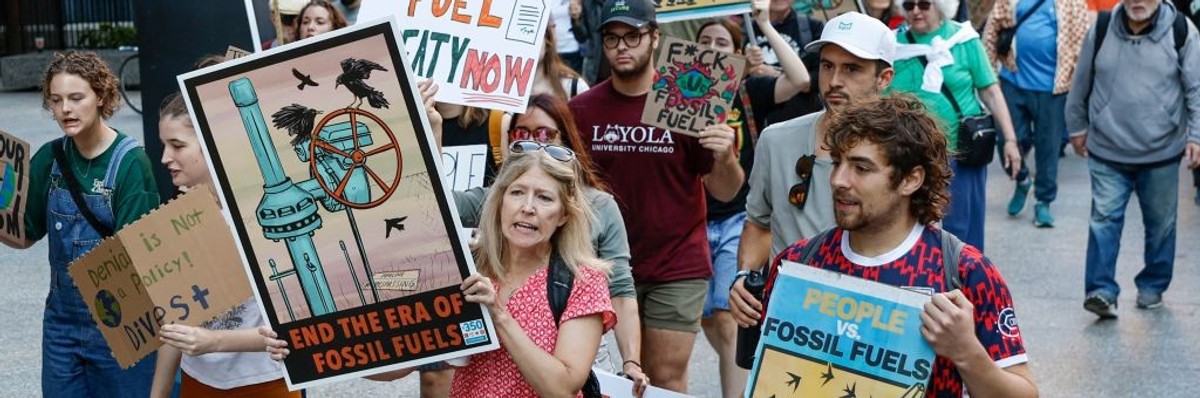
Environmental activists march during the Global Climate Strike in downtown Chicago, Illinois, on September 15, 2023. (Photo: Kamil Krzaczynski/AFP via Getty Images)
The city alleges the industry “funded, conceived, planned, and carried out a sustained and widespread campaign of denial and disinformation about the existence of climate change and their products’ contribution to it.”
Chicago on Tuesday joined the growing list of U.S. cities and states suing Big Oil for lying to the public about how burning fossil fuels causes and exacerbates the climate emergency.
The administration of Chicago Mayor Brandon Johnson, a progressive Democrat, filed a lawsuit in Cook County Circuit Court against ExxonMobil, Chevron, BP, Shell, ConocoPhillips, Phillips 66, and the industry lobby American Petroleum Institute, which “funded, conceived, planned, and carried out a sustained and widespread campaign of denial and disinformation about the existence of climate change and their products’ contribution to it.”
“The climate change impacts that Chicago has faced and will continue to face—including more frequent and intense storms, flooding, droughts, extreme heat events, and shoreline erosion—are felt throughout every part of the city and disproportionately in low-income communities,” the suit contends.
In a statement, Johnson said that “there is no justice without accountability.”
“From the unprecedented poor air quality that we experienced last summer to the basement floodings that our residents on the West Side experienced, the consequences of this crisis are severe, as are the costs of surviving them,” he added. “That is why we are seeking to hold these defendants accountable.”
🚨BREAKING: Chicago is suing Big Oil companies for climate deception!
“The fossil fuel industry should be able to pay for the damage they’ve caused. We have to see accountability for the climate crisis.”https://t.co/CTrqbzcc0v
“Big Oil has lied to the American people for decades about the catastrophic climate risks of their products, and now Chicago and communities across the country are rightfully insisting they pay for the damage they’ve caused,” Center for Climate Integrity president Richard Wiles said in a statement.
“With Chicago, the nation’s third largest city, joining the fray, there is no doubt that we are witnessing a historic wave of lawsuits that could finally hold Big Oil accountable for the climate crisis they knowingly caused,” he added.
Chicago joins eight U.S. states plus the District of Columbia and numerous municipalities across the country that have sued to hold Big Oil accountable for deceiving the public about its role in the climate emergency.
“To date, eight federal appeals courts and dozens of federal district courts have unanimously ruled against the fossil fuel industry’s arguments to prevent these lawsuits from moving forward in state courts,” noted the Center for Climate Integrity. “In 2023, the U.S. Justice Department added its support for the communities. The U.S. Supreme Court has denied Big Oil petitions to consider the industry’s appeals of those lower court rulings three separate times, most recently in January.”
Angela Tovar, Chicago’s chief sustainability officer, told the Chicago Sun-Times that “the fossil fuel industry should be able to pay for the damage they’ve caused.”
“We have to see accountability for the climate crisis,” she added.
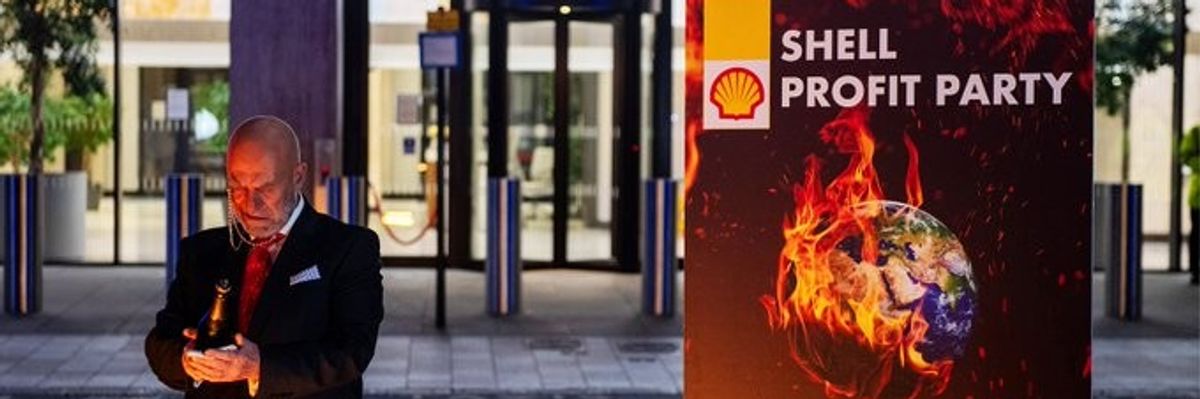
A protester pretends to celebrate outside Shell’s London headquarters. (Photo: Greenpeace U.K./X)
“They have amassed untold wealth off the back of death, destruction, and spiraling energy prices,” a Global Witness investigator said of a new analysis.
As Russia’s invasion of Ukraine approaches its second anniversary, one group has clearly benefited: the five biggest U.S. and European oil and gas companies.
BP, Chevron, ExxonMobil, Shell, and TotalEnergies have made more than a quarter of a trillion dollars in profits since the war began, according to an analysis published by Global Witness on Monday.
“This analysis shows that regardless of what happens on the front lines, the fossil fuel majors are the main winners of the war in Ukraine,” Global Witness senior fossil fuels investigator Patrick Galey said in a statement. “They have amassed untold wealth off the back of death, destruction, and spiraling energy prices.”
The world’s five largest listed oil companies have made profits of $281 billion since Russia invaded Ukraine
🗣️“…regardless of what happens on the frontlines, the fossil fuel majors are the main winners of the war in Ukraine.” Says our @patrickgaleyhttps://t.co/EzghPq4dFz
Big Oil’s profits were fueled in part by high wholesale gas prices, which were already elevated before Russia invaded Ukraine on February 24, 2022 and skyrocketed afterward. All five companies covered by the analysis reported record profits for 2022.
This bonanza came as the conflict killed more than 10,000 Ukrainian civilians.
“Russia’s invasion of Ukraine has been devastating for millions of people, from ordinary Ukrainians living under the shadow of war, to the households across Europe struggling to heat their homes,” Galey said.
During 2022, U.S. President Joe Biden accused Big Oil of “war profiteering.”
Global Witness calculated that BP and Shell have raked in enough since the war began—at £75 billion—to pay all British household electricity bills through July 2025. Chevron and ExxonMobil have made a combined $136 billion while Total has netted $50.4 billion.
These massive profits also come as the climate crisis, driven primarily by the burning of fossil fuels, continues to escalate. 2023 was the hottest year on record, and likely the hottest in 125,000 years. Yet instead of using their record profits to invest in renewable energy technology, the five major oil companies have cut back on their climate initiatives and handed massive payouts to shareholders.
“This is yet another way in which the fossil fuel industry is failing customers and the planet.”
Of the more than $280 billion the five companies have brought in since the war began, they returned what Global Witness said was an “unprecedented” $200 billion to shareholders. At the same time, Shell rescinded a promise to curb oil production by 2030 and said it would fire around 200 people employed by its green jobs division. BP, meanwhile, slashed its emissions reduction target from 35-40% of 2019 levels by 2030 to 20-30%.
The money paid to shareholders is also money that could have been paid to help communities adapt to the climate crisis or recover from the damage it has already caused. The $111 billion that the five companies paid to shareholders in 2023 alone is 158 times more than the money pledged to climate-vulnerable nations at COP28, and the €15 billion that TotalEnergies rewarded shareholders with was more than the €10 billion that France needed to recover from droughts and storms in 2022.
Galey said the companies were now “spending their gains on investor handouts and ever more oil and gas production, which Europe doesn’t need and the climate cannot take.”
“This is yet another way in which the fossil fuel industry is failing customers and the planet,” Galey said.
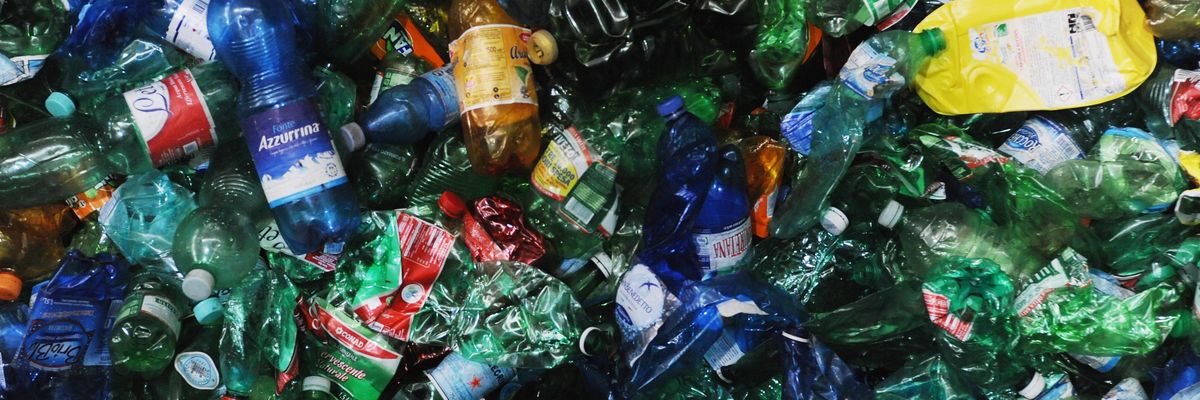
More than 90% of plastics disposed of between 1950 and 2015 were not recycled. (Photo: Laura Lezza/Getty Images)
“The oil industry’s lies are at the heart of the two most catastrophic pollution crises in human history,” one advocate said.
The petrochemical industry—including major oil companies like ExxonMobil—knew for decades that recycling was not a sustainable solution to the problem of plastic waste, yet continued to promote it in order to avoid regulation and deceive consumers into continuing to buy and use their products, a report released Thursday by the Center for Climate Integrity reveals.
The report, titled The Fraud of Plastic Recycling: How Big Oil and the Plastics Industry Deceived the Public for Decades and Caused the Plastic Waste Crisis, includes newly disclosed industry documents proving that companies and trade groups knew that plastics could not be recycled indefinitely in the 1980s and 90s even as they launched a massive public relations campaign to sell voters and policymakers on the process.
“This evidence shows that many of the same fossil fuel companies that knew and lied for decades about how their products cause climate change have also known and lied to the public about plastic recycling,” Center for Climate Integrity (CCI) president Richard Wiles said in a statement. “The oil industry’s lies are at the heart of the two most catastrophic pollution crises in human history.”
Big Oil and the plastics industry 🤯knew decades ago that recycling plastic is not viable at scale 🧐deceptively promoted plastic recycling as a false solution 😡directly fueled the plastic waste crisis
Plastic pollution is a major environmental and public health crisis. If current trends continue, plastics are expected to outweigh fish in the ocean by 2050, and the toxic fumes from plastic production facilities and incineration are a major environmental justice hazard for frontline communities. Humans in general also ingest an estimated credit-card’s worth of plastic each week, with unknown but potentially serious health impacts.
Recycling is often touted as a solution for keeping plastic out of the environment, but this has proven to be ineffective and insufficient: More than 90% of the plastics disposed of between 1950 and 2015 were either burnt, sent to landfills, or dumped into the environment. There are several technical and economic reasons why plastic recycling doesn’t work at scale. Plastics lose quality as they are recycled and can only really be reused once or potentially twice. The decline in quality also means that recycled plastics are more likely to leach toxins added during production or picked up from other waste items. Economically, it is cheaper to produce new plastics than recycle older ones, and only two types of plastic—PET and HDPE—actually attract markets that will recycle them.
The industry has long been aware of these limitations. In 1969, the American Chemical Society declared, “It is always possible that scientists and engineers will learn to recycle or dispose of wastes at a profit, but that does not seem likely to happen soon on a broad basis.”
“We are committed to the activities, but not committed to the results.”
Despite this, petrochemical companies and their trade groups began to push plastic recycling in the 1980s and 90s as a response to growing public concern over plastic waste, and the threat that this would lead to bans on plastic products.
“No doubt about it, legislation is the single most important reason why we are looking at recycling,” Wayne Pearson, the executive director of industry front group the Plastics Recycling Foundation and a DuPont marketing director, said in 1988.
The plastics industry used various strategies to sell the public on recycling, according to the report. These included:
Funding front groups to promote recycling;
Running ad and PR campaigns;
Investing in recycling research to convince the public that it was taking action;
Setting unrealistic internal recycling goals;
Writing educational material promoting recycling to school children;
Advocating for “advanced recycling,” a term for breaking plastics down to chemical components that can theoretically be reused but are not in practice; and
Claiming, against evidence, that recycling can be part of a “circular economy.”
CCI provides new evidence that, while the industry was employing these strategies, it was simultaneously aware of recycling’s limitations.
For example, a report from the Vinyl Institute trade group concluded in 1986 that “recycling cannot be considered a permanent solid waste solution, as it merely prolongs the time until an item is disposed of.”
In 1994, Exxon Chemical Vice President Irwin Levowitz told employees of the American Plastics Council that “we are committed to the activities, but not committed to the results.”
CCI argued that the petrochemical industry should face legal consequences for its “campaign of deception” similar to suits brought against tobacco and opioid companies.
“When corporations and trade groups know that their products pose grave risks to society, and then lie to the public and policymakers about it, they must be held accountable,” Wiles said. “Accountability means stopping the lying, telling the truth, and paying for the damage they’ve caused.”
CCI vice president of legal and general counsel Alyssa Johl added: “Big Oil and the plastics industry’s decades-long campaign to deceive the public about plastic recycling has likely violated laws designed to protect consumers and the public from corporate misconduct and pollution.”
“Attorneys general and other officials should carefully consider the evidence that these companies defrauded the public and take appropriate action to hold them accountable,” Johl said.
With more proof of Shell’s climate deception, Rep. Ted Lieu is once again urging the Department of Justice to look into whether fossil fuel companies broke the law.
After new evidence emerged last week showing that oil major Shell internally acknowledged the dangers of their fossil fuel products decades ago, a member of Congress is renewing his previous call for the U.S. Department of Justice to investigate whether Shell and other Big Oil companies’ “alleged campaigns of climate deception” may have violated federal law.
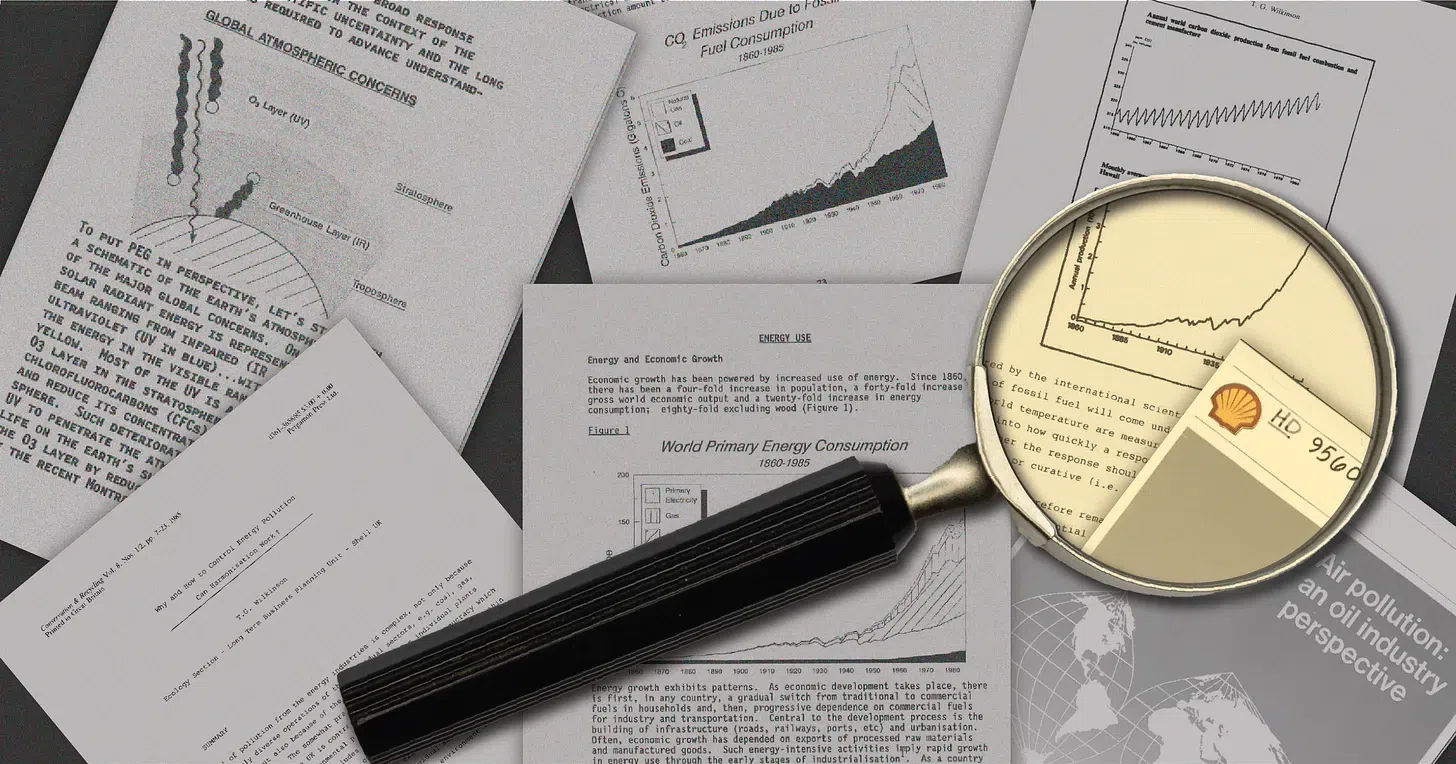
The company documents, first unearthed by Dutch researcher Vatan Hüzeir and reported last week by DeSmog and Follow the Money, reveal Shell executives and employees predicting “major adverse changes” to the climate from fossil fuel emissions — and admitting Shell’s role in causing the problem. “Global warming could challenge the very fabric of the world’s ecological and economic systems,” warned Shell executive Ged Davis in one newly uncovered document from 1989.
“This new set of documents further demonstrates that Shell privately knew about the dangers its products would cause to the environment yet continued to deceive the public in pursuit of company profits. This is wrong and potentially illegal,” said U.S. Rep. Ted Lieu (D-CA), who along with Sen. Richard Blumenthal (D-CT) led 20 members of Congress in a letter last year urging the Department of Justice to look deeper into evidence that Shell, ExxonMobil, and other fossil fuel majors “lied — and continue to lie — to the public about their central role in exacerbating the climate crisis.”
“These new documents provide additional evidence and make our calls for an investigation even more urgent,” Lieu told ExxonKnews in response to the latest Shell revelations.
The lawmakers’ July 25 letter cited an initial batch of internal Shell documents released by Hüzeir last March. The evidence, they wrote, should inspire the DOJ to “investigate Exxon, Shell, and other members of the fossil fuel industry to determine whether they violated RICO, consumer protection, truth in advertising, public health, or other laws.”
A separate letter from U.S. Sens. Bernie Sanders (D-VT), Elizabeth Warren (D-MA), Ed Markey (D-MA), and Ed Markey (D-OR) urged the DOJ to go even further and “bring suits against the fossil fuel industry for its longstanding and carefully coordinated campaign to mislead consumers and discredit climate science in pursuit of massive profits.”
The latest documents add to an abundance of proof that Shell was well aware of the harm its products would cause — and acknowledged its culpability for the damage.
“If a product is used, as indicated by Shell, and annoying consequences nevertheless arise, Shell feels partly responsible,” representatives from Shell told researchers from the Dutch University of Leiden in 1970.
Those “annoying consequences” — which turned out to be more catastrophic and deadly than just annoying — were plainly elucidated by the company in the years to follow. In a 1985 journal article, Shell employee T.G. Wilkinson observed that the burning of fossil fuels has “upset the balance” of carbon dioxide in the atmosphere, and “will cause major adverse changes to some areas.”
“The dilemma therefore remains as to whether to encourage the continued use of fossil fuels with the potential enormous effects on the world’s climate,” Wilkinson wrote.
Two years later, an internal Shell report titled “Air Pollution: an Oil Industry Perspective” noted that a rise in CO2 in the atmosphere “could lead to a higher average surface temperature on Earth, which could have far-reaching environmental, social and economic consequences.”
In 1989, Shell executive Davis warned that “Two groups who could bear particularly heavy costs will be: Future generations who would have to live with the costs of adaptation, and…Those in countries yet to industrialise who would face constraints on energy use.”
Davis is now executive chair of world energy scenarios at the World Energy Council.
Armed with the information it needed to steer the world toward cleaner sources of energy, Shell embarked on a campaign to undermine climate action instead.
The same year Davis made his prediction in the OECD report, Shell helped found the Global Climate Coalition (GCC), an oil industry lobbying group that worked to spread disinformation about climate science.
A year later, in an internal publication, Shell admitted the need to reduce greenhouse gas emissions and embrace alternative sources of energy — but stated that “by the time the enhanced greenhouse effect has been conclusively proven, it may be too late to do anything about it.”
Shell went on to promote the idea that climate science was uncertain and downplayed the role of fossil fuels in the years to come. “It is very difficult to aportion [sic] the increase in greenhouse gas concentrations to any particular cause,” read one paper published by the company in 1992.
When Shell left the GCC, citing its opposition to the Kyoto climate agreement, it explained in a 1998 report that “The Shell view is that prudent precautionary measures are called for.”
Hüzeir, the researcher who unearthed these reports, told DeSmog that documents like this could help litigators make the case against Shell in a growing wave of lawsuits seeking to hold the company accountable for knowingly fueling climate chaos. “Shell’s deepening embrace of the precautionary principle, as revealed in this document, shows that Shell was well aware of the crisis ahead,” he said. “What else did they know?”
The documents add to a heap of evidence that could spur the country’s most powerful public interest law firm to investigate Big Oil.
“If the allegations against ExxonMobil, Shell, and other major fossil fuel companies are true, their coordinated efforts to deceive Americans constitute the most consequential deception campaign in history, with potentially existential consequences for our planet,” Lieu and other members of Congress wrote in their July letter to the DOJ. “We respectfully request that the DOJ investigate whether these actions violated federal law.”
Since that letter was sent last year, more state and local governments have taken the companies to court for that deception. California — the most populous state in the nation and one of the world’s largest economies — sued Shell and other fossil fuel majors for climate damages and consumer fraud. Two Indigenous tribal governments in Washington State, forced to spend millions relocating their communities due to rising seas, filed their own lawsuit against oil giants. Honolulu’s climate accountability lawsuit cleared motions to dismiss the case by fossil fuel defendants, putting it on a path to be the first case of its kind to go to trial.
The stakes of these legal efforts are only getting higher, as climate disasterscontinue to batter many of the same communities awaiting their day in court. The DOJ threw its support behind the plaintiffs in a U.S. Supreme Court brief the agency filed last March, but it hasn’t yet taken independent action against the fossil fuel industry.
“It’s time to hold polluters accountable for their lies, which could have existential consequences for our planet,” Lieu said.