



https://www.independent.co.uk/news/world/middle-east/israel-gaza-yair-golan-netanyahu-b2754280.html
The leader of Israel’s opposition party says the government’s approach to the war against Hamas risks the country becoming an “outcast among nations”.
The comments from Yair Golan, a retired general and the leader of the Democrats, are rare criticism from within Israel of its conduct in Gaza.
“A sane country doesn’t engage in fighting against civilians, doesn’t kill babies as a hobby and doesn’t set for itself the goals of expelling a population,” Mr Golan told Reshet Bet radio.
…
Mr Netanyahu swiftly hit back against Mr Golan’s remarks, calling them “wild incitement” against Israeli soldiers.
The prime minister accused Mr Golan of echoing “disgraceful antisemitic blood libels” against the country.
…
https://www.independent.co.uk/news/world/middle-east/israel-gaza-yair-golan-netanyahu-b2754280.html
I avoid quoting articles from the Independent. Small sections only have been quoted with full attribution according to fair use provisions of copyright laws.
Original article by Eloise Goldsmith republished from Common Dreams under Creative Commons (CC BY-NC-ND 3.0).
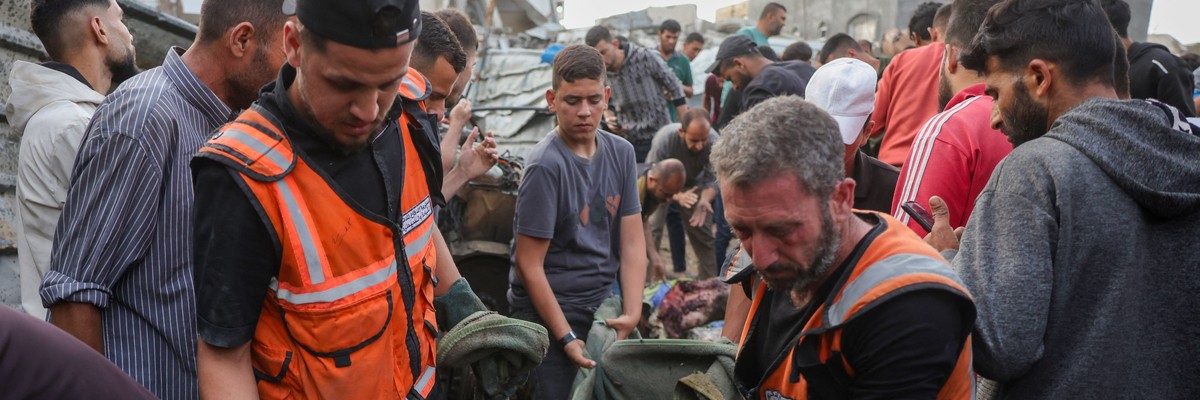
Over 140 Palestinians in Gaza have been killed by Israeli strikes since early Sunday as part of a new ground operation launched by Israel, according to Al Jazeera, which cited medical sources.
The Israel Defense Forces (IDF) said Sunday it had begun “extensive ground operations throughout northern and southern Gaza as part of Operation ‘Gideon’s Chariots.’”
According to The Associated Press, the offensive is the largest since Israel shattered an eight-week cease-fire in mid-March.
Local health officials report that over 3,000 Palestinians have been killed since that cease-fire ended, and 53,000 people have been killed in Gaza since October 7, 2023, when Hamas attacked Israel, prompting Israel to launch a fierce military campaign on the enclave.
Amid reported Israeli attacks on the Indonesian Hospital in northern Gaza, the Gaza Health Ministry on Sunday said that all public hospitals in northern Gaza are “out of service.”
Israel has also imposed a complete blockade of humanitarian aid into Gaza in early March, but according to the AP Israeli Prime Minister Benjamin Netanyahu said Sunday his cabinet approved a move to permit a “basic” amount of food into the enclave.
On Sunday morning, the journalist Mehdi Hasan wrote on Bluesky: “135 Palestinians killed in Gaza so far today. Massacre after massacre, day after day. The world does nothing.”
Original article by Eloise Goldsmith republished from Common Dreams under Creative Commons (CC BY-NC-ND 3.0).

Original article by Julia Conley republished from Common Dreams under Creative Commons (CC BY-NC-ND 3.0).

As Israeli leaders were split over a plan to allow a “minimal” amount of aid into Gaza on Monday, Palestinian and global civil society groups issued a call for an international humanitarian mission that would go much further in fighting the looming famine across the enclave.
With the World Food Program and the United Nations Relief and Works Agency for Palestine Refugees in the Near East having “exhausted their reserves,” more than 750 international groups joined “Unified Call to Confront Famine” and ensure the blockade stopping more than 3,000 food aid trucks and 116,000 metric tons of food are allowed into the enclave.
“We are witnessing, in real time, the deliberate starvation of a civilian population as a method of warfare,” said Human Rights Watch (HRW), which also joined the call, in a statement. “Over 2 million Palestinians in Gaza are living in famine.”
The group echoed an address by Tedros Adhanom Ghebreyesus, director-general of the World Health Organization (WHO), at the World Health Assembly on Monday in Geneva.
“The risk of famine in Gaza is increasing with the deliberate withholding of humanitarian aid,” said Tedros. “The WHO has said around a quarter of the 2.1 million population in Gaza are facing ‘a catastrophic situation of hunger, acute malnutrition, starvation, illness, and death’ due to the Israeli blockade.”
With aid that is “ready and waiting to enter Gaza” entirely blockaded by Israel since March 2, just before the Israel Defense Forces (IDF) broke a temporary cease-fire, civil society groups said states should join a “Diplomatic Humanitarian Convoy to Gaza through the Rafah Crossing.”
In the convoy, official diplomatic missions would accompany thousands of aid trucks into Gaza, coordinating with the United Nations and the government of Egypt.
“Inaction will lead to mass death by starvation, enable further grave illegalities, and undermine the international legal system.”
Supporting groups noted that governments that are “complicit in the ongoing atrocities,” such as the U.S., the top international IDF funder, and called on “individual diplomats, parliamentarians, and ministers from those countries to join the convoy in their personal capacities.” They also called on international media outlets to join—”to bear witness, to document the famine, and to expose the blockade starving Gaza.”
“This is a human imperative,” said HRW. “A Diplomatic Humanitarian Convoy would mark a historic step to break the siege, end the starvation, and affirm the world’s rejection of hunger as a weapon of war.”
The call came a day after Israeli Prime Minister Benjamin Netanyahu said the government’s “greatest friends in the world” had made clear that they “cannot accept images of hunger, mass hunger.”
Images of Palestinians in Gaza suffering from a lack of food, medicine, water, and other aid have been widely available since long before the current blockade, but Netanyahu’s comments suggested that allies like the U.S. government have applied pressure to allow aid into the enclave.
On his trip to the Middle East last week, U.S. President Donald Trump said the U.S. would have the looming famine in Gaza “taken care of.”
The Integrated Food Security Phase Classification (IPC), a United Nations-backed food insecurity initiative, said last week that at least 244,000 people in Gaza are facing Phase 5-level hunger, defined as “extreme deprivation of food.”
“Starvation, death, destitution, and extremely critical levels of acute malnutrition are or will likely be evident,” said the IPC.
The entire enclave is in Phase 4, which is characterized by “large food consumption gaps… very high acute malnutrition and excess mortality.”
Aid and medical workers are struggling to treat thousands of children who have been diagnosed with acute malnutrition.
“We currently are lacking nutrition rehabilitation supplies and equipment, including pharmaceuticals,” said Richard Peeperkorn, WHO representative in the occupied Palestinian territories. “Because of the blockades, supplies are dwindling rapidly.”
Nutritionist Rana Soboh told The Associated Press Monday that she treated a mother who had fainted while breastfeeding her newborn after having gone days without eating.
The next day Soboh met a mother of a malnourished 1-year-old boy who weighed just 11 pounds, having lived his entire life during Israel’s bombardment of Gaza and the near-total blockade that began in October 2023 in retaliation for a Hamas-led attack.
“He hadn’t grown any teeth,” the AP reported. “He was too weak to cry. The mother was also malnourished, ‘a skeleton, covered in skin.’ When the mother asked for food, Soboh started crying uncontrollably.”
A U.N. official said Monday that under Netanyahu’s plan to provide “minimal” aid, 20 aid trucks carrying food was expected to enter Gaza; before Israel began its assault on Gaza, about 500 trucks entered the enclave per day.
Israeli National Security Minister Itamar Ben-Gvir has objected to the tiny amount of food that may soon enter Gaza, saying it will “fuel Hamas and give it oxygen.”
Netanyahu said the plan would be a “bridge” to a new aid system in which a private foundation and U.S. security contractors would distribute humanitarian assistance. The U.N. has rejected the proposal, saying it is “at odds with the DNA of any principled humanitarian organization.”
HRW said the call for all humanitarian aid to enter Gaza in diplomatic convoy was grounded in “international law, shared morality, the Genocide Convention, the International Court of Justice’s provisional measures, [and] the U.N. Charter.”
“Inaction,” said the group, “will lead to mass death by starvation, enable further grave illegalities, and undermine the international legal system.”
Original article by Julia Conley republished from Common Dreams under Creative Commons (CC BY-NC-ND 3.0).
This work by Middle East Monitor is licensed under a Creative Commons Attribution-NonCommercial-ShareAlike 4.0 International License.

The United Nations children’s agency UNICEF said Sunday that the situation in the Gaza Strip has drastically worsened due to Israel’s crippling siege on the Palestinian enclave, Anadolu reports.
“The situation in Gaza has drastically deteriorated over the last two months due to the imposed siege and the prevention of humanitarian aid,” UNICEF said in a statement on X.
It said Gaza’s children continue to endure relentless Israeli airstrikes and are being deprived of essential goods, services, and life-saving care.
The organization called for the immediate resumption of a ceasefire and the urgent entry of humanitarian aid into the besieged enclave.
Since March 2, Israel has kept Gaza crossings closed to food, medical, and humanitarian aid, deepening an already severe humanitarian crisis in the enclave, according to government, human rights, and international reports.
READ: ‘This must end’: EU commissioner slams latest Israeli attacks on Gaza
Earlier this month, Israel’s Security Cabinet approved an aid delivery plan for the Palestinians in war-torn Gaza through private US security contractors based on handing over aid boxes to individuals.
The Israeli plan, however, has been rejected by the UN and dozens of international aid groups, saying it runs against humanitarian principles, is logistically unworkable, and could put Palestinian civilians and staffers in harm’s way.
The Palestinian resistance group Hamas also decried the Israeli plan as “political blackmail” and “a violation of international law.”
Nearly 2.4 million people in Gaza live completely dependent on humanitarian aid, according to World Bank data.
The Israeli Defense Minister Israel Katz said on Sunday that Tel Aviv is coordinating with a US firm to distribute humanitarian aid in Gaza, suggesting that the aid distribution may start on May 24.
The Israeli army has continued its brutal offensive on the Gaza Strip since Oct. 7, 2023, killing more than 53,300 Palestinians, most of them women and children.
Last November, the International Criminal Court issued arrest warrants for Israeli Prime Minister Benjamin Netanyahu and his former Defense Minister Yoav Gallant for war crimes and crimes against humanity in Gaza.
Israel also faces a genocide case at the International Court of Justice for its war on the enclave.
READ: At least 153 Palestinians killed as Israel intensifies air strikes across Gaza
This work by Middle East Monitor is licensed under a Creative Commons Attribution-NonCommercial-ShareAlike 4.0 International License.